Bob Bachtold Live on Shally's Alley
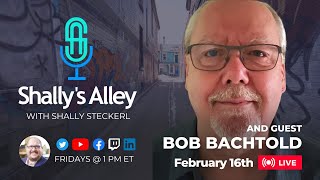
In this live interview, Shally Steckerl welcomes veteran recruiter Bob Bachtold for a wide‑ranging conversation that weaves personal anecdotes, the history of recruiting and sourcing, and the impact of modern technology. The show opens with Shally showcasing his new Mac Mini and discussing his recent jazz fundraiser. Bob shares his early career, recalling the transition from VAX/VMS and bulletin‑board sourcing in the 1980s to the first web‑based recruiting tools, his stint at Oracle, and the birth of eShop. They compare the evolution of the internet—from ARPA‑DARPA origins to the web’s commercial debut in the mid‑1990s—and how platforms like eBay, LinkedIn, and 6‑Degrees reshaped sourcing. The dialogue then shifts to current AI tools (ChatGPT, Copilot, Claude, Gemini, Perplexity), prompt engineering versus Boolean search, and the ethical challenges of algorithmic bias and New York’s AI‑in‑hiring law. Shally warns about over‑reliance on cloud storage, while both hosts argue that human engagement remains irreplaceable. They discuss social networking theory (Dunbar’s number), the potential of immersive tech like Apple Vision Pro, and the future role of recruiters as project managers and architects rather than replaceable “paper pushers.” The episode ends with reflections on personal relationships, a “creepy question” about Vision Pro, and a preview of the next show.
Chapters
All right, everybody, check this out. I got my new special effects courtesy of FaceTime. So I'm ditching my jet for the time being. And I gotta tell you guys, man, I upgraded my computer. I got a new Mac Mini and I am just loving it. This thing is spectacular. You cannot get a better mid-range desktop, period. It is so phenomenal. All the activities that you can do with it. I can even do this. How cool is that? I can do like double cameras. Anyways, so definitely loving my new Mac. And that's right, you can also do this.
Impressive.
That's right. And loving my new guest, which actually technically, man, you are not a new guest. You are an old guest. And I say that respectfully because this is your second time around.
That's right, you are. November 2022.
That's that.
November 2022.
Yeah, it's been a, it's been a while, my friend, but I know we keep in touch and, uh, yeah, I kept promising to, to, uh, offend our audience with your presence once more. Yeah, this time around I, uh, I was able to play some music because folks, you probably don't know this, or maybe you remember from last time, uh, Bob is a master musician amongst many instruments. His favorite is of course the drums, but he also plays a lot of other things. And in fact, Bob has a live concert tonight. How fun is that? So Bob's playing live, and I'm taking my wife out on a post-Valentine date to the High Museum, uh, here in Atlanta for Jazz in the Museum, where they have a jazz band inside of the amphitheater, inside of the museum, and you can walk around and absorb all the exhibits and really take your time, you know, with a, with a cocktail that you can't bring the cocktails up into the exhibits, but you can have a cocktail, listen to jazz, go walk around. Fun times. And you're doing this as a fundraiser, right?
Yes, I play with a local group called The Power of Music, and in fact, I'm taking my wife out for a post-Valentine's Day dinner tonight. She's playing keyboards in the band and is the musical director.
I did not know that your wife was also a musician.
Oh yeah, she's, uh, as, as good as I may or may not be, she's, uh, she is the consummate musician. If necessary, you know, she could go fill in tomorrow at the Grammys or the Emmys or any of those shows. She can read and write conductor scores, plays world-class keyboard, sings. Uh, yeah, she's, uh, she's pretty amazing. 28 years Canadian Armed Forces, uh, She ran big bands and put them together. She's a formidable musician.
It sounds like both of us definitely are punching above our weight class. Yeah, I definitely know I am.
Yeah, I lucked out that she said yes, and I'm very glad for it.
I had to beg and ask, like, I don't know, 7, 8, 9, 12 times. I eventually just kind of wore her out, you know, basically. But no, it's good to have you on the show, man.
Great to be here, Shelley.
Kind of circle back to some of the things we talked about last time. And also we've got some fun, interesting new things to talk about. And so folks, if you have any questions, please participate via the chat. We do have chat active on any of them. We'll see your chats. I'll even put them up on the screen if it's funny enough or, you know, interesting. But anyway, so Bob Backtold is a veteran of the industry. And when I say veteran, I mean, you know, one of the people that I revere and admire for their depth and breadth of experience. And he has been recruiting for almost 4 decades. And is it true that over the last 4 decades, close to 4 decades, you have never placed anyone without talking to them. Is that true?
Well, let's qualify that. I have placed probably about a dozen or two people that I've only communicated with via online. So for instance, uh, let's call it— yeah, chat, you know, Zoom, those sorts of things, uh, Google Meet, Teams, etc. Um, or, or in some cases, uh, some of the younger folks out there who prefer texting, I've done a lot of texting. Um, but yeah, it Our business is all about being a talent scout and a matchmaker. That's the core of the recruiting business, whether you do the sourcing front end, full life cycle recruiting, uh, even on the back end. It's all about the engagement. We're— we sit in the middle and we try to make things better for everybody. We find the talent companies need, we find people better jobs, more interest, more challenge, sometimes more money or comp. And it's about making actually, in that sense, a world a better place for people via how they, how they work and where they work and what they create.
And that's definitely a noble view of our industry and something that I've always held up. You know, when, when I talked to folks about my, my foundation, the nonprofit foundation that, that I used to run, they asked me, why would I want to be a recruiter? I said, you know, I would say that there's a couple of reasons that you want to be a recruiter. One of them is if you're interested in business, There really is no better center stage seat in the entire corporation than the seat of recruiting because you get involved with, if you're lucky and/or if you stay in it long enough, almost every aspect of business. You know, recruiters totally specialize and just do technology and they never leave that. But, you know, I've been— I've done everything. Locum tenens, nurses, legal, corporate, all of it. And I know more about business at least how business works. Doesn't mean I'm a better businessman, but how it works than just about any MBA that you can point your finger at.
Well, absolutely. I mean, it's all about people. Yeah, it's all about people.
I mean, almost everything is what you just said, is the fact that it really is a job that if you do it correctly can really improve people's lives. You know, switching a job, switching jobs, if you're going from one job to another, really needs to be something that you're doing because it's a better position. Could be better pay, but it doesn't always have to be about the money. I've taken pay cuts to go to a better job because of the team, because of the challenge, because of the environment. But it usually is an improvement in some way, shape, or form. Now, if you are unemployed, getting a job doesn't necessarily mean it's an improvement on your previous. You might have just lost a job that you really loved, but the company, you know, just couldn't support that position anymore. So yeah, it's not always going to be, you know, an upward trajectory. Sometimes you got to take a step back. But if you're unemployed, getting a job is still an improvement from being unemployed. So it's always a step forward, right? So those are the two reasons that I think that just, you know, if it's selfish, you want to learn about business, there's no better place. If it's— if you have a bit of, you know, altruism, Helping people and getting them into a job that makes them happier, wealthier, improves their career, whatever, is definitely a noble calling. But absolutely, this business has evolved considerably in my career and in your career, certainly. So that's what I wanted to kind of circle back to and talk about and kind of bring things back from our previous conversation. The evolution of sourcing, the evolution, you know, you know, I, I claim that I was one of the pioneers of sourcing. And the reason I can get away with doing that is because when I started in 1996, there wasn't really much of an internet to speak of. In fact, I had to connect to the internet via a dial-up modem from home because there wasn't even a phone line in my office. That wasn't part of the internal switch network, and those I couldn't dial out from. You had to have a separate, you know, line. So I literally was sneaker-netting it on my little 5.5-inch floppy disks, uh, sneaker-netting from my office to home with resumes that I got off of online bulletin boards, right? But you've been around and you were a recruiter before that, so you, you literally went from recruiting to sourcing. So tell us about the evolution of, you know, like when did, when did, when did internet recruiting really start?
Well, um, I, I like to claim I was one of the very first recruiters on the internet. Uh, as far as I know, I'm one of about a dozen people who was doing it back in the '80s. Um, I got into this, I got in the business in October '84. Um, I got online in November '86 at my first in-house, you know, wholesale retained, uh, in-house recruiting assignment. Prior to that, I was in the agency business for 2 years. I used to source basically from technical magazines. Uh, I started out essentially recruiting VAX VMS internal gurus, operating systems people that were totally vital in college in the '80s. And right, and I, I literally made my business from one resume and a dead file and a stack of magazines. Literally, that's what I did. I learned the business from people who could make make recruiting happen with a roll of quarters, a phone booth, and a phone book, and a pencil and pen and paper. That's literally how I learned. Yeah, yeah. And I got my first computer, it was a Macintosh Plus with a Dataframe 20 hard drive in November of '86, and I never looked back. I walked into the client that morning, literally with a hand truck with 4 legal-size file boxes full of notepads and resumes and file cards and all that contact stuff. And I got in and I saw the internet live and I said, I wanna do that. Well, you need to spend this and buy this and get a Macintosh, it connects easier. And I went out that lunchtime to Computer Addict in Palo Alto and I bought $3,600 worth of gear and I would never look back.
And— $3,600 back then was like $36,000 these days in the shitty economy.
Well, yeah, pretty close. Yeah, I mean, it was primitive computing. One of my mentors, Dave Law, now long since retired, he's worked for everybody. Was the guy— was one of the guys who convinced me to get a Mac because I could actually do the work on the Mac myself without having to learn PCs and all kinds of cumbersome stuff. I built my own database over the weekend, for God's sakes, in Borland Reflex. Yeah, you know, back— I mean, the early, early days.
It's true what they say, once you go Mac, you never go back. I mean, well, I got this Mac Mini now, and it's like, I just— I'm, I'm— I had a Mac laptop before 4, but you know, it's a laptop. This, this mini has so much more power in every possible way. I've been tracking this thing, man, not to geek out, but for the last, uh, full-on week I've been using it. It's only a week old, but full-on week I've been trying to throw everything at it I possibly can. I put widgets on here, I put multiple monitors, and the CPU has been at 5%. That's 95% idle. 5% utilization. I used my last, my last laptop, which is a MacBook Pro, and it was at 50-60% all day long. And this thing is 5%. It just barely— I can't even touch the computing power.
Yeah, my 2021 Mac that I'm still relying on, 64 gigs of RAM, the last highest power, uh, Intel i9 chip in it. I haven't even gone to an M chip yet. Um, I'm running it probably 60-75% all the time at this point. I got to get a new one.
You need to get an M— I got an M2 Pro on this thing. The M2 Pro rocks. Definitely.
That's what I've heard.
It rocks hard. Absolutely. So, all right, so back to, you know, uh, you got, you got your Apple Plus, and what did the web look like in 1986?
There was no web. The web didn't come about till '93. I was on the internet, technically the Usenet, which is a part of that. The internet basically started—
A lot of people on this call have no idea what you just said, so break it down for us. Oh, okay.
Well, ARPA and DARPA founded the internet in the early '70s by the Department of Defense. It was designed as an alternative communication medium that could survive all sorts of calamities, tragedies, you know, major, you know, nuclear war, all kinds of things. It was designed basically as a failsafe communication network. And it gradually got adopted by the technology companies because a lot of them were participating with the DOD in this.
And by academic institutions. Right.
And the first company to really get it from the software and system side was the old Sun Microsystems. Now, of course, long, long since purchased by Oracle and been fully absorbed.
Java, that's Sun, right?
Yeah. James Gosling and all those guys. But Sun Microsystems was the first company to understand In fact, it is actually the byline on their sign in front of the main building. The network is the computer because they understood the value of connecting all the computers together. That's the real value of the internet.
That was what year?
1982. I got in in '84.
1982. I just want you to think about— you probably never thought about this before, but fast forward from the network is the computer all the way to today, and we're back there again. Yeah, I think that is.
Yeah. And they will use a computer, of course. And the web actually started in beta form, essentially available in 1993. It came— it went full live in '95 with Netscape. Prior to that, it was all beta-level programs and stuff and people trying things out.
And brown.
Exactly.
Yeah.
And, and that's, and that's when things really took off. The web actually started. Most people also don't know this. The Usenet and the internet, until 1996, it was prohibited. You get blacklisted for doing anything commercial. It was strictly non-commercial. The company that blew it wide open, if you go back to the history books, was eBay. Why? Because they hosted auctions that they didn't actually sell or, or buy and sell. The people that were on it bought and sold. And that's when everything broke wide open. That's when commercialized— up until then, it was strictly an information and communication network. There was no way you could do any business on the internet until 1996.
I was doing business on the internet. However, that, that was because I was connecting with people on bulletin boards. Well, I'm questioning, like, yep, uh, does anybody know what this Oracle thing is I heard about? So I have a funny story. I was actually hired by MC to, as I had a staff, I was part of a staffing firm, to, to find somebody that was an expert in Oracle DB, right? And, and I'm like on these bullet boards going, does anybody know what this Oracle DB— nobody had ever heard of it. And some guy on a bullet board was like, oh dude, I know somebody that just started working on that. They've been working on this Oracle DB now for like almost a year. Um, you have to contact him. And this was my very, very first placement, and it was in 1996. And I will always remember the name of this individual. His name was Sashi Joshi, and I found him through a friend that I had made virtually on a bulletin board who said, you got to go to this other bulletin board, here's the number. Yet you get a phone number, you dial in.
Oh yeah, right.
And then I was on all of them, you know, and I can't remember the name of it, but I'm like, hey, uh, I'm new here, just got referred over by so-and-so. I was told that Sashi Joshi hangs out here, if anybody knows him. And then Sashi's like, yeah, I'm Sashi, you know, some username handle that I— he's like, what do you got? And I'm like, I'm working on this thing called Oracle DB, do you know anything about it? He's like, oh yeah, I'm working on that, dude, send me your email. And we emailed, then he sent me his resume, and then I put it on my desk and I walked it over to the office.
Yeah.
Oh yeah, put in there. And I hired this guy for MCI on contract They kept him for 3 years. He was so happy to make $150 an hour from this contract, which was way more than he was making at the time. And I'm not even going to tell you how much I made on the margin because it was sick. And he was happy. I was happy. He knew how much I was making. He's like, he's like, good for you, man. Yeah, I'm happy I'm getting $150. And I was like, oh my God. So I broke all kinds of records with that. That was literally the beginning. And then that's when I realized in 1996— I know it was a little late for, for you, but 1996 when I realized somebody, somebody's got to do this. Nobody's doing this, you know, like actually recruiting on this thing.
Well, well, you're going to love this. I worked at Oracle for 3 months in 1990. I was brought in there by my mentor Dave Law, the same guy I mentioned earlier.
He never heard of Oracle TV.
Well, I was the guy hired to staff the group at Oracle building the first distributed network databases. Nobody had ever done it before. And I reported— I reported to Larry Ellison once a week. Larry Ellison himself, the guy, you know, the multibillionaire.
Yeah.
And talk about— talk about an intense meeting every week. It was crazy. Did you know? And I actually built I built a prototype sourcing system for him that never really got fully implemented because that was right when they had their first big crash. And, you know, the Oracle stock went from $26.25, I think, down to $4.78 or something when they got caught in an accounting scandal. He managed to save the company but didn't build that project. All the people that I, that I got hired for that project, he had all the offers sitting on his desk for like 4 months and then he hired them. But, but anyway, I was working on that kind of stuff way back then, long before there was the web and communicating with people via the internet. I borrowed all kinds of collegiate accounts and corporate accounts. My email address at Oracle back in 1990 was actually Bob Bach, B-O-B-B-A-C-H, at stealth.oracle.com. They gave me an account on their stealth development machine, you know, in the, in the 400 building. I was in building 400, Office number 704. And, and yeah, so it goes, it goes way back with that kind of technology. You know, I started out in operating systems, I got into network, I got into databases, I got into compilers, got into all that deep tech stuff. And then of course the web came about and, and the web changed everything because it made the internet really accessible to people. What the, what the web actually did, Tim Berners-Lee, the guy who's credited with founding the web, really solved the biggest problem that they had at that time, which was that there were 3 different kinds of file formats. Macs had a file format, PCs had a format, IBM had a file format, and then actually there was a smattering of others, but they didn't really matter. All the file formats were incompatible. And so what happened is the web— he went back because at that point, technical, technical writers were using what's called SGML, which was advanced from HTML, which we all know and love. And what happened was he went back and saw, hey, I can put everything in HTML format and make a browser window, or in this case a web interface, an internet interface, that would be able to read all of them and it would look the same. Genius. Because all of a sudden everybody could access everything from everybody, and that's how the web came about. They took a step back in technology deployed it universally and created, you know, the world we know today, essentially from that really brainstorming, you know, brilliant key idea. And that's how that all came about.
So basically, I mean, it's like, it's everything changed, but then everything didn't change. So, right, changed in that, like, it all, you know, it, it, the, the big, the big disintermediation where, um, you were able to cut the middleman out in a lot of ways And that led to a whole bunch, you know, eBay of course being that basically the first example, the commercial. Yeah, yeah, the, the disintermediation of like you take direct, you can go directly from the buyer to the seller, you don't no longer need that middle person, middle, middle, multiple middle layers, right?
Yeah, I was, yeah, I was the recruiter in '95, '96 at a little startup company called eShop. They were the first guys to put a really functional web store on a modem, as you mentioned before, really slow tech, super, super slow, way slower than—
Only one customer at a time, wait in line.
Right, but they managed to land 10 key clients, 1-800-Flowers, Spiegel Catalog at the time, a bunch of other companies. They were later acquired for $50 million, I understand, by Microsoft, you know, and I actually helped put that deal together, but that's another story entirely for another time. But they were the first guys to actually put a store on the web. It was eShop. It's well documented. Will Poole was one of the founders. He later retired from Microsoft, very successful venture capitalist.
So we went from that experience to, in the '90s, an actual user interface. Yeah. And in the 2000s, the advent of like multi-layer social media.
Oh yeah, yeah, it all took off.
Instant messaging, and that's what, that's what led to the IRC, Internet Relay Chat, which led to Slack or Skype, uh, ICQ if you remember that. Um, somewhere in the, in the middle there, somewhere along the way, probably I think it was in, um, I want to say 1998 or 1997, 1998, there was this company called 6 Degrees. That, oh yeah, was a website that you could, you could, um, upload your contacts and connect with people that knew people that you knew. So the whole idea was the game of 6 Degrees of Kevin Bacon, right?
I know someone who knows Kevin Bacon.
Yeah, yeah. So 6 Degrees was the LinkedIn of the day. They really invented that concept. LinkedIn is not new, it just took a while for it to become commercially viable.
Yeah, so, you know, Reid Hoffman started it with some other guys in 2005. I was one of the very first people to get a LinkedIn account.
Yeah, and that was, you know, exemplary of what happened with this kind of web interface and what was starting to evolve. And back then, you know, people had computers that had all this equipment on them, um, and were standalone machines. And now we're going back to essentially thin clients where almost everything, you know, if you think about it, we used to have all of our files on our computer. You needed a 1 terabyte, 2 terabyte drive up until very recently. But now when I went and I bought my Mac Mini, I was like, you know, I, my, my, my other computers all had big drives. This one only has a 512. You know why? Because I don't even need all that. Sure, it's all on the cloud, right? Which means And by the way, just cautionary word to anybody that's listening to me right now. Just because I have everything on the cloud doesn't mean that you should. And just because I have everything on the cloud doesn't mean I don't also have everything on my hard drive. So FYI, I have a very large hard drive that is solid state and everything gets backed up here regularly because—
Same here. I've got, I got a 5 terabyte currently.
Yep, exactly. That's right. And they're actually really cheap. But this is the lesson here, folks. Just because it's in the cloud doesn't mean you ain't paying rent.
And absolutely, absolutely, and you can get evicted, okay, for a million reasons.
You can get evicted because the landlord went out of business, or you can get evicted because you stopped paying your bills, or you can get evicted because somebody broke in and stole your— so there's a lot of reasons not to have your stuff on the cloud exclusively. But for my daily stuff, everything is cloud-based because I got a, you know, I got a fiber optic connection and I can do everything.
That's because the bandwidth now for communication via fiber, gigabit internet, all sorts of things, is fast enough to make that work. Back in the old days it wasn't. It was, right?
Well, nonetheless, and then it wasn't. It was, and then we maxed it out. It was back when it was VAX VMS, and then we started adding all these other things, like for example, people wanted to share pictures. And that's when it got to the point where you had a dial-up connection that took 10 minutes to download a very low-resolution picture of your, you know, of your cousins or your, or your, your grandkids.
Not to even mention video.
Well, yeah, it wasn't even— yeah, forget that. I mean, it took you 10 minutes to download an image, right? Well, I remember it came full circle. Now, now we have, we have dark— it— we have dark internet. Like, in other words, we have not the dark web. I'm talking about dark fiber connections that are not being used because, right, we don't even have the, the technology yet to utilize that bandwidth. But I want to go back to recruiting. So it went from like chatting online to bulletin boards to chatting online on LinkedIn and, and all that. And now we have this behemoth that is LinkedIn that is essentially, um, you know, disintermediating the recruiting industry again. And their big play LinkedIn's big play is we want to get rid of all recruiters. We want to eliminate everybody that's in recruiting. We want to have candidates go directly to the hiring managers. Don't be fooled, folks. If you're listening to this, the job that LinkedIn wants is your job. They want you to stop existing. Their ideal situation is where hiring managers go to LinkedIn and hire directly from LinkedIn.
It helps to also visualize this is not just LinkedIn. LinkedIn, as we may recall, is a part of Microsoft. And Microsoft is driving this because the most profitable avenue for Microsoft at this point in time— there you look at their annual reports— is Azure, which is their cloud system, competes with AWS and Google and all that. But excuse me, but also LinkedIn. LinkedIn is incredibly profitable for Microsoft. And as a result of that, you know, they're trying to maximize where we grow this.
We grow it by disintermediating the middle person, which is you, the recruiter. So that brings me to the next thing that I wanted to bring back. So we go all the way from like literally the history of the web to the present state and how LinkedIn is doubling. You know, you could— I talk to talent leaders all the time, not just on the show, but, you know, in general, as a consultant and as I'm out there, folks, you know, that I recently left my corporate job, so I don't have a square job anymore. This is what I think about square jobs, by the way. Square jobs. Yeah. So I'm back in the market as a consultant, and, um, I've speak to, you know, even more now than before, and everybody complains about LinkedIn's doubling their price. Doubling from last year to this year. They're not doubling their price to make more money. They're doubling the price get you out. They want to get rid of you. That's what they're doing. But let's talk about who else is trying to do that. So that brings us to AI, right? Recruiting tools in 2024, this year, and AI. Um, Bob, you remember when Online Career Center or Hot Jobs or whatever came out and they're like, we're replacing recruiters?
Nice try.
Career Builder, we're replacing recruiters. Sorry, Monster Bottles, you see. We're replacing recruiters. Didn't happen. Where's Monster today? I don't know. CareerBuilder, we're replacing recruiters. Didn't happen, right? And LinkedIn, we're replacing recruiters. Still trying. And then, uh, you know, SeekOut and all these other companies, HireEasy, HireTool, whatever you want to call it, HireNow, they're all saying the same thing.
We're replacing Eightfold, all those guys. Yeah.
How come you— I need you to tell me how How come I haven't been replaced yet?
Well, it's very simple. The bottom line at this, the bottom line at this point in time, even though AI can write some of the code and AI can do this and AI can do that and everything else, we're dealing with people, people at the companies, people that do the work.
And so before 1986, we were dealing with people And after 2023, we're still dealing with people. So nothing changed.
Yeah, nothing's changed.
We're not getting replaced.
No, no, no, nothing's changed in principle. Okay. What happens is always somebody's always trying to automate it or get— it's a constant game of hand slap. Remember this as a kid? You know, it's a constant game of— it's a constant game of tech hand slap. And so what happens is somebody gets the bright idea that we can replace the human element in human interactions. And yeah, you can make it easier. Yeah, you can do certain functions. Yeah, you can do data storage, you can do data contact, you can do all those other kind of things. But the bottom line is there's a keyword that you can't get rid of in the, in the whole, in the whole equation. It's called engagement. If you don't engage, nothing happens. And because you're, you're hiring people, you're not hiring machines to do this stuff. When you're dealing with machine to machine.
There is no effing way that machines are going to replace engagement. They are going to enhance engagement. Yeah, just like robots enhanced manufacturing. But there is no way that all manufacturing is going to be completely unsupervised. That's how you end up with a, you know, pileup of accidents going on. I mean, there's always got to be some— what, what has happened is you have reduced the amount of mistakes, right? Yes. And Six Sigma. And the same thing probably is what's going to happen with this in recruiting, is that we're going to have the ability to very quickly interpret data, make sure that we're not making any errors. Um, one of the things that's scary, and very, very scary to regulators, is that law that passed in New York where they basically are making it essentially illegal for a machine, for an algorithm, to make determinations or pass judgment on qualification of candidates. Now, that is a preemptive strike against letting the machines take over.
Yes, but it's also happening all the time for the company's detriment.
Because here's the problem, I think that the solution isn't telling the machine or isn't shutting down the machine. I think the solution is figuring out, and I'm going to be talking about this, by the way, at the HRO Data AI Ethics Conference.
Yeah, I can't wait to hear. Yeah.
I think the solution is not to shut down the algorithms, but to make sure that the algorithm's bias is known. And the problem isn't that they have bias. Everything has bias. Bias is okay. Bias is good. There's good bias and there's bad bias.
But disclose it. You—
and you— and plan for it, right? If you know that the algorithm has bias, then you prevent the, the bias from having adverse impact. That's what you want. You don't want to prevent the bias because you don't want to prevent also the good bias that comes with it, which in this case what I'm talking about is the error detection. So these machines should be assisting us, and that may mean that we are free. What I— when people ask me, what's your prediction for recruiting and sourcing? Here's what I say. I say we're going to become project managers, we're going to become architects, we're going to learn how to automate. And in particular, Bob, I think this is going to be very, very, very interesting for you. Your job and my job as sourcers, because where we came from, you came from the same— you were cut from the same cloth. Your solution in 1986 or whatever was how can I get this thing to do something that it doesn't already do? And that is essentially a hacker, right? So you and I were born—
yeah, people, people forget that the word hacker is, is not negative, right? It was originally positive jailbreaker, right?
No, what we ended up doing is testing the search engine and putting in keywords and massaging them and adding this, taking this out. What if this happens? Guess what? That way of thinking is the exact same way of thinking that you need for prompt engineering.
Well, absolutely, because you have— it's try— and the, the thing is that people have forgotten there's all kinds of theory and hypotheses and all kinds of stuff like that. But the bottom line, when the rubber meets the road, metaphorically speaking, it's all about delivering results. And this has always been an empirical function. Empirical is the word here. It's about tried and true. You tried it out. You tried a bunch of stuff that didn't work. It didn't kill you. It made you stronger. You figure out what didn't. Look at Thomas Edison. He figured out— he said publicly, and it's all quoted all over the place, he discovered, you know, 1,000, you know, ways not to make a light bulb. 1,001, metaphorically speaking.
That's what we did. And that's what product engineering is. 1,000 ways to— oops, that didn't work. That didn't come out. Don't expect the product. Look, Just like I used to say, don't expect to have a silver bullet. Don't expect to have a search string. People are like, what's the best search string? There's no best search string. Come on. There's never going to be a best search string. And nowadays maybe there's not even going to be a search string anymore. I mean, Boolean is dead. I've been talking about this for a while.
There is no Boolean. Well, it's not— I don't think it's dead, Sally. It's kind of in a coma.
Boolean is dead.
It's in a coma. I've been a big fan for years of extended Boolean, which of course the old AltaVista used to do.
Now, of course, Bing search commands, that's not—
yeah, exactly. But it's about being able to understand how to fully utilize the technology.
Yes, yes, yeah, it's easy. Yeah, that right there, that is it, is about understanding the technology. And so that's what I'm telling you is the techniques that we use to understand how Google worked, whether or not you knew advanced syntax, that's what people think Boolean is. But Boolean is not that. Boolean, the basics of Boolean is this. I want to find this and this, but not that. You don't need that anymore. You know why? Because you don't need the and, and the or, and the but. There's no more but. Buts are gone. What we need now is a very specific series of prompts, prompt engineering, to get to what we want. And it's essentially evolving those multiples. Now you have to set it up. You have to start here. Go here, go here, and set it up. And then once you get to what you want—
it's iterative, it's iterative. You have to do it step by step.
That didn't work?
Okay, we'll go this way. You know, it's all about that, that iterative process, which, which is basically the empirical process. That's the way it works. It's the way life has always worked for all of humanity's, uh, history, is figuring out what worked empirically.
Test— what do you call it— trial and error, right? Yeah, the scientific method of hypotheses, uh, testing, failure, hypotheses, testing, theory, testing, failure, theory, testing, law, right? Well, right, guess what? There was no sourcing law, and now there's no ChatGPT law. We're still in the hypothesis.
And people also don't realize that they haven't read the fine print. For instance, the original ChatGPT that was released only utilized data through 2021, so it's already out of date. 3.5, I think they bumped it up to the middle of 2023. GPT-4 is more current. 5 is going to be even more current, you know, and so on and so forth. And there's all the other competitors to that. Obviously, Microsoft's got all of their stuff as well. They recently renamed their whole process. Google's got all kinds of things in the wings coming up. I'm sure Amazon does as well. Everybody's fighting for that space, right? Because it's going to be basically the future of being able to figure out how to do stuff.
Okay, so here's a question for you. All right. Yeah. First of all, let's start with the basic understanding that all of these generative AI models all have the same common crawl. Literally, it's called common crawl. So the baseline data is the same for all of these open large language models. The large language model is based on the large language of common crop. Okay. They're all applied differently. And ChatGPT-4, the reason it's a lot more powerful than ChatGPT-3, again, this is baseline, is because there's more computers involved. So more processing power.
And more current data.
Yeah. Well, that's a big evolution is the ability to have current data on top of the— but the large language model was the beginning. So now all of that said, let's assume that most of the big players that have their own, uh, AI assistant are thinking things differently, right? So here's a, here's a multiple choice question for you. Okay, Copilot, ChatGPT, Claude, or Gemini? Which one's the best?
Depends what you're doing. I think Gemini is good.
Very good. As a large language model that answers questions like, um, what's wrong with this paragraph, you know, spell check this video, the basic answering questions. Copilot, ChatGPT, Claude, and Gemini?
Well, it, it used to be— it was originally ChatGPT, then Copilot, Claude was kind of on the outskirts, and I think Gemini is probably the best available today. But, you know, but again, it's a constant hand slap. So right now, today, as we're talking right now on, you know, Friday the 16th of February, 2024, you know, in the afternoon, it's— I think it's Gemini, but their interface isn't as commonly used as ChatGPT or Copilot. So it's kind of— you have to be able to use them all because they're all going to basically hand slap each other depending upon what you're trying to do.
Yeah, that's my browser. And I've got a little folder for AI where I've got all of those. For those of you that are not able to, including myself, not able to see that pixelated, horrible thing that I just showed you, that is Copilot, ChatGPT, Claude, Gemini, and Perplexity. Perplexity is kind of like the—
Yeah, I use Perplexity on my phone. I use them all. And I—
You're right. They all have different So what do you, what, what is Copilot best for?
Um, they all good. I actually use it the least, although I suppose it's probably better for finding certain kinds of people contextually. ChatGPT is kind of general purpose. Claude, it seems to me, went more toward the, the graphics and video side of things, perhaps. Um, to me, you know, for the uses that I do, I'm just getting deep into the new Gemini and I'm liking it a lot. It's got some really interesting features and stuff. I mean, the bottom line is you have to approach a task or a search or, you know, an assignment. You have to know what the end result that you want is, and then you figure out what's the best tool du jour, or for this particular hour even, is going to deliver me the best results. Or you do them all.
I mean, I regularly test all 4.
Yeah, back before the, let's call it the LinkedIn slap of 2024, you know, I relied a lot on just Google search, Google X-Ray of LinkedIn, LinkedIn itself. The search engines in LinkedIn to me are abysmal. They're horrible. They're really inefficient. Why? Because they want you to want you to subscribe to LinkedIn Recruiter Full, not just Lite. And/or Sales Navigator. But even those search engines don't do a complete job, which is why you still had to do a Google X-Ray search to get to the real meat of things hiding in the corners and crevices that they're all—
search engines are— yeah, yeah, that's a good point. But search engines are really looking for— you're looking for pages on the internet where these AIs are really not looking for a page as much as they're looking for an aggregate of like all— what are all the best pages et cetera. So yeah, just supporting your argument there, right?
And also, you know, very often we have to operate as sourcing people on the sourcing side, especially as detectives. We have to approach it like a detective where you get a scrap of data from here and a scrap of data from there, and you're able to—
and I think that's a really good use of these, right?
And you, and you have to, and you have to be able to coagulate and then synthesize all these remote and apparently disparate data points. I'm a big fan of a bunch of different TV shows and movies and things over the years that have featured that kind of thinking. Uh, there was a brilliant series back in 2008, 2009 called Rubicon. Only lasted one season, but it was about a, a CIA think tank that was so remote the CIA didn't know about it except for a dozen people whose job it was, was to put together remote disparate data points and figure things out. And I won't, I won't, I won't spoil the surprise. Watch the series. There's 12 episodes, I think, uh, 10 or 12. And it was brilliant. And a lot of the other shows, like recently there was a great movie on Netflix called Lupin, uh, uh, L-U-P-I-N for those that don't speak French. Um, and it was about a guy who was a master thief and, uh, and master of disguise. based apparently on original characters, but he put together scraps of data and stuff to figure things out and to stay constantly one or two steps ahead of everybody.
Yeah, things like, you know, Three-Dimensional Chessboard. Yeah, that's a really good show.
Oh, absolutely, absolutely. And yeah, and chess of course is really valuable to that. I, I, uh, I deterred from a chess master path when I was in high school. I realized it was not the best use of my time overall. I still play a pretty mean game of chess, But, you know, it— I'm not, not at the level that the pros do it, but they're, they're really focused on that kind of play, you know, and stuff. But the, the idea is to keep the open mind about thinking, be able to not only see similarities but differences, little things, discrepancies, little points that pop out and stuff like that, and be able to, to think in such a way that you can synthesize all these pieces of data and put together a picture.
Putting the— that's the advantage that these models have. You know, Copilot and ChatGPT and Claude and Gemini, they all take the same common crawl, but, and, you know, they add the new stuff, but they all think about it slightly different and come up with a different answer. They all come up with a different answer, even if it's the exact same, but you give them a paragraph, the exact same paragraph, and say, how would you improve this paragraph? And give it to all 4 of them and you get 4 different answers. Absolutely. You may— your writing style might be different, but it's not just for writing, it's also for, um, you know, finding those patterns. But, um, I, I— we're getting pretty short on time, and what I wanted to do is I wanted— there, there's two things that I wanted to kind of circle back to. One of them is, you know, you said at the very beginning that— and also in the middle— that we're not going to get displaced because this is about engagement, right?
This No, the number of recruiters will probably drop drastically because a lot of people were just right, but I'm talking about recruiting, they're just pushing, right? They were pushing paper.
Yeah, right. Yes. So the industry is not going to get, you know, the, the job of recruiting isn't going to go the way of the dodo bird.
No.
But, um, I do think that retaining that personal touch is going to become even more important.
And so here it's vital, it's absolutely mission critical.
But here's my creepy question. Creepy question of the week by Shelly Snagirl. Apple Vision Pro. How creepy is that?
It's at once super incredibly amazing and ultra super creepy at the same time. It's both sides of the coin. How are you going to determine how you're going to use it? You're going to use your superpowers for good or for evil?
Oh man, I don't know, man. I mean, just the idea of people walking around, you know, going to the store and going out to a restaurant where, you know, wearing an octopus stuck to their face. Oh yeah, then you see their eyes through the glass, but they look like these robotic eyes and they just look very weird. I saw somebody wearing them and I'm like, oh, do you know that uncanny valley from animation? And from like robotics. It's the absolute— it's the bottom of the uncanny valley. It's like you go to uncanny valley, just drops, and then it's the bottom of it. You see somebody wearing that and just like, oh. And then I did a meeting with somebody that was on FaceTime wearing them, right?
Oh yeah.
And so what you see, because they're not— they don't have a monitor, they don't have a webcam, they have this, you know, thing.
Yeah, parasite appendage.
Yeah. Yeah, exactly. So what you see is like a somewhat virtual representation. And it is the absolute— it's bad enough. Listen, I love talking to you, man, but we've had like maybe 3 conversations face to face. Talking to you virtually, even though you're really good at making eye contact with the camera and I'm really good at making eye contact with the camera, the reality is that we both know it's not eye contact and it still feels somewhat alien. Well, do that with somebody that's got this Apple Vision Pro thing.
Oh, I know, it's, it's just—
and I just want to turn the video off. I would like— you know what, let's just make this a phone call because this is disturbing. Yeah, that kind of personal touch. So I don't know, man, it— I, I wanted to get your thoughts since you've seen it all from, you know, from the beginning till now. Is there even a remote possibility that people are going to be okay with that sort of level of Well, you know what, people are going to get used to it.
It's going to be— it's happening. We can't stop it. We don't want to stop it, actually. But it's got its place. And the problem is, like every other technology, it tends to get completely overused at the expense of the underlying reality. So it's always coming back to ground zero, if you would, back to the basics. All these kind of things are going to be enhancements, but some people, it's going to take over their lives. I mean, there's people right now who don't have replacement, who I think I don't have intimate relationships with a human being in real time in the same space and time. They have it via machines or via Slack or, or, you know, Google Meet or whatever, whatever you pick your, pick your poison as far as the technologies go. But it's not a replacement for the real human interaction. So as long as humans are around, there's going to be that need for actual real-time connection face to face, you know, uh, handshake to handshake, etc., etc., to basically make it happen. And so that's right, that can't be lost. It— there's all the other stuff, it doesn't—
I hope it doesn't. Well, I get that we're going through an evolution.
Well, you know, well, you know, like every other adopting technology, Shelly, it's going to be a pendulum. It's going to be too much and too little and too much, too little. Eventually it settles out.
I'm getting seasick. I gotta tell you, so, you know, social networking architecture, SNA, I was a big subscriber to the theories and was, you know, wrote about the Dunbar number and all that. Now, those theories have been blown apart because technology has essentially made it possible for us to far exceed the Dunbar number. So for those of you that are wondering, it's the limit of social interaction. So a human According to this social networking architecture study in The Scientist by last name of Dunbar, he's posited that the limit of human interaction was you couldn't possibly maintain relationships with more than 250 people. In other words, within your community of people that you're friends, your family, intimate relationships, friends, acquaintances, everything from your baker to your dry cleaner, you couldn't possibly in your head hold relationships where you have knowledge of more than 250 people. But that has been exceeded by some individuals and by technology. And that's what LinkedIn and tools like Facebook and Twitter are able to do, because you can then hold more relationships. Now, here's what I'm thinking. These tools, these, you know, virtual meetings, Slack, um, the Apple Vision Pro are going to help us extend that Dunbar number even further.
Sure.
But I think what's going to evolve as a repercussion, or as a— here's my prediction— as a, um, as the counter-revolution to that is that we are going to have two levels of relationships. We're going to have a level of relationship—
we already have multiple ones, Charlie.
No, I know that, but I'm saying deeper than that. I'm going to say there's like, there's people that you communicate with only on, uh, in person, face to face, and via text messaging maybe, but never via email, never be, you know, that, that's going to be your very inner sanctum, right? And there's going to be everybody else, and the everybody else is going to be Snapchat, Instagram, Apple Vision Pro, you know, the whole thing. But right now, I don't think that there's a lot of that inner sanctum yet. People are still kind of trying to bridge the gap. So I had a conversation with, uh, my friend, uh, recently, Garrick Chan, and he said You know how I can tell if somebody's not my friend? I said, no, how can you tell if somebody's not your friend? He said, if at the end of the conversation they say have a nice weekend, they're not my friend. And I'm like, well, that's interesting. He says, here's why. He says, if they say have a nice weekend, that means that they know they're not going to talk to you until who knows when, and it's going to be some other long-distance, you know, it could be a week, it could be a month. They're just saying goodbye. You know, like, have a nice weekend. But if they're really your friend, there's a very distinct clear possibility they may talk to you before the weekend. So they don't say a very, you know, courteous, like, have a nice weekend. They just say, okay, talk to you later, or okay, bye, or just, you know, see you later. And I'm like, you know what, I'm gonna think of it. A lot of my conversations end with have a nice weekend. You know what, Bob, I want less of my conversations to be have a nice weekend. I want more of my conversations— or absolutely, I don't know.
Well, a lot of my friends speak French. So the French have had for thousands of years that I know of, they have two terms. They have "à bientôt," which basically translates as "until later," and "au revoir," which means goodbye. And so with close friends, it's always "à bientôt." It's until later. I don't know when. It could be in an hour. It could be in a week, it could be in a month, it could be in a year. I mean, I have very good friends of mine that are very, very close to me I haven't seen in person for 2 to 3 years, but we talk all the time. And when we do talk, it's— when we do visit in person, it's amazing, you know. So there's that level. And then there's people that I talk to all the time online, and, you know, they're just, you know, second, third tier friends, you know, associates, you know, almost. And so it's going to get— it's going to be murky before it gets clear again. But I agree with you in principle. Absolutely. There's the close inner circle, there's the next circle, you know, so on and so forth and whatever. And it's about being able to work within those constraints and with people and be able to communicate with them in a way that they're comfortable with. It makes sense to them, maybe even open their eyes a little bit to something new. You know, all those sorts of things, you know. And it's a, it's a, I mean, the essence of the human experience to me, it contains the idea of being able to communicate and relate. I mean, no, no, the old saying, no man, no person is an island. We're not, you know. Imagine if you were the only human on the planet, you know, it'd be a really weird scenario, wouldn't it, you know? Or even on, on, in the same town, or by yourself in a whatever. I remember during the pandemic, uh, the Rolling Stones released a song called, uh, Living in a Ghost Town, and it was a scary video to me at first. It's like, whoa, this is really, uh, a little, a little too, uh, dystopian. Also, um, you know, Jeff Beck and Johnny Depp did a, uh, uh, I saw they did John Lennon's Isolation, and, you know, so they did a really great version, amazing music. But, you know, the principle, the premise behind it, you know, Lennon was, was, you know, was all— he felt alone. He wrote this song called Isolation, you know, and the idea is to not be that way. The idea is to— we're happiest and healthiest when we're, when we're relating to people live in real time, you know, and it matters, and you can affect somebody's life positively, and they can do the same for you.
And that's not Apple Apple Vision Pro?
I do.
Yeah.
No, there's a lot missing from that. Yep, there's a lot missing from that. And people are gonna—
look, I'm not saying don't use it. I actually wanted to buy one. If I had $5,000 burning in my pocket, it's probably the first thing I would buy. But it's a tool. I don't think I would replace every— you know, I, I still think that there are people that I would say, hey, let's go grab lunch, uh, or, you know, let's, let's go have a brewski or whatever, and I'm not gonna be bringing my Apple Vision Pro while I'm hanging out with them, you know. So yeah, that's, that's, guess, I guess what I was trying to get to.
Yeah, absolutely, you're, man, we're on the same page.
Yeah, I think so. So last time I dropped a doozy on you and I said, who should be on our show next? Um, did you, were you prepared for that for this time? Do you have a, a recommendation for my next guest? Well, you know, um, I already sprung that on you, so I'll let you off the hook as a return visitor if you don't.
Um, you know, I, I would, I would get, uh, one of the sourcing guys. I'd get, uh, Chris Ackerman Carver or Mike Batman Cohen, or get Arena.
Chris what?
Chris Carver. All right, or get Arena.
I'll, uh, I'll, I'll try to reach out to Chris. Yeah, one is enough. I'll try to reach out to Chris and, uh, see if we can get them.
And then of course tell them I sent you.
You're right. Yeah, that's right. That's the only way he'll pay attention to me.
And there you go.
The other question is, you know, what do you want to, you know, what do you want to leave people thinking about? What do you want them to, what, what thought-provoking thought do you have?
I want to, I want them to think about how can I really take the whole high-tech, high-touch thing to the next level today for 2024 and beyond, which is what tools can I use to enhance my life, my relationships, my experience, and help others do the same, you know? Because it's— I mean, we're trying to improve the condition of humanity, I would hope. At least I certainly am. There might be some people out there who aren't, but I'm sure we are, and I am.
That's fine, we let them do their own thing. Yeah.
So how can we enhance life, the human experience, you know, life, love, happiness, all those sorts of fun things And what tools can we use to help make that happen?
What modern tools can we use?
Even better. Yeah.
Okay.
All right.
All right.
It requires some deep thinking because I certainly have spent enough time on it. I'm sure others will too.
That is the entire point, right? I fashion myself a thought provoker. I don't like the title of thought leader at all because I usually ask more questions than I have answers, as you are.
Oh, I witness I, I get slammed by my friends all the time because I ask at least 10 to 20 times more questions than any group of people that I ever know. That's how I know what I know. And the problem— funny thing is with life, the more you know, the more you realize you don't know shit.
That's right. Absolutely, absolutely right.
Is that the truth?
Which is why I keep asking questions, because I want to remedy that, but it ain't happening anytime soon.
So interesting paradox.
It is, it is. All right, well, folks, It is— I was gonna say have a nice weekend, but I can't do that anymore. So what I'm gonna say is thank you for coming. We will see you here live 2 Fridays from now. I am skipping next Friday to go pay my respects to a dear friend that passed away, and it's their funeral, so, uh, it is a long day of, um, ceremonies and all that. So I'm not going to be online next week, but the week After that, we do have a show with a very special guest named Luke Dubler, and you might have heard of him before. If not, look him up. So we'll see you here two Fridays from now, um, with Luke Dubler. Until then, be kind to yourself.
A bientôt. Until later.
Ciao. Hasta luego. Bye-bye.
More from Shally



Scaling Talent at Hypergrowth: Leadership, AI, and Hiring Excellence with Cindy Nicola







