Busting the AI Myth of Candidate Fit
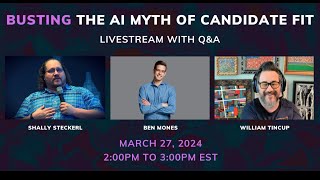
Recruiting veteran Shally Steckerl, host William Tincup, and Fama CEO Ben debunk two big AI hiring myths: that AI can make fully autonomous hiring decisions, and that it strips out human judgment. They cover bias risks, legal exposure under GDPR and the EU AI Act, and practical safeguards like transparency and continuous oversight.
Chapters
Live. Hello everybody, welcome!
This is gonna be so much fun. I, I, you know, this is— I've been looking forward to this for like weeks and I just can't wait to get into this. We are in it, we are in it right now, we're in it. And, uh, will there be comments? Do we get to see anything or interaction?
Something comes up in the chat, I can highlight it and, or we can, we can do live chat, but that only usually only works if there's a lot of chat. So there's a lot of chat, I'll put it in there. Okay, now I can highlight it. I can also add captions and stuff if we need it. So just let me know.
All right. All right. So the, the mission, as we all understand it, is to talk about AI myths and candidate fit and kind of the cross-section of those things. So before we get too far into it, let's do introductions. So make sure everybody understands who we are and what roles we're playing. Ben, why don't you go ahead and first tell us a little bit about yourself?
Despite often wondering, who am I? Don't spit out— don't start spitting out your drink yet. We got a whole hour to talk. Anyway, I'm Ben. I'm the CEO and founder of a company called Fama. We're in the candidate screening business. You know, very simply, what we do is help companies understand candidate fit through a range of technologies that we use, really helping people understand who folks are as they exist in text, image, video, online to help you increase quality of hire and make smarter decisions. And I've known William for a while, Tin Cup more recently, and I am thrilled to be here.
Shelly.
All right. My name is Shelly. Hi, I'm Shelly. You can call me Shelly. I've been in the industry, I guess, the recruiting talent industry for about 27 years. I'm known as a bit of a pioneer/rule breaker. Bottom line is I like to break HR technology to see how it works so I can find ways to extend how we use it. So because of that, I get invited to conversations around just what can we do and what should we do. And very recently I spoke at an AI in HR ethics conference, which is kind of what brought me into this into the fold here.
I love it. William Tin Cup, uh, that's all, just William Tin Cup. I got a lot of sun yesterday because I went to my 8th grader's track and field event, and it was cold, but, uh, and I had a t-shirt on, so it was cold. So I had to— I got out in the sun to warm up, not knowing or not being, uh, self-aware enough to know that I was, uh, becoming a french fry. So, uh, so yeah, so I look a little, uh, red, but, uh, it's gonna be a great conversation. All kidding aside, I think you look great.
I think you look great. You're, you're great.
I've always liked you. I've always liked you. Thank you so much. So, so let's talk, uh, let's talk fit, candid fit. I want to— I would for the audience to kind of again chime in, please, as you're listening to us, watching this, etc.
I've been to the comments and chat. We'll read them out on screen.
Please do that. It always makes these things much more fun when people actually spur us on to different places where we probably wouldn't go. But I want to go backwards into candidate fit pre-AI. So let's just do this before we break all the myths, as we should. Ben and Shelly, both of y'all been dealing with candidate fit forever. So why don't we talk to what is candidate fit and how have we historically looked fit from a historical perspective and pre-AI? How do we look at fit, Ben?
Sure. Yeah. I think the question of fit has historically been candidly one of the most human parts of the candidate journey and the onboarding process overall, right? The question of qualification, for example, the question of quality, right? Oftentimes easy to ascertain. You know, if you think about does this person have the skills, do they have the experience, maybe they have the license, the credential, for example, to perform the job in itself, right? The question of fit then, you know, focuses on quality, right? How are we thinking about, you know, this person's ability to mesh with a culture or perhaps to be the iconoclast we need within the culture to transform things and drive things forward, right? And so I think the really interesting thing about fit is that it's often been the product of very vibrant discussion between talent acquisition hiring managers and folks on the front line who are running that interview process. Hey, you know, this person has— talk about a salesperson— this person has the book of business, they have the network, right? Well, this person actually has the you know, a technical skill set, the ability to do a great follow-up email or connect with folks in a social selling type way. Who's better? How do we judge? Okay, how do you think about it culturally? So I think a lot of candidate fit has oftentimes been discerned and distilled through vibrant discussion where HR practitioners have to lean on their expertise and their experience, their pattern recognition to make a bet on what a future candidate is going to look like in terms of embedding within the organization. But I think it's important. I think when we think about fit, we often think about fit as a puzzle piece to make something contiguous, right? To make something— right. Yeah, exactly. As opposed to an aberration. But I think often what we miss is that fit can be iconoclastic, as I was saying, right? Maybe you want the person in your organization to shake things up, to transform things, right? So fit doesn't have to make things contiguous and whole. Fit can create a whole new shape, a whole new type of fabric within the broader blanket of your organization.
Shelley, you've dealt with thousands of hiring managers. So what's been the discussion and dialogue between you?
A lot of times they talk about skills, abilities, qualifications, competencies. And these are things that can be to a very great degree measured. There are soft skills that are hard to measure, but in general, the qualifications of a candidate are not what we're talking about here. The fit is something that's extra qualification. It's beyond the qualification. So for example, somebody could be a great candidate in all, in all aspects of the qualification, but still not get the job because of this other, you know, fit factor. And it's a factor that has often been, as Ben said, subject of controversy and conversation because it can lead itself to deceptive tactics, to discriminatory tactics. Oh, well, they just don't fit here. And, you know, how do you qualify that? Well, you know, there is the qualifications are, you know, has to have 5-year experience in this, know this toolset, know that toolset, but we're not going to hire them anyway because they don't fit.
Right.
Is that because of the color of their skin? Is that because they smell bad? Is that because of their weight? I mean, what, what is that really? And it can be a lot of things. So what we need to understand is, yeah, it, it can be, um, people like us, right? Which is that just being a— hiring your mirror, hiring yourself, hiring people that look like you, it's all the biases. It doesn't necessarily mean fit either, right? Fit could be we have an introvert and we have an extrovert and we need someone that can kind of bridge the gap, or we have someone who's really good at outbound calling and we have someone who's really good at marketing, but we need someone who's really good at technology, or, you know, just beyond skills. It's like someone who's like patient with technology and stuff like that. So fit is just as much a criteria, right? But it can be easily manipulated and misinterpreted.
Right. Both of y'all have talked about the positive and the negative, meaning this could be a fit, can be, or historically, well, we're going to kind of put this in the past and then get into the future as we, as we want to. But fit can be used as a weapon for good or a tool for bad, right? So people have used culture fit in particular, just the term, as a way of, oh, I need to be able to have a cup of coffee or have a beer with so-and-so, whatever. And I I can't see myself doing that. They're not really a great culture fit. I know both of y'all have heard this over and over and over. I think the skills part both of y'all seem to kind of mesh on. Like, there's certain parts of this that are just really easy to measure. They either have that experience or they don't. They either have that title or they don't, etc. But the part, the way that we've used culture fit, I'm going to stick there, culture fit can, can be positive or negative, and depending on the hiring manager, depending on the recruiter, depending on the situation.
I like to think of it as a puzzle, right? So if you have a puzzle that's comprised of a bunch of different pieces that are cut in different shapes, and etc., to complete the puzzle, you're going to need one of each of those different shapes that completes the puzzle. If you have all of the pieces are identical, you're never going to be able to finish the puzzle. There's, you know, hiring a bunch of people that are identical twins, and, you know, fit the culture and don't, don't stretch it or expand it or whatever is not really going to be very conducive.
No, it's, it's homogeneous. So what's great about, first of all, what's great about homogeneous cultures is everything's really easy because there's really no need to have disagreement. If you all went to Stanford, right, and you're all part of the same country club, you think the same way, right? So we can— everything's easy because there's no conflict. Problem is, if there's no conflict, there's no innovation.
Well, that I think is the interesting point, right? And I would almost posit, you know, to some degree on the puzzle analogy, you get a puzzle, right? You get a picture on the box, you know what you're trying to build, right?
Right.
I would argue that in some cases, teams don't even know what their culture is. You could ask 100%, you could ask 5 different people on a hiring team, on an HR, 8 different answers. What is our culture? Where do we draw the line? And I've seen this, you know, firsthand. One of our Our products is around, for example, mitigating risk and who you hire, making sure that nobody's said something hateful, violent, acted intolerant towards others. You don't want to bring that into your org, damage your brand, damage your culture. Check out our website, you can see all that stuff there. But through the onboarding process, we ask companies to draw the line. Where is that line for your organizations? Is someone making one misogynistic joke 6 years ago, is that a problem for your organization? Is it somebody who's said it a dozen times, right? You can ask 5 different people on the same team where the red lines are within their organization, and nobody has the same answer. So I think this is something that you might know what the puzzle looks like at one point in the trajectory of your company, right? But it's something that evolves as new people join the organization and as strategic plans change, markets you enter into, and, you know, a wide array of second and third order effects that twist, transform, and modulate the culture to look about as crazy as that wall behind William right now, right?
100%. You could—
it's as multicolored and multidimensional as, you know, the red on your face and the yellow behind you in that painting, right? You know, it's all day. So—
But see, I think, Ben, I don't think hiring managers— I don't think they know what you're saying. I mean, I absolutely agree with you. I don't think— I think they think their culture they, they know what it is. And if they don't, maybe it's a Jesse Helms, I'll know it if I see it.
Yeah, for sure. For sure. Right.
I mean, so that's just the team culture. You've got team culture and you've got organizational culture.
You have team microcultures. Yeah, yeah.
Right. You know, if you hire somebody for today that fits your team today, but that person doesn't fit the greater company, when that team is dissolved or changes, then is that person going to be out of place and not going to be able to find a home somewhere else in the organization, and that's detrimental too.
See, I think the way to break culture fit— and this is— I've done this with people before. I'm like, okay, so you have a salesperson, male, female, doesn't really make a difference. They crush quota. You have a $4 million quota, they come back with $12 million. You give them a $12 million quota, they come back with $50 million. So they crush quota. They are a sexual harassment claim waiting to happen. Again, male, female, I don't even care, or other, doesn't matter. Now, what do you do? You take that to your board. I can tell you what your board's going to say. Your board, because of what they have to do, they're going to say you have to fire said person, right? Because you just— the risk. Now, would you actually fire that person if they're crushing quota? This gets to the litmus test of what is and isn't your culture. To Ben's point, what are you willing to accept? What are you willing to reject? And I think you, you ask a CRO that question, they're gonna give you a wildly different answer than, than someone else.
And so, I think the answer to that question is, is a function of the leadership within the organization. And then a short-termism versus long-termism view. The bottom line is if you have a risk like that within your organization, the, cost and impact is insidious of somebody like that in the company. That's right. Getting good people to leave, in terms of damaging productivity, in terms of like having people not show up. There's like, you know, you and I have talked about this in other podcasts, William, but there's like real data behind how toxicity adversely affects an organization. But I think it's, it's almost, to turn it on its head a bit, a question of leadership within that organization. And strategy and seeing the forest in the trees that, hey, $4 million, they come with 12, amazing, that's great, but one lawsuit, that's all, you know, half of our team turned over.
And it's not just the lawsuit, it's not just the—
it's just not just the lawsuit, the payout, loss of business, the loss of goodwill, reputation, 100%.
I like how you said short-termism versus long-termism, because that's exactly right. But how many leaders would actually make that bet? That's probably arguable to find out. All right, so history lesson done. Got it. AI is going to obviously fix all this and has fixed all this. So what's— yeah, right, done. Okay, livestream over. So y'all have seen this both from clients and prospects and people that you talk to, that they're getting a bunch of marketing messages. They're getting a bunch of this stuff. Like they've, they've been through what we've all been through in terms of fit. What do you think the biggest myth right now around AI and fit is? And I'll start with you, Ben. What do you think people are coming to you, or what are people coming to you and saying? Okay. So we want to move to AI because it'll fix these things.
I think you see in the world of enterprise technology in particular, I call it kind of the consumerization of enterprise tech. In other words, that people think their interactions with ChatGPT, for example, or AI-based smart routing with Waze is the kind of automated decision-making that they're going to start seeing within their day-to-day, within their enterprise. In other words, like, I'm going to give you 50, 100, 1,000 candidates, and here's your winner, send them the offer letter, right? Like, the easy button.
Did you just do the easy button?
Genuinely, I think the, the lack of understanding at times of the difference between enterprise tech and, you know, consumer tech, where enterprise tech is really designed to fuel the power of the, the user, right? To give them power tools instead of a screwdriver, right? To go from a typewriter to a laptop, to accelerate their ability to collect information, to understand the implications and the meaning behind what the insights are providing, to enhance their own decision-making. I think the, the biggest myth is exactly where that role of AI sits, and, and people think, I think, that you're going to get like, uh, I've tried some of these like AI SDRs. I'm sure you guys have gotten emails around that kind of thing and it sounds like replace the human altogether. The AI will figure out who your contacts are and you get a reply back and it'll send a smart message and connect it with the sales rep. Like, sounds cool. Doesn't actually work like that. So it's not helped, for example, by vendors who are promoting automated decision-making in the enterprise, which I think is still a long ways off.
Shelly, what about yourself? What do you—
I just want to— yeah, I want to reiterate that it's the autonomous decision-making that Ben was talking about. Autonomous, automated. It's the complete outsourcing, or as I like to refer to it, prescriptive analytics or the prescriptive result where the AI is coming back and saying this is the definitive answer. That is the myth that really, um, that really doesn't exist. It's, it's not something that's actually practical right now. In medical diagnosis, for example, there are a lot of AI tools that help doctors understand, um, using a, you know, differential diagnostic algorithm patient presents with these 27 symptoms, what could it possibly be? What the AI is able to do is it's able to say, well, check for these other 27 things, run these tests. It could possibly be one of these 7 different things. But still, the doctor has to, you know, use their judgment, run the tests, get additional information. The medical AI doesn't just say, oh, here's what's wrong with them, give them this pill and it's cured. Right.
And by the way, we already wrote the script. You're done.
Exactly.
So my favorite— or go ahead. No, fair go.
Yeah, I just wanted to reiterate that that is— I mean, Ben's answer is my answer, that that is the biggest myth. But since I have to choose one, then I'm going to go with the second biggest. And the second biggest myth is that it is impersonal and dehumanizing, that AI is going to remove the the part of judgment and bias that is necessary, because bias is good if it's, as we were talking about before, producing the result that we want and it's a fair and equitable result. Bias is necessary. It's the experience that we bring and our, you know, it's the gut instinct in a good way. The same gut instinct that allowed us to duck when the tiger jumped out of the woods and bounced on us, is, you know, survival, right? So there's good bias and then there's bad bias of like, well, I'm never going into the forest again because all forests have tigers and every, you know, and people die. Like, that's just, that becomes fable, right? So I think it's the, the myth of this impersonal takeover that is going to remove the human aspect of it, you know, the, the takeover. That's, I would say that's the second biggest.
So the question that was going across the screen a second ago about anxiety, my biggest anxiety around AI and matching and with fit is that we're just going to take our biases, our human or regular biases, and multiply them and just bake them into the AI.
Really biased, right?
Like really, now it's, now it's on steroids and it's legitimized because it's tech. It can't be wrong. Now Bobby could, because, you know, Bobby's a— he's terrible.
Bobby's biased.
But yeah, Bobby's absolutely biased and racist. But like, AI can't be those things. AI can't be racist. AI can't be misogynist. AI can't do that. Things— no way would a computer do that. So my biggest fear and anxiety is that we're legitimizing AI with our own biases. Now, do— am I— first of all, y'all are the experts. Am I, am I, am I wrong, or is it just an un— is that an anxiety I shouldn't have?
You know, I, I think the— I'm not sure—
anxiety, so you should have it.
Yeah, it's okay.
Fair enough.
Thank you, anxious, my friend. Um, but I, I would say, like, look, to, to Shelley's point, you know, I, I know we were supposed to disagree on this Dang webinar, but I keep finding myself agreeing with what Shelley's saying. So in any event, like his point about avoiding the lions, right? Avoiding the tigers who are jumping out at us, right? Of the ability to discern the direction from which sounds approach us, right? All of these different things that we've cultivated both at a biological and bias level, right? Have happened over thousands of years, right? Thousands of years of trial and error, right?
That's hot.
That's hot.
And honestly, like, I still touch a hot pan, like, probably once a month. So maybe I still need to work on mine a little bit.
That's hot.
I think the anxiety where you're kind of referring to is that we're trying to compress thousands of years of bias reduction and bias modification. I think because to Shelly's point, sometimes this bias is good. In informing us of the right decision and that kind of reptile brain instinct to go a certain direction or intellectually, right? The neural cortex, the more rational, higher-level decisions that we make are also affected by bias. But with GenAI and even AI over the past, let's just be generous and say over the past 20 years, you're compressing 20 years of thousands of years of bias reduction into a 20-year period and you're expecting both things to, to get level, right? And so I think in some ways it is an unfair expectation that you expect the AI to, you know, be as unbiased as people when people are biased in themselves. So it's a very, it's a very controversial and I would say difficult problem to solve simply because I think a lot of people have different biases about where the line on where AI bias should be, you know. Um, and how you build it is, is there's a bit— there are ways to reduce it, right? And you look at even what the EEOC is, is doing right now and some of the stuff at the enforcement division level. Like, they're looking at, you know, uh, independent audits of models, making sure that, you know, nobody in the commercial or technical chain of command— meaning you have either some tech role in building it or commercial benefit from launching it that no one's involved in, you know, creating that audit too. And also there are ways to overtune models and put your thumb on the scale before that kind of testing that the EPA is also looking out for. So I think the proper controls are in place, and I think the, um, you know, the role of DEI, especially in tech companies where, uh, you know, they're looking at how do we source engineers that reflect the customers that we serve so that the people who are building the technology, the people that are leading the development efforts of that technology are reflective of the communities and customers that they're serving. So I think there are good approaches that are happening in the market, but I think it's frankly unrealistic to expect that we can catch up in 20 years what took, you know, the smarter machines, us humans, thousands of years to cultivate.
Well, so I think I actually finally did find something to disagree on. Yes. Gonna disagree with both of you guys on this one.
Oh, thank God.
Disagreeing with Ben on that these things are in place. Actually, they're not. So one of the big takeaways from that conference that I attended is the fact that from the surveyed population, 89% of employees at these organizations are concerned that AI will make decisions about them. But only 39% of the organizations surveyed had any kind of ethical committee organized around AI. So, it's a huge concern for a majority of people, but a minority of organizations actually are even thinking about the ethics of it. So, it's not right there. And then I'm going to agree, I mean, I'm disagree on William, I think it is a reasonable anxiety to have because it is the fear or the apprehension of relinquishing control to an unknown entity. But what I can do is give you a little bit of Xanax for that anxiety by saying that there's 3 things that we can do to help prevent that fear from becoming a reality, and that is, first of all, boundaries. So we make sure that we, that we implement these systems, these algorithms, in an environment where there are specific limitations to what it can do and cannot do, right? So it doesn't just go off the rails. If you, if you program a robot to keep going in the same direction, it's going to keep going in that direction no matter what obstacles it overcomes. So you have to tell the robot to not continue if it encounters resistance, for example, right? So it doesn't create destruction of property. So we have these boundaries. So number one, boundaries. Number two, I think transparency. Making sure that it is possible for us to communicate how the math works and who's responsible for it. If we have that transparency, then when it screws up, which it will, it will, we can then figure out how to fix it, who's gonna fix it, what went wrong, you know, things like that. And then the third piece of it is human oversight. So if we have boundaries, transparency, and oversight, I think the worst of your anxiety can be mitigated.
Right. And so the both of y'all have touched outputs. So looking at the outputs and calibration. If I understand what you've— you both have said that and agreed upon it at some level, that you've got to continuously, if I understand this correctly, look at the outputs. If we're trying to hire software engineers, AI engineers, and this is the output that we want to achieve, okay, how do we create that fit and match, etc.? How do we do that in a responsible way with less bias and all that other stuff? So how do we create that output? And if the output is incorrect, how do we recalibrate or calibrate to continuously get either the same or better outcome? So if I have that correctly, what questions should practitioners be asking of us, of vendors and people in the know, et cetera? Like, I can see, like, the three of us all kind of have some shared experience and probably have some shared ideas on these things. But I see a whole community of people that don't follow AI. They're not— they have a job job, whether or not they're global head of TA at Cineas or, or whatever, the CHRO at so-and-so. They've got a job job. They're not paying attention to this stuff. And, you know, HR tech, TA tech, it's sold, it's not purchased. So there's a lot of marketing shtick, there's a whole lot of disinformation, misinformation, and just noise So like, what I'm worried about is like, okay, the three of us, we're going to agree on a lot. There's a whole class of people, a whole group of people, they have no idea what we're talking about in the sense of like, okay, I'm a practitioner, how— what, what questions should I ask? How do I— what should I be asking of these people that say they do?
How is the data going to be used? How is the data going to be used, right? They're asking for data and they're going to run some programs on the data. How is the data going to be used? And I don't think that a vendor is necessarily going to spill the secret sauce and, right, you know, the formula, but I, I still think that they can be transparent about how. And, um, also, how is it going to be protected? Because once I give you my data, you know, like, one of the concerns about ChatGPT and privacy issues, right? Yeah. I mean, I saw a bunch of companies that said, we are going to not allow— you We're not allowed under any circumstances to use ChatGPT because it gives up all of our intellectual property. Well, what if you use ChatGPT to ask a question instead of providing all of your proprietary information to it? What is— can you still not use it? You know, so how is the data going to be protected, I think, is a good question. And I would say, um, yeah, I need to know. I, I need a, a single neck to squeeze.
For sure.
I like that, all three of those. So protected, used, protected, and, uh, neck to squeeze.
Yeah. Who do I, who do I hold responsible?
There's probably a really, you know, yeah, there's a real nice way of saying that. It's at the end of the day, I'm paying you for an output.
Ultimate accountability, right?
Yeah. Who's, who's, who's accountable? Ben, what's, what's your coaching practitioners all the time?
Oh yeah, man, for sure. And for the first time, um, uh, one of our, our long-term clients who we were working on an RFP with for a more of a global expansion, for the first time as part of a global procurement team, we actually had like an AI auditor. Now this was a French company, right? But for the very first time, we started seeing detailed questions, not, not SOC 2 level, you know, information security questions, but to Shelly's point, what training data are you using? Talk about the F1 precision accuracy of the models, which are basically ways to judge the accuracy of the data models that you're using to generate these insights. But I think high level, we should be looking at our friends. If anyone in Europe is listening, they're probably like, these stupid Americans, they haven't even figured this out yet. Because a lot of our European colleagues and folks that are out in the market with the AI Act that recently passed in EU, there are a lot of questions, you know, that are asked of vendors that are required to be added to what they call, you know, extensions to the GDPR, whether you're transferring data between the EU, the US, Switzerland and the US, the UK and the US, right? Where you do get asked these questions on what type of data is being used. There's a whole category, for example, of sensitive data, right? Sensitive data that's required that, you know, is classified as gender, political information, information with disability, sexuality, for example. So I think to Shelly's point, the data types are, are a big piece of it. And I think you can, you know, look no further than any European customer or client that you've engaged to see the questions they've been asking. Candidly, since like 2022, when some of the SCC, the standard contractual clauses, those laws changed and evolved. But to like totally simplify it, there, there's one, two questions I think you got to ask. One, Is there any independent audit on the AI that you guys are providing, especially if it's automated decision-making? Because outside of HR tech, there are tools that are using some of that automated or, you know, fully machine-based processing.
And just to stick you out real quick, when you say independent, sometimes I think vendors hear that as we have Janet, who's our AI expert. She has a team. It's internal. Etc. And Janet's team is always looking at the algorithms. They're always looking at the outputs. That's, that's their job, is to independently audit. Now, what I heard you say was someone that's outside your organization, a third party.
That's right, that's right. You need— and, and I, I would turn to my favorite website, uh, LMGTFY. Let me Google that for you so you can get the exact right answer, uh, on, on, on, on the, the prompt, but, um, generally it's somebody who's outside of the development or commercial chain of command who had no role in creating and no role in the financial success or financial outcome of the sale of such a product.
Um, can they still be in the line of, of production? So typically created it? Okay.
Yeah.
Okay.
Typically no. So, so this, you know, applies, I would say, if you look at, um, the New York AI Act, which recently came out. And, you know, most folks don't know, but Textio played a big role in actually lobbying for that law and getting that law over the finish line because a lot of what Textio and their approach to data science, their approach to, you know, fairness from an algorithmic standpoint, they've presented and positioned themselves as a market leader. So they actually got a law passed that reflected how they do work as a way to consolidate and further, you know, own their position. So I think, you know, at the end of the day, you're going to see procurement teams at big companies, Fortune 500 companies in particular, start adding, you know, more AI-specific auditors in the same way that they added. And there'll be a whole wellspring of third-party companies similar to like, uh, Drata from a SOC 2 perspective, for example, that, you know, are either helping companies get there to pass those sort of procurement checks and balances, but also, you know, firms like OneTrust that support the procurement SOC 2 completion process as a third party for firms evaluating vendors. So I think you'll see that industry mature pretty substantially over the next 5 years. But in the intermediate, the one question I would ask is, are there independent audits of the AI that you're selling to our company? And how do you think about ethical AI development? And that should pass the—
Is there an independent auditing body? I mean, how does one go about getting an independent in an audit.
There are third-party service companies that, that do provide, uh, independent AI audits that are out there.
And, and academics. There's actually, there's actually schools that do this as well for, for money.
Yeah, for money. It's a commercial endeavor.
Academic.
I know, I know. I just threw it out there.
That's never gone wrong before.
Um, you know, Ben, I have a I have an anxiety.
Um, this is therapy, really. This is a livestream therapy.
It's good anxiety that maybe you can, uh, address. What I consider to be probably the central or pivotal or core of GDPR is, um, and I may be wrong about this, is the right to be forgotten. Right. The right to be forgotten. The right to be removed.
I own my stuff. Yeah.
Right. I own my stuff. Or yeah. So I own my stuff, therefore I can delete it. I own my stuff. Great. But what am I going to do with it? The fact that I can actually delete it, is that even possible with what we're talking about here? Is there even such an undo?
The GDPR, I think when it first came out in 2018, that was a central tenet and it was largely banking data. In particular. People had to be able to take their financial data with them so they could get the same rate from another bank because banks were locking consumers into financial packages and interest rates, for example, and not letting them take their data. Kind of had to like start over going to a new bank. So that was a central tenet when the GDPR came out. It still is. It's still a big part of it, the right to be forgotten, but it's much more today around what I would call the permissible purpose and the use of data. What data is being consumed? What data is being transferred? How is the information used? I think to the point that you—
Used and secured or taken care of.
Yeah. So let's say it's not my information proprietarily, but it's information about me. So the question about ownership may be a little bit debatable here. You know, do I own my LinkedIn profile or does LinkedIn own my LinkedIn profile? Obviously LinkedIn owns my LinkedIn profile.
Actually Microsoft.
I wrote it.
Yeah.
Right, exactly. But I wrote it so technically I could protect it with a copyright, whatever. The point is, is it possible to essentially say, hey, get me out of this AI?
There is a, that line of personal data and the definition of personal data. Has moved so much over the course of, unfortunately, bad behavior by big companies. I will say, to answer your question directly, generally, yes, you can remove your data. Anybody who's operating in the EU has to provide the recourse. Like, you go to our privacy policy, for example, and like, you can get your data removed, you know, if it exists within our system. And you do have that right, you know, to be forgotten. So It's a really interesting—
opt out or whatever that—
yeah, yeah. So you should have an opt out, and that is also like the central theme of, uh, a lot of the big tech companies right now and their ability to operate abroad and where they have their offices, etc., and, and, you know, lobbying overall. So it's a hot topic in the industry.
Dude, something just popped up on the right-hand side. OpenAI has a setting feature allowing people to have their data removed. Bonus points for LinkedIn user. I don't know who you are, but thank you, that's very cool. All right, so it might sound like we're negative if someone just popped into the middle of this. Like these are three dudes right down on AI.
That was just my personal anxiety.
No, no, no, no, no, no. I was blaming myself. So. So we're not, obviously. So where do y'all see this being a positive over the next couple years? A positive thing for HR, for recruiters, for sourcers to be able to do their jobs, create great outcomes for their companies, and again, use AI in a way that facilitates good things and good outcomes. So what are you excited about is what the question is.
I'm excited. I think it's more WALL-E than Terminator.
Nice.
You know, wow. It's— what? Yeah, it's like, what did— what did WALL-E do? WALL-E got rid of, uh, garbage. That is a tedious, menial, unsatisfying job that humans couldn't do in the case of the, you know, the environment. Um, but just generally did— it's, you know, it's, it's a, it's a job that the robot can do quite well without complaining, and a human would, would find probably not very This is not very—
this is what people in the industry called low-value tasks.
Yeah, but in our industry it's low value, but if you don't do it, you end up with a planet full of garbage.
Good point, right? So I take it—
yeah, yeah. So I, I think it's— that's what I— that's my, my, uh, hope is that it's WALL-E, not Terminator, that it's going to help us be more efficient, perhaps bring transparency and objectivity. Scalability versus, you know, taking over and becoming this dark force?
Yeah, I'll use a separate— I love WALL-E. WALL-E is a great movie. Also Terminator 2, like both great films, but I'm gonna go with a non-HR tech, non-business, you know, analogy and go to a slightly different direction. So Imagine somebody who's like a woodworker. They make hardwood wooden tables, right? You got one person who's got all hand tools, right? They've got like screwdrivers, they've got a hand, you know, hand sander. They've got, I don't even know the tools, right? I'm not a believer, right? But they got all the manual stuff.
Then you got somebody— saws, routers. Totally.
Then you got someone who's got the table saw, they got the lathe, they got all the different powered and automated tools. Both of those craftsmen and women get the same bid for the same table from the same customer, open bid, right? The person who has the power tools, they're still going to get the same product in a lot of ways. This is genuinely what I believe. They'll still get the same product. I believe the person with power tools is going to do it faster, the quicker turnaround time, a cheaper price point, and generate more repeat business over time. And that's what I think you're going to start seeing with AI. You're going to see certain vendors that are able to deliver on their existing value proposition to their customer in a way that's faster, cheaper, more consistent, and enables them to scale faster. And I think that head start will be consolidated by— and that differentiation between companies will be consolidated and deepened in a compounding fashion, uh, based on their ability to integrate AI. So I don't think it's honestly more complex than that. And that's why I'm very long on it, is that I think it's going to unleash the potential and the capability and the expertise of the user in a really unique way. I think you're gonna start seeing people who have their own pattern recognition, their own expertise, their own experience be able to shine even brighter, delivered faster, delivered more intelligently to help them advance in their careers. Faster within the organization or accelerate their company forward, honestly.
But didn't you just describe tool demand? Tool, every tool is exactly, I mean, it's another, didn't we have the same problem with fire? Oh my God, it's gonna take over the world. The wheel, oh my God, it's gonna cause so much death.
This is every technological shift people fear it.
Yeah, the wheel, the printing press, oh no, it's gonna destroy the world. World. Radio, horse and buggy, the internet, uh, you know, social media. I mean, isn't that literally like the history of mankind?
I suppose. Yeah, I suppose. I guess it is a history of mankind.
So there's an adoption curve is what, Shelley, what you're talking about is that there's people that at the front of it will say, yeah, cool, great, done. There's a bunch of people in the middle that are like, I'll wait and see it. And there's a group of people like I'm just going to die and just let all that kind of play out and not worry about it. Right. And a lot of those people— so that's every technological shift, I think, Shelly. But both of you are making great points. A question that came up on, on Ryan and I's— one of our podcasts was around compliance. And I know you both love compliance on so many levels. Who owns this? Like, like, again, I can see again with software vendors, we're going to go to HR Tech. The three of us will be at HR Tech sometime in September or October, whenever the hell it is, and we're going to go to this event. We'll walk the, we'll walk the floor. We can walk the floor together, that would be fun. We'll walk the floor and we're gonna get bombarded with AI, and especially this year, generative AI. One Oh yeah, Gen AI, baby. All right, so I think you— we all know this, we've seen this happen too many times. We're all going to be bombarded. The practitioners that are there honestly trying to learn something new, they're going to get bombarded with the same thing. At some point, somebody's got to step in and be mommy and daddy or be the compliance person.
And there's already 7 organizations that have oversight over recruiting. So there's already 7 separate entities. Which one are you talking about?
Yeah. See, well, therein lies one of the problems. So you got 7 people, which means you're gonna get 15 different outcomes of that. Our, our, our fighting with Ryan and I are to not fight. Our disagreement was, is it something that government should own or is it something that academia should own? Now, first of all, you don't have to pick either of those, by the way. That's false, false, false choice. You don't pick either of those. But the question is, is as we demystify these things and as we look at it, they're going to be bombarded— practitioners are going to be bombarded with a bunch of AI messages that are all going to sound wonderful. Again, over the hill is a, a house, there's a field, there's a meadow, there's horses, there's rabbits. It's fantastic. You can't not like the thing that's over the hill. People have been selling real estate this way for, you know, 300 years. Nothing, nothing new here, right? However, at some point somebody is going to have to actually lay down guardrails. To Shelley's point, all right, we already have a bunch of things popping up. Is it just going to be a game of which of those actually is the loudest or the one that becomes the more definitive and used? Do you all think it should be the EEOC and, and even the National Labor Relations Board? Like, do you think it should be government? So it's a loaded question, but I'm really interested because we're dealing with myths.
Yeah.
And one of the myths might be— no, not might— is, is that somehow this has been formalized, which—
well, so, okay, I—
there is in the vendor world it hasn't been formalized because there's no standardization.
There's no standardization, but standardization does not mean regulation. The ISO, International Standards Organization, is a voluntary participation organization.
100%.
Every country sends their own representative. In the United States, that's ANSI, the American National Standards Institute. But if you violate the ISO 9000 standards, there's no consequence other than decertification. Um, yeah, so I think we have to look at it in 3 dimensions. The first dimension of those is public safety, and if it's got to do with public safety, it absolutely needs to be governing. However, the only entity in our government that is legally authorized to enforce something by law that could potentially send a practitioner to prison, right, for violating that law is the EEOC. There's no other entity that has that. There are entities that can, you know, bring out the fines.
Sticky note: is the EEOC politicized? Can it be weaponized for one party or another?
I don't know. I, I don't know the answer to that.
I do, and they can't. So there you go, lesson learned.
Okay. Yeah, but that's— so that's a governing body that's protecting the, you know, like I said, public.
No, I know, I know.
The second piece, and this public, it is public safety, can it be subjective?
Meaning, if I'm an employer or a candidate, can I—
damage is not subjective. You know, there are many different kinds of damage. Emotional damage is not subjective.
Emotional damage could be, I didn't get the job, I'm now terrified and affected and can't apply for another job. It has damaged me.
And again, root cause. Why didn't you get the job?
Yeah.
Then where are you at with this? Because I love this and I know it's bopping around in practice.
Did you not get the job because of the AI? In which case the AI damaged you. Or did the AI do a good job of preventing this employer from making a bad decision? In which case it's justifiably—
Dude, if the AI rooted me out of the application, right? It did its job.
Right. That's my point.
I would just say, you know, in the EU, it is definitively the government that is making this call and this decision. You know, I think in the United States, you know, there has been a history, right? If you look at the old way of data collection, the FTC got involved in, you know, with the FCRA regulating the use and the compilation of consumer data. Consumer data to be used in hiring, credit granting, benefits decisions. And to Shelly's point, you know, it's not like you're getting arrested, but you are getting big fines, companies getting shut down, and mega fines essentially for not following the law and in the screening industry.
That's my second one, right? The first one is public safety. The second one is regulation. Like, for example, the organizations that oversee banking, you know, and that's public good.
It's a regulated industry. Industry. So before you go too far down the path, is AI something that should be a regulated industry?
My, my, my answer to that is that I think there need to be commercial incentives for companies to change the way that they do business.
Oh, I like this.
I don't, I don't think that business owners and business leaders are not gonna do it on their own, are not going to do it on their own. It's too fast of a path to profitability. 100%, you know, the, the—
like ISO, that's the argument for the ISO. Yeah, I got you.
The short-termism we talked about earlier, you know, it plays a whole lot of how we operate in this.
The irony of that, you tied those two together, is so great.
Coming back to it, right? And so I, I think, you know, finding ways— if you look at, you know, SOC 2 compliance, right, the only reason that SOC 2 has become such a, a critical part of how companies operate in the technology world, it's because of data breaches, right? It's because we've all seen what's happened, you know, from the Colonial Pipeline on down to every other example of data breaches that are happening right now. There are commercial incentives for companies to do it because there are untold damages in the millions and billions of dollars that stem from not doing it, right?
And so I've told people it's right and wrong. That's not gonna work.
Until there are untold billions that are going to affect companies if they don't do it, uh, then, you know, I like where you're going because you're saying carrot and stick.
We can only do so much with a stick, and companies are, you know, they have lawyers and they have law. They, they, they're, they're not going to be too much persuaded by the stick. However, if you say the carrot and you say, you know what, here's what we're going to do here. If you have your, if you have your AI audited once a quarter by an independent third party, we'll give you 2% off your taxes or something like that, right? Yeah, we're gonna probably do it anyhow because you're running a great company, you know, so you're probably gonna do it anyhow. But you know what, even if you weren't, your CFO is going to go, hey, uh, let's go do this bit, right, and reduce our taxes.
Yes, similar to some like ESG stuff, you know, that—
yeah, yeah, yeah, yeah.
15 years. Yeah.
So a great question. Again, LinkedIn user, I have no idea who you are. You're probably, uh, somebody that knows Shelley. Curious if your org is leveraging GenAI content in their marketing or email outreach. Is it a good first step to have the AI symbol at the bottom of the email with some disclaimer informing them? This could be initial first start. I want, I want to ask you the question on both sender and receiver, catcher and pitcher, if you want to go that direction. But the idea of should we disclose in our career sites and otherwise where we're, what is being created with AI, then flip that. Should candidates disclose where they're using AI, like in their resume creation, all of that type of stuff, right? So let's do the first one. Let's do— because it's a wonderful question. Thank you for asking, by the way. Have no idea who you are.
Please, wonderful LinkedIn user.
Wonderful. No, seriously, thumbs up. Um, great question because it is about disclosure, and I believe both of y'all touched transparency during, uh, during this bit.
So content in marketing emails is pretty low stakes, honestly. I think the game of like, you know, emails, marketing emails and email outreach is all designed to elicit a response. And if you believe that AI can help you do that, there have long been tools well before GenAI, like, right, uh, you know, uh, spreadsheets, you know, that you could just like upload emails to and auto-send emails before all these crazy sales tools came out. Um, right. So for me, I, I think it's unnecessary in, in marketing and, and email outreach because you're just trying to get somebody's attention. If AI can do that better than a human, uh, seems pretty low stakes to honestly, in terms of impact.
Where should disclosure be? If— or should there be disclosure from the company to the candidate? Should— do you think there's disclosure even in the process? Like, even if we look at the vertical chain from sourcing all the way to interview to, let's say, offer letter, maybe even onboarding, if there's places where AI is being used, if where those places be, it's AI is being used, do we have a responsibility to disclose?
So there, there are laws already that exist to protect this. There's something called the Guidelines for Employment Selection Procedures, the Uniform Guidelines, the UGESP is what it's called. Uh, often great read, totally awesome, the guidelines, but Yeah, you know, there are already rules in place that if you are using AI in a hiring process that is going end to end, you have to be able to explain why someone had a decision made about them, right? The tool that you used. So that exists today.
How many candidates do you think know that?
Very few. It's like, it's a— you can really even find this thing online, but it exists.
Shelley, transparency? Where—
how many, how many recruiters do you think know about all 7 of the different entities that have oversight over their job?
I mean, again, I'm going down into the 0% and work up, if you don't mind.
Work up from there.
Work up from there.
Sorry, transparency.
Yeah, transparency for the candidates. And again, where they're using AI and where we're using it. Obviously, there's rules that we already know that we should Again, there's no teeth to that law as I understand it.
No, but I think transparency is one of the three tenets that I was talking about to reduce anxiety and increase trust. So I think the question goes back to, do you want to be trusted? If you want to be trusted, then be transparent. If you don't want to be trusted or don't care as much about that, oh, I like that, then You know, go back through the 3 pillars in case people came in late. So there was transparency, public safety, the, the, the boundaries, right? Limiting its ability and, and human oversight.
I like, I like all 3 of those. And again, if you're, if those are your, what you're grading for, then you grade yourself out. Now, questions for both you in terms of the boards and maybe even advisors, et cetera. How often should they be talking about AI? Because I had— well, the board of directors, let's stick with the people on the board, uh, because advisors, it's— it can be nebulous a bit.
So the people on the board need to be asking the very, very, very basic question of, do we need to adopt this yet, or can we wait?
Oh, that's interesting. So I just had a meeting with a large—
by the way, sorry, to clarify, can we wait without losing our competitive advantage?
Yeah.
I just had a company with an executive team for a publicly traded company, and I told them that AI should be on every board meeting that they have going forward. It should be a standing item. Like, to not have— to not talk about AI is a— you're not doing your job. They should not pay you as a board, uh, as a director. Now, that was a little harsh, but I wanted to be a little harsh with them to make them understand that, hey, listen, this isn't going away. Putting your heads in the sand, yeah, that's not an option.
No, you can definitely ask the question, do we absolutely have to do this without losing our edge? And if the answer is no, then you can say, okay, We're tabling this or we're putting it in the parking lot until the next meeting, but then we have to ask that again. Yeah.
Love that.
And I think it depends on the country you're in, right? It's like the board's responsibility is either the shareholders or all stakeholders, right? You know, in the United States, it's mostly a shareholder mindset. So I think, you know, to Shelly's point, like, is there a commercial impact to us not asking this question right now? And I think frankly, a lot of companies, if not in 2024, 2025, 2026, we'll have to start asking that question through the lens of shareholder due diligence, shareholder responsibility, and in the EU, I think stakeholder due diligence. In the EU, I think this question is being asked right now, no doubt about it. I don't think it is in the States.
So I want to thank the ASA, American Staffing Association, for saying great point on transparency. Absolutely agree. Final thoughts from the two of you? What would you if you could talk to all practitioners right now about, again, the myths of AI and matching, what would you tell them?
I honestly, my, my biggest takeaway would be fear is not an option. Being afraid of this is not going to—
Right. That gets back to your historical fire wheel. Yeah.
Yeah, totally. And my, I mean, I, agree strongly with what Shelly is saying. I, I would add, you know, it would be more of a yes and, you know, to, to that point, which is this will make you better. This will improve your station personally, professionally, politically within your company. There are ways to let your own expertise and experience shine by an effective adoption of AI tools.
All right, lastly, this was sponsored by, uh, Fama. Ben, thank you so much for getting Shelly and, uh, myself together, and yourself, obviously. Yeah, uh, the website's, uh, fama.io.
That's right, check us out.
I read, that's what I do, I read. So, uh, thanks everyone for playing, thanks for coming, thanks for being a part of the live stream, and we'll see you later.
Thanks.
More from Shally



Scaling Talent at Hypergrowth: Leadership, AI, and Hiring Excellence with Cindy Nicola







