Faith Saenz Live on Shally's Alley
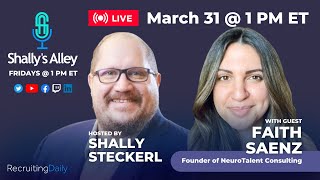
In this episode of Shally's Alley, host Shally Steckerl interviews Faith Saenz, a neurodiversity talent acquisition specialist and founder of NeuroTalent Consulting. Faith shares her personal experience as an autistic recruiter and explains the staggering unemployment rate among autistic adults (65‑75%). She argues that reliance on self‑disclosure is ineffective because many autistic candidates fear stigma and lack safe avenues for accommodation. Instead, she advocates redesigning the core recruiting workflow to be universally inclusive: offering choice of video or phone interviews, providing clearer interview structures, extending interview time, and planning questions in advance. Faith highlights the immense variability among autistic candidates—some prefer video, others find it distracting—making a one‑size‑fits‑all approach impossible. She discusses communication differences such as direct language, lack of subtext, and the exhausting nature of masking, noting that these traits can be strengths (attention to detail, curiosity) when recognized. Legal and diagnostic hurdles are examined, including the high cost and limited availability of adult autism assessments, and the fact that accommodations often require proof of diagnosis. Faith critiques the industrial nature of traditional interview processes, urging recruiters to view interviews as human‑centered rather than purely data‑gathering. The conversation concludes with a call to action for Autism Acceptance Month, resources for connecting with Faith, and a recommendation to avoid Autism Speaks in favor of autistic‑led advocacy.
Chapters
To Shelly's Alley! It is Friday, March 31st, the last day of March, and I think that means the last day of Q1 for those of you that are tracking. Also the day before April Fools', so you've been warned if you get any weird messages tomorrow, it might actually be an April Fools' joke. Today I have a very special guest. Of course, all my guests are very special, but each one of them brings their own particular gifts. And in this case, Faith Science joins us as a specialist or an expert in all things related to talent acquisition and autism. This is a topic that is very, very near to me. Many of you might be aware that I have a nonprofit foundation, the Sourcing Institute Foundation, and we work with people in all kinds of displaced situations, disadvantaged, people with disabilities. You know, we have groups that we work with the blind, returning veterans, military spouses, and so on. And in the past, we've had two projects with people that are in the autism spectrum. And unfortunately, both of them didn't really pan out. Sometimes pilot programs just don't work out. And honestly, it's really my fault. I mean, I didn't know enough about it. I, I had thought that we would be able to figure it out on the go, but we really needed to be better prepared. So I've been on the lookout for, you know, people that can help us with that, and that's how I came across Faith. We've never met, but I have great referrals and references from you. So Faith, welcome to Shelly's Alley.
Thank you, I'm excited to be here.
Yeah, it's usually a pretty fun discussion. So tell everybody a little bit about— you essentially, you teach organizations in talent acquisition how to, to learn to assess autistic talent because we've seen the discussions on various groups, sometimes neurodiverse talent doesn't interview well, or maybe it's not that they interview poorly, but they're interviewing is very different and their skills don't necessarily come across as loudly. So if you learn how to assess them, then you are giving them more of a fair chance. Did I get that right?
Yeah, that's exactly right. Yeah.
Yeah. How?
Yeah, it's a great question. So, you know, the autistic community as a whole is— I think the estimate is somewhere between 65% and 75% of us are unemployed, which is obviously just a shocking number. It's, it's massive. And it's really too bad. And, you know, the reason for that, I mean, there's, there's a lot of reasons, but one of the main reasons is just misinformation around what autism is, and how it affects people and how capable autistic people can be. So, you know, I think for me, as someone who is autistic and, you know, had the first part of my career was in talent acquisition, um, I got really passionate about creating more space in the hiring process for autistic people to actually be successful. Because, you know, the massive unemployment number scares all of us, right, into confessing that we have autism or disclosing it to companies. And when we don't disclose it, we also don't get the accommodations that we need, and it just causes a whole list of problems that really just only starts with the interview. And so that's definitely something that I really, I really wanted to solve for. And because we can't— currently, the ADA requires for someone to disclose a disability, and then you get those accommodations in the hiring process, right? We can't rely on autistic people disclosing, because it's not really safe for us to do so. You know, I and every autistic person I've met at this point, which is quite a lot. We all have stories of getting an interview, disclosing that we're autistic, asking for an accommodation, and getting ghosted. Like, that happens again and again. And a lot of it, like I said, it's just misinformation around, like, you know, they think it's maybe too much trouble or too difficult or that we wouldn't be able to handle the role. And, you know, so because of that, like I said, none of us want to disclose. So we cannot rely on some sort of special process for disabled candidates or like a second, like, this is our special autism hiring program. We can't rely on that because that still makes people have to tell you, I am autistic and I need help with this. So really, my passion is just driving TA teams towards a basic, like their actual main process to just be more—
In other words, making a process that is inclusive rather than having an exclusive process for people that self-identify.
Right, exactly.
Which, you know, in all fairness, it should be inclusive of lots of other things as well, and it probably isn't, right? Absolutely. So, you know, one of the things that I talk about when I'm talking about interviewing is the fact that there are different ways that people express themselves. And for example, people who are introverted, which is controversial because sometimes people say, well, I'm an introvert and I don't do that. Well, Everybody who's introverted has different ways to representing. I'm sure everyone who's autistic has different ways to represent. And if somebody met you, they probably would have no idea that you're autistic. Just like if somebody— I can tell you for a fact, most of the people who meet me have no idea I'm introverted, right? But when I interview, I have had to teach myself to not be introverted, otherwise I don't get the job. It sounds like it's the same thing. It's like if you if you don't, like, I don't know, somehow force yourself to not show up that way, right? So what's the, what's the, what's the solution? Like, is there, is there some kind of— how do I know that someone that I'm speaking with might need a little bit of accommodation? Or I guess, what's the— what is the accommodation?
Yeah. So, I mean, I think, like I said, it's, it's just opening up the main process a bit. Right. So, you know, maybe that initial conversation you ask them, would you prefer a video call or a regular phone call rather than just sending them a Google link? You know, if they're going to get there, you know, you typically know as a recruiter what the kind of interview you're sending them into is, right? Like, oh, this is a technical interview. This is assessing their whatever. Like, really making sure that they have broken down like questions of this is, this is the topic that will come up. We don't recall information the same way that you do, right? So this idea of like thinking on our feet, it's like if I, if I wasn't here today with you planning to discuss autism and the TA process, I might not be able to articulate myself really at all, because I wasn't thinking about it. So if we get a left field question, that we weren't planning to discuss, we're really just kind of lost in that moment, right? And so really it's just about opening up the sort of basic process to those sorts of things. And honestly, I had a manager, Rob, at Twitter who— he was really, really great. And he said, like, having you on my team, really, it just forces me to be more organized. And I think that's what it is. And I honestly think that's a bit of the pushback too. That means that I would have to have all the questions of the interviews from all of the interviewers and what they're asking. And I'm ready to schedule a different kind of interview. And I'm not overwhelmed by scheduling that I'm able to stop and make sure that I'm scheduling what they want. And, you know, all of those different things, it does take more thought and more planning. But it really is better for everybody. Everybody can benefit from having better planning.
Yeah.
Like, that's so not just autistic people can benefit from that, you know?
Right. So you said video versus phone. Is there a— I know there's nothing as such a standard. This is something that I learned in my, in my two failed pilots working with autistic people that wanted to become recruiters, is that the biggest failure came from the fact that we had 7 people in one of the pilot programs, and each and every one of those 7 people had completely different needs. Whereas when I work with— when my foundation works with blind people, they are— there are obviously, there's differences in every person, but there are commonalities across the blind. For example, you don't want to do a PowerPoint presentation. It kind of doesn't really help. It doesn't do anything. So those sort of things you can prepare for. But with autism, I just didn't expect how varied there were.
Yeah.
That said though, is there some sort of commonality with video? Because I feel like you mentioned video versus phone. Are autistic people less comfortable, more nervous, somehow dissuaded from video for a reason?
Um, you know, like you said, everyone is different. No, like, we like to—
hence the question, would you rather video or phone?
I see, right? Yeah, yeah, because if, if You've met one autistic person, you've been one autistic person. Like, there is no standard. Like, these are all of our qualities. So there's definitely plenty of people who just need, um, to only hear the voice, and like, if they're seeing your face, it's a little distracting, right? Or maybe like the screen is distracting. Like, all of these things, like, just whatever is happening, it's—
there's too many other things to take you at it from their focus. So that's, that's a possible—
yes. And then, but then there are other people who have trouble with auditory processing, um, like I do. So it's helpful for me that I'm also seeing your face and reading your lips at the same time. So that's what I mean when it's— it's just, it really is so different from, from everyone. And, and it is really challenging to accommodate autistic talent for that reason, and for the reason that none of us tell you we're autistic. So it's hard to get— you can't get data on us. And if you can't get data on us, it's hard to properly support us. And so there's, there's a lot of, a lot of those sort of hiccups. But yeah, I mean, I feel like we should maybe talk a little bit if you, if you would like to about like just autism in general and sort of the ways in which it can make an interview.
Yeah, exactly. That's what I was going to say are what, where are the pitfalls, right?
So there is a lot. And I'll say to my, my company, NeuroTalent Consulting, you know, another half of it is interview courses for autistic candidates that just kind of learn better because the candidates take an interview on how to—
or take a course on how to interview.
Yes. Oh yeah. Because it really is like there's, there's a great opportunity for accommodation, but there's only so much accommodations can do because there are definitely challenges that are just the way that we think is so much different than the way you think that communication is challenging. Right. So when you think about the kinds of questions that people ask, a lot of times neurotypical people will ask a question that sounds more conversational, but what they were really asking was a different thing or like a slightly different thing. And you sort of naturally pick up on the fact that it's different. So if you were to say to me, so I heard that you recently opened NeuroTalent Consulting, my answer would be yes.
Yes.
But really in an interview, you'd probably want me to be like, yeah, I opened it a few months ago and here's why. And this is what we're doing. It's been really great.
Rather than having— right. So really what I would have meant was, tell me more about it.
Tell me what you're doing. But those are like insinuated questions, and you can't assume that we're picking up on any kind of nonverbal cue insinuation. The sort of layer of subtext that goes into that of like, I said this, but I'm really thinking that— it just doesn't really exist for most of us. Right.
Interesting. Oh, go ahead.
Yeah, I was just going to say, like, we say what we mean all of the time to the point where that can also be a fault too, because we're really, really direct. I had—
is that a commonality?
Definitely.
Yeah. Generalism. Okay.
Yeah, it is a good— it's a, it's a good sort of consistent thing. You can see that we're just really direct. I had a candidate one time, my interviewer came back to me afterward and they were doing a tech It was like one of the assessments. It was an assessment interview for an engineering role. And the engineer that he was interviewing stopped him and was like, this test is so dumb. Why do you guys use this? And like, here are all the reasons why this is not a good way to assess me. And so the interviewer was like, how could this guy have said this to me? But he was just thinking it. So he said it. That's the kind of thing where that's going to take just really, um, number one, understanding on this end, right? That like maybe someone's being direct and not mean is, you know, like those sort of like biases. But then also learning how to communicate differently during an interview. That autistic person needs help understanding that, like, even though that is probably what you were thinking and it is probably true that there's a better assessment out there, right?
Right.
You know, like, here's the focus of the interview, right? Um, And then, you know, it is also to just the idea that we're less compelling. I don't know, charming and like all of the things you're supposed to be.
I beg to differ. I mean, so far, if somebody joined this right now, they would have no idea that you're autistic.
Yeah, I think that's definitely true.
And you definitely are coming across like you are eloquent and charming and not, I mean, you know, it's so, it's It's hard to tell.
Yeah. You know, and that's an interesting conversation. We could go down a really big rabbit hole.
I'm sure. Yeah. But it's kind of like you could say the same thing about, hey, it's hard to tell that you're Jewish. It's hard to tell that you're Hispanic. It's hard to tell that you're LGBT or, you know, yeah, it's hard to tell that you're Black. I mean, these are all things that, you know, you could say. So it's very like stereotypical. I was going to share with you, though, this might be— I'm going to prepare you as you you've taught me already. This is a story, and it's a story about something that happened between myself and someone who at the time I didn't know that they were autistic, but I found out later, as an example. And they were a software developer, a software engineer that I met personally, not through recruiting, but personally. I asked them what it's like because I wanted to understand, right? So what's it like? Or how do I— and they gave me this example, which may just be unique to them, but this is what they said. Well, you know how when you're gonna cross the street, you go to the crosswalk and you use the, um, button to call the light for the, the crosswalk? I'm like, yes. And he goes, well, that's the rule, right? Yes, that's, you know, otherwise it's jaywalking or whatever. Well, when I cross the street, I want to go right across the street where I'm standing. I just don't see the point of having to go all the way to the corner to go to the— so I was like, oh, that's interesting. So basically the rule doesn't make any sense, and you would almost— if you didn't, if you weren't aware, you would almost like not obey the rule because it's nonsense. And it's nonsense to me too, by the way.
It's a nonsense rule. Yeah. And it's really hard for us to follow. And for the record, like any social rule or social norm, all of those are made up rules. It's just made up that like, you know, you can't say things super positive about yourself or else you're conceited. But if you say something negative about yourself, all of a sudden you're disarming and charming and it's adorable. You're self-deprecating. It's like, those are just weird made up social rules. And so autistic people just don't naturally pick up on them. Yeah. And I want to answer Jason Singer in the comments. Eloquent and charming does not mean someone is not autistic or on the spectrum. That's so true. I was going to say really quick, I grew up undiagnosed, so I wasn't diagnosed until my early 20s. And so I masked a lot. Autistic masking is just mirroring neurotypical behavior. Um, and it's something that's so natural for me to do now. I don't even really not do it like ever.
Most of it, you pass for neurotypical.
Exactly right. And so, um, so masking is actually exhausting. It's not great on someone in their mental health and things like that.
That's how I feel when I'm an introvert and I'm interviewing. You have to make yourself like, yeah, I'm masking being extroverted and it's exhausting after, after I present in front of an audience, I'm like, okay, I'm done.
Okay. No one talks to me for a whole year. Yes.
That's exactly right. Wait a minute, are you saying I might be autistic? No, I'm probably just introverted. I may be reading into this.
Maybe. Maybe.
Here's another question. Would you say something that you said earlier about how you communicate made a light bulb go off in my head? One of my studies when I was in college, I had a— I focused in international business. Within that, there was a specialization for communications, in particular, international communications. So, there were lots of classes on nonverbal communication, on cross-cultural communication, and things like that. One thing that you said really struck me hard, which is, it sounds like, it seems like, it feels like, it's another language. Because when you speak, if you're an English speaker and you speak with someone that, let's say, is a native Japanese speaker, their thought structure is different because their grammar is different.
Yes. And sometimes sentences, right?
You say, well, you ask me, hey, so I heard you recently started this business. Your answer is going to be yes, because that's right. That's almost like another language, right? Is that possible? Am I—
no, I definitely— I use that as an analogy often.
Okay.
It really— it does feel like I am— like, when I'm talking to people that I'm not really familiar with, when I'm talking to someone I've just met, I do feel like I'm in— I'm translating really quick in my head before I respond, right? Like, what did they mean when they said this? What was that tone? Did that tone mean what I memorized it to mean? You know, like, all of those—
you're translating.
I'm translating, right? And And so, yeah, it's tiring sometimes, for sure.
I can identify with translating because I am an ESL, English as a Second Language.
Okay.
So for a while, especially in college, it took me a minute to formulate a thought because I formulated it in Spanish and then had to translate it appropriately. Otherwise it would come across rather strange, right? And then sometimes people would make a comment that I— because it's a reference to a social norm that I didn't understand, it would be like, what are you talking about? Why are you saying that?
Yeah, and that's, and that's it too. The culture norms come in there as well because like you said, you know, from one country to another they're so different. So, and it's, it's like I'm in a foreign country. It's like I've been plopped in a foreign country, but it's like kind of all the time because I'm— I don't really understand like you know, yeah, some of the sort of typical, I guess, things or mannerisms.
So I just want to clear something up. Being autistic is a disability.
Yes. Yeah. So this one is something where there— anyone who is autistic may have a different relationship with the word disability, right?
But it would be legally recognized as medically a disability. Okay. And you have to be diagnosed?
Um, do you said you do have to be diagnosed?
Do you have to be diagnosed in order to legally be protected as a listed class?
Well, it's, it's hard to say because sometimes people will ask for proof and they are allowed to have to ask for proof, or they're allowed to ask for proof. Sometimes people don't. Like, I had, um, an apartment complex where I asked for an accommodation and they didn't even think twice about it. They're like, whatever. And then I had the next one that was like give me paperwork. So it's, it is always different. They're allowed to ask for us to prove it. Unfortunately, for adult autistic people, there is like, a lot of issues with accessibility to a diagnosis, because it's considered a children's disorder, which is so annoying, because you also, we also know already, nobody grows out of autism, like, I'm always going to be autistic. So like autistic kids become autistic adults and you'd think there would be support here. But, um, you know, in the US at least, like, no health insurance is going to cover an autism assessment or any sort of autistic support. And then, you know, there's a real lack of people that are qualified to assess adults. And essentially have to go, yeah, like find someone in like a major city. Um, and it's, yeah, it's very expensive. It's it's $4,000 or $5,000 easy. So it's, it's definitely something where we in the community have made self-diagnosis really accessible with a lot of information and like educational things out there, because it's important for people at least to know this is something that I may have. So now I'm going to apply these changes in my life and see if it's helpful to me. So yeah, it's off and on. You don't necessarily have to be in the sense that, like, a lot of people just can't be.
Oh, oh, I see. Okay, got it. So tell me a little bit more about the definition, right? So you said, how do you recognize it? So if I'm, I'm a recruiter, and I am responsible for that first round of— some people call it screening, some people call it interviewing, but the idea is basically As a recruiter, very frequently, I'm the first person at the organization that potential employees will meet, and therefore, I am a gatekeeper of sorts, right? I get to decide who has a second chance. So to be fair, or to be more— I don't even know what the right word is, but for me to be better at this, what do I How do I prepare? How do I recognize it? What else do I look for?
Yeah, I don't think— and this is the part that's challenging— I don't think that there is a way that you can recognize it, right? Like, I don't think that you're going to be able to talk to someone and sort of suss out— I mean, maybe if you're someone who knows it really well and, you know, they— the way in which their autism is expressed is more typical and by the book, maybe. But I do think You're— that's why I'm so passionate about making the main process accessible is because you're really not going to be able to know a lot of the time.
Change your interview to accommodate the possibility.
The possibility. Because the reality of the situation is everyone like neurotypical, the more that we're finding different forms of neurodiversity and just learning more about neuro conditions like autism and ADHD, the more we're learning there's a lot more of us out there than we thought, right? And the reality of the situation is it's not like we all have one consistent neurotyping. There's so many different neurotypings out there. So to be able to have just a customizable interview process, right? Like, you know, like, it's not going to be unfair. It's not going to be any of those things because they got to choose. I want a video, I want a call. So it's not unfair. They got to choose. Like, I need this interview to be an hour, actually 45 minutes. Probably won't be enough, like, to be able to request those sorts of things. Because that's another thing too, is just extended interview times is really helpful for us. It takes a little bit longer to think of things and find the right answer. And we also sometimes just talk a lot. I don't really have an edit button anywhere in this.
Okay. All right. That's fine. That's cool. I definitely don't— my edit— my edit button got deleted. Yeah, I also have an eject button that's definitely very plainly available. You know, I wanted to remind— not remind, but inform the audience today that there's a reason why you are an expert at this, and that is you actually are in the TA field, I didn't really do a good job of introducing you. Worked at Expedia and Uber and Twitter, and you have a lot of experience with being a recruiter.
Yes.
So this is not just, you know, you read a book and now you're an expert. This is actually firsthand experience.
Yes. Yeah, yeah. Um, I should have circled back and said that as well. But yeah, I, I got into, um, talent acquisition when I was like 24, 25. I, I joined Expedia as a contract recruiting coordinator. So I was like helping schedule interviews and things. And I originally got the job because I was looking for a job and it was a job, right? But as soon as I started working with people and helping coordinate their interviews, it really clicked with me because like, I have such a hard time interviewing. It's so stressful. I'm, I'm stressed and nervous all day until the interview, and then the interview happens for like an hour, and then I go home and I like sleep for 8 hours because I was so stressed and I wound myself up so much. And if I can do anything to make that process less, like, horrible for anybody else, I really wanted to be able to do that. Um, so, but I, I just kind of got really passionate about recruiting, like, right away. Like, I was, like, 3 months into working as an RC and I was like, I want to do this, I want to be a recruiter. Um, so, uh, yeah, I had the opportunity to shift into recruiting at Expedia, and I owned our— we had sort of a sales team, so to speak, and I hired for them and also—
Wow. Okay. They put you in the group that has to have the most conversations with the most people.
Literally assessing sales talent is like, who's the most fun? It's so crazy sometimes. And that was really challenging for me, but I think it was good that I was kind of thrown into the fire in that way because I really had to I had to really get my skills really quickly refined. But yeah, I was hiring sales and operational leadership roles at Expedia for several years. And then I got laid off during the pandemic. It was a travel company, so that's just life. But yeah, I started at Uber, and Uber was the first time I ever got into technical recruiting. So I instantly started hiring engineers and that was my niche. When I started working with engineers, I was like, oh, I'm good at this now. I really can—
because they are used to communicating in precise— to write software.
Exactly.
You have to tell the computer exactly what to do because it will do exactly what you tell it to do.
That's exactly right.
So are you saying that autism is like being a computer?
It isn't. And that's something that can sometimes be kind of a negative of, um, stereotypes because we're emotionless or we don't feel right.
That's not the way it's meant, but none of that is true.
But in the sense of, I do think clearly, directly, and I'm— and I also have, like, autistic people are really great on the whole with, like, attention to detail. So something that's great is if you— if you're on— if you have, like, a product team or programs team somewhere where you're, like, launching something, it's really an amazing thing to have someone on your team that's autistic that can— like, we run every scenario, think of everything that could possibly go wrong, and see every pattern and every potential and, um, and all of those things.
So it's always very like a computer and point them out without, without any reservation, right? Like, this isn't—
this doesn't work, this is a bad process, this is bad, here's what we should do.
Why would you say that? We've always done it that way. Yeah, but it's wrong. It doesn't matter if It's always been that way.
Yeah. But yeah, I mean, I think engineering was really fun for me, especially because autistic people are also just really curious. So I just got to get on the phone every day and listen to people talk about really specific things they've built and done. And engineers are so passionate about what they do. So getting to just talk to me on and on about something they built, they had a really fun time and I was having a really fun time. It was just, yeah, it was a lot of fun. I kind of miss actively recruiting these days, actually.
Well, yeah, I think you can still do it through the, through the consulting firm, right? And, you know, kind of live by proxy.
Exactly. And this is definitely, you know, I'm in a position now to help more people, right? It's not going to be just whoever I happen to interview. It's like I'm I can actually build processes that are more accommodating for people, which is really—
Yeah, that's true. That's true. Well, we're getting pretty close to time, and I said I was only going to keep you for half an hour. I do want to ask if there's something that you want people to think about, like a thought-provoking— could be a question, could be a comment that you want to leave people with so that after this is over, they'll, they'll, you know, process that.
Okay. Um, yeah, I mean, I think I'm trying to think of it as it relates specifically to recruiting, right?
Yeah, recruiting autistic people, or— yeah, that's a good point. So recruiting is the process, hiring is the outcome. That's right.
Right. Yeah. Um, but I think, hmm, I'm trying to think of like the best one. This is autistic thinking.
This is you thinking. Yeah, I get it. I totally get it. Um, and this is me giving you time to think.
There we go. I'm accommodated. Um, I think, um, something that I would especially for TA people really want them to remember is just like, um, the process, whatever the process is, um, wasn't built around a real human. It was built around the theory of, of us getting the information we need, right? So it's, it's not necessarily a process. I mean, we see it all the time. People hate interviewing, and some of these processes get to be 6, 7, 8 interviews long. Um, it's not just autistic people who don't want to do that.
And no, I, I think you, you can— I, I think interviewing and being interviewed are universally hated. Oh, you know, even if you get to be good at it, it's not the— it's not something that people would want to do all the time. And you're right, companies invented interviewing for the purposes of getting the— what they need out of it. They didn't invent it as a, oh, let's be humane and, and nice people. They invented it as We have to get these answers in order to be able to make a decision. It's almost an industrial process.
Yes, exactly. Yeah. And I feel a lot of times too in the corporate space, it's like, this is an important job, so we'll just— there's like, let's have a meet with this guy and this guy and this guy when it's like, are you getting more new information or now are you just introducing them to people and asking for people's opinion, their biased opinion? Of like how that person found them to be and if that person wants to work with them. And obviously that's just not what, that's not what you should be hiring for.
Wow. That's literally built-in bias. Like it is. That's a very deep thought there.
Yeah. The now meet so-and-so. I think that's something we need to be thinking about.
Wow, okay, that's really— that's— I'm thinking about that right now. That's really cool. Well, I wanted to share with everyone here last, last time the link to connect with Faith. She's got a lot of experience and is available for speaking engagements and things like that. So check out her LinkedIn page.
Yeah, I'm sorry, just one more push. It is— April is Autism Acceptance Month. So it is a really important month to be thinking about these things, to be talking about these things, to be learning about autism and listening to autistic people, listening and learning from autistic people specifically. And stay away from Autism Speaks. We don't like them.
Okay.
Yes.
So coincidentally, I did not plan this today to be the beginning of—
I know, it's great. It's great.
Yeah, serendipity. So lovely. Okay. All right. Stay away from Autism Speaks and speak with faith instead.
That's right.
I mean that in two ways. There you go. So, all right, everybody, well, thank you so much for being on the show. I really appreciate it. Everyone else out there, and you as well, have a great weekend and be kind to each other. See you next Friday.
Thank you so much, Shelley.
More from Shally



Scaling Talent at Hypergrowth: Leadership, AI, and Hiring Excellence with Cindy Nicola







