Katrina Kibben Live on Shally's Alley
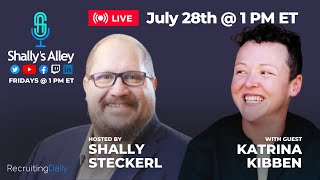
In this live interview, Shally Steckerl welcomes recruiting expert Katrina Kibben (Kat Kinnon) to discuss the pervasive bias in job postings and the limits of current de‑biasing tools. They explore how platforms like Textio score language, the outdated practice of categorising words as "boy" or "girl" terms, and why true bias runs deeper than word choice—manifesting in requirements such as years of experience, degree mandates, and overly long listings. Kibben shares historical research linking degree requirements to the civil‑rights era and the rise of experience requirements with the advent of computers. They debate the role of benefits sections, the promise and danger of generative AI in drafting postings, and the erosion of apprenticeship‑style learning. The conversation shifts to allyship, examining the difference between performative gestures and concrete actions, and how subtle signals (stickers, water‑bottle badges) can create safe spaces for marginalized people. Personal anecdotes about non‑binary identity, travel safety, and everyday micro‑aggressions illustrate systemic bias. The episode ends with a recommendation for a future guest on neurodivergent talent and a weekend thought prompt encouraging listeners to embed subtle, inclusive cues in everyday objects.
Chapters
All right, all right, welcome to Shelly's Alley. We are live. It is Friday, July 28th, the last Friday of July and heading into August. We were just talking about how hot it's been. It's an inordinately hot summer, or into the summer, or whatever. Very happy, very excited to have my very special guest on the show today, Kat Kinnon.
Thank you.
That is a specialist. Ah, you're more than welcome. Yes, I'm— I can't believe we haven't had you on here sooner. Cat is a specialist in a few areas. One of them though is they are an expert in job postings. In particular, has been digging into bias, especially bias in job advertising. So as, uh, keeping the tradition of some of the diversity conversations we've— we had on the show, I wanted to jump into kind of a lively conversation about that with some of my thoughts on it and get the expert's opinion on what's going on, particularly as it relates to some of the generative AI and things like that. So we really want to kind of talk about that. And also, if you don't mind, we'd like to talk a little bit about being an ally and allyship as well. But hopefully we have time to do that if we can. Would that be okay with you?
Of course.
Of course.
It's a little bit of my life.
Yeah.
Yeah. You know, it's interesting. I spent so much of my career just wanting to be really good and like being an expert at one thing that I didn't realize that being who I am is also helpful, right? It also creates space for other people. And so I'm more than happy to talk about both sides of that life.
Perfect. Perfect. Perfect. Yeah. Well, let's tackle the job posting thing first. So There was a long time ago when I had a corporate square job. Not that I don't have a square job now, but I think it's a little bit less square. I was working at a company that onboarded Textile for the first time. And I mean, not for the first time Textile was being used, but the company onboarded Textile and I became the like sort of power user, sysadmin, you know, Coached everybody on how to use it. Had a lot of fun kind of tweaking it and figuring out how it worked. And my biggest, I have to say, guilty pleasure was getting the score. I don't know if you know what I'm talking about, but getting the score to 99 or 100. For those of you that don't know what I'm talking about, Textio kind of scores your text of your job posting. And later on they added email capability on a score of like 0 to 100. 0 being like way super heavily biased to 100 being apparently their, their version of not biased, which you and I both know that is impossible. But anyway, I like to play with the system and get to that. And I would, I would often take recruiters' job postings who were stuck on the 70s and, um, like be like, all right, let me, let me try. And then I would like tweak it until I got it to like 80 or 90, and they would always be so impressed. And I was So proud of myself. And then they added— so this was gender bias. Then they added the email, and then they added other things like that. That was kind of just gamification of the whole thing. But I want your take on that. Like, is that really job posting debiasing? Is that even a word? Is debiasing a word? Can we debias?
I maybe, uh, I'm not sure if it's a word, but I do know that most technology— and I want to be really clear, I think very highly of Textio. I think they've done an incredible job of researching.
Me too, I had a great time with them.
Yeah, like, I mean, they're doing a, um, a series right now about bias in ChatGPT that I highly recommend, where they test asking ChatGPT to write a posting for Howard versus Harvard, and ChatGPT delivers completely different results. So highly recommend checking that out. But most of these tools are simply categorization tools. All right. So I'm not talking about Textio, but the majority of tools in this space, what they do is when they say they're gender bias decoding or de-biasing, removing bias, they take words, they sort them into boy words and girl words, and they say you use too many boy words. This is a masculine post. And I think that that methodology is a little outdated and it also leaves a lot of room for error because Because we don't necessarily have boys and girls anymore. Exactly. As a non-binary person, right, I strongly feel you're actually adding bias that we're trying to remove because we know better now.
By making it a girly post versus a boy post.
Yeah, exactly. So the thing we should really be aiming for is neutral content while knowing that databases are only categorizing the words they want to use. And this is why I say that. So I have an example that I show all the time of this job grader. JobGrader. Uh, I won't name names on the vendor, but the JobGrader, I typed in the words poop poop poop shit job description. I'm not kidding, because I wanted to see what it would give me. Shelly, it gave me a C. It said that was an average job posting, which we could debate one way or another if it's average, but all of that might be above average, right? All of that to say, I don't think we— I don't believe that removing bias from job postings is about the words we use. The bias is so much deeper than that. It's how we talk about skill and experiences that I believe is where the bias actually lives. It's the standard ways that we approach requirements that we need to rethink if you truly want to remove bias from the system.
But can you? Can you really remove bias?
I think you can.
And do you want to? Because isn't bias like a— isn't bias something that First of all, everybody, every human has bias. It's how we got here and survived. I have a bias against getting hit by a truck. I have a bias against getting eaten by large animals, right? So do we want to get rid of bias or do we just want to understand it and operate intelligently, right? Like, would it be better to say, rather than let's try to eliminate all bias, would it be better to say let's recognize the bias and do something about it?
Yeah, that's a really good question. I think you're right. It's probably not. The goal is not to just remove bias. It's to tell the truth, to tell in a way that people— what you need to know and what you need to understand in order to be successful on day one. And the traditional ways we talk about requirements are part of the problem, right? Years of experience, for example. So years of experience, very common in job postings. If there were 500 people watching this and I said, who has years of experience in their postings? Most of those hands would go up. I can almost guarantee. Right. And but years of experience, it's inherently ageist and it doesn't actually get us what we want. So when I say ageist, it means when I say I expect 20 years of experience, I expect someone older to show up. And when I say no experience, I expect someone young to show up. That's part of the bias that our brains naturally start to do.
Absolutely.
This is the other factor we don't talk about enough. If you and I had the exact same job for 5 years, you cannot guarantee that we did the exact same work every single day, even if we had the same job title, even if we work at the same company, because there is no job title distinction or systemization across industry, across jobs, across anything. There is no job title book. All job titles are made up, but we still fall back to years of experience within job titles when all of those factors are highly variable?
They absolutely are. And as someone who checks a lot of boxes, I can tell you that I've definitely seen language in job postings that is alienating in more than one way. You know, for example, the targeting, you know, the younger generations with that no experience required or something like that, it's almost like, well, do I even want to apply for this job because they're probably going to immediately think I'm overqualified, right? So I'm just— and I may not be, but that they've disqualified me based on— I've disqualified myself based on that, right?
Yep. It's psychology. It's psychological alienation. And it happens through things that are very obvious, like saying yo yo yo, we're looking for someone who can whatever, right? The like young language that made me feel very old to say that. And on the other side, it's also the alienation psychologically of women and people of color. So for example, they've seen, you know, if your job posting is too long, if you have too many bullets— there have been many companies who have replicated this study where you see fewer of those applicants. And then on the other hand, you go on their website and everyone is— has a commitment to diversity, but no one It is very rare that people are actually taking steps to change how they ask. And that's why I got so invested in job postings in the first place.
Do you know Georgine Wang from Fairy Godboss?
I know the name.
So I had a conversation, very— excuse me, very enlightening conversation with— I need some of that drink here. Pass me this. A very enlightening conversation with her about— this wasn't intentionally about bias, but it came up. And what she told me that I've, I've taken to heart, and I've used it several times in the show, is that in general, what they found in Fairy Godboss, which is a career site for women— not just a job posting site, but an actual career advocacy and everything— is that generally their respondents, women or people who identify as female, are a lot less likely to apply for a job if they don't meet all of the criteria versus men will, and people who identify as male, will apply even if they only have 70% of them. So when you have a job posting that has extra requirements that are really not requirements but nice-to-haves, you've just alienated 30% of the females that are not going to apply because they want to have, you know, a better match. So that's, that's something that doesn't even have anything to do with the words you use. Just simply the fact that you have more requirements than you need. That's one thing. And here's another thing that I wanted to ask you about. Do you think— have you thought that the benefits that are highlighted are also biased?
You know, I actually tell people not to talk about benefits when they're talking about the job because of bias.
Is that why?
Well, it's not necessarily bias. There are a few factors that I'm considering. Number one, I'm not trying to oversell you at this point, right? At this point, I want you to say, yes, I want to do that work. Yes, I can do that work. Knowing that psychologically, if, if a woman or a person of color, Black, brown person of color, opens up this posting and scrolls through it and it's very long, they're not likely to read it, and they're likely to think that they are not qualified. The other piece is that I think it's a powerful part of nurturing your relationship. And so I would rather see a recruiter sending, or even your automation, that first response that says thanks for applying. Thanks for applying. Here's an overview of our benefits package. If you're selected for interview, bring any questions about the benefits package to that conversation and create the prompt and the connection for them of why it matters. Because most people are just scanning at that point unless it's a deal breaker.
That makes a whole lot of sense. So like sort of, I want to say the, the part of the conversation, not the attraction. In other words, benefits. And this is something I've maintained long before I started even thinking about textio and bias and all that, is that unless your benefits are really extraordinary or unusual, for the most part they're just sort of table stakes, right? Like, yeah. Excellent healthcare. Listen, I, I worked at Microsoft. I think you— did you work at Microsoft?
No, I did not.
No, I worked at Microsoft, and I got to tell you, when I was there, they have the absolute best benefits I have ever seen. Zero copay on anything medical. Zero, nothing. Prescriptions, zero copay. Any doctor's visit, in or out of network, zero copay. Zero copay. That's incredible. But that's only one company. I don't know a lot of companies that have that. So, if I was Microsoft, I would say, "We have fantastic benefits." But I would actually say, "We have zero copays for health insurance." Right? That would be extraordinary. Otherwise, it's just healthcare. If it's expensive, if it's cheap, you know, it's dental, it's vision. So don't highlight it unless it's super special, which again, shouldn't have it on that job posting. But the other thing is, I also find like there are cultural differences, um, that it would, would make some benefits less or more attractive. Some cultures would value elder care more than others as a benefit. Some would value pet care more than others. So if you're highlighting our top 3 benefits are elder care, uh, life insurance, and whatever, and someone that doesn't really care about that, looks at that, goes, man, that's not only is that not exciting, that's also just not exciting for me.
Yep. I think there are two exceptions when the benefits really matter. High volume, low retention roles that are highly competitive in a small community because you can do some really interesting analysis on that group that's consistent for that group that doesn't need to scale for X, Y, and Z and all of the variables that might impact what you just said about cultural value of benefits. The other thing I would say is highly competitive roles. So for example, a doctor at a hospital, right? Like, you need to say something to be competitive in that space. But we also know that highly technical fields like medic— medicine— so hiring an orthopedic surgeon, you very rarely get your orthopedic surgeon because they applied to a job. They're getting in there because someone knows them.
They knew someone, right?
Exactly.
Yeah.
And so it's just a different value proposition altogether. But most definitely you want to include this on those high volume, low retention roles where you're filling the exact same job over and over again in a microclimate, so to speak.
Okay. So then again, another reason. All right. So benefits, definitely. I was thinking about it from the bias point of view, but definitely multiple reasons why it shouldn't be highlighted in the job posting.
Yeah.
And, you know, so try to be neutral, basically. What other biases are there in the requirements that I may not be aware of? Like, I was aware of the gender one.
Yeah.
Um, what else is there?
College degrees. College degree is a privilege, not a right, in the United States of America. And I just want to set that tone here, right? I think so. I think everyone adds these degrees without understanding what you learned during that degree program that would help you do this job? I'm sorry, but a VP of HR does not need a degree. If you have been working in an HR role for the last 15 years, I really don't care if you have a degree or not, because I know I did like radio and billboard ads in my marketing degree. Let me tell you, the last time I used that, it was a long time ago, right? I think we need to question it because college degrees, they're really interesting. I did some research. I'm going to nerd out here for just a second, but I, I did some research on job postings over history and I aligned trends in job postings with social movements. So what's happening in the world and how do job postings reflect that change? What shifts do we see decade to decade? And a really interesting shift you'll see is that around the time the civil rights movement was happening and we were creating more equal access to labor, you'll simultaneously see college degree requirements get really common. And it's because these employers knew that those people did not have access to college degrees and they were creating a 4-year gap between those people and work. And now we have copied and pasted job postings so many times from the '60s to today that we still include it even on roles where you absolutely do not need a degree.
But there are roles where you do.
100%. I want my lawyer to have a degree. I want my doctor to have a degree, right? I want— if you refer back to textbooks, my engineer, right? My brother's an engineer, absolutely needs a degree. He's a civil engineer, right? He works on the, like, water and AC systems. Very important when it's this hot. But I do not need some— a recruiter to have a degree. I do not need these roles where you learn how to do it on the job or you learn through experience. I just don't care if you've had the privilege of going to college.
Right. What about or equivalent? Does that not— does that not provide a band-aid? Or you think that the degree or equivalent is just another way of saying degree, please?
It's degree, please.
Yeah.
I think you and I have both been in those conversations with the hiring manager where all of a sudden we're down to the last 3 candidates and they go, oh, well, this one doesn't have a degree. Degree. And they use it as some kind of exception, even though this person made it all the way to the last 3 candidates for a reason.
Well, computer science, man. I mean, like, it's just, I don't know if you hang out with lots of, you know, techies, but some of the best developers, programmers out there don't have— some of them do, but some of them don't have a computer science degree. They might have a degree, but It might be in math or music or something else, or it might be in computer science, but it doesn't— it's not a prerequisite. You can learn how to write code and not necessarily have a degree because it's a different skill set. Language, it's language. It's not, you know, if you have a degree in English, it's not a degree in speaking English. It's a degree in interpreting literature and perhaps composition and these other things that are what your degree is for, but it's not a degree in being able to talk, you know, like, exactly what it is.
I mean, I'm not kidding when I say I've done thousands of intake meetings at this point with highly technical people from some of the biggest companies in the world. Okay. And not once have they ever said, I need someone who has a degree. And a lot of that is about the recruiter and it's how we ask questions. So if you go to a manager and you ask for a list, you'll always get one. What degree should they have? They'll tell you if you ask them that way, they'll make something up. Right. But if you go in and you ask, what do you know how to do? Where did you learn how to do that? What— how can they work by themselves? What tool set do they know how to use? Not once does the degree come up and they'll actually end up telling— what I found is that when we get to the end and I'll push through and say, you know, all right, you didn't mention any kind of degree. Are you okay with no degree? Often those managers will flat out tell you, actually, yeah, my best— like you just said, my best developers learned how to do this by actually doing it.
Yep. What happened to— you don't have to answer this, but I'm thinking rhetorically— what happened to, um, apprenticeships and like learning? Oh my gosh, how to do something by working with someone and getting paid. But you know, you've got that And I'm gonna use gender bias words because it's how they are used in this field, not because of my own gender bias, but, you know, journeyman and what do they call the other one? Master. Yeah, journeyman, which doesn't mean male or female. It's just the halfway stage, right? You got apprentice, you got journeyman. What happened to that? Why don't we do that?
Yep. You know, I have been thinking about that a lot because to me that's the role that AI is eliminating. It is eliminating the job where you learn how to do your job.
Okay. Because, because it can sort of like teach you. It's a, it's a good learning tool. Okay. So, okay. So are you saying the generative AI is, is finally the disintermediator of education?
It might be because what it does is, so I was, I grew up in marketing. That was kind of my first pipeline toward where I am today. And so by the age of 28, I was a VP of marketing. But every job along the way, I got to learn from someone who was great. There was no way I would have moved that rapidly through my career.
You were lucky.
Yeah. Exactly, because I was very lucky to work under people who had track records, who had actually done it, who asked hard questions, hired me.
And gave a shit enough to teach you.
Yep. And would let me just sit in their office and watch and listen. They'd be like, don't talk, listen.
Instead of hoarding information.
Exactly. And I think that I would not be able to do what I do today had someone not only showed me how to do things but taught me how to think about them. What's happening is now the role where we would hire someone to do the thing— schedule tweets, create this, manage this group— that's where technology is starting to edge in and it's the opportunity where we learn the most. And so the leader or even the young person, instead of going to the boss and saying, show me how to do this, they're asking ChatGPT how to do it. And they're not getting that access to learning where they learn why we did it that way or really that background. And that's what in the technical and the service fields as well, that's what makes that so special is that you watch another plumber for 5 years. You watch another—
you watch another plumber, you know, their toe and break their knuckle and break that tool and break that pipe and come up with a solution nobody had ever came up with before because they literally were in the moment and they MacGyvered it.
You nailed it. Exactly. We learn by watching other people fail and then failing ourselves in a way.
Yeah, yeah. So that's why I've always scratched my head at the whole apprenticeship thing because it seems like such a good idea to— I don't want to say replace an education because apprenticeship is an education, and education doesn't mean degree too. That's another thing that I've always had a problem with. I ran a business, Job Machine, which later on became the Sourcing Institute, for a very, very, very long time, since the late '90s. And whenever people said instructor or trainer, I It always made me cringe because I never felt like I was an instructor or a trainer. I always thought of myself as an educator because when I teach, I don't, especially, you know, professionally when I was getting paid to teach, I don't just sit there and dictate and say, this is how you do it. I take them on a journey of discovery. Help them discover that on them on their own, because otherwise it's just a— like, they might as well read a book. It's just a lecture.
You need to know why it matters. Same.
So experience it. Yeah, yeah.
So whenever I talk about job postings, the very first thing I do— excuse me— is I tell people the story of losing my job 3 days before I bought a house.
And ouch. Yeah, I didn't know that, right?
That was my job right before Recruiting Daily. And I, because I want people to remember that a lot, every single person on the other side of a job posting has a story. And whether it's as dramatic as mine or they are simply unhappy, no one is looking at jobs for fun. We look at Zillow for fun. We look at cars for fun. We scan Reddit feeds for fun. We do not look for jobs for fun. It is an emotional activity to open up the internet and look for a job. And I think it's a disgrace that people copy and paste someone else's job posting and share it on the internet hoping that the right person will find it, completely disregarding the emotional weight of the person on the other side of that piece of content.
It is so humiliating and dehumanizing. And just, I mean, I— applying for hundreds of jobs. There was a— there was a— there was a— I don't know if it was a meme or kind of more of like a conversation that was going on. Um, I'm not exactly sure what— it might have been Instagram or something, but an engineer was saying that applying for hundreds of jobs was their response to there being so many crappy jobs. It's, it's like they were basically saying, I can't— I don't have the time to look through your 517 duplicate job postings and figure out which one is for me, so I'm just applying for all of them. So I created a— that's what they did is they created a script and essentially hacked their way into applying. They figured out whatever Greenhouse or Workday format was, and it literally had this machine that would just fill in all the right, you know, fields.
Oh yeah, and it gets easier every single day.
And applied for, you know, 1,000 jobs a day, and then they got a job because of it. Only because it's like basically taking a giant— taking a giant stab in the dark. If you're trying to hit the bullseye from 100 yards, you can send one dart, right? Or you can send 10 billion darts and one of them will get there. So that's what this person did in response to all of these job postings that are just triplicate, duplicate, expired. So yeah, so is there, is there a future in generative AI and large language models to assist us with this? Or my, my feeling is there isn't, and, and I'll, and I'll tell you why. I think maybe you might have a different opinion. I think there isn't because we can learn from what Amazon did and what happened with Amazon, which is they created a model that looked at patterns and they took the human out of the equation because they thought the machine would be unbiased. But in fact, what happened was the machine learned the bias and made it systemic in the actual selection process. And so, the machine was being very intentionally very biased. But had no idea that it was being biased. So I think what happens with ChatGPT, or, you know, systems like that, large language models, is that if you give it enough garbage information and you ask it to write a job posting, it's going to give you the same old garbage job posting.
But it'll sound good, Shelly. It'll sound nice on your ears, like a magazine, right? I tell people this. I've had this conversation a lot, right? Is that generative AI— so the first thing you need to consider whenever you're thinking about generative AI is the dataset, and you just nailed it. The dataset's trash. How many people go on the internet and find hundreds of amazing job postings? Nobody. Nobody, right? That's why my business exists. 5 years of writing job postings because they— most are awful. So generative AI can make us generically good, meaning everybody will sound the same and it'll sound okay, but Sounding good was never the problem. We don't need things that sound good. We need things that tell the truth. And AI can't tell the truth. It can't.
It can only tell you what aggregated— it can tell you the aggregate of what it has. And you know what? The same thing with search engines too. Search engines don't give you an answer. They give you an aggregate of whatever the last most common bit of information was. Exactly. So here's another thing I was thinking about, the, the whole, you know, um, the ease of use of these tools. There are, there are, there is a place. For example, one of the things that I like to do with it is to, is to correct grammar and check spelling and things like that, because I'm providing my verse my language. I'm not saying write it or generate it. I'm saying take my words and make them grammatically correct. To me, that's where the benefit is. Or the other thing that I do is tell me about this thing that I don't know about. Tell me what is— what was the other thing I was looking at the other day was quantum computing. Tell me what quantum computing is. But whatever it tells me, I'm always going to go and do my own research. I'm just using this as a starting point. I think that the problem is that people are using the answer as the answer, and they're like, oh, that's what it is. And they're not going to verify the source or going to confirm the information. So it's not this— this is not the Discovery Channel where you're going to learn about something from the people who are the scientific experts in that. This is the This is the collated version of the Discovery Channel where you get all the dirty corners of the internet.
Yeah, you do not put those in your mouth, right? You do not put that on—
eat those.
Exactly, don't eat that. It's like a little kid, like, no, stop trusting the AI. Seriously though, I, I see all of these people and they'll come to me and say, well, why can't I use AI? And I'm like, because it's this it's a different version of bad. It's both of these aren't telling the truth. And it makes the recruiter role even more important because that consulting element. Exactly. Actually helping a manager interpret what they need and being able to create that content is— it is absolutely critical because, and you know this, you can't find what you don't know you're looking for.
Hmm.
Yeah. That busts the AI wide open.
Again, that way it doesn't know what you want. That's why we go shopping, like, you know.
Exactly. And that was most of our first experience with AI, and I think there's something to that in that we grew up in this like Netflix experience where they would serve things up to us and we could trust the recommendation. So now that we're giving— given prompt systems and we give them a prompt, we trust that they're going to give us the right recommendation.
And that's not real or true or unbiased or debiased.
Exactly. Because again, it's all the corners of the internet, and there are dirty corners. It's gross.
So what else can you tell me that is— I'm fascinated by this historical, um, what you described about the degree and the reason that was put in there. That was a— that's a historical little tidbit. That I didn't know, wasn't aware of. Are there any other historical 100-year-old bad habits in job postings besides the degree?
You know, the 100— the years of experience are another version of that, because when you read years of experience start to skyrocket, start to skyrocket in postings is actually when computers became very popular. It is really fascinating if you know, and we're working on this and we're going to release it as a white paper and kind of let everyone see this research we've been doing because I find it fascinating. And hell, if one other person does too, I think there's something to it. But being able to look at what was happening in the world truly, like computers became popular, uh, going all the way back to the New Deal and how that might be impacted when we changed to a 5-day work week. And fundamentally seeing, frankly, where my position is that corporations have more of an influence on society than government. That corporations are the first to make big changes, and that rolls up and creates pressure on government to actually create policy that impacts everyone and creates consistency in that impact. And that's been kind of my biggest learning of all of this research, is there is bias, but it— again, it's coming from these companies, and they're trying to— it is a reflection of this constant push between government and, and corporations on how they impact society and what society actually wants.
Wow, that's, uh, way deeper than I expected to go. Um, that is pretty deep. What, what did the civil rights movement do to job postings?
It made them longer.
Made them longer?
Well, you also have this variable of the internet versus no internet.
Yeah, well, yeah, okay, well, there's a classified ad which was shorter by design. Yeah. Right.
Yep. But at that point, right, it was kind of like the bathrooms. Like, you would see, like, for whites only, colored bathrooms. Job postings also fell into some of those categories because we weren't protecting people at that time. And it's— there's a lot of blurred lines because things changed on a policy level, but things didn't change on a people level. You can take that all the way back to Juneteenth, right, when all of these people were free but they weren't actually free. In fact, some of them weren't even notified of that change. And so, I mean, if you go back to that, on Juneteenth we let all these people go out into the world, but what happened to them as far as work? They didn't have jobs. There wasn't— there weren't online ads they could apply to. We let all these people be free, but we didn't give them any of the systems to actually be free in this world, which involves being able to make money for yourself.
That's one of the populations that my foundation SourcingFoundation.org helps the most. It's the, the two communities that have been best impacted by our efforts have been the blind and visually impaired, and which is one community, and returning citizens. Like, like enslaved people when they were freed, for, you know, incarcerated people when they're freed, or say it's the same situation, they're like, here you go, you're free now, bye-bye. I have nowhere to go, no jobs, no prospect of employment, severe bias. If you're Black, if you're a Black female that was imprisoned, I mean, good luck. You have like the trifecta of, you know, gender bias, race bias, and former— I mean, it's a— forget it. It's, it's the thought of, you know, them applying for a job. They must, they, they must be so discouraged to even apply.
I can't even imagine.
I can't imagine either. I have no idea.
Yeah, and I, I think depending who you read and who you think of, right, like jail is institutionalized slavery in many ways. And it just points to the fact that there are so many things, and frankly my eyes have been opened over and over again. These are things I did not know and frankly things I did not believe or really understand for most of my life. I grew up in a rural Southern, and you can imply all of the things from that family, and it took a lot to kind of rewire my brain on understanding and Even as we're seeing the courts changing as far as affirmative action and protections, it's like, no, we, we need to understand that this goes back hundreds of years. Our systems are broken, and the systems that are so broken are why AI is just showing us our bias and becoming that mirror. Because we're taking data that for hundreds of years was causing institutional bias and we're moving it at rapid fire, and that's just going to constantly hold up mirrors. And eventually we're going to be living in a house of because we're going to realize how bad it's always been and how much we've never done.
It definitely is becoming very apparent how bad it's always been, especially when you travel to other countries and compare it to the progress we have made here and the progress that hasn't been made in other countries. I mean, you know, we have— I think we have a common friend who lived in a European country where they reversed their anti-gay laws and made it recently, in modern times, made it illegal to be gay. Yeah, like they reversed it. And our friend was like, uh, yeah, F this, like, I'm leaving this country. Like, this is what— whatever, you know, like, right, kidding me, you know, it's like going backwards. Um, I'm not saying that we don't have we haven't taken a step backwards. But when you leave the country and go elsewhere and you see some of the things that have gotten worse, and then you look at— come back and say, okay, well, we didn't really do much better, did we? We sort of, we sort of painted over it.
Well, we talked a little bit about allyship at work, right? And that's one of those things, it's like, like people don't even realize that when they invite me to come speak in their country, or they invite me to come there, people don't even realize that it's a illegal for me to be there. It's not safe for a non-binary person to be there. I could be arrested. Uh, someone was arrested in Turkey recently for 3 weeks because they appeared to be gay.
Oh, it wasn't even for sure?
Yep.
It was like, we think— oh wow. Yeah, the thought police. Yeah, that's right.
I think about that. It's not just my vacations, it also deeply impacts my business. I have to think about what communities I travel to. Where I can be safe. At this point, I won't go to Florida knowing that we have given people permission to police bathrooms and to police spaces that were originally safe for me. I mean, I've traveled extensively, both through work and also because I chose to live in a van and travel the country for a year. And so I traveled to areas you would never go on a business trip, right? Areas where there is no cell service, where there's only people camping in the middle of the woods And it's— I went to so many state facilities thinking I would be safe there. And honestly, I told myself, like, these people have pensions, they're going to be nice to me.
Right.
And even that has changed in the previous weeks, let alone the last year.
Wow. So I want to— I did want to ask you about allyship. Yeah. I can't remember where I heard this, but it was, it was at a conference. I just don't remember which one. And, uh, the, the person who was presenting said you can't declare yourself an ally, you have to be appointed by others. So like, basically what they were saying is you can't say you're an ally. What's the truth or not truth on that? I want to get your opinion on it.
You know, honestly, when you said that, I just thought to myself, why are we so obsessed with being called allies instead of showing I totally get that, and that I don't think is the point that they were trying to make.
Yeah, I think the point that they were trying to make is, um, you can't just say— you can't just say that you're an ally and makes you an ally. So I have a non-binary child, and, uh, we've had this conversation several times. It becomes more and more prominent as she gets older, um, about, uh Gay Pride and, and, and, you know, business putting out the rainbow flag during that month, right? And it's also now during Black History Month. And she's, she's always come to me and said, I don't get it. It's like they're basically using, using it as a way to get business. Like, it has nothing to do with it. So they support the gays when it's the gay month, but they don't support— like, what do they not support? It's a very compelling argument that a young mind brought to my attention. And then I saw this person in this conference saying that you can't declare yourself— declare yourself, that's what it was— you can't declare yourself an ally. And I'm thinking, you know, nobody knows what you know. Nobody can see the world the way you see it. If I didn't say that I had a non-binary child, people would have absolutely no idea whether or not I'm even receptive to that. The fact that I'm raising a non-binary child doesn't make me an ally, The fact that I'm raising a non-binary child does make me at least aware. And there's a huge difference between, you know, and the reason I'm saying this is because she has friends whose parents have abandoned them and kicked them out because they were non-binary or identified different gender than they were born. So I know that at least she doesn't have to be worried about that. That doesn't necessarily make me an ally. but it does make me not an ignorant jerk.
Yeah.
So where's— what's the— that's the, that's the question that I have, is at what point, at what point are you allowed to identify that you can at the very least relate? You know what I mean?
I, I think—
or that you're aware, like, I am aware. I don't know what it's like to be trans, but I have a child that is trans, and I can, you know, at least I know that there's things I don't know. I I know that I don't know.
And I think you just, uh, gave a perfect example of the concept. And so to me, allyship, the way I define it with others, is it's what you do when things are hard.
Okay.
And I like— when companies come to me and they're like, I want to add this rainbow, I want to do whatever, is that— is that allyship? I say no. You show, you don't tell. The poster is telling. It's marketing. It's a, it's a marketing concept fundamentally. Showing is what do you do when there's a trans employee at your organization? What do you do for the family whose child is transitioning and the state that they live in does not protect that child? What are you gonna do for that?
I'm gonna have to go ahead and ask you to wear male clothes when you come to the office, please.
Exactly, exactly. And then hosting a trans author for Pride Month, right? That is just so contrary. And those issues, the contrast will always come to light.
So it's the label, it's the self-labeling that is repulsive or opposed to, but there is a genuine way to, to let people know that you are informed. So what is that? So what is that?
The fact that you were willing to talk about your kid. Right, that is allowing space.
That's right.
You know, you don't have to say I accept it or I'm cool with it because you wouldn't bring up your kid if you did. You showed me instead of telling me.
Got it.
And I'll tell everyone on this call, like, Shelly never mentioned this to me prior to right this minute. And again, that's a show versus a tell, because if we had gotten on and the first thing you said to me is, oh, my kids, I've been waiting to have you on the show, my kids are binary, I'd be like, that's a tell. Yeah, that's, that's a— there's something I don't understand. There's something I'm not uncomfortable with, and I need you to help me. To me, like, that's the flag I hear when we start there instead of ending. And I think that's the, the, the space where most people feel very uncomfortable, is they feel like they gotta show you. They gotta wear the rainbow shirt.
They gotta put the sticker in the car. And then, and then that's what's disingenuine.
Yeah.
And that's what, that's what Sam—
performative.
Yeah, that's what Sam identified with. I had a conversation recently. We had to take in one of Sam's friends who was abandoned by their, by their family. And so they're now living with us. And I had this conversation with Sam about, you know, doing the right thing and not— like you said, it's courage, right? It's doing the right thing and not being afraid of the consequences, even if everybody has to pay the price a little bit. Like, it's going to come out of all of our pockets. To be able to take care of yet another mouth to feed because some jerk didn't want to do it, right? Like with their own kid, right? So that's like, and that's very different than going to a rally or going or whatever, right? So that's kind of what I was trying to get at is where is it okay to tell people that it's safe to talk about that with me?
Yeah.
Right. Because they wouldn't know, they would have no idea. I don't want to go around talking about it. I certainly don't want to embarrass my daughter by bringing it up everywhere I go, right? You know, she— not that it's embarrassing to her, but she doesn't want me to talk about her no matter what her choices are, you know what I mean? Like, yeah, teens, right? They don't want me to talk about it.
So, you know, how do I probably get something wrong? Come on, you don't know everything.
Yeah, okay, I got that 50 seconds after she was born. I got something wrong.
So, right, you know, and I think that's such a beautiful thing as a kid whose family is not part of their life anymore. The majority of my family is not. I have to tell you that that's so special. And I think for me, when I am able to step up, I just think of it as this incredible opportunity to do something great, knowing that the story will be told by the people it impacts.
Yeah, it's the right thing to do. And it doesn't matter, you know, it doesn't matter right now. I don't have to tell anybody about it. It just irks me when people make all these assumptions, right? Um, 'Oh, you're white. So, you know, you have white privilege.' Do you really know that for sure? I mean, I face a lot of ageism. I face a lot of— I don't even know what to call it, but a lot of discrimination against people that are overweight. A lot of it. I remember a job when I was at Google and I would walk around the cafeteria. I used to have a particularly colored badge. The badge identified where I was, what I did. And because of the color of the badge, I thought people were staring at me because they're like, oh, what's this person doing with that color badge in the cafeteria? But one day I wasn't wearing my badge and I was walking around the cafeteria with another friend, Kevin, who is equally, uh, uh, plus-sized. Um, and I was like, dude, why is everybody staring at us? And he knew right away. He's like, can't you tell? We're the only two fat guys here. Everybody else is 22, 23, and skinny. And I was like, oh, yeah, are you kidding me? He's like, yeah, absolutely. And ever since that time, so I faced that. I faced a lot of anti-Jewish hatred. So don't tell me just because of the color of my skin that I don't have what it takes, right? But I don't need to wear it to say that.
I mean, I think we all have privilege and we all, I think the more that we can accept that and say like, I do walk with some privileges in this world, even if it doesn't make me safe all the time. Absolutely. It allows space. I would tell you one of the most shocking events of my life was when I went— I've been— I like have gone through a bit of a transition process, so like my body has changed. And I, during my van travel, where, right, a little bit of that, a little bit of like hormones, right? And my transition, because as a non-binary person I take very low dose those hormones over time because it makes me feel better. It's gotten me off of my depression, anxiety medicine. Like, it literally has altered my mental state to better balance my hormones for my life. And one of the things I recognized— I, one day I was in a, um, like a store, and people were being very, very nice to me, and I realized it's because they thought I was a white man.
Not because you were white, but because you were a man.
Someone was holding the door. A person stepped out of their way for me. And they were like, oh, thanks, sir, I really appreciate it. And it clicked in that exact moment. I was like, they're being nice to me because I think I'm a white guy. And the tell— you ready for this? The tell was when I apologized and someone instantly realized I was a woman, that I was born a woman. Okay, it's because I apologized, and women apologize.
And then they were like, oh, never mind, we're not gonna help you anymore. Oh my God, that's a—
you know, I just realized it is so subtle.
It's very subtle. Yeah, I just realized that it reminds me of a funny story. So when I was visiting New York, I went to the NYPD gift shop and I bought— I'm a big fan of a lot of these NYPD type shows and everything. So it was just a t-shirt that has the NYPD thing on it and everything. And I was wearing it in Atlanta. Of course, in New York, people see that all the time and they know it's a t-shirt. But I was wearing it in Atlanta and I didn't realize I was wearing it. And I was walking around and people were like, Good morning, sir. Good afternoon, sir. And I'm like, why is everybody sirring me? I mean, never. Like, people never— like, how are you doing today, sir? And I'm like, what is going on? And later on, I got home and I realized, I'm like, oh, could it possibly be that it was— yeah, it was because I had a police logo on. It was totally like a fan shirt, you know. It might have been a concert tee for that matter. But it totally— I mean, if we treat people that differently just because of a badge, on their shirt that's made out of cotton. Um, the other things that you can't take off are, you know, a lot harder to identify.
Yeah, exactly.
So that was my question, is how do I make it a safe place for people who may be struggling with that to talk to me about it?
And, you know, for me, it's subtle cues. I, I put a sticker on my, uh, water bottle that says 'Protect trans kids.' I have a little— right, I I'll even wear, like, people get— I wear Catholic medals, right? I also wear my rainbow t-shirt when I'm in the airport. Like, I, I like to do the little things because the kid who needs it will always notice.
They'll notice. And everybody, all the bigots, will probably not even know what that's— yeah, that's really— that's what I needed. That's the answer that I needed.
Subtle cues.
You gave me— yeah, I don't want to put the, the rainbow flag 6 feet wide on top of my car and be another, you know, marketing gimmick. I want that. I want the I want the secret handshake that tells people that it's safe.
Yep.
To bring that up.
It might be as simple as a little button on your backpack.
Cool. That's really cool. Appreciate it. Of course.
Happy to help.
Man, I have kept you for definitely more than our allotted time. And I wanted to say really thank you so much for being here. But before I let you go, I have 2 questions that I need to ask. You still only ask 1, but now I have 2.
All right.
The first one of that, of those questions is, Who should be our next guest?
Who should be your next guest? I'm going to say, I'm going to butcher her last name, but Christina Morici, M-O-R-I-C-I. And she has been doing some just like understanding of neurodivergent talent. And it's something that I've been thinking about a lot too, as more people recognize that they're on the autism spectrum and we're just getting a lot more education around it. I've been thinking about job postings from that lens, and she's somebody that I've been going out of my way to listen to and talk to about that.
Well, reach out. It doesn't necessarily mean they're going to accept, but, you know, I always like to have a recommendation. So I definitely will reach out. And then the last question everybody on the show gets is, what would you want the audience to think deeply about over the weekend? This could be related to what we talked about, but I just want you to Give them some chewable words to ponder, consider, deep thoughts to think about over the weekend, like until, you know, for next week.
You know, I'm gonna go with our last topic because I think this is special. It's the subtle cues that say a lot without saying anything at all. Look around your home, look around your backpack, your water bottle, your laptop. Look for little ways that you can show other people they can belong with you. And it doesn't just have be gay stuff. It can be anything that you're really passionate about, but create access to you through those little education points and allow them to see you. Because I think there's something really powerful that happens in this world when people let others see them.
See them. Yeah, don't hide. So don't hide, but you don't need to be obvious about it, basically. Yeah, yeah. There's no need to be— to label. Just subtle. I love that. Access. That's a really good word. Yeah, for this.
Yeah, we don't allow other people to experience us very often. I'm thinking, not to extend our call, but you know, the name— one of my neighbors loves butterflies, and I don't know anything about butterflies, but every single time I see her, she tells me a little something. And I don't think we share what we learn often enough with each other. And I think that's, that's actually the theme of this entire conversation, is that too often we hide information or we don't allow other people to get intel they need. And when we don't do that, it only perpetuates the bias and the belief that everyone hates you in this world, and that's just not real.
Or yeah, everybody could, you know.
Yep.
Well, thank you so much for being on the show. Hope to see you out there on the road sometime soon again.
I would love that.
All right, take care. Bye everybody, see you next Friday, and be kind to each other. Take care, bye-bye.
More from Shally



Scaling Talent at Hypergrowth: Leadership, AI, and Hiring Excellence with Cindy Nicola







