Maaria Tiensivu Live on Shally's Alley
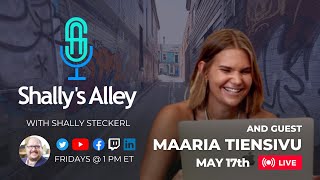
In this live interview, host VITAL‑BARITONE talks with coach and researcher Maaria Tiensivu about her approach to personal development through tiny, self‑run experiments. They contrast traditional training (task‑specific, repeatable) with education (adaptable, problem‑solving) and explain how Maaria co‑creates ultra‑small behavioral changes—like a three‑minute silence in meetings—that can ripple through a person’s work and personal life. The conversation then shifts to how generative AI, especially fine‑tuned large language models, can automate the discovery of challenges, generate experiment prompts, and iterate quickly, reducing manual analysis while still requiring human oversight. Maaria shares a practical prompting framework for non‑technical users: state the problem, give contextual scenario, ask for the first step, request a breakdown, and iterate. They discuss the limits of AI versus human coaches, emphasizing the human ability to sense tone, energy, and subtle cues that AI currently cannot. A case study of the silence experiment illustrates the method’s impact. Maaria explains her nickname “human gardener” as a metaphor for nurturing growth. The episode ends with a challenge to the audience: identify one postponed goal, design the tiniest experiment, and test it over a week.
Chapters
Hey everybody, it is Shelly's Alley time. You are live in the alley Friday, May 17th, and, uh, wow, I can't believe it's already spring. It's flowers everywhere, uh, allergy season. Yeah, fun times, fun times. Well, at least allergy season for us up here in, in, in the northern hemisphere. Um, so today we have a very different kind of conversation I was introduced to Maria by one of my former, or not former, but one of my past guests, John Kelly, who is kind of one of my data analyst gurus. And he said, you know who would be really good on the show? And then he told me about Maria Tsiantsivou. Did I say that right? Yeah, yeah. And I'm like, so what's so interesting? About that and he said, well, she's doing experiments with people. And I'm like, what? Experiments with people? That doesn't sound like a good thing. I think in the past when we've done that mad scientist kind of stuff, we end up with like Frankenstein or whatever. But no, so Maria specializes in conducting experiments with human and AI interaction. Did I get that right?
Yeah.
So pinpoint.
Yeah.
Yeah.
Just to clarify, the people experiment themselves. I don't experiment on them. So on the people, right?
You create the experiments for them to exactly execute, to personalize their experiments so that they can find the best, the best way to handle the, the, whatever the challenge is.
Exactly. Exactly. So it's people experimenting with their own life, with their own work. Whatever it is that they want to work on. And yeah, there's always— you can always run the experiment or you can choose not to. But yeah, it's always co-created, personalized, never something that comes from the outside. That's why it works as well, because you commit to it because you created it.
Yeah, you created it. Yeah. I mean, I created it.
Yeah.
Yeah. So instead of like this came about as a revolution or as an answer to training, because training, that is, this is something that I've been doing most of my life, majority of my life. And oftentimes people ask me what the difference is between training and education. And I like to explain it as training is teaching somebody how to do something, and then they know how to do that thing. But that doesn't necessarily mean that they can apply it anywhere else. So in, you know, fast food restaurants, they train people on how to operate the grill, but now all they know how to do is operate that grill at that restaurant. If they go to another restaurant, it's a different grill. They have to get training on that grill. So training is, you know, monkey see, monkey do, right? Like, I'll show you how to do it. Great, now you do it. Versus education is preparing people for the unknown and giving them the tools to be able to solve their own challenges. So it sounds to me like what you're doing is education, but it's more like figuring out how to self-educate.
Yeah, yeah, that's actually a really interesting definition that you have there. Yeah, it's definitely education in the sense that you describe it. So It has like two parts to it, right? So first we understand, we understand like what is the challenge? What is the blocker? What have you tried? Why hasn't it worked?
Understanding always comes before learning.
Exactly. But then quite often in kind of like traditional ways of approaching learning or education, you then just kind of stop there and then you're like, okay, you go and do based on what you learned. But you don't actually have any practical ways to apply it or implement it.
That's kind of the difference between training and education.
Yeah, exactly. And then with the experiments, we actually take the understanding and we craft it into an experiment where you literally— we pick the smallest part of that problem or the challenge that you have, and we start with one thing, always one thing at a time that you change in your daily life. Usually it's never something added on top. It's just something that you would do anyway, which is shift it slightly. So you start doing something slightly different and then you start to learn how does that impact you? Does it work better? It's just like playing with the, with what you're doing already. And that's what, that's why it's so impactful because it's teeny tiny things. It's nothing big, nothing you can't do.
Yeah. Yeah. That makes a lot of sense. I mean, you know, companies hire me all the time to, when they contact me, they're like, hey, we need to train our team. And they think it's training. And I'm like, well, okay, I don't know, I'm not gonna, I'm not gonna convince you otherwise. But I know that if I, if I come in and give them a bunch of more shit to do, they just have more shit to do. And they're just gonna do less because, you know, you're just giving them stuff to do. So what I like to do is, as you said, Think of it as how can we reduce the workload so that you have the capability of adding, you know, other skills. Otherwise, just adding more skills just means you are doing it. So you've gotta make things more efficient. And it sounds like that's what you are doing, but in an iterative scientific kind of, let's take that task. And the little bite-sized pieces, that makes sense too because I like to say, It's like performing surgery. If you're going to perform surgery, you want to replace one organ. You don't want to replace every organ. I mean, you just can't do that. You know, the body would not be able to. So you got to do it one little piece at a time.
Yeah.
And that's how it builds up on itself. But I like, I like this analogy because to me, I think understanding is the first step. It doesn't matter how you, whether you're visual, tactile, auditory, doesn't matter how you learn. The first step of that is after you've absorbed the information is to understand it. Then the next step is to put it into practice. And in my opinion, the next step after that is to teach it. So if you understand something and you're able to do it, great. But if you're also able to teach someone else how to do it, here's the tricky part. After you understand and you are able to do it and you teach it, then you understand again. And this time you understand even better. So for me, teaching is not the ultimate. Teaching is the next evolution before you get to that next level of understanding and it's a continuous cycle. So you teach and you understand from your own teaching, you learn more and then you understand more. So you teach more, so you understand more, so you teach more. And that cycle, that's why I think it's always important to, at least in development, to have a mentor that can help you with that teaching and learning and teaching and learning. And then eventually you become the mentor, not because of like some altruistic, oh, let's give back to the world, That's great and that feels good, but also because as you teach, you learn.
Yeah, 100%.
So is this somehow related to that? And tell me, how does AI come into that?
Yeah, no, 100%. And I think it's actually very similar except instead of, or replacing the teaching part with experiencing it. So if we use the analogy with the body parts, if you take out an organ, you put another one in. The whole body adapts, the whole body changes, like everything around it. So you need to actually, when you run an experiment, you have no idea when you're planning it usually what it's going to impact. It usually impacts everything around it. So this is—
you don't know what it— right, okay.
You never know why it impacts. Um, and I noticed this a lot with, because we, we work with AI, we're kind of like moving into that direction as well, but we work with clients also kind of face-to-face, more traditional coaching as well. And you notice it so well with these coaching clients because they, they change one thing, they think it's gonna impact that thing, and then they get feedback from around them and people are saying, oh, you changed, but you changed in these ways, like, what did you do? And the person is usually rather confused because they thought that they were experimenting on a specific thing and it would only impact that one thing. Uh, but it actually impacts everything. And that's why it's so important to have that iterative process and really give the time to experience and live the experiment and then see, hey, what did it actually impact? Because it usually impacts so much more than just the one thing that you thought it would, because everything's interconnected, right? Um, that's why it's sometimes a bit hard to say, is it like professional development or Personal development because I mean, we're human. We don't have a skill set. Yeah.
If I get better at it, but you know what that describes that I think you hit on something there that describes professional because if it's blue collar, not a profession, I know I'm going to get a lot of criticism for this. But the difference between white collar and blue collar, horrible ways to define that. But like the office worker, the knowledge worker, the profession, which is the career, versus the blue-collar worker, which could potentially be doing a bunch of different jobs. You could be doing construction one day, driving the next, whatever. That's the difference. If you're a professional construction worker, then what you learn personally, you also apply professionally. But if you're just not— if you're not a professional, then you're just doing that job. It's not a skill you're going to carry with you. Right? Like, think about, uh, what some of the older skills are, like masonry. You don't see a lot of masons anymore. It's still very important, but there are just not that many masons around. It's actually really hard to find somebody who's a true— not a bricklayer, but an actual mason, right? An architect-level mason. It's a very difficult skill. That's a profession Putting bricks on cement, that's an activity, right? So I think what you're saying is that when you're a professional, personal and professional development are the same because you're improving your, your, your, not your skill set. See, that's tricky, right? It's like you're improving your understanding of how to do things.
Yeah. And it's the being like you, it always impacts your being. That's, that's what I've noticed. It's like, even if you have a super concrete— let me give an example of an experiment someone ran. So they had some challenges with communication in one-on-ones. They were quite kind of confrontational. They had a lot of conflict. So the experiment they ran for a week was they just needed to stay quiet for 3 minutes at the beginning. Literally, just don't speak. Just say, hey, I'm going to time 3 minutes, talk about whatever you like, then we're going to discuss it. He called me 2 days after and said, Maria, I've never had meetings without conflict. This is the first time. Super skilled person, but it impacted his being. He actually started to shift the way he appeared and showed up at his work. And it was literally 3 minutes of staying silent.
It was just the one thing was shut up for 3 minutes.
Yeah, that was literally the experiment and it impacted everything, everything around it. Their relationships got better. He felt more calm because he wasn't in conflict all the time. So it's the impacts can be surprising sometimes.
So now does he shut up for 6 minutes or still 3 minutes? Yeah.
It's like increase, increase, increase.
Just stay quiet the entire conversation. Say nothing. There's no conflict if you say nothing, right? He's so shy and quiet. We don't know why. Yeah. What's wrong? Are you okay?
Yeah, exactly. But you never know. You never know what happens. That's the beauty of the experiments. You never know what it changes and you learn about yourself. You learn because it's always an interaction. So with your example of, for example, a construction worker, there are ways that you can— it is the being, it is the person, and it is the way you show up at work. It's the energy that you bring. It's everything. And also like what you work on, let's say, because all of my principles come from design, right? And design is a very kind of hand— it's based on making. We learn by making in design, which is also why, why experiments. Um, so the more you start actually making things, uh, creating things, whether it's painting or building or whatever it is, it has crazy impacts on, on your kind of intellectual side as well that you can't necessarily necessarily, um, know beforehand, right?
Because even if you understand, like, okay, I understand that I am a conflicting personality, I understand that all my conversations end up in some kind of conflict, but understanding it doesn't necessarily give you a course of action.
No, exactly. And we started when he got his, um, uh, performance review. That said, you are, you have a lot of conflict, uh, conflicts and confrontation. You need to change it. Take a course. That was the, that was the, the guide. And he was like, I don't know what to do with this. I gave him a concrete tool and he changed it. Literally took 2 days for him to change it.
So how does AI help here?
Yeah.
And I'm assuming that by AI we're talking about generative AI because there's really not independent artificial thinking machines. But something like a large language model, machine learning kind of GenAI, how does it contribute to this?
Yeah, so that's something that we've been kind of shifting towards. When we started, it was more kind of traditional. We have a survey, we analyze it, we create experiments, kind of like more standard traditional way of approaching it. But now that we've been shifting over to AI, we can actually, we're training the AI to understand and pinpoint the main problems that the person has and generate the experiments directly, which gives the person a way to kind of tweak them as they go along. So it makes it way faster, it makes the person more involved. It's less like you tell me, I give you— it's less me giving you the experiments. With the coaching clients, we can still have that conversation, we can go deeper in those sessions because we don't have to use that time in the understanding and the experiment creation part. We can just like tweak them and make sure that they're doing them optimally. So it just really removes a lot of that manual analysis and that side from the, from the equation. There are obviously limitations still. The experiments that AI creates are not as innovative perhaps as the ones that our team creates. Yes.
Well, yeah, that stands for a reason because it's based on, it's using, um, you know, what it, the data that it already has. So it's, it, it is a creative tool because it creates something new from the existing data.
Exactly.
But still it's from existing data. It's not actually brand, brand new that's never been done before. Yeah. So is there, do you have like, um, I don't know, like a, a prompt framework or something for experimentation that you apply? Okay.
Yeah, so basically we're training and fine-tuning AIs to tackle specific ways of approaching things. So yeah, there are ones for more like kind of self-leadership, like work-related things. There's one that I really love, which is about creating balance. So we've trained it to create both challenging and activating experiments and then balancing and grounding ones so that you have this kind of like natural flow between going outside your comfort zone and then doing something to integrate in between. So you're not just pushing, doing, doing, doing. So kind of like to create that natural flow where you actually also recover. Because when you are changing things in your life, I mean, it takes energy, right? And it's hard. It should be hard. But you do need to recover from those as well and make sure that you integrate and evaluate Did it work? Do I want to keep doing it? Um, and that's one of the things I love about the experiments is that you have something for a week. You can do anything for a week, pretty much. That's what I, what I can say based on my experience. Almost anything you can do for a week because you know it's going to end and you're not going to have to do it.
Right. No matter what, whether it worked or it didn't, this is going to be over soon.
Exactly. So you can shut up for a week. After that week, you can go back to talking. But it gives you the real experience of that thing because you don't have that fear of, oh my God, I'm going to have to do this forever. What if it destroys my life? No, you just do it for a week and see.
And it either works or it doesn't work. And then if it doesn't work, you try a different thing.
Exactly. Exactly.
How often does it not work?
I would say that you always learn something. You learn something, but it may not be a solution to the challenge that you Not necessarily, but sometimes usually it gives you something, some kind of insight, like, oh, I thought it was this, but it's actually not this.
So maybe your challenge is a different challenge than you originally thought.
Exactly. So you just keep going deeper.
Maybe you're not a conflicting person. Maybe you just talk too much.
Exactly. You never know what you're going to learn.
Maybe you're just a terrible listener.
Yeah. It really depends. Like you never know before you start. That's the thing, but you always go deeper. You always learn something.
And then you go back to the AI and continue the experiment.
Yeah. Then you can always create new ones. You always create new ones. You always keep going deeper. That's the beauty of it. Because you can reflect back how the previous ones went. Then you go back and you get new ones. And you could have like something completely different that next month. You could have like, okay, this month I really needed to focus on this. Specific thing. My communication was not great. Now it's okay. Now I am really struggling with, I don't know, time management, or I'm not sleeping well.
Like, what are they on their own after that, or do they continue to work with you to do that?
We have two paths. So you can do it with the AI, solely with the AI, if you want. That works for some people. Me personally, for example, I need a person. I need a human. I need accountability. I'm not very good with just working with machines. But yeah, so it depends on the person. If you want to have a person, a coach, that's one option, but you can also just do it with the AI. For some people it works better because they don't need that.
I suppose it depends on, like, for example, you might not need a coach or a personal trainer to motivate you and be accountable for going to the gym, but you might for this other thing, or you might need a personal trainer or else you don't go to the gym, but for this other thing you may not need. So yeah, we do have different drives for different aspects of our life. So how do I— well, I have one other question. Folks that don't know you, they probably don't realize with your unusual name where you're from. You're originally from Suomi, or the end of the world, Finland.
The end of the world.
Yes. And so that's your natural, original first language. But you currently live in Mexico, and you also told me that you lived in Colombia, which is where I'm from.
Ah, amazing.
So did you use this to learn Spanish?
I have not yet. It's one of the things. It's one of my experiments, though. It's actually one of my experiments for the next month is to experiment on learning Spanish or using AI to learn Spanish. To learn Spanish, actually. But yeah, there are some tools, actually, AI tools. That help you learn Spanish, you know, like vocabulary, grammar, etc. I haven't used it yet for like language learning per se, but yeah, you could definitely do that. And the beauty of it is that you can use it for so much more than just the kind of traditional just learning words or grammar. You can pinpoint like, what is it that I actually want to learn? What do I need to learn? What is the use I actually need to get into because language learning can be quite, you know, like it's always the same kind of.
No, I understand what you're saying, but it's not actually. One of the things that I learned when I was in the Peace Corps was how to teach language. And I think a lot of language learning is approached the wrong way because it's approached pedagogically, which works for children, but it doesn't work for adults. Adults, I think this idea of experimentation with AI is a very adult way of learning because adults like to experiment and jump around. Very few adults are going to read the book from chapter 1 to chapter 10 in order and, you know, follow all the— we like to kind of jump around, go back, go forward, you know. So, and we all have different styles of, you know, learning or different combinations of auditory and visual, visual and, and, you know, I had a friend Well, I have a friend, he's one of my best friends, who is an olfactory learner, believe it or not, which is very unusual. You know, a lot of people go, oh yeah, yeah, I see what you mean, or I hear what you're saying. So they're visual or they're auditory. He's like, no, I smell it. It's very unusual. So we all have a different way of learning, and this allows us to kind of— can you eventually train the AI to know how you learn?
Yeah, for sure. And it's also what I would add is we all have different motivations to learn a language, for example. So someone might want to travel.
I want to communicate with my new boyfriend.
Exactly.
I want to do business.
Exactly. So those are things that are not often— I mean, there are good apps out there that kind of at least aim to take that into it. But I think it's like you just need to find the driver. You need to find a way to motivate. I am terribly— yeah, if I'm not interested in something and I don't see the point, I just don't do it. So I need to find the time.
Yeah, I love it when they're like, donde está la biblioteca? I'm like, when was the last time you actually went to a biblioteca? Come on, seriously, why are you asking for the biblioteca if you're never even— most people you ask, they're going to be like, la what? The biblioteca? '¿Dónde está la cantina?' would be much better.
Yeah.
At least for me anyway.
Yeah. Yeah. But it's amazing. There are so many applications. There are so many ways that we can use and train AI to help us with all kinds of things, to be honest. And that's— Yeah.
Now, one of the things I wanted to ask you about is how you said that we could talk about how to make the most out of human versus AI.
Yeah.
So like, that's, that's an interesting thing for me. I'm experimenting a lot. For example, on my, um, on my browser, I have a window with 4 panels, and on each panel I have one of the models. You'll have Gemini, Copilot, ChatGPT, and Claude. And, um, I'm constantly like, I will ask the same question of all 4 and analyze how they answer them. And they're, and they're changing. Like the new ChatGPT-4 that just came out, for example. So I'm constantly kind of experimenting with the AIs to figure out which ones do what things better. But is there— am I just— this seems kind of random is what I'm saying. I'm just kind of throwing it at all four and seeing which one does better. Is there a better way for me to interact with the AIs to get more out of it?
Yeah, I mean, there are— if you're a dev, there are ways for you to actually build apps that connect to the most relevant AI for that specific question. So there are ways to do that.
Um, but that's a user of the AI.
Yes.
How do I get more out of, rather than just shooting my question at all 4 of them to see which one has a better answer, how do I get more out of working with the AIs?
Yeah, that's a good question. So I think like, unless you really want to go into prompting and, you know, really go deep into that. Uh, there are so many good AI apps that are specifically targeted for a certain thing. So if you know what you want to achieve, I would just go to the, to someone who actually did the training part. They probably chose the right one. They probably trained the AI in a way that it's going to be actually helping you with.
Okay. So you're saying if I want to improve my cooking, go to a cooking-specific AI.
I would probably do that just because they've already kind of like— because the way that we train the AI, for example, is you don't need to ask questions. You just answer the questions. We did the thinking for you. So you just answer and you get it. You don't need to think about, okay, what is the question I should be asking myself?
Which is really hard to do, actually.
It is really hard.
Thinking of the question to ask is— and for me, I have very specific questions. That I want the AI to do, and I'm using all 4 because I am writing a book on, right? So, and I do teach a class on that, so I need to know day to day how these are changing. But I do have a question. I don't go to these to figure out what I want to ask. However, a lot of people that come to me, for example, I had someone that after taking my course came back and said, You know how in the class you said you can ask the AI to do research on top companies in the Boston area for oncology biopharmaceuticals? And I'm like, yeah. He's like, well, I asked the AI that question and it only gave me 10. I know there's more than 10. And I'm like, well, did you tell the AI that you needed more than 10 or that you wanted to know how many there were? And I was like, you know, think of it like, a recipe. If you want to make an apple pie and I want to teach you how to make an apple pie, I'm not going to say, okay, take some apples and put them in a pie because that's not specific enough. I need to specifically say, take 4 cups of sliced apples and put them, right? Like, so with the AI, you don't just say, I want some apple pie because it doesn't know what you mean by that. Do you want to make it? Do you want to buy it? Do you want to sell it? You know, So I want to make apple pie. How do I make apple pie? And then, you know, what are the steps to make apple pie? How many apples do I need? What kind of apples do I need? Do I slice them? Do I cut them? Do I grind them? Do I puree them? Like, that's— but people just say, how do I make apple pie? And then the AI is going to give you the generic, you know, main recipe, which is probably not what you want. Do you want it with a lid? You want it without? Do you want canned apple? Do you want, you know? And so asking the question, I think ideating the asking of the question is actually difficult for people.
It is. It is. And I think coming up with the question, it is. And that's, that's also why coaching is so powerful because we don't usually know what to ask ourselves. What are the questions that we need to answer? So that's having good questions. The right questions is a, is a skill.
So part of what your, your trained AI does is asking questions.
Exactly. That's the part that we're asking, kind of guiding you.
So it's a virtual coach.
Exactly.
So what would the end experiment or the virtual coach with the end result being to create a specific experiment for?
Okay, exactly. So it's the questions mostly that we do the training. And it's really interesting because the more you approach AI like a person, the better it behaves. It's the same, like you can't just tell a person like, hey, like how do I make apple pie? And then, I mean, they're going to just say something.
Yeah, I know I bake it, but like, yeah, yeah. How do I bake it? Well, you bake it in an oven.
Yeah.
You know what I mean? No, I don't know what you mean. Do you want me to give you a recipe? Do you want me to do it for you? So it's almost like you're talking to a child.
It's like talking to a person. It's like a young person. Yeah, yeah, yeah, for sure. And it is beautiful in that way because it is very similar to when you're training an AI. It's like training a person. It's super similar. You notice when it doesn't work, it's because my guidance was wrong or my guidance was not accurate enough. I didn't specify it enough. It's really not that different from training, let's say, an intern. It's actually very, very, very similar.
So now I can say when I don't work, it's because of you. Yeah, you walked into that one. Sorry.
Yeah.
So, okay, so give me some concrete for, you know, the purposes of like, I want to not just go to ChatGPT and bumble around. Give me a little bit of a framework to do just a very basic interaction with ChatGPT that doesn't require me having a programming degree or advanced degree. Like, just what is How do I start? How do I get an experiment started with AI so that I actually get something out of it?
Yeah, um, so let me see. Uh, we've created it so that you don't need to think about that, but if you want to go and use it, people can come and visit your— Yeah, exactly.
But if you just want to go to ChatGPT, get an answer, right?
Yeah, exactly. So the first thing I would do is probably I would I would just say what my challenge is and I would ask it to tell me how to get an answer to it.
So it's like instead of saying, instead of asking a question to solve the challenge, the first thing is like, I have this problem, can you help me?
Yeah. How would you, how should I approach this problem?
Got it. And then the AI can start guiding. Okay. So that's a good, that's a good first step. I like that. So the first step is just, State your problem.
Yeah. And how would you start solving it? What are the steps that I should take? And then you can see, yeah, because then you can also see what the process that the AI has is, right? And then if you don't agree, you can change it. Or if it misunderstands, you can correct it. So one of the things with AI is like, it's good to ask it to kind of explain how and why it's doing what it's doing. So that you understand where it's coming from. Right, gotcha.
All right, so you go to like, uh, I don't know, uh, ChatGPT, and you say, I need to increase sales. Yeah. And then it comes back and goes, okay, well, sales is complex. Um, you need, you know, customer segmentation and you need personas and you need sales training and digital media. And then you're like, oh my God, that's way too much. That's not what I meant, right? So then you can kind of take a step back and say, yeah, well, how do I get started?
Yeah, what's the first thing I should do? This is my situation, this is what I'm good at.
Um, yeah, just because you might, it might be overwhelmed by the way, like, how do I increase sales? Gives you a 10-page sales plan.
Yeah.
And then you're like, wait, no, that's not what I meant.
Exactly.
Okay. So you can say, okay, break it down, or what's the first step, or, um, I don't understand all that, you know, make it simple, or something like that.
Yeah. And I think one thing that I would always do is kind of describe yourself, like, hey, I'm actually really into LinkedIn, it's a natural platform for me, so is— what is the best way for me to 'potentially use LinkedIn for sales,' or 'I really don't like LinkedIn, so please don't suggest it.' Okay, yeah, so I need to increase sales.
I'm in the digital space and I don't want to use LinkedIn. Now it's okay. Yeah, so you're giving it the problem, but you're also giving it the problem with like some sort of a scenario.
Exactly. Scenarios are good.
Scenarios are more than just the problem. It's the problem in context.
Exactly. Because the more you give it, the more it understands you, and the more you understand where it's coming from. I mean, again, it's the same as with a person.
Yeah. Imagine if you went to ChatGPT and said, I'm hungry.
Yeah.
What you really want is an apple pie, but you're like, I'm hungry. And then ChatGPT is going to be like, okay, so you have to— I'm hungry. Where can I go eat apple pie? Or I'm hungry. How do I make apple pie? Or you just You can't just say, I'm hungry. Interesting.
Yeah. And it's playing around with it and seeing that the reason that it works so well for experiments is that because you're the one actually doing the experiment, you're running the experiment. So it's not about, because I mean, there's all these things about hallucinations, the data not being correct, et cetera. But when you're creating experiments for yourself, it's actually the actions that you do that are the value. So it doesn't— I mean, there's much less—
you're the one that's hallucinating.
It doesn't matter. That much of the hallucination, if you decide to do it, then yeah, that's what you do, right?
I need to improve my communication skills. By the way, I'm on shrooms right now. Yeah, magic mushrooms. Oh, man. Okay, so taking this a little bit in a different direction. The, um, human gardener. I saw that on your profile that, you know, that people call you the human gardener. What does that mean? Does that mean, um, like, I, I guess I, I, I understand the concept of growth, but can you explain in the context of what you do how that's human gardening? Because earlier you said, I'm the— you said I'm the gardener, not you, right? You're the coach and I'm the gardener, but, but you're actually saying you're the human gardener.
Yeah. So it's something that a friend of mine called me years ago. Um, and it was just based on the fact that I, I meet people and I leave them better off than I met them.
You like to grow people. I get it. Okay. So you like to grow people, therefore you're the human gardener. Okay. Yeah.
Yeah. Can't seem to help not to. It's not sometimes Sometimes I say I'm a great coach, not so great in a relationship. Not a great partner, great coach. You always leave like better than you came. But yeah.
You know, that's interesting. I struggle with sometimes explaining consulting in a way that is not as— there's a lot of stereotypes, just like with coaching. There's a lot of stereotypes. right? Oh, consultants don't really know anything more than you do. They just, you get paid to tell you what you already know. Okay, you, I hear that a lot. Consultants get paid to tell you what you already know. Or, you know, coaches aren't really doing anything. You're doing all the work. They just, it's so like, there's always this misconception, but I like to say, well, even, you know, the most, even Roger Federer, the top tennis player, I don't know if he's still the top, but he was, the top tennis player in the world, he still has not just one coach, he has like 3 coaches. He has a coach for working out, for his endurance. He has a coach for serves and he has a coach for, like, so the best in the world have coaches and the coach is not better than they are, right? The coach isn't a better tennis player and yet they still hire coaches. Because the skill of coaching, like the skill of consulting, is about, it's about guidance. It's not about doing the work or being like, if I was the best in the world, I may not necessarily be the best coach. I could be the best coach and also not necessarily be the best in the world. So it's not mutually exclusive. Now, if you are the best in the world and you're a good coach, great combination. But how long can you be the best in the world? Right. I mean, at some point, Federer— I guess probably not anymore, but at some point he's no longer a top-ranked tennis player. Does that mean he'll be a good coach?
No.
Yeah, we don't know that, right? Maybe he will become a really good coach because now, you know, he's a little bit too old for tennis, um, with all the injuries and everything. So he maybe learns another skill set, but coaching is not something that, um, you do when you can't do the job. Coaching is something that you do because you have that drive or that intrinsic ability. And what would you say is, how do you recognize in yourself that you are a good coach or a good consultant or a good teacher? How would you recognize that?
That's a very, very good question. And actually relating back to like what the biggest difference between AI and a human coach is, is that as a human, when a person comes to a session, let's say 2 weeks later, a month later, I sense the energy shift. I'm the witness to the growth. Whereas when you're just typing or explaining, the AI won't see it. They don't sense everything about being human. Whereas when a client comes to the session, I sense if they're more calm, if they're energetic, if they're more just right. Exactly. So you witness, you observe. And one of the core things I think for a coach is to help the other person because for them it's gradual. They don't usually see the change because they do it, they, they do it so slowly. They don't really notice it. You're the witness. You're the one who can observe it and kind of bring it out for them. Like, do you notice that you're a lot more calm today? That's something I said to a client actually in our last session. Like, do you notice the shift in your energy? And she was like, Not really. But now they say, like, I do feel very different. So I think that's one of the things, the ability to observe and notice either the strengths or the challenges. And I think what you asked about, like, what are the kind of skills of a coach, or how do you know you're a good one? Yeah, it's noticing those things and just kind of bringing them up for discussion. So it's a lot about just witnessing.
And observing and having that experience to be able to recognize what might be— hey, you just need to move your foot 1 inch to the left. And, you know, they would be like, really? I didn't— I never noticed that. You know, well, you're just a little bit off balance, so if you move your foot 1 inch to the left— and you know that because you know what good looks like and you know what it takes to get to that. So that's okay. So if you have the intuition, observation skills, listening skills, whatever. You can observe, witness the change and continue tweaking in that direction. Okay, I like that.
Yeah.
And that's probably not something AI is going to be doing anytime soon.
I really doubt it. I mean, tone of voice, I guess it can with the audio and like some of these things, maybe facial expressions, but I think there's the energy side. We, we sense each other in so many different ways. It's not just the kind of heart, right? Uh, it's not the words, it's not just your posture, it's all these things combined. And we don't need to think about it, we just sense it, right? We need to train the AI to sense it. And that's going to—
plus there's probably things that you may not realize that you're observing or that you know about that may be completely different. Like, it's got nothing to do with your step It's got to do with your racket. It's too big for your hand.
Yeah.
Nobody ever told me that before. Like, well, you know, is an AI really going to be able to analyze every possibility that, you know, stuff like that? So, okay, I get it. Well, um, it's been really fun having you here, but I do have a challenge for you. At the end of the show, I always ask two questions. My first question is, who should be our next guest? And that's how I met you, by the way.
So, ah, oh, I wonder who should be your next guest.
Hmm. Doesn't mean they're going to accept. I can invite them, but who do you think I should invite as our next guest?
That is a very good question. Um, I am thinking of Zach Young. He would be amazing. Quite different probably from what you've had. He's a therapist, a coach, incredible human. Absolutely. Amazing. Actually met him through LinkedIn, which is funny. Um, it's one of these location-independent humans out there. Um, but yeah, he's, he's great.
Really kind of an introduction. Um, I'll try and find them, but yeah, an introduction. I'll send them a message. Good. Okay. Thanks for that. Then the, the last question I always leave people with so that they have something to really sink their teeth into and chew on. Most folks listen over the weekend or watch the replay. What question do you want the audience to ask themselves? What do you want them to— what one thing do you wish that they would all think about this weekend?
Yeah. Oh, I love that question.
Not what to do. Don't tell them what to do. You're a coach.
No, I never do.
Tell them what to ask themselves.
Yeah, no, that's exactly what I do. Um, so what I would like them to ask themselves, so everyone has like that one thing that they kind of always wanted to do but haven't so far for whatever reason. So what I would like everyone to think about is what is that one thing that you keep postponing or pushing, or it's like, ah, I can't do it because X, Y, Z. What is that one thing? And what is the first step that you can actually start doing it? What is the first experiment that you could run to actually move towards that direction?
Okay. But first, what one thing have you been postponing doing, but you really wanna do?
Yeah.
And what would be the first step? The tiny, just the first step.
Yeah, the tiniest step, the whole journey, and to see it as an experiment. What can you experiment about that, that you can easily get an answer to, to move forward to that, closer to that goal at least? But yeah, first figure out what it is. There's always that one thing.
Okay, right. Good. I like that. I like that a lot. That aligns well with with everything we talked about and, and with, you know, your particular skill set. Okay, good. What is the one thing you've been avoiding— you want to do but you've been avoiding your whole life? All right, well, thank you so much for being on the show all the way from deep in Mexico.
Yes, thank you so much.
I really enjoyed being in touch with, uh, we'll try to get in touch with Zach Young. Yes, hopefully you can make the introduction. Thanks everybody for coming on the show. If you tune in Next week, we're going to have Jim Miller, VP of Talent Acquisition for Ashby, a new ATS on the market that's making some waves. And I also want to thank my sponsor, Gem, for allowing me to pay the bills. This is not a for-profit show. Anybody can tune in, but it does cost money to host the server and all that stuff. So Gem helps us keep the lights on, and it's a great CRM System for Sourcing and Recruiting. So please check them out. Until next week, be kind to yourselves. Bye, everybody.
More from Shally



Scaling Talent at Hypergrowth: Leadership, AI, and Hiring Excellence with Cindy Nicola







