Matt Ekstrom Live on Shally's Alley
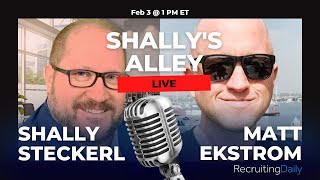
In this livestream interview, Shally Steckerl welcomes Matt Ekstrom, a veteran of the recruiting and sourcing industry with experience at Monster, TweetMyJobs, HiringSoft, Prospectify, Yobs, and Recruiting Daily. They trace the evolution of online job boards from early platforms like Online Career Center and Monster to modern tools such as LinkedIn, Twitter for jobs, and AI‑driven rediscovery platforms like HiringSolved. Matt emphasizes that while sourcing tools have become more accessible, the core skill set of recruiters must evolve beyond any single technology. Both hosts discuss the promise and limits of generative AI (ChatGPT, Microsoft’s Bing) for tasks such as candidate engagement, interview transcription, summarization, and cultural‑fit assessment, noting legal and ethical landmines. They explore emerging applications of AI for interview assistance, internal mobility, and candidate rediscovery, and debate whether current layoffs are true economic downturns or performance‑based terminations. The conversation also covers alternative hiring pathways, notably apprenticeships championed by Shally’s nonprofit, and the need for systematic up‑skilling, reskilling, and better assessment tools to match talent to roles. Throughout, they share personal anecdotes, critique legacy tech companies that failed to evolve, and conclude with a call for the community to share new tools and to generate transcripts for further AI analysis.
Chapters
It is Friday, February 3rd, the first, the first Friday of February. Okay, that was a little harder to say than I expected. First Friday of February, and you are live on Shally's Alley. That's right, it's that time of week again. So I'm excited to have a special guest today. His name is Matt Ekstrom, and unless you've been in the conference circuit or gone to some of the staffing industry events. Um, you might not have heard of him, but he's actually pretty influential in the business. Matt has been in the business for at least 15 years. I've known him for a little bit less than that, but he started at— at least in our business, he started at Monster. You remember that company, Monster Worldwide? He was there for a long time, like 5 years, as an internet recruitment consultant and team leader. So we're talking 2006. So he's been sourcing since 2006. Of course, he's done a few other things since Monster. For example, he went to work for TweetMyJobs. That's right, you might have heard of TweetMyJobs. Uh-huh. You might have heard of another company called HiringSoft. Well, he was the co-founder of HiringSoft. So this guy definitely gets our industry. Since then, he went to found another company called Prospectify, which I think is not about recruiting, right?
No, that was a stop outside of, uh, recruiting. That was sales.
It was like prospect generation, which is sourcing but for sales leads.
Yeah, exactly.
Cool. So it's still sourcing, same thing, right?
Um, yeah.
And, uh, then you went on to Yobs, which is like jobs but if you couldn't pronounce J. Um, for a little while, and now he's, uh, editor-at-large here at Recruiting Daily. So Matt has an interesting perspective from kind of like the inside and behind the scenes of our industry, and I wanted to just kind of have a little chat about that. Um, why don't you give us the, the quick 15-second elevator pitch about like your experience in talent acquisition? Has it been fun, exhausting, what?
Oh yeah, no, it's definitely fun. And thanks for the invite, I'm flattered. But yeah, you know, I kind of stumbled into it by accident at Monster. Had no intentions of, you know, seeking this industry out. But as you said in that, you know, that little brief summary, stayed in it for the most part, and my brief stint outside of it, I knew I wanted to get back to it. I love the community, love the, love the people, love the emerging tech. It's, it's always interesting. So it's been great.
Yeah. So basically you went to work for this company called Monster, and you're like, what the heck is this Monster, right? And then all of a sudden it's like internet recruiting, and then you're like, what the heck is internet recruiting? Because a lot of people that come into the recruiting industry don't even know about recruiting until they get a job in recruiting, and, and then they realize, wow, this is like a whole business.
Yeah, totally. I, I was finishing up school at my last semester. I got a random email. Um, I was in the Tempe area, and they were opening a huge call center, um, out in Tempe during their major expansions. And, uh, I, I— it was an invite to an open house, and I literally thought to myself, this is how naive I was, like, what can I do for a website? Like, I don't build websites, what do they want? So I went to the open house just 'cause I was, you know, laying around and I got the invite and, you know, they had a pool table, a ping pong table, bartender, DJ, everyone's just standing around. I'm like, you know, I'm 22 years old. I'm like, what do you want me to do, sweep the floors? Sign me up.
That's startup, right? They're like, yeah, we want you to be vice president of sales. Amazing.
Yeah. You know, talk to him and that's how I got into sales in this space. Cut my teeth there, spent about 5 years there and yeah, look back on it fondly. It was a rocky road during the Great Recession and everything, trying to sell job ads during that time was pretty brutal, but—
We lived through that. So did you ever, in Phoenix, did you ever meet Aaron Matos or Matos?
Sure, I was familiar with him. You know, actually at HiringSolved is where I think I first met him. 'cause he was kind of, you know, figuring out what we were up to and what we were doing, that sort of thing. And I knew obviously of Joel Cheeseman and Cheese that was acquired by him. So I was well aware of that. I did get, I did interview there at one point when it was still Jobbing.
Jobbing, yep.
Yeah, but—
I'm sure you don't know this, but I actually was living, I lived in Scottsdale, Arizona.
When was that?
Yeah, yeah, it's— it was only for a short while. In 1997— no, it was either '96 or '97, probably '97, to about 2001. So I guess that's, uh, what, 4? Yeah, 4-ish years. I met my now wife there, and then we left when we realized we were free to go. Um, we left Arizona as quickly as we could. Well, mostly Scottsdale. Um, it was just where we were in Scottsdale. It was not the place to start a family. Um, yeah, of course we didn't know anything because we were young, and we ended up— we were living in a place that was basically a retirement community. Oh, okay. So pretty much it was like, oh wait, yeah, this isn't, this isn't right. And she's from the East Coast, and so am I, so we ended up moving back. But, um, then, um, when I was there, I met this guy who— because I was a recruiter back then— I met this guy who had a van and he was driving his van around to shopping malls, and he had kiosks at these shopping malls where he would, um, get you to apply for a job at this kiosk in a shopping mall. That was Aaron. Yeah, that was jobbing, like 1998 or '99, something like that. It was that— that's how far back it goes. So it was just him in a van. It was, you know, that's, that's, that's incredible. I met him Yeah, long, long time ago. And then, you know, of course we've seen the evolution. So what I wanted to ask you is you've, you've seen the evolution of like the online job board, which I think even in 2006, Monster was still the top dog, right? You probably have every one of those Trumpasaurus collections, right? Probably have every Trumpasaurus imaginable. I'm sure you do.
Not, not anymore. I've got one or two laying around, but yeah.
Oh, you got rid of them?
Yeah, but yeah, no, I mean, they, they were seeing the evolution everywhere. They were great. They were great stress dolls, you know.
They're just, you know. Did you ever see the big Trumpasaurus? I still have it.
I did. And there was a— we had a similar one in, uh, in Tempe. I've got a picture of me standing next to it somewhere.
Yeah, it's like—
that was really cool.
Oh yeah. Well, anyways, so you've been inside the industry when job boards, online job boards, were the top dogs in the industry. And, you know, LinkedIn was a glimmer in someone's eye. And then shifted from that to— fast forward, I'm skipping a few years here— to like Twitter for jobs, and then to HiringSolved, which was a platform that does rediscovery, and it searches— it's an aggregator, searches the internet. So clearly the whole job board thing has pretty much devolved. So what lesson can you teach recruiters today who may not even know what Monster is about the evolution of, like, I don't know, Online Career Center to Hot Jobs to CareerBuilder to Monster to HireResult to what's going on today? What lesson can you teach us?
You know, I'm not sure I can teach a lesson, so to speak. But what's been really interesting to me is I think there's been great advancements in the sourcing space. There's still, if you're going to be someone like yourself, Shelly, you can use tools, but you're going to have to get beyond that. But the sourcing tools have made it way more accessible to those that are newer and still learning all the most cutting-edge techniques and stuff like that. And I think it's been really cool. On the job front, meaning job ad front, I don't think there's just certainly not been enough evolution, especially from the standpoint of candidate engagement, because how many people still to this day apply to jobs and get an automated message back at best if they're not a good fit? And just the painful process of getting through ATS systems and everything. You know, it's one of those things no one loves to do it, but, you know, apply for jobs, they do it out of necessity or if they're having a particularly bad day at work, you know, later on a Friday, they just start searching. But I think the greatest advancements and certainly the technology certainly has evolved for sourcers in a very good way.
I agree with that. I mean, you know, considering our industry started with basically smoke signals or like a chisel and a tablet, you know, help wanted, put it outside your cave. And like, you know, that was the earliest form of recruiting or sending help wanted on the smoke signals, right? That was recruiting, you know, however millennia ago. And, you know, in the digital age, it started with, let's just say the equivalent of the wheel. And it's evolved quickly from, you know, back in 1996, '97, where we had Online Career Center till now, it's gone from the wheel to like all these different kinds of sports cars and jet airplanes. And but you still need to know what you're doing. It doesn't mean that just because there's all these tools that all of a sudden the tools make you an expert at what you do. So I would say the biggest lesson is, and I'm going to just come out and say it, the tools change, man. You know?
Yeah.
I mean, it was Online Career Center and then it was HighJobs and then it was Monster and Monster's still around, but it's not the, you know, it's not the be-all end-all. There's Indeed, they'll come and go. There's LinkedIn, they'll come and go. They all come and go because they're tools, and tools change just like websites change and society evolves. So I think the lesson there is if you want to stay in the game and you want to be sharp in your skills, um, don't become dependent on any one tool. Sure, use the tool that works. Hey, if you're getting results from Monster, use Monster all day long. but once you aren't getting as great results, don't like give your, you know, throw your hands up and be like, all right, this doesn't work. You know, you gotta keep, continue to expand your horizons. And what I do is I spend about 20% of my time testing out stuff that I don't know anything about. Like I've been doing a lot of testing on ChatGPT right now, the last few months to just kind of figure out since like November or something when it, when it came out to try to figure out what I can do with it. And honestly, I've, I'm running into all kinds of limitations left and right. There's just not a lot that it can do that is out of the box. But with things that are in the box, I hate to say it, there's a lot of things in the box in recruiting, right? I mean, yeah, you know, job descriptions are pretty repetitive. Outreach messages, even if you personalize them, they're still pretty, you know, there's not a whole lot of difference between emails other than the personalization that you're using to contact that candidate and, and tell them that you've actually read their profile. But besides that, right, like you said, it hasn't changed a lot. So I would love to see, do you think this is possible in the, in the, you know, you worked at a basically an AI company, right? HiringSolved was, it had some machine learning and things like that behind it. You think it's possible for a ChatGPT-like type of tool, not ChatGPT because that's not the right one, but something like that that could say absorb all of your company policies and absorb all of your job descriptions and all of your interview guides and be like the customer service rep for jobs on your career page where it's not something that you're, you know, applying for a job. It's not something like Olivia or those chatbots that are out there now that have a limited scope. I'm talking about basically freeform conversation about the company. Tell me about the company. What's the culture like? Stuff like that. And actually answer questions to the point where somebody might say, okay, I know you're a computer, but now I'm interested in talking to a person. So like, is that even— am I thinking— am I— is this Minority Report, science fiction, crazy stuff?
It is. I think, I think, I think we're not quite there yet, and I'll, I'll, I'll explain why. I've actually thought about this a little bit, almost.
Yeah, I knew it, I knew it, I knew you had that.
And, uh, you know, I think there's just so many landmines there. So if you're talking about true AI, like ChatGPT is which is generative and it's learning, it's probabilistic, not deterministic. I think with delicate, there are certain landmines and questions that somebody might ask before engaging in the application process or agreeing to become a candidate process, especially if you're talking about policies and stuff like that. I've read someone who was really doing some testing on ChatGPT in its current state. And it would ask questions, for instance, like, who was our first Jewish president? And there is no answer. There's not been one, but it doesn't say no. It takes a roundabout way of saying, well, we're open-ended. We're non-discriminatory against—
Right. In America, there's been lots of presidents of the United States.
Yeah, right, right. And I, I don't think you want necessarily a non-human, um, you know, giving out policies or other things that, that again are potential landmines. Uh, we're talking about potential culture or disabilities, you know, things like that that could really go haywire. So, but I think where machine learning is, you know, it's more algorithmic, at least my understanding of it, more algorithmic, you know, if this then that, and you can set specific rules. It's not going to go off on its own like true AI.
And that's what the chatbots do now is they have these rules that they follow. And so if it's something that's outside those rules, it's got an escape valve. It's like, you know, let me send it somewhere else. Yeah, exactly. So that's what works. So right now, these tools that so-called AI that are really, as you said, not really AI, but they're assistive technology that removes some of the barriers. Previously, without these chatbots that exist today, there was no way for the candidate to contact recruiting. It was apply for the job. I mean, and before that it was fax your resume, and before that it was mail your resume. Good luck, right? So this is an evolution in that you've gone from mail your resume to fax your resume to apply online to actually engage with something that, you know, it's a step forward and Yeah, so I like that. I like that. Now, what I found that as you were talking about this prescriptive stuff, what I found that ChatGPT does really well and what I'd love to be able to sort of like, I think they're providing an API so that you can train your own model. So essentially use their engine, but you provided your own chunk of data, your own corpus, they call it. Of data, a corpus of data. So what I would love to do is experiment with something like that in an isolated situation where I could provide a corpus of data of, say, um, anonymized interview transcripts, right? No people's names, but the conversation of, uh, question and answer. So there's a company called Honit that I had their CEO, Nicholas, on the— yeah, on the podcast here before. What they do is they they enable the call through their service, which does speech to text and vice versa. So essentially when you're doing the interview, like we're talking right now, it's actually recording that audio, transcribing it, and putting it into a tagging system where it extracts specific keywords that you provide. Like if anybody mentions the word Java, then highlight that section. So something like that, if that existed, and then you could have all of those interviews without the personal information, okay, this is not about singling anybody out, but it's about what questions lead to successful hires, what answers lead to successful hires, and you can put that into ChatGPT, perhaps you could get rid of some of these really stupid questions that people ask. I mean, some of these questions that interviewers ask are like, I'm sorry, what are you expecting? Like, what is the correct answer to that? Is there a correct? What is the benefit in asking that? Or, or even better, the other thing I see a lot is hiring managers, multiple, right? So you've got 3 people that you need to meet, all 3 hiring managers ask the same question.
Mm-hmm.
And all in the same question is like, it's not even necessary. So you've got all these theories about what do they call it? Uh, behavioral-based interviewing and yeah, situational, situation task. So I would love to see the ability to take all of the you know, the conversations and then say, okay, these conversations led to hires and maybe even these hires became productive, you know, members of the team and didn't like come here and realize the culture wasn't a fit because that is a little bit more deterministic, right?
Yeah.
Then say culture because, you know, when was the last time you interviewed for a job? It's probably been a while, but think back to the last time you interviewed. The culture of the team that you interviewed is probably different than the culture of the team that you ended up working with or the culture of other teams that are adjacent to your team. Right, right, right. So if you interview for culture, it's the culture of your team. If you have a robot that is able to conglomerate the culture of the entire organization, it'll be the culture of nobody because it'll be the aggregate culture that is not really anyone's culture. It's everyone's culture. It doesn't really, you know what I'm saying? What do you think about that?
Yeah, I think that's a really interesting take. And I've thought about the narrowing the scope, like you said, incorporating your own corpus of data. The downside I can see from that is what makes— I think what's really wowed so many people is just the amount of data that's been aggregated and therefore labeled and trained. Within ChatGPT. And if you limit that scope, I don't know how powerful it can be. I think maybe then at that point it becomes more if-this-then-that rules, uh, rules-based stuff. There's just not enough for it to really learn and get trained.
You need that.
That's just my take.
Plus this other— so it's almost like that and then with this extra material. And so what are these questions with this context kind of thing?
Yeah, yeah. And then I think, you know, what I've seen recently— I've done a lot of demos recently of various tools of our, our current partners and hopeful partners here at Recruiting Daily. I've seen some really, really interesting stuff. Um, you mentioned HoneIt, which is certainly cool. I've seen that recently too. Um, where I think I've seen AI being applied, even some of the stuff from, uh, potentially from OpenAI, ChatGPT, maybe part of that solution is things like you mentioned, the transcripts, right? So having a video interview with transcripts that are then, if transcribed really well, which is in itself hard, and then summarized using AI to summarize and provide notes and context, you know, so, you know, it can be shared around internally at the company. And I think that's really, really powerful. You know, as potential part of the hiring process. The other is really having guidance provided to interviewers. So if someone's hiring for a really technical position that they have no idea what the right answers potentially are, I've seen a couple different tools, one that kind of prompts them on the screen, prompts the interviewer on the screen like, make sure to listen for these words. If they say these things, then click, you know, click here.
And follow up with this, right?
And another one even just talking to the interviewer and saying, this was a good answer, you know, like, which is really, really interesting. At least getting them through that next stage and providing the interviewer confidence that they are passing the right people along. I think that's, those are some pretty cool tools for AI.
Yes, that's very useful. Yeah, there's not a lot of confidence sometimes when, when you're, you know, when you've— if you've made a bad hire, and I'm not saying it's anybody's fault, bad hires happen, right? That has happened the same reason you, you make a mistake, you know. Yeah, I— you take the wrong job and it's, it's nobody's— it just something, it just wasn't working out, right? So not, not blaming anyone here, but when you make a bad hire as a hiring manager, um, you kind of get a little, uh, gun-shy next time, or, or like a little apprehensive. You lose that confidence, like, well, gosh, maybe I'm not that great, you know, of an interviewer or a judge of talent because I didn't do so well last time, right? But that's not necessarily the case. So I think that bolstering that confidence will be good. The other thing I wanted to ask you is, as you said—
I want to touch on that a little bit because I, for a brief while— was not brief, it was over a year— but I was building an SDR team at a company and entry-level candidates right? And being able to predict whether someone's got this required soft skill set in particular, and you mentioned culture fit too, was so, so hard. I still have yet to see a really good tool that I, that, that I think could be built for teams of any size where you could say, because what made those particular SDRs, you, there was a unique process. It wasn't selling widgets, right? It was selling something else. And so understanding that not just anybody with the required soft skill set to be an SDR would work here, but it was a different— but the requirements getting the job were pretty, you know, you think, and you think of someone who's been in sales or something like that, you hear all the time hire for, you know, people who've been athletes because they're competitive and stuff. But, you know, really, I don't know, like it doesn't— that clearly didn't work for me. And I couldn't figure out what made the people that I did hire that were successful successful and the ones who weren't, what made them not successful? What were they lacking or what were they really good at that made them not good for this position though? And being able to, to your point about culture, but also just around the team, what are this being able to use them as a dataset, of here's what these successful candidates have and here's how we can assess those incoming candidates for those same things and being more confident about it. Because really at entry-level candidates in a lot of places, you're just winging it. And I think that's a big problem in the space. If there's a great solution out there, I would love to see it. If anyone's listening.
I have a possible solution, but it doesn't have anything to do with technology. It's got something to do with like going back to practically, uh, the Middle Ages, and that is, um, apprenticeships.
Yeah, yeah.
It's something that I've been very passionate about with my nonprofit, the Sourcing Institute Foundation, that puts people to work, you know, people with disabilities and returning citizens and veterans, puts them to work as, as sourcers and recruiters. One of the things that we promote is essentially an apprenticeship period where it's a, it's a paid job, but it's not paid at the wage that you would get if you were a professional. It's, you're getting paid to learn and to see if you can take the job. And, you know, you take on an apprentice or two and they either pick up the job or it's either for them or it isn't, but that's not the same as going to college. So in this country, they're very anti that system because it eliminates the whole need to go to university. You know, you don't have to go to a liberal arts school and get a liberal arts degree if you're going to be an apprentice somewhere. Where after a few years they have what, journeyman, master, et cetera, you know, like the guilds, stuff like that. So that's a possibility for a job that doesn't require any prequalifications, but it's a lot of cultural change. So that's my solution.
Yeah.
I don't think technology's gonna solve that, but my model on ChatGPT might actually, not using ChatGPT, but something like that, if it was able to somehow collate all of the criteria that went into hiring, and then you could say these are the ones that succeeded, maybe it'll see a pattern we don't see. We don't know what the pattern is because you didn't see it. I don't know what it is. But if one of the things that I do know that ChatGPT is really good at and other AIs that like Watson, for example, that are really good at is essentially digesting massive amounts of information that you and I could not, we couldn't absorb that much content in our lifetime, but they can do it. And then they can find patterns that we just aren't able to see because we don't have the macro enough perspective. So maybe that's what it's gonna take is a real macro perspective to start identifying what some of these traits, these macro commonalities as my friend Glenn used to call them, are in that realm. You know, it might be from company to company. So that's another change that you might have to learn the system or teach the system for a while before it starts being productive.
Yeah, yeah, totally. Yeah.
Well, I did have one other thing I wanted to ask you, and that is, given the evolution of technology and the recession, you know, whatever you want to call this, the— there's all these layoffs and everything. You and I both have lived through at least one actual major recession. And, uh, I've actually lived through a couple— three, as a matter of fact. So I know what it's like coming in, or it's like going out. This, to me, this doesn't feel like the other ones felt coming in. So I don't think it's a recession, but that's my point of view, which is just mine. Um, I want to hear from you. You're seeing companies getting investment, you're seeing companies launching products, and you're also hearing and seeing all these layoffs. And some of these layoffs in my opinion, don't look like layoffs. Like, when a company lays off 5% of their workforce and it happens to be the 5% of people that normally would be exited because of lack of performance, I don't think that's a layoff. I think that's a MeToo movement where it's like, oh yeah, we're having a layoff, but we were going to lay these people off anyway because it's really not a layoff, it's really ending them, uh, the, you know, terminating them because of performance issues. So I don't know how much of that is true, how much it isn't. What do you think? Are we going into some kind of modern age post-pandemic recession, or are we actually in a growth mode but it just isn't showing up on people's paychecks and bread baskets yet? Which one? Or is—
well, I think I, I saw a chart, right? I saw a chart the other day that would argue that it is showing up in people's paychecks. But, you know, inflation, inflation is real. Like, actual wages have increased. And if you look at the post— the immediate COVID downturn and the, and the Great Recession before it, I mean, wages were plummeting, payroll, you know, was plummeting, and it's not, uh, right now it's actually up. Um, and then the jobs report today too. I think you're on to something. I think it's, you know, whether it's a a MeToo thing or just, you know, a media bubble or information vacuum that people are living in. I think they're scared, which is understandable.
Right, certainly. Yeah, I mean, it's definitely doing that. And I'm not saying don't be scared. I mean, I think only the paranoid survive, right? To quote that book from, I think it was Michael Dell. You know, be smart. I mean, if you smell something going on, hey, it's better to take initiatives and, you know, protect yourself than it is to pretend it's not happening. But I just don't think that it's actually happening the way we think it's happening.
Yeah, I agree. I, I think, you know, this is definitely got unique traits. Whatever we're going into right now has definitely got unique traits in my opinion. I, I think, you know, personally I'm optimistic about it. I think the fever is going to break pretty soon. This does not feel anything like The Great Recession, for sure. Um, right, you know, like I said, trying to sell job ads during that was, was absolutely, uh, what jobs?
We don't have any jobs.
They had no jobs and they weren't, and they weren't hiring. And, you know, a lot of the companies that I'm hearing, you know, laying off are also still hiring, um, at the same time. So there is a need for And it seems to be concentrated to tech for whatever reason. That's true.
Yeah, that is for sure. Especially companies that have technology that I don't want to say is obsolete because it's not necessarily obsolete, but technology that has seen its peak already. I'm not going to buy into this ChatGPT is going to kill Google hype that's going on because there's one very, very easy explanation why that's not gonna happen. And that is that ChatGPT is looking at models of language in history. It doesn't find something from today. So if you ask ChatGPT a question that takes place in something that happened today, it doesn't know. So like forget, it's not search because it's not looking for content that's been added unless somehow you're able to, index all that information, which guess what? That's what Google does. So I don't think it's going to happen.
But there was a really interesting take on it too, where I think ChatGPT is better at some things than Google. And I think Microsoft's investment is really going to pay off. I think they're already putting it into Bing in a little bit. But things like if you go to Google—
There's a premium version of Teams that has it. Yeah.
If you go to Google and you ask what are the pairs of shoes every man should own, different, different styles. You're going to get ads and you're going to get links to different places. ChatGPT will actually answer it. I think that's really cool. But they are doing different things, you know. Google is meant to be deterministic and, you know, it's looking for the answer real time and not here's most likely, you know, here's an amalgamation that tells me you're most likely looking for this. But, um, but I agree, but It's like directions, Matt.
If I stop you in the street and I go, hey Matt, uh, how do I get to Carnegie Hall? You're gonna go, well, you know, go about a mile that way and then you'll see this building and turn left. That's ChatGPT. Google Maps, it's go 500 feet in this direction, turn in this way. So you see what I'm saying? It's like literally an instruction. So there's a lot of reasons why ChatGPT isn't the quote-unquote Google killer, but what I was going to say is that the model of an ad-supported search engine that is basically doing nothing but trying to convince you to buy stuff is kind of outdated. Yeah. So there's got to be another way that we can do search that isn't so tied to advertising revenue, and that's what Microsoft is trying to figure out.
Yeah, yeah, I agree. I think their investments in it— and they just made another one, I believe— um, are really, really really smart and forward-thinking.
Yeah, because they, you know, I don't think Bing makes as much— well, I'm pretty sure they don't make as much money on ads as Google does, but that's because Microsoft doesn't have to make as much money on advertising because they have other products, right? But I think if you could figure out a way that search can provide a better answer— and so, because ChatGPT isn't free, by the way, I want to make sure that people understand this— you might be using it for free, but what you're using is literally a demo. And believe it or not, folks, I'm here to tell you, I will testify for the last— I don't know how many years that I've been on the internet, and I've tried everything that's a free tool. Guess what? If it's free, you are the product. And it's the same story with ChatGPT. You're using it for free, but what are they doing? They're running tests and they're analyzing what people ask for and how the answers come up. You are essentially their beta or their gamma testing. So whatever. My point is though that it's more about like, how do we modernize some of these older technologies that are, that are still around and should have evolved on their own? A company like IBM has managed to stay in business for so long because they don't do the same thing that they used to do when they started. But a company like Motorola, not the same. You know, Motorola started by making car radios. Motorola, like a rockola. That's where they came from. Yeah, car radios. And from there they went to field radios, military radios, telephones, cellular. And they stuck this one thing and they went bust. The same reason that Kodak never evolved, because they were all about film. And when digital came around, they're like, hahaha, nobody's going to want to do digital, everybody wants to print. Was the same thing that IBM said to Xerox when Chester Carlson came knocking on the door and said Hey guys, I got this idea for making a picture of a document and making unlimited amounts of copies. It's called xerography. And IBM was like, what? No, we have typewriters and carbon copy. That's never going to happen. Get out of here. So Chester's like, all right, fine. I'll start my own company. And there goes Xerox. Xerox is still around, but Kodak is not because Kodak laughed at digital, right? I mean, they're still around, but it's a completely different company now. So where's Google in all this? You know, they're not a startup anymore. No, I was there when they were a startup. I was there in 2003 when they went public. Oh wow, it's the same search engine. It is, right? That's what I want to see is real true evolution. So mash it up, right? And do you see that now that you're looking at all these products? Do you see an actual, uh, product or two? Remember we talked about this at HR Tech where we were looking around at the booths and there were only like 3 or 4 companies there that actually had something new? It's been a few months since then. Have you seen anything else that's really new since then, really evolved, or like something that's not just another carbon copy of, you know, a carbon copy?
I, I think the, the stuff that I've, that I've seen that is really, really interesting, or that's not necessarily new, um, well, some of the, some of the video stuff that I said with the transcripts and the summarization and stuff like that, and, and the the, you know, giving cues to interviewers who may not have that skill set. That's interesting. That's really cool and something I haven't seen before. I think the other big trend that is not necessarily new, it's just being applied differently, are tools that are designed around internal mobility and candidate rediscovery.
Internal mobility. Okay.
So they're not necessarily new tools, but they're thinking about things—
New applications and—
differently, which is, which is the solutions. I mean, we just hit a, what, unemployment rate lowest since 1969 today. You're gonna have to find new candidates, you know, and we're better to find them than people who've already been on, who already know your culture. You've put a ton, a ton of investment in them already.
Um, so yeah, and internal mobility is a really tricky one. I really like that because that solves a problem in multiple ways, you know, it's— there's, there's something to be said for having been hired into the wrong job. You accepted the job, you know, and it's the wrong job. So it's everybody's mistake or nobody's mistake. So I can see where you definitely want to exit people from an organization if it's not a good fit. But sometimes, and I would rather say maybe often or frequently, it's just the wrong job, not the wrong company. So if you could find a different job for that person, they might still be a good match for the company, but we're just doing something that wasn't a good match for them as a, you know, job. So mobility, I think, is not just a matter of like, do I move from Rochester to, you know, whatever. Mobility is also interdepartmental, interfunctional, interdisciplinary mobility. Yeah. So that's a huge You know, when I was in college, and you probably encountered this too, and I'm sure a lot of people did. When I was in college, it's always, they always tell you that the career advice professionals like, don't worry, you'll get a job. When I got outta college, by the way, it was a recession. So I went right into a, there's no jobs. Don't worry, you'll get a job. It's all about who you know. It's all about networking, blah, blah, blah, blah, blah, and all that stuff. But really what I ran into is, sorry, you don't have any experience. Sorry, you don't have any experience. So how am I supposed to get the experience if I don't have any experience? It's literally the, the catch-22 chicken or the egg quandary. I can't get experience if I don't get experience, and I can't have experience if I don't get experience. So I'm there, how am I supposed to get the job? And I think that answers a big question there, because you could start out as an apprentice or an entry-level, um, you know, let's say in the beverage industry, you start out stocking shelves and you have the ability to move into other jobs. You eventually end up in manufacturing or accounting or sales because you have mobility. So that to me, that is a really noble use of technology and I think it's a really good solution. I like that. Do you have anybody that you— that comes to mind that's doing internal mobility, um, in a good way that maybe we should look at?
Yes. Although I'm going to pause on that one because I just went through a bunch of demos and I'm not sure what's been released yet or not. But there's one in particular that I'm thinking about that is really doing it from a standpoint of the assessments of skills. right? And so they've already done it, you know, in the traditional sense, etc., but keeping tabs on them and allowing their customers' current employees to continue to develop and show and demonstrate different skill sets that might be unique. And maybe they were hired for something completely different. They brought some skill sets, maybe things that they're certified or even licensed in, or things like that, but you wouldn't know because they weren't applying it right then. But if they're sitting in there and just the value of, hey, you've got months or years of observing this person, how they interact, how they fit within your culture, just how proactive they are, just all these different things. Right. So they're really good at all the investment.
Yeah, just good at some function. Let's say, I don't know, I'm going to make it up. I have no idea what you're talking about here, but Let's say this person is in a job where they're really good at spatial recognition, but their job is not in architecture and design. It's something else. And the company realizes that they have abilities, natural abilities, or have developed these abilities through some other activity that make them really good for another job. So they move them from this to that. And it's a job that they would never have qualified for because they don't have experience with, but their abilities are aligned. And so now they're doing that job. So it's actually— yeah, that's pretty— that's cool. I like that. Um, I can think of two organizations that do that really well: the church, just the church in general, right, religion and churches in general, and the Army or the military. Both of those organizations are really good at recruiting entry-level people and then teaching them the basics, boot camp or seminary school or, um, yeshiva or, you know, whatever, right? And then they come out of that and find a spot. It doesn't work, they do it for a year, they go to another one. Eventually they grow into it. Now the one thing that I know for sure the military that, that doesn't do is they, they cannot make their own doctors or chaplains. Every other job they can make. Every other job they can teach it to you. But to be a chaplain, you have to have already served the community and the public and have been ordained in whatever faith in order to qualify. And to be a doctor, you have to already qualify as a doctor. So they don't teach you either one of those, but everything else they make. So I don't know, maybe that there's something there about being able to somehow— of course, they invest a lot in training, teaching, and developing as a big part of it, but there's got to be something we can learn from there. That allows us to create a model for mobility where it is about what we are capable of doing, not about what we have been doing, right? That's what you're saying, isn't it?
Yeah, that's what you described, is they can do this, not they've been doing that, or they, they brought that skill set to the table and it just wasn't applicable for that job, and so you didn't know that they have that, right? But being able to document that within a system that's searchable, etc. But just think of, you know, if, if companies invested more in upskilling and reskilling their employees on the regular, not just, not just when you're in a pinch, but just if you invest in that from day one and just continue, or at least offer that to, to the employees that, that, you know, want to, want to continue to grow. Want to explore, want to continue to grow and push themselves, etc. How many— how— we just talked about all these companies that are laying off and hiring at the same time. You know, could that be mitigated?
Beautiful. Yeah, maybe, maybe. I think, I think some of these layoffs are not layoffs. They're people who are being forced out because of performance issues that may not have anything to do with, you know, their abilities or their skills. It may be something else, just disciplinary action and things like that. It's being covered up as a layoff. Yeah, not all the time, but there's definitely some of that, you know.
Yeah.
Um, yeah, somebody asked, how can we adapt this model to help people to find the right jobs now? Like, so it's what you're talking about, but, um, getting a job, not switching, not mobility between— not mobility inside the organization, but, right, um, make— making a match. I don't know if you can solve that. That's a— that's a That would be a huge one. Like literally, you know, analyze everything that you know and then tell you what your abilities are. That would be cool, right? ChatGPT. Hey, ChatGPT, what am I really good at?
You're right.
Well, Shelly, um, apparently you're really good at stalking people. So, uh, unfortunately that's, that's not a profession, or at least not one that pays well. Um, so yeah, that's a really good idea. I like that. Something that helps us It's not predictive because these are your abilities, they're your talents, but more like matching your talents to organizations that require those talents but wouldn't hire you because your resume doesn't say that you've done that job. Something like that.
Yeah, I, I think, you know, from my standpoint, a lot of the, a lot of the assessments in this, in the space are missing out on some real growth marketing opportunities and putting some, you know, candidate-facing stuff out there just to get visibility and build a brand and just have people talking about putting badges on their LinkedIn profiles if they take one. I think Plum's done a pretty good job of that. I've seen that recently. Maybe others do it and I haven't seen it, but you could also build that as, hey, you were just laid off, take our assessment. We can tell you what types of places that or what types of roles you might be uniquely suited for that you didn't even realize.
You didn't even realize, right? Yeah, maybe a good time to, you know, consider another career. So, man, it's funny, it's funny.
Going back to the very beginning of our conversation, I was given an assessment at monster.com as part of the hiring process. It sat for 5 years. 5 years, right? Nobody— no one ever did— no one ever did anything with it. No one told talk to me about it. And then I had a vice president who wanted to do it with, with our team in particular and had, had a one-on-one. He had just been trained on how to read these, right? So that's why he was looking at it, interested, interested in looking at them. And turns out in my one-on-one meeting, I was in the absolutely wrong role for my, for my skill set for 5 years. I was successful.
You're like, told you so.
He's like 'You're really tired when you go home, aren't you?' I'm like, 'Yeah.' He's like, 'Yeah, that, that, that's why.' And I'm like, 'Would have been nice to know,' you know.
But anyway, man, I— you know, you were like, 'I don't know if I have enough material to talk about for 30 minutes.' You know, I've kept you for 15 minutes longer than I told you I was going to keep you. So clearly we had some fun here. Really appreciate your time with us. And, um, yeah, I want to say to everybody, have a great weekend. Matt, any last Any parting ideas that you want to leave everybody with? I always like to give my guests the option of dropping a pearl of wisdom on anything, you know, before we say goodbye.
Uh, if anyone's out there that's come across some new tools in the space or whatever, I'm always game to look at them and understand the ecosystem better. Happy to set up a demo, just take a look at it. But all right, um, it's really fun. I do have, I do have one request. If there's a transcript of this Can we put it into ChatGPT and ask it to summarize it?
Dude, let's make a transcript of this because we have the audio, so we can give the audio to a file, uh, text, you know, maybe, maybe Hone can do that for us, right?
Yeah, yeah, that would be cool.
And then we'll do the— yeah, it sounds like a good idea. And then we'll post it and see what happens.
Yeah, summarize. Awesome.
Cool. Cool. Thanks everybody, have a great weekend, take care.
All right, thanks so much.
More from Shally



Scaling Talent at Hypergrowth: Leadership, AI, and Hiring Excellence with Cindy Nicola







