Rebroadcast: Dani Herrera on Shally's Alley
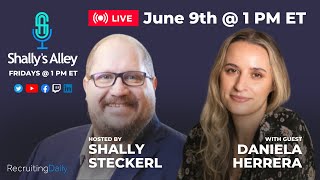
In this episode of Shally's Alley, host Shally Steckerl interviews Dani Herrera, a veteran equity, diversity, and inclusion (ED&I) consultant with extensive recruiting experience. After brief personal introductions, Dani explains the key difference between diversity recruiting—simply sourcing a diverse candidate pool—and inclusive hiring, which requires redesigning the entire recruitment process to be equitable, accessible, and bias‑free. She outlines a step‑by‑step self‑audit that starts with gathering granular data at every stage (sourcing, interview progression, offers, and acceptance) and highlights how hidden salary gaps can emerge, especially for Latina women. Dani recommends regular candidate surveys and one‑on‑one follow‑ups to surface why offers are declined. A major focus is on accessibility: ensuring job descriptions use screen‑reader‑friendly fonts, alt‑text for images, subtitles for videos, and providing detailed interview agendas for neurodiverse candidates. She critiques the over‑reliance on phone screens, noting they can exclude candidates who need visual or other accommodations. Throughout, Dani stresses intentionality, continuous data‑driven review, and the need to embed equity and accessibility into every hiring touchpoint. The conversation closes with a concise call to action: prioritize inclusive processes as the harder, but essential, work beyond simply recruiting diverse talent.
Chapters
Hey, party people! All right, all right, I hope everybody's doing great on this Friday, June 9th. If you are watching me, it's because you are on Shelly's Alley. Don't ask me why there's an alley in an airplane or an airplane in an alley. That just, uh, that's just my background. But hey, you know what, um, as usual, we have a special guest today. Our special guest today is Dani Herrera. Dani is a diversity and inclusion, ED&I, equity, diversity, and inclusion consultant. She's been in the business for about 20 years, 15 of those years in recruiting. So she actually knows what she's talking about when it comes to attracting and engaging and recruiting talent. She's a former director of recruitment operations for equity and diversity at a very large marketing and advertising company. Global company that you may know of, RGA. And she is now actually a consultant, an independent consultant. You might have seen her articles on Forbes or HR Brew or LinkedIn News. Or like me, you might know her from HRTX, where she's done a number of presentations and masterclasses about inclusive hiring. So welcome, warm welcome to Shelly's Alley, Dani.
Thank you, thank you so much. That was an amazing intro. Like, I don't know if there's anything left for me to say, so we might just close it now.
Other than I probably need to put your, uh, put your URL up here somewhere. So I'm gonna—
yeah, put it on the— yeah, people can find me like in all of my socials in that link.
Yeah, here we go. I'm gonna put it on there. There you go. Yeah, Linktree. Not LinkedIn, Linktree. Um, and actually, uh, interesting side note. So like me, Dani also identifies as Hispanic. We are both, we are both white-passing Hispanics, right, Dani? Yeah.
Yeah. So I, yes, I'm, I'm, I'm white. So I was actually born and raised in Buenos Aires, Argentina. So actually my first language is Spanish.
Same here.
Um, oh, yay. I didn't know that. That's amazing. Um, so I moved to New York, I want to say about like 7 years ago and And that's where I am right now.
Yeah. So yeah, that's interesting. Um, and so when you came, did you have English? I guess the hard question is, um, how was your English when you got here? Right? Like, are you completely English as a second language or did you like maybe in school, you know, high school or whatever?
Kind of. So in Argentina, you actually have English at school, but you only have it like once a week. So you just, you know, learn the basics.
Familiar.
But interesting. Yes. So interestingly enough, what happened was when I was, when I was a teen, and this is, I don't know, it's like an embarrassing story, but I'm just gonna go ahead and say it. When I was a teen, I was obsessed with Backstreet Boys, which is also speaking about how old I am. So of course, they sang in English, and I really wanted to understand, like, what they were saying, right? So I basically— and this is spoiler alert, this is not how it works— but basically what I did, I started translating their songs manually with a very, very small tiny dictionary. And that's how, like, of course the songs didn't make any, any sense because that's not how translation worked. But basically what happened, I got a little bit better with my vocabulary, which actually got me to be a little bit better at like English at school, and that actually got me to like study English like outside of school. And then as I finished high school, I actually started, um, studied to be a teacher of English. I did not finish that, and then I moved on to being, um, a simultaneous interpreter, which I also did for a couple of years. And then, um, I actually entered like the workforce back home in Argentina and always worked for American companies. So I want to say that I'm like, I've been fully bilingual for a couple of years now.
Yeah, yeah, yeah. That was similar story for me. When I got here, my Spanish wasn't great, and I knew a lot of— I'm sorry, my English is what I meant to say— wasn't great. And I knew a lot of, I knew a lot of, um, words because I had a really high score in the TOEFL, the test for English.
Right. Yeah, yeah, yeah, yeah.
So I was great with the vocabulary, but it was putting them together and sometimes kind of the grammar and And for me, the trickiest part, and probably likewise for you with like it being a little bit more self-taught, is the difference between homonyms and heteronyms. So there's words that sound the same and mean different things, and there's words that spell the same but sound different.
And mean some— yes, and mean something completely different as well.
Wound, right?
Yes.
Bound a bandage over my wound. It's spelled the same. So if you're reading, you're like, what? And there's so many of those things like that. It's crazy.
Yeah, it is. And I'm sure that you do this as well, but I mean, I don't do that often anymore, but sometimes I think in Spanish and then automatically translate in my brain, which it doesn't go well. That's the only thing I can say about that.
You know when I do that the most is when I have like a saying that I grew up with that is very, very eloquent and poetic in Spanish.
Oh, 100%.
But in English there is an equivalent, there's the same saying in English, but it's a different saying. So like the other day I was trying to remember one and it sort of roughly translates to 'in the plumber's house all of the pipes leak,' right?
Yes. And that's actually the one— yeah. Oh, how would you say it in English though?
In English, I learned yesterday, believe it or not, that the equivalent for that is 'the cobbler's children have no shoes.' Oh, got it.
Yes, you're right. So basically, in Argentinian Spanish, and I'm sure that maybe in other countries as well, but that saying actually, it's like a play with the words and uses my surname, like my last name. So it's just like, there's, there is no way that I can explain what that means in English.
I know, exactly right.
I don't even try.
Herrero is someone that works with, with iron, and so, right, right, right.
So I'm just not gonna go there, right?
So anyway, yeah, that's, that's crazy. Well, listen, um, tell us, tell us a little bit about Tell the audience about inclusive hiring, which is, you know, there's, there's diversity, there's equity, and there's inclusion. Of course, there's different— we've talked about this on the show before about the difference between diversity and equity and the difference between equity and inclusion. But your specialty is inclusive hiring as opposed to diversity recruiting. So tell us the difference between inclusive hiring and diversity recruiting.
Awesome. So, and, and I think, and hopefully this is easy for the audience to understand as well, but diversity hiring is mostly just focusing on hiring a diverse pool of candidates, which in my opinion is the, it's the easy thing to do. I mean, it's very easy to do, right? Like you have to be intentional about it, but the talent is out there. They want to get hired. The only thing that you need to do is find them and hire them if that's what you want to do. That's diversity recruiting. And there are so many websites and platforms and communities that can help you do that. So again, like hiring the diverse talent is the easy part. The part that actually takes a little bit more intentionality and commitment and time and like buy-in from not only the recruiters, but, um, the talent teams and the executive teams at whatever company we're talking about is making sure that the hiring process is inclusive, equitable, and accessible, right? Because again, if we want to hire diverse talent, we interview them, we hire them. However, what we see happening is that whenever we reach out to diverse talent, between a million air quotes, our processes are not ready, right? So we are still embedding all of the very outdated biases that we have in recruitment. We were actually talking about this, I think it was Tuesday or Wednesday with Recruiting Daily as well, like how we recruiters embed so many of our own biases in the processes that we follow, right? So what I do is I help recruiters and companies take a look at the processes that they have, which I hope every company at least have a semblance of a recruitment process. And then what we do is we break it down as much as we possibly can We identify all of the biases that are embedded there, and then we redefine the process just to make sure that, again, it's inclusive of all of the candidates that we want to interview and hire, that it's equitable, again, for all of the candidates that we want to interview, and that it's also accessible, meaning that candidates with disabilities or neurodiverse talent is also welcomed and included in the process as well. Um, so it actually takes a little bit of time because again, recruiters, we've been following the same processes for decades now. And something that I've noticed is like, we all kind of like, there's, there are a lot of courses for recruiters, but there is, there is no school, right, on, on how to learn how to be a recruiter. So what we do is we all end up like copying whatever somebody else is doing or whatever another company is doing. And That's how we kind of embed more biases into the way that we work. So it's something very tailored for every company and every recruiter as well.
So would you, so as you said, you would hope most companies, most companies have an onboarding process. Most companies have, you know, but they don't necessarily always think about inclusion because the first step typically is to standardize, right? The first thing is, "Hey, we are getting bigger. Now we have multiple offices, multiple divisions. Let's at least have one single process. Then we don't have like this department onboarding people like that and this one like that." So that's the first step. Then after you standardize, then you start to look at how to refine it and everything. Inclusion is often kind of, you know, a maturity. Like we, you mature into, okay, we have a standard process now, let's start looking at how to make it better. One of the things that we need to look at to make it better is to make sure that it's a fair process and that it's inclusive, etc. So what advice would you have for our audience on, if you don't, let me back up a little bit. What advice do you have for the audience so they can determine whether or not they have an inclusive hiring process? Okay. So a self-audit, you know, like a, like a, like a self-check, right?
So this is a tough question again, because everybody might be in a completely different level. And of course I know that your audience is global as well.
Let's say they don't have an inclusion.
They don't have an inclusive process. So the very first thing that I usually recommend is taking a look at the data, right? And I know that sounds like a, you know, like an easy answer. It really isn't. But one of the things that we can actually do is take a look at the data on every single step of the interview process. For example, okay, um, what candidates are we reaching out to? Like, are we reaching out to every single demographic? Are we leaving some demographics aside? Like, even before that, like, do we know exactly what our company understands by diversity? Is our company only focusing on, I don't know, like race and gender? Or are we actually focusing on all of the different possibilities of diversity? And again, it could mean different things at a global scale. But once we know that, again, like, who are we reaching out to? Are we actually interviewing all of that talent? Are they moving through the interview process? If they're not moving through the interview process, can we identify, I don't know, like an interviewer or a hiring manager that is deciding either consciously or unconsciously not to move forward with a particular demographic? What's happening with the offers? Like, are we extending offers in an equitable manner? And if we are, which a lot of companies are, but if we are, do we know if our candidates are either accepting or rejecting an offer? Is there a reason for that? So I think that—
Oh, I see. Because of the inclusivity, right?
Or Could be something else. Maybe something that actually that happens is, and this happens a lot for women, Black women, and Latina women, they actually tend to get offers that are a little lower compared to their white counterparts. And you won't actually know that if you don't actually like stop and measure and review the data and review the data intentionally, right? Because if you look at the data like from a bigger point of view and you compare just like women to men, you might say like, okay, maybe there's a difference, but it's kind of okay. Right. But as you start breaking it down a little bit more, you might realize that your Latina women are actually getting more than 50% less than a white man in that very same role. Right. So that's what I mean when I say that we need to break down the process on a million tiny steps. Steps and reviewing the data behind it and see what we can do to make that process a little bit more equitable and inclusive and accessible as well.
So in your experience, this is an interesting point because, you know, our audience, the show's audience consists of a lot of people that are, they're in the recruiting workflow. They're not necessarily, I wouldn't say people who listen in are necessarily HR in the traditional sense. They're either either HR and associated with talent acquisition, or they're, you know, they're somehow leading the function, but there's some connection to that. So it's not pure HR, right? And so, um, what, what I— the reason I'm bringing this up is it kind of makes sense to me that they may not necessarily be aware. As a recruiter, you don't necessarily know why someone is turning down an offer. Okay, they, they can tell you, the candidate can say, I have a better offer, but that doesn't really say a lot. Like, I'm trying to, I'm trying to walk carefully here because when— if, if I was putting myself in the shoes of, okay, I've got an offer from Company A and I've got an offer from Company B, and the offer from Company A A is $100 and the offer from Company B is $120, I'm still not going to just take the other one because it's a little bit more money. I'm going to look at other factors. And everybody does the same thing. It's not only about the money. There's other, you know, career opportunities, et cetera. If I feel like Company A has a more inclusive hiring but is paying a little bit less, I may accept that job and I might just tell Company B that I accepted a better offer. I don't necessarily explain why. So how do we know if people are rejecting our offers because of inclusivity?
So there are a couple of things that we can do, right? And again, this might really depend on like how the company has like built their process. Like the very first thing that we could potentially do is if we are intentional recruiters and we built a relationship with a candidate, I mean, if they made it to the offer, it is extremely likely that they We've been chatting with them for a couple of weeks, right? Like at least, at least 2 weeks if the process moved like very, very fast and sometimes even months. Right. So whenever that happens, what I like doing is having a conversation with the candidate and they may not tell you, and that's completely fine. And that's right. That's their right. And that's—
force them to tell you, but exactly right.
So when they decline the offer to have the conversation Right now, just so basically what I do is like, hey, I know that you are not going to move forward with us, but I would love to hear a little bit more about like your experience. Like, is there anything that we could have done better in our process to, you know, make you decide to move forward with our particular offer? And again, that's not always possible. And that's completely fine. The candidate might tell you, no, there was no reason I just accept it because of money, or they might not, they might not even respond to that email. And that's completely fine. But that's like the one-on-one approach. Something else that we should be doing, and again, I know that this is stuff for the individual recruiters, because individual recruiters, they, they don't usually have the power or the proximity to power to actually change the entire system and the way that they come, that the company operates. But one of the things that If the audience is listening, if this is not something that you are doing, maybe this is something that you want to chat with your manager about. But, um, what I always recommend as well is running surveys after the process for every single candidate that went through the hiring process, right? So you can get a little bit more data on that as well.
But maybe yes, have that. So what would you put in the survey?
So in the survey, I try to keep it as short and sweet as possible because again, like it's an after-interview process.
Like, no, they declined.
I don't want to do that.
Here's 57 questions we want you to answer. Exactly. So I'm asking, what would you— what would be the one question that you would ask?
So I would probably ask like 3 to 5 questions. Okay. One of the questions would be— and again, something else that we need to keep in mind with this type of surveys, you you might actually get like very positive answers or very negative answers. So there is a lot of work that actually goes into analyzing the data that you get. But having said that, is asking basic questions about the interview process. Oh, I lost you for one second. I don't know. Am I back?
Yeah.
Yeah.
So awesome.
I'm sorry. I don't know what happened. So, um, about the questions I would probably ask. Ask if they would consider going through an interview process with us again at some point in the future, if there was, if there was something in the process that they actually really liked or that they didn't enjoy, and then give them the opportunity to share their thoughts. And then again, depending on the ATS, you might do it for all of the candidates or only the candidates that rejected offers, but if you can do it for only for candidates that rejected offers, ask again that question like, hey, is there anything that we could have done better to actually be able to hire you at the end of the day? Um, so that's one thing. And then the other thing is actually going ahead and reviewing the data that you get from the offers, even though you might not get an actual answer like, hey, I didn't accept because you paid 30% less or whatever that is. But we do, we do have that information, right? Like we have the information of candidate rejected and candidate accepted. And then quarterly, what I like doing is reviewing the data on who accepted offers, who rejected offers, and then taking a look, a closer look at the rejected offers and compare that to the salary band, like comparing the number that we offered to the salary band that we have for that particular role, and if we can compare that to market numbers as well. So we can get a little bit more of information, and sometimes it's actually very easy to identify because say that you have one role and you had like 3 candidates that made it to the offer stage, and again, 2 of them were women and they were offered like 40% less than the final candidate who was a white man. Accepted, you can easily see what's going on there.
Okay, that's good advice. Yeah, I love that. I love that question. Okay, so another thing I wanted to ask you about is if you were to summarize the, the, the I don't know how to say it, the thing that is most often missed with inclusion. What do people usually miss? Like, I know companies will put a lot of effort into diversity and focus on a particular segment, like, you know, whether it's proactive or reactive, whether it's proactive or even if it's punitive, you know, it could still be specifically one sector. Females, for example, female engineering, or African Americans, or, you know, etc. So I know that, but in inclusion, inclusion by the very nature, the very definition of inclusion is about making, making it so everyone feels like they're included, right? So diversity is the variety. Equity is that there is a fair distribution. So diversity would be, if we had a room, it would be, let's make sure that lots of different people are in the room. Equity would be, let's make sure that everybody in the room has an opportunity to have a voice, right? And inclusion—
and I would, I would add to that, like, even when they're in the room, equity means to make sure that everyone that is and the room actually has the information that they need to get to the room. Good. The space that they need to fit into the room, because again, we might have some members of that potential meeting that use a wheelchair and might need, you know, like a ramp to be able to access the room and might need a little bit more space. So it's not only about like giving them the opportunity to use their voices, making sure that they also have the space to actually be in the room.
Not just the opportunity, but the that they're enabled to be able to. Okay, got it. And so I appreciate you clarifying or adding to that clarification.
Yeah.
And then inclusion is the, is making sure that everyone feels like they are part of the room. That doesn't sound right, but, you know, that people who are there and are enabled to don't feel like they're being excluded for some reason.
Right, exactly.
So when it comes to inclusive hiring, what is the one thing that we often forget, that we most frequently forget about or ignore or don't even think about?
So the one thing that I see repeatedly being either, again, forgot or ignored is accessibility for both candidates with disabilities or neurodiverse talent, especially in the interview process. And I'm going to give you a couple of examples so everybody can more or less understand what I'm talking about. Like, for example, even when we write a job description, right? Like, I know that we all talk about like, yeah, we need to make sure that our job descriptions are inclusive. So we use tools that help us like scan that language, which is great, but we might be only focusing on gender inclusion. We are not actually looking into the fonts, like the actual like types that we are using to write a job description. Is that accessible for someone that cannot see and is using a screen reader? Are we using a lot of pictures? And if we are using a lot of pictures in our job description or our company website, for instance, are we using alt text? Alt text means to describe what is in the picture so, again, someone that cannot see can actually understand what's going on in that image. If we are using a video, right, are we using subtitles? If, for example, we are scheduling an interview with a candidate, are we making sure that we are sending a very detailed agenda of what the conversation is going to be about? Because sending a detailed agenda about, like, an interview or any meeting actually helps a lot Whenever you're talking with a candidate who might identify as neurodiverse or might have anxiety, for instance, and might have— might need a little bit of context on what the conversation is about. So there's so many things that we could actually do in the interview process to make it a little bit more accessible. And that's, that's the one thing that I see companies failing at, like, a lot. Wow.
Accessibility. That's good. Yeah. And accessibility doesn't just mean a ramp for wheelchairs. —It means—
Exactly.
Yeah, so it means, is it accessible for people online? Is it accessible for different, you know, people with different abilities online? Like, I work a lot with the blind, and so for us in our training, when we're training people that are blind and visually impaired or visually impaired, there's a concern about images, not only Is it, you know, do the images have an alt tag that the screen reader can pick up and describe the image? But it's also asking the question, do you actually need an image for this, or can you describe this in another way, or can you use an image to enhance the point for people who can see the image but in a way that doesn't leave out the point for people who can't see the image. So you still have to do it. Exactly. You know, both ways. That's a— yeah, that's an interesting— I, you know, I always look at the same training.
So yeah, go ahead. And the same thing happens with like phone screens, right? Like one of, one of the things that all recruiters do is like do phone screens, either because that's the only thing that they learned, or because they believe it's like the best way to minimize bias. And that's kind of true, like half and half, right? Like we are minimizing visual bias because we cannot see the person who's talking to us. Right. But on the other side, we are actually excluding so many people to whom having a phone screen or having an interview via the phone is not the accessible way or the most equitable way for them to be interviewed. So again, that's, that's what I mean when I talk about like we need to like really deconstruct every single step of the way and see how we can make that a little bit more inclusive. Okay. Wow. A lot to think about.
Yeah, a lot to think about. You know, I usually try to keep the calls to about 30 minutes and we're a little bit past that, but I want to, at the end of all of these, I always ask my guests to give us something to think about. So, uh, yeah, it could be about anything. It doesn't have to be about what we talked about, but just something for us to think about over the weekend. It doesn't have to be very deep, just words of wisdom, encouragement, um, whatever. So do you have anything that you want our listeners to, um, chew on this weekend? Yeah, yeah.
And I think that I actually mentioned this at the very beginning of the conversation, but If I had to say anything, I would repeat that diversity recruiting is the easy part. There is no excuse for us not to be hiring diverse talent. What actually needs a little bit more of our attention is making sure that our processes are inclusive, equitable, and accessible.
So pay attention to it.
Just pay attention to it. Be intentional. Be intentional about your work. Be intentional about inclusion.
That's, that's really good. Okay, think about how you're not being intentional about your inclusion.
Exactly. That's really cool.
Exactly. Yeah. Well, Dani, thank you so much for coming on the show today. This was illustrative and informative. And, um, yeah, all the best for, for everybody this weekend. Have a great, wonderful, restful weekend, and, uh, we'll see you here next Friday. Be kind to each other.
Bye-bye. Bye.
More from Shally



Scaling Talent at Hypergrowth: Leadership, AI, and Hiring Excellence with Cindy Nicola







