Sage advice from Dena Davis on Diversity in this Shally's Alley
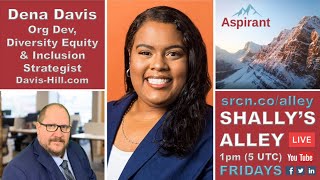
Dena Davis of Davis Hill explains how to build authentic diversity programs. She warns against the
Chapters
YouTube and then from YouTube back to Restream. So, okay, when I see YouTube come up, I'm like, ah, here we go. Okay, it is Friday at 1 PM, so that means it's time for Shelly's Alley. Today the focus is on diversity, and with us today we have a very special guest Dina Davis. Dina is an aspiring partner from her own consulting firm, Davis Hill. If you want to find out more about Dina, you can go to Davis-Hill.com. Dina is an expert in all things culture in HR, so culture and engagement, and DEI is part of that. So we had a really interesting conversation when I was introduced to, to Deena around some of the ways that she thinks about diversity that I, I resonated with. Deena had a great way of putting into succinct thoughts, some ideas that I've been bouncing around or have been kind of rolling around in my, in my head for a while. So I wanted to invite her and bring her onto the show. Welcome, Deena.
Thank you, Shelly. Glad to be on.
So it's a pleasure, absolutely.
Yeah.
So we talked a little bit about it. Oh, before we jump in, I did want to say, I thought you were going to be doing a webinar or panel or something. Are you doing a panel?
Yes, yes, actually we're doing a panel discussion next. It's on the 21st.
So, OK.
Yes, the 21st at 11:30, we are going to be hosting a live panel discussion. And it's, I nickname it affectionately, the State of the Union for DEI. And we have some local folks that are practitioners that are running programs for various companies. And we're just gonna talk about like what's going on in the State of the Union as it relates to today's world.
Yeah, that it was gonna be like important elements of a DEI program. What are some of the barriers that people overcome? How to jumpstart your DI efforts and what are some of the trends that are coming down in the horizon. And it's a panel discussion, so, you know, please join us if you'd like to attend. It's actually— I have a shortcut because the link to register is pretty long. So it's srcn.co/dinadavis. What I'm going to do is I'll probably just put it on a PowerPoint slide here so we can— share it on screen for folks that want to, you know, write it down. So the nice thing about the short URLs is they're easy to remember, but unfortunately the domains are usually not, you know, the cleanest because they've gotten much longer over the years. Exactly. So here, let me put this on screen real quick.
We're really excited about this discussion. You know, a lot of times when we're starting to engage with new clients, they're all coming from a very similar place, believe it or not, regardless of how mature their program is. It's more of, this is what we've done, what's next? You know, and what do we do next? And we've kicked this off and it's going well, and how do we continue that? So everyone's in a different space, but everyone has the same challenge of figuring out what do you do next with what you've done, or how do you get started? So I think, again, having the diverse panel will give some really good perspective.
Yep, so join us there. As you can see, srcn.co/dinadavis. And I'll stop that and bring us back to here. So we had a very interesting conversation. Some of that touched on what you're going to be doing in the panel, so I'm going to try and stay away from, from that so you guys can, can hit that hard in the panel. But there was something that when we first met you told me about, and it took me a second to register And then it was really funny and really insightful. I'm a big fan of metaphors and analogies that summarize complicated ideas very well in a way that you can quickly pick them up because you can always dive into something like diversity. You know, this is a PhD level. You and I talked about this too. It's a PhD level conversation. You could talk about diversity for, years, right? So, but sometimes you kind of need to make a real pithy conversation, quick and easy for people to just get the grasp of it. And then you can jump in and go from there. So you used an analogy that I want you to see if you could possibly repeat for us today. You talked about the Crayola box.
Oh yeah.
Can you tell us that again?
Yes. Yes. And so, you know, DEI is beyond the Crayola boxes. I kind of affectionately use that term. The reason that came about is because even in today's world— so just take a quick pause— DEI, diversity, equity, inclusion, in some form of training, curriculum, etc., it's about 50 years old, okay? So this isn't new just in the last 18 months to 2 years. What has been the new is people have renewed their commitment and/or interest in really taking certain things, I think, to another level, right? But DEI is not a new thing. So when you think about it, even in today's world, we still think about it as the Crayola box where, you know, and I think I gave the analogy, you know, you have the box of crayons and you have all these different colors in there. And when you look at that box, it's beautiful and you see the rainbow of colors. And, you know, we think that it's the translation of that where we're saying, okay, For me to be diverse, I need 1 of these, 2 of those, 3 of these, 4 of this. And we're very much coming from a perspective of color, right?
And picking and choosing. That's the other part that really struck me. Like, oh, I'm going to pick, you know, the Crayola box comes with the colors that are in the box. You don't go to the store and buy just 3 yellow crayons or 3 black and 2 yellow and 1 white. It's a box of crayons. And why are we like not moving past that idea? That's what was so engaging about what you said about that.
And that, that's really where I think is the challenge that most people have. That's how you overcome is first of all, it really is simple in its inherency. Treat people with dignity and respect.
If we wouldn't really have this conversation, we should be doing all the time anyway.
We should be doing that, right? And so if, if you're following certain, we call them basic human being or societal principles as far as treating other people, and you can put that into other perspectives too, then you don't technically have these types of challenges. A lot of the DEI work that we are doing is really helping people to, one, understand what does DEI look like in your organization. There's no cookie-cutter program that we just pick up off the shelf and just go and, you know, implement in a company. Everything has to be tailored specifically to your company. You also have to look at where are you at today versus where do you want to be? Because one big mistake— and I know we like to talk positives, but I'm going to talk about mistakes here— one mistake we do is we act as if we are already in the future state of what we want for DEI in our organization. And I think especially on the recruiting side, that's a big mistake. I think where we should be is honest. And say, here is where we are very honestly and wholeheartedly, but we have aspirations to improve these parts of the culture or to have better engagement or, you know, to make, have team environments more collaborative. When you come to a candidate that way and you're very honest about your journey of DEI, one, it's gonna resonate best with your internal employees 'cause they know what it all looks like, right? You can't tell them that, oh yeah, we're doing much better than we actually are actually are because they see it and feel it every day. So you're going to get more buy-in with your internal staff, but then you're also going to be telling an authentic story to your candidates. And you're not kind of doing a bait and switch and saying, oh, hey, come here, we have all this wonderful diversity. And then you get there and it's like, not really. Yeah. Huh?
I want to summarize that. So the Crayola box analogy is We got to get past the idea of selecting color.
Yes.
Basically. Sorry to be crass, or hopefully that's not offensive, but, you know, the box comes with 64 colors and, you know, that's the part, that beauty of diversity in the world is that everybody has a different perspective. So diversity isn't just a bunch of colors, right? Right. Number 2, when you're going to start out, or even if you're already in the midst of a diversity program and you don't know where to go, the first question you should ask if you haven't already is What does diversity look like in your organization now? Use whatever tools you can use. You might have the internal data, you might not. Even if you have to go out and, and use estimates, at least start somewhere to get an idea on what diversity looks like at your organization. Then where are you today? And then where do you want to be? Because that's the other thing that really resonated really well when we first connected, I always use the analogy of a GPS system. You know, as a consultant, I'm sure you get this question a lot. People often ask us consultants, what, what should we do next? What is, you know, that's what they're hiring us for is our advice on, you know, our experience and our knowledge from having been in lots of environments. So basically they want to know how to get there. Well, to me, the first part of how to get there is where are you now? Because you can't get there from here if you don't know where here is. So if you open up a GPS app and you're in the basement of the garage and it doesn't see a satellite and you try to get directions, it's not going to work. GPS is not going to give you any directions because it doesn't know where you are, right? It has to acquire the signal. So the first part of that is Where are we? Then we can figure out how to get there, or what the stages are to get there.
Right. Yeah. And that's, like I said, that's a big challenge because a lot of times we want to come out like raring, you know, like we are so committed, boom, and we're going to put this big stake in the ground. And guess what? People have caught on to tactics of, you know, using public relations and certain kind of messaging. And that's why I made the comment that your internal staff knows. They know what the culture is like. They know if you have broad acceptance of DEI or if you guys are on that early stage of that journey, right? And just a quick step, I just wanna mention, when we talk about the Crayola box and the colors, I don't want to minimize the importance of understanding unique groups, okay? Because there are, and one of the things we do that's, I think, probably a little unique is we really talk about DEI as a business. A business driver, as well as an engagement and culture initiative, right? So there's, that's the internal and the external. And it's really important that we not just, you know, what happens a lot of times is we just say people of color, okay? Well, look, even if you say Asian, you've got Chinese, you've got Japanese, you've got Korean, you've got, you know, Filipino, you can go on, you got, there's, there's different and distinct things within cultures. And so we, we want to gloss things over, we want to kind of generalize them sometimes too much, or we put too much focus and emphasis on things that don't matter. So I think there's a balance of that Crayola box analogy where we—
the uniqueness is— yeah, I get that. The uniqueness, right, is, is a palette.
It is.
It's a palette that you can use to construct, you know, the different perspectives. So rather than focusing on any one, whatever it is, does color criteria, whatever that criteria is, one criteria does not make diversity.
I think that's absolutely— Yeah. And then, like I said, you know, none of us want to feel ignored either. So if you have, you know, Black employees, they don't want to feel like you're just lumping them in with kind of everybody else when maybe there are very distinct cultural, like, There's African American. You can, you can be black, quote unquote, what we call black. Sometimes you get the questions of kind of like, what kind of black are you? Right. You and I talked a little bit about that. But you have people that look like me that speak Spanish. That's just the reality of it. So how do you— you don't want to be lumped in.
People that look like me that speak Spanish.
Right. Exactly. Right. Exactly. And so that's where we talk about just you don't focus on it, but you don't ignore it either. You don't ignore that uniqueness that we have.
It's an overemphasis too much. Yeah. Yeah. I love it when, you know, people— I identify as Hispanic and I check the box, you know, and I just, I love it when people are like, oh, funny, you don't look Hispanic. Like, what am I supposed to say to that? Yeah, sorry, I need to conform to your prejudice of what a Hispanic person is supposed to look like. Well, you're not dark like other Hispanics. Okay. Like, have you ever been anywhere outside of the United States where there are people that are, that, you know, that identify as Hispanic? Where I grew up, we got every color of the rainbow.
I mean, right. There actually is a question on the set, or a lot of times either for affirmative action or census, it will ask you if you are Black but of Hispanic descent. So there is a very specific question around that. And that does distinguish, you know, like my family's been here for, you know, I actually traced it back before the country was a country. And then you have people that have migrated at different times. And again, you know, we're not talking about judging anybody. We're just talking about just factual migration in history, right?
That affects your upbringing and your culture and how you see the world and the values that you hold and how that may be different from the values that other people— you know, on our last Shelley's Alley, I had a guest who is a diversity and inclusion champion and a staunch member of LGBTQIA+ community, who's— by staunch, I mean, is a supporter, is very vocal, very advocates a lot for the community in his corporate role and is a good example. But we had a really interesting question about sort of inclusion and belonging, and I wanted to bring that back to something that you said, and I promised him I was going to bring it back, um, because— and this is the— this is where the connection is— his focus is international, global, right? So the, the conversation veered towards what is global diversity, because I use the example of when I went to the Middle East and I did some work in Saudi Arabia. You know, look, I studied intercultural communications. My degree is in international business. I was prepared for this academically. I've lived in 5 different continents. I mean, I have, as far as I believe myself to have, a pretty diverse view of the world, right? So here I am in Saudi Arabia thinking I'm more enlightened than most people who visit Saudi Arabia and have these preconceived notions. And I was completely shocked at what they consider diversity there and what's normal for them, which is to them in several locations in the Middle East, not just Saudi Arabia, but it's Middle Eastern kind of diversity situation all around. They have people who worship on Fridays, others who worship on Saturdays, and others who worship on Sundays. So they have to— HR has to accommodate for people whose weekend begins on Thursday or Friday or Saturday. For some people in that culture, Sunday is a regular workday. They begin work on Monday as we do, but on Sunday. So, you know, so here we don't have that much difference that we have to accommodate for that. They do already. So you might think, oh, it's a very homogeneous culture, very— you know what, there's actually a lot of complexity to having to work. And now there's also an advantage, which is what we had this conversation about, which is, hey, you know what, that's great because you're not going to have a problem finding people to work on a Sunday because there's a bunch of people that are, you know, and you're not going to have a problem finding people to cover for them because So it's actually good to have that diversity, and that's actually a tool. But where we kind of got stuck— not stuck, but where we sort of ended up on our "let's ask Tina," which reminds me of something we talked about, is the belonging part. You mentioned on our conversation that there's an— there's a pro— I don't want to say problem, that's not the right word. There's a challenge, there's an entanglement with belonging that people sometimes don't consider. Can you expand on that, or do you mind expanding on that a little bit?
Yeah, the— actually, the belonging in itself, honestly, I think we can do a whole discussion on this. There's a lot going on in this space, and this is actually one where I'm pretty passionate. I've been on pretty— I'm an employee, but I'm also the HR person, right? So I have that unique perspective of seeing the organization at its worst Okay. HR gets to see all the problems and all the kind of dysfunction of the organization, usually firsthand. Reason why I say that is because what I see happening a lot is we're taking something where we want to, again, where we want to be aspirationally is kind of being, I should say, put into today's world prematurely and without a lot of thought. So here's what I mean by that. We hear terms talking about things like, "We want the work environment to be psychologically safe." Okay, well, you know what, who would have a problem with that? So here's what we mean. We want to have an environment where people can speak freely, meaning you can come to, I can come to Shelly, I can bring up a concern, we can talk it out, we can move it through, right? Or I can, you know, navigate through that organization effectively in the way that I need to communicate without fear that I'm going to be judged, or, you know, sometimes you have these hierarchies, well, don't talk to this person, must talk to me, right? Like, those all create stress. And so when we're talking about psychologically safe, we're really talking about environments that have good ways to manage stress, not stress-free, right? Not stress-free. And the reason why I say that is because now we're saying, OK, we have some things to work on. Now we have to shift this pendulum And I call it being like Pollyanna. Now we have to be like Pollyanna, and we have to— we feel as if we have to accommodate everyone for every emotional response or concern or what have you they may have.
I see. So what you're saying is the danger of— what we mean by psychologically safe is providing a safe environment for people to voice their opinions. But what you're saying is the danger of that, or the flip side of that, is that we may be accommodating for things that maybe we shouldn't be.
Yes, I will give you an exact story. This happened to me a couple of months, about 2 months ago. I was leading a team and we were looking at starting to roll out a diversity program. And one of the team members was very, very adamant and said, well, this is all fine, but what are we going to do about all these men in this organization that disrespect women and don't give them a seat at the table. Okay, I'm paraphrasing a little bit. And here's me, I'm kind of sitting here thinking like, wow, like, first of all, this is the first I'm hearing any of this, you know, working with this client. I know where our areas are, I know what we're trying to do, we have a pretty good direction. None of this has come forward, not in conversation, data, surveys, nothing. So I'm like, where is this coming from? It's a very different vibe. But in her mind, we were there as DEI practitioners to solve that problem. When I looked into that problem, it actually was a personal problem. This was a person that was in leadership, and she was asked to not be in leadership. She did not have good followership. She did not have good strategic planning. She wasn't good at getting the team riled together and get consensus. So she was asked and basically taken out of a leadership role. So basic bottom line, she was bitter. And there was no other evidence that we needed to take the program down the path of beating the men on the head for disrespecting women. But if I would have just listened to her and not done the additional investigation or even question and be like, well, where's that coming from? Is that a circumstance of just one time that happened, or is this all the time? Like, help me qualify this because I'm glad to put resources around certain things, but we just don't have any clear evidence that that's a focus area of the program. So I don't need to take everybody in the organization down this path because it seemed to be a very isolated incident, and I was able to confirm that it was.
Right. And now we've responded to an isolated incident that is a personal dynamic and painted with a broad brush. Had you not done what you did, all of a sudden, you know, putting a program in to try to fix or repair or mediate a situation that actually only exists between one person and another person.
Right.
Yeah, I get it. So with belonging, the danger is we want to include everyone and sometimes we take one idea that is very personal and make it a group idea, and it's not a group idea.
Yeah, it's, it's that whole analogy of the squeaky wheel gets the oil, but you've got to make sure that you're not—
it's really squeaky.
It's really squeaky. You know, years ago I worked at the University of Pittsburgh, and they have a food service operation, and we had a lot of activists that would do a lot of protesting because they wanted, you know, more vegan and plant-based foods and fine. Okay, fine. I mean, but they caused a lot of, you know, I did a lot of protesting and things like that because we were unhealthy and et cetera. And I say that with quotes because there were obviously choices you have to navigate. Long story short, we accommodated and put more of this type of food that they wanted and they protested for. And we were throwing thousands of dollars of food away every single day. And the top 3 sellers of pizza, hamburgers, and, you know, chicken fingers continued by far. So again, it was another example where we went and tried to accommodate what that small group of people said they wanted, and we created a solution that was actually bigger than the problem. So we were creating much more food than people wanted. And so we lost a ton of money off of that and ended up, you know, that program kind of You know, and people didn't eat it.
It's not only you lose the money, but you also wasted the food. People didn't eat it. So the goal was not accomplished. Nobody's goal got accomplished.
Right. And I think like, again, just those two examples, I think we can all resonate with. We all understand food and, and that sort of thing. But the challenge is to balance. We are coming to work. That's just the reality of it. Where you and I, if we work together, we're going to have challenges that come our way. We're going to have obstacles. We're gonna have to figure out things. You know, that's what work is. And it doesn't have to be contentious. We make it contentious by putting some of these— I call them layers of ego, you know, into the picture. But, you know, the best way that we can be clear about what kind of work environment we want and then putting the conscious effort toward it, that's what gets your results, not some big stake in the ground.
Staking a claim, we will be diverse.
Right. PR campaign. Right. Exactly.
When, when we spoke, you talked about how diversity is a hidden recruiter problem and hidden as in sometimes it gets the can gets kicked down the road. They stake the big claim of we will be this. And then they pass the, we're going to do this great. Now, hey, recruiters, go out and recruit some diversity people. Like, woo-hoo, you know, like we can just push the easy button on the vending machine and the next diverse candidate pops out. Right. So you talked about how it's a, it's a hidden recruiter problem. Recruiters are told to go do it, but they're not given the information that they need to know in order to do it well. So how are they supposed to do it right? What would be your solution to that? Right. Because this is something that I resonate with a lot. We have clients that come to us and say we want help with diversity recruiting. We have— I have people that ask me for advice on diversity sourcing. And it's not— you can't solve diversity through sourcing alone. Sourcing is like it is in recruiting in general. Sourcing is a tool. That you can use in recruiting, but it's not going to be the sole answer to diversity. And the problem that you identified was that recruiters are being directed to go and recruit diversity, but they don't have the information to actually do it correctly. So what happens is it backfires. What would be your advice on how to solve that? Because we don't, as, as recruiters, we don't necessarily have a direct line to the people. In the chat, somebody made a comment, which is why I'm asking this. We don't have access to the people that are making these decisions.
Right.
That's not— it's, it's a little bit too far. We'd love to be able to have a seat at the table, but the reality is we're not even, we're not even at the window buying tickets yet.
Right. So a couple of things, I think I can break this down. So first and foremost, recruiting, and this is actually one of my favorite things I love to talk about. Recruiting is the sales and marketing of HR. Okay, that's how I always use that term. It's our job to figure out what kind of opportunity we have. So we're going to look at, you know, what benefits, what are— what things are exciting about the job, you have career paths, etc. I have to create a product, right? And then I have to go out into the job market and I have to see who could be a good fit for this, right? Who could be a good fit for this role? So I am very much, when I'm in a recruiter role, a sales and marketing person. So I'm marketing the opportunities to the people that have or are interested in this type of work. I do that through job ads and networking and things of that nature. But then my one-to-one is a salesperson. I am then selling this opportunity to that person. The reason why I say that is If we think about it that way, I don't think we would have so much disconnect internally of making sure that the recruiters are fully equipped with understanding and having a good, effective way of explaining the culture and what's going on within an organization. People today, and you keep hearing all the news articles of just these mass resignations and such, and there's a variety of reasons. But, you know, there's a lot of times where, again, we're on the recruiting end. People want to know that you're authentic. They want to know that, okay, you say you're collaborative and this is the environment you have. When I come here, I am kind of expecting it to look and feel that way. So if there is a disconnect on how the recruiter is, quote unquote, selling the opportunity to the candidate, that's where you're going to get either dropouts. You're going to get people that don't call you back or they kind of ghost you at different parts of the interview process.
They're not going to tell you why.
They're not going to tell you why because they don't want to burn a bridge. No one wants to— I'm not going to sit— even though I do this for a living, if I interview with someone, I'm like, look, I can break apart and tell you where they messed up and how they didn't understand what I could break that down because I interview people all the time and I'm trained to interview. But on the other hand, it's like, I'm not going to go and just complain about every time I encounter somebody who you know, can't really answer a full breadth of questions about the company or the role. But that's your first line. And if you're disconnected internally, I think it's because, again, you're thinking of it something other than a business function. You're thinking of it like, oh, well, we need to just do this thing instead of looking at it strategically as sales and marketing, right? And then the third piece to that, I'll just cap off, is onboarding. So you need all of those components. So we need to figure out, again, what kind of culture environment we have. How do we communicate that to people in a realistic way? That, you know, again, you know, entices them to want to join our organization through that process of learning, right? Because that's what they're doing is through the interview process is the candidate is learning. We're learning about them. They're learning about us. And so we have to also be prepared for onboarding. You know, this is not a new thing. Again, none of this is new. I remember going back many, many years, I'll probably say like maybe 20 years. And I was at a committee and we were talking about how do we help companies retain the diverse talent that they brought in from all these other cities, because they bring you here and, you know, in this case, this was Pittsburgh. So they bring you here to Pittsburgh and they're like, okay, well, help me find a house. Okay, here's a realtor. Go buy in Wexford. Go buy in, you know, Fox Chapel. Go buy here. And then you end up, you know, if you're someone that we'll call it again, the POC, You're like, well, where are the barbershops? You know, like, oh, you know, like there's certain things culturally that you need access to.
I have direct experience with that exact, exact situation where I had a team that I managed and we flew into the headquarters city. I'm not going to spill the beans. And several members of my team came to me and said, we don't know who to ask. We don't know where to go. We, we need a barbershop. And I was like, you know, ignorant as I was, I said, well, can we just wait? Can we wait till we get back? Because it was only a 2-week trip. And they're like, uh-uh, no, we, it's, we go every week. We got to go like soon. I'm like, okay, all right, fine. So then I had to go and find somebody else, another POC to ask. And I asked them, hey, can you help me? Because I don't know what to, how to advise them. And that POC said There's only one in the whole city. And fortunately, he was able to share it with me and I gave it to my team. But I was like, oh my God, I've never even thought of that. Like, just how uncomfortable all the way around.
Well, you know, my hair is not very difficult, but I have a hairdresser in Pittsburgh. I have been seeing her for 15 years.
Okay.
I've lived in 4 other cities since then, and I fly back home so that she cuts my hair. It's just that serious. Like, we are in a serious relationship.
That's right. Yeah, no, I totally get that. I just, you know, of course it's a 2-week trip, so I didn't think about it because to me 2 weeks isn't long enough for me to be worried about it. Yeah, but it was for them, and I just never, you know. So you said something. I, I got your recap on the 3 bullet points. I've got that now. But you said something I want to touch on. Um, so where we are is important in all 3 of the things that you just said. Where we want to go is important. All three of the things that we just said, but there's something that really stands out. And that is, as a recruiter, we are selling the opportunity to them. We're telling them about the company, the culture of the organization. But then you also said when it comes down to onboarding, we need to teach them about us, but we also need to learn about them. I have a, first of all, bone to pick about that. And secondly, I want to say, isn't that already too late? Shouldn't we have been learning about them recruiting call? So, you know, on the second step of the salesperson selling the opportunity, talking about culture and diversity in our organization, we could have used that opportunity to start learning about them, not wait until, until the onboarding. And I think that may be something that's missing in recruiting in a lot of ways because the recruiters are told, go out and find people and attract them. So we tell them about our diversity programs at our company, but we don't stop to ask them what they define as diversity. But the bone that I have to pick about is you don't— I'm going to die on this one if I have to— you don't have to be in whatever group to recruit that group. Oh no. And I get this a lot. People say, do you know any diversity recruiters? Sure. Yeah. I can make some recommendations. Oh no, no, no. They have to be Black. Why do they have to be Black? Why does the recruiter have to be Black to talk to Black people? Do only white candidates only want to talk to white people? Wait, do, you know, so now we have to have a recruiter that's Black, a recruiter that's Asian, a recruiter that's Hispanic, a recruiter that's got a disability. Which disability? We gotta have, you know, a bunch of those. And a recruiter that is LGBTQIA+, but which one? Because there's, you know, like, come on, really? Do we have to, does the recruiter need to be No, you can listen open-mindedly to their culture and make the connection, just like you do when you interview them about their skills. You don't know how to do their job either.
Yeah.
To be a recruiter, you don't have to do the job. You just have to be able to ask the questions and make the connection. You don't have to be in that culture. You have to be able to ask questions and make the connection. I hate that. It's always been a pet peeve for 20 years. It's been a pet peeve of mine, particularly because I'm Hispanic and identify as Hispanic, but I very frequently get overlooked for the diversity jobs because people don't think I'm diverse.
And see, I think about that in terms of overall strategy, because if you have an overall strategy for your organization, you're going to have advisors or resources that help you understand specifics about different cultures. So I am going to reach out to my Indian friends and I am going to ask them, you tell me, I'm going to ask you a bunch of questions, refer me to people, help me to—
right.
You help me navigate this. Matter of fact, one very quick story. A friend of mine is very good friend of mine. Actually, he's a sales leader I've worked with and he's from India. And he showed me a picture of his daughter had just gotten a new job straight out of school. And again, we've known each other for a few years. I was really happy and seeing her. Go through her journey. And I'm like, oh my God, that's awesome. She's with an advertising firm. He sends me the link to the advertising firm. And the first thing you see on the picture is there's a, there's like, it's like a blackface kind of a character. Okay, now if you know anything about blackface or heard anything about blackface, it was kind of like a character where there's a blackface with like the big red lips and the big eyes kind of thing. And I'm sitting here like, wow, like, what do you do? Right? Like, I'm so happy for my friend and his daughter and making this career move. But do I say anything to him? Because culturally, that could— that's very offensive in our culture, but it obviously doesn't have the same translation there. So, you know, you have to be— and that's part of what we work on in the programming is creating situations and languages and dialogue that help us to have these conversations. Because I shouldn't feel offended and say, hey, Shelly, you know what, I'm going to— I need to really start. You know, I feel like there's a good labor pool in the Hispanic community for this type of role. And that's nothing to— that's not a bad sign. I recruit a lot of Asian, Chinese, and Indian engineers. That's just the reality. A lot of their industry and their countries have designed their school systems and curriculums to really crank out a lot of engineering. So that's, to me, not a bad reflection on that culture at all. It's actually appreciation for the fact that you all have set out to take over and dominate engineering. And you know what? That's kind of what we have today, right? So I shouldn't feel that it's a, you know, I shouldn't feel uncomfortable going to you and saying, hey, help me understand, like, what are some things, what are some blind spots I might have? Do you have some contacts that I could get in touch with? Can you introduce me? We should be working that way.
And I wouldn't feel uncomfortable being asked that. And the fact that, you know, when I was helping put together a diversity strategy at a client, One of the first things that I recommended was that we essentially create these internal subject matter experts.
Yes, exactly.
You know, they're already there. I mean, we didn't have to create the expert. They were already there. But we created a team, a table. We're like, all right, if you have questions about this, go there for simple things like, for example, translation, right? So French, you would think French is just French. Well, the thing is, if you're sending an email outreach as a recruiter and you're communicating with candidates in France that speak French, the language that you use culturally and even some of the words are different than if you're reaching out to people in Quebec. Québécois is still French, but, you know, in the same way that there are elements of French in patois and other French derivative languages, it's not the same. So it's totally okay to send the message to your patois friend and say, hey, can you read this? Make sure I'm not saying like the wrong thing. That's part of my preparation when I'm doing the recruiting and the outreach, because otherwise you could completely accidentally, without any intent, be culturally insensitive. And that's different than bias.
Okay.
I'm not talking about unconscious bias. I'm saying you're just oblivious to the fact that something that you say may be considered offensive, inappropriate, or simply just confusing. I mean, it doesn't even have to be a bad thing. It could be a, what is that? What does that mean? Kind of thing.
Right, exactly. And that's why, again, just engaging and having this conversation beforehand and really when we talk about creating strategies and things, people tend to think that this is very heavy, very long drawn out kind of work. It's really not. And it's really more of you deciding what you want to be. And then we figure out how to get there, right? And what sort of things need to move in order to do that. But what you just described We have taken time to think in terms of the connections of DEI through the organization. But more importantly for this conversation is we have plenty for you to feel prepared as a recruiter to then go out and engage. You see what I'm saying? The challenge comes where we just kind of, oh, look, okay, now I need 5 Blacks, 2 Hispanics, 1 Asian, and any combination of women, right? 'Cause that's, you know, that's what I call the Crayola box, right? So that's a lot of times what I see and I'm hearing from a lot of my recruiter friends. And that's honestly, like I said, that's very unfair. It's not saying that we don't want to increase or improve our recruiting efforts with a certain community, because then that gets into your strategy. You know, if we, like, there was an example, a local police department back home, this was many, years ago, I was at a community meeting and we were talking about diversity challenges with hiring police officers. And we were trying to, everybody's kind of presenting different ideas. And I told them, I said, none of those ideas will work. And they said, why? I said, because what's going to happen is you're going to hire a bunch of diverse people, quote unquote, and then they're going to come in and they'll be at the very bottom of the union ranks. And so that means they have to work all the holidays. They don't get to go the hunting season, you know, deer season opens. They don't get to, you know, they don't get to do any of that because your system created the hierarchy of these tenure-based union environment. So everybody in the union is here, all your minority, quote unquote, people are gonna come in here. You've not solved the problem because what's gonna happen is these people are gonna fall off because they're gonna take better jobs. They're not gonna stick around and wait 20 years to be where you're at. You have no— You have no equity. So that's the other piece of what you hear now in today's world is the E, right? Is the equity. And so I explain that example for them in that way to say, again, like we're talking, it's not just about getting them in the door, it's about what happens when they're here, you know, and we forget that and we're just like, go get them, go get them.
Yeah, bring them in. It's just like if we build it, they will come. It's not like it's not going to.
Yeah, I've seen that crash and burn my whole life.
Right.
If we build it, they pay me. That's okay. Keep letting it crash and burn.
You just tell me. I'll come back. Stashhill.com is all I'm going to say about that. Um, I know we were running a little bit over, but there was something I've been dying to tell you because you educated me on this and I was embarrassed and ashamed that I didn't really have a very good explanation for this because I profess to have the answer. And my answer was incomplete. So I would like for you to complete the answer. And I'm just going to ask the question. You give your full answer. Explain the difference between affirmative action and DIB or DI.
Oh, yeah, this is a good one, too. So now, again, there's— these aren't completely separate things, but they are completely separate things, right? So I kind of sound like—
I got it wrong because I just, I just think I separated them. And put them on a PowerPoint slide where I described the two, and that was only partial answers. So I don't want to ruin it for other people. Tell us what the difference is.
Yeah, absolutely. So you're— we'll start with the DEI because we're already on that. So your DEI is, it's a program. And so again, what we're looking at is we're looking at the internal and the external drivers that impact DEI for the organization. And then we're figuring out what needs to happen in order for us to achieve the outcome or the goals we set. Again, that's just as simple as I can, vanilla as I can give it to you. But that's gonna have a lot of, what you're trying to do is create synergy. So you want different parts of the organization that are going to be talking to each other and sharing and making sure that what we're doing from a DEI perspective, it's infused in what you're doing. It's not just this separate thing, okay? Now, your affirmative action, that really comes honestly down mostly to compliance. Compliance. So if you are a federal contractor, for example, and you hold a certain amount of federal contracts, you are required to do an affirmative action plan. An affirmative action plan is a compliance process, and that is the federal government wants you to make sure that you are actively recruiting and making your jobs available to a diverse pool of candidates. And then they want you to do some work at that, meaning you need to look at and understand your, local demographics in order to help figure out. So like we're saying, it's not a— this is not a quota system in this example when we're talking about employment. It's not a quota system of like the Crayola box, but it is to say, what does your local population look like? If you work in an area and it's, you know, I don't know, 40% Hispanic, and you've got 2% of your senior leaders as, you know, that are Hispanic, it's kind of like, oh, well, wait, Then the question says, why is there a gap? Are we underrepresented? Are we not communicating our effort or our jobs to, you know, this diverse slate of candidates? Because this is what our local population looks like. So then they will ask you in that affirmative action plan to then break down and create remediation plans. So are you, are you going to increase your efforts in that population? What are you going to do? Because demographically you look very different than what your local labor pool looks like.
So essentially, who are you leaving out that should be— yeah, and it's not, it's not you are leaving out Blacks, you are leaving out gays. It's who are you leaving out? And then let's make sure that doesn't happen. It's completely different, right? That's to me, that's the biggest question. And in every diversity conversation, I start with What does it look like right now? Because you can't— if you— I'll use Atlanta as an example. Atlanta is a very diverse city. And in fact, if you have headquarters here, you would be pretty hard pressed to not have decent representation amongst the, you know, the POC community. Because it disproportionately compared to the rest of the country, we have a higher percentage of people in the working population So, you know, you're already at an advantage, right? If you looked at diversity here, you might find that you're very well represented in that community, but you're lacking in another. For example, we also have a high population, high percentage of the population in the LGBTQIA+ community. But have you even looked at that in your organization? Are you forcing those people to remain silent when they're in the room? And can't speak because they don't feel like they're being recognized. So that's the question of who are you leaving out, as opposed to we have a program, our program is going to be to have— we're going— my favorite one is an example of a client that said we're going to have 30% diversity hires. Like, you know, pound the gavel as of right now.
Yeah.
One out of three or whatever, whatever the number actually turned out to be. Of all of our hires will be diversity. Well, first of all, how do you know that right now you might have 2 out of 3 of your hires are already diverse? Are you even gathering that information, right?
Yeah.
I check a couple of boxes. I check the Hispanic box. I check the people with disabilities box. There's a couple of other boxes too, you know. So are you, are you looking at that, or are you just categorically writing a number on the wall and saying this is going to be our goal. And I think that's, that's where the error is, is in not understanding who's in the room, who's trying to get into the room but can't get into the room. And once they're in the room, who's not being heard.
Yeah. Yeah. And I think too, when you're talking about then bringing the teams together, we, again, you've made the point earlier, we often think like build it, they will come. And I hear this all the time, like, oh, these are very bright, intelligent people. And they absolutely are. But that doesn't mean we we can't take a couple of minutes to try to make sure that everybody is clearly understanding and fully on board with how we need to operate. Because this is a little-known fact, the biggest challenge that most of us have internally with DE&I within our workplace, it's not ethnicity, it's work style. And so what— Again, you don't like the way I express myself. Oh, she's too animated. She's too this. Well, you know what? There may be some cultural elements to that where, you know what, this is kind of how we've always, you know, communicate. So it all ended in the bottom and the end of the day, I should say, it ends up being mostly about work styles. And that's why I talk so much about the onboarding. And so, you know, the other thing is, you know, our society in the US— we'll just keep it US-focused— is largely based on middle-class white values. Our school systems, education, everything that prepares you for the workforce is really based on that. And you can go back to the '50s, right? So that's where our kind of modern kind of view of things has started to really come together.
That's, that's our— that's how our work style evolved was from that wellspring. Right? Regardless of your ethnicity or gender or sexual preference or religion, your work style was either— you were either brought up in that or you adapted to that, right?
Exactly. And so, you know, when we are judging people, if you want to say, of how well they are assimilating to a culture, we're generally using the middle-class white value view of of that as the benchmark. So that says—
As the rule of thumb, remember that one?
Right, it says listen when you're being talked to. It says be respectful of authority. It says don't interrupt when someone's talking. Well, look, I mean, my community, it's double Dutch, baby. You gotta get in on that conversation. You can't just be sitting on the side waiting for somebody to pause 2, 3, 4, 5, and then just jump in. We're very, very fluid and we're very animated, right? And sometimes in our communication, which we call expressive. So to us, that's very normal and it's actually pretty endearing. But when you take that into the workplace, it's distracting, intimidating, because you're basing it on the middle-class white value of system of things. And that's what I talk about too with organizations is Who do you want to be? I'm not trying to tell you who you need to be. I'm just trying to say you have to decide who do you want to be. If we are the organization that is founded and holds very strong principles on the middle-class white values, then we are going to do our best to try to get people to assimilate to that in the most, you know, embracing way we can.
I think that's, you know, that's a way bigger, way bigger concept than even the neurodiversity. Neurodiversity, because people have been talking about neurodiversity a lot recently. But even within the concept of neurodiversity, you still are operating within that predetermined or pre-established work style. So if you had that diversity of work style, it would probably also allow for neurodiversity organically because of what you just described and the way that communications I mean, I would say this. I'm going to find this and post it with the chat. But one of the things that I learned in college, because as I said, international business was my background. I took this class. I can't remember exactly what it was called, but it was basically called something to the effect of nonverbal communication.
Oh, yeah.
That was really enlightening. And I think maybe that's what I want to bring into you know, this conversation that helps people understand how different this— because it's not just work style, it's communication style. It's not just introvert versus extrovert. There's all these other nonverbal clues before you speak or outside of speech or outside of the words or even the language that you use that form a very large part of processing of signal, the signal that you send and the signal that you receive, not with words. Is sometimes 70, 80%. I mean, you could say a word that is poisonous in a way that is not, it's funny. You can say a word that is not poisonous in a way that is, it's not funny.
Yeah. Always like, "I love you." So that's a great one. Like, "I love you," or "Love you." Right. You know, very, very different feeling, right?
Oh yeah. Except for in the, uh, in the— I went to school at RIT, which is houses the National Technical Institute in DAF. And, you know, early on in college, somebody taught me this. If people are reading lips and you say elephant shoes, it looks exactly like I love you.
Oh, interesting. Yeah.
Wow.
I think about it on the psychological plane because, you know, like most of us, we're driven through subconsciously You know, and like I was telling, you know, some of my classmates that I grew up with, I grew up in the white middle-class value system. Okay. That's just the way it is. I had to go and kind of explore myself, you know, to find other things outside it. And which is why I'm also, I feel like that's led me to this type of work because I was always just so curious and always wanted so many other people to meet other people and kind of learn about them because I didn't have very much diversity where I was. And so, you know, I just share that because, you know, as I look at how I go through life, you know, it is, it's very similar in a lot of that, but I've learned because I've worked with a lot of people from other countries, mostly, of how and where Americans tend to have some of these biases. And when you said that, you know, DEI is becoming global, it's always been global here in the US because we're all coming from somewhere else and we have a mix of different cultures. So that's why I talk about then again, that translates a little deeper into the work style because, you know, I'm, uh, you know, like my family, you know, we're, we're assertive, we're builders, we're, we get stuff done, we get organized, and that's kind of like, you know, our thing. But then you come here and it's like, oh, well, You know, things are happening so fast and I don't know what's happening. It's like, well, what do you want here? You know? So again, it becomes these more, you know, personal things that we're bringing our— one of my practitioners, she always used the term backpack. You know, like you have your backpack full of all these experiences and thoughts and ideas.
Right.
And so every time, if you come in and you and I are working and you trigger something in me, I'm literally, I'm taking that backpack and I'm throwing it on the table. I'm like, wait a minute, right? And you know, that's not necessarily the way we need to resolve things, but that's what happens a lot. We, you know, and I just very quick, I know we're on time, but I had a friend of mine, he had talked about a situation that was actually quite horrific. It was about a 2 to 3 year ordeal. There was a person on their team in a customer service area that was transitioning. And there were a lot of— it was transitioning from male to female. Nobody had an issue with the person transitioning, but the person's behavior, they were creating a lot of discord. They did not get along very well with their coworkers. And everybody was afraid to say anything because they're like, if I say anything, they're going to think I'm homophobic and I'm not supportive of this person. But this, there were literally dozens and dozens of employee relations issues, complaints from staff. He was a, you know, he, I would say she, he going into she, she was aggressive. There were different kind of reactions that were very unpredictable. And so everybody suffered in that environment for years because they didn't want to come across as the person who didn't wasn't supportive of that person's transition, which was not the issue at all. The issue was they were a tyrant. And when that person finally left that department, literally people got up and celebrated because they created so much stress in that work environment.
It had nothing to do with their being trans, nothing to do at all, or female, or—
yep, exactly, nothing to do at all.
Personal.
Yeah. And I, again, I just share that because a lot of times most of us don't get to, you know, we're not in HR and we don't see these types of things come through, or we don't oftentimes speak about them because of confidentiality reasons. But these are real stories. And that's why I talked about the belonging and making sure we're not swinging the pendulum too far, because in that example, we did. We let bad behavior go on for years. At the expense of the employees, and either because they didn't feel comfortable or we didn't create an environment where they felt that they could bring their concerns forward, or we didn't handle them appropriately when they did.
Belonging became, you know, the danger of groupthink, essentially. Yeah, people belonging to the wrong thing, right?
My friend even said, like, one of his friends complained and they were told that we accept this person's transition. And that person was trying to tell the person they complained to, like, that's not even my issue. I don't have any problem with, you know, him transitioning to female. I have nothing with that at all. But he's aggressive and he's disruptive and he doesn't participate and he doesn't share. And he— you ask him for information and he, you know, he was very, very moody and aggressive with people. And that was her issue. And they actually, in that case, It's— he said that they ignored the issue because they didn't want to—
they didn't want to confront the other thing or get it mixed up. Yeah. Yeah. Wow.
So yeah, it's graduate level here.
Yep. PhD. PhD in DEI. All right. Well, thank you so much. We have srcn.co/dinadavis. Dina will be hosting a discussion group panel on October 21st, and you can always reach Dina at davis-hill.com. Thank you so much for being our guest today, and I hope to see you back on the show.
Absolutely. You just tell me when. We'll get— well, I'll put it on the calendar.
See ya.
Take care. Have a good one.
Bye, everybody.
More from Shally



Scaling Talent at Hypergrowth: Leadership, AI, and Hiring Excellence with Cindy Nicola







