Shally's Alley Live
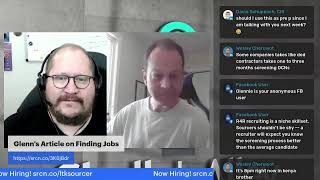
Vital-Baritone shares how to hire talent sourcers and find sourcing candidates. He covers key interview questions, metrics like conversion rates and submittals per day, and a four-to-six-week probation period. He also explains Boolean search strategies to surface relevant titles while avoiding false positives like procurement roles.
Chapters
All right, all right. Hello everybody, happy Friday, August 19th. It's time for Shally's Alley. Well, today I have, uh, an interesting topic. What I would like to talk about today is hiring sourcers, uh, kind of a selfish topic really because I'm hiring a sourcer right now. So if you're tuning in I am currently hiring and, well, first of all interviewing and then hiring a sourcer. Let me put this on the screen here. There we go. If you're interested, check out srcn.co/LTKsourcer. Well, what I want to talk about today, and please chime in here as much as you want to, this is kind of an open floor. 2 things. Number 1, interviewing as a sourcer. So interviewing for a job because some of you affected recently by the layoffs are probably out there looking for work right now. So here's some tips on how to interview when you're the sourcer being interviewed and flip that also to the other side as the interviewer, talk a little bit about that. And then the second component is how to find sourcing jobs, how to find jobs that are available for sourcers these days. And I know you're sourcers, you can find anything. I mean, I used to think the same thing too, but honestly, when I was looking for a job, it was hard to sift through a lot of the information that was out there and find the, the right job, the right mix. So it wasn't as much as there's no jobs open, it was like there's lots of jobs open. There were, I think, something like 30,000 openings for a sourcer at the time that I was looking, and I'd scratch my head and be like, how am I supposed to even apply for this stuff. So please join us in the chat if you would like to chime in. I've got the chat overlay over here, so your comments will appear in the, in the stream. And don't forget to visit srcn.co/LTKsourcer if you are interested in applying for the job. And please ask questions right in the chat, in the, in the chat box there. It should show up over here on stream, uh, actually whatever you type in there. So be careful, don't type anything that's, you know, too obscene. Um, this is, uh, it's not a, you know, it's, it's not a censored show, but, you know. So I wanted to talk a little bit about interviewing as a sourcer. I, I've, I've conducted a number of interviews recently, and, uh, 6 months ago as well when I put together my team, and, um, 6 months before that and a year before that. So over the years I've accumulated some I guess let's say good and bad experiences. And I wanted to relate some of those for you guys here today. The most important thing that I remember from all of these interviews is that as much training as I received in don't make a decision in the first 5 minutes, you know, try to force yourself not to have a bias. Everybody has a bias that, you know, they call it unconscious bias, but being aware of it. Oh, thanks, Jennifer. Big shout out from Jennifer. I have to say, despite all that knowing about that, there's still some things that can happen during an interview that almost— they take me to the edge of like almost getting, you know, of the bias coming back. And one of those is over-talking. I encourage you to Be economical with your words when you're interviewing for any job, but in particular, when you're interviewing for a recruitment-related job. There are some questions that we need to ask, and if you don't let the interviewer get through those questions, it's going to hurt your scorecard in the long term. So, if you're asked a question and you don't understand the question, Ask a clarifying question. If somebody says, "So tell me about your sourcing experience. What kind of roles have you sourced for?" And you're not really sure what to answer, there's certainly nothing wrong with coming back with, "Well, do you mean most recently or which ones have I sourced for the most in my career?" "Oh, okay, well, how about most recently?" "Oh, all right, well, I've sourced for this role and that role and these roles." And that's it. So you answer the question, perhaps add a tiny little bit of color, but what I've seen a lot of sourcers do is either nerves or, um, I don't, I don't really know why. I probably do it myself. They just keep talking and they try to explain more, like about the role or about the company or about the environment. Well, I didn't really ask about that, and I have another question I want to ask. So if it takes you 15 minutes to answer my first question about what type of roles you sourced for, and I have 5 questions I want to get through Now we only have 15 minutes for the other 4. So try to stay on point and answer the question. And if you don't feel like you've answered it enough, you can always follow up your question with, did that answer your question? Or have I answered your question sufficiently? Or did you want another example? Or something like that. So that, that over-talking and, uh, continuing to explain can, can be helpful if you're repeating something in a different way and explaining it in a different way, but sometimes it's just going off on a tangent. So that's number one. Number two thing that I've seen, not as frequently, but that it also sort of taints the interview, is when you start providing almost like excuses. For the things that you did or you didn't do. For example, one of the questions I like to ask sourcers is, tell me about which search engines you're familiar with using. Now, if you were a developer or a programmer, I might ask you a question like, what is your preferred programming language? That's a perfectly natural question to ask a developer. What is your preferred— they know lots of languages. Most developers these days will have started in one, you know, they started with C++ and now they do Python or whatever, and they may have a favorite. So it's okay to ask them which one is their favorite or preferred and which one are they most comfortable in coding in or writing in. So same thing, right? I'm asking a sourcer what your preferred search engine is or what search engine you're most comfortable using. And what I want to hear is an honest answer. Like, for example, I don't really use search engines much, I depend mostly on LinkedIn, or I like Google, or I've tried Google and Bing and I prefer Bing because of this. What I don't want to hear is, well, I don't really use search engines much because, and then blah blah blah blah blah, and we get into this whole explanation as to why you think maybe I'm asking you about the search engine because I'm testing you on your— no, I really just asked you what your preferred search engine is. If you start telling me about all the reasons why you didn't use that one, or you did, you're over-answering the question, and it has nothing to do with the question that I asked. So maybe don't read into it is the second thing, right? Sometimes the questions are basically that. I want to know what your preferred whatever is. If you have any ideas, by the way, please throw them up on the screen here. If you have any ideas or questions on, you know, the things that you've encountered But these are just some recent experiences as I've been interviewing sourcers. Another thing I want to say is the job of a sourcer is very different than the job of a recruiter. And if you're interviewing for a sourcer job, the job title is talent sourcer, researcher, scout, whatever. It's, it's a research function. If you're interviewing for that job, um, and you are more passionate about the recruiting side of the business, it's probably not going to be a really good fit. Let me tell you why. You may be able to do sourcing. Hey, a lot of us are utility players, and by that I mean we can do multiple things. You're not a one-dimensional character that can only do the one thing. You're not a hammer that only hammers nails all day. Sure, you can also recruit. You can also perhaps sell and talk about benefits and write job postings. We, we all have various abilities. But if you're interviewing for a sourcer job, I want to hear about your sourcing experience, not about all the recruiting experience that you have, which makes it sound like you're very passionate about recruiting and not very passionate about sourcing. If I want to hire a sourcer, I want this person to be a sourcer and want to be a sourcer, not someone who's going to take the job in the meanwhile until they become a sourcer or grow up one day to be a sourcer, or until a source— I mean, a recruiter, uh, grow up one day to be a recruiter, or until the recruiter opening, uh, opens up. No, I'm hiring somebody for a sourcing position. I want to hear the passion. I, I don't mind career growth. I will help you if your ultimate goal is to get into a different career. As a, as your boss, as your leader, I'm going to do that. But I don't want to hire you for that role. I want to hire you for this one. So don't answer those types of questions. And what I'm talking about is, if you're a recruiter and you like making the offer, that's great. Sourcers don't always make offers. In fact, very frequently we don't. Sometimes, rarely, we do. But most of the time, our job begins at the front end or at the top of the funnel with identification. Where are these people? How do we find them? How do we get to them? Some of us will go on to engagement. How do we reach them? We contact them, email, text them, calling them. Some of us do phone sourcing. But in general, we're bringing people in that are not applying for the job. We're looking for passive talent or whatever you want to call it. Semi-passive, hidden talent, etc. We're looking for people that don't apply for jobs. So, a majority of our job has to do with that. Some people call it hunting. Whatever you want to call it. And then some of our jobs depend on converting those people. We might have to do outreach email and be persuasive on the phone and on email. So, I'm looking for that as well. But once we've got somebody interested and we answer their questions and we ask them some questions, and we determine that this is a person that is interested and qualified in taking the next step, our job is done. We don't stay involved, if anything, other just to track and follow through what we've done, but we're not as involved in the rest of the process. So, when you're talking about your experience as a recruiter that can do sourcing and you want to switch to a sourcing role because you're no longer interested in recruiting or you're more interested in sourcing or you want to gain experience as a sourcer, answer the questions from the point of view of How did you find these people? Where did you go? What did you do? What was your outcome? What was your response rate? What did you ask them? Did you screen them or not? How many submittals did you present a day? I've been on calls where I asked how many submittals a day or a week have you averaged on a scale or a range. I don't care if it's 5 to 10 or whatever. I just want to get an idea as to the volume, and for different roles is different things, right? Directors and VPs is one thing. Help desk technicians in another, but I want to get to know kind of the volume and the pace and I ask that question and the answer that I get is basically a whole bunch of explanations on how many candidates they presented for one rec, but that doesn't tell me anything about per day or per week. So keep in mind the perspective of the life cycle of a sourcer and even though you may be a recruiter that wants to transition, answer the questions that way. In other words, think about finding them, getting them to engage, converting them or getting them to become interested basically, and then following through, tracking, presenting to recruiters or hiring managers, and that's it. Anything beyond that is now out of scope. Now you can ask and clarify, "Hey, well, in your organization, where's the handoff?" That's a good question if you're interviewing to ask the interviewer. You can ask questions like, what type of roles? What's the workload going to be like? What's the relationship structure between the sourcers and the recruiters? What's the relationship quality like between sourcers and recruiters? Are they well regarded? Are they considered equals? These are all really good questions that you can ask a recruiter. You can even ask in your organization, do the sourcers conduct some of the same job as the recruiters do? That happens. There's some overlap there. Where requisitions that have been escalated or sent to the sourcing team sometimes are taken over by the sourcer, and the sourcer essentially does almost all of the job up until presenting to the hiring manager, and the recruiter only gets involved at that, you know, last point to kind of manage the offer cycle and things like that. It's okay to ask all that, but don't jump to conclusions and start answering the question as a sourcer. It is a very different job. I want to hear from you. What experiences have you had, good or bad, when interviewing for a job as a sourcer? Have you had any really funny or interesting questions that you've been asked as a candidate, or are there any questions that you always ask as a recruiter recruiting sourcers that you want to share with the audience? Wow, we have a long-distance traveler from Kenya. Welcome. I wonder what time it is in Kenya. It's probably pretty late at night. Well, thank you, Wesley. Uh, do you have any experience interviewing for sourcing jobs? Are things really that different in other parts of the world, or am I talking about the same kind of things? Recently, what I started doing, and you'll see if you go to the application for this job, is I've asked a few more questions at the beginning on the form when you complete the application. This does reduce the applications somewhat because I'm asking 2 questions, and you know, people don't want to fill out forms. But however, we have made it so that you can do, uh, upload a resume or easy apply on LinkedIn, so it shouldn't be very cumbersome. Uh, it usually takes a couple of minutes to, to fill out the form. So I feel like 2 dropdown questions is not too much to ask. And what I'm doing is I'm using those dropdown questions to understand if you really are more on the sourcing side or on the recruiting side, because there's some confusion. And I'm doing that because of the amount of confusion, because there are recruiters that apply for the job thinking that they can do it because they've sourced for their own candidates. But there's a big difference between sourcing for your own candidates when you're a recruiter and sourcing exclusively as your primary job and sourcing for a lot of other recruiters, not for your own candidates. Ah, here we go, a good one. A recruiter will expect you to know the screening process better than the average candidate. That's good. Yeah, because you're screening candidates. That's right. Yeah, exactly. So what type of questions do you usually ask? How long do you take to screen a candidate on average, right? Sometimes it'll be 15, 20 minutes, maybe 30 minutes, whatever, those kinds of questions are really good to ask. Good point from a Facebook, anonymous Facebook user. So these two questions that I ask are designed to essentially help me go through applications a little bit more intelligently rather than just going through in order that they come in. I can group them. So if you answer question number one a certain way, then I— you go in this group. And if you answer question number 2 a certain way, is batch number 2. Oh, Glennie, hey, good to see you, man. Hey, you know, you've interviewed a lot of sourcers. Why don't you come on the show and talk about that? I want to hear about it. Let me send you an invite here to be on the show if you want. You don't have to, don't feel any pressure. But I know you've been hiring sourcers. In fact, you've probably hired quite a few, if I'm not mistaken, um, recently in your new job. So I'd love to see or hear what kind of questions you have. I just sent you the invite in Messenger. All right, hope you can join us. No biggie if you can't, um, but I'd love to hear— not hear, but read— if you can't join us, read about some of the questions that you have asked in interviews. So the other thing that I wanted to share with you a little bit is how to source for sourcers. And, uh, oh, it looks like we got Glenn here, so let me bring him in a little bit. Hey Glenn, how's it going?
I'm here. Sorry I'm late.
Oh no, of course, don't be late. You're, you're right on time. When you're here, you're right on time, Glennie. Well, it says some companies like DoD contractors take 1 to 3 months screening. Oh, wow. Okay. Sorry, go ahead. Yeah.
I don't actually interview a lot of sourcer candidates in my current role, but I've obviously done it in the past. I just like people to probe and to dig, because I would want them to do the same thing when they're talking with a candidate. So you should be doing that in reverse here when you're talking to that recruiter who's interviewing you.
Right. That's a good point. Right. Probe. Exactly. Be curious. It's a sourcer's, you know, one of the core essential competencies of a sourcer is to be endlessly curious and investigative and keep, you know, searching. Right. So probing and searching, that's a really good point. Absolutely. Now, have you, have you had any weird experiences when you were interviewing as a sourcer?
Well, I mean, I, I won't name names, but they're obviously people who are freaking clueless, and I'm amazed that, uh, they thought that they would be qualified for anything beyond entry-level sourcer.
Wow. So they just like, you know, didn't even read the job description?
Uh, that, and I, I just don't know how you advance in your career to whatever point you are that you consider yourself a senior sourcer and you don't know jack about Boolean and X-ray and all the other basic stuff, right?
Yeah, well, I guess the cat's out of the bag. Um, the, the two questions— one of the two questions that I'm asking is of the 4 below, which one of them is not a Boolean? And there's AND, OR, NOT, and IF. I'm not gonna give you the answer here, but you can imagine how many people choose one of the 3 Booleans and not the one that is not a Boolean so many times. And it's like, whoa, wait a minute. Now what I've started doing, partly because of your advice, is questioning that. So I'm not eliminating anyone based on their answer, but when I start talking to them, one of the first things that I get to is Hey, you know, when you started filling out the application, um, you answered which one of these 4 is not a Boolean, and you said this one. Are you, are you sure? Is that, or was that a mistake? And they're like, oh yeah, you know, I meant to change that, or whatever. Like, okay, because it's like really, really basic. But I know what you're talking about. I've had some people come in that had like 6 months of experience and they're applying for a senior technical talent sourcer. Which means two things. It's a senior position. I don't think 6 months qualifies. And it's technical, which means that it's okay if you've had a lot of experience sourcing non-technical positions, but I'm specifically looking for someone that has experience with technical. I don't necessarily need you to have experience in ML or AI or, you know, very narrow, but, but just knowing how to talk to screen, as you said, programmers is, is what I'm looking for here. So, you know, that's— I think that's kind of what you're getting at, right? Just a mismatch, right?
Yeah, the type of role demands some domain knowledge, and if you don't have that, yes, a good sourcer can eventually learn it, but I don't be wanting to be paying you for the next 6 months until you get that, right?
Because you're paying for senior sourcer rates. Exactly. Yeah, there, there is a junior sourcer position. Yeah. What do you think, Glenn, and, and my audience members, what do you think about this? What do you think about the metrics as part of your interview process? And I'm asking because in the job description, I do have a couple of metrics only just for the sake of transparency, right? If you're going to come into a job, I want you to know roughly what's expected. Now, I'm not holding your feet to the fire to an exact metric. For example, it says 75% conversion rate. To expect a conversion rate of 75%, what I mean is if you're submitting 10 people, then the hiring manager and/or whoever it is that's receiving them is accepting on average of about 7.5. Obviously, that's not a real number because nobody accepts the half a candidate, but if you're averaging 7 out of 10 8 out of 10 submittals to accepts, then I know that your quality is good. And it's a very objective way to look at whether or not you're presenting candidates that are wanted by the hiring manager. If you're presenting 10 candidates and another sourcer is presenting 10 candidates, but yours are accepted to the 8 out of 10 rate and theirs are accepted 5 out of 5, then I know that there's some gap and I need to, you know, hold the other person up a little bit and maybe spend some time with them and support them. It's not like, uh-oh, you only got 5 out of 10 this year, or you only got 5 out of 10 this week, you're cut. No, it's not like that. But what do you think about being transparent in the job description upfront and asking them about their metrics at their current job? Is that unfair? Anybody? Anybody?
I think it's fair to ask. I'm just worried about people potentially fudging that number. Because how are you going to prove it one way or the other?
No, I can't, and I'm not really asking for proof or evidence. I'm just asking from the point of view of, listen, if you do want this job and you take this job, just know that I'm gonna expect 2 to 3 submittals a day, you know. And, and that also has to do with the type of job and volume. Now, in my business in technology, it's 2 to 3 submittals a day, but if you were in healthcare recruiting that would be pretty dismal numbers because the volume is much higher. I mean, I know some nurse recruiters that make 300 hires a year. I don't know any software engineering recruiters that have 300 hires a year, right? So obviously that's going to depend. In my environment, which is technical and software engineers, 3 submittals a day is, you know, kind of a good target. It could be more, it could be less, but that's what good looks like. So I like to be transparent about it that way just so you know what to expect coming into it. If you fudge it, if you tell me, oh, I've done 10 submittals a day, I'm not going to ask you to prove it. But if you come in here and you only do one submittal a day, I'm going to know that there's something off with that, right? You know, so what other questions? Yeah, go ahead.
You need to have some kind of probation period to prove that the numbers they're claiming are good. So is that part of your hiring criteria, or you have some probation?
Yeah, I do. You know what, I usually tell them when— if this is something that comes up during the interview, and if not, it's something that comes up once they get on board— and I tell them that they have 4 weeks to ramp up. But the reality is that I think it's really more like 6 weeks, and let me explain why. The first week essentially is orientation. I mean, the first week is like, even though we got you all your equipment and you're all set up with your logins and passwords on Monday morning at 8 o'clock, the first week is still what are the departments, who am I working with, meet the recruiters, um, get familiar with the ATS. Even though it may be an ATS you already know, it might be configured differently. So the first week is like getting your orientation Right? The second week, I think, is when you start presenting some candidates, but I don't expect you on your second week to carry a full workload yet. So the 4 weeks really begins after week 2. Does that make sense? Like, week 1 is orientation, week 2 is like acclimation, and then you got 4 weeks to like ramp up. During that 4-week time, I expect you to get to that, you know, typically 2 submittals that are accepted per day.
Well, I think we know a lot of famous sourcers who will admit, and when they get a new role, that they're not necessarily productive until about 6 weeks in.
Right, exactly right.
And that's right, their reputation precedes them. But again, it's a new job, new environment, it's very different.
And also think about the response rates, right? No matter how good you are at finding them even if you found everybody you needed on day one on Monday, it's still gonna take a week or so for them to reply and you to phone screen them. It's not like you're gonna be able to submit somebody on Tuesday. I mean, how'd you get that candidate unless you're falling into a pool of already active candidates? So good, good, good. The other thing I wanted to, to talk about today is, um, how to find a job as a sourcer. Glenn, I, I don't know if you have secret sauce for this. I created a custom search engine for it that I shared on that, um, Start Me page that I think Brett Frague created. You know what I'm talking about? And if there's a Facebook group to help you with your resume, and they— he runs that page, so I put it on there. Um, have you, have you done anything with like helping folks find jobs as a sourcer? I'll tell you my experience while you collect your answers if you have them. My experience is that when I do a search, like say on LinkedIn or Indeed— by the way, you might be, you might be interested in finding out where most of the candidates come from for my job that I am currently hiring from right now. If I, if I was to tell you the entire population of candidates about, let's see, what's the math here? Let me do the math real quick. I need my calculator. So this was interesting to me anyway, about 50%, 50% came from LinkedIn, which is not what I would, I would have expected a higher percentage. I don't know about you. But I would have expected a higher percentage because recruiters and sourcers are on LinkedIn almost daily, if not, if not daily. I mean, I know a lot of recruiters that are on LinkedIn almost as much as they're in their ATS, but only 50% came from there. Um, the other, this other, the second highest source of applications has been Indeed, and Indeed represents See if I can do the math real quick here. 33%, a third. So half from LinkedIn, a third from Indeed, and then the next highest number, essentially the third highest number is from our website, so directly landing on our website. Now that could just simply mean people that are familiar with a brand name, or just, they're just using Google and Google's directing them to our website. And then the fourth one is referrals. I've actually had 8 referrals for this position, and I've had some good interviews there as well. So referrals for this is working out pretty well. Sorry to jump ahead there. I was, I was gonna switch to finding a job as a sourcer. I thought you might find those statistics interesting.
Yeah, it is. I put a link in the private chat, which you're welcome to share, which is the article I co-wrote with Brett Feig, who you mentioned before, on job hunting for TA professionals, so people are welcome to read that. It's still on the ERE website. Yeah, there are lots of groups out there. I think the networking is very valuable. You've already illustrated that you're getting a lot of quality candidates from the referral channel. And I would hope that other people are leveraging that. As a sourcer, you should definitely know how to find someone on the hiring team. So either director of talent acquisition, if not the hiring manager, and be able to strike a relationship with that person and sing your praises. So don't necessarily depend just on applying for the role alone.
I'm going to put it as a short URL so people can write it because I don't think it's clickable. Glenn's article on finding jobs. Here we go. Add. Oh, wrong one. There we go. That's it. Uh, the, uh, B is an uppercase B, it's case sensitive. So, um, that— so is the K actually. So 3K6J capital B D R. And, uh, it's an article that Glenn co-wrote with Brett Frigg. And I think, um, he's also the one that, that put together that group, right?
Yeah. And you're a sourcer, you should have been able to do site:ere.net find good mocker and find it.
That's right. Yep, a good, uh, good list of, uh, AngelList, Crunchbase, Facebook groups. Um, definitely one of the things that, that I noticed when I would go to LinkedIn, for example, or Indeed, is that there are a lot of different job titles for the role that we did, that we do. So looking for like the word sorcerer wasn't always— I didn't always find the jobs that actually were for sourcers. I mean, there would sometimes be, um, jobs that are for something that's not a sourcer, but like, like a materials supply chain, and that was a false positive. But then also didn't— I didn't find the jobs that was like talent researcher or talent scout or things like that. So what I learned to do in looking for jobs is use the natural language phrases that we use to describe what it is that we do. For example, in a job posting, when you read a job posting that is for a recruiter or sourcer or whatever person that finds talent, whatever the job title is, because that's kind of the problem is the job titles are a little bit, you know, all over the place. There's some pretty common words that we use, like find candidates or finding candidates or submit candidates, present candidates. Um, let's see what other— and these are the kinds of things that are— might— that might be listed maybe under the duties and responsibilities or something like that. Prescreen prospects, pipeline, Um, let's see. Search.
Yeah, I mean, research is a good term. It just should be in the job description, not necessarily the title.
Yeah, and along with research and candidates, or, you know, like that.
Even the word Boolean is a great filter.
Yeah, yeah, add Boolean and research, maybe CRM and ATS, those kinds of things. And that's what I ended up doing because And then I would get job titles that were just like, wow, really? This is, you know, so I'll put in candidates. Let's see if I can get you some now. Candidates and CRM, and let's see what kind of job titles come up.
And then the other trick that is related to this is once you get that big list of job titles, you can do a simple scrape and sorting process on that Excel file once you download it and figure out what those common titles are and create some interesting Boolean ORs that can work in the job title field.
Yeah, like, check this out. Here's some interesting ones: talent acquisition partner, but you read the description and it's basically a sourcer. Um, sourcing specialist— that doesn't say sourcer, it says sourcing. But if you look for sourcing, you get a lot of the procurement. So sourcing specialist, uh, talent acquisition partner, talent engagement specialist, uh, sourcing recruiter, corporate sourcing. These are like— I would never have even thought of searching for these job titles, right? And they're coming up because of a combination of the keywords that we're talking about. So sometimes you have to get a little creative with looking for the text that might be in the body of the um, on the job posting itself.
But your, your point about finding people who do the other kind of sourcing is good. And actually, that can be easily handled when you do a minus sign in front of procurement, or minus category, or minus supply chain. That knocks out a lot of those kinds of jobs.
Oh yeah, supply chain especially. Yeah, materials sourcing, you can eliminate that phrase, right? Minus quotation materials sourcing or materials procurement or something like that. Hopefully you don't eliminate a job where you'd be sourcing for procurement people. Uh, tech technical recruiter, and you read the job description and it's all sourcing. There's talent engagement again, tech recruiter, tech lead recruiter, uh, TA specialist. I'm assuming that's talent acquisition specialist. Well, they're not even spelling it out. There's a lot of stuff out there that is just not, you know, you wouldn't expect. So get creative with that. And the, uh, the other piece of advice, the last one that I would, that I would give, um, well, for today anyway— by the way, feel free to reach out to me anytime— the other one that would be to look for the decision maker or the role of the person. Like, for example, I'm global head of sourcing and people analytics. Look for global head of sourcing. Global Head of Talent Sourcing, Head of Talent Sourcing, Director of Sourcing. Be careful with the procurement one, obviously. But let's see what other job titles, Glenn, have you seen?
Yeah, I'm sourcing director.
Sourcing director.
Yeah, there's— that's very rare. And of course, my job is probably the rarest of all. It's a sourcing training manager.
Right. Yeah, sourcing training. Um, yeah, those kinds of— I mean, if you're head of sourcing, even if it's not global head, if you're head of sourcing, probably you're the hiring manager, right? Uh, sourcing lead, uh, sourcing manager. Look for those types of job titles, um, and then connect with those people, right? Like, I would be totally open to getting a connection request even when I'm not hiring. Like, if you know, if you try to connect with me anytime and you're in the business, I'm more than likely going to accept your connection request despite LinkedIn warning that I should only connect with people that I already know. Right, Glenn?
I love that. If I never accepted requests from people I don't know, I don't think I would be networking.
That's not networking. That's not networking. Oh man. Well, um, thanks a lot for coming on, Glenn. I really appreciate it. I was getting kind of lonely. I had a speaker lined up, but a couple of weeks ago, um, they, uh, they had a family emergency, and I don't like kind of switching up at the last minute. So really appreciate you coming.
Not at all. No, you had some really great guests over the last couple of months, so keep, keep up what you're doing. I'm sure most of them will accept it. They should.
Yeah, I just didn't want to bring somebody in at the last minute, you know. I had a cancellation and I was like, you know what, I can just go solo. But if you— please, if you want to be on the show, drop me a note. Uh, Glenn, if you know anybody you want to recommend that comes on the show, it just— let them know. And you know how this is, the format is pretty much just an open chat and we usually have a lot of fun. So send some people my way. And you know what, guys, have a very healthy, safe, and happy weekend. We'll see you next Friday. Thanks, Glennie.
More from Shally



Scaling Talent at Hypergrowth: Leadership, AI, and Hiring Excellence with Cindy Nicola







