Steven Rothberg Live on Shally's Alley
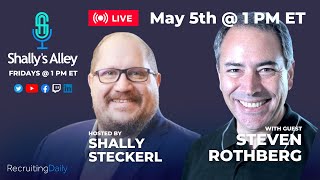
In this informal interview, Shally Steckerl talks with Steven Rothberg, founder of College Recruiter, about the evolution of early‑career recruiting and job advertising. They compare the old‑school, campus‑visit model (the "1952" approach) with modern, internet‑driven strategies, highlighting the high costs and long lead times of on‑site recruiting versus the speed and scalability of online channels such as LinkedIn, Indeed, and niche sites. The conversation delves into the shift from "post‑and‑pray" to pay‑per‑click, cost‑per‑application, and the emerging cost‑per‑qualified‑application models. They discuss attribution challenges—how employers often mis‑measure source of hire, the limitations of candidate self‑reported data, and the need for better integration between ATS, CRM (HubSpot, Pardot), and programmatic job‑ad platforms. Programmatic advertising is explained as rule‑based, automated distribution that can pause under‑performing boards and scale successful ones, but it still requires human oversight. They also touch on measuring effectiveness by cost‑per‑interview rather than cost‑per‑application, and the difficulty of defining a "qualified" candidate. The interview closes with Rothberg’s advice on workplace politics: focus on win‑win relationships. The dialogue provides practical insights for talent‑acquisition professionals on sourcing strategy, measurement, technology integration, and strategic thinking.
Chapters
Welcome to Shelly's Alley. It is Friday, May 5th, and, um, one day past May the 4th be with you for those of you that celebrated May the 4th, the, uh, the, I guess, the whole, you know, Star Wars universe celebration day. But there is also something to celebrate today, and that is Cinco de Mayo, which is another holiday Although I guess May the 4th— or May the 4th is not technically a holiday, but Cinco de Mayo is definitely a holiday of great importance to a lot of people in the community of the Mexican diaspora, if you will, all over the world. And I guess we've kind of adopted it here in the United States as an honorary holiday. I certainly celebrate it with, with my friends as well. So happy Cinco de Mayo and happy belated May the 4th. Our guest today is a very long time friend of mine. Um, I mean, gosh, like, we just go way back. Steven Rothberg. You might know him as College Recruiter, and that's probably intentional because College Recruiter has been around Well, I think, Steve— Steven, you started College Recruiter when you were in the 5th grade, right?
Um, almost. I, I did have my first entrepreneurial experience in 5th grade, but it wasn't with a job board.
And it's definitely been around at least 30 years.
Yeah, I founded it. I— yeah, exactly. We, we went— I founded the company that College Recruiter grew out of in, in 1991, so 32 years ago. And we went live— College Recruiter went live in '96.
So yeah, '96 is the year that I started, you know, stubbing my toe on the internet trying to figure out how to make it work. And then you and I met at, if my memory serves, at an ERE conference, one of the first ERE conferences, if not maybe the first or second one, in San Diego. And you had a booth there. OK. Back in the day when you were, you know, when booths were a thing. I mean, there were like thousands of booths and, you know, that's how I learned about you.
And I remember one of our first meetings, it might have been a second or third, because if that was the first, then it wouldn't— it wasn't this. You were, you were leading a workshop at a conference. It might have been an IQPC conference.
That's right.
And I think like 5 people signed up for the workshop. It was a, it was a lightly attended event.
Yeah.
The whole conference. And, uh, and I think, you know, rather than having the 2-hour workshop in some drab hotel ballroom, you had a much smarter idea. Let's go up to the lounge and have cocktails and cover the same topic.
That's right. So we just grabbed some cocktails at the lounge, sat around the round table, and it was actually very productive.
Way more, way more productive, uh, and certainly more enjoyable.
And that was it. The rest is history. We've, uh, we've known each other for a while. I, um, I think I was one of the first people to find out that you had COVID very early on because I reached out for something and I'm like, how you doing? You're like, I don't feel so good. And we went back and forth and it was like, I want to say before the shutdown, like, oh, probably.
Yeah.
I was like, wow, okay, this is spreading really fast because you— it was really early.
I, I, my wife who's our CEO and I were on a business trip to Atlanta. So it's kind of your fault, you know, because your neck of the woods. And we came back and this is March 2020. Yeah. And, uh, 3, 4, 5 days later we started to feel like crap and, and our symptoms were all very COVID-like, but there wasn't testing back.
Right. And you had the, the classic first round type of COVID I remember because you were just, yeah, you were miserable.
Yeah, but no, we had nowhere close to having to go to the hospital or anything like that. It was, um, yeah, yeah, it was like, look, looking back on it, it probably was, you know, we were, uh, we were wearing masks on the airplane, but I remember we were in a meeting with people at, um, a staffing company and there were, I think, 8 of us sitting around a conference table. And everybody was kind of joking. People had hand sanitizer. Everybody was obviously nervous about what was coming. They had no idea, but nobody was taking any—
right, because they had no idea. Yeah, yeah. Well, that's a long, long time ago. Uh, folks might not know that actually you go further back. You, um, you are a fully recovered attorney. So, uh, actually, uh, Stephen has a Juris Doctor, which makes him a doctor in law. So I guess I'm supposed to, I'm supposed to call you counselor, right?
Um, correct. And you can't— and you, I guess you can ask, but I'm not legally allowed to write prescriptions.
That's right.
So it's not, it's not the good kind of—
that's not the right kind of doctor. No. You really quickly, uh, ran away from, from law and then had this idea to start this college recruiter. And the first time that I had a, I don't know, straight business conversation with you about our industry was when I was completely clueless because, you know, my universe was all about finding people that had a lot of experience and were hard to find. And I knew nothing about this other side. So I was— I came to you and said, explain, what is this? What is this college recruiter? How do you recruit people from college? And you said, oh, Shelly, let me tell you, there's so many ways. So if you don't mind, for, for the benefit of our, our broader audience, most of which are probably in sourcing or even recruiting experienced professionals. What is the— I want to say not the mystery, but what is the, what is the gap that most people and organizations have, um, with, with college recruiting? The misunderstanding, or, or, you know, the thing that prevents them from really doing it right?
Interesting. I would say that, that the The biggest gap that, you know, recruiters, hiring managers, talent acquisition folks have when it comes to college and university recruiting is thinking that it's still 1952. And what I mean by that is in 1952, pre-internet, even pre a lot of domestic air travel, stuff like that, larger employers would send out a recruiter or teams of recruiters, sometimes hiring managers, to physically go to individual college campuses. There's nothing wrong with that. And that can absolutely be— continue to be part of the early career hiring strategy where you physically go on campus, probably September, October. For internships, maybe January, February. And you interview people across the table. But unlike in 1952, in 2023, there's this thing called the internet. And shockingly, a lot of young adults, the stereotypical student and recent grad, a lot of them are on this thing called the internet. So yes, you can reach them on campus, in person, across a desk. But you can also reach them on LinkedIn, TikTok, a job search site like College Recruiter, you know, any number of ways. And you can do that. The advantage of doing it online— well, two main advantages. One is speed. If you recruit on campus, you typically need at least 12 months sometimes 15 months lead time. Your hiring managers need to tell you that a year from now, I need this many people with these credentials. And then you have to plan out which schools to go to, make arrangements to go to those schools, interview those people usually in the fall, and, you know, extend offers. And then they come back to work for you in like May, June of the following year. So the lead time is ridiculous. The other factor is cost. And that to me is very interesting because a huge number of large employers— and they are the employers that most students go to work for— do not properly account for their costs when they're looking at cost per hire of travel costs.
I know that for a fact in all facets of recruiting. And what they usually do is they take their budget and divide it by the number of hires. And that doesn't include the compensation they pay their recruiters and coordinators. It doesn't include the cost of their website or any other major advertising. It doesn't include the cost of interview travel. Uh, I mean, it's just, it doesn't include so many things. So I know for sure, I can't even imagine in college recruiting how that would be completely forgotten because all they think is, oh, I'm going to go on a hop on a plane, go in October to this booth and doesn't cost us anything other than the airplane and hotel.
Right. And even then, the— yeah, if that, because— and I've worked for very large organizations. I worked for Honeywell before starting this company. And I totally get how if it's not your budget, it essentially doesn't exist. It's kind of free money. And if your employer, not through your budget, but just some other budget that doesn't really have anything to do with you, if they're going to pay for you to jump on a plane and go to a nice city and spend a few days in a, you know, a swanky Marriott or Hilton or something hotel, and then go and have some wine and nice meals with professors, maybe have like 50-yard tickets at the homecoming game. That's not such a bad gig. And, you know, to the extent that you hire some really great people, great. But a lot of employers have this mistaken impression that they have to recruit by school. And we don't recruit schools, we recruit candidates. So if you can recruit that same candidate faster, usually about 10% of the money as to compared to going on campus, then it's really in your employer's best interest to, to do so.
So yeah, the cost of vacancy, that's a good one. Somebody chatted it. That's right. So, the biggest gap basically is, or the biggest opportunity, however you, misfire is still thinking of it as a, almost like an event-based activity and not using the same techniques that we do for digital media and digital marketing in recruiting. However, the significant difference that I'm hearing is that there is a, first of all, there's a longer cycle. Because they are not going to be available until— and, you know, by the time they graduate, it's now too late. Um, they probably have something lined up, or, you know, that they at least have been entertaining opportunities. So it's a longer— you have to get to them a little bit earlier. And the second thing is, it is, um, also more— what sort I'm looking for— it— there, there's a lot of, uh, attention for, like, lots of, lots of people looking at very few companies. In other words, there's a lot of attention.
And that, I think, Shelly, you'd probably agree, that is, that's something that impacts like the entire job search world, right? Like, you know, if you're working for a company and trying to recruit a a whole bunch of salespeople that have, say, 3 to 7 years of experience. If you post a job, whether it's to, you know, Indeed or LinkedIn or a college recruiter, whatever— well, that's probably a bad thing to post to a college recruiter. But if you do, if you post a job, that is likely to help. It's likely to lead to some hires. But you're going to miss all the people who are being more passive. I'm not a believer in candidates being either active or passive, right? Monday morning you wake up. Yeah, and it can change at different times of the day. You go to work on a Monday morning and probably you're going to be more passive. You're not in the mood to be searching for a job first thing Monday morning. But when you walk in the door and your boss is a jerk to you, you suddenly become quite active. And at lunchtime, you're probably, you know, jumping on your company computer to search the job boards and see what might be better out there. The same applies with students. They can be very passive during finals if they've got a big project or something like that, and then suddenly there's a career fair or their friends are finding jobs and they become much more active. So it is I think employers can do better by understanding that hiring candidates who are early in their careers really is more similar than different to hiring candidates with a lot of experience.
Yeah. And you don't need to necessarily need all that fancy travel and everything. I was gonna, as you were explaining the whole wining and dining professors, I I used to work at Coca-Cola. Back then, it was still Coca-Cola Enterprises and the Coca-Cola Company. So, CCE and KO, and now it's one company, but back then it was different. And I was going to tell you that I went to a National Black MBA recruiting event. And so, there's these, you know, MBA events, which I'm sure recruiting MBAs has some differences. With undergrad. Are they undergrad if they graduated? Yeah.
No, they'd be graduate school students.
Right. So, okay. Recruiting graduates is probably different than recruiting, you know, master's MBA candidates because there's a whole other type of work that they usually do. But I went to this conference because it was relevant to what we were doing, this recruiting conference. And of course, it was put on by Coke and everything that you described and more, man, they did it right. They actually, it was in San Diego. They rented a luxury yacht and invited all of the MBAs that they were interested in hiring aboard the yacht on a cruise around the, you know, the coastline, um, and dinner and everything. And it's like, I was thinking about that. I'm like, that's smart because basically that's a captive audience. There's really nothing— they can't leave. So I'm like, oh, that's a good idea. If you do it in a hotel, they could leave at any time. The old Irish goodbye, you know. Yeah, sneak out the back door.
However, I wonder if there is a candidate or two that is just really awful, do they have like a cement block and maybe some chains stowed away so that they can just sort of like toss that person overboard and not have to deal with them for the next 2 hours?
But walk the plank, matey! That's right. So yeah, I just— that popped into my head and I wanted to share that anecdote. So one of the things that we we've shared over the years is the evolution and lack of evolution in our industry. The industry that we both— some people may not realize that we're both, you and I are both in the same industry, right? We are in the business of connecting people with employment opportunities. And that's pretty much, you know, whatever, however you slice it, whatever point of view you have, in, in looking into that vector-wise, it's the same outcome, right? Um, people getting hired hopefully for good jobs. So one of the things we've gone back and forth on is, you know, how things have evolved, right? You know, we, we start— we knew each other when I was still bumbling around the internet on, uh, bulletin boards and, and, you know, dial-up. And that was the part that was evolving, was how easily people go online, and it became easier and easier and easier. But the one thing that never changed is what you're talking about. That's still, you know, the same mentality since 1952, as you said. Recently though, very recently, there's been a fairly large shift in advertising for jobs. Can you tell us a little bit about how that's come about and what does that mean? Kind of explain a little bit. I know that Um, I know there's been a big change with Indeed, for example. I don't know if you can talk about that.
Yeah, yeah, yeah, no sweat. So just for context, um, recruitment advertising dates back to probably the 1700s.
Smoke signals, the earliest. Need help?
Yeah, the early— well, the earliest newspapers. If you go back and look at the earliest newspapers, it was not uncommon to see a little classified ad, you know, Cobbler needed, inquire at, you know, and you'd give a sixpence to the town crier so that when he hands out—
exactly, yeah.
And, and until about 15, 20 years ago, that basic business model of paying to post an ad and hoping that it turned into applicants who were qualified, who you would be interested in extend an offer, hire, start, stay on, etc. That basic business model stayed. What they changed with it going from print or maybe billboards, broadcast, whatever, to online was just another way of getting that same ad in front of that same candidate. But the business model was basically the same. A lot of people would call it post and pray. You post the job, you pray for results.
Pray and spray. No, I— yeah.
And then, yeah. And if you're posting in a lot of places, absolutely. Like, yeah, then, then you, then you're spraying it. So what changed? Indeed did not invent it, but they definitely popularized it. They changed the pricing model going back to the beginnings of Indeed from paying a fixed fee per post, so $200 for 30 days, to charging on a per-click basis. Indeed's definition of what constitutes a click has changed, and other job boards use different definitions. But usually what it means is that the candidate sees the job ad and then they click on the apply button.
Okay.
To either go to a page that the job board hosts, the application page, right, or to the ATS. And for a medium or large employer, especially in the US, they have the ATS. Some overseas Listeners might not be all that familiar with it. They're much more common in the US than they are in, you know, Ethiopia, for example. Right. So, but whether the candidate applies on a page that the job board hosts or goes over to a page that the employer hosts, a click is a click. Now, how much— what, what that does is it shifts the risk of the ad not working. From the employer to the job board. Because if the job board runs that ad and hardly anybody clicks to the application page, then the job board doesn't get as much money. On the other hand, and this is where some employers have been upset over the years, if a lot of candidates see that ad and click through, then the employer can end up paying more. Now, employers historically have said that what they want is quality, quality, quality. And pardon my French, it's mostly been bullshit, bullshit, bullshit. Because when they come to deciding whether to renew that contract with Indeed or Monster— oh, they're looking at anybody else— they look at volume. And that has just started to change.
You know why?
They look at the last couple years. It's the easiest thing to do.
In many cases, the only thing they measure.
And right. And so they can see until a few years ago, the vast majority of the employers that we worked with had absolutely no reliable metrics that they owned, that they could control through their own systems. They had to rely on the job board to tell them if the ad was working. Shelly, when was the last time you went into a restaurant and the server came to your table and said, 'I brought you this meal and you like it,' right? They always ask you if you like it, and it's your opinion that matters. But then you've got the ability to say, 'I like the meal,' 'I don't,' 'It's hot enough,' 'It's tasty,' 'It's spicy enough,' whatever it is. Employers, until just recently, really didn't have the ability to know with any degree of accuracy that last month we got 1,000 applications from this source and 500 from that source. And this is what happened to them. This was the disposition, how many got offers, how many accepted, whatever. It was all at best anecdotal or people choosing.
How did you hear about this job? From a dropdown and selecting the first one or.
Yeah.
And not even knowing half the things on that list.
Or. Right. And somebody that you probably know, Don, for Jobs from Jobs and Logistics, Top USA Jobs, years ago did this study. 83% of the candidates that self-identified their source identified the incorrect source. So when people say it's better to have some data than no data, they're wrong. That's better. You're actually better flipping a coin than having 83% of your data points be inaccurate.
So when Monster's advertising, they choose Monster. When Indeed's advertising, they choose Indeed. When LinkedIn's advertising—
whoever's on the Super Bowl.
Yep.
And it's just the strongest brand. The candidate's going to identify it. The candidate doesn't care where they saw the job. They shouldn't care. You as the recruiter or hiring manager, if it's coming out of your budget, you should care, but the candidate shouldn't. Therefore, you shouldn't be relying on the candidate to tell you where your money is being best spent. So a few years ago, there was a real tipping point, and suddenly the vast majority of employers started to be able to accurately track when they posted a job to LinkedIn, Indeed, College Recruiter, wherever, that click converted into an application in the ATS.
Unfortunately.
As soon as it gets into the ATS and you've got the correct source identified, now you can go back at the end of the month and you can say, okay, I spent $5,000 with LinkedIn and I got 500 applications. I spent $500 with Indeed and I got 250 applications. So Indeed did better on a cost-per-application basis. Um, you— so employers used to look at where did we get the most applications from, and that was your best source. But if you're spending 10 times as much money per application, is that really your best source?
Um, no, I'm not measuring that anymore. I'm measuring the cost per interviewed candidate.
I'm so glad that you said that, both because I think it's a great thing we can discuss here. And also, that's what I'm hoping the industry evolves to. So you are, I think, a couple of years at least ahead of the vast majority of the industry. So what the industry is evolving to right now and what Indeed announced in the fall fall of 2022 was that it is moving away from cost per click, where the candidate just goes to the application page, to cost per application. So the candidate has to complete the application either on Indeed or on the ATS. They didn't communicate it as well as they should have. They didn't give as much notice as they should have. And now for an unknown period of time, employers will be able to choose both. So good for Indeed. They did the right thing. They said, We're heading in the right direction, but we could have done better in how we rolled it out. The industry, the job board industry, is rapidly moving away from duration-based in, in the US, Canada, and the UK. The rest of the world, it's still there, to cost per click. The next step is going to be cost per application. 2024 will be a big year for cost per application. So employers that are just getting used to cost per click, buckle up. The next thing after that, I think it's going to be at least 2025, probably more like 2026, is going to be cost per qualified application. And qualified or quality, if you want to call it that, it's— Shelly, as a fully recovered lawyer, this is something that stuck out to me from law school. There was a US Supreme Court decision, I think, 100 years ago, and it was a pornography case. And one of the dissenting opinions said something to the effect of, I can't define pornography, but I know it when I see it.
Right.
And let's be honest, when we see resumes, is it— how able are we able to define what a quality candidate is?
It's completely impossible.
Yes. So subjective.
It's not just subjective. It's impossible because we don't even know if the resume is verifiably accurate.
True. Right. And, and, and if you're in a good mood in the morning, and you, and you look at a resume, and if you're in a bad mood in the afternoon, and you look at the same resume, you might treat it differently. If you've received no resumes for an opening, you're going to look at resumes one way. If you've received way too many resumes for that same role, you're going to look at them other ways, you know, your standards can change. So recruiter to recruiter, employer to employer, time of the day, how many applications— it's— there is no good way of defining quality in my mind unless you interview the person. Well, that's why I mean that, that's objective.
Yep, that's what I'm doing.
If, if—
and, and by the way, I'm measuring the interview, um, having been accepted, not concluded, because sometimes interviews don't happen. For multiple reasons, but there was an intent to do it. Sometimes interviews have bad outcomes, and that could be the candidate declining or the employer declining. But the fact that there was two parties interested in having a meet, to me, is the check mark where I have that, that, you know, this was going— this was scheduled, so I count it. But I do— but here's a problem. And, John literally just got right in front of me and that's only the tip of the iceberg. And, Steve, this is one where I have fought this fight for many, many, many years and I still have no— I've not gained any ground. Here's the problem. The source is still unknown.
Even today, in, in, in a lot of cases, the, the technology exists using like programmatic job distribution, um, where it's automated, it's fully automated into the ATS. So when you post a job from the ATS through a system like Pandologic or Radency system, which used to be Parango, or Appcast, etc., they automatically track the source, and that can automatically be fed into your ATS. Now, let me be— let me clarify that. I said the source, right? Singular. I don't think there has ever been any applicant for any job that has ever existed that has had one source. That they— there are— you're influenced by multiple things. When you go to the restaurant and you choose that meal, you didn't go to the restaurant simply because of the sign out front. It's also because your friend told you about it. It's because you got a coupon. It's because you saw an ad on TV. There are multiple reasons why people apply to every job. And the technology only looks at the very last thing you did.
Before you, which unfortunately isn't the source, it's the destination. And so basically all you're measuring is the point of entry.
Yeah, that's the point of origin. It's like the straw that broke the camel's back, right? Like a typical job seeker might see a job on, say, Indeed, go over to Glassdoor, look at the employer reviews, talk to their mother, talk to their friend. 4 days later, they're driving down the street and they see your company logo on some billboard. And then they jump on their mobile when they're in the bathroom and they apply online. That's like— so what's the source?
However they found the job when they applied online, they probably went to Google and saw a job posting for whatever job. But so here's, here's the thing. And here's where I— here's the fight that I fight. And I'm not saying that I always lose. I'm just saying that this argument that I'm about to enter into with you always ends in a stalemate. It always ends in agree to disagree. But I recently went to Ellis Island. I took my family on vacation to New York, and we did the whole New York City tourist thing. You know, I'd only ever been to New York as a business person, so it's always been to the location and out, right? I never got to take in the city. So it was a blast. And one of the things we did is we got on a boat to the island for the Statue of Liberty and then Ellis Island on the way back. So here's the analogy that I want to draw. When we are calculating the source of hire right now, even, even with the technology that you're describing, that's saying, okay, this candidate came or applied for this job because of Indeed, because of LinkedIn, whatever. That is equivalent to the record-keeping system in Ellis Island saying that this citizen that just entered our country originated from this boat. Yes, yes, and having absolutely no clue where that person came from. We don't know if they came from England, Ireland, Poland, or Kenya, or Australia, or Antarctica. I have no idea because according to the ledger, all it says is Stephen Rothberg entered the United States by way of, uh, the St. Mary ship.
Yep.
And you might know that the St. Mary ship came from London. You might know that, but that's as far as it goes, right? How many people got to London from other places? And so what's happening right now is all we know is that they came from the St. Mary's ship.
Yep, 100%. And you also might know if that immigrant/candidate self-reported that they originated from some country. But I've been to Ellis Island also. The record keeping was wildly inconsistent.
Yeah, all over the place.
And very incomplete.
It was like a piece of paper sometimes, or it was like, yeah.
Yeah, my ancestors came in through Canada. I was born and raised in Canada, immigrated to the US in '88 when I came here for school. But when they came, if they had come in through Ellis Island, there's a really good chance that the immigration official would have written down their nationality as Jewish. Well, there is no Jewish nationality, right? It's a religion, it's a culture, but it's not a nationality. But a lot— that's how a lot of people were tagged. If you came from what's now Romania, there's a good chance that that immigration official might have written you down as Gypsy, right? Right. In today's language, that would be Roma.
Came from Ireland, would you be Druish?
So I totally agree with you, but they would know your ship, the steam— they would know the steamer and where it came from and where the last— exactly, they— it came out of Dublin, it came out of Ireland. So like my ancestors, some of them came from like a little village near Kyiv, walked overland to Odessa, caught a ship that went through the Black Sea to Dublin, and then from Dublin to Halifax. So in that case, the Canadian customs official in Halifax would see them as having come from Ireland. Yeah. And So what was the contributing reasons, plural, for why they went to Canada? And that's important for an employer to know, right? Like, that's what I'm trying to figure out. What's the brand of, of the country/employer? What caused you to get onto that ship in the first place? How do we get more people like you? Um, because the ship that you happen to take across the Atlantic It's important, but it was— it's kind of more of a means to an end.
That ship was LinkedIn, but that happened to be the ship that was sailing. If the ship that was sailing would have been Indeed, you would have come from Indeed.
Exactly.
So here's the thing, uh, what I'm trying to do right now, and this is why I'm bringing this up— I'm glad we don't disagree because, um, it— to me it means either, either I'm on to something or, uh, we're both crazy. But what I'm trying to do right now is we, we move—
I think, I think John should chime in on that one.
Yeah, we moved to where we can track all of the point of entry into our website where it used to be the career page was hosted by the ATS, and so all of those logs were, were not available. But now our pages are on HubSpot Inside the page is the ATS, but everything is HubSpot, so we know where they came from. Um, unfortunately, my biggest source right now, and this is where I'm struggling with, it's the same thing, my biggest source is the St. Mary. In other words, from, from our HubSpot data, the number one point of entry is our corporate homepage. Yeah, and, and, and, you know, a few minutes ago, get the one before that. What I want to do— is there a way, can you tell me, yeah, is this new, is this change with programmatic advertising and cost per application and that you're talking about, is this going to be able to tell me that someone saw, um, an ad on a particular blog like MSVM and that's what prompted them to apply And I get that they apply through LinkedIn, and I'm still going to pay LinkedIn for advertising. I'm not trying to avoid paying for LinkedIn, but I do want to know if MSDN is a destination I should visit or monitor, or— right? And then that, that's completely missing.
Yeah. So, okay, so if you're running an ad on, say, LinkedIn, and the same would apply on Indeed, any other job board, right? You're You're telling Indeed— when you— sorry, LinkedIn— when you post that ad, there's a field there for the URL or, you know, email address. You're copying and pasting the URL into that field, and it sounds like it's probably a HubSpot URL that takes people to your home page. Why don't you send them directly to the job detail page?
Because then the data is in the ATS. Okay, in other words, uh, the, the history of how people got to our website—
yeah—
is not visible to us. It's only visible to us because of HubSpot.
So you need a better integration between HubSpot and the ATS?
No, I know exactly where they came from. In the ATS, I know that they came from LinkedIn. Yeah, the problem is that of, uh, so there's All the sources that I can track, right? All the sources that I pay for and everything, I know what happens to them when they get into the ATS. But there are— there's this other portion of traffic that is the largest amount of traffic that we get. The number one source of traffic is our company homepage.
Yeah. And that's a destination. Nobody starts a job search on a company website.
I went to the company homepage engineers and said, can you tell me where people are coming? Because they do have that.
Right.
I'm trying to figure out where they're coming from to go to our home page to then apply for the job. I know if they came from LinkedIn, I know if they came from Indeed, I know all that. It's this category of your careers page that shows up in, in our ATS. Yeah, that's your careers page is like, okay, great. How did they get to our careers page? No idea.
Yeah, that's a, that's a HubSpot question. Um, we use a similar— we have a CRM that's somewhat similar to HubSpot. It's, it's called Pardot, um, which is owned by Salesforce.
Oh yeah, yeah. And I actually know the guy that, uh, um, he's from Atlanta. I, I met the— I met— he did a talk here. I met the guy that actually started that.
Oh, well, if he's from Atlanta, then maybe he's a good guy anyway. Um, just kidding.
Despite—
yeah, um, Pardot will show you the referrals that, you know, these are the URLs that this person took, the path. So you might see that this person came from— well, like, we have a partnership with LinkedIn. So a candidate might find a job on a college career service office site that we partner with that goes to College Recruiter, that goes to LinkedIn, that goes to your ATS. And to the candidate, that's all invisible. They're not stop, stop, stop, stop, stopping. They're just automatically being redirected. So it's not a bad experience for them. In Pardot, we can see that. And then you can run some data to—
Partial attribution. So you see the attribution points.
Years ago, it's like this person is 10% here, 20% that.
Yeah, I got you.
Yeah. Years ago, one, one of our customers was Enterprise Rent-A-Car, and they, they showed me sort of how they do this. And I don't know if they still do this the same way or not, but they were I thought incredibly innovative. They had— they, they talked about attributed and assisted sources.
I love that. I want that. How do I get that? Can you sell me that?
Uh, we don't have that, but, um, exactly. I can connect you with, with somebody at Enterprise.
Is that programmatic? I mean, is that the thing that you're saying?
No, it's, it's not. I mean, this is like from 10, 15 years ago. I I think this was a Talent Brew feature, which was— I don't know if that product even really still exists, but it was what's now Rate and Seat. It used to be TMP. But the last stop before the candidate came to your ATS was what they called attributed. So if you just ran like a report showing like, show me the source of my candidates, that's it. Then they would also have what were called assisted. You know what? I think this was through DoubleClick. Now, now that I'm thinking about this, and so they would basically cookie. Yeah, they would cookie the user's computer and track them through. Now, cookies are becoming more and more problematic.
They are.
We keep hearing that they're about to go away. They're about to go away. They're about to go away. Maybe it's like high fructose corn syrup. At some point way after we die, it'll be gone. But um, but they're still out there.
We'll be embalmed with it. Um, somebody posted on, on the chat about using an affiliate marketing, uh, Commission Junction, etc. So can we come back to this, the programmatic— yeah, changes that you said, the Indeed pricing and the programmatic and cost per application. You're, you're saying this is a good— this is good news?
When used properly.
When used properly. Okay, so maybe that's what we need to do is what is the— what is it that we should be doing with whomever we choose as our advertiser? Yeah, um, or advertise— that's not the right— you know what I mean, whoever we choose as a vendor, what should we be doing? What's the smart way?
So let's— I'll take a second to sort of define what it is because a lot— it's a fairly new word for a lot of people. So programmatic simply means that a— that your computer, you know, through rules that somebody sets up, is deciding what job ad to run where. When does it start? When does it end? What rules— you can put in rules to say if this happens, run this ad on in this place and stop it if this happens. So for example, you post an ad, a job ad for salespeople, to your ATS, you can set up a rule that says something like, if I don't receive any applications within the first 3 days or only 5, then post that sales ad on the job boards where other sales positions that I've had have produced good results. And you define what that means. The cost per click, the number of applications, the cost per application, whatever. But you can set up all those rules. And then also, very importantly, is when to stop running that ad. So employers traditionally have run ads for 30 days. Why 30 days? Because it was a pretty arbitrary number that just sort of became standard in the job board industry. And the ATS has adopted that. There's no good reason for 30 days, but it just, it's just sort of standard. And so that's what it is.
My standard is 90 days because everything runs on quarters here.
Yeah, the— but a lot of job ads get almost all of their applications right at the beginning, not at the end. And so what's really common is that an employer within, say, a week will have almost all of the applications that they're going to want to have. But if you're hiring for one person and you know from experience that you need to get, say, 20 applications in order to feel really confident that you're going to hire that person, then you don't want to get 200 applications. You might want to— you might want to cut it off at, say, 30. Or 25, you know, sort of your—
whatever your number, like, say you have a history. Yeah, we know what the funnel is. We know that typically 150 applicants means X amount of, you know, 7 interviews. And we typically— 7 interviews means a hire. So like, we had— now that could vary, but there's a— there's a—
yeah, but the basic idea is the same regardless of what the actual numbers are for a particular role. Now, if you're a— if you're a you're a pretty small employer and you're only hiring like a person here, person there, it's pretty easy for a, a recruiter, a hiring manager, an HR generalist, whatever, to kind of keep an eye on that. And when you've received enough applications, log into Indeed, LinkedIn, whatever, and deactivate that posting so you don't get way more applications than you need, right? Now let's say you're an employer with 500 recs open at any time, or 5,000 recs open anytime. It's just not feasible for a person or even a team of people to do that. So, that's when you want to have technology do that for you. That technology is programmatic. So, one of the beauties of programmatic when done properly is that that ad will run in multiple job boards. And if the results— if, let's say, College Recruiter sends you 100 candidates to your ATS, and none of them convert into applications. The software will know I'm wasting money by having that job run on College Recruiter. So I'm going to stop running it on College Recruiter. But hey, LinkedIn, I spent $200 on LinkedIn and I got 50 applications. So I'm going to continue to run on LinkedIn.
Yeah.
And so it learns machine learning, usually not artificial intelligence. It learns that sales positions do well on these job boards, healthcare job— healthcare roles do well on these ones, accounting does well.
And so over time, around, it starts there, but if it sees no traffic, then it switches, right?
And then you also say— and, and some employers do this in their ATS and some don't, but it's really important as to the volume. If you're hiring one person for a sales role You might need 20 applications. If you're hiring 10 people into that role, kind of more of a high-volume situation, rather than 20 applications, you probably need 10 times that. You need 200 applications. What if you're hiring 200 people into that role? You know, then, you know, if you're Amazon and it's 2020 and you need to staff up your warehouses, you literally want 1,000 applications a day for that opening because you want to hire 100 people a day. Programmatic doesn't do anything that a human couldn't do.
It just does it.
Except it does it except, yeah, almost instantaneously. It does it at scale. But one of the big misnomers about programmatic is that the machine makes all the decisions. And I can tell you the dirty, dark secret is all of the programmatic vendors, all of the job boards that use programmatic, there are a whole lot of people keeping a real close eye on that machine because the machines are not smart enough yet, right?
They're looking at the data and the machine helps, or the machine can flag, hey, look at this, and then somebody makes a decision. That's really smart. I appreciate that, that breakdown. That's exactly what I was hoping to get from this. As usual, I have an anecdote as you are describing this. So do you— you probably know this, but maybe others don't. Do you know where the term broadcasting comes from?
I could get politically incorrect really quickly here, but I won't. So no, I don't.
So the origin, you know, the origin of the word, right? Basically, the way that we classified ads, for example, or just about all advertising, television advertising, everything, all of that is a type of broadcasting. And where the broadcasting comes from is, if you literally look it up in the dictionary, the second definition is going to be to scatter seeds by hand or machine rather than placing in rows. This came from agriculture. So broadcasting was when the farmer would take a bag of seeds and spread them out as they're walking the field like that. That is how we advertise.
Yes.
And so broadcasting is the old way. Um, what you're saying is that we evolved like agriculture did and we plant things in rows on the fields that are most likely to be rich in the minerals that that plant needs. Rather than just randomly spreading the seed. That's what I'm hearing. And normally we could do that ourselves manually if we were not large enterprise. But even I would argue that even if we were going to do that ourselves manually, we still don't have the data to even know, like I said, because of the— so the advertising, let's say Indeed, for example, they know where their traffic is coming from. I would love for them to tell me. They're not going to, and I know most of it comes from Google, by the way. But they know where it comes from, and they know what they're doing on Google to make it work, so they can change it so that they get the results. That's fine, as long as somebody's doing it and we're not broadcasting. That's literally my takeaway.
Yeah, to an extent. So what—
one of the—
one of the beauties of broadcasting is that And programmatic would be this way in the job world is we all as humans have the tendency. It's actually, it's good from an evolutionary standpoint to generalize. Some might call it discriminate, right? When you walk up to a street, it's good for you to discriminate In other words, are there cars?
I could get run over.
So are there no cars coming? Right. Discrimination in that sense is a really good thing. Discrimination when you're like saying, oh no, I'm not going to hire anybody that's female, you know, for the vast majority of opportunities, that's a really bad thing. But discrimination generalization is good in most contexts. The problem with it is that you don't know what you don't know. So if you only plant seeds in rows, then yes, that row might be good for that crop, but you don't know if other rows might also have been better. So in the old days in the job board world, and it's still somewhat true today, employers would run ads on Monster, CareerBuilder, now Indeed, LinkedIn, etc. Because those are the job boards that, that have the strongest brands. They're good. They probably produce really good results. Monster, CareerBuilder, more in the past than today, but certainly Indeed, LinkedIn. They're really good for most purposes, but they're not the only ones that are good. And for some roles, they're good, but others are better. But how do you as an employer try out your job ad on 50 different sites, on 500 different sites with— in an economical way? And programmatic does that because it'll spend $3 on Indeed and $8 on Indeed and $2 on College Recruiter or whatever. So your one ad might run in 50 places or 500 places, but your total budget is still only a couple hundred bucks. So You're, you're getting your ad in front of where the candidates are, regardless of what job board might have purchased a Super Bowl ad the previous year. And the results drive where, if that ad continues to run, for how long, how prominently, etc. So it's data-driven. It's, you know, a lot of talent acquisition people until a few years ago we're forced to use data to justify decisions after the fact. I ran an ad on LinkedIn, it ended up being a good thing, therefore it was the right decision. But that's kind of putting the cart before the horse.
Can't do that again next time.
Yeah, what you really want to do is use data to drive the decision. I don't know where this ad should run, I'm going to test it out with very, very low budgets per job board and let the software decide it's performing best on Indeed and LinkedIn. Get rid of everything else, just run that ad on Indeed. And then that's it. And that, that happens at scale— hundreds, tens of thousands of postings at any given time. So job boards, when we buy and sell traffic from each other, like third-party recruiters do splits, you know, where one kind of owns the employer relationship, the other kind of owns the candidate relationship. Job boards same thing. We all used programmatic technology for that.
The only—
the very small ones are doing it now.
Volume.
Yeah, because the volume. So, so the programmatic for employers is absolutely idiotic if you are not hiring at scale. If you're hiring a person here, a person there, you're a company with 20 employees and maybe you hire 2 or 3 people a year, don't use programmatic. It is like hunting a fly with a bazooka. But if you're hiring dozens, hundreds, thousands—
well, yeah, I was gonna say, what is it? Is it 100, 300, 500?
Yeah, easily. I mean, I, I would—
so like 500 and up, basically?
Um, if you have 500 and up employees—
no, uh, job openings—
higher? Oh, I would say it's even lower. I mean, if you've got dozens, 50 recs above, then it's worth it. Then then you want to be talking, and it's probably not the job board vendor. You want to be talking to people like at RecruiterX, at Shaker, the advertising agencies, the Jovios, the Pandalogix, the JobAdXs of the world. And it's not so much an issue of the cost, the money that you're going to write the check. It's more about the staff time. You know, to post one job at 3 different job boards might take you half an hour, but to get set up with programmatic and to be managing it and all of that, it takes way too much time unless you've got dozens of reps.
Right. And that's the part. And it, and yeah, you probably need some branding and other things like that as well. Well, this has been very educational. I want to thank you sincerely for your time here. I learned a lot. Now hopefully we can rebroadcast this tomorrow morning as well. Uh, every, every show I like to end with, with one thing, and I, I like to have my guest leave the audience with something to think about. It could be a deep thought, it could be a joke, something that you want them to mull over the weekend. Um, so it— do you have a drop of wisdom that you can leave us with?
This is my favorite part of your show. So when I was thinking about what what to say here. So I'm just going to relay a very, very brief story. When I was in my mid-20s, I was in grad school working for Honeywell. My second— the second boss that I had there was there for 2 years. So the boss that I had for the second year was a guy named Marv Granth, and Marv was a senior vice president of HR legal. He reported to the CEO. Marv taught me that corporate politics are a good thing. And the, so the lesson that I would leave to people is when you go into meetings with coworkers, vendors, customers, be political. And what I mean by that is understand what they want and what they need. Understand what you want and what you need. And then work to accomplish both. Create a win-win. Marv would go into meetings. I got to tag along to some of them, and on the way to the meetings, he would say, we're going to be meeting with, you know, Fred Jones, and he's the head of this business unit. And I know from working with Fred that this is his issue, his hot button issue. If I can give that to him, then he will owe me, and I'll be able to call in that chip at a later time. And so he would work— my boss would work really hard to get Fred what he needed, and then 2 months later or a year later, he would get back. And it was always about creating a win-win for those 2 people and the organization. Uh, that's how I try to approach life.
So what I'm hearing is politics— a lot of times people think politics at work can be bad, dirty, ugly. I don't want to be part of it. I'm above it. I'm beyond it. I'm below it. It's out of my league, whatever. But what I'm hearing you say is, yes, politics can be bad when it's the backstabbing and other things. But what you're saying is that there's a way to do politics in a win-win situation or to do politics for good. What you're saying is don't ignore politics, pay attention to it, but by being people smart.
Yeah. And, and, okay, and, and if you just work to create win-wins, you still get what you want. I mean, like, I'm a guest on your show, that's the secret, right? And for, for me, this is a win-win, right? Like, hopefully I'm helping you and your audience. Um, you certainly— it's also good, it's also good for me and for College Recruiter. We get some exposure. Win-win.
Absolutely. Love that. Well, that's the end of our show today, folks. Again, thank you for being here. Have a great weekend, everybody, and be kind to each other. Take care. Thanks.
More from Shally



Scaling Talent at Hypergrowth: Leadership, AI, and Hiring Excellence with Cindy Nicola







