194: Unabridged Interview: Shankar Vedantam
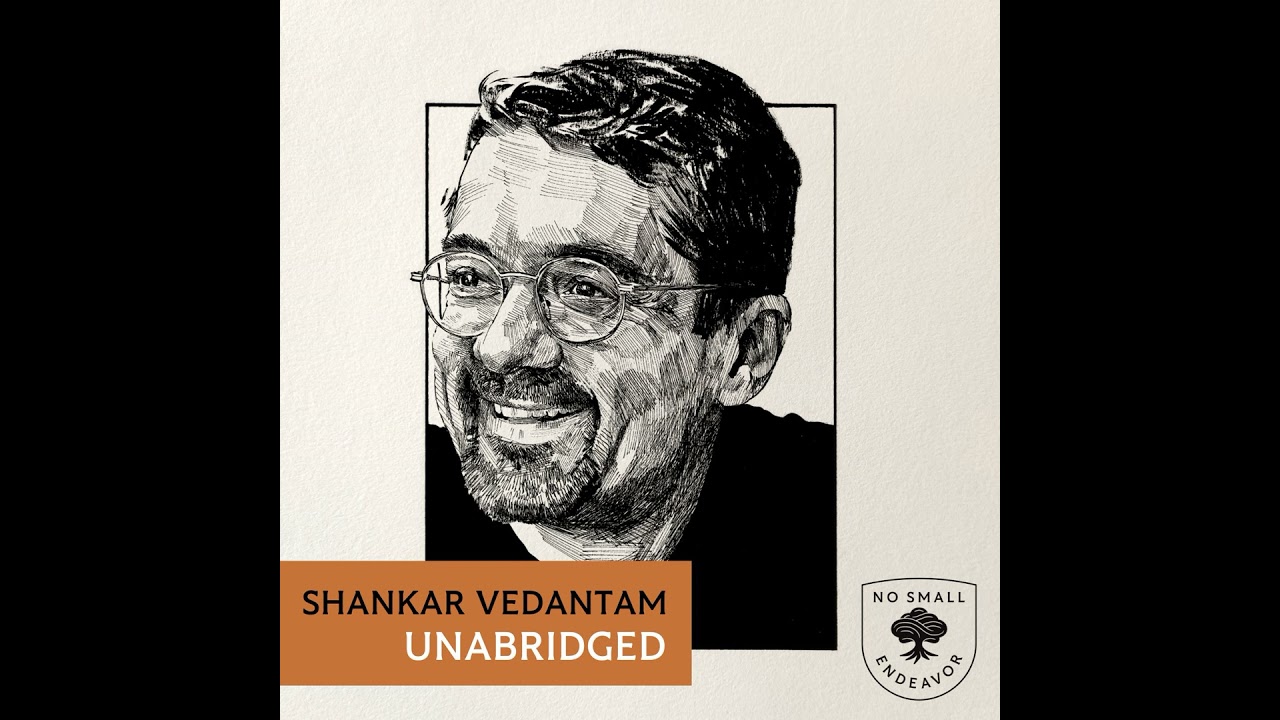
Shankar Vedantam, creator of Hidden Brain, talks about how much of our mental life happens outside conscious awareness. He explores unconscious bias, why social relationships matter, and how curiosity and self-compassion shape who we become. Vedantam argues that spiritual traditions and modern psychology say similar things about living authentically.
Chapters
No Small Endeavor is brought to you by Progressive Insurance. You chose to hit play on this podcast today. Smart choice. Make another smart choice with Auto Quote Explorer to compare rates from multiple car insurance companies all at once. Try it at progressive.com. Progressive Casualty Insurance companies and affiliates, not available in all states or situations. Prices vary based on how you buy.
Why do people commit themselves to the things they do? Why are people so worried about sport? Why wine? Why video games? I'm Brian Lowery, and in this season of my podcast, Know What You See, I'm asking a simple question, but a really big one: What's the point? In conversations with people with a variety of passions and obsessions, we get the chance to look through a window and see what it means to truly focus on a realm of human experience. Join me on Know What You See. New episodes begin November 26th.
I'm Lee C. Camp. This is No Small Endeavor. You're listening to our unabridged episode with Shankar Vedantam. Shankar is the host of the Hidden Brain podcast and public radio show. It's a delightful conversation. Shankar's coming at questions about human flourishing from his background as a science journalist. And so our common overlap in the kinds of questions that we work on, think about was a great deal of common interest there, which made for a delightful conversation. Here's Shankar Vedantam. Enjoy.
We the people shape our country's story. America 250 is gearing up to celebrate the 250th anniversary of the founding of America's democracy by collecting and preserving diverse stories from across the nation. Nominate any living person you think has a story to be preserved and celebrated for generations to come. Help tell our American story, every unique version of it. Visit america250.org/nominate to submit.
Shankar Vedantam is host of the Hidden Brain podcast and radio show, where he explores the hidden patterns that drive human behavior. Hidden Brain is featured on more than 400 public radio stations around the United States. Shankar is also the author of The Hidden Brain: How Our Unconscious Minds Elect Presidents, Control Markets, Wage Wars and Save Our Lives, and Useful Delusions: The Power and Paradox of the Self-Deceiving Brain. Welcome, Shankar.
It's a delight to be here, Lee. Thank you so much for having me.
It's a pleasure to have you. I've been really looking forward to our conversation and grateful to get to spend some time with you. Your vocational pursuits, as I understand, began with training as an electrical engineer in your home country of India to being a science journalist in the United States, which is a fascinating transition. So my first question is, if you were to use your own approach, namely that there are hidden patterns that drive our behavior, use your own approach on your own life story. How would you say you got from there to here and that you've learned things that were hidden to you at the time but have now become perhaps more apparent?
Yeah, that's a great question. I will say first off, one of the important insights that I've had in my life is that life is unpredictable and that things will change in your life as you go along with them, and it's important to try and take those into account. So I think many of us spend years, especially as young people, trying to plan ahead for what we will want to do in the future. And that's a good thing to do. It's a good thing to make plans for the future, but it's important to make those plans with some humility, if you will, because life has a way of changing its mind on you as you go along. So my own journey from electrical engineer to journalist, to science journalist, is in some ways less surprising than it might look on the surface. I was always interested in writing. I had always freelanced for various newspapers. I was fascinated with the idea of talking to people. Right after I finished my engineering course, I worked for a brief period of time at a newspaper in India. And I realized that something magical and transformative happens when you hold a notepad in front of you and you're talking to another person.
Ah.
All of a sudden, it gives you the license and the liberty to ask people, you know, really difficult and personal questions. And for some reason, they will give you answers. They will answer it if you have a notepad in front of you. And I realized this was a way of understanding other people that was really very powerful. And I think, you know, theologians and priests and psychologists and lawyers and doctors, they have the same experience, which is people open up to these professionals in ways that reveal things about them that they might otherwise keep hidden. And I feel like I had that same sense of like really understanding what other people were about when I had a notebook in front of me.
Right.
I gravitated to science writing primarily because, you know, with a background in engineering, I felt like the science aspect of journalism was always appealing to me. The wonder and the mystery of science trying to unpack problems was always fascinating to me. I slowly gravitated to covering the science of the mind and really, I think that's because the scientific questions involving the mind and human behavior are the most fascinating questions that are out there.
I want to go back to what you said about the exercise or the practice of interview. It is remarkable to me the way in which asking someone a question in that sort of context opens people up in such vulnerable ways. Why do you believe that that's true?
Well, I think one reason it's true is that I think you perceive when you're speaking with a lawyer or a doctor or a journalist or a priest, that at some level this person is listening to you in a nonjudgmental fashion. At least that's how it should be in the best case. I mean, so I know that there are journalists who listen to their subjects with an ax to grind, but I was genuinely asking people questions because I wanted to know the answer.
Hmm.
You know, I wasn't a part of their family. I wasn't a part of their company. I didn't have an ax to grind. I was genuinely curious about how they came to feel what they felt, how they came to think what they thought. And there's something very powerful, I think, that happens when people ask us these questions in a nonjudgmental fashion. So much of the time, I think, when we have conversations with people, they're often with interlocutors who have points of view that they are eager to communicate to us.
Yeah.
We talk to a spouse or a partner or a friend or a colleague or a manager, and these people often want us to do things, or they have things that they want us to do, or they want us to change our behavior in certain ways. And I think as a journalist, when I asked people questions, I was genuinely trying to ask them, why do you feel the way that you feel? And I think there's something very powerful when you give people that kind of license.
As I've mentioned to you, my academic field's in theology and moral philosophy. And ethics, I would say, at its best, classically understood, was always asking the question, what does it mean to be human? What's it mean to flourish as a human being? What does it mean to flourish in human community? And of course, in the last couple of decades, the social sciences, neurosciences are also asking similar questions about human flourishing and well-being. And it seems that the questions around human flourishing are key to the work that you're doing now with Hidden Brain. Is that a fair assessment?
I think that's absolutely a fair assessment. I think we're trying to grapple with questions in some ways that are very, very old questions. that have bothered human beings for centuries or millennia. But we are trying to do it using the tools of psychology and neuroscience and the social sciences.
You have some recent episodes, for example, where you're dealing with these questions of well-being. So unpack some of that more for us about what are you learning, what are you seeing from the various disciplines you're engaging?
Well, the question of what prompts human flourishing is a very, very broad question. I think there are many, many different strands to it. For example, there is a voluminous body of research that suggests that our social relationships are key to our emotional flourishing, that we are designed to be social creatures, and that many of us in some ways downplay social relationships to our peril.
Right.
Some years ago, we did an episode called The Lonely American Man, talking especially about the decline in social relationships among men and middle-aged men and older men. and the consequences this has on their physical and mental health. So social relationships, I would say, are an important domain of flourishing. Another important domain, I think, is to understand who we are. And in a series of stories that we have published in January, we have looked at questions related to authenticity. How do we know what it is that we should be doing? What happens when, you know, our internal self is at odds with our external self, when the world tells us to, behave in a way that does not feel concordant with what we want to do on the inside. And many of those stories have explored, how do we bring the inner self and the outer self into better concordance with each other? How can we live more authentic lives? There are also a variety of different studies that basically talk about the role of seeing others clearly, of interacting with people clearly, of bringing curiosity and wonder and awe into our lives. And all of those, I think, are also elements of human flourishing.
One of the things that attracts me so much to this notion of human flourishing is how one doesn't have to grapple with these kinds of questions that are being raised very long until you start seeing how holistic it requires us to be in our thinking.
Mm-hmm.
So what you just said about social relationships, for example. Aristotle talks about how we're social animals, and for him, the fact that we are social animals means that he sees justice as one of the cardinal virtues. I think a lot of times we can think about flourishing as this sort of individualistic endeavor.
Yes.
But here, going back to Aristotle, he's saying, no, precisely because we care about social relationships, we must care about justice and fairness and equity in all of our relationships. I think similarly, it not only thinks about these big social questions, but it also thinks about these habits of the self, as you just said, with curiosity, for example. So I just find it so lovely engaging these broad sets of questions and how it can keep us going for a whole lifetime and growing in these various ways.
I'm so glad you brought up the question of ethics and morality and how we treat other people, because I think you're absolutely right, Lee. Sometimes we have a very narrow and perhaps selfish view of what flourishing is. But I think, again, the research I think is very clear that We live our best lives when we can be not just in harmony with other people, but in service to other people.
Mm-hmm.
There's something very profound that happens when we reach out and help someone else. A couple of years ago, we started a spinoff show called My Unsung Hero. Short excerpts of the show run on NPR's All Things Considered on Monday afternoons across the country on public radio stations. And the essence of the project is to have people recall a time Mm-hmm. When someone came to their assistance in a moment of need. And these are just wonderful stories that people have related to us, stories where they've been lost in an airport, or their car has broken down on a highway, or they've run out of money and they're in a strange country, or they have an illness and they're in a strange location and they don't know what to do. And in all these stories, you have someone who shows up, often out of the blue, to basically help the person. And one of the things that I'm struck by in these stories is not just that they're charming stories, Or, you know, beautiful stories, but there's something deeply, you know, morally uplifting about them. To sort of see someone acting in a way that feels morally elevated, you know, produces a sense that I think is not different than seeing a beautiful waterfall or seeing a magnificent sunrise.
Mm-hmm.
There's a sense of awe that we have when we see, you know, moral beauty.
And I think in some ways, moral beauty is an essential Yeah, that reminds me of an episode we did with Dacher Keltner at Stanford on his recent book on awe, and the way in which he says that one of the primary ways we're moved towards awe is through stories of moral exemplars. So fascinating overlap there.
Yes, indeed. Dacher was on Hidden Brain as well, and his work on awe, I could not recommend it more highly to your listeners.
Yeah, very helpful. So as you think then about These hidden patterns that you've been investigating for a long time now, what are recurring hidden patterns in the way we operate as human beings that you continue to unearth, or what are some of these that you consider most remarkable, most powerful, and yet at the same time perhaps the most overlooked?
I mean, in some ways the central thesis of the Hidden Brain Project is that most of our minds are in fact hidden from us. You know, even after I wrote the book, The Hidden Brain, you know, probably 15 years ago at this point, and it felt like a revelation to me at the time because when I think about my own mind, when I think about my own inner thoughts and feelings, it does feel as if I know everything that's happening inside my own head. I feel like I have a full picture of what's happening inside my own mind. And so it came as something of a shock and a surprise to me to learn about this huge body of research that showed that in all kinds of ways, much of the workings of our minds were in fact hidden from us. And that's the origin of the term that I coined, the hidden brain, the idea that much of our mental lives in fact is happening outside of our conscious awareness. Now, that has very, very profound consequences for literally everything that we do. It has consequences for how our senses operate, how we see, how we hear, how we feel, how we taste. It also has important implications for how we go about our lives. How do we make decisions? How do we make judgments? Because in all of these cases, it turns out There is a large portion of our mind that's happening, that's working outside of our conscious awareness. So we may think we are making a decision rationally, deliberately, consciously, but in fact, much of the time there are hidden factors that are swaying our decision in one direction or another. I think that fundamental idea that much of our minds are hidden from us, and therefore, you know, often when we reach conclusions, we should do it with more humility than perhaps we often exercise is, I think, a central construct that continues to fascinate me. And even as I go about my daily life today, I feel there are all kinds of examples where I constantly have to tell myself, oh, that's my hidden brain at work. This is why I wanted to do something, but in fact, I wasn't able to do it. It wasn't because of a lack of will or intention. It's because I hadn't fully appreciated the role of the hidden brain in this decision that I was making.
So for those who are unfamiliar with your project, what would be some of your favorite examples of these hidden realities in our brain that we may be unaware of?
Well, I'll give you a couple. The origin story for the Hidden Brain Project looked at how we relate to other people in the context of the unconscious biases that we might have about them. And so when I wrote the book 15 years ago, a lot of the book focused on the ways in which we draw very quick and intuitive judgments about other people. We leap to conclusions about other people. And what's striking is I think we do this so naturally and so effortlessly, and we do this all the time, that we're not even aware of doing it. So if you ask most people, how do you interact with others, they will say, you know, I'm very good at picking up what other people are sharing with me, or I'm very good at seeing what they have done and reaching accurate conclusions about them. But the research studies show over and over and over again that in fact we don't do this, that if somebody is elderly, for example, we have instantaneous judgments about who they are and what they are and how they might think. When someone is very beautiful, for example, we have instantaneous reactions about what the moral character of this person might be. So in all kinds of ways, we have these biases that are nudging us in one direction or another. Another really, I think, powerful domain where this affects us is in the domain of when we make resolutions. And in some ways, at the start of A new year, you know, many of us have made resolutions at the beginning of January and find by the time we reach the beginning of February that those resolutions have fallen by the wayside. And an interesting question is why this happens. You know, we started out the year with all kinds of positive intentions of saying, you know, I want to exercise more, or I want to sleep better, or I want to build stronger social relationships, but we haven't actually done those things. And part of it is that we're not fully appreciating all that's happening under the surface that might keep us from accomplishing our goals. We seem to think that willpower and conscious intention are everything, when in fact they might be only 10% of the equation.
So as you've done this work, I'm wondering if you have any sort of recurring frustration that keeps you doing this kind of work. Is there something that you keep experiencing that you feel this sort of Annoyance about this reality?
Well, I think I feel that annoyance in my own life because I feel like I often don't live up to the person that I want to be. I'm not as generous as I would like to be as a person. I'm not as brave as I would like to be. I'm not as focused or undistracted as I would like to be. In all kinds of ways, I feel, why can't I be the kind of person that I want to be? And I think part of it is also sort of what I think has changed is is perhaps not so much frustration, but a growing sense that I need to exercise a degree of self-compassion when it comes to my own flaws and foibles. And in some ways, we've done episodes about this. The tendency that I think is especially pronounced in a country like the United States is that when you don't do something that you want to do, you set yourself a goal and you don't reach that goal, many of us beat up on ourselves mercilessly.
Right.
And I know that I do this myself all the time. And the research actually is quite clear that, in fact, doing this is actually not helpful. It is not helpful in reaching your goals to beat up on yourself when you fall short, that in fact, exercising self-compassion is actually a better way to go to accomplishing the goals that you have. But I suppose a perennial frustration, since that's the question that you asked, is the sense that I'm often falling short of the kind of person that I would like to be.
Yeah, I do think that that research on self-compassion that Kristin Neff has done is so fascinating because it's so counterintuitive, I think. And it would be interesting to hear you first comment on whether or not you think that's particularly American. But I think that even her exercise, for example, of writing a compassionate letter to oneself for, I think, a week, and how the incident rate of depression declines over a given period of time for doing that sort of thing.
Yeah.
Yeah, it's just— again, it's a very counterintuitive Unless somebody points out that this is the way our brain works, we simply wouldn't be aware of it otherwise. And we operate in very potentially self-destructive ways when our brain would operate otherwise.
That's right. And I think maybe it is not uniquely American, but I think it is especially American because I think there's a very strong streak in the United States that basically says, that links in some ways suffering and self-castigation with better outcomes. So spare the rod and spoil the child is an old adage that has been around for many, many, many decades. And the idea is that the harsher you are with yourself, the better your outcomes are going to be. Now, I have no disagreement with the idea that hard work and perseverance and grit are important components of success. I think that is almost self-evidently true. But I think the idea that if we are cruel to ourselves, we will actually perform better, has almost this mechanistic model to how we think our brains operate. That if we just think that if we just press the accelerator harder, the car will go faster, we tend to think of ourselves as being the same sort of machine-like object that if we just push harder, we will actually do better.
Yeah.
And I think the error in that thinking comes about from the fact that when we're so busy castigating ourselves for making a mistake, when we When we do something wrong and we are so eager to beat up on ourselves, more of our minds now are focused on the beating up of ourselves rather than in a nonjudgmental way asking, what did I do wrong? Why did I do something wrong? And how can I fix it going forward? In other words, being nonjudgmental with ourselves allows us to see things about the things that we have done wrong that being angry with ourselves keeps us from seeing. When we're angry with ourselves, we're so consumed with that anger and self-hatred that we can't actually diagnose the problem correctly. I mean, a good analogy might be, imagine you go to a doctor with a medical problem, and the doctor gets so upset with your medical problem and so emotionally exercised by your medical problem that she's unable to actually diagnose what is actually wrong with you.
Hmm.
That's what we do when we fail to exercise self-compassion. We are so consumed with our self-hatred that we stop being good diagnosticians. And when we stop being good diagnosticians, we can't get to the root of the problem and can't actually improve ourselves.
Yeah, yeah, that's very well said. I'm wondering what sort of engagement with any particular religious tradition or philosophy has informed your life pursuits?
Well, I would say that one of the striking things that I have noticed in the last 10 years that we have been producing Hidden Brain is how often the ideas and insights that we're exploring have intersected with religious ideas that have been around for centuries. In some ways, I think the, the question that you're asking has sort of the arrow of causation pointed in the wrong direction, as far as I'm concerned. I think it's, it's less the case that my religious or spiritual interests have prompted me to go in a certain direction in terms of my research interests or the research that I'm interested in exploring, and more sort of the other direction, which is that the research I'm interested in exploring often has pointed back to religious and spiritual traditions that have explored solutions to these problems over many, many centuries. And I'll give you a couple. One of them just looks at the idea of treating other people well, right? Every religion in the world that has stood the test of time involves a mandate to basically treat your fellow human beings as if they were your brothers and sisters. And religious traditions, I think, preach this as a form of saying this is good for you in terms of your soul, in terms of your morality, in terms of your afterlife. And I think psychological research would say now, regardless of the soul and the afterlife, doing good things for other people is good for you in the here and now. It's good for your psyche. It's good for your mind, for your brain. It's good for your physiological health. Another interesting domain, I think, which is pointed in this direction is the value of mindfulness, of paying attention to how we are thinking, to paying attention to what we are thinking, to notice our own thought processes. And of course, mindfulness traditions have been practiced by many, many religions and many, many spiritual traditions going back many centuries. And so for me, I think what strikes me is how much modern psychology and neuroscience are finding their way back to ideas that have been in some ways preached for centuries or millennia.
Yeah, that raises a fascinating consideration in some religious traditions. I'm thinking, for example, in the Christian tradition, you know, you can find some who find pragmatism as threatening and some who find it as a necessary element of their faith. So unpack that a bit. There's one strand in the Christian tradition going back 500 or 600 years that argues that something is good simply because the divine has decreed that it is good.
Hmm.
And then there's another competing tradition that says, no, no, things are good or not, and the divine speaks to us about that which is good. And points us toward that which is good. And these seem to have very important consequences down the rut of the alternative ways of thinking, right? So the first way of thinking could respond to social science findings, for example, and say, I don't care what the social science says.
Mm-hmm.
It's simply whether or not God said this or God said that. Right. And then these others would say, no, no, we should expect that if something is truly good, that we could find concrete scientific evidence that this works in a way that leads to human flourishing. But I don't know, any thoughts or feedback on that sort of dilemma?
Yeah, I think that's a really interesting question. And I can see how that tension might be real, that if you believe that, you know, my religious faith depends on my just following the word of God, then it's irrelevant or perhaps even a distraction to ask, you know, what does the science say about it? And I can also see the argument that says if something is mandated as being divinely good, it wouldn't be surprising at all for us to find scientific evidence that in fact those things are good, because in some ways there would be a meshing of those two ideas. I'm not sure I understand the theology well enough to basically to comment on it. Certainly as someone who comes to these questions from a scientific perspective, I start, I think, with the science. I start with the research. And for me, there seems to be no contradiction whatsoever with the Sermon on the Mount basically saying, look after your fellow person, look after your fellow human being, care for other people, be gentle, be kind, and the social science research that basically says all these things are actually good for us, not just good for our fellow citizens, but good for us in terms of our individual behavior.
Yeah.
We've also done a few stories, and I don't know how this will you know, strike the people in your audience who are believers, that looks at the idea of religions themselves as scientific phenomena. So if you think about religious ideas and, you know, we have a multiplicity of religions around the world, you know, you have Christianity, you have Islam, you have Judaism, you have Hinduism, you have Buddhism, there's so many religions. And of course, if you go back through human history, you will find there are hundreds of other religious traditions that have at various points risen and fallen over the centuries. And there is a body of psychological research that basically asks the question, how is it that we have the religions that we have today? And it looks at them in some ways as natural phenomena and basically argues that the religions that we have today have survived precisely for hundreds or thousands of years because they have helped human beings and helped human societies Flourish in very important ways, and if they did not help us flourish in those ways, they would not be around anymore. You know, I was at in Mexico City to give a talk about a year ago, and I visited this wonderful Museum of Anthropology that they have in Mexico City, and it tells the story of civilizations that have risen and fallen over you know two thousand or three thousand years in in in the area that we now call Mexico. And and what struck me as I went through this museum was a number of different religious faiths that rose and fell over the centuries. And you can see at different points, there are different kinds of religious beliefs that become popular. So in times of famine or drought, people turn to religious faiths that help them understand why it is there is a drought happening. How do we respond to this drought? How can we prevent this drought from happening in the future? But as technology improves and you have better irrigation and better control over weather systems, and now you're no longer as vulnerable to drought as possible, the same religious faiths that seem to be very powerful when droughts were really widespread and caused a lot of damage, those religious faiths are less relevant to us today. You know, they have fallen away because in some ways they're not fulfilling the need that arose in human societies. Now, I think some believers might again sort of look at this as, you know, social scientists basically stepping on their turf, and I fully understand that. But I would argue that the more humanistic way looking at this is to say, human beings have been trying to solve problems in their personal lives and in their social lives for thousands and thousands of years. And we've always tried to come up with ways to help us live together, work together, treat one another better, survive together. And to my mind, the fact that you've had religious faiths that have tried to do this, or spiritual traditions that have tried to do this, or psychological and scientific traditions that have tried to do this, To me, there's no contradiction or a huge conflict between these ideas. They're all ways, I think, in which human beings have tried to live better lives.
Yeah, fascinating. I mean, I think one could also say the opposite might be true in the sense that there's plenty of evidence as well in the history of various religious traditions that in some cases, these traditions are used to instantiate or justify various hierarchies of oppression. And so they have— I think it's hard not to accept the notion that whatever our various so-called religious traditions are, they have profound social implications.
Exactly.
And those social implications are worth a lot of our attention to see what's really going on with the things that we say we believe about the divine.
Correct. Correct. And I think it's also then useful to actually ask ourselves periodically, you know, religious traditions tend to be very broad. I mean, you can look within the world of Christianity and you can find, you know, beliefs and traditions that are at odds with one another, right? The Christian tradition is not one tradition. It's hundreds of different traditions that are woven together. And you could make, you could make the case that at different times, different aspects of those traditions have appealed or spoken to people or the challenges that they're dealing with. And in some ways, that's part of the role that a religious tradition plays. I mean, it's a little bit like reading Shakespeare and asking, you know, was Shakespeare, you know, pro this or anti that? And you can read almost anything you want in Shakespeare because the traditions and ideas are so widespread. I sort of sometimes think of religions and religious texts in the same manner.
You began to allude to this a moment ago, but let me put more of a— come back and revisit this question. What are things that you've learned in doing this work that have become a sort of persistent intentional component of your life? And on the other hand, what are things you've learned that you have not, from your perspective, sufficiently incorporated into your life?
Hmm.
So I would say that one of the things that I have tried to learn is the idea that when I'm making plans for my future self, I am, I think, a little more humble today in pretending that I know what my future self will actually want.
Mm-hmm.
Many years ago, the researchers Dan Gilbert and his colleagues ran a very interesting set of studies where they interviewed people who were 30 years old, 40 years old, 50 years old, 60 years old, and so forth. And at each decade, they asked people, how much have you changed in the last 10 years, and how much do you expect to change in the next 10 years? And what they found is that 30-year-olds said, I have changed a lot since I was 20. I knew nothing when I was 20, and I'm much, much wiser and smarter today. But I don't expect I'm going to change very much from this point onwards.
Hmm.
40-year-olds said, I have changed enormously since the time I was 30, but now I'm pretty sure this is who I am. I'm not going to become a different person in 10 years' time. But of course, as you might expect, 50-year-olds said, I knew nothing when I was 40, but I think I'm baked now. 60-year-olds said the same thing. And regardless of which life stage you were at, people noticed that they had been significant changes in their lives in the last 10 years, but did not anticipate there were going to be significant changes in the next 10 years. And so there's a paradox here in some ways, which is that we assume that the people we are today is the people we are going to be in the future. And of course, even a cursory glance back at our own lives, even if you're 20 or 25, can tell you that you will change and you will change dramatically. in the next 10 years in ways that you cannot anticipate. And of course, that raises sort of really interesting and important questions about how we can make plans for our future selves when we don't know who those selves are going to be, when we don't know what they will care about. So many of us spend 30 years, 40 years, sometimes working at jobs that we don't like because we say, our goal is to help this person that we're going to become when we're 60 or 70 be happy. But if we don't know who that person is going to be at age 60 or 70, how do you make plans for that person? How do you know that that person is not going to look and say, what made you think that this is what was going to make me happy?
Mm-hmm.
So I think I have become a little bit more humble on that front in terms of sort of pretending that I know what my future self is going to want. I'm more alert and vigilant, I think, to the ways in which I myself might be changing. So just because I've believed something or I know something or I feel something or I have felt it very strongly for many years, I'm no longer as confident that I'm still going to feel those things very confidently 5 years from now, 10 years from now, certainly 30 years from now. I think some of the areas where I've fallen short, I think, have to do with— there's been a lot of research that shows that having more time in our days, not being as rushed as we go about our days, is good for us, that having time to reflect and to think. And again, this goes back to ideas in many Religious traditions, of time spent alone, of time spent in reflection, that these are really valuable things in our lives. I have found that very, very difficult to do in my own life. I feel like I'm constantly overstretched. I'm running between one thing and the other. You know, this interview that we're doing here, Lee, I had to reschedule, you know, twice because I had conflicts come up in my own life. And so I have not left much time in my life for reflection. Reflection and contemplation. And I know that that is probably a shortcoming, that I would be a better person if I carved out some time to do that.
I'd like to go back to the first thing you said that you're trying to incorporate and a sort of humility about your future self. And you've got this great TED Talk on this. And in talking about this illusion of continuity, you're sharing one particular episode of your own life from your 12-year-old self. and the way you had changed in an important way to your 12-year-old self. And you said, now my 12-year-old self wouldn't just find this incomprehensible. My 12-year-old self would see this as a betrayal. And I find that really help— the way you put that very helpful because I think it points to the way in which we experience certain inhibition to change.
Yeah.
I think at our best, we all want to believe that we have some sort of sense of integrity.
Yeah.
And that sense of integrity means that I shouldn't give up this vision of who I think I am or my convictions lightly or easily.
Yeah.
And yet here we are with this ongoing change. And even though I had written down Dan Gilbert and I've thought a lot about change and so forth, even as you were going through what we say at 20, what we say at 30, what we say at 40, I was sitting here thinking, Well, I know that I've changed a lot in the last 15 years, but I don't think I'm going to change that much over the next 10 years. So there's just this part of our brain that just doesn't want to believe that that's true. So I don't know, any other ways to unpack that or help us to see that?
Yeah, I think the compassionate way to look at it is that when we look back, we can actually see the evidence of the ways in which we have changed. We know that we are different because we believed one thing 10 years ago or 15 years ago, and maybe we believe something else today. Maybe you thought that you would never like Japanese cuisine 10 years ago, and now you think Japanese cuisine is the best cuisine in the world. So we can look back and see evidence of change, and so we can know that we've changed. When we're looking out into the future, we don't know how we're going to change. So even if theoretically we might imagine we're going to change, we can't see concrete evidence of that change. So in some ways, I think that's what makes it easier to look back and say, I've changed a lot. And then imagine that we're not going to change very much into the future. I think that the question of betrayal is sort of a really fascinating question. And I think when I raised it, I was talking about how when I was 12 years old, I was deeply into soccer and I wanted to be a soccer star. And today, I barely watch any soccer at all. And as I said, my 12-year-old self would see that not just as a change of heart, but as a betrayal because soccer was so important to my identity. identity when I was 12 years old, and the idea that several decades later soccer might not be an important part of my life, I would've— my 12-year-old self would ask, what happened to you? How did you lose your way? How did you come to forget this important part of your identity? I think one of the important insights that this raises is that not only do we change over time, but I think it's also the case that we do not have one self inside of us. And I think this is the other very powerful illusion that we have, that there is one Lee inside you, Lee, this one Shankar inside me, and this one person is inviolable as I move through my life. The truth is, I think we are constituted of many, many different selves. Some of these selves are at war with each other. Some of these selves are constructed in conjunction with other people. So in other words, perhaps You're married and, or you're in a long-term relationship. Part of yourself is in construction with this other person whom you're spending your life with. You get divorced from this person or separated from this person, and all of a sudden, that self that you had constructed together with this other person is now no longer prominent and perhaps changes, or maybe another self comes to the surface in a much more powerful kind of way. And I think the fact that many of us fail to understand that we have different selves inside us is part of what causes this feeling of betrayal that And so when another part of ourselves in some ways comes to the fore, you know, a decade from now or 2 decades from now, we can— our younger selves might say, how come you have changed? When in fact that other self was actually always inside us as well.
Yeah.
I don't know if that's helpful, but I think one way, again, to have a little bit more humility is to actually recognize that we have different sides to ourselves. And I think the modern world, and especially, you know, social media, don't lend themselves very well to this sense of humility. We're always expected to express ourselves with great confidence, with great certitude, to be very confident about our views, to say, I know exactly what I need to do, when in fact we might have doubts within ourselves. And those doubts might in fact be pointing us to very important aspects of ourselves that we should not doubt.
So in your TED Talk, you also spoke of the way in which our future self, being unaware of the fact that we change so consistently, persistently, being unaware of that fact could lead us to resentment of our younger self, which again, I thought was quite insightful because I flashed back to 10 years ago when I was going through some very sharp resentment of my younger self about why I made some of the decisions I made when I was younger. And I did so precisely because I thought, well, this is what What it means to be me, right? But give us some direction or thoughts on how we can avoid that kind of resentment of the younger self.
I mean, in some ways, I think part of the story is what we discussed at the start of our conversation, Lee. As a journalist, I interviewed people, and I interviewed people without having an axe to grind. I was genuinely interested in why they did what they did, how they came to be where they are. I was asking questions with curiosity. And I think people picked up on that curiosity, which is why they opened up to me. And they shared things with me that perhaps they have not shared with the people in their lives who they were closest to. They might not have told those stories to their partners or their children or their colleagues at work, but they told them to me, who was a perfect stranger, and all because I evinced genuine curiosity.
Mm-hmm.
And I think the power of curiosity is something that I think is deeply undervalued in our lives. And I think it actually is the answer to the question, that you're asking, which is when I'm thinking about my older self and I don't know who that person is going to be, it's helpful to look at that older self with curiosity, to ask not just, this is who I'm going to be in 20 years' time, but to ask myself the question, who can I be in 20 years' time? What are the different possibilities that I could explore in 20 years' time?
Hmm.
So to look at it with curiosity. And similarly, when we interrogate our younger selves, when we Have done something, for example, that maybe we shouldn't have done. Maybe we committed a crime 20 years ago. Maybe we did something that was deeply embarrassing. Maybe we did something that blew up a career or blew up a relationship 20 years ago. It's understandable that we have rage and anger and regret for the person we were, for the actions that we committed. But a better approach might actually be to say, let me understand why you did what you did. Help me understand And how you came to think that that was the right thing to do at the time. Curiosity is a very, very powerful weapon, I think, in our arsenal. And in fact, using the word weapon, I think, is the wrong word. It's a very powerful tool in our arsenal to really bring self-compassion both to our older selves as well as to our younger selves.
Yeah. It also seems to take a great deal of courage, I think, to Presume that I'm going to be capable or somehow what I need will be provided as I change or as I encounter things that require me to change.
Yes.
Though that may evoke a great deal of fear or anxiety, that the courage can allow me to kind of step on through that.
Yes, and I think that's a really important question and point that you're raising, which is I think many of the reasons that drive our focus on our future selves stem from anxiety, stem from worry. What is going to happen to me if? What might happen if? What will this person do if? If I do this, is this other person going to be mad at me? So much of our lives are spent in some ways focused on the future. And of course, we don't know what the future is going to hold. We don't know what we will think in the future. We don't know how other people are going to behave in the future.
Right.
And this in some ways goes back to the idea in many, many spiritual traditions, including the Hindu tradition in which I was raised. One of the important ideas there was try not to live in the past and try not to live in the future, but try as much as possible to live in the present.
Hmm.
Now, it's easier said than done. I feel like I spend most of my life living in the future, trying to plan ahead and figure out what I'm doing 2 months from now. I have a calendar that looks insanely busy 3 and a half months from now, which seems really ridiculous to me. But really, all of that insight is the more time that we can spend in the present, being aware of the present, being mindful of the present, acting in the present, the less we are worried about the future, the less we're regretful about the past, the happier and more fulfilling our lives are going to be.
How have you reacted to the increasing incident rate of anti-science sort of reactions that we're seeing?
You know, to be honest, I find it bewildering, especially I think when it comes to things like, you know, vaccine safety or some of the medical insights that have been hard-won. You know, the concerns that many people have about childhood vaccinations, for example, right now, or concerns about whether scientists have agendas. And I don't mean to say that all science is good and all scientific research is accurate. I'm fully cognizant of the fact that science itself updates itself regularly and things that we thought were true 20 years ago, we sometimes no longer think are true. It's also the case there are undoubtedly scientists who are not good scientists and some people who are actively malevolent actors who basically make up their data and practice fraud. But I do think those things tend to be in the small minority, that for the most part, science has been a wonderful tool that human beings have used to improve our lives. If you think about the improvements that we've had in our lives over the last 2 and a half centuries, science and technology have played a very important role in making our lives so much better. I don't think most people, given the choice, would say, I would prefer to be returned to 200 years ago compared to today?
Mm-hmm.
Would you rather live in 1825 rather than in 2025? I think very few people would make the choice to basically go back to a day where there was no indoor plumbing and we didn't understand bacteria and viruses and we didn't have childhood vaccinations and we didn't have clean sanitation and water and transportation and all the things that we have today. And so much of those are the result of scientific endeavors. And I find it a little bewildering and certainly very sad that I think many people have come to distrust and mistrust science. And I think there is great work that communicators like you and I have to do to try and help people understand what the scientific enterprise is about and how many scientists, in fact, are dedicating and devoting their lives to making the rest of our lives better.
So last question for us, which relates, I think, to this conversation we were just having about sort of hostility towards science. I haven't read this book, but I know you have a book of short stories, The Ghost of Kashmir, and as I understand it, you're grappling with kind of divisions of politics and pride, especially between India and Pakistan. And I wonder how I wonder, one, why that particular writing for you, but more broadly, more abstractly, what are you hoping we might see that might help us navigate the sorts of sharp hostilities or partisanship that we're dealing with in our world today?
Yeah. Yeah, that was a book of short stories that I wrote many, many years ago, more than a quarter century ago at this point. The larger question that has animated me, and I think animates many people, is that I think when you sit on a quiet summer's night in a remote place and you look up at the stars and you have the sense that you are a very small creature in a very large universe, right? So this is what Dacher Keltner talks about. The sense of awe that we have is a sense of restoring to ourselves a perspective on the world that we often That we are so consumed with our own worries and animosities and anxieties that we fail to see the big picture, that in fact, we are tiny creatures in a very, very large universe. And in some ways, restoring that sense of perspective is really vital to our wellbeing. When I think about many conflicts that we have in the world today, I often think about that idea. You know, you're— imagine you're a traveler who is coming from You know, a distant part of the universe. And, you know, it's a lonely universe and an often bleak universe. And for much of the universe, in fact, there are no signs of life. Perhaps there's no life elsewhere in the universe. Perhaps there is. But as of now, we don't know if there is intelligent life elsewhere in the universe. And if you're a traveler from a distant galaxy and you travel across, you know, many millions of miles of space and you stumble on this tiny little blue planet where we are one species among many, Millions of species on the planet. And this is the only planet that we have, this tiny speck of life in this vast universe of darkness and bleakness. And then you see human beings on this planet carve up the planet into hundreds of different territories and then massacre one another and harm one another. And even within these territories that we call countries, people are at each other's throats all the time.
Yeah.
Surely this person from another distant galaxy will say, don't you just realize what it is that you have?
Mm-hmm.
How can you be at each other's throats when you have this incredible gift of being alive in this special place in the universe? And I think that's the question that I think often I have when I think about many conflicts in the world today, not just between India and Pakistan, but many other conflicts that we have around the world today, which is I think they often stem from a lack of perspective. And this is true in our interpersonal lives, by the way, not just in our global geopolitical lives, which is very often when we are at odds with someone else, the antagonism and conflict that we feel with another person tends to occupy 90% of our worldview. But in fact, if you had the perspective to think about this clearly, the conflicts that we have with most other people might only be 5% of our total worldview, that if you actually sat down and cataloged all the things in our lives that that involve this other person, we might come up with any number of examples of ways in which they agree with us or we agree with them or we're on the same page or we have the same values. But so much of our minds are so focused on points of disagreements that those points of disagreements eventually expand to take up our entire worldview. I think part of the work of psychology and psychological science, but certainly also the view, I think, of many spiritual traditions, is to restore that sense of perspective that says, what is the bigger picture here? What are we in this together for? How can we be each other's brothers and sisters? And I think when we have that, we are going to live much more happy and fulfilling lives.
I've been talking to Shankar Vedantam, host of the Hidden Brain podcast and radio show. Shankar, it's been a delight to talk to you today. Thank you so much for the conversation and your good work.
Thank you so much, Lee. It's been an honor.
Hey there. Did you know that we have a newsletter? Just imagine if you could have one of your favorite ethics professors send you a list of things to reflect on, think about, practical actions with which to experiment, all on your way to sorting through what it might mean to live a good life. Well, that is the NSC Notebook. I riff on themes and topics related to the show and our guests. Sign up for my NSC notebook today at nosmallendeavor.com/newsletter. Our thanks to all the stellar team that makes this show possible. Christy Bragg, Jacob Lewis, Sophie Byard, Tom Anderson, Kate Hayes, Mary Evelyn Brown, Carriet Harmon, Jason Cheesley, Audrey Griffiths, Thanks for listening, and let's keep exploring what it means to live a good life together. No Small Endeavor is a production of PRX, Tokens Media LLC, and—
Great Feeling Studios.
From PRX.










