Shankar Vedantam: The Hidden Brain
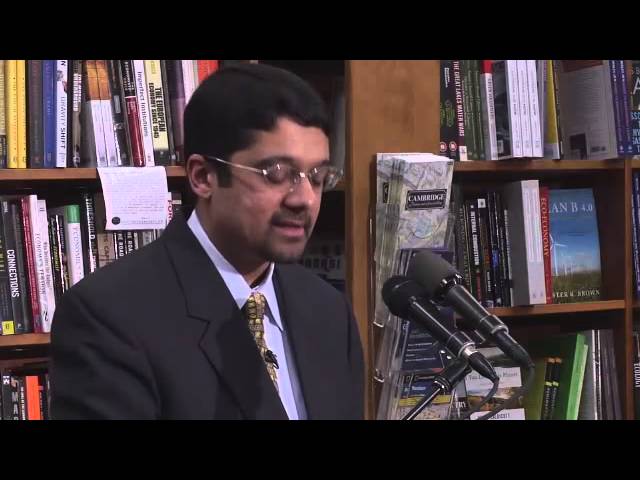
Shankar Vedantam explains how unconscious mental processes drive behavior far more than conscious intention. He uses experiments like the coffee-honesty study with eye pictures, workplace sexism cases like Lilly Ledbetter's, and group dynamics in disasters to show how the hidden brain operates. Awareness of these biases doesn't erase responsibility, he argues, but demands deliberate strategies to override them.
Chapters
This evening, I'm very pleased to welcome Shankar Vedantam. He's here with us to discuss The Hidden Brain: How Our Unconscious Minds Elect Presidents, Control Markets, Wage Wars, and Save Our Lives. The idea for this new book grew out of a Sunday magazine cover story that Mr. Vedantam wrote for The Washington Post called See No Bias, which focused on the effect on the effects of the unconscious prejudice. In The Hidden Brain, Mr. Vedantam posits that a common belief, that our behaviors and our beliefs are generally aligned, is wrong. Yet The Hidden Brain doesn't assert that conscious intention does not exist. It argues instead that conscious intention plays a much smaller role in everyday life than we imagine. Kirkus Review calls The Hidden Brain a tour into the dark realms of the psyche by a very personable guide.
Thank you.
And another great local thinker, Daniel Gilbert, hails the book as a smart, engaging exploration of the science behind the headlines and of the little man behind the screen. Shankar Vedantam is a national science writer at the Washington Post. Between 2006 and 2009, he authored the weekly Department of Human Behavior column in the Washington Post. He is the winner of several journalism awards and previously worked at the Philadelphia Inquirer, Knight Ridder's Washington bureau, And New York Newsday. Mr. Vedantam is a 2009 and 2010 Nieman Fellow here at Harvard University and currently moved to Cambridge, Massachusetts from Washington, D.C. We know our community is richer for his presence. You can learn more about Mr. Vedantam by visiting his website, thehiddenbrain.org, where the most recent article is entitled Love, Lust, and Harvard Book Store Event. Ladies and gentlemen, thank you very much for your patience. Please join me in welcoming Shankar Vedantam.
Thank you all so much for coming. It's a delight to see so many familiar faces and so many unfamiliar faces as well. Thanks to WGBH and to C-SPAN for covering this event. I'm very grateful. I want to make a special note of one person in the audience, Bob Giles, who is the curator of the Nieman Program. I'm a Nieman Fellow at Harvard this year, and I probably would not be standing here were it not for Bob's encouragement. This event is also really meaningful to me because in many ways launching the book while at Harvard has brought me full circle. The origins of this book really began from reporting that took place at Harvard 5 or 6 years ago, and so I have a sense of completeness in completing the circle in terms of coming back here at the time of its launch. It's also the case that Harvard, the university, has contributed enormously to the intellectual content of this book, and I think it's fair to say that without this great university, this book would not exist today. I'm hoping to give you a very quick overview about the book and then maybe read a little bit from one of the chapters in the book. And then take your questions. Theories about the unconscious mind go back centuries. Philosophers and theologians and scientists have studied the unconscious mind and tried to figure out why we do what we do for a very, very long time. In the last decade or two, there has been a host of new tools that have been developed that have given us new windows into the hidden brain, or what I call the hidden brain. Most of these tools are in the discipline of social psychology, but some of them are also in neuroscience and in economics and in sociology. And the picture that they paint of the unconscious mind is rather different than the conventional picture that we have about the unconscious. So in contrast to an unconscious that is filled with seething impulses and powerful forces, the unconscious mind that has been unearthed in recent studies is rather mundane. The analogy that I often like to use is that the unconscious mind that has been recently discovered is very much like the autopilot function that we have in a plane or the cruise control function that we have in a car. It plays a very useful function, but it's problematic when you're driving through a thunderstorm or you're flying through a thunderstorm on autopilot instead of on pilot. And so the analogy between pilot and autopilot is one metaphor to think about the unconscious mind, and it's a way to think differently about the unconscious mind than previous theories. Now, the hidden brain is a term that I coined. It does not refer to a secret part of the brain that is actually physically hidden. It's a metaphor, much like the selfish gene, and it's used to describe a very large range of forces that affect us in our everyday lives, from our romantic relationships to our financial decisions to the way we think in disasters. To our moral judgment, to the way we think about politics. Now, I'm using the term, I think, much like The Selfish Gene, as I said, but— and the fact that these biases are mundane, the fact that the hidden brain is a mundane mechanical thing in many ways, should not suggest in any ways that its effects are mundane. Its effects actually are extraordinary. Its effects are actually profound. The book is organized in what I thought of as concentric circles, where I start with very small and simple examples of the hidden brain at work, and I gradually build outward, and I show the effects of unconscious bias in the criminal justice system, in presidential politics, in the way we think about genocide, moral judgment, and risk. I'll start with something really simple. In one of the opening chapters, I describe a very simple example of the hidden brain at work. There was an office in England where a psychologist decided to conduct a very simple experiment. The office had something that's common in offices the world over, a beverage station where people could make their own coffee and tea. And there was a little honor box where people could drop their money into this box after making their coffee and tea. Now, the beverage station was located in a portion of the office that was not visible to anyone else. So if people were honest and paid for their tea and coffee, nobody complimented them. And if they cheated and didn't pay for their coffee and tea, nobody punished them. There was a little notice stuck on a cupboard door at eye level which detailed the price for tea and coffee and for milk. And the psychologist who worked at this office conducted a very simple experiment. Each week she changed the notice that was pasted on the cupboard. The text of the notice remained identical with the prices of the coffee and tea and milk, but there was a small decorative image that was on the top of the sheet of paper. And she downloaded images from the internet and pasted them on this little sheet of paper that was at eye level and on this cupboard door. On some weeks, the picture displayed a series of flowers— roses and daffodils and tulips— and on other weeks, the pictures showed a pair of watching eyes. At the end of 10 weeks, the psychologist asked if anyone had noticed that the picture had changed from week to week. People hadn't even known that there was a picture on the notice, let alone that the picture was changing from week to week. And yet this very small change from week to week produced a giant effect in people's honesty in paying for their tea and coffee. On weeks when the picture showed a pair of watching eyes, honesty levels soared. On weeks when the picture showed daffodils and tulips, honesty levels plummeted. Now it's a very simple example of the unconscious mind at work, and it's striking, you know, it's amusing and it's striking, because what it shows is not only that there's a part of our minds that processes things that we don't think about consciously, but there's a part of our mind that then influences us, that influences our behavior. I talk in a subsequent chapter about how these biases begin very early in life. The hidden brain is really active right from the time that we are born. And it plays a, you know, it can be measured right from the time children are 3 years old, which is about as early as researchers are able to study anyone to get meaningful results. In one set of experiments conducted at a daycare center in Montreal, a psychologist called Frances Abood showed that children as young as 3 were already categorizing the world according to racial terms and making positive and negative associations between faces that were white and faces that were black. When we hear these results, the first thing we ask ourselves, of course, is whether the parents of these children are indoctrinating the children with racist or bigoted views, because it doesn't make sense to think of a 3-year-old child as a bigot when the child doesn't know how to tie her shoelaces yet. It turns out that the parents actually were not indoctrinating their children with bias, and in fact, the parents were so afraid that their children would become racially intolerant, that they didn't discuss the issue of race or bias at all. They made no mention of it. And what's disturbing about this research, it's actually a step up from the coffee experiment, is that it shows that people can form, or children can form, these unconscious biases without anyone intending for them to happen. Not the parents of the children, not the teachers of the children, and not the children themselves. So how do these biases form? Around the time I was writing this chapter, my own daughter turned 3. And we were playing— we would play this game called doctor where we bought a doctor kit and she would check up on all of her stuffed animals using the stethoscope and the magnifying glass. And she would ask me to play the role of doctor and she would play the role of nurse. And we did this for a couple of days and then I suggested that we switch roles. And she was willing to play the role of doctor, but she was not willing to let me play the role of nurse. And this went on for 2 weeks. And I pushed and pushed, and she resisted and resisted, until I eventually asked her why it is I couldn't play the role of nurse. And she said— and it's surprising that she actually was able to articulate this, because I don't think most people are able to articulate where their assumptions are coming from— she said she had never seen a storybook where a nurse was played by a man. And it's true. When I thought about it, I had read her dozens of stories, dozens of children's stories. And in all these stories, invariably, The nurse was played by a woman. Now, there was no act of conscious bias on the part of the storyteller of the story. There was no act of conscious bias on my part. There's no act of conscious bias on her part. And yet, by age 3, she has formed what is clearly a stereotype that nurses are supposed to be women and doctors in general are supposed to be men. Much of the book, or a good chunk of the book, talks about the nature of prejudice. I try and argue in the book that prejudice is actually a special case of a much larger phenomenon, a phenomenon that is fundamentally psychological in nature. Much of the book talks about the problems of the hidden brain, the problems caused by unconscious bias. And one of the automatic reactions that we have is, well, if we could do away with the hidden brain, then we would all be bias-free. It turns out that it's not so easy. The hidden brain plays an enormously positive role in our lives much of the time. And in one of the chapters of the book, I talk about what happens or what might happen if we were actually to be deprived of the hidden brain, if we were to do all our thinking intentionally and consciously. And I show that it would result not in us becoming enlightened figures, but profoundly disabled in many ways. I tried throughout the book to try and find ways to link the research conducted in laboratories, the scientific research, with the real world. And I do this for 2 reasons. One, I wanted the book to be accessible to people who may not have a direct interest in science. But second, I believe that that's where the research actually belongs. It doesn't belong in laboratories, wonderful though Harvard is. It belongs in the real world where people are wrestling with these issues all the time. In one of the chapters of the book, I try and discuss the issue of unconscious sexism. in our world. And I look at 2 specific examples: the case of Hillary Clinton during the Democratic primary in 2008, and the case of a woman that some of you will be familiar with, Lilly Ledbetter, whose case went up to the Supreme Court a couple of years ago. Lilly Ledbetter worked for the Goodyear Tire and Rubber Company, and she'd worked at this company for 2 decades. She worked the night shift. She was at the level of a floor manager, and there were 4 other people who did similar work, and all the others were men. And And one evening when she got to work, she found a torn piece of paper in her cubby, in her mailbox. And when she looked at the piece of paper, she never found out who left the piece of paper in her mailbox. She found out it listed her salary and the salaries of the 4 other managers on the shop floor who were doing identical work. And it turned out that she was being paid substantially less than them. I won't go into the details about the case that happened and how this case found its way to the Supreme Court. But I use this example and the example of what happened with Hillary Clinton to ask the question of whether we can tell whether unconscious bias, in this case unconscious sexism, caused the effect that we see. And I try and show how in real life it's very difficult to draw the kind of conclusions you can draw in the laboratory. Because on the one hand, it is true that Hillary Clinton may have faced unconscious sexism, but did she lose the Democratic primary because of unconscious sexism? Or did she lose the Democratic primary because of her views on any number of issues? Did she lose the Democratic primary because of her associations with Bill Clinton? There are hundreds of other variables in everyday life which make it very difficult for us to say this caused that. The same goes for Lilly Ledbetter. Do we know exactly what happened at the Goodyear Tire and Rubber plant? At an intuitive level, I believe that Lilly Ledbetter and Hillary Clinton were the victims of unconscious bias. But if you were to ask me to prove this, I am not able to prove this with scientific certainty. The issue, of course, is that real life doesn't provide us with control groups. Scientific experiments provide us with control groups. As I was working on this chapter, though, I realized that there was one population, one group of people who could provide us with a control group by themselves when it came to the issue of sexism. And that was the group of people who are transgender. Because transgender people are men who were once women, or women who were once men. They've made the transition from male to female or female to male. And if the effects of what we are seeing in gender are true, then what we should see is that everything else being held constant, a person's education and professional background and experience and skills, if they make the transition from male to female or female to male, we should see a difference. And it turns out that there is research, sociological research in this case, that shows that that's exactly what does happen. That when men make a transition to women, they report losing all kinds of privileges that they didn't know that they had. And when women make a transition to being men, they gain privileges that they never knew existed. One lawyer who made the female-to-male transition reported that somebody at another firm reported that, you know, he was delighted to be working with the new lawyer at the firm, without realizing that the new lawyer was the same as the old lawyer, And just the gender had changed. Many of the examples that are— many of these examples are anecdotal. The most compelling part of the research comes from evidence that shows that when men make a transition to being women, their hourly salaries drop quite precipitously, as much as a third. And when women make the transition to being men, their salaries on average rise. And it's an example of how impossible and implausible though it may seem, making the transition from male to female or female to male has profound effects on how we can function in everyday life. There are several other chapters that discuss what unconscious bias tells us about the way we make moral judgment, how we judge genocide. There's one chapter that looks at how— what new research shows about the processes by which young men and women are recruited to become suicide bombers and sort of the unconscious biases of suicide bombers. There is another chapter that looks specifically at the 2008 presidential election in the fall and talks about the results of a secret experiment that was conducted that fall that tried to ask the question, are there ways that we can disable unconscious bias in the course of an election campaign? Some of the results of these experiments— I'm happy to discuss it if it comes up in the Q&A— but many of the results of these experiments were counterintuitive, that the ways you go about disabling unconscious bias are not the ways we would conventionally assume. The chapter I'm going to read from is called The Siren's Call, and it looks at a separate dimension of bias. What happens to human beings in the context of ongoing disasters, as disasters unfold? And this would have— this chapter would have bearing if a fire alarm were to go off right now in this room. What would we do? How would we behave? What are the unconscious factors that would affect all of us in making judgments about how to react? to a warning of disaster. As I did with many of the other chapters, with this chapter I began with the scientific evidence, and then I tried to find an example, an illustrative example from real life that could show and dramatize what the scientific evidence had found. In 1993, a bomb went off in an underground parking lot at the World Trade Center. It didn't bring the towers down, but the towers were already evacuated. A sociologist called Benigno Aguirre went in and asked a very simple question. He asked how quickly people were able to exit the towers and what factors influenced how quickly they left the towers. Aguirre found something very surprising. He found it didn't matter so much whether people were on the 20th floor or the 60th floor. In other words, you didn't get out of the building sooner because you were on a lower floor. What mattered, what was decisive, was the size of the group that you belonged to. If you belonged to a large group, it took you much longer to exit the building. If you belonged to a small group, you were much quicker to exit the building. Aguilar's research has been backed up by many other strands of research, and one of the ideas that comes out of this research is that when a crisis unfolds and we're not quite sure what happens, Human beings turn to one another both to try and figure out whether other people know what's happening, but also for something else very important, to develop a shared narrative about what's happening. It's very important when we are in a group not only to know what it is to do, but to try and get a shared agreement where everyone says, I agree that this is what we should do. I agree this is what we have to do. And the process of arriving at consensus took longer for a larger group than it did for a smaller group. The chapter begins with a fairly horrific case, which I'm not going to read tonight, that took place many years ago in Detroit, where a woman was assaulted on a bridge that connected Detroit with an island called the Belle Isle, it's called the Belle Isle Bridge. And the assault took place in full view of probably 200 people, maybe more than 200 people. And like the Kitty Genovese story, which I'm sure many of you are familiar with, No one came to the woman's aid, and hardly anyone called police. And so the woman eventually, fearing that no one was going to come to her help and uncertain about what to do, leaped off the bridge. She didn't know how to swim, and she was eventually drowned in the river. I'm going to start reading a little bit from the end of that example and then go on to the section that I'm— the main section that I want to read for you. What do you think happened on the bridge that night? From the outrage that followed, you would think that Dalitha had been surrounded by the only people in the world who would not help a victim in distress. Everyone else swore they would have come to her aid. Children in schools told reporters they would not have sat idly by. The right course of action was obvious: step forward, do something, Think for yourself. This was my own view of the tragedy when I first heard about it as a reporter. It was not until I started learning about the hidden brain that I realized there was an entirely different way to think about what had happened. The more I learned, the more I came to see that the bystanders— I described what happened to several bystanders during the bridge incident— the bystanders did not really have insight into their own behavior. My research into the tragedy of the Belle Isle Bridge led me unexpectedly to a beautiful September morning in New York in 2001. 6 years after Dalitha's death, a young equity trader at a financial services investment bank in New York went to work on a sunny Tuesday morning in September. Bradley Fetchit had been at Keefe, Bruyette& Woods for less than a year, but his talent had already been noticed. There was another Brad at the firm already, so the 25-year-old Bucknell graduate was given the moniker Fetch. Each day, his mother told me, Fetch took special pride as he stepped into work on the 89th floor of the South Tower of the World Trade Center. It is not surprising that Fetch came to think of the firm as special. The employees of Keefe, Bruyette& Woods prided themselves on their camaraderie. They thought of themselves as more than colleagues. The firm felt like family. New recruits, in fact, were often literally family. Many came to the firm by way of recommendations from relatives at the company. Tied together by blood, outlook, and social ties, the employees formed an unusually cohesive group. On September 11th, 2001, the 7:30 morning meeting at the firm was particularly well attended. As the meeting broke up about an hour later, people drifted back to their desks, chatting with one another before the start of trading at 9 o'clock. That was when they heard a terrible muffled noise. It was as if an earthquake had struck. It was 8:46 a.m. According to an account of the event pieced together by the man who would later become the new head of the firm, the muffled explosion brought Joe Berry, the chairman of the company, running out of his office. Jesus Christ! he shouted. What the hell was that? If the architecture of the Belle Isle Bridge produced a situation where Dillither Ward's options for physical escape were tragically limited, the muffled explosion that Fetch and the others heard created a similar situation. What mattered in this case, however, was not the physical structure of the tower, but the architecture of time. Fetch and his friends did not know this, but their own lives were in deadly danger. They had just one opportunity for escape, a sliver of a window that had opened by an event hundreds of miles away. Earlier that morning, United Flight 175 from Boston had seen its takeoff delayed by 14 minutes at Logan Airport. That delay created a small opportunity for Fetch and his friends to survive, but of course, the employees of Keefe, Bruyette& Woods did not know that. When Fetch and his friends heard the explosion in the North Tower that Tuesday morning, they did not know the United Airlines plane was 16 minutes away from crashing into their building. The impact of the United plane would tear a diagonal gash in the South Tower that would stretch from the 77th to the 85th floor. Virtually every person who was still in the building above the zone of impact would die. In the overwhelming tragedy that was enveloping the United States, hardly anyone noticed that something strange happened at Keefe, Bruyette& Woods that morning, a puzzle. The investment banking firm was actually spread over 2 floors in the South Tower, the 88th floor and the 89th floor. Escape routes from both floors would be severed by the impact of the United Airlines plane, But when the survivors were accounted for, it turned out that nearly every employee on the 88th floor escaped and survived. Fetch and nearly everyone else who worked for the same company on the 89th floor stayed at their desks and died. John Duffy, who became CEO of the firm after the tragedy, and whose son was among the employees who died, told me that 120 employees were spread over the 88th and 89th floors that morning. Of the 67 people at the firm who died, 66 worked on the 89th floor. Only one person who died worked on the 88th floor, and as we will see, that death was the result of a conscious act of courage. Accounts pieced together from telephone calls made from the 89th floor and accounts from a few survivors show that Fetch and the others did not know that the explosion they heard was caused by a plane crash. The North Tower was not directly visible from the firm's trading area in the South Tower. But from their perch in the sky, they saw smoke and thousands of pieces of paper drifting across the sky. One employee would later say it looked like a ticker tape parade. Confusion broke out. People raced to windows for a better look. Senior staff recalled what happened during the terrorist attack on the World Trade Center in 1993. Those who tried to leave got stuck for hours in elevators. The emerging school of thought in disaster management was that rather than trying to get everyone out of a big building like the World Trade Center, It made sense for people who were not affected by a problem to stay inside their workplaces rather than wander out into danger. This wisdom had filtered down to every old-timer in the building. Put yourself in the shoes of the people on the 89th floor. You have no idea what is happening. A muffled explosion from an adjoining tower, smoke, and drifting pieces of paper is all the information you have. The idea that 19 hijackers have taken control of 4 airplanes and aim them at the nation's most prominent landmarks, including the building where you work, is not just beyond the realm of comprehension, it is beyond the realm of imagination. Fetch and his friends also had one nervous eye on the clock. Trading on the stock market was about to open in a few minutes at 9 o'clock. Chairman Joe Barry dispatched someone to check with building officials about what to do. Meanwhile, families, friends, and colleagues who heard about the explosion on television started calling to make sure their loved ones were okay. The calls had the unintended effect of keeping employees at their workstations. Meanwhile, the United Airlines plane, after initially going southwest through Massachusetts, Connecticut, and New Jersey, pulled a lazy U-turn over Pennsylvania. A subsequent recreation of its flight path showed that the plane drifted southeast at first, then made a 90-degree left turn at the New Jersey border and headed northeast toward Manhattan. Some of Fetch's colleagues wandered over to windows that offered a good view of the North Tower. Others settled into their desks to get ready for the start of trading and advised their slacker friends to do the same. Officials in the building finally announced over the public address system that people in the South Tower could stay where they were, rather than risk exiting the building where they could get hit by falling debris from the North Tower. Fetch saw the burning North Tower from a window with a good view. The sight shook him up. He saw someone leaping from an upper floor and falling hundreds of feet. It was horrible. He didn't realize that something even worse was about to happen. United Airlines— United Flight 175 was plunging 10,000 feet a minute and aimed at the southern tip of Manhattan. Fetch did what anyone else might do in his situation, what most people around him were doing. He picked up the phone. He called his father at work. After a brief conversation, he hung up. The United plane was only moments away. Fetch dialed another number. He wanted to reassure his mother that he was all right. Mary Fetchit was not in, so Fetch left her a message. He said, I want to tell you the plane hit Tower 2, and I am in Tower 1, and I am alive and well, Mary Fetchit recalled in an interview. He said, it was pretty frightening because I saw someone fall from the 90th floor all the way down. There was a long pause. He cleared his voice and said, give me a call. I think I will be here the rest of the day. I love you. Seconds later, Fetcher's building shuddered violently with the impact of United Flight 175. Virtually no one on the upper floors knew that one stairwell in the building survived the crash. Nearly everyone above the zone of impact who did not escape within the 16-minute window perished. I wanted to read a little bit more about— that shows— gives you a little bit more sense. This is too— a little bit of a tease right now because I've sort of described what happened, but I haven't actually told you the phenomenon that drove this. So I'm going to read a little bit longer. It might take another 5 or 10 minutes. There is a way for us to lay bare the working workings of the hidden brain in disaster situations, but it requires us to suspend our model of people as autonomous individuals. Let me show you what I mean through the example of a single employee at Keefe, Bruyette& Woods who worked on the ill-fated 89th floor. Like everyone else I interviewed at the firm, Will DeRiso was clearly above average in intelligence, social skills, and smarts. You don't get to work at a place like Keefe, Bruyette& Woods unless you are pretty bright. With Will's permission, however, let us stop thinking about him in the usual way for a few minutes. For the purposes of illustration, in fact, let us exaggerate the role of his hidden brain. Instead of seeing— let us imagine that he has nothing but a hidden brain. Instead of seeing Will as a smart and handsome young man with a smile that lights up a room, imagine him as a node at the center of a web. Connections radiate from him in every direction. A slender cord runs from his brain to Cold Spring Harbor, New York, where he grew up and his parents live. Another thread goes to South Bend, Indiana, where his brother, the Catholic priest, lives. Another to New Jersey, where his sister lives. And still another to Long Island, to his, to his other brother. If you'd mapped a diagram of Will's life in this way before the morning of September 11th, 2001, you would have seen cables running to his gym, to the golf courses and beaches he liked to frequent, and to his high school friends. Wherever Will went, new cables sprang up around him. Some stretched to acquaintances, others to strangers. Some were thick and strong, others slender. Some came into existence and snapped off within moments as Will passed someone he did not know on his way to work. Others endured great absences and distances, the bonds of love, loyalty, and longing that make up a life. After graduating from Cold Spring Harbor High School, Will attended Notre Dame. He worked for a couple of years for the Bank of America in Chicago before returning to Notre Dame to help coach the men's lacrosse team for 9 months. He joined Keefe, Bruyette& Woods on July 31st, 2000. Will got married 6 weeks before September 11th, 2001. He and his bride went on a honeymoon to the Caribbean island of St. Maarten. Christina DeFazio and Jessica Slavin worked in the firm's back office group on the side of the 89th floor closest to the North Tower. The cords that connected Will to them were slender because he did not know them well. Cliff Gallant worked in the firm's insurance research group. He was a good office acquaintance. Eric Thorpe and Bradley Vadaz were close friends. They knew about Will's propensity for anxiety. College friends used to call him Crisis Boy for blowing things out of proportion. Rick and Brad regularly played practical jokes on Will. Sitting across Will on the 89th floor was Carol Kiesler, an event coordinator and administrative assistant. She had a bubbly personality and changed her hair color regularly from blonde to brown and back again. Another nearby employee was Chris Hughes, an arbitrage trader. Will's job forced him to speak to countless buyers, countless people each day. He sold the stock, he sold the research that people such as Cliff Gallant produced. Like a scene from a science fiction movie, The hidden cables writhed and snaked about Will, growing and fading. On Monday, September 10th, 2001, Will moved desks. In his new location, he happened to be the member of his group that was closest to a little corridor that led to a solid metal door. The door opened onto a hallway and then the stairs. Employees needed a pass to unlock that door. On Tuesday morning, September 11th, Will jumped onto a train from his home in Westchester around 6:15 AM, and then caught a subway from Midtown Manhattan around 7:00. He attended the morning meeting at the firm and then drifted back to his desk. Like everyone else, he heard the explosion at 8:46. It was more of a rumble than a boom, like an earthquake tremor or the sound of workmen rolling something very heavy on the floor above. As we go through the next moments, remember that we are not thinking of Will as an autonomous human being. We are seeing him instead at the center of a complex web of interconnections with thousands of cables tugging him in different directions. If you prefer, think of Will as a cork bobbing on an ocean, passive, acted upon by every riptide and wave and drop of foam. Carol Kiesler yelled, what was that? After a moment, Chris Hughes, the arbitrage trader, exclaimed, there was, there was an explosion in the other building. Oh my God! Carol Kiesler's voice was panicked. Oh my God! The explosion itself was just outside Will's peripheral vision. But when Will looked through a window that normally offered him a spectacular view of Midtown Manhattan, he felt his stomach churn. The Empire State Building and all of Midtown Manhattan had vanished. In its place was black smoke and thousands of sheets of drifting paper. It gave Will a sense of the magnitude of what had happened. The smoke and debris must have traveled 50 or 100 yards from the other tower to so thoroughly obscure the view. Chaos erupted. People were jumping up. Fear leaped from one face to the next like a contagion. Calm down, calm down, Chris Hughes shouted. It is in the other building. Like a vacuum, the windows drew Will and Brad Vadas and Rick Thorpe. The horrific spectacle of the smoke and debris was irresistible. But as the tide of people drew Will toward the windows, a frantic knocking came from the door through the small hallway. It was a decisive moment. I can't believe someone forgot their passkey, Will thought. The desperate banging escalated, a connection that demanded his attention. Will didn't want to answer the door, but he happened to be the one closest to it. It placed an obligation on him. His connections with his friends pulled him toward the windows, but the plea from the door pulled him in the other direction. It broke him away from the tide. He went to the hallway and opened the door. As he left the main area of the floor, the connections he had to the people he left behind weakened. When he opened the door, new connections sprang out between him and the 2 ashen-faced women who stood outside in the hallway, Christina DeFazio and Jessica Slavin. Like a robot, Will repeated what Chris Hughes had just said. Calm down, calm down. It's in the other building. DeFazio and Slavin were so afraid they could not speak. And then Cliff Callan came charging up the hallway from his office on another part of the 89th floor. He had been sitting with his back to the window when his room filled with a terrifying bluish light. It blasted him right out of his chair. He ran out into the research department screaming, get out! The bond between Will and Cliff sprang to life. There was a stairway exit right outside the door where Will was standing. Cliff Gallant and the 2 women made straight for it. Will glanced back once, still drawn by the weakening connections he had left behind. To his great good fortune, the architecture of the hallway that separated the door from the trading floor obscured most of the room he had left behind. He could not see his friends. And then 4 people from his own office, Bill Henningsen, Jeff Hanson, Andrew Cullen, and Amanda McGowan, came charging right at him in a pack. When Will later reflected on the moment, he realized he made very little by way of a conscious decision. You do what you do, he said. You're right there. You see people running down the stairs. You see people running right at you. You go down the stairs. Will found himself running down the stairs so quickly after the, after the initial explosion that he didn't see any other people besides his own group until they, until they reached the 80th floor. The Keefe, Bruyette& Woods employees paired off, and Will found himself with Cliff Gallant. It was only when they got to the 71st floor that Will stopped his friend. It was partly because there were very few people in the stairwell, and the hidden brain makes us feel self-conscious when we do things that few other people are doing. And some of the old connections were drawing Will back to the 89th floor. Cliff, he said, it's in the other building. The news that the explosion had occurred in the North Tower came as a complete surprise to Cliff Caland. I thought it was in our building, he said. No, it's in the other building, Will insisted. 2 connections snaking back to the 89th floor tugged at Will. If it turned out that this was not a big deal and no one else had run, Rick Thorpe and Brad Vadas would have a field day. This was the kind of episode that would ensure a full month of jokes at Will's expense. Something minor had happened and Crisis Boy had taken off like a rabbit. Will persuaded Cliff to wait and see if others came trickling down. They stood in the stairwell. United Flight 175 was probably over New Jersey by this point. The minutes ticked by. No one else from the 89th floor appeared. Will and Cliff sheepishly started climbing back up the stairs, drawn as ever by the cables that connected them to their comrades. They climbed 2 floors. They were right at the edge of the zone of impact of the coming plane. It was yet another decisive moment. What saved the day was that people from other floors were now coming down the stairwell. They were strangers, and they formed only weak connections with Will's hidden brain, But there were many of them. Besides, it was getting difficult to climb against the tide of people. Climbing 15 stories against that kind of traffic was crazy. Will and Cliff turned around and went with the flow. They resolved to get out of the stairwell and take an elevator back up. Luckily for them, every door they tried was locked. The stairwell was now a tunnel leading them out of the building. Doors could be opened by anyone inside the building, but were locked against intruders trying to enter offices from the stairwell. We're going to go back and get laughed at so much for this, Will fretted. Will and Cliff Gallant were in the stairwell on the 54th floor when they received the ultimate confirmation that they had overreacted. Building officials made the announcement that people in the South Tower could remain in their offices. There was a lot of noise in the stairwell, and the announcement was not heard clearly, but after people shushed one another, the announcement was repeated 30 seconds or a minute later. But by now, the stairwell was so crowded, it was impossible to go back up. Just as Will was resigning himself to weeks of humiliation at the hands of his jokester friends, the United airplane crashed into the South Tower. The stairwell shook. It actually undulated like a snake. Will recalled seeing people on landings 3 or 4 floors above him. He clutched at Cliff. This is it, he thought. The North Tower had tipped over, and hit the South Tower. He was going to die. There was no way he could have known at that moment that he was actually supremely lucky. The cables connecting him with friends and strangers had conspired to spring him from the trap in which he had been encased. His hidden brain had extricated him from the zone of impact. The South Tower would stand long enough for him to get out. Nearly everyone from the Keefe, Bruyette& Woods office on the 89th floor who survived escaped within the first moments after the explosion in the North Tower. Those who stayed behind would have found it increasingly difficult to leave because their hidden brains were anchored to dozens of other people who were staying put. It would have required an enormous and deliberate effort for an individual to overcome the strength of those ties, or for the group as a whole to reach a new consensus. Many of the victims who stayed behind on the 89th floor were not wracked by the kind of self-doubt that plagued Will. Once the United Airlines plane struck at 9:03 AM, they had less than an hour to live. Thank you. I'm happy to take any questions. Usually it's at this stage where another facet of the hidden brain kicks in, which is that nobody puts up their hands. But the moment one person puts up their hands, many others will join in, which is a small and trivial example of the phenomenon I just read to you in this chapter. Where were you on September 11th? I was in Washington, D.C. I was just heading into work on that morning and I lived at the time in Arlington. And so the impact of the— I don't know if it was the 3rd or the 4th plane into the Pentagon was felt, could be felt in my— home. I wasn't home at the time. And then I went in and worked all day at the Post. It was a surreal experience. The question was to talk a little bit about what the new research has found about the hidden brain in suicide bombers. When we think about suicide terrorism, invariably we think about the individual personalities of the suicide bombers. We ask, what is it about these individual people that prompts them to be willing to kill themselves for a cause. Very often we pick up on religion, religious fanaticism, as being an explanatory factor for suicide terrorism. When you study the matter systematically and scientifically, however, we find that our intuitions are not supported by the evidence. It turns out that religious belief is not only not a necessary cause for suicide terrorism. It is not even a sufficient— it's not a sufficient cause either. There are many suicide bombers going back 50 or 100 years who came from entirely secular backgrounds or even atheist— atheistic backgrounds and had nothing to do with religion. And a lot of the research that has looked at the phenomenon of suicide terrorism from a scientific perspective has looked less at the psychological makeup of the people and the specific elements of their ideological background and looked at what's common between suicide bombing across the ages. So if you look at what the Japanese did in the closing days of World War II against the Allies, or if you look at what the Sri Lankan Tamil Tigers did in the 1980s, or if you look at the use of suicide terrorism in a variety of theaters today, what we find is that the process by which people become suicide bombers is common across these different cultural and national contexts. Suicide bombers tend to be in situations where they are largely cut off from the outside world for a variety of different factors, some deliberate, some not deliberate. And it is small group psychology, the ability of small groups to rewrite the norms of human behavior that make the phenomenon of suicide terrorism possible. So when we ask how is it people can do these abominable things, What we are doing is we're examining the phenomenon from the outside, from outside the tunnel. What we are often not able to understand is that within the tunnel, the tunnel of the creation of the suicide bomber, the norms have been turned upside down. And so the people who are volunteering to be suicide bombers are not doing it because they're evil or depraved. They're doing it in the same way that young people who you and I know might want to be rock stars or might want to be book authors. It wins them the spotlight. It wins them attention. The norms have been turned upside down in the suicide bomber's tunnel. And once you turn the norms upside down, you actually have to do very little to go out and recruit people because they will come to you. I think insight is an important first step in dealing with the hidden brain. It's a necessary condition, but I don't think it's a sufficient condition. So there are people who are aware. So for example, to pick on my daughter again, the fact that I've mentioned this, the fact that we've talked about why nurses can be women, you know, don't have to be women or can be men, doesn't mean that the unconscious associations that she has picked up from the time that she's very young disappear from her mind. So it's not as if the unconscious mind stops working just because the conscious mind knows something different. One of the things I'm trying to get at in the book is that the conventional way we have to approach prejudice is to preach to people to tell them that prejudice is wrong. And that might be successful. I'm not sure it is successful, but it might be successful when prejudice is conscious because then you're having an argument with people about whether prejudice makes sense or doesn't make sense. But when prejudice is unconscious, going up to someone and saying, I think you're being homophobic, produces nothing because when they look in their hearts, they don't see prejudice. They see themselves as being unprejudiced and all that it produces is defensiveness. In the chapter where I describe the experiments that were conducted in the 2008 election looking at how you can debias people, one of the insights that's come out of that series of experiments is that it actually shows that what the Obama campaign did in the election, I don't know whether they did this consciously or unconsciously, but they found ways to take the issue of race off the table without confronting it directly. So there were many people, for example, who said explicitly that they would never vote for a black man in the 2008 campaign. But whenever Barack Obama or Michelle Obama or anyone from the campaign spoke, they never drew attention to the fact that people were using race as a metric in voting. The Obama campaign always said America has transcended race, we are a better people, we have— we've moved past this, we've had a long and difficult history, but we are better than we are. I mean, you're better than we used to be. And so rather than confronting bias directly, what the Obama campaign did was call people to their better angels. And a lot of what the research suggests, it's sort of counterintuitive, is that you actually might be less successful at calling people out on their biases precisely for this issue, which is that even when you're conscious of the unconscious biases that might be within you, it doesn't necessarily change behavior.
Thank you.
I would like to know. Well, the short and honest answer is I don't know. I think in some ways this becomes a little bit of a parlor game when you're trying to apply the research on unconscious bias to real-life situations. And I can toss out hypotheses and give you my impressions, but I should start by saying that what we're doing right now is not— this is not scientific. We are theorizing here. You know, I think for many people, I think many Democrats included felt that Martha Coakley didn't really care enough to run a very hard campaign and didn't really value their vote hard enough to want to campaign for it. I know a lot of people who are not Republicans who understand why people would have voted Republican. And so at some level, I think people in some ways want to have their egos stroked, want to have the sense that politicians are speaking to you. I think an interesting dimension of the hidden brain when it comes to politics is that we often seek to have personal connections with politicians. And it's an odd thing because most of us will never meet Barack Obama or most of us will never meet George W. Bush. So the fact this person happens to be someone who would be fun to have a beer with is actually completely irrelevant because we're never going to have a beer with them. And yet when it comes to our decision-making, we often value and overvalue the personal connection that we feel with people or the personal disconnection that we feel with people. And so in some ways, I think when it comes to politics, one aspect of bias that cuts across not just this election but many elections is the overreliance we place on personal relationships with these people with whom we actually do not share a personal relationship at all. Well, I think so. My book is sort of not a book about Freudian psychology, but it's been, I think, informed by the central insight of Freudian psychology, which is that the unconscious plays a role in our lives. So where Freud may have spoken of defensiveness, you know, the new research would talk about the whole phenomenon of motivated reasoning, which is that when we are asked to make judgments about something, we tell ourselves that we are carefully weighing the issues and making judgments, when in reality what often happens is that we have preconceived opinions and we go looking for the evidence that will back up our preconceived opinions. I'll mention an interesting experiment that may be tangentially related to what you're asking about. In the course of the 2008 election, people conducted this experiment where they asked— where they measured people's unconscious associations between Barack Obama and whether they felt that he was American. And they found that at an unconscious level, people thought Barack Obama was less American than was Tony Blair. In other words, people thought Tony Blair was more American than was Barack Obama. And what's striking about this research is that if you asked people at a conscious level whether Barack Obama or Tony Blair was American, they would look at you funny because they would say, well, obviously, you know, Tony Blair is a prominent British politician and Barack Obama is an American. And the reason this research is interesting is that it found that when people who are more likely at an unconscious level, not at a conscious level, but at an unconscious level to think of Obama as being foreign, were much less likely to support him in both the Democratic primary and the general election, even if they agreed with him completely on all the policy issues. So it speaks to the idea again of motivated reasoning, that we think of ourselves as being, you know, detached information processors, when in reality we have these factors that are at the back of our minds that prompt us to go out looking for evidence that essentially backs up our preexisting views.
Yes.
Is that a fair statement? I think that is probably a fair statement. And I think in some ways the reason I chose the term the hidden brain and I didn't choose the term the unconscious mind, for example, is because the unconscious has so much baggage from Freudian psychology. And as I said, I don't disagree completely with Freudian psychology. Where Freudian psychology meshes with what the experimental and empirical evidence has found, I'm happy to call myself a Freudian psychologist or, you know, an adherent of Freudian psychology. But where it parts ways with the empirical evidence, my bias is to go with the empirical evidence. The will is quite powerful and the will plays a very strong role. One of the questions that often comes up when I've— after the book has come out is, so if I'm saying the hidden brain does all these things, does that mean an end to personal responsibility? You know, because I can say, I didn't do it, my hidden brain made me do it. And I try and make the point several— at several points in the book that While it is true that we don't always have control about— over our unconscious mind, we are still always responsible for our actions and behavior. Regardless of what associations, positive or negative, are in our minds, we are ultimately judged on what we do, how we act. So in other words, whatever the algorithms, they may be in the autopilot function, it's finally flying the plane for which we have personal responsibility. So when we pass responsibility off to the unconscious mind, whether deliberately or not, we are still responsible for that action. We can't turn over control to the autopilot and then say, I'm not responsible for crashing the plane. I try and show several techniques and ideas in the book about ways people can become aware of their biases and what they can do once they become aware of their biases. So, for example, to go back to my daughter, one of the things that I do when I read her stories right now is I try and pay more attention to the choices that the author of the storybook may have made. And I try and say, well, why did the author of the storybook make this choice? Why is this a man or why is this a woman? Why does this person have to be black? What does the story mean? Could the story have turned out differently? And the goal is not so much to get my daughter to agree with me as much as to try and move more of the conversation from the level of unconscious assumption to the level of conscious dialogue. So I bring up this issue actually in the context of the Hillary Clinton campaign because there were many things that were said about Hillary Clinton that were explicitly racist. explicitly sexist, many of them on right-wing talk radio.
Such as?
Well, you know, I can find the examples. I mean, I think Rush Limbaugh at one point said, would we really want to see Hillary Clinton growing old before our eyes? As in, you know, if she's on television every day as president, would we really want to see this woman growing old before our eyes? Tucker Carlson, I think, on MSNBC said, every time I see Hillary Clinton on television, I involuntarily cross my legs. Someone else equated her to everyone's first wife standing outside a probate court. So there were, you know, just tons of really offensive, you know, and overtly sexist things that were said about Hillary Clinton. At the same time, it's not clear to me what effects this actually has on the outcome of an election. And this sort of goes to your question, which is that If I'm a Democrat and I'm hearing Rush Limbaugh say these things about Hillary Clinton, does that make me more likely or less likely to want to vote for Hillary Clinton? You know, if I'm a Democrat and I'm hearing this person beating up on someone whom I'm weighing, I would, I think, be more inclined to vote for Hillary Clinton. Now, that doesn't account for the fact of what my unconscious biases might be about sexism. So I think that's why I try and come back at all times to the idea of the unconscious, which is that— In some ways, I personally have less of a problem with overt prejudice. I have less of a problem with people who say overtly prejudiced things, even if they have the megaphone of talk radio, because it's out there. I have much more of a problem when the conversation is unspoken, when people feel they're making decisions entirely based on policy, entirely based on the merits of the candidate, and then they're coming to a conclusion that is actually unconsciously biased. And the reason this is powerful is not just that it's insidious, but that it's a bias that's shared among the vast majority of people. And so even though the amount of bias in each person might be small, collectively it can have gigantic impacts on our national behavior. Sure. I think you can find any number of examples actually that our brain is wired to find simplicity appealing. In one of the early chapters of the book, I write about an experiment that was conducted on the New York Stock Exchange. Where the researchers looked at companies with easy-to-pronounce names and easy-to-pronounce stock ticker codes. So a stock ticker code such as KAR is easy to pronounce, and a stock ticker code like RDO is difficult to pronounce. Now, obviously, the company's name and stock ticker code has obviously no bearing on how— what this company does and how they're going to perform. But what the experiment found is that companies with easy-to-pronounce names vastly outperformed companies with difficult-to-pronounce names for the first year when these companies were new entrants onto the stock market. So at an unconscious level, people used the fluency with which they were able to, you know, say the company's name or the stock ticker code. At a purely unconscious level, they associated this ease of pronounceability with the riskiness or non-riskiness of the company. So I think it depends on the context. I think there are times in our lives where the autopilot serves us very well. In the blog posting that Heather mentioned on the blog, thehiddenbrain.org, I'd write about new research that was conducted that shows that people in love usually overestimate the qualities of their partners. They idealize their partners. They think their partners are better than they are. They think their partners more closely match their own vision of the ideal partner. And their estimate of the partner is usually much better than the partner's own estimate of himself or herself. So in other words, people in love do not see reality accurately. However— However, it is the case that people in love who have this illusion tend to have much more stable relationships and tend to be much happier in their relationships. Okay? So at a functional level, this is an example of where a hidden bias is completely useful. And to do away with bias would result in vastly increasing the divorce rate because we would see see our partners for who they really are. There are numerous other examples, of course, where what you're saying is true, where there is a nefarious effect of the hidden brain. So I think it's really contextual. And what I'm arguing is not so much that we should live all our lives consciously or all our lives unconsciously, but to try and make more of the decision of whether to do something consciously or unconsciously at a conscious level.
Thank you.
Yeah, I mean, my personal sense is that these biases have probably been with human beings as long as there have been human beings. But it is true that I think that human beings today can cause more damage to other people than they might have been able to do 200 years ago or 300 years ago. And so the— our biases no longer just affect ourselves and those in our immediate vicinity. They now affect people in distant lands, as I talk in the final chapter, which looks at, you know, how we make moral judgments and the unconscious biases that affect us in moral judgment. Thank you. But thank you so much.










