The Secret Coding in Your Brain That Makes Art Unforgettable
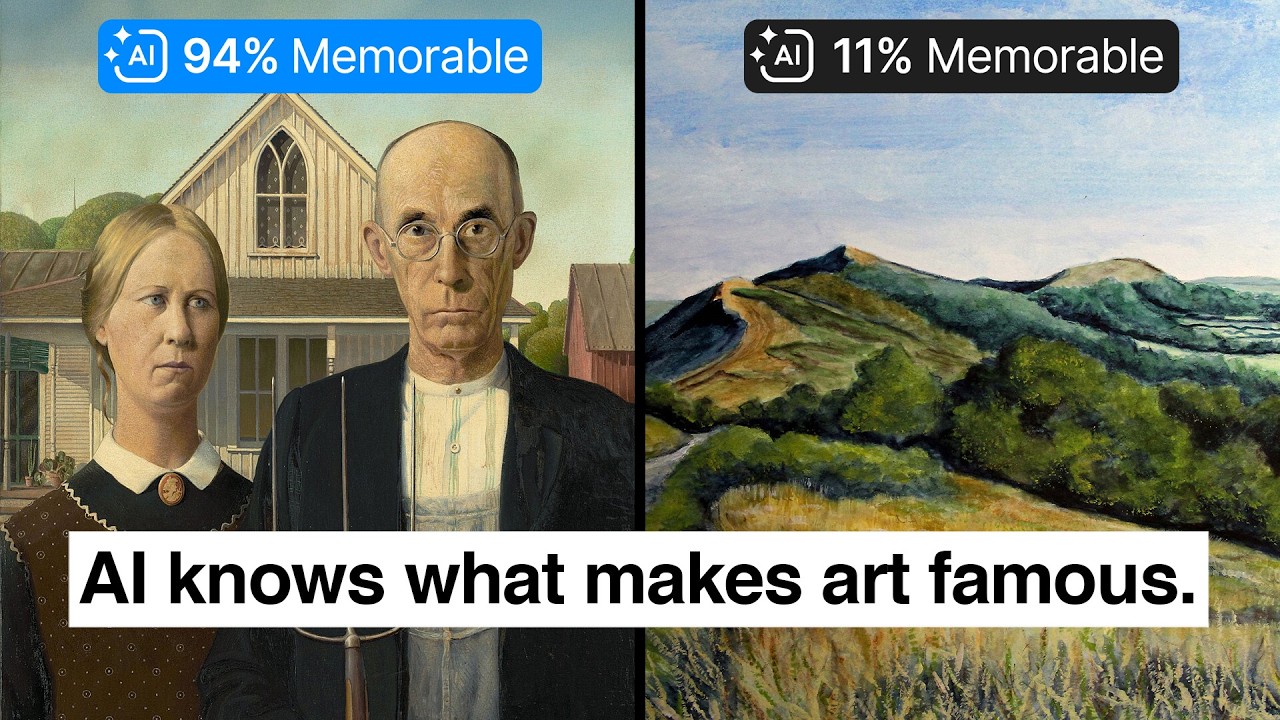
Psychologist Wilma Bainbridge discovered that some images are universally memorable while others are forgotten, regardless of beauty or emotion. Her AI model ResMem found that famous paintings share visual features that hack the brain's memory system. The research could help diagnose Alzheimer's early by identifying images memorable to healthy people but not to those with the disease.
Chapters
I want you to imagine 2 paintings. They were painted in the same year, in the same city. They used the same pigments and depicted the same subject matter. One of these paintings hangs in a climate-controlled vault in Paris or New York. It's insured for $100 million. It's a masterpiece. It sits among the Picassos, the Matisses, the Georgia O'Keeffes, and the Salvador Dalís. These are works that seem to transcend paint on canvas. They have become something eternal. The other painting? It's currently languishing in a basement in North Carolina, or maybe in a thrift store bin, priced at $5. It's been forgotten. When you look at 2 works of art, it's not always clear what makes one so valuable while another is discarded. Is it pure luck? Is it just about who the artist knew or which rich patron decided to buy it? Here's the strange thing, though. We say beauty is in the eye of the beholder, that there's no accounting for taste. But if art is subjective, how is it so many people agree that some paintings are masterpieces? For a painting to truly become famous over decades, lots And lots of people need to agree that it's a masterpiece. Are they just sheep following one another? Or is it possible that there are specific combinations of color and texture that make paintings evocative and memorable? Specific things that can make a painting a masterpiece. Is it possible there is a formula for masterpieces? Today, I'm going to share with you a powerful idea. The place to look for the secret formula? It isn't in the paintings. It's inside your brain. The reason we remember some kinds of art and forget others has to do with a set of hidden algorithms inside the human brain. To understand this, I need to start somewhere completely different. Not with genius, but with failure. Let's play a game. Here are 2 versions of the famous Monopoly Man. Look closely. Which one is the real mascot of the popular board game? Lock in your answer. If you picked the version with the monocle, you're wrong. The Monopoly Man does not have a monocle. He never had a monocle. In fact, He has no eyewear at all. Did you get that wrong? Don't worry. So do lots of people. Let's try another one. Star Wars fans, you're up. Here is C-3PO, the anxious droid from a galaxy far, far away. Is he entirely gold, or does he have a silver leg? If you said all gold, you're wrong again. C-3PO has always had a silver left leg. But you're in good company. Lots of people get this one wrong too.
And for me, it was clear that he was the completely gold one. I don't know why he would have a silver left leg.
That's Wilma Bainbridge, a psychologist at the University of Chicago. One last try. Third time's the charm, right? Here's Waldo, the guy you spend hours searching for in that game, Where's Waldo? Does Waldo hold a cane or are his hands empty? Lots of people say, yeah, Waldo doesn't have a cane. He does. Now here's the fascinating part. It's not remarkable that you made mistakes. We all forget things. We forget where we put our keys. I constantly forget faces and names. What's interesting here is that many, many people make the same identical mistake. We remember a monocle that never existed. It just feels right. This phenomenon, where lots of people collectively believe something that is false, has a name: the Mandela Effect.
The Mandela Effect is a term coined by Fiona Broome. She is a paranormal researcher. She coined this term when she realized that she had the same false memory as many other people about Nelson Mandela. So she had a false memory that he had died in prison in the 1980s.
But he didn't. Nelson Mandela spent more than 25 years in a South African prison during apartheid. But he survived it. He became president of South Africa. He lived a long life. Yet large groups of people remember news reports of his death, his funeral— memories that are false. Now, some people on the internet believe this is evidence of parallel universes, that we have slipped from one dimension where Mandela died into another where he lived. But Wilma had a different theory. She suspected this wasn't about multiple dimensions of reality. It was about how the human mind has a tendency to make predictable errors when it comes to memory. She asked herself if the same thing was happening with the Monopoly Man and C-3PO. She decided to call it the Visual Mandela Effect.
We specifically focused on visual examples of the Mandela effect or ways in which it's manifested in images, because you can do all these interesting analyses on images, like look at what people look at in the image.
Wilma took these cultural icons into the lab. She started with 40 different images: the Monopoly Man, C-3PO, Fruit of the Loom, Curious George, and she altered them. She showed versions of the pictures to hundreds of people to see if people had false memories. Take the Fruit of the Loom logo. What do you see in your mind? A pile of fruit spilling out of a cornucopia, a woven basket? Most people do. But the real logo? It's just fruit. No basket. No cornucopia. Never has been. Now, there are a number of possible reasons we make these mistakes. It could be that wrong versions of these images are everywhere on the internet and we've absorbed this misinformation. Or it could be that they have mental associations that lead them astray. A rich old banker from the 1930s? He's got to have a monocle, right? Wilma tested these theories. She found they were wrong. It turns out the brain simply has a propensity to remember certain images. The wrong version of the image is just more sticky. And that made Wilma think. Is it possible, then, that other images are simply easier to remember. We like to think that memory is personal. You remember a face because it looks like your mother. You remember a painting because you saw it on your honeymoon. Vilma argues that the scientific evidence suggests some things are simply more memorable. We've all seen this firsthand. We tend to remember some faces and forget others. We might not be able to tell why, but lots of us remember the same faces. They're just more memorable. Now, you should be jumping up and down at this point and shouting, the reason we remember some movie stars is because we've all seen the same faces on the big screen. Good point. In one of her earlier studies, Wilma addressed this problem by building a massive database of over 10,000 ordinary faces. She showed them to thousands of people, and she found something stunning.
So there were some faces that everyone just remembered, and there were some faces that everyone just forgot.
Do we remember beautiful faces? Not necessarily. Wilma found that attractiveness had a weak connection to memorability. In fact, being beautiful can make you more likely to be confused with somebody else. Do we remember some faces because they convey certain emotions? Wilma did find that looking irresponsible made you slightly more memorable, but it only explained a tiny fraction of the data. Instead, There seemed to be an X factor, a hidden visual code that made certain images stick. Wilma's next question was logical. If there's a code for these faces, does it also exist for art? To find out, she visited the Art Institute of Chicago, one of the largest and most prestigious museums in the world. She ran an experiment. She recruited volunteers and gave them a simple instruction: go explore The American art wing. Look at whatever you want. Talk to your friends. Take as long as you like. Just make sure you walk through the whole gallery. When they were done, she sat them down on a bench outside and gave them a surprise quiz on their phones. She showed them paintings from the exhibit mixed in with similar paintings they hadn't seen. And she asked, do you remember this painting? Now think about the variables here. Some people love abstract art. Some love portraits. Some people might have spent 10 minutes staring at a landscape while others walked right past it. Surely their memories would be totally different.
What we found was that actually there were still some pieces of art that everyone remembered and some pieces of art that everyone forgot. And this was surprising to us because you would think when you visit a museum, you're really motivated to remember everything. It's, it's like an important, valuable experience for you. But even so, there were some that people remembered and some that people forgot.
Okay, you're asking, what was it? What is the formula for memorability? Wilma found that size mattered. Bigger paintings were more memorable. Okay, that seems obvious. Context mattered. Paintings in the more modern, spacious wing of the gallery were remembered better than those in the cluttered traditional rooms. Less competition for your attention, maybe. But here's the kicker. She tested for beauty. She tested for emotion. She tested for colorfulness. None of those things predicted memorability. You could have a heartbreakingly beautiful painting and people would forget it 5 minutes later. You could have a weird, jarring, abstract piece and it would stick. The stickiness had to do with some mysterious arrangement of the pieces that appealed to the brain. But what was it? Now, the human brain has billions of neurons. Between them, they make trillions of connections. Everything you think, you feel, you know, it's all there in an incredibly complex network. Somewhere in there is the answer to the puzzle of memorability. We might not be able to pinpoint today exactly what's happening in this network, but Wilmer realized She could do something that was nearly as good. What if you took pictures of ordinary people, like the ones Wilma showed her volunteers in that early study? You ask an AI to make a guess about how memorable the first face is going to be. It makes a random guess. If it guessed the face was memorable and humans also find the face memorable, you tell the AI, good job. Keep doing what you're doing. Strengthen the connections you used to make this guess. If it guesses a face was memorable, but humans think it isn't, you tell the AI, you got that wrong. Whatever connections you use to make that guess, weaken them. Do this often enough, over and over again, and eventually the AI will start to learn the secret patterns that humans are using to determine whether something is memorable. What you've done, of course, is you've built an AI model for memorability. You still don't understand what's happening inside the human brain, and you might not understand everything that's happening inside the AI. But now you can use the AI model to make predictions about how memorable a new face is going to be. If the AI has learned well, it will tell you whether humans will find the face memorable. Wilma and her team built an artificial intelligence model to do just this.
They called it You can upload a picture and it'll tell you how memorable that picture is. So like 1 means 100% of people remember it, while 0 means no one will remember it.
They trained this AI on regular photographs— faces, scenes, everyday objects. They didn't train it on art history. This AI knew nothing about Picasso. It didn't know who Van Gogh is. It has no idea what a masterpiece is supposed to look like. Wilma put the AI to the ultimate test. She took the paintings from the Art Institute study and fed them into ResMap. And she asked, is this painting memorable? Some of these paintings were famous works, the ones printed on coffee mugs and tote bags. Others were obscure works by the same artists or from the same era that never became famous. The result was staggering. When asked which paintings were going to be more memorable, the AI tended to pick the paintings that humans consider masterpieces.
And what we were surprised to see was that ResMem predicted that famous pieces were more memorable than non-famous pieces.
Think about what this means. American Gothic isn't just famous because critics liked it and a bunch of humans behaved like sheep and followed them. It isn't just famous because it captures something about the American spirit. It's famous because Grant Wood happened to arrange the visual information in a way that hacked the human brain. He created an image that was cognitively sticky. The AI, blind to culture and history, was identifying masterpieces by looking at the pixels. It seemed to be identifying the visual hook that makes a painting turn into a memory. And that memory turned into fame. So does this mean that art is just an algorithm? That we can paint by numbers to create the next Mona Lisa? Not exactly. ResMem can tell you if an image is memorable, but it cannot tell you if it has meaning. A photo of a car crash might be highly memorable, but you wouldn't want it hanging over your sofa. But this research does challenge the romantic idea that art is mysterious or purely subjective. It suggests that there are deep, ancient currents in our brains that dictate which images make a lasting impression. There is a formula for masterpieces. I need to mention one final profound application for this very nascent technology. It goes beyond art. It speaks to the very fragility of the human mind. While healthy brains tend to remember similar images, people suffering from early cognitive decline, like Alzheimer's disease, start to diverge from healthy people when it comes to identifying memorable images.
We published a study a few years ago where we found that there are some special images that are memorable to healthy people, but forgettable if you're in the early stages of Alzheimer's disease.
Researchers might one day use these images like canaries in a coal mine. If people remember certain images, but your friend forgets them, it could be a warning sign that something is wrong in her brain. We often feel that our memories are a recording of our lives, but Wilma Bainbridge's work suggests that what we remember and what we forget are shaped by our own histories and preferences and knowledge. Whether it's the false memory of a monocle on the Monopoly man, or the enduring fame of a Van Gogh self-portrait, our minds are constantly curating our reality based on rules we are only just beginning to understand. So the next time you create something— a painting, a photograph, even a presentation for work— remember, you are not just fighting for attention. You are fighting to be remembered in the brains of other people. And yes, the fight is rigged. But at least now you know something about the rules. If you want to test your own creations or just see how your memory stacks up against the machine, Wilma Bainbridge has made the ResMem tool public. You can check it out at this link. If you like this video, please check out the Hidden Brain podcast on Apple, Spotify, or your favorite audio podcast player. I'll be back soon with more ideas about the hidden currents inside your head. I'm Shankar Vedantam. See you soon.










