Why The Past Feels Better Than Now
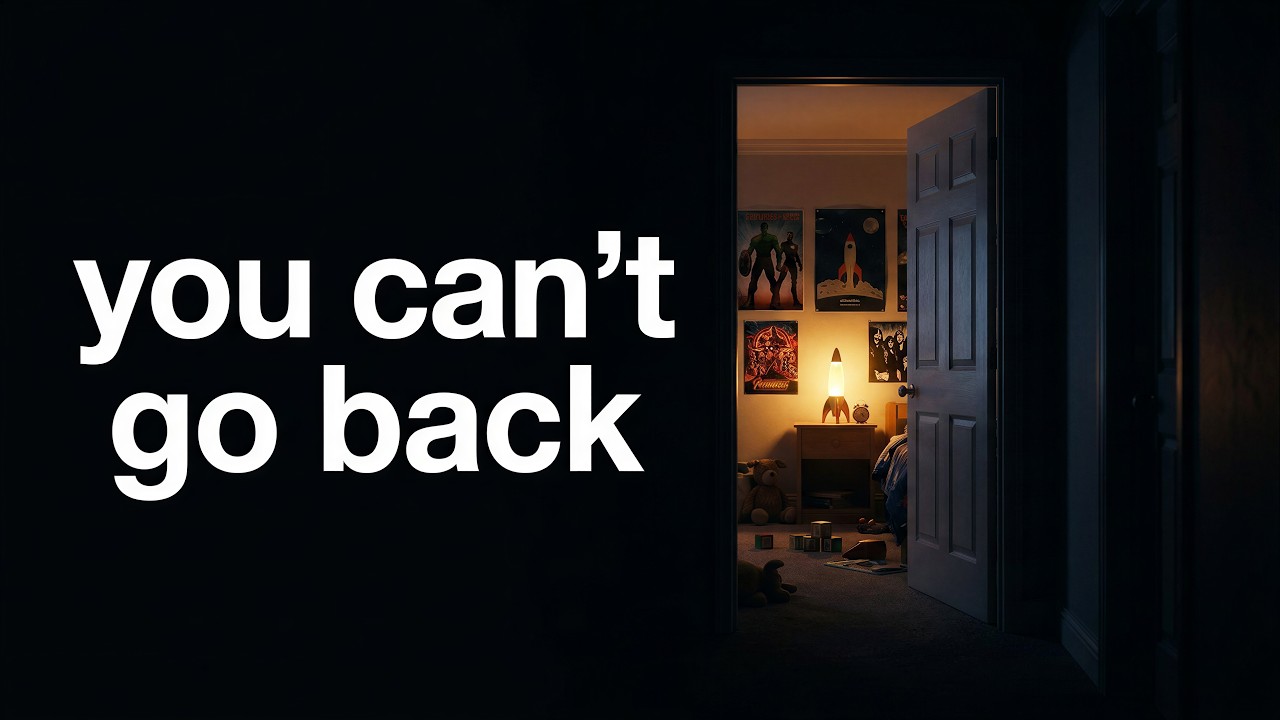
Psychologist Clay Rutledge explains how nostalgia works as a psychological defense, triggered not by happiness but by distress and loneliness. People who feel nostalgic become more motivated to strengthen relationships and plan for the future, but collective nostalgia for eras we never lived through can mislead us into chasing false versions of the past.
Chapters
Picture this. You're standing in line at the grocery store. All of a sudden, you hear a song from the year you graduated high school. Suddenly, you're 18 again. You can smell the inside of your first car, feel the heat of a summer that ended long ago. What you're feeling, of course, is nostalgia, that mixture of bitter and sweet that unlocks memories of bygone times. Why do we feel this emotion? Today, I want to share some fascinating research with you about what's going on in your mind When you experience nostalgia. I'm going to show you how this emotion can be a force for good, but also a force for evil. Let me explain. The place to start is by looking at when nostalgia shows up in our lives. We assume we feel nostalgia when we're reminded of happy times. A friend shares a childhood photo of you on a camping trip. Your wedding song comes up while you're waiting on hold with your doctor's office. But psychologist Clay Rutledge says nostalgia is not just a fast track to our happiest memories. He has studied this emotion for years and found that it's more interesting and more complex than many of us assume. Years ago, Klee and his colleagues ran an experiment to better understand how nostalgia works in our minds. They separated volunteers into 3 groups, and each group read an essay. The first group read an uplifting story about a cute polar bear. The second read a neutral article about the solar system. The third read a sad article about the victims of a devastating tsunami. Then they asked the volunteers to rate their moods and whether they were feeling nostalgia. Interestingly, the group that read the sad essay about the tsunami reported the highest rates of nostalgia.
There seems to be a class of triggers that are about negative events or life experiences or emotions that appear to motivate nostalgia for more of a, what we'd call a compensatory reason or, you know, psychological reasons that about regulating distress.
Nostalgia can serve as a psychological defense. When something threatens to knock us down, our minds might grab onto a pleasant memory in the same way that a falling person reaches for a railing. Think about the last time you felt a surge of nostalgia. There's a decent chance it didn't land on your best day. Maybe it found you when you were lonely or stressed out, when the ground felt unsteady. Now think about the memories you turn to when you're feeling nostalgic. Are they happy ones? It turns out that many of the memories that trigger nostalgia are complicated. They often include a redemption arc, moments where life hands us a setback and we persevere. Clay interviewed a group of older adults in Britain who had been children during the Second World War when German bombs were falling on London. People told him about being sent away by their parents to the countryside, about fathers shipped off to fight, about families pulled apart. By any measure, these were some of the hardest days of their lives. And yet they look back on those days with something close to gratitude.
They were tough, but they also sort of stripped away all the nonsense of life and reminded them, you know, how precious it is and what's really important in terms of their family and their meaningful connections.
This is one of the intriguing things about nostalgia. It often triggers memories threaded with hardship. Because these are the memories that remind us of who we are and what we value. The struggle is what gives these memories their meaning. And that brings us to perhaps the most surprising finding about nostalgia. Nostalgia is about looking back. But when researchers prompt people to feel nostalgic, they become more motivated to strengthen their relationships with others, and they feel more optimistic about their ability to do so. Looking backwards Actually helps to push us forward.
There is a big element of nostalgia that isn't about us retreating to the past. It's about us pulling the past forward to the present and using it to mobilize us, to energize us, to take on new, new challenges and opportunities.
Clay keeps a photograph on his desk that captures this idea. It was taken years ago in London. He was a poor graduate student, a dad with 2 young kids. He didn't have much to his name. Life felt uncertain.
Here we are. We've got these small kids. We moved to England. We don't know anyone there, and we're having this great adventure.
He doesn't look at that picture to escape into the past. It reminds him that he's someone who once crossed the world with nothing and built a life out of it. That memory is fuel. It pushes him forward. So to recap, nostalgia can comfort us. It can remind us of who we are. It can drive us to seek out others and make us more optimistic. This view represents a radical departure from the way nostalgia was once viewed. For a very long time, experts didn't see the nostalgic mind as a master editor at work. They saw a disease. The man who gave nostalgia its name was a 17th-century medical student in Switzerland, Johannes Hofer. He observed soldiers stationed far from home, unable to eat or sleep because they were sick with longing for the mountains they'd left behind. Johannes Hofer decided that this was a, quote, cerebral disease caused by the endless vibrations of what he called animal spirits deep inside the brain. Other physicians blamed nostalgia on changes in atmospheric pressure or on the relentless clanging of Swiss cowbells. Seriously. This idea that nostalgia was an illness to be cured, it hung around for centuries. Fast forward to the 20th century. For the first time, the idea that nostalgia is a medical condition is about to be challenged. But the people who do so are not scientists. They're advertisers. Ad executives begin to notice that the pull of the past can sell almost anything— hamburgers, cigarettes, even computer software. It turns out that nostalgia, particularly for the products and entertainment that were popular when we were teens and young adults, is powerful and easy to trigger. We can even feel nostalgia for an era we never actually lived through. Clay calls this historical or collective nostalgia. Some people feel wistful for the 1920s or the 1950s, decades they only know from photographs. Members of Gen Z and Gen Alpha sometimes feel nostalgia for the 1990s and early 2000s, a time before smartphones and social media. Whole countries can feel this longing for an earlier era. There are people across the former Soviet Union who ache for a time they are far too young to actually remember. And this is where we start to see the negatives of nostalgia, because what can be psychologically useful at an individual level can become dangerous at a national level. The same instinct that trims the grief out of a personal memory can erase the complexity and contradictions from a nation's memory. A shared dream of the good old days It can quietly edit out all the people for whom those days were not good at all. The feeling is warm and seductive, and it feels true, but it can sell you a past that never existed and steer you toward a future that is built on a fantasy.
I mean, a lot of negative memories fade from our awareness faster than positive memories, and this seems to be adaptive for us personally moving forward in life, but it also biases us towards You know, not necessarily doing a good job of thinking about the complexities of the whole picture and thinking about other people's experiences. And so I do think that though nostalgia certainly has a number of positive benefits, that we shouldn't let ourselves be intoxicated by nostalgia because there are some real dangers associated with that.
So where does that leave us? Nostalgia, it turns out, makes a wonderful companion And a terrible compass. Lean on it for comfort, and it will steady you. It will remind you of your values. It will make you more hopeful about your relationships and more eager to connect with others. Try to navigate by it, though, and you run the risk that it will lie to you about where you've been. Thank you for watching this video. If you want more insights like this, please check out the Hidden Brain audio podcast. You can find it on Apple, Spotify, or at hiddenbrain.org. I'm Shankar Vedantam. See you soon.










