[FINAL HOURS] Book Donation Countdown
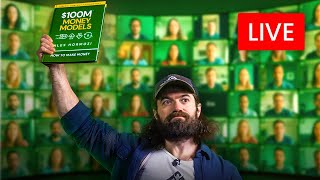
In this live segment of the Hormozi Hotline, Alex Hormozi (joined by Leila Hormozi and moderator Sharran Srivatsaa) celebrates his birthday while running a rapid‑fire business coaching session for donors who have contributed books. The core of the session is a deep dive into the "Pick Your Price" attraction offer from Alex’s "Lost Chapters" book, illustrated with a car‑wash story and multiple industry examples (lemonade stand, art gallery, weight‑loss coaching, dental cleaning, gym, podcast agency licensing, real‑estate brokerage, and medical‑evaluation services). Alex explains the mechanics of four money‑model frameworks – Pick Your Price, Discount + One‑Time Fee, Freemium, and Lifetime Upgrades – and walks through how to structure pricing, bonuses, and one‑time fees to increase commitment and reduce churn. He then applies these concepts in real‑time coaching calls with founders from Vibes Creative (a podcast agency), Onyx Homes (real‑estate brokerage), and a medical‑evaluation firm, offering concrete advice on scaling, pricing power, de‑commoditizing, expansion, and lead generation. The segment also covers logistical details of the book‑donation drive, the countdown timer, and the bonus AI‑powered consulting package offered to donors who give 200 books. Throughout, Alex emphasizes actionable, data‑driven decision‑making, the importance of framing offers to change buyer behavior, and the psychological levers behind discounts and fees.
Chapters
Yeah? We're live? Rock and roll. All right, everyone. We are in the final hours of the launch. And so at midnight Pacific, which is 11 hours from now, all of the bonuses associated with donating more books will go away. Based on all the things that you guys said, you guys enjoyed, uh, Hermosi Hotline. And so I'm going to be doing a lot of those, trying to get as many of you guys on the phone, help, help anybody out. Um, and beyond that, uh, we're going to be doing some giveaways, just some free prizes, give, uh, giving stuff away. And on top of that, I think I'm going to be reading a couple, uh, of the chapters from the Lost Chapters. So inside the Money Models book, I basically put the 15 most effective model mechanisms that are in there, but I have others. And so I'll explore some of those guys with you. And I think if you're seeing this correctly, there should be some milestones that we'll try and hit along the way to close this out as we ride into the sunset. And then I retreat back to Willy Wonka's factory and then spend the next 2 years trying to put something else really cool together for you guys. All right, so first up, we're talking to Heather, Nat— Natural Rev MD. All right, let's give her a call. Let's see what Heather's up to, shall we?
Hello?
Hey, Heather, what's going on?
Hi, how are you?
Good. So you've got 5 minutes. Tell me what's the biggest— what can I help? Like, what's revenue right now? What's profit? How can I help?
All right, sounds good. So I'm a physician by background, own a medical billing company, started from scratch, have 190 $100,000 per month for gross.
Okay.
And we're at like 25% net profit. I do this on a somewhat semi-passive model, meaning I've got an executive team that runs day-to-day ops.
Okay. What's headcount?
Biggest things— say that again.
What's headcount?
So 7 W-2s and then the rest are contractors that we, that we have. So maybe 65 total.
Okay, got it. All right, so what's the, where do you wanna get to and what's holding you back?
So leads are biggest issue. So I've not done, other than my podcast, which has been 100% what we've done for marketing, I've not done ads, I've not done really cold outreach, like nothing. It's podcast 100%.
Okay.
But leads are inconsistent. Like it's feast or famine, you know? It's, yeah. So it's, I don't know if I, you know, obviously I can continue to podcast and that's worked.
Yeah.
I guess I show up on other people's podcasts, all the things. Yeah, but do I start another acquisition channel or do I just keep doing—
How many podcasts a week are you doing?
I've done 110.
No, per week.
Oh, one. One.
Okay. So an easy one is to combine outbound with your podcast and invite people who would be potential customers or whales onto your podcast. You'll have super high response and show rates and talk to them about their business. Sorry.
I do a little bit of that, but maybe I should be doing more.
Well, yeah, if you're doing one a week, it's not a lot, right? So yeah, I'd be doing like, can we do like one a day? It's like, well, there's a 5x. It's like, that's just that. All right. So that's, that's like I think about like least operational change possible that we already know doing something that actually works. So that's thing one. Beyond that, what's the, what's the avatar of who you're going after for medical billing?
Private practice facility. You know, really, we want their collection to be, you know, greater than, you know, $150,000, $200,000 a month. And that's been the other problem is in the very beginning, right? Small client, small fish. That has improved where we've gotten bigger fish over the time. But, but yeah, getting the right avatar or getting the right client in the door from a lead perspective.
So I think conferences are going to be really good for you because I said the way that I would set this up is you go to the conferences, I would pay for the booth if you can get on stage, even if you have to pay for it. And one of the benefits of this is that when you— I go, I try to get the first one as you turn right into whatever the area is, because 70% of people turn right. And so they're typically— organizers price them all the same by size, but you'll get more ROI from on the right hand, right by the door, number one. Number two, I would create some sort of giveaway for people to like win that you'll reveal on the second or third day of the event. And then by doing that, You'll get, like, they basically have to give their contact information in order to enter the giveaway. And if you want, you can model the way I did it, like, it's better than this and it's less than that. So it just gives a little bit of sandwich of value of like, okay, it's better than NFT, less than Bitcoin. It's better than a gift card, less than a Tesla. Like, I like to have some sort of sandwich of up and down value in terms of the giveaway. And so the whole time you're collecting leads. And if you want, Taron talked about this yesterday, but If you can say, hey, I have a $25,000 speaking fee, instead of the speaking fee, one of two things you can do. So one is, can I send one email to the list? That's an option. And then secondarily, you can, when you do your presentation, your slides or whatever, you can say, hey, if you want these slides, like, Joe, just give me your email and I'll send them to you. And then you can just basically ask two or three more questions and then it'll sort out the traffic of the people from the audience who are the most engaged. And so I think if you have lead flow is the number one issue, then that gives you two things. So one is you 5x your podcast and using outbound to get more of the quote whales, and that's going to be super targeted. And then from a speaking perspective, that's three different ways that you can monetize the conferences. So getting the list, survey closing from stage, and then also having a giveaway at your booth that's bigger and badder than everyone else's. So you can collect leads that way too.
Awesome. Done. I can do all of that.
Rock and roll, Heather.
Enjoy. Appreciate it.
All right.
Thanks so much, Alex.
Happy birthday. All right. Thank you.
Bye.
Bye. So as my birthday present to myself, I'm going to help as many business owners as I possibly can. All right. So that's the, that's the goal for the day. That's what we're doing. For those of you who are hopping on, we're closing out the book donation drive. I've got all these, all these prizes and bonuses for anybody who donates over 200 books, but they all disappear at midnight Pacific. So if you're like, I don't know if I should— like, if you're one of those last-minute people, this is now the last minute. Beyond that, though, I'm just calling people as they come through. And the 800— basically, people donate the most books. I'm trying to call as many of them as I possibly can. That's the— that's what we're doing right now. All right. So we got Dacian Floria. All right. Let's see what Dacian's up to. 80% margins. Hmm. I wonder what this is. Hello? Hello? Dacian, what is LIMS Plus?
Well, it's an environmental testing platform for environmental testing labs.
Thank you, man.
And thank you for doing this as a gift.
You bet, man. Come on. Okay. So 200. Well, thank you for donating books, which I super appreciate. All right. You got 5 minutes. So let's rock and roll. So you have a testing platform. Got it. You're running 80% margins, which is super, super impressive. What's the issue right now? What are you trying to get to?
I try to make money.
The only problem, or the biggest problem I have right now is that I have this software platform. Yeah. I'm targeting B2B labs, like they are enterprise.
Uh-huh.
They have like usually 2 to 3 people, or maybe more that I have to talk with to get a deal done.
Yeah, that's normal.
Usually the deal size, deal size starts at $50K upfront and then it can go to like $100K.
Yeah.
And I go into annual recurring revenue of $50K usually for this type of client.
Cool, cool, okay.
The problem I have is that I don't have anybody in the pipeline and I don't know how to get them in.
Yeah, you're like, I've got this great business, there's no one, no one's buying it. So is it $250K a month or $250K a year right now that you're at?
A year.
A year, okay, got it. So you're really not getting that many clients if that's your price point. Okay, understood. So what did you do to get these first clients?
So first client was luck via cold call.
Okay.
And then the second client was same cold call, and the third one was trade show. So I have 3 customers right now.
Okay, heard, okay. So you've got cold call, trade show, and what was the other one? Cold call as well. Okay, so how many cold calls did it take to get you the one deal?
Well, it was a while ago, probably around 100, but it was luck.
I mean, dude, that's how it works. You did. I mean, you're like, I did 100 and then one of them bought. It's luck. It's like, no, you did 100. It's like, if you called one and one of them bought, that would be luck. If you call 100 and one of them bought, that's just a process. So let me, let me ask you this way. So I've said this before, but it's super common for sub-a-million, which is that what feels like volatility is actually a symptom of insufficient volume. I mean, you're not doing enough, which is what makes it feel erratic. And so it's like you did 100 and you got one, and then you did other cold calls and you got the other, right? Yeah. Okay. So how many cold calls did it take you to get the second one? Probably around the same. Okay, so that sounds lucky though. The second one sounds lucky. The first 100, you get one, you know that. You know what I'm saying here? You made 200 calls, you got 2 customers. So the question then becomes, what stops us from doing 10,000 calls? Well, one would be that You need leads.
I'm not that good at cold.
I need— Well, dude, you got one. Dude, 1% conversion on cold calls, by the way. Fine. Totally fine. On a $50K, $100K price point. Totally fine. Do you think of it like this? You're making $500 a dial. Yeah. Yeah. That's, that's pretty good for a dial. I don't know about you. If I want to go out to dinner tonight, I'll be like, okay, I'll make one dial. There we go. I covered my dinner, right? Of course you have to think of it because you've gotten your head about this. Like every time you make 100 calls, you get a, you get a deal. Then it's like, how do I need to game this for you so that you just make 100 calls every day? Okay, so what you have— we have 60 seconds. So what's the thing that's holding you back from just saying like, yes, that makes sense?
Well, that makes sense, but I don't know how to get myself leads.
Okay, right, then that's the leads list.
The second problem is how do I position myself, what attraction offer can I create so it makes sense for these guys?
Well, for a bigger, for a bigger company, a way for what you have, a waived fee structure, which is the third fee structure that I talk about inside of the continuity section for money models. Which is you have a big upfront nut. We say, hey, it's $50,000 for me to do this whole integration, and then it's $5,000 a month, month to month. Right. It's like, or if you want to commit, I'll waive the $50,000, but you got to commit to the whole year.
Yeah, but anyway, you do that because all their data is in our system, right?
Well, the thing is, but you're just— no, no, dude, I get it. The way that a money model works from a positioning perspective is that you don't, like, whenever you give someone a choice, it doesn't mean that you're saying you actually give them the choice. You give the illusion of choice that then obviously selects or waits for one of the selections. So you'll basically, the question that you had is, how do I get more of these people to sign up? How do I make it more compelling for them? Well, if they think that they're getting something that costs $50,000 to set up for free, They're far more likely to do it than just saying, well, I do that anyways. It's like, yeah, no shit. But the problem is that they don't know that. You know what I'm saying? Yeah, makes sense. Okay, so I'll give you—
let me put this into an ad or something.
No, I think I actually don't know. That's— this is more for the mechanics of how you actually close when you, when you get into the, into the, into the thing with them. But let's solve the original issue really quickly. We are over. So I'm going to just make this as fast as I can. They got to get the next person. Okay. So number one is I would say list brokers. You can do that. Number two is you can scrape using software. Number three is that you can go to people who own groups or communities that— and there always are some. You just look, there's, look, there's someone at school, there's someone on LinkedIn, there's Reddit, whatever, right? There's definitely communities for these people. And then you want to pay the group owner to basically make an ad inside of the group. Those are three different places that you can look like right now to go get leads. Okay, cool. Also highly recommend flying out there and saying, hey, it's, you know, you find out that they're in California, you know, like in Los Angeles, you say, hey, it's so crazy, I'm actually in LA this week. I figured there might be— I'm happy to swing by while I'm in town. And if they say yes, then you just fly there. Okay. That's how that works.
Yeah.
Rock and roll, man. Appreciate you.
Appreciate you.
Thank you for donating, Book Station. Oh, thank you, I appreciate it. All right, bye. All right, next up we got Shamaine. All right, Shamaine, here we go. Easy Dwell. So I think this is— I'm guessing this is like a home, like dwellings. Dwellings, that sounds legit. Shamaine? Hey, what's up, Alex? What's up, dude? It's an honor. Oh, honor's mine, man. Did I say your name right, Shamaine? Yeah, that's right. Okay, rock and roll. Okay, so you're doing $3 million top line. What is EZ Dwell?
Oh, EZ Dwell, we're out here to change the way people buy homes. Oh, we sell them in an LLC, like a business that owns the house instead of like traditional financing.
Okay, got it. So you're doing $3 million top line, $5 million— sorry, $500,000 in profit. What's the What's the, what's the constraint? And we have 4 and a half minutes left. So what's the constraint right now?
Right now there's a team of about 20 of us. Okay. And so I'm getting into like the acquiring and training leaders. Our goal is to do 280 houses. So we've done in the last 2 years 46 acquisitions. We've sold 30 of those. We're scaling up. Dispo. Dispo, where we sell the properties, is really how we, I think, can get our, uh, our CAC up on that. Um, a bunch of stuff, I guess. I mean, I'm trying to get to 280 in a year so we can iterate quickly enough. Um, you know, launching an investment fund of $18 million.
Are you wholesaling?
Yeah, no, not wholesaling. So we'll— it's like a fund and an operations company. So we buy properties sell properties and we raise capital, but we've also like structured it on our own model.
I do. I'm, I'm so confused. What? Like, walk me through how you make money.
Okay, so let's say you have like a 2% rate loan or you're a private lender, you're seller financing, doing like sub-2s, or they're transferring the mortgages. So sub-2s, you can run cash. For right now, we're leveraging sub-2s because of capital constraints. Buy a property, average cost $25K. Pay the operations $25K, holding cost, marketing, et cetera. Average deal cost is $65K. We'll sell the property to a buyer. Average time on market right now, about 90 days. We want to get that down to 45. Collect $25K upfront and then about $800 cash flow for the next 30 to 40 years. So we're not a 3-to-1. We're like 60% cash on cash at the fund level, at the total level. And then let's say we take that $25K, we do that twice. Now we can buy another deal so we can cycle those funds back in. So trying to build a compounding machine with a lot of like stickiness.
So what do you need? You need what, $18 million?
Uh, well, we need to be able to acquire more properties.
So you need capital to acquire more properties?
We know the capital we have.
Okay, so you just don't have enough deals?
Yeah, not enough deal flow on acquisitions right now.
Got it. What are you doing right now to get—
it was sales, now it's acquisitions.
Okay, I heard. So what are you doing right now to get deals?
Uh, just wholesalers, like wholesalers in the state of Florida, Facebook groups, uh, and we've been doing it for a year, so we know a lot of the people.
Yeah, yeah.
But we've had some team— there's a lack of like leadership over there right now, which I may need to kind of jump back into.
Yeah. Okay, so what stops you from just like basically instead of buying from wholesalers, just learning how to wholesale?
We started out wholesaling.
Okay.
And it was, we were doing, we'd pull all the pre-foreclosures, we'd do, you know, cold calling. It was just, it became way more leverage to just go to the wholesalers who had already negotiated on those and just buy from them.
So, so then, yeah, all right. So if I'm you, I'd be thinking, what are the wholesale networks and associations that I can get into so that I can just say like, I'm a guaranteed buyer for all of this stuff? Because it sounds like you have a pretty good return on capital. You're getting 60% cash on cash returns. It's phenomenal, right? Yeah. So I'm just basically— you can outspend if you have that kind of return. Even if you got 50% cash on cash, you could still, you know, you still be probably pretty happy. If it meant you could double the amount of deals you did, right?
Yeah. So we've— part of the problem, like, we've joined like some of those groups and we've— like, there's a site where all the wholesalers post their deals on Facebook and we've quite literally scraped like all of them. It's almost a lead problem at that point where now we're shifting to look at portfolios. Like, hey, who owns 170 homes?
Who owns 200? I understand.
Yeah.
But my thing is, is that you've only done 40— you did 40 deals in the last 2 years, something like that?
46.
Yeah. Yeah.
Yeah.
I mean, you're not even close to tapping the wholesale market for the state of Florida, you know what I mean? You're not even close. There's no— like, you're not even close. It's like you're like not even a blip on the radar. Like, I just want to break your belief around this. Like, you're not like, oh, I've, I've, I'm in every single one of these groups. Like, dude, you're doing $3 million a year wholesaling. You're not, you're not even close. Like, a single franchisee for some of the wholesale franchises that exist average $3 million a year per location.
Right.
A lot of that's cash, though.
No.
What? I'm not trying to protect my limiting belief here.
Yeah. No, no, you're not even close to— I like— there's zero way. No chance. Not like— not even in a million years. You're not even close. Okay. If you're like, I'm doing $200 million a year in Florida, I'd be like, okay, he's one of the bigger players. Like, you're not even close. Okay. Just like, just like, blow through that right now. I do think that you revisiting the idea of, like, if I'm you and I want the fastest way to grow this, I'm going to find the biggest wholesalers and see if I can bring them in-house. Because they're just giving you what they're giving you, not what they have. Yeah, right. They sell to other people. So it's like, I want to bring— like, again, I like to control the whole funnel, right? I want to say, like, how do I go from click to close? How do I own the whole thing? Because, like, if I, if I could be vertically integrated here and I can bring someone in or acquire, like you have the cash, if I can acquire a wholesaler who has a good amount of volume, then it's like I have a way better monetization vehicle than they do. And so then it's like I buy something that cash flows and then I just have another way to make even more on it. And so it's like that business works on its own, with mine it just juices. And I love, that's the game, those are the games I like to play. Yeah.
Right?
Juicy games. Yes, juicy games, big juicy games. I gotta call the next person, but Hopefully does that, like, first off, belief broken. Like, you are not even close. Not even close. Yeah.
Okay.
Yeah. And then number 2, it's like, what would it take? And this is the question that I would ask them. What would it take to be an exclusive person to get all of the deals that you're doing? I would ask that as like, if I had to make money tomorrow before even doing anything complex, I'd call every single person I did a deal with over the last year and say, what would it take? Okay, cool. And you've got the returns, man. If you go from 60% to 50% or 45%, But all of a sudden you have exclusive pipeline and that triples your pipeline, then there you go.
Yeah, I appreciate you.
Thank you. Appreciate you, man. Thanks for donating books. Later. All right. All right, see ya. All right, so anyone hopping on, I'm just calling all the people who donated the most books. So we have a bunch of 800-book donors, and so I'm calling them. And this is in spirit of the final countdown. I think we're at 10 hours and 10 hours and plus 10, 10:40. Yeah, 10 hours, a little less than 11 hours. And we're going, we're marching on. All of these bonuses disappear for anyone who donates 200 more books. All that stuff disappears in 10 and change hours. All right. So if you are a last minute person, this is the last minute. All right. Dang Duong. All right. Calm down. All right, calm down, guys. Let's not get carried away. All right, Infinity Medical Consulting. Infinity Medical Consulting. Dang Duong. What's up, man?
Hey, hey, Alex. Happy birthday. Thank you again for your time and helping us with our constraints. I really appreciate it.
You bet, man. Thank you for donating a ton of books. Alright, so you got $5 million top line, you got $2 million in profit. Okay. What's the, what are we working with here? We've got medical consulting. What's holding you back?
Yeah, so essentially we are dealing in the space of chronic wounds. So we help folks with chronic wounds close their wounds. So the largest constraint that we have is trying to hone down on our specific avatar in terms of the actual patients, because the LTV is once it's closed, it's closed. There's no more LTV afterwards. So we're trying to do Facebook ad leads that actually constraints it to Medicare Part B. That's the specific insurance that we're able to accept to provide the service for the patient.
Okay.
But I don't know how to essentially filter out so we can have that specific avatar in terms of Medicare Part B.
Okay, well, what does the application say and what does the ad copy say?
So essentially we are here to help with hard to heal wounds. I think it's very generic and we're trying to refine it and then essentially provide a PDF so that it's in layman's so folks can understand the wounds that they're having and seeing if they could help themselves during the times when they don't get treatments from services that does standard wound care.
But you make money from Medicare Plan B, right? Or that's what you just said, right? Yes, yes, yes. But so you just want the, like, not from a humanitarian perspective, so I'm just purely talking business here. The point for you is that you wanna get as many Plan B people as possible, right? Exactly, exactly. Okay, so you're trying to get as many Plan B, and right now you're doing Facebook ads and you're getting some people that are not Plan B, right? Yeah. Okay, so before we even like fix that, I wanna understand, is it really a problem or is this a feature? So let me explain. Right now, how much, how much is it costing you to get one of these people versus what you make on them?
So it's costing roughly on average about $15 per acquisition of a lead.
All right.
And, and so it is a range based on the wound size. So if it's a 1 by 1 centimeters, it's less of a payout than compared to if you have a big gigantic one, it's 100 centimeters. So if we could refine the wound size and then the qualification, because the only payout that we receive is Medicare Part B. Yeah. That's why there's so many different insurances. We can't take any of those.
I'm getting— I totally hear where you're coming from. It costs you $15 a lead. Like, we just— the way, the way you have to grow this is like you're making it sound special snowflakey to you. And I think that's why it's making it confusing. But fundamentally, it's just like it cost me $15, $15 a lead. 1 out of 10 leads is going to be a qualified person who's Plan B and has a big enough wound. Right. Gotcha. No, it was like, we just have to know this, this math. That's it. It cost me $15 a lead. I convert 1 out of 10 leads. So it cost me $150 to acquire a customer. Each customer is worth this on average, even though there's variability. It cost me— this is what I make on average. So do you know, do you know those 3? Like, I know, you know, the lead cost, but what about the other 2 numbers? What percentage of leads do you close and what the average deal size is?
Yeah, it's pretty low. I mean, we've had 5 treatments out of 1,000 leads.
That sounds bad. Okay. Yeah. Okay. How are you making sure Sure, yeah, yeah, how are you, so the funnel right now is that they're just opting into a PDF, right?
Yep, yep, and then a consultation call afterwards.
So it automatically takes them to a consultation call, or in the PDF it says if you have these things, then do a consultation call?
So essentially, once they provide their email, their name, and phone number, they receive the PDF, and then the next kind of landing page is book a consultation call for wound care.
Okay, so you've got name. So I'm writing this on the board. So maybe if you're watching the livestream, you can see it. All right. So you got your, you've got your opt-in thing for the PDF. Okay, cool. And then they put name, phone, and then email, right? Something like that.
Yeah.
Yeah. Email, whatever. And then, and then if their stuff is qualified or everyone goes and sees the scheduler.
Yeah, everyone does see the scheduler.
And are you taking all these calls with all this trash? Uh, yeah, yeah, that's horrible.
Me and one other, yeah, one and one other rep.
Yeah, yeah. Okay. And then, and then you're just running lead ads, what, nationally?
Uh, no, specific to the areas where we have providers that can provide the service.
Okay, got it.
A city, state, location.
Heard. Okay. So, um, big picture here, I think I'm going to bet that there's an ad copy issue. Like, how many people know that they have Plan B or not?
Um, the thing is they're also not educated to know, um, since they can— once they're 65 and older, they automatically have a Medicare Part B.
But well, dude, then why don't you just advertise to everyone who's over 65 and older?
I knew we do, we do do 65 and older, but they still have other insurance that they could kind of opt into.
Yeah, yeah, but they all have Plan B if they're over 65, right? So they do qualify to use your stuff. Yeah.
So, but once they hit 65, they also have the option to choose other more affordable Medicare, uh, medical insurance plans. So that's where the, the challenge is.
So you're trying to find people who are not over 65?
Um, we are trying to find folks that are over 65, even though they qualify like automatically at 65. They do have the option to choose other more affordable options.
I got it. I hear you. I hear you. Let me— I hear you. So let me— I want to help because I also want— I got to make through the next— the donor. Okay. So big picture right now, you're taking too many calls that are trash. There's definitely diamonds in there. And so we have to add filters to the funnel. And so the filters that we have to add is the copy itself. Now, if you say they have no idea, then we're going to have to do what are the other things that they have in common? Now, to your point, you said everybody above 65. Has this, but they have other stuff too. For me, that just sounds like a sales call. So if you know 100% of people over 65 have the thing, then to me I'm like, well then why would I focus on anyone else? 'Cause then I'm just gonna try and have the max hit rate knowing that every single person you get on the phone with can do this thing. 'Cause now all I have left is, do you have a wound and are you ready to say yes? So if I'm you, my targeting is gonna change to 65 plus. I would also make the messaging change on the opt-in page to just reinforce that. And then you have your— Yeah. And then the application part, I would add in how big is the wound? And then that way you can score the leads. And if you— and like even with that level of lead flow, maybe that's enough filtering. If it's not enough filtering and still getting trash, I would then start scoring them and only showing the scheduler to the people who have wound sizes above X. Gotcha. All right. That's how— that's the first thing that I would do and think through it. Yeah. All right. Appreciate you, dude. Congrats on the business. Appreciate you. You bet. I mean, dude, you're doing $2 million profit, $5 million top line. Like, you're— I mean, you're not suffering right now. All right. But if you're being inefficient, then we have to add friction. That's fundamentally it. Like, if you're sifting through too much crap, you got to add friction. Yeah.
Gotcha.
No, I appreciate that.
You bet. Awesome, man. Talk soon. Thanks for donating books. All right. Thank you. Of course.
Absolutely.
Alright, rock and roll. We rockin' and we rollin'. Alright, dude, I'm checkin', checkin' boxes right now. Okay, Zach Reinders. So Zach Reinders, R2 Studios Architecture. This sounds interesting. Alright, so anybody who's tuning in, it's, I already said it, I'll say it again later. Okay, so Zach Reinders. I'm callin' the people who donated $800 as fast as I can. That's what I'm doin', just so you guys are curious. That's what I'm doing. I'm doing 5 minutes apiece. This is Zach. Zach, we've got 5 minutes on Hormozy Hotline, and I want to help you with the business. So the timer has begun. You bet, dude. The timer has begun. Okay, so talk to me. What's— yeah, what are we looking at?
Okay, so I'm actually in a client meeting. I'm stepping out right now.
It's only 5 minutes. You can tell them that. Perfect. Okay.
We own a local architecture firm.
Okay. Got it.
We niche down unintentionally, but it's worked to our favor.
Fine.
We only do assisted living facilities that are converting, so it's people that are taking a single-family home with 5 or less bedrooms and converting it to an assisted living facility. They need to get licensed architecture plans from the state, or for the state, so that's where we came in.
Uh-huh.
Our problem is really cheap. Well, we actually, we do 80 of those just off of referrals every year.
Okay.
So it's pretty solid where it just sustains itself by our service.
Can I, can I make a guess at what you need to do? Because I— pattern recognition, like I promise you. Okay, so you're in it, you're in a space that it's super price-driven, right? Because you've got— it's construction, they're looking at cost, blah blah blah, right? Yep. Okay, you have 3 vectors of winning. You have to pick one. Ideally you can have more than one, but one is what I like to lead with. So you either got speed, you've got risk, or you've got ease, right? And so in your business, time is money if you can do things faster, right? There's also a risk component of like what kind of costs are going to come down the road if you do it the wrong way or do it differently. And then it's like, is there a way that we can throw some sort of verbiage or guarantees or some sort of like clawbacks that a customer can get where we say, listen, we'll put our skin in the game to make sure that we'll, you know, we'll be on time and on budget. So that you can build your thing faster, so you can get faster returns on capital? Because I'm assuming these, like, you quote sell to an investor, or you sell to a GC?
So they're all, they're individual business owners. That's the hard part, is we're going to small business owners. It's likely their first business, right?
So they're cheap too. Okay. I mean, who are the best business owners that you deal with?
People that don't question the price, that understand the process.
My favorite, right? But yeah, exactly. No, but it's not— Okay, so then what stops us from getting only those people or focusing almost exclusively? Like, can we get deal flow that has higher percentage of those people so we can command the prices we want?
Oh, I would love that. And part of it is I've tried to expand so that we give one faster speed, like you mentioned. So we get our plans back to you within a week.
Yeah.
So that's faster than most everyone. Yeah. And then we on the back end, no one understands the process, so I've learned it really well. So that's where I come in and I can give them that guidance versus just someone that's giving them a commodity of just a single plan.
Yeah.
So that's where we've been able to get our price up some, but I need to get it up higher.
So I'm wondering if you need stats, dude. I'm telling you right now, you need stats. So this is a logical sale, right? This is not an emotional, you know, thing for most of these guys, I would imagine, right? This is a pure like dollars and cents thing. And so you need to line up and come in with that frame, which is like, listen, let's be clear here. You and I are both business people. You need to make this make sense, you know, make sense from a dollars and cents standpoint. They're going to say yes. It's like, cool. So there's, there's a concept called, you know, save a dollar today, cost you 4 tomorrow, or pay 2 today and it saves you 4 tomorrow. Which one are you like, would you rather pay 2 and save 4 or pay 1 and have it cost you 4? And they're like, well, obviously the save one. It's like, right. I like to establish that because if someone says no, I'd rather just save as little as possible, then we all know that's not going to work for either of us. Right? Okay, cool. So then it's like, this is where the stats come in. Like, I'd look at Statista, I'd look at, I'd ask, you know, GPT. I'd be like, hey, find me all the stats of average unforeseen costs that can occur. And so then now we took the frame of the fact that it's just going to be a logical sale. We're all dollars and cents here. But the reality is now we go fear, uncertainty, and doubt, right? So now it's like, well, these are the top 4 things that occur. This occurs in 22% of circumstances. This occurs in 15%. This occurs in 38%. Right. And these are all the different things that can go wrong. Right. And so what we've done is that we try to minimize this thing, which is going to cost you way more money than what I cost. And so now we're anchoring around all these way more expensive things, and then basically that's how we can basically nudge our way into a completely different price because we've changed the context around the conversation. Okay.
Would you think about any way to get recurring revenue, or would you just double down on this and try to get as many people as possible?
So the only way that I would see recurring revenue in your specific business is going to be people who do regular business. More so than like subscription, anything like that. It's more like, who are the nodes of referrals? Those are my quote, reoccurring more than recurring business. Like Coca-Cola, super amazing business, not recurring but reoccurring. And so I put your hat on, so what you need to do is chunk up in terms of how you think through your business. I'll give you an example. So when I had Allen, which is a software company, we had, you know, the first thing we did is we went to market for small business owners., right? And that sucked because they'd be like, oh, this is great, it works our leads, but we don't have any leads. And I was like, oh darn, that's— I didn't think through that. And so then all of a sudden the people who did really well were the ones who already had agencies that were working with them generating leads, and then our thing just did the lead flow. So then all of a sudden I was like, okay, well I'm gonna go after agency owners and say, hey, we can improve the results of your services and decrease churn and increase, you know, like basically make more money, et cetera, using our software. And so all of a sudden what happened is instead of having, you know, trying to go onesie twosie after business owners, We just went after agency owners and I knew that, let's say a chiropractor agency comes in, he only does chiropractors, he comes in and he pays, you know, he onboards his 50 clients at a time. And I was like, oh, that was fucking great, right? And for you, it's like somebody might have a portfolio, but he onboards 50 clients. But then after that, I could rely on the fact that 10 of his people would turn every month and then he would sign 10 more up every month. Right. And so he— so our churn at the agency level was almost zero. Our churn at the SMB level was whatever the churn of the agency was, which is not really our issue. And so when we redefined our business as, oh, we're actually in the agency servicing business, not in the SMB servicing business, that's when it really started stacking. And so translating this back to you, you said you've got these referrals that are coming in, right? Yeah, we typically get 3 to 4 referrals every week that we're going to try to book. Amazing. And so then I'll bet you have a list, or hopefully you do, of all the top referrers that refer your business, right? 100%. Right, and so then the whole paradigm around this for me is how do I partner with the referral partner so that they can frame the conversation with their introduction to me in the way that maximizes the likelihood of a close and the framing around pricing that I want? Okay. That's how I approach this, and so your business, if I'm thinking through this, right, like if I'm you, my business is I'm really in those centers of influence, right? Those affiliate partners, those referral partners that you have, those are the quote customers. And so I want to see like, what's my sales guy for those guys to get them to consistently, you know, bring me more in? And how can I acquire more of them? Because each one of them is a node that over the years, if I go from having a base of 20 guys who refer me business to 200, that becomes reoccurring by nature rather than recurring. Okay, but still stable.
A suggestion on a referral bonus for those people?
Are you allowed to do kickbacks legally? I think so.
Okay, great.
Well, if you're allowed to do double check— yeah, if you're able to do kickbacks legally, there's, there's 3 different affiliate structures that I like. Like, you'll immediately know. I'll say all 3 of them and you'll know which one's right for you. So version 1 is that you peel off some element of your particular service, a very small element, and then you allow them to sell it for whatever, whatever they want. They keep all the money and then you deliver on that as step 1 of a multi-step process. That's V1. So an example of that is, hey, new business owner gets an LLC set up. We'll do the LLC setup. You can charge whatever you want for that. Let's say they sell for $300. We do the LLC setup, but then we upsell tax and bookkeeping right from there. But they keep 100% of the upfront. That's option 1. Option 2 is that they just straight up sell your thing, right? And then they get to keep whatever percentage, right? They keep— you give them 10% or 20% or whatever number makes sense for you. For them to actually just legit, you know, cradle to grave. All they got to do is just acquire the business and then just send it to you. Then you deliver. That's the second, right? And then the third is more of a, more of a lead gen version of this, right? Which is kind of what you're doing right now, it sounds like. And then you can, quote, give them kickbacks later. And that's— and then they basically factor it in to how much every 3 referrals I send, I get, you know, 1 sale or whatever.
A lot of ours come from consultants that are on the actual application.
Dude, 100%. Then consult, like you need to basically build out, like think of this, like you need a customer journey for the consultants. Okay. Like, and then that's— Yes, exactly. And then they're the ones who are gonna consistently be sending you business month over month over month. Okay.
Got it?
Yeah, thank you so much. Dude, you bet. I know you got, you got your guy. I went over 5 minutes, so I'm, I'm so sorry. Uh, but hopefully you're gonna— No worries.
Yeah.
Thank you so much.
I appreciate it. Dude, you bet. Thanks for donating books. Yeah, absolutely. All right. Later, man. All right. You guys digging this? Is this cool? This is fun. El señor chat. El chatísimo. Yeah, you got extra value, Albert. Super farm. Love it. Okay, cool. Yeah. Day 3. I know. Well, it's really like hours. Jeez, I'm going to lose the phone. Hours, 10 and a half until close. All right. We're closing this thing down as a team. We started together. We're ending together. All right. Starting is one. Finishing is one. Alright, so that was, who was that? That was Mr. Reinders. So now we're gonna go Trent Husky. Husky's Paint and Design. Alright, so we're gonna talk paint and design. This'll be fun. I know, we're rockin' and rollin'. This is great, buy all 3 of his books. Awesome. Alright, so that was— What's up, Trent? Trent, you're up, dude. Hey, how's it going? Good, man. All right, so we got paint, we got 5 minutes, and let's rock and roll, man. So you got— was it a $5 million top line? What did I see here? You got, uh, paint, paint, paint, paint, paint. Okay, $5 million top line, $500,000 profit.
Yes, sir, that's me. Yeah, that's me.
Yep. All right, rock and roll, man. Okay, so, uh, what is the— like, what do you want and what's, what's holding you back?
Yeah, so I've been at this for 7 years now. I got 40 people on staff. Congrats. Um, thank you. So, um, my issue is I'm kind of at a fork in the road. I started off doing residential repaints, that was my bread and butter, I did that for years. And then I actually went to one of your conferences and you guys talking about recurring revenue, you talking about LTV to CAC. Once I saw that, I went there to learn Facebook ads was my agenda, you taught me that, completely pivoted, I was like, holy cow, I should go after GCs. Well, that was almost a year and a half ago now. So now that I doubled down on GCs, it's like every time I land one it stacks, okay? But the downside to it is, is that the gross profit is less, but the advantage of it is that the LTV to CAC is insane. 3 to 1. So, so it's like, so it's like, what do I do? Because my GP on repaints is 52, but I pay a salesman 7% and it cost me another 5% market, and that's 12%. So when you wash it, it's, it's 40% GP to GP if you take away the, the CAC. You see what I'm saying? So I've, I've been doubling down on it. But then here's the next thing, is that so since I did that, I was like, okay, I'm going to go full force. I hired, I hired a, a virtual assistant assistant who, uh, who just does my takeoffs so I could produce way more lead. I could bid way more jobs way faster. This whole year, I have 3 salesmen selling repaints. They've sold about $2.8 million. I'm already at $2.6 million by myself with a takeoff guy assistant. And so I'm already doubling down on it, but I just want— I like, am I making the right decision here? Because they are way harder to produce. It's the hard thing. Like, most people get their ass kicked in new construction. They go bankrupt. Uh, the AR crazy. My average pay per time right now is 65 days, but it gets up to 90, 120. So it's very capital intensive and it's a way harder business model to run. Do you think I'm making the right decision?
Well, thank you for the context. Um, so when you said you were getting 20 to 1, were you talking revenue or gross profit? Gross profit.
Yeah.
So you still make way more on, on the contract, on the, on the, on the GPs.
So what do you mean by that?
Will you explain to me?
No.
So you said you're going after these bigger deals because they're recurring, the GCs, the general contractors, right? Yes, sir.
Yes.
And the issue there is just that it's really just that the pay cycle is extended. So it just costs more cash for— basically you have to float cash for a period. That's the biggest problem.
Okay.
So there's— so I'll give you like the, the simple, the simplest answer here, and I'll tell you a story to illustrate this. So there's a company that I was looking at investing in and it was a couple of years back and they were at like $2 million a year and they had $4 million in debt and it was just a mess. And I ended up not doing the deal. And one of the big issues was that they had, they had bad terms for payment as a physical products business. And what they ended up doing is finding a manufacturer that gave them net 90 terms. So they basically fronted them the inventory and then gave them 90 days to pay them back, which is amazing, right? It's literally the opposite situation that you're in. And the result of that is that within 18 months they went to $5 million a month. Holy cow. Right. And so my point here is that there's— we could look at model, but I lean towards this. This is, this is far more likely to be a financing solution. Like we could do all sorts of crazy things, but like realistically, you probably just find a 90-day rotating credit line at a bank and just show them what your financials are and what percentage of deals you collect on. And basically you have to show them diligence that you— when, when you say, hey, I've got this, this money coming in, it's just called AR financing.. And so by doing that, you can accelerate the cash flow cycle and basically eliminate that as well. Obviously, you'll be responsible with it because you got to pay it back when you get it. But that capital tends to be very cheap because it's basically, you know, it's somewhat secured. Technically, it's not secured, but it's secured by your AR. So it's like a line of credit. Exactly. Yes, exactly. And then that solves the cash flow issues.
Yeah, because that's by far the biggest issue. Like my AR routinely sits at $500,000, $600,000.
It's crazy, right? And so if you could pull that down, you could just like, okay, great, I have this here. And then that way, and usually those are around a percent a month that they'll hold. And so very easily, like you can find a percent, you know what I mean? Just like you could raise the price by a percent and get it back. That's genius, that's genius. Yeah, I don't wanna mess with anything else. It sounds like what you found when you came here worked. So I'm happy about that. And now you have a 20-to-1 machine. Like when I see a 21 machine, I don't want to mess with anything about it, dude. And so the only issue you have is a cash conversion cycle issue. And because you're in a space where financing exists for this problem, I just say like, let's just go pursue that.
That's the first thing I would do. That is genius. Thank you so much. I'm telling you, because like whenever I was there, I had that epiphany and like you guys, you guys were passing around the mic and I was raising my hand. I was like, please just tell me this is right. And I didn't get to ask. I was like, I'm just fucking going for it.
Excuse my language. No, you're good, man. Well, I appreciate you donating 100 books. And, you know, honestly, thank you so much for me and from the entrepreneurs that you donate books to.
Happy birthday. Thank you so much.
I really appreciate it. You bet. Thanks, Rhett. All right, bye. Okay, now we're going. Is that cool? That's exciting, right? It's kind of fun. Yeah. This, like, honestly, guys, I could literally do this all day. Well, you will see. I really— I just like— I love business. It's like the only thing that I really enjoy. It's like the only thing I derive joy from. So, yeah. I would do it for free, and here we are, and I'm doing it if you donate books. So Daniel Mueller, next up, sounds German. All right, let's see what this is. Heismuller. All right, let's see. It's 49, I'm guessing he's German, like actually German, not just like his ethnicity, but I think his country of origin. What's up? Are you, are we in Germany? Yeah, we're in Germany. I guessed it, I guessed it. Okay, talk to me about the business.
What's Heinz Müller?
All right, so— We have 5 minutes too, just wanna give you a heads up. We have 5 minutes just to give you a heads up.
Okay, go for it. Great, thank you. I just started business 4 months ago, and I, the first business, I had a little bit of, like, I grew too fast.
Okay.
And I had various issues.
Okay.
And so now I'm like wondering how you could like decide when to grow and like when to, when and what systems to grow first, you know?
Yeah, yes, really good question. So first off, off the bat, I don't know what went wrong when you said you grew too fast, but my guess is that you, so one of the sayings I have is that you can't really over-expand, but you can under-talent. Meaning the people that you brought in when you were quote growing too quickly were just insufficiently skilled and as a result things started breaking and falling through the cracks.
So I went to the VAM last year. Yeah. I think the issue was we identified it as like I went over my skis. Yeah, yeah.
That's what you said. Yeah, basically you were spread too thin. And you can be spread too thin because you don't have enough support from good enough teammates. And if I say anything you don't understand 'cause I talk fast, just correct me, all right? Just, you know, hold me back. But right now, the speed of your— I'll talk a little slower. So the speed of your expansion should be correlated with the speed of your ability to acquire talent. So the speed of your ability to get good people into your business to hire them. And so the reason that it felt like you were overexpanding is because you had no help. That makes sense. Okay, so if that's— if that was the situation, I would then look at my calendar. Basically, the follow-up question is, do you have the cash flow to pay somebody what's required to get the help you need to expand the business currently?
Do you? I do, like, so right now I hired my first sales rep starting next month. Okay. And I'm doing $150K revenue like this month, and I have like $25K profit.
Okay. It's a little low. I don't know, like, if that—
It's a service business?
Yeah. Um, I do, uh, it's like an HVAC company and yeah, we specialize on heat pumps. Yeah, heard. So I think that especially if you're a niche, uh, you know, service like that, niche home service especially, or commercial service, um, you probably— this is me just guessing— you're probably also a little mispriced. Um, so I'll bet that you do need to raise your prices because if you're running $150,000 top line, $22,000 bottom line, you're running what, like 13% margins or something like that, right? Yeah. Yeah, right. And so for me, a home service business, especially if it's niche, like for me, I would say 30% is going to be where I'm like my kind of like minimum target for just— I would say like if you were just, just HVAC, right? But if you're like, I specialize in heating pumps specifically, I would expand that even further to like you could, if run well, this business could run 50% plus margins.
So it's like a very competitive market in Germany because it's very like—
no, I know, I know, subsidized. Yes, yeah, yeah, no, I hear you. But the, the— okay, so I'm just going to put a pause here for a second. I'll ask the original question again, which is, do you have the cash flow in order to hire the help? You said you're hiring a salesperson, right, that's coming in? Yes. So in order to make sure that you don't grow too fast What you have to do is that when that new salesperson comes in, before saying, okay, now I'm gonna hire the next person, we have to make sure that that salesperson becomes productive. So the speed of your expansion is gonna be the speed of your ability to onboard and activate teammates. So just like you activate a customer, like you say, okay, you know, they have to go through this journey and then they, you know, they get a good result, they're happy, like you have that journey. We basically need to think through your expansion from the employee perspective of how do I activate the employee so they don't have to think about them as much. You go from training to managing. Once they're managed and they're consistently generating revenue for you, especially because it's sales, right? Then at that point I'd say, okay, now you can take your eye and then put it to the next constraint of the business. But it sounds like acquisition was taking a lot of your time, and so you hired the salesperson, which, you know, that's fine, that makes sense. I would look— do you give any discounts at all? Do you give discounts when you sell people? Discount. Yeah, or anything like that. Yeah, but I don't know how to use it. No, no, I don't want you to. I was going to say if you don't want to raise your price, at least eliminate your discounts. All right. Yeah. Okay. No, because literally you're at, you're at 15% margins and if you're giving, you know, let's call it 10% discounts or 15% discounts, you're giving half your profit away. And so if you feel uncomfortable about raising the price, then what I would do is say eliminate discounts and then add speed or add risk-free. So it's like, okay, so If you buy today, we'll do it faster. If you buy today, I'll guarantee this, rather than if you buy today, you can pay less. Does that make sense? Yeah, it makes sense. That's what I would approach to try and get a little bit more premium on your pricing. So that because like, dude, your margins are so low that even 5-10% jumps is like 60% increases in your actual take-home.
I'm kind of afraid that if I raise price, I don't sell.
Well, everyone's always afraid of that. And that's why no one does it.
Yeah.
But I guess I do it now. Yes. Again, you have to focus on— the thing is, is you only— you are afraid of raising prices because you believe that you sell a commodity. If you and someone else do what the prospect believes to be the same thing, then they will choose the lower one for sure. No question there. So the question is, how do we get them to not perceive them the same thing? Which is why the first chapter of The Offers Book is like, It's an apple and orange issue, right? You're selling a commodity. And so we have to get you to not sell a commodity, which means that we have to either add speed, we have to add ease, we have to make it more risk-free for them so that they say, okay, good, fast, and cheap, pick two. This guy is cheap and he's fast. But the thing is that it's not really cheap because you have to pay twice as much because I'm going to have to fix it and it's going to cost you way more and it's going to take you longer. So which one do you really want, right? So it's like you have to break the frame to reframe the conversation. Got it. Cool, and again, sometimes that frame even, sorry, go ahead.
So I raise prices and then I hire for the next constraint and I only hire the next person when the person I already hired is fully on board.
Yes. All right.
You nailed it.
Thank you. No, you bet. Thank you, man. Good luck with the business.
Congratulations.
And you are in a niche, man. I bet. Like, I'll bet you have the pricing power.
I'm just telling you, man.
All right, I got to jump to the next call. I appreciate you donating books, man. Thank you so much. Thank you. Bye. All right, dude, I'm telling you guys, pricing, like, the biggest lever by far on your ability to generate profit. It's like a 3— I think PC said this 2 days ago. Patrick Campbell, he's one of the speakers at the launch. They did a huge meta-analysis of this. It has a 3 or 4x stronger influence on profit than any other thing you can do, which is you could keep customers longer, which is amazing. You could get more customers, also amazing. But the thing that's gonna generate by far the most take-home increase, if you were to proportionally increase each of them, pricing is gonna be way, way, way more. And so nailing pricing and being willing to experiment and do that with different prospects that are coming in and try new pricing structures out, again, Money Models is about monetization in general. But the bonus is, by the way, the entire profit system, which is the last column on the playbooks, which is the Fast Cash Playbook, the Pricing Playbook, and the Price Raise Playbook, those 3 playbooks basically walk through the process of what does it look like to actually raise prices, how do you do it without fancy analytics, and then there's 10 optimizations of just like, how do I position this in a way that changes how they perceive the price so that it allows me to charge 50% more, right? If you're like, well, both of these are apples, it's like, yeah, of course the customer is going to go for the cheaper apple. I would too. So would you. And so it's like, well, I need this to be a banana and then say, okay, well, what are we really looking for? Do you need fruit or just need vitamin C? Because in fact, I can give you a vitamin, vitamin C IV drip, right? And then the— and it's 500 times the price. But because we're trying to figure out, do we have to sell a fruit or is it like a totally different way that we're trying to solve the problem? All right. So that's how I'm thinking through. Next one up we've got is Daniel. We have two Daniels in a row. What do you know? Daniel Linares. DLE Event Group. Oh, events. Fun. I know something about that. I know something about events. A little bit. Run an event or two in my day. No, Raven, the playbooks won't be available later. They end in 10 hours and then they're gone. The offer's gone forever. Yes, sir. Oh, thanks, dude. I appreciate it. Thank you for donating $800. So talk to me about the event, the event business. We got 5 minutes and I want to, I want to get as much, I want to give you as much as I can. Totally, totally.
So we do a luxury kind of unique blue ocean. We're trying to dominate this category.
Okay.
For luxury wedding entertainment. It's not live bands, it's not a live DJ. It's this kind of combination group. Dude, I love that. The industry is starting to know it's called a hybrid DJ band kind of concept. Now there's not high search volume. But when we do get exact match people searching for us, a lot of times they are our right fit and we are closing, you know, people in that kind of $10K to $30K price point range.
Dude, I love it. Actually, actually, I, you said the hybrid DJ, whatever, that's like feature jargon. Like I, as somebody who, well, I'm not, I'm past, I can, I'm not past wedding age, sorry. But like, but like the, when you said luxury wedding entertainment, That— I mean, I'm a luxury buyer, right? That struck a chord. To be fair, though, the price sounded cheap for what it sounds— what I would imagine, because luxury to me denotes significantly more expensive.
Just a side note.
True.
True.
I mean, honestly, there's, you know, for the ultra 1%, we're the downsell to the ultra 1%. Yeah.
Yeah.
So there's still headroom for us to ascend.
Do you have a $100K option? We don't. Okay. Can we do something right now? Like right now, add a $100,000 option because you, if you're in the luxury space, you don't, you don't win on volume. You win on volume of dollars, right? Not volume of transactions. And so if you're, if you're doing all the work in the positioning of being luxury, then we have to capitalize on the sole benefit of luxury is that you can have super sky-high prices. And if done well, which I think you will, it's, it's, it's a Veblen good, meaning the more you raise the price for the right buyer, the more they want it, not the less they want it.
So everybody finds us, they're like, man, your brand is like the 5-star Four Seasons.
You're my pre-conversion dude. I will bet you right now that you're like— this is, this is not a promise to anyone who's watching or listening, but if I were to bet, I would bet that if you were to double or maybe even triple your prices, you will close at a higher percentage. Because $10,000 to $30,000 doesn't sound luxury to me, man. I wouldn't even believe it.
It's incongruent with the messaging. I mean, the, the luxury people, you know, $300K, $500K flowers.
That's what I'm saying. Like, you're like, dude, the— and so, I mean, my— if I'm you, right, my sales pitch— and do you have a VSL before you talk to these people?
I just made one. Okay, great. Pre-call up to our Zoom call. Yes, I now have a—
here's our stuff. Are you running ads?
Only Google Ads, a 4— a 7x return on ad spend, but we're not doing anything on Amazing.
Is it a pure opt-in?
Yep, request a quote after they've dabbled on our site, pure opt-in.
Okay, dude, so let me just, I'm gonna cut through, like, let me just, let me love you. Okay, so this is what I would, if I'm you, if I had to transport brains and like this, I have to take over the business tomorrow, the opt-in would not be request for quote. That's like the lowest converting thing that you can do, alright? Instead, I would have it be a questionnaire about the wedding. Right. So and it make it seem like it's like, oh, that way we can tell you the exact perfect type of, you know, entertainment experience for a luxury wedding that would match your style wedding, blah, blah, blah, blah. Right. So they answer 5, 6, 7 questions, whatever. Then on the thank you page, they either— if they have a budget that's high enough, they get shifted straight to the calendar where they can have the call, or if they're not, then you just send them to PDF or something like that. Right. So if they are qualified, they go to the call. Okay. Now If at that point you have the booking, then you nurture them by sending them the VSL before the call. And then you put a secret word in there that says, hey, would you rather watch it together? Would you rather watch it on your own?
All right.
Everybody's going to say, I'd rather watch it on my own, which is great. But now they committed to watching it, which is the point. And if for some reason they forget to watch it, then you've already set the seed so that you're like, oh, did you get a chance to watch the thing? Which if you put a secret word inside of it saying, hey, by the way, just so we're prepared, tell us the headcount of your wedding. Just text the person who texted you this back. And so you should get numbers that are like 50, 195, whatever. But then that way, you know, they actually watched it, right? And so then when you hop on the call, you reconfirm they watched it. And then the first however many minutes, if they didn't, you say, hey, no worries, I'm going to grab a coffee, go watch this video, and then you'll pick back up, right? Just as an easy way to make sure that every single person is pre-framed properly for the call. Now, the contents of that VSL, I know you already filmed it, but the content of the VSL, the way I would think about it would be how Basically, I wanna break frame here. It's like, okay, so what do you think people remember the most about the wedding? Right? And again, I would look at statistics, I'd look at surveys, I would do whatever I could to try and have like, the thing that people remember the most is this. The thing that people spend the most on is this. And so no one remembers whether they had chicken or steak. No one. But what they do remember is how good of a time it was. That's where memories are made. And so we should be spending our money in proportion to the memorability or the basically the memory contribution, you know, size of each dollar. Right. And so this would be the frame that I would enter the conversation with. And so if they're spending $500,000 on flowers, no one remembers the flowers. Everyone remember what the entertainment was. It's really good, man. That's the frame. And then you can start selling $100,000, $150,000. Dude, you're luxury. Like, we're luxury. Let's go luxe, right? Let's make—
let's feel it.
And just continue to be messaging-wise, you know, more and more unique as, as we do it. Yes. And so I would— again, I mean, I said put $100K offer up there, but like $100K I think is probably where you is going to become your bread and butter. Just being real. Like, you need a $250,000— like, dude, if you're luxury, luxury weddings, you've got a bridezilla and dad's paying and he's a hedge fund manager.
He doesn't give a fuck. Bam.
Mind blown, brother. Yeah. As a luxury consumer, like, let me tell you, they will spend. They just want the best. And right now your price is actually I honestly think are hurting you. $10K for a wedding is like the napkins.
We get so many people that don't flinch, right?
And right. What's your close rate? Yeah. What's your close rate right now?
Close rate. You know, we meet with 10, we probably close, I think like 20% out of it.
So like about 20% close rate of booked calls. Yeah. Of booked calls.
Okay.
Of booked calls. Well, how many of those would you say you cancel because they're just not qualified? They cancel themselves.
Okay. Our automation shows them our pricing in advance.
Yeah.
They'll set up a meeting and then they'll cancel it.
It's like, oh shit. Yeah, that's the thing. So it's what I started with, like that's where we have the question flow rather than, you know, request an invoice. It's like, no, like take our perfect entertainment quiz, perfect match entertainment quiz. They go through it and then it automatically sorts them so they don't even see your calendar. You don't have to waste your time with it. Right. Yes, yes, yes. What percentage of the calls that you take do you close? Not of call, not of scheduled.
How many do we take that are actually like—
you mean our show-up rate? Yeah. Well, yeah, showed calls that you make an offer to. Of the offered people, what percentage close?
Of the offered people, what percentage close?
Probably 20 to 25%, about 25%. Oh, so the vast majority don't cancel their call.
They don't. We get a 90% show of the people that, yeah, you know, that, yeah, you know, get on our calendar.
So the way that I framed it is what that needs to be reflected in that VSL. It needs to be reinforced at the beginning of the call. You should be anchoring around $250,000-$500,000 expenses so that when you say your price, it'll seem like way better. And I think that you start with $100K and you really do like go for the $100K. And if you want, so obviously you just got a bunch of books, but the anchor upsell, which is the, in the upsell attraction mechanisms, the way to really, really juice it if you wanna get nasty with it is that you present the $100K offer, all right? That's now your new offer, okay? Just, I know I want you to like wrap your head around that. $100K is the offer, but your core offer right now, which is your $30, right? Let's make it $35 'cause that's the same thing anyways. So make it 35. But what you're going to do is you're going to look at the $100K and you just say, of these things, what one thing is just really specific that most people don't particularly need except for somebody who's a superballer, but everyone else is really happy with 9 out of these 10 things. And so what you do is you have the $100K thing and then some people just say, yeah, I want the best thing done. They don't even care anything. They just say yes at $100K. If they say no, then you say, oh, you know what? Well, do you care a lot about where the DJ was born. I'm just giving it a stupid example, but they're like, oh no, I don't care about where the DJ was born. You're like, oh, well, we have this other thing that's $35,000 because some people really care about that. But if you don't care about that, then this is $35,000 and it gets a lot of things that you wanted. And they're like, oh yeah, because when you do an anchor upsell properly, right, the first thing is like you want to get the whales and you got to commit to it. You can't just like toss it up and then be like, oh, you don't want that, and then start selling the other thing. You have to truly sell $100K. You got to commit and they have to really consider it. Otherwise anchors don't work. If they really consider it, then they're already starting to justify why it would be worth $100,000. And then when you just say, cool, well, this thing's 90% similar and it's one-third the price, then they're like, oh, done. Yeah, yeah, yeah. And so now all of a sudden everybody's buying your most expensive one, your current most expensive one, and maybe 10% or 20% buy your $100K. And if I'm right, 30% are buying your $100K. And just by doing that, we doubled LTV.
Thank you, brother. I know you spent some extra time with me, man.
You're good.
I want to help. Happy birthday, man.
Congrats with everything. Well, I appreciate you. If I make you more money, you donate more books, you help more people, we save the world.
Everybody's happy. Yeah, brother.
Thank you so much. You bet, man. All right. Good luck. All right. All right. That was fun, right? I know that was more than— oh, we got to— oh, we hit a milestone. Okay. 3.28. So we just hit a milestone. Oh, geez. All right, let's rock and roll. Sweet. Okay, so I got a call. Okay, so who am I— who do I— who's hooking me up with a number? Ed, are you sending me numbers? We'll do it in a second. Okay, I'll call one more and then we're calling single book buyers. All right, hold on. So I'm gonna call one— I'm gonna call an $800 buyer who's coming in. All right, Ed, text me another $800 buyer. All right, Hamza Solomon. Okay, so you just— you got $800 books, and so I'm going to help you make more money. Not a promise, of course. Your results will vary. Uh, results are not typical. Hello, Hamza. We got, we got 5 minutes, brother. Talk to me. What's, uh, you're the dentist, you're doing $9 million top line, $3 million in profit, right? That's right, that's right. All right, $9 million, $3 million bottom.
Okay, that's correct. So I'm just gonna say thank you, happy birthday, brother. Congratulations on the biggest and wildest book launch in the world. I took the advice you gave to me last year in Vegas. We were doing around, I think, $1.5 million, and then the advice that you gave me was just to do more, more, more of the same, and we ended up here at $9.4 million.
So you went from $1.5 million to $9.4 million from some advice. That sounds like it was a good return.
Yeah, I remember what you said to me, you need to do more ads, spend more time in the day doing ads, get more creative.
Yeah, yeah, yeah. I remember, I remember, I remember, I remember.
Yeah, yeah, yeah. Yeah. So that's, that's, anyway, so ever since then I've just, I've been watching every single moment, every little piece I could get from you. But this moment here now is where I want to understand exactly how do we take it to the next level?
Okay.
Or how do we dominate the UK dental market? Because we are hungry. We are all locked in. In the team. Yeah, everyone's motivated, everyone's got good momentum.
It's going to come down to stick. I'm going to tell you right now, it's going to come down to stick. Okay, okay. Like, you, you figured out the first part, which is why you, you know, you just 7x or whatever the number is, 6x, right? You 6x in a year following the Do More advice, and you still need to keep doing that volume. I want to be clear. But the thing is, is that like really tremendously large businesses get really, really big 95% of the time because of one thing, which is that they have— well, not 95, 100% of the time they have one thing, which is a compounding vehicle. So they have something that compounds onto itself. And so virality, for example, is compounding, right? And so brand itself is a compounding vehicle, media, because people tell other people who tell other people who tell other people, and then that's how a brand compounds. So that's one way. Now given the nature of your business, you're not gonna have a viral, I don't think, right? I don't think you're gonna be like the, I'll just leave it there. The main, yeah, your B2B high-ticket service, like that's not your game. But the key is gonna be how do we make sure that dentists never leave? That is now your mission. Because if you did whatever, $9 million in sales this year because you were at 1.5 last year, right? So you pretty much did almost all that growth this year, right? So the key is if over the next 5 years you did no more acquisition, but every year you do $10 million a year in sales, right? It's just that next year you're at 20 and then the year after that you're at 30 and the year after that you're at 40 and your margin is disproportionately growing because you don't have a huge amount of of OpEx, that's the game we need to get to now.
That's your next level. But how do we do that, Alex? Because right now I'm getting, I can see the pressure on the sales team. I can see that they're kind of not listening in a way as well, and it's hard to, I guess, manage the sales team when there's more ad spend. I wanna spend more, I wanna spend—
Well, I don't think the answer is spend more right now. The answer was spend more when you came. That was the answer. Right now the answer is not spend more. The answer right now is you have to keep the people you're selling. You have to keep delivering on them. You have to keep them happy.
You have to reduce churn. Alex, at what point do we, do I know that it's a sign now to move into a different location and then aggressively scale locations and as a dental group?
Like that's also something on my mind which I don't wanna ask you Wait, is this out of 4 walls right now that you got the 9 million? Yeah.
Oh, badass.
No, okay. Yeah, we've got one more room available. Okay, heard, heard, heard. No, I think you're actually, now that I understand that last piece, yeah, you're ready to open a second location using the same model. You're good. Okay, I'm glad we got there. So we still, we have 55 seconds to spare, but that's, yeah. Sorry, I misunderstood. Yes, 100%. Four walls. You need to add another four walls. I'd go across town so that you don't— you have as little crossover as possible with the ads. And the thing that you have to be careful of is backfilling the talent who's required to, you know, start, you know, pop off that next one.
And with the sales team, just some advice there, Alex, like how do I get a solid sales team here to handle inquiries and make sure no-show rate doesn't go through the roof because that's what I'm—
Well, did you just got— So follow the lead nurture playbook that's coming in the mail, right? Like literally follow that to a T. Number one, before you do anything, that's number one. And then from a closing perspective, one of the key parts, and this for everyone who's watching too, is that the more I've studied sales, I feel like it's like the Midwit meme. I don't know if you've seen that. It's like really just ask more times and don't bother them. And then there's all these tone and pacing and blah, blah, blah, blah, blah, and then at the end it's just like, just ask more times and don't bother people. That's really what it comes down to. And so basically we need to have a very straightforward script that anybody can learn. And so it's how can we decrease the complexity of the sale, remove as many variables as possible so that there's, so it's easier to onboard and train reps, and grade them because the more complexity is the longer it takes to train them, the longer it takes to onboard them, then the harder it is to basically manage their performance. When it's like you have 5 questions to ask and you ask them in this way and you ask them in this order, it makes it significantly easier for somebody who's not as skilled to still succeed. And that makes a better business model rather than have a business that requires exceptional salespeople to succeed. I got you. Okay. But in terms of how do you find salespeople, like it's the same for every business, you're going to have to recruit hard. And you wanna think about your acquisition channel for getting salespeople the same as you think about your acquisition channel for getting customers, same concept. You're gonna advertise, you're gonna have an offer, you're gonna work the leads, you're gonna interview just like a sale, same, same. It's just that that is now becoming the constraint of the business is that you need more salespeople so that you can open the next location, which then can double the business or whatever. I mean, I mean, I could more or less anticipate, yeah.
I mean, the difference is the closure rate.
I got it.
Yeah, follow TikTok. TikTok. What? Layla just walked in. No, I think it's more that you want to demonstrate that you've done some level of personalization for the prospect that makes them want to get that value. So it's less about bribing them, like the term itself. It's more like, what does someone like that really want? It might be something that gets them out of pain or something that absolutely guarantees that this is going to actually solve it for them. But we want to show that. Okay, I appreciate you, man. Congratulations on your 6x this year. Thank you. Thank you. All right, you bet. All right, bye. All right, we have the great, the great Layla, the one, the myth, the legend. Legend, actually, legend's way better. The legendary Layla. The legendary Layla's in the house. And, uh, so we're doing— so we're doing—
this is our special edition because we just hit We're just gonna call single book buyers.
That's one. Yeah, right. That's the— that's the— we just hit the milestone. Okay, so we're calling single book buyers. Okay, so do we have— am I getting—
am I getting some? Yeah, so they texted to you.
Oh, there we go. Okay, great. So Brandon Spry, you're watching, we're calling. We'll see, Brandon, you just bought a book. And so that was— we hit this milestone, and so we're, uh, we're going. Oh, Brandon, we're on the live. Hi, Brandon, you bought a book, you donated a book.
Thank you, we appreciate you.
Yeah, oh my God, I was just watching the live. Did you stop watching seconds ago? Seconds ago? Oh, I lost you, I lost you on the dentist. That's what did it.
Yeah, that's just all you want proof. You just want to open down, ask them to open a new location. Yeah. Oh yeah, there you go. No, I love it.
Oh my gosh, well, really great to meet you, man. Well, appreciate it. How can, how can we help? We got, we got it, we got a minute or two.
Let's do it.
What, how can we help? Yeah, let's do it. Um, so I'm a closer. I'm gonna bore you with that, but I'm really trying to help. I work for an offer right now and their show rate is terrible. And really great, it's honestly the best offer I've ever worked for. Well, you haven't worked for us, so— Dude, I just had a group reach out to me. It was like, hey, I was just looking for a closer. And I was like, I don't really trust you.
Like, they do it themselves, right?
That's actually correct. Yeah.
Yeah.
You know how it is. Yeah, I do.
This offer is great. They scale plumbers and they're so good. And I just have so much conviction for their offer.
Yeah.
Our close rate is great, but I mean, you obviously have closed way more than me, and you know that if the close rate is too high, there's a problem.
Yeah.
And part of that is our close rate— or excuse me, our show rate is 20%, and our close rate is insane. So, you know, we get 3 calls a week and we'll close 2 out of 3.
We'll get 5 calls a week, we'll close 3 out of 5 or 4 out of 5. Yeah. You mean they actually pick up? Is that what you're saying?
Not scheduled?
Yes, exactly.
Yeah, couple things.
And I'm an amateur. No, you're good, dude. You're good. So there's probably a handful of issues that are actually happening prior to. So like sometimes it's an uphill battle. Like if you're like, dude, I'm calling the lead immediately, I'm calling them 10 times within the first 3 days, and I'm calling them twice in the first 5 minutes, like you're doing all the fundamentals, like the basics, right? If you're doing that stuff and you're still not seeing increases increases in, in show rates, then it's usually things that are happening prior to the scheduling.
Okay.
So that means— Exactly right. So basically there's not— there's insufficient friction likely in the funnel. And so as a result, it basically— if you remove too much friction, then what ends up happening is that like it's so easy to book a call that you actually have fewer total shows. And so your metrics, like it's kind of getting into the vanity metrics game of like, look, we got 100 calls scheduled. It's like, dude, it doesn't matter. Like, we only care who shows, right? And so being willing to say, well, we doubled our cost per booking, but our show rate, because you're at 20%, it's like our show rate went from 20 to 60. So we tripled our show rate, but we doubled our cost, which is still a 50% increase, right?
Yeah.
Okay.
So I would look at the application, number one. I would also look at like, so is it, is it just, is it just straight to booking or how's the— I can't see the funnel, but like Is that the, like, how's it working?
Bro, I can't say. I mean, the funnel's changed too much in the last couple months. So as at the exact moment, the funnel is for, um, like an offer or promotion we're running. And then it's also just like, hey, if you wanna scale up, book a call. Um, and then it's very basic info, uh, you know, name, email, how many people are working in your company, what's your revenue? And then, and then it just goes straight to, hey, no, Don't miss your call.
And it's basically a 10-second video of the owner going, hey, this just changed my life. Oh, that's the VSL? Yeah, basically. No, no, no, you need like a 5 or 7-minute VSL. So the proof checklist, which is— tell your owner to go buy that, but donate some books by the end of the day. But the proof checklist basically helps you script out the VSL because you have to— right now, like, the symptoms you're expressing are things that are— I mean, all of this is in the sales system. So you've got the lead nurture process and you've got the proof checklist. Both of those things are the things that are missing, which is why you're having so few show rates, or the show rate's so low. The fact that you're closing is great, but I would bet you that if you put in that basically more proof on the funnel and the VSL itself, which typically the way it's going to be is going to have proof, promise, plan right at the beginning of the VSL. So like like, you know, how do you know we're good? What's the promise? What's the plan of how we're gonna help you do it? And then what's proof that I know that you're legit? And then we walk through the 4-step belief breaking, which is like, okay, what are the 4 things that people, you know, struggle with, or like why they, why they object, right? So it's like belief 1, 2, 3, 4, and then we order this, and you'll be able to watch this livestream later, so I'll just talk fast. So, so it's what they believe, why they're wrong, What's right, and then proof. Alright, and then that stack of that 4 steps, you do 4 times, so it's basically 16 pieces to that VSL, and then you CTA at the end, whatever the next step is, which is like, hey, text us back, you know, this thing. And then when that person texts you, right, then what we wanna do is personalize the roadmap that we're gonna show them so that they're like, oh, they actually did some work for me ahead of time, right? It's just like, I mean, just like plumbing, it's like, oh, we actually, you know, I looked, I pulled up I looked at Google Maps and it looks like your home was built in 1971, they were usually using these types of pipes at that point, and so I'm gonna bring the stuff that's actually gonna be able to fix this, I'm gonna be able to do this even faster for you. They're like, oh wow, that was impressive. So now the question of you not showing up, or like, I'm just using a home services example, but like, the question like vanishes, right? So they're like, oh wow, they like really understand my business. And so I would, if I were you, the salesman, we have to install those two playbooks, but in addition to that, I would, if I'm you, I would, basically do little mini AI research, Zapier or Make.com automation, whatever, to get a full breakdown of that business, the reviews they have, what people say, you know, some of the employees at the business. Like, like imagine like, hey, so I know Tom and Gerald work for you. Do you have any issues with— they're like, holy shit. Like, it's like you want to blow them away. But with automation and AI now, you like, you can do that really, really well. All right. I got to call the next person.
Okay.
I got that. Help. All right, man. Nice to meet you too. Appreciate you.
Yeah, cheers.
Yeah, bye. All right, bye. TikTok.
TikTok.
I know, I know.
I get, I get here.
You know what I'm saying?
We gotta call these buyers.
Yeah, my bad. Okay, special numbers that I've been given as well.
It's about— you want to— or do you want to tell me what it is? Come on, Ed, I need that special number. I'll call Santiago first and then we'll call this special number.
Okay, Santiago, what if we prank call them instead?
I don't even know what that means.
Like Wouldn't it be funny to be prank called by yourself? What?
Yeah. You didn't do that in like high school? No, I didn't.
I didn't.
So lame.
Your call has been forwarded to your voicemail.
Tough one, Santiago.
Why don't you leave a voice memo? Oh, well, it's gone now. That's so rude. He doesn't know. Leave a voice memo. The opportunity of a lifetime just passed him by. Okay, well, I'll leave a voice memo. Fine, you leave a voice mail. Uh, Nathan? Yeah? What's up, dude? You're on Hermosia Hotline. What's up?
How's it going?
It's going good. All right, rock and roll. We have like 2 minutes because I'm calling people who bought books, so we're doing it right now. How can we help?
Um, right now I am a sales manager for, uh, oh, that's crazy. Um, I, I'm a sales manager for a proactive maintenance company. We are launching a new software with sensor capabilities and an AI platform. And yeah, just was buying the book to see how we can enhance— yeah, enhance that above all your other books. And yeah, just trying to upgrade my career and sell some stuff.
60 seconds to ask a question, Nathan.
Yeah, that's pretty much it. Well, I mean, I can just say thank you.
Yeah, yeah, honestly. Yeah, this is a crazy honor. I'm like a huge fan of yours, dude.
And yeah, just love your stuff. Well, I'm a huge fan of yours for putting in the work, man.
Chopping wood. Yeah, we appreciate you.
Thanks for supporting and buying a book. Yeah, absolutely.
My pleasure, guys.
I appreciate it.
You bet. Hey, have a good Monday.
Thanks. All right. All right, bye. I always wave at the phone.
I don't know, that's my own thing.
That's you, old man. Old man Mosey. OK, do you have a special number?
I'm waiting on a couple of them.
So let's go Alex. Alex. Oh, there's not enough room in this livestream for more than one of us. Not enough room in this livestream. Do not hang up. Oh, you want to leave that? Okay, Layla's gonna prank call.
Can you imagine this, dude?
Do you guys remember when I know very Hot or Not? You remember that, dude? What did you do growing up? I went to— to be fair, I went to all guys school, so like Hot or Not was not really a thing.
Denver. Sorry I missed your call.
Feel free to shoot me a text and I will get back to you as soon as possible.
Tough, tough, Alex. But this is Layla and Alex from OZY. What's up? Saying hi from OZY Hotline, but you missed the call, so I said we have to leave you a voicemail.
I feel like this is so— it's worse than not getting a call. Like, I feel like getting a voicemail, it's like, it's worse than just not getting a call. I don't think so. God, it's terrifying. Well, Alex, thank you for grabbing a book, and, um, we wish you all of the, all the fortune that comes from Everything. Thanks for supporting. Yeah, appreciate you.
All right.
Okay.
How awkward was that?
That was—
I don't think that was that awkward. I don't think that was awkward at all. I thought that was friendly. All right, do we have another one?
I don't know, it's taking this number so long.
All right, fine. All right, well, I'm gonna call, uh, the next one. What? Okay, I'm gonna call this one.
Yeah.
All right, we don't even know who it is.
Carlos. Hi, this is Carlos Rodriguez.
Please leave your name and message.
Wow.
Thanks.
What should we say?
Leave him something inspiring.
Something inspiring.
Leave no doubt. Be one of zero. This was from OZY Hotline and we missed you because you just grabbed a book and you're probably on the livestream and I don't know, you missed it, but we love you and we appreciate you supporting. You love him? Well, I like— calm down.
Jeez.
Jig, come on, get out of here.
No, no, no, one second, sorry.
Oh shit, I didn't mean to miss anything, dude. You saved by the bell, dude. I was— I— my finger was, was hovering over that hang up. All right, dude, how can we help, man?
Okay, so who, what, when, or why? Um, who? I'm Carlos Rodriguez, CPA, CPA research student. What do we do? I make medicine, so I'm working on creating new treatments for leukemia, trying to get rid of chemotherapy and radiation to help treat people with blood cancer.
Cool.
The problem that I'm having is that we're having a hard time getting funding, right? Uh, recent budget cuts, a lot of funding is going missing. It's getting harder for people to get funding.
Sure.
We just recently submitted one thing, uh, which I think has a pretty high probability of getting $100K, $200K over the next year or two, which isn't really enough to cover the 3 staff that we have.
Okay.
So I'm looking to you seeing if we can come up with more creative ways of getting this funding, research funded, because we have some really exciting results that we can do bone marrow transplant without chemotherapy or radiation in mice, but we— Well, how much you need, dude?
We need money.
How much? I'm thinking $2 million would get us to the finish line in monkey studies, you know, by the end of this year, possibly middle of next year.
Got it. So how big is the average grants? Like, how many do you just normally get? One grant or multiple grants?
We normally apply to, you know, 3 or 4 grants. On the high end, they can be $10 million, but you get that, you know, once every decade. Or, you know, the more sustainable version is $1,000 every, every year or two, and that keeps the lab running and helps pay for the staff.
Yeah. So my thinking process is that this is— I mean, believe it or not, this works the exact same way as like closing a deal, you know what I mean? And so I think to me I would hear this and I know, Laila, you can jump in, but like insufficient volume of like, okay, we're applying to 3 or 4. It's like, how do we apply to like 300? Like, I try to solve that question. Like, what would it take to guarantee that this doesn't fail. And I just, I do that. I know that sounds incredibly violent, but hopefully this launch was like a little, a little example that I try to walk that talk. Like, I just, like, I just think like, how can we max—
maximize the likelihood of success, right? There's only so much that you can write or rewrite yourself. Yeah, there's all these AI detection tools. So you have this body of work that you've written You want to use AI to say, hey, take some of the points that I've already written and help adapt it to this thing. But then you don't want it to get flagged by, I don't know, an AI checker on the other side.
Okay. But I mean, you said you only applied to 3 or 4. Like, could you do like 30 or 40? Because the alternative is that you lose the research, right? What was that? Well, the alternative is you lose the research, right? Is that it stops, right? So to me, it's like life or death. Right, it's existential, right? So to me it's like, all right, well then like, what, like, again, what would it take? Yeah, like, yeah, we pull out all the stops. If it's like this or die, then it's this, right?
Well, uh, I guess we don't— we have maybe, uh, a year of funding left, maybe less. So yeah, it's do or die now, right? I guess shifting, shifting everybody's focus from the research that we do, you know, we have a body of research But it's going to go to waste unless you get the grant.
It's going to go to waste unless you get the grant. So like the constraint of the system is cash flow, and the way to solve that is through volume of outreach in order to— volume of applications literally to get grants.
Are there other perhaps creative strategies, I don't know, crowdsourcing funding for research that might be able to—
Yeah, there totally is. I would just say what's the— like I always operate from find the highest likelihood path and then make it unreasonable that we wouldn't succeed by doing so much volume on the highest likelihood path. And so if you already know how to do grants and you've done multiple of them in order to get grant money, then I would say, well, if we 10x the amount of volume, the likelihood that we, you know, are successful— so let me ask this differently. If you were to do 30 grant applications, what do you think the likelihood, if all 30 were good, that you'd get the funding you need? Um, I'd say pretty good. All right, well, to me it's like I don't even have another question.
Like, to me it's like It's just the time it would take to— yeah, the time it would take to figure out a different strategy. It's just the same as a business. It's like, all right, we want to figure out a new funnel right now. It's like, no, we want to just see ruthlessly pursue making the old one work.
Okay, that's it, man.
It's just ruthless volume. And say, hey, we got to try a little bit harder.
Well, if it's like, if it's like, oh, the team, it's like, well, we can't stop the research. It's like, well, the research is going to stop. Matter what unless this gets solved, right? So like, that's that. But all right, dude, I appreciate you.
Thank you for grabbing a book.
Yeah, and also just to respect what you're doing. Yeah, respect what you're doing, man. Thanks for saving lives.
All right, all right.
Wow, so discreet. All right, we're doing so, uh, all right, Santiago. Santiago Ramirez. I know, Tyler Mars. That's the— just popped up. All right, Tyler Mars, it's you.
You're up.
Sorry, the number you have has calling restrictions. Tyler, you didn't even call her. Call her.
Oh, fine, go for it.
I got one, I got one. Okay, these are hot, hot dials. The weather is hot. What?
What?
I just decided to call. Oh, well, there you go. Well, now you got— you don't— there's no overhead mic. You're good. Or overhead, um, thing. Cameron. Cameron, what's up, man? How do you— who, who, who are you? How do you know who this is?
Oh, I'd say we've known each other since we were probably 3 or 4. Cameron, what's up, dude?
What's up, man?
How you doing?
Hey, Cameron, what's up, man? You ass. Okay, so, well, you're on a Rosie hotline. How's the physical? Well, how's your new baby, man? You got, you got—
oh, good, good. Yeah, he's, he's, he's doing great, man.
Having two girls is, is wild ride. All right, Alex knows what that's like, having two girls. Well, you know, anyways, it was before Layla.
Um, We're running on fumes here, Cameron.
Okay.
Okay.
Talk to me.
You guys, I mean, have got to be riding on straight caffeine at this point. Oh yeah.
I don't even drink caffeine.
Well, I just downed a whole— anyways, so tell me about the business, man. What can I do? So physical therapy, you guys are online.
Yeah. What do you tell me what you're doing right now? So yeah, we had started as online. We moved into two sublease brick and mortar spaces.
Places.
Okay. I've been doing concierge mobile stuff. Concierge mobile had like a good margin, but it just was really hard to grow with that because just travel time and everything. So I just prioritized the brick and mortar.
Yeah.
Um, my wife Lindsay, she's been crushing it.
Yeah.
Um, where we kind of hit a snag was we had— we made a hire last year in September, hired a PT.
Okay.
Started off okay and then just when Lindsay came out for maternity leave, yeah, we found out our PT just like tanked. So we just separated with our PT this past week.
Got it.
Um, so our margins had like gone way, way, way, way, way down. Yeah. Um, but now we've been building back up, so we're getting back to where we were, um, with revenue. Okay. And then I'm gonna, I'm gonna step in while we, while we're looking to bring in 2 PTs.
Okay. And this is brick and mortar, right?
Yeah.
Yeah, I got it. Okay. So what are you doing for lead gen?
So we do meta ads, so Facebook, Instagram ads. Okay. I'd say about 60% of our lead generation is word of mouth, either through our patient base or through like referral contacts.
Yeah, heard. So, but 40% comes from ads. So I mean, right now the limiter to grow, like how much more, how many more patients can you take before you're at full capacity at the location?
That is the problem, is that we have these two subleases that just don't really allow for us to grow. And so like it's been kind of stuck in this cash flow problem where it's like I'm not able to generate enough to move out of this.
And so I wonder, I wonder if you have a pricing issue.
Yeah. So we increased our price 4 times over the past year and a half. Love this for us. And so our, uh, yeah, our, uh, so our single visit rate is $279. Um, so, and then we, we offer most of our— we don't try to not sell one-offs, so we do packages. Yeah, we have two different ones that we sell.
Okay, what's the price point?
Yeah, the low one is $239 a visit, and, uh, sorry, $219 a visit, and the other one's $239.
And you're selling them as bundles those though?
You're selling them solutions, right? It's a— I mean, we're not marketing it that way. We market it as the plan of care.
But I mean, yes. Yeah. So they come in, you're like, it's going to take 12 sessions, so it's going to be $2,400 or whatever, right? Yeah. Okay. Got it. Do you have CareCredit? We do not. I would set that up.
We do have financing options.
I just haven't been using it. Okay. Well, I mean, if you do, typically you'll get a 30% lift in revenue when you have like a good financing partner. That happens kind of across the board, especially if you're in higher-ticket stuff like yours is. And yours is something that there's plenty of lending partners that do stuff for health, you know, since you're in a— you are, you know, a doctor. So like if you have the option, which you do, I would use it. And if you're not— if you're like— if no one's even needing it, then to me you still probably have some room to increase price. Because if you're like— you're struggling with cash flow, which I'm not entirely like— So you've got these— you have multiple locations right now that are subleased?
Yeah. So because Lindsay's in public health, that niche. So we're the two places we sublease are multi-provider practice areas. So it's birth specialty workers.
Yeah.
So that's where we get like a shit ton of our referrals from.
And why not specialize in that? What was that? Why not specialize in that? Because I feel like it's I mean, I'm—
I— so the only reason I'm even going back into treat is just to like pump our cash flow up.
Okay, so you got to do what you got to do.
Okay, right. Yeah, it's not like what I want to do either. Okay, uh, but yeah, it's, it's just so, so we can get somebody, uh, so I can get a little bit of cash so I can bring someone back in.
Okay, um, yeah, we were just like getting crushed by the lack of production by our PT and the overhead was killing Okay, so basically you just need to drum up more cash flow, but is the ultimate escape path like waiting till these subleases go out, or like what?
I mean, I'm not locked into them. At the end of this month, I'm technically out of my—
like, they go to month-to-month, so I can leave whenever. Okay, well, that sounds nice, but you said she's doing well online, right?
She—
I mean, so I would say the vast majority Majority of the demand is for in-person. Okay, good to know. All right, even from like your Instagram stuff?
Yeah, I mean, we haven't been pushing the online stuff.
I can, I definitely can. You said she's in pelvic health, like pelvic floor therapist?
Yep. Yeah, she's a pelvic floor PT.
Yeah, that's why it's in person.
It's, it's a little tough online. Yeah, I'll get hurt.
Got it.
Well, it's not— okay, so maybe— so fundamentally, we just need to make more money, and the way to do that is that we have to get more people in, add financing, raise prices. Do you have any kind of VSL that people watch prior to coming in?
No, but one of the guys in the mastermind I'm in sent me his, like, his nurture sequence. It's like a clinic tour and like welcome. So I'm going to mimic that and then build it into ours.
Yeah, well, like that, like right now you, you're selling $2K+ packages and you're doing it without a VSL and without financing, which means that you probably still have room to go up price-wise. Yeah.
And Lindsay's close rate's 95%.
Yeah, right.
I mean, it's good. So you've got to like— people are coming in for that are in screaming hot pain from what I understand, and they just had like a traumatic event or they're about to, you know, I would, I would like, I would raise the price, man. If cash is like, if you're closing 95% and you don't even have like all the sales stuff in place for like the right sales motion, then you probably have at least a double in that.
So yesterday you were doing one of these calls and like you were talking to, but you said something that was like really intriguing to me. It was a little bit different model. The guy was like doing SaaS stuff. But yeah, you know, one thing he talked about was that we had like a, you know, a premier program upfront and it was like a really short like, yeah, 8 weeks, something.
Yeah.
And then it was like, because like right now, for me, our biggest problem is I don't think we have— or not our biggest, but a big problem is we don't have like strong, uh, monthly recurring. So I think it would be interesting if like I did something similar when you were talking to that guy where I have like a premier package for like somebody who's coming with that hot CPA paid. And I said, but like, I'll give you this for free. Yeah.
If you just come into this, that's the decoy offer. That's the decoy offer in money.
Like, $1,500, $2K a month.
Yeah, that's the decoy offer. That's what it is. So they come in, you say, hey, this thing's $6,000. Or if you just become a member of our, you know, pelvic platinum club, uh, Platinum Pelvic— who doesn't want a platinum pelvis, right? And so, so then we'll give you this $6,000 gift for free if you just join our club, right? Obviously not club, but you know what I'm saying, right? Like the membership, right? So that— so that's like— so either or is fine. Like if you're You want— you don't want to do any continuity, no big deal. You can just pay $6,000 today and we'll take care of you, or we'll just give it to you for free when you join. The goodwill on that offer is crazy, right? And I mean, it crushes— it goes like— and the way that you do this, for everyone who's watching this, by the way, is you can balance how much cash you get up front by the price discrepancy. So I go over the metrics inside the book, but basically there's a price premium of 30% because we ran this test. People are willing to pay the basically when you're at parity, meaning 50% of people go to continuity and 50% of people just buy the one-time thing is when the one-time thing is priced at 30% higher than the recurring. So let's say it's 2 months is the duration of your thing and your membership is, let's say, $200 a month. So $400 is the membership price for 8 weeks. And if I sold an 8-week thing and I sold it at $550, I'd have the same number of people who take $550 as $400. So that's the 50/50 split and you'll have more front-loaded cash. If you want more, like more people into membership, then you just basically keep jumping it by 10% each until eventually like no one, you know, takes the front-end thing and everyone goes into continuity. Right. That's the idea. But the goodwill on that offer smokes. It's great. People love it. And then, and then you can combine that. With the waive fee offer, which is in the continuity section, um, and just say like, hey, if you cancel before this period, you got to pay that. And that's the way we do it. Love it. Cool. Yeah, rock and roll, dude.
Appreciate you.
Congratulations on the kiddos.
Give, give Lind— and congratulations to the both of you.
This is monumental feat. So Cam and I went to— for anybody who's watching, we went to to— where did we go? We went to middle school. Middle school together, but we were neighbors. And so, from Baltimore. You can hear the Baltimore accent. Uh, um, you know, I've been told that several times, and I, I, I still to this day I'm like, dude, you have like a deeper Southern drawl than the last time I talked to you. Maybe. Yes, maybe. Okay, well, dude, I got to hop on these other calls, but I appreciate you, man.
Of course.
Thanks so much. Alright, see ya. Alright, Hormozy Hotline. Next up, we're going— oh shoot, we're about to hit our next— no, no, no, we're good, we're good. Okay, well, we have our next milestone that's at 3.3, by the way, guys. So, which I'll read. So yesterday I went over 15 mechanisms inside the Money Models books. That was a whole presentation, the Money Model System. But inside the Lost Chapters, which which is that guy, which everyone who showed up live on the first day— are you displaying it? Thank you. There you go. So everybody who showed up live got a free digital copy of this. This will be for sale after the event. So anyways, that was just my thank you for everybody who showed up live for the actual launch. But inside of here I have some of the other mechanisms that I cut out because they're like maybe too niche or too advanced. And so we'll do a little reading when we hit 3:30. All right, so just look out for that. Yeah, we got special stuff. Yeah, we got some special goodies. Okay, so. Who do we call next? Who do we call next? What name do you like? Okay, so we just got a, let's get a hot one. Okay, Joseph, Fit for Life Academy just came in. All right, $800. Is this for the book flyers? No, this is $800. Oh. Okay, I thought we did a book. Hey, whoa, that was a. Hey. Speedy Gonzalez on that one, man. All right, well Joseph, Fit for Life Academy. $600K revenue, $300K profit. Shoot, talk to me.
Got 5 minutes.
First off, happy birthday, Alex. Congrats. Thanks, man.
I appreciate it.
Happy birthday for the 1,000th time.
Anyways, man, no dude, I'll take it.
I'll take 1,000 birthdays. Um, I'm a young entrepreneur, been in the whole business game probably for like a year and a half now. I've been growing my socials for about 5 years. Cool. Um, we do online health and fitness coaching, primarily weight loss. We focus on slightly older population, probably 40 to 60 people who have been struggling with weight loss for the majority of their life, pretty much.
Okay.
And, um, where was I going with this? The main goal right now is to be able to double the business over the next 6 months.
Sure. Okay.
I think the simplest strategy is to get from— we're doing 12 to 15 new clients at the moment at a $3,800 price point for 6 months. It would be to double the amount of clients that we're getting per month.
Okay.
And using linear principle of just more, doing more of what's already working.
So we get to a million. Love this.
For our general funnel is free lead magnet, which is an ebook. I'm gonna find it on social media. Okay. 100% organic.
We don't do any paid.
Okay.
That goes into a DM setter flow in the DMs.
Okay.
And then they book sales calls.
Okay.
So the DM setter is setting about 10 to 15 calls per week at the moment. Yeah. And we're getting about 200 new leads per week. My thought process to double leads Um, would be— I can't do double the content because I already create a good amount of content. Okay. Um, I would love to be able to start running some paid ads simply because we get a lot of unqualified leads from overseas, India, etc., that can't afford our service.
Well, how much content do you make right now?
Um, pretty much daily across all platforms, and then one long podcast and one long YouTube, uh, per week.
Per week. Okay.
So I could double down and I do want to expand with at the moment.
Okay. So this is what I'm—
so go ahead.
We're going to say the same thing. Actually, I don't know if we will. I don't know if we're going to say the same thing. So instead of doing twice the volume, what I'm going to recommend is that you spend twice as much time on each piece of content.
Yeah. I would say I feel like I have the content dialed in pretty well. Like that's what I would say I'm most skilled at by far. We have close to 400K followers on Instagram. Instagram, and we probably get on average about 50,000 to 60,000 views per video.
How much time do you put in each week to make content?
Uh, probably between 10 to 15 hours of my week goes towards content creation, and that would just be scripting, recording. We have an editing team that does all of the editing and posting for us.
You want to just post twice a day?
Instead of once a day? I mean, I'm thinking like, how do we deconstrain him in the content creation process and then do double the content with half the time?
Most of it comes from doing research of seeing what sort of formats are doing right now.
Hooks. Exactly.
Yeah.
So you do a lot of that research?
I do 100% of that. Oh gosh, I don't, I don't know the last time I don't even scroll content. Yeah. So that's something that you can for sure get. You can also, you can literally automate that task now.
Okay. Yeah, I think honestly, I think a lot of people get really caught up in the content creation process and think like, especially because it's you and it's a personal brand, often it's like, who else can do this but me? And you have a system, and it's just a matter of being able to write it down, explain it to somebody else what your system is. And now with AI, it's easier than ever so that they can do those pieces for you. Because I mean, you're gonna say better quality of content Correct. It's like if you want better quality, you essentially— you're— to get better quality, you have to put in more time, but you're already putting in a decent amount of time. And so the first thing that you probably want to do is make sure that you're not spending so much time on content. So how can you cut in half the time you spend? I was spending a lot of time scripting mine, and then I just stopped because I was like, I just can't even make content if this is what it is because I have to run the business. And then what do you know, it's actually doing better now that I have other people helping do it.
Gotcha.
And so I think that that's probably the biggest unlock for you is getting that off your plate. And honestly, we know a lot of the biggest content creators and they do not do their own scripting.
Gotcha. Or research. I'll also say it's what I enjoy the most. Like, I enjoy creating content. That's how I started. So I enjoy that aspect of it. And what you're saying makes perfect sense. And one thing I have been— in the question I originally asked, what are my big bottlenecks? Is that we've gotten to the point where we have about 5 to 6 sales calls on the calendar, probably 3 or 4 sales calls on the calendar every day. And it's a great problem to have, but I take all of those. So I know I need to delegate that and get a salesperson in place. My thought process with doubling the leads sooner than later would be because I heard Alex, you talk about this on a podcast recently, that it's a pretty simple unlock to start running some ads just to get more leads. Yes. To the lead magnet that's already working.
Yeah.
So my thought process is just like start running some DM ads and just get a second DM setter, double lead flow, get 1 or 2 sales closers. And then that being the simple, at least in my perspective, the most linear path to 25 clients a month.
Do you, when you're running a DM flow right now, is the, at the end of every reel, are you saying like DM PDF or DM?
Every single video and stories daily. I feel like that also overwhelms the audience.
Well, I'll say this. I don't know if it completely overwhelms the audience because a lot of the reels are going to new people, so they've never seen you before. Also, are you posting like many, many times a day on trial reels? No. Okay, so right now trial reels are 100% guaranteed new audience. So what I would do is look at your like sort by, uh, you know, best reels of last 12 months, right? And then you're gonna get, call it, you know, your top 20 or top 30 of all time. And I would post all 30 of those every month. You can even post like 2 of those a day in addition to your existing post and post those straight to trial reels. Only new people see them. And then it's still like, honestly, if you did nothing else from what we're talking about right now, just do that and you'll probably get like, you'll get a, you'll get a noticeable boost. And as long as they let you do it, I would just be I would be milking the hell out of that.
Okay, that makes perfect sense. Cool.
Would you encourage the ad strategy? I want, like, real talk, I want to figure out how to make the content better. Like, just being real, because like, I think that when you do start running ads, one of the issues you're going to have if you go straight to DM is that like, they're going to be real, like, they're not going to be nearly as warm as the people who are doing it now.
Even if it's retargeting based to people that have engaged with my content?
Well, if it's retargeting, okay, but then if it's retargeting, it's not going going to be the end. The number size is not going to be high.
Gotcha. Okay.
You know what I'm saying? Okay, cool. I would do, I would do aggressive volume on the trial reels as thing one. And I, me personally, I would see how can I spend more time on the content? And that means that how do I, how do I eliminate all the other stuff that are lower leverage on the content so I can still maybe spend your same 15 hours or 20 hours, but on the higher leverage work so that you can still make it better? 'Cause that's the long, long term is that you just have to keep growing the brand. Because the ads is just gonna reach further into the base you have into slightly colder people, unless you have a true cold conversion mechanism, which right now you don't. And to me, the risk of trying to figure that out right now wouldn't be my first bet.
Okay.
The last thing I will definitely say is that we do have a pretty strong brand. Socials are probably growing around 6 to 8K per month in terms of new followers. At what point would you say turn on the ad switch where it's like have that supplement the organic content?
I just, what do you think?
Not while you're selling. Well, not while you're selling.
Yeah. I just, look, the thing is it's like hard for me, which is like I prefer if you can to hire ahead so that you don't have to turn down, 'cause what always happens is people turn up the lead flow and then they're like, well, I can't take any more calls, or you say I am gonna take those calls and then you drop the ball on your content. Yeah. I'm just looking like let's create that excess capacity so that when you get more lead flow, you have something to catch it. Yeah.
Yeah. I'm in the process at the moment. I'm in the process of hiring 2 sales closers, so this all makes sense.
Okay. Rock and roll. Thank you for donating books, man.
Appreciate you.
Of course.
Thank you.
All right.
Oh my gosh, how many copies are we away? We're very close to 3.3.
I think the team has a present if we hit it.
Oh really? Well, let's do a— let's do a— let's do a— For anyone who's tuning in right now, we're calling people who are buying books and donating books. And so that's what we're doing. Okay, randomly, randomly. Yes. So who's coming in? I got my— so many notifications. Okay, we got— who we got? We go— we got— let's do— what's this? This is this. Okay. Oh, which— oh shit. Okay, wow, we just hit 3.3. Okay, so we hit 3.3. 3 million.
Um, yay!
Huzzah!
Amazing!
Yeah! So now I'm going to read an excerpt from the $100 Million Lost chapters. And when we hit $3.35 million, I'll be randomly selecting people who donate, um, 200 books. So as soon as we hit $3.35 million, I'll be calling immediate— I'm just shifting the list of people that we're calling based on who donated books. And I'll be signing a personal copy of $100 Million Models Money Models for 10 of you guys. Okay, so at 3.35, stay tuned for that. We're gonna be signing books now. Oh, we're signing them now?
Yeah.
Oh, okay, here we go. So we're signing books now. There we go, we got it. Let's rock and roll. Okay, so we— shit, oops, something broke. It's okay. All right, it's a lot. Hey, this is real. All right, so I'll sign this guy. Oh, well, they got a blue one. This is a special—
whoever gets the blue one, you should kiss it or something.
What the— unhinged. Uh, A and L. Okay, that's that one. Okay, why don't you call somebody else? I'll sign. Okay. Yeah, what if I call and they think I'm you? Oh God. Well, you have a lovely singing voice.
When we're at hotels and I call the front desk, they're like, oh, Mr.
Store, I'm like, Jesus, Mrs. It's Mrs. T. All right, appreciate you guys. 3.3. Yeah, thank you guys. You guys are awesome. Honestly, I'm excited because then I know that over the next 12 months so many entrepreneurs are gonna get books, and it's like, it's the coolest thing.
I think I gotta wait because we have a surprise for you once you do this, so I'm not gonna call you. You can't call one?
You're just gonna have to just call one. Do like a 60-second one. 60-second one. The 60-second one. They want a 60-second 60-second one? I want a 60-second one. Oh, Leila signed two. That's the request. Also, somebody— I saw somebody asking in the chat, uh, Lost Chapters comes Tuesday morning, so that's tomorrow morning. It's via email, it's digital, um, and basically anybody who gets a book gets the digital stuff faster. All right, um, but yeah, so, hmm, you signed one? That was so kind of you. All right, just unhinged, just absolutely insane. Okay. This is what I deal with. Just such a simple request. It's like, just call, just call somebody, you know? She's like, I don't— she's like, I don't care, I don't need you.
You need to sign them faster so that we can get back.
Well, you know, normally I have, you know, I have an assistant.
And then maybe we can get in like the most recent person who purchases. Yeah, yeah, to call.
Could we do that actually?
All right, hold on. Could you guys text me the number for the person who called? Could we get the person who just bought at the 3.3? Is that possible? Somebody just text me the number.
Yeah, so we have this feed on our phones of people who are buying— who are grabbing books. The book looks super thin. Oh man, you do not know how my stuff works, do you? First off, a book like this, if I were to cut it in half, it'd be twice as thick, which is what most books are. I also put pictures in there to make sure that you can understand it. And the thing about a concept is that a concept when described well, should be as short as humanly possible and as long as humanly possible. We are not in the age of more information equals better. So if this was 1,000 pages, would you feel better? Of course not. If I were to pull your tooth out, it took an hour rather than 5 minutes, you'd rather take 5 minutes. So it's about what's contained inside. Yes. Why do we have— Oh, what's this?
What do we have going on here?
I don't know.
It's somebody's birthday. Oh God. Yes. The things I deal with.
All right. Listen, we don't get to hang out on your birthday, and so I wanted to make sure—
We're hanging out. We're talking business. This is all I want to do on my birthday.
Guys, are you going to sing?
I'm not singing on live air.
Happy birthday to you.
There we go.
Happy birthday to you.
Happy birthday, dear Alex.
Happy birthday to you. Oh God, make a wish. Oh, make a wish. Oh, okay. Uh, I hope all you guys grow your businesses. Um, you can't say the wish, otherwise it doesn't come true. If only I believed in these things. Uh, so okay, I won't, I won't wish for you guys to grow all your businesses and accomplish all your dreams.
That was disgusting.
That was disgusting. That was the wettest candle blow I've ever seen in my life.
Nobody eats this. I feel bad. There's like, there's like literally spittle. Yeah, that's on me. That's on me. I'll take that. I take that one. That's on me. Okay.
All right.
Who we calling? Yeah, who we calling?
Oh, you got to read the lost chapters.
Oh, I got to. Yeah, you're right. Okay. Lost chapters coming up. Okay, I'm gonna be— listen, can we put a poll in the chat real quick? I want to see which one they want to, uh, which— I'm gonna, I'm gonna read a couple names, uh, just put 1, 2, 3, or 4. I'm gonna say 4. I'm gonna say 4 different chapters from the Lost Chapters. Um, also for the gentleman who's like, that's not very thick— that's what she said.
Um, you think I'm unhinged?
I'll be back. Layla will be back.
Okay.
So I'm gonna read the table of contents. I'm gonna read— I'm gonna pick 4— I'm gonna pick 4 different chapters. Let's go— gosh, there's so many mechanisms I have in here. Okay, free pick your price, that's an attraction offer. Pick your price, that's number 1. Number 2 is gonna be discount plus one-time fee, that's number 2. Number 3 is gonna be freemium. 3 is freemium, and then number 4 is— let's see here, um, let's do lifetime upgrades. That's number 4. So which of these, uh, do we want to do? 1, 2, 3, or 4? You guys can vote in the chat, which is French for chat, by the way. Le chat. Um, You guys can write that one down if you want. Um, my feed just cut out, so I think that they're— we're still live, correct? Yeah, just the TV died. Okay, got it, it's back. Okay, um, it looks like we've got Pick Your Price, uh, number 1. Yes, is winning. Pick Your Price is leading the way. You guys are casting votes. I'll stop it at 1,000 votes and then I'm gonna go. So we got, uh, 700 votes. We got 800, 750 votes. All right, cool. It looks like, it looks like Pick Your Price is gonna be the winner here. Okay, so we're going with Pick Your Price. All right, I'm gonna read the story. Story time, story time with Alex. Okay, Pick Your Price is on page 97. All right, you guys rock, by the way. Okay, so this is an attraction offer. Pick Your Price. So this is the visual for it, by the way, which looks nice and cool. I don't know if they can zoom in at all, but that's the visual for the chapter for Pick Your Price. This is in the Lost Chapters book, by the way, which is free because I like you guys. I'm sorry, it's free for the people who showed up live. Sorry, it's $29, which we'll make available for other people, but everybody who showed up live will get one of these bad boys. All right, so let's read it. June 20th, Austin, Texas. I could see the Texas heat bouncing off the hood of the car as we drove. The roads were empty, not a car in sight. It was like driving through a ghost town, except the town was our home. It was right in the thick of COVID As Layla and I were driving back from the pharmacy for some goods, we saw a young girl on the side of the road frantically waving a sign. Free car wash is what it had on it. Intrigued, I said, I wonder what the deal is. There's got to be something to it. I want to go check it out. So Layla obliged my whim as she'd done many times in the past. She just knew how much I love going through sales processes because I'm a weirdo. So I turned the wheel of the car around toward the girl and headed up the ramp next to her. So around the bend, we rolled our car into the main car wash. As we pulled up, a man stood out from his seat in the shade, and we came up to a stop and rolled down the window. He pointed to a pricing chart and exhaled his spiel. Which it became clear he'd already done hundreds of times already that day. The standard— this is what he said— the standard car wash is 100% free, but we're accepting donations on behalf of the staff to help the guys feed their families and get through this. We would all be super appreciative. We accept cash, credit, and Venmo. And then he shut up and said nothing. I got the hint and took out a $20 bill. Looking at the pricing board, it was more expensive than the most expensive automated wash they charge for even during normal conditions. He grabbed the $20, gave me a ticket, and waved me on. So I'm always pro-business and I always will be. I felt great about helping a group of working men, and that being said, it had a very different feel than any normal process. Normally we buy things and don't think much past the transaction. In this instance, my purchase was funding something great, the American dream. As we went through the car wash line, I couldn't shut up about it. I was like, how great was that? Goodwill, lots of new business, cash flow on a high margin service. Brilliant. I'm definitely figuring out a version of this for gyms. And in the middle of COVID our gyms began using this scripting in their sales process, and it worked wonderfully. People who couldn't normally close were able to get an average ticket of about $99, which is more than the average low barrier offer for like a boot camp or something like that. It was splendid. I'll give you the details about how to do it and how you can apply this offer like, like this to attract new customers. All right. So that's the, that was the story behind this. So here's the description. You market the promotional offer as free. When the person gets to the checkout, you give them an offer to pick their own price. You'll explain the benefits of investing more equating to higher investment in their own results. If they're after results, the more they pay, the more they'll pay attention. So here's some examples. So if you had a lemonade stand, you would offer a free lemonade cup. The upsell is, but you can choose to pay something to help the families of the employees. As an additional bonus, the crew offered to make a cup of hand-squeezed lemonade for anyone who pays or donates over $5, and we'll give you a pitcher to take home with you for any donation above $25, and give you 3 months of shipments for anything over $99+. Maybe this starts to sound familiar. Car wash example. So it was a free machine car wash and soap. That's the free one. The upsell is,, but you can choose to pay something to help the families of the employees. As an additional bonus, the crew offered to wax anyone's car who donates over $30, and hand buff anyone who goes over $67, and do the entire interior of the car for anything over $99. You guys catching on how this works for whatever business you have? Here's weight loss. You'd offer a free 21-day weight loss program. The upsell would be pick your price, but most people pay $99. We give this just to the coaches and their families. If you pick $99, we'll also give you an extra one-on-one call. If you pay over $199, we'll also provide our entire supplement handbook. If you pay $499, we'll guarantee you'll lose 10 pounds, and if you don't, we'll let you use that credit towards any service we have. That's an example of another one. So here's another, another example of a pick your price. So this is for a dentist. The offer would be a free dental cleaning. The upsell: pick whatever you want to pay. Most people pay $99. Notice the way the phrasing works. Most people pay $99, which also gets them an extra XYZ. Or $299 for an extra VYW. If you had a coaching offer, it'd be like, the offer is free coaching and/or mentorship. The upsell, pick your price. If you pay $299, you will get the course that goes with it. At $997, you get 6 group calls on top of this. The zero price comes only with access to the group. Alright? So, that's the concept. Now I'll give you some of the details that make this work. Okay. To further incentivize them paying, you offer bonuses for 3 levels of payment. So think small, medium, large to encourage them to pay something more than zero. Ultimately, if someone doesn't want to pay for the first thing, you've got to give them the basic level for free. That being said, you can and should still upsell them on other products and services during their time with you. This is similar to a limited free, which is a different thing, except instead of either or you have— and limited free is what I called it in an earlier version. It became the decoy offer, but I digress. You have a sliding scale with no predetermined amounts, only rungs. Alright, so this also has no max. People can pay whatever they want. They can donate as much as they want. Now you want to make sure that at the beginning of the sale you explain that you do have a pick your price setup and that the staff is offering some different bonuses. The staff is offering some different bonuses at different levels, but they're not obligated to pay anything. So it'll seem like they're paying the employees, not the business, which for some reason people feel way better about even though most businesses businesses pay their employees. And so explaining that you're accepting donations and/or allowing people to pick their own price will avoid any awkwardness at the end. You also get the goodwill of the prospect being upfront. Now, when selling with that pre-frame though, you can and should hit the prospect hard with confrontational questions to ensure they'll be a good long-term candidate. This is especially if you sell like service, like heavier services. So if you feel as though they have no intention of staying, just weed them out. Alright, so be genuine about this. This should feel a little bit more like an interview. So the types of clients, again, this is shifting more from transactional like the car wash story to more relational type sale that you're gonna be doing ongoing client work. Okay, where were we? Okay, this should feel like an interview. So the types of clients you want are the ones who willingly pay and are appreciative. You want people who think with reciprocity. So this is the sort of mini test, this is like a little mini test for that. So ask real questions engage commitment level for their own good and yours. So examples, so are you willing to change the way you do X? Are you willing to stop doing Y? What if life gets busy? Will you stop showing up? Will you attend to all of these appointments? So make sure the thing that you're giving away for free has low operational cost so you can still give it to people without burning out your staff. All right, so save the higher operational cost stuff for the people who choose to pay. After you get to the end of the pitch, you'll outline what they get each level. And then say, and this is key, we accept Visa, MasterCard, or XYZ payment. Which would you prefer to use? Then shut up. They will then take out their card and tell you the level they want. It's hard for people to say no because we obviously attract with free and we deliver free if they so choose that. But we say, hey, many people do these other things instead, and as a result, if you want, you can just get all these other benefits as well. And when someone's— when it's framed that way where it's like, hey, the employees are chipping in and doing this extra work, which is how businesses work in general. But for whatever reason, consumers feel way better about paying employees in a business, even though the business pays the employees, whatever. That framing allows many people then feel like, oh, I'll, I'll do the most expensive thing. We're benefiting the employees, which is exactly what business does to begin with. Now, summary points. These offers can generate a lot of goodwill when done properly. People feel good when they buy them because this is— it's not a demand, it's a choice. Alright, so it pulls on people's generosity or reciprocity. People feel 100% in control of their own destiny and you can play up the fact that you're helping folks for free. It sets up a relation based on goodwill and sets the stage for future upsells. This is really key. It sets the stage for future upsells. Again, a money model is not just one of these, it's a series of offers. Alright, and on top of that, the conversion rate is super high. So although the average ticket is typically lower with this type of play, it works well in low trust environments because it has so much goodwill loaded into it. So this is one of the easier kind of free upsells or free attraction offers that exist. All right, so pro tip, what did I write for my pro tip here? Paid version, pick your price. Okay. Oh, actually I remember this.
Yeah.
So I saw an art gallery use this as well and this is how they did it. So every piece of art had a price range and so they said people could choose how much they wanted to support the artist. So for example, they said this painting is between $149 and $299. So I asked the owner how it worked and she told me that most people pay more than the halfway point because they don't want to seem cheap or unsupportive. So this version is kind of like half goodwill, half capitalism. So I kind of like it, it's just kind of a permutation of it. But give it a try if that type of thing fits your business. And if you're like, well, why did you not include that in the Money Models book? So some of the plays that are in here are like, there's just, they're more niche, I think, in some instances, so it didn't match. 100% of businesses. I have a very high standard for, I would say, the $100 million cannon. And so it has to be able to apply to like every single business, has to be easy to understand, it has to be the most powerful one. This one has a little bit less cash up front than the other attraction offers that I put in here. But I'd say the main benefit of this particular offer mechanism is that it's really easy to sell. It's like very easy to sell. So if you're somebody who really struggles with sales, especially in a low-trust environment, sometimes even in online online environment where you don't have as big of a brand, it's a great, what I would consider, intro offer. And so that's just one of 24 chapters inside of The Lost Chapters. So hopefully you guys dug that and that was kinda dope. So without further ado, let's— this fork, what are we doing here? Let's call some more book buyers, all right? So, all right. Can somebody tell me the name? It's like, is it Sir Mix-a-Lot? He was like, call 911. It's like, my girl ain't doing that thing she used to do. You know that? I, I keep thinking it's like some song. Maybe, maybe one of you guys in the chat can tell me. Um, okay, so we're gonna go Onyx Homes, Christian Stubbs. All right, Christian, you're up. You just donated $800, so we're gonna do it. Let's rock and roll, baby. Was that cool for you guys? Did you guys like that? That little reading? I can pick another one if you guys want. Just let me know in the chat if you want. I can read another one. I'll stop between this call and the next one. Hello, this is Christian. What's up, Christian? What's up? You're on the Mosi Hotline and we have 5 minutes. What is the— Oh, kiss, kiss. Thank you, Steve. Thank you, Steve. Appreciate you. Okay, so talk to me. Onyx Homes. You've got 10% margins, so we want to fix that, right? And I bet you cash flow sucks. Yeah. Okay. But you're pacing $25 million. So with that kind of growth and probably extended payment terms, yeah, I can imagine cash is super, super tight right now. Okay. So first off, thank you for donating books. That being said, you're pacing $25 million. That's massive growth. Okay. Oh, really? Oh, okay. My bad. Well, then 6, then back to 6.2. There we go. Okay, great. So that's top line. And then profit margins is 10%. So $600K. Got it.
Okay, so construction.
Okay, now residential real estate brokerage. Oh, is it Onyx Homes? Yeah. Oh, see, I assumed— oh, really? Real estate brokerage. Wait, is Sharon here? Is Sharon here? Because we can bring the goat. You want the goat? Let me see if I can get you the goat. Okay, Christian, I'm going to call you back in 2 seconds. I will call you back. Don't worry. And when Sharon comes and I'm going to have him because he obviously is like literally the king of this whole space. All right, I'll call you back. Okay. All right. So exciting for Christian. All right. Nelson Ferreira, Vibes Creative.
Let's go.
What is— what country is 6-1? Area code? Anyone know? Okay, I'll do another reading. I saw you guys in the chat. I'll do another reading for you guys. Another reading.
Yo, what's up, dude?
Happy birthday! Thanks, man, I appreciate it. All right, tell me about Vibes Creative. We got 5 minutes. I want to help.
All right, talk to me.
Awesome.
So we're a video podcast agency based on Australia, and we grew our business mainly on completely done-for-you services.
Okay, so done-for-you podcasting. So you— so people send you audio clips and you just post them? Video clips of the podcast. Yeah, heard, heard, heard. Okay, so they send you video clips and then you done-for-you make them into podcasts?
Exactly.
So I do everything regarding the strategy, production, posting, and all that stuff.
Heard.
Okay. And we started coming up with the licensing now of our systems, which we tested and it worked really well for the first person on scaling their business.
Okay.
Now we have added a few other people on it, but we're struggling with now with the results of some of them because it seems like we are almost overwhelming them.
But we're doing—
Dude, why'd you do this instead of just— why didn't you just like keep growing the business that was working?
Great question, because logistically it is quite complicated to scale it. Oh yeah, essentially like profit is, is about 40 to 50% with it. Okay, you can still do it that way, but it just seems like the licensing could be a bigger opportunity to scale to a million dollar month, which is the goal that we have right now. Okay, totally wrong though, but The licensing, which is an $11K offer. Yeah, that's what we've been thinking in order to scale this.
I'm not in love with it, to be honest with you, man. I mean, you're running 40-50% margins, right? In your main thing. And then you kind of started this new like side hustle deal. Is this a distraction then? Yeah, I think so. You have a good business. It's like if you took all that attention that you've been spending, all of it, and just put it on how do I get more customers in? Because I would imagine that your churn is relatively low with the podcasting done for you, right?
Yeah. Yeah. Clients stay at this point. Most of them past 12 months. Yeah, we have 12-month agreements. Yeah, there is a 90-day lock it or leave it. Yeah.
In place. Yeah, I heard. Heard. Yeah, I do. I think, I think you're, you, you have, you have a golden goose that you have 12%, you know, 12, 12-month stick, you've got 40, 50% margins, you're doing $1 million plus top line. You just took your eye off the ball, man. You have a good business, just grow it.
Dude, this is my thing though. It feels like right now that just adding more clients is kind of like, it's the hardest way to do it with the completely done for you.
The team in a way is also overwhelmed with the level that we do it. Dude, it's just a fast cash thing, man. Like right now, like you did the licensing thing and it's just like, like do the business, you know? Like, I mean, do you, do you like, do you want this to be a long-term thing?
Yeah, absolutely.
We're, we're, we're in to build the number one podcast agency in Australia and then—
Well dude, if you wanna build the number one podcast agency in Australia, don't like just build the number one podcast agency in Australia. I know how attractive it can be to just go sell something that's expensive. I get it. But like the team you said is overwhelmed right now, but that's okay. Like, like then you just hire more people to the team.
The thing, the thing is like, it feels like it's almost not the right way. Like as an example, like the goal that we set up is, okay, we're gonna launch 10,000 podcasts. And if we do it as a done for you, like we're doing it right now, which basically for that offer now we charge $10K per month for it. So we're selling it to, you know, 7, 8, and 9-figure entrepreneurs.
Yeah.
It just feels that we won't be able to get there, right? The goal of the done for you that we set up, it's like, okay, let's find— why can't you have 100 clients? So you reckon that that's, that's a better way to go, like just add 100 clients on the completely done for you?
Well, I will promise you that doing both will decrease the likelihood that you hit either. So if you insist on doing it, then I would say go all in on it. But I still think the thing, the thing is, it's like right now it's shiny and it's new and you just don't know the problems that exist with it yet because you haven't done enough of it. So it's like you're comparing all of the issues of this, this girl that you've dated for a long time, and then you've got this new girl that walked in your life, but you just don't know that she, you know, is crazy and that she has a crazy ex-boyfriend and then she's got all these other issues. You just, you know, you have one devil you know, and there's another devil you don't, and you just see the exterior. You don't know the interior yet. Like, this is shiny object.
Like, this is how it works. So then would you, if you were in my position, right?
You did it successfully with Gym Launch. Yeah, but I didn't own any gyms then. I didn't own any gyms. And also Gym Launch, and also with Gym Launch, I don't necessarily know if the decision I made was the best decision. It was just the decision I made. Like, and you already have a nationally scalable business. Like I, I was constrained by local, which again, anyone watching this, there's nothing wrong with being constrained local. I thought it was limited. I was wrong, but whatever. So point being, you just have to get 90 more clients and you're at $1 million a month.
That's not crazy. So would it be better then to just focus on getting 100 clients and completely done for you? Forget about the licensing for now. Do you think that that's the best and most efficient path to hit million-dollar months with this instead of doing the licensing, which is obviously is way more profit and we can launch way more podcasts because it's more about passing on the systems, the templates, and we're vetting, training, and placing.
But you're— let me make sure. I wanna make sure I'm understanding what you're saying when you're saying licensing. Are you just saying that you're saying for $11,000, like you're just giving them stuff? Like, are you Are you feeding them clients? Or are you just giving them systems to get their own clients?
So what we do on the done-for-you system, we basically pass on to them and we help them one-on-one for 8 weeks to install it and running. And we then train and place the video editor and social media manager at a stupid cost to run it for them. So all they do is basically be in front of camera and then we offer on the backend of that, consulting.
Wait, wait, hold on, hold on, hold on. So I'm gonna make sure I understand this. So you're not— okay, so you're not helping people start podcast agencies, you're trying to help people do their own podcast? Yes. Okay, correct.
Where's the recurring on this? Okay, the recurring in the back end is we place a video editor and social media manager for them to run the system so they don't have to do all the level low-level activities, okay? And there is a 50% margin on that. And then on top of that, they can either scale to make more content with that team, or they can stay on consulting.
What do you— Say on consulting with you? Yeah. Yeah, yeah, heard, heard, heard, heard. Okay, got it, got it, got it. Okay, so now I understand the offer better. I thought you were trying to help people start their own podcast agency, so I was like, dude, what are we doing here? Just, you know, like, just grow your agency. Yeah, yeah, yeah. Okay, okay. That, that— this makes me feel significantly better. Um, I'm, I'm not against it. I'm actually not opposed to it. This makes a lot more sense than the first thing I thought you were trying to do, and that's why I was so against it. Um, yeah, I'm— I— this, this is fine. I'm okay with this. And you just want to basically— you want to switch your front end, right? You just want you to start selling this instead.
So we started already and we have got about 10 people The first person that we got has tripled the business and it stayed with us over 12 months at this point. So it has proven the concept. Yeah. Now we're just trying to— basically, we noticed that we're having drop-off on the retention and people are not sticking to doing the things because essentially we're going— we're just launching their podcast and placing the team and all this stuff, but we're also helping them launch their ads for them to start getting leads ASAP. And then building as well the backend funnels and things with them.
Sounds like a lot of work. And that's easier than just— Yeah, that's easier for you? Well, oh shoot, I've gone way over on this one.
Yeah, okay.
I'm focused more on getting them bigger results. Okay, I get it. At the end of the day, man, all we have to solve for, let me just tell you all you're solving for, so you can answer this with a math question rather than a feeling question. All right, then I gotta go to the next one. But what we have to solve for is that you need to have the maximum LTV and conversion rate. So basically, if you have something that sells to more people that more people want, which is what it sounds like this is— does that sound right? Yes. Okay, more people want it, so we have higher conversion rate. Fine. Is lifetime gross profit on this offer superior to the other offer given the backend? Absolutely. Yeah. All right. Well then, yeah, you have, then it's a superior model fundamentally. So more people want it, more people convert, and they're worth more. That's a no question. And so then the issue that you're going to deal with right now is you just have to transition from the old business to the new business. Um, and the way that I want you to do that is just keep selling this on the front end until eventually this surpasses the total revenue and profit of the other business. And then basically just don't replace the customers on the, on the done for you side. Okay. Just don't replace them. Just keep selling this instead.
Does that make sense? Yes. Okay. We're looking to just get like a small group that can eventually become, you know, the next Alex Ramos to keep it done for you.
Well, cool. And then all you have to do, by the way, is if you get done for you clients, just sell them into the base of these other podcasts and then just take a spread and then you have 100% margins on that. Cool. Got it. I thought that was pretty clever. All right, rock and roll. Appreciate you, man. Thank you for donating books. And, uh, thanks, legend. Thank you, dude. All right, see ya. All right, Christian Stubbs, we've got the man, the myth, the legend. Uh, Christian, if you're watching, we're calling you right now. So we've got, uh, we've got the, the Michael Jordan of real estate. So Onyx Homes. All right, I got, I got the Michael Jordan right here on the line. Uh, For everybody who's— everyone who's watching, Shiran is president of Acquisition.com, and, uh, he was president of Real Brokerage, which was, uh, they did $1.2 billion, publicly traded company that, uh, that literally does real estate agents. And before that, he sold, uh, TELUS, which went from $50 million to $3.4 billion, also in the real estate agent space. And so, um, I think he might be able to help you out, Christian. I'm just gonna throw it out there. And thank you for donating $800. I'm getting you on demand with that, with the GOAT himself. All right, so talk to us. So it was 6 million top line, right? I hear that.
Yeah, 6 million. So around on pace to do 6.5-ish this year. Um, we did 4 last year-ish. Um, we're a team model, so we are lead generation for agents, right? So we, we generate leads for our agents, and then, um, we're a Zillow Flex Teams is a big chunk of our business and they, they take a big 40% referral fee off the top. So our main focus has been we're going to your BAM days. Our big focus has just been basically in-house deal flow. It does not have a referral fee attached to it. Okay. The question I was asking for you specifically, Alex, was more of a strategy question on should we add on like the traditional brokerage services outside of just our team model, which is more like the real model, if you will.
What do you mean? What do you mean by traditional brokerage services?
Yeah.
So we run the traditional team model and then like if somebody is basically not a fit for the team and just wants to be a part of a brokerage, would we want to do that?
Yeah.
Why would you? Yeah. Yeah. So if you have the infrastructure, if you have the infrastructure already, then you allow for that. So I'll tell you how to think about it. You want to think about it as a minor league-major league model. So the minor league-major league model essentially is like, hey, if I, Shanli Liu, am doing well in the minor leagues, you promote me up to the majors, and for some reason if it doesn't work in the majors with your team model where you get all the lead flow, etc., then you get me back to the minors, and when I'm in the minors I still get all the other services, but then I see the guys in the majors doing well, it gives me an aspirational frame to do better. So the minor league-major league model does really well. In this process. As you grow, what you want to add is also a JV model. So you get the new agents coming on board. So if you can get a new agent development program, then you have a JV model, a minor league model, and a major league model, and you have a clean ascension among all three.
Got it. That makes sense. And you would use the team as the—
keep the team as the major, obviously.
Oh yeah, absolutely. Absolutely.
I don't want to be with a real—
Absolutely.
No, no, yeah. Whatever brokerage is fine, but however, I would tell you this, um, you want to get— your Zillow portion to a third or under of your business and keep it there because that 40% referral fee is not going down anytime soon. That is 40% off your gross margin immediately. And so now you're taking 40% off, so it's $100, take 40% off, it's $60. Even if you do a 50/50 split, that's $30 each. And then they have taxes, so the average agent's making $15 on a $100 commission, which gets not fund very quickly.
Yep. Yeah, I mean, that's our entire focus, like, from the van days.
That's all we're doing.
Yeah.
And a very easy way in your minor league model, you can cap them out too. You can just say, hey, once you pay $15,000 to the brokerage, that way you know that you can expect $15,000 or whatever from a capped person, always contributing to brokerage for the same amount of flat fixed.
It becomes super sticky. Yeah.
Mm-hmm.
Mm-hmm.
For sure.
Rock and roll. And then, yeah, for sure. I was gonna ask on geographic expansion, we're looking at branch on the adjacent market from Orange County to Riverside. Yeah. What should I, what should I be looking out for knowing this is the first, first expansion? For context, we have 72 agents. Yeah. Yeah. We've grown 2 in 2 years here in Orange County.
That's awesome, by the way. That's awesome. That's awesome. The key part of expansions, where expansions break, is that they don't have the ability to duplicate your current model in the new expansion market. So you have to pre-fund a little leadership in the expansion market. Otherwise, you're not going to— you're going to say, "Wait, how do I not have a home base expansion? Why am I not getting the same results?" So if you just think that the mothership is going to serve the expansion, it's going to be difficult because geographically that market is not as tight. So if you can get a local market leader that can then train up and duplicate your model, then it will work. Otherwise, it gets very hard to duplicate the model that you've built in a new market. You think you can, but there are market-specific dynamics that are super difficult to do. If you can get a leader there and that leader can duplicate and that can duplicate your model, then it works better. So I would do top down in that market, not bottom up. That's exactly what we're doing. Okay, good. Awesome, man. Congrats, Brad. Thank you so much for the donation.
Awesome. Thank you, guys. Appreciate you, man. And thank you on behalf of the entrepreneurs for getting the books.
So thank you, man. Yeah, absolutely. By the way, your AI gave exactly the same answer as Sean just did.
Oh, amazing. I'm, I'm replaced. I am unnecessary. We are on brand, which is good. Yeah. Well, dude, I appreciate it. Thank you. Thank you. I appreciate you. For anybody who's curious, the AI that he was referencing, that's what comes with this. So if you donate over $200, you get HQ AI, which is 226 one-on-one consultations that we did with 226 different businesses. So if you're like, oh, I wonder if it'll work for my business, We probably did not only your business, but multiple businesses like yours. It's like, wow, that was the advice that somebody who was in the same space got directly from you guys. It's like, yeah, there you go. Our very pretty representation of this because a whole stack of notes probably isn't as compelling. But, but yeah, no, it's— I mean, this is— we spent 2 years training this because, listen, we own an advisory practice, so we are AI enabled. And so my entire life I've always just made more by giving away the things that serve me than holding them back. And so you guys can get access to this, which is what our team internally uses to analyze businesses. Because I was like, how do I, how do I, how do I take all the years of owning physical products, SaaS, B2B services, B2C service, brick and mortar? I've owned all these different businesses in my life. And I was like, well, like, I have lived the weirdest entrepreneurial journey because I've had all of these different experiences, which has only made me like best suited for one thing, which is like to help other entrepreneurs. And so I put all of that in here so that this can basically know as much as I do and can give you, you know, answers specific to you and your business. And so if you donate $200, you get that, you get the 12 playbooks that are there, the lead system, the sales system, the delivery system, and the profit system, because those are the big 4 biggest constraints after doing 1,000+ deep dives with businesses. I paid $35,000 for our team to do an analysis. Those are the The Big Four Problems, and most of those problems don't have one solution. They have multiple things that have to get solved, but we put all those solutions there. And then we also have an HQ Implementation Workshop, which is next week actually, so that you can actually learn how to use the tools to actually, you know, help your business deconstrain. So that's all if you donate $200. I like— that's because he brought it up, that's why. And I know we're getting questions in the chat. Okay, beyond that, I saw a couple other questions in the chat. Lost chapters, um, this is Everybody who showed up, you'll get this on Tuesday. So all the free stuff that was on the launch will come to you on Tuesday. So today's Monday, so it's tomorrow, okay? And the reason for that was 'cause I just didn't wanna distract people. It was like, we're focused on the launch, and then after that, everyone get all the free stuff on that day. So Tuesday, you'll get this. Now, other people asked, audiobook. The audiobook is also a part of the free stuff. The free stuff comes on Tuesday. Beyond that, thank you for the Chris Brown. I saw many of you said the song is Kiss Kiss by Chris Brown, so thank you. Noted. Also, some of you guys asked about the timer. So the timer— I don't know if it's above the screen somewhere— but the timer is that this launch offer, which is if you donate 200 books you get all this other stuff free, it expires when the clock goes to zero, which is midnight tonight PST. So depending on where you live, if you go to sleep before that, then it goes— then the clock ends when you go to sleep. Alright, so that's the deal. And what we're doing right now is we're calling people who are donating books, but you guys requested an extra chapter read, so I'm going to do one more chapter. And then we'll call another one. So we're gonna do— let's do this one. Okay, so let me see which chapter. Let's do, um, let's do, let's do— so much good stuff in here. This is gonna be probably used by a lot of you. This is like a— yeah, the discount. You, Jen, this is for you. Discount chapter. Okay, so this is discount plus one-time fee. So this is a different structure. I'll show you guys the visual. This is what this chapter looks like. This is my original hand drawing, by the way. This is not AI. This is just, just Alex. All right, so let me, let me show you how it works. All right, so I was— this is spring of 2015. I was walking out the door from my La Habra location. Sun baked the black asphalt of the empty parking lot. It was midday before before the afternoon rush would begin in just a few hours. Before I could take a step forward to my car, a man quickly approached me almost out of nowhere. He said, "Are you the owner?" And I was a bit startled and I was like, "Uh, yeah." He said, and before I could ask what he wanted, he plowed right into a pitch. He said, "My name's Owen. I'm a personal training manager of a gym that just went under across town. I've got a group of trainers that just want to sell personal training packages. We do about $100,000 a month in personal training sales." We just need a facility to work out of. And I said, well, we don't really offer personal training here. I said half lying because I just didn't want— I didn't like the guy's vibe. He didn't seem trustworthy. So I started to turn to my side, you know, showing that I wasn't really that interested and began working my way towards the car. And he realized that he needed to change his approach. He said, I promise we're a self-sufficient team. I can see through the window that you guys have a lot of dead space even when your sessions are going on. We can just help you monetize that area. It'll cost you nothing. It's just upside. I said, well, it'll cost me time and attention, and most importantly, it'll cost me the goodwill that I've accrued with my customer base. He said, no, no, no, it won't even cost your customers if you don't want us to. Like, we'll go get our own leads and sell them. We just ask that you give them a discounted month up front, and then we charge an enrollment fee, which I give to my guys as commission for the sale. So whatever they can close for the fee is theirs. That's how we do it. It'll cost you nothing. I said, well, think it over. After thinking it over, I decided I didn't want a foreign group trainers and salespeople that I'd never vetted walking around my gym representing my company. But I did notice the offer structure that he presented, which was a discount plus a fee. So he clearly seen the success with it, that much I did believe. And this is the first I'd heard of this monetization structure. It both attracted customers with the discount and liquidated commissions and acquisition costs through a fee. So here's how it works. So the description: so you charge a discounted rate for your first term or or period of service. You then charge one or more additional fees that you've made up, just like free with fee, which is an old, an old name for a different thing, which is just also in the Lost Chapters, which you would have read if you have this book. Okay. So you can waive some and charge others, waive them all or charge them all. So it gives you a lot of offer flexibility depending on the strength of the salesperson. So this offer will tend to surprise fewer people since they already came in expecting to pay something. This is why it's a discount rather than free on the front end, which is one of the key benefits of using discounts over free in general, is that people expect to take their credit card out. So let me give you some examples of this. So if you have any kind of recurring service, you can offer 95% off the first month, you know, $1,900 off the first month, or first month for $100. So what I just described there, what I just said, was 3 different ways of describing the same discount. So by the way, for those of you who use discounts, there's multiple ways you can describe it. And so you can test out the headings. So like, let's say, let's say I have a $1,000 a month thing and I offer 50% off. Okay, let's keep that super simple. So if I'm advertising, I can say 50% off first month, number one. Number two, I could say it's $1,000. I could say $500 off instead of 50% off. I could also say, well, I used an exact 50/50 split. But I could also say $500 for the first month. So I'll use a different example of $1,000, but now 20% off. So I could say 20% off first month, I could say $200 off first month, or I could say $800 first month. All three of those are different ways of making the permutations work, okay? And so if you're doing any kind of discounts, and if you follow the way I do it, I prefer all my discounts to be 50% or higher. And because for me, a discount has to change behavior. So if someone's, 10% discount, 20% discount, like it doesn't, like, in my opinion, people were already going to buy and you just gave away margin. I have to have a discount that's sufficient enough that's actually gonna get somebody to buy or get interested who otherwise wouldn't be. And that's how I think through discounts. And so you're like, why don't I wanna discount my service that much? It's like, well, duh, we don't discount our service that much. So what you do is let's say you've got 5 things inside of your service. You say, instead of saying I'm gonna give you 20% off, we say I'm gonna peel this thing off and then make this thing 80% off, and then these are still 100%. Does that make sense? So you give the 80 and then you upsell the 4. That's how it works. Now, those are two examples. That's, that's, that's how you think through displaying it. So monetization. So I gave you three examples. Here's how you monetize. So they come in for the first month for $100, but they still get charged a setup fee. And so all in all, they'll get charged whatever you want as your setup fee, even though you gave the big super discounted first month and then they go straight into recurring. And so from a monetization perspective, you just add up the discount plus what you charge for the 4 and then you put that together and that's how it works. All right. So that's if you have a recurring service, if you have a defined end or a program like 6 weeks, 12 weeks, whatever, you know, like we had physical therapy earlier, my, my buddy Cameron, like he has a defined end service, like we have to do, you know, X period of time. You would say to the same degree, 88% off the first month, selling a 12-week program for like $3,000. This is like perfect for what he does. Okay, so monetization. So you say it costs $1,000 a month for 3 months, but you get 88% off your first month, so that's only $120. And we have a $1,000 setup fee, so they end up paying $1,120 for the first month., and then continuing their next 2 payments for $1,000 each. And so we just did this. That's all it is. Okay, now you have to listen to whatever laws in your area in terms of advertising compliance, all that stuff. It depends on every nation, every, you know, local area that you're in. But as long as you follow the law, that is how that works. Now let me give you a couple of the details, some of the specifics. So the higher one-time startup fee, the lower the churn. All right, this is where the concept of big head, long tail kind of weighs in here. The higher the barrier to entry, so too becomes the higher the barrier to exit. So, um, John told me— so John was an early mentor of mine, uh, when he had a tanning empire. He said he had a $100 sign-up fee for a $10 a month membership. He said the churn on those clients was next to nothing, whereas the clients who signed up for $19 down and then $19 a month turned at a way higher rate. So this means you can use made-up fees that we've been talking about— well, talk about in this book, uh, to actively decrease your churn and increase the investment of your prospects. So this helps them and you in the long run. So everyone wins. So when people pay, they pay attention. So this is especially important for services where you require something to be done by the customer, getting your information, filling out forms, showing up at certain times, making selections, changing behavior. So like physical therapy would be an example of that. So if you need someone to do something in order to be successful, then the more, more times than not, it makes sense to charge a one-time startup fee of some kind to get them invested in the long run. All right, so you even have a massive disparity between, you you can even have a massive disparity between the setup and the recurring fee. So a good friend of mine who runs a multi-million dollar online weight loss coaching business charges $5,000 to start and then only $267 a month thereafter. Think about that, $5 grand up front and then less than $300 a month afterwards. Now his client lifespan is more than 2 years in an industry where people churn out normally in like 3 or 4 months. Um, and so, uh, this large upfront sum gets clients invested in the process and makes leaving almost insane. It's like, I just paid $5,000, why would I ever quit, right? And so you guessed it, if they leave and want to come back, they have to pay it again. So it keeps these people committed, especially when they have to do their part of the work to achieve the result that you sold them on, whatever that thing is. Now to be clear, whatever the reason is for the one-time fee, even though it's completely made up, just be clear about it, okay? This fee should not be taken lightly. It's also something that you should bring up with, uh, with, with every customer. You are doing the work So you might as well let them know exactly what you're going to be doing for them. So again, here are the 4 steps to creating a one-time fee. You pick your fee name, you pick your fee price, you pick your reason why, and then you start charging it, discounting it, or waiving it. That's how it works. And you know what's really interesting is that even having the fee is incredibly powerful because even if you never even want to do it, you can literally waive it for every person who walks in the door and they'll be thrilled. Like, at the very least, like, they'll just be thrilled that you did that. So think about it differently. I could say you get $1,000 off signing up for my thing because I invented an onboarding fee. And then when people come in, I have now invented this fee that I will also not charge them. And then you can go straight into continuity. Okay, again, you have to, you know, listen to whatever the advertising laws are in your region or area. So consult, you know, somebody who does legal stuff like that.
Can I ask you something? Yeah. So there's two notes, one common and comment and a question for you. The comment is, if you noted what Alex said, he talked about the discount actually having to change behavior in some way. So just don't think that, hey, I'm just going to do this 5% discount and it's going to work in some way. If the discount in your opinion is not going to change behavior, as Alex said, you're just giving away margin. So please consider that. The second thing, Alex, love your comment on this. There were several thoughts on the chat about, hey, I just don't discount. So how do you respond to that?
Is your thoughts around that comment? I think it's fine. I mean, like, that's a— it's a business decision. It also depends on what you do, you know what I mean? Um, I like— there's promotional— so what I don't do is I never present a price and then change it. That is how I— that, like, to me, that is where you lose leverage and then you enter these haggles. So the price is the price. We've already calculated the price, and the discount is also the discount. So it doesn't go up, it doesn't go down. That is what it is, period. And so that's kind of how I see this. But no, I— my strongest— not the thing that I'm most against is, hey, it's $1,000, and then, well, I can't afford $1,000, you know what, I'll do it for $900. Hate that. Never do it. You'll lose all the credibility. It's like, wait, so you would have just gotten me— you would have bought it for $900? Like, now I hate you. Now I think You're like, well, why do I believe $900? Why can't I get it for $800? Right? You open up this can of worms. But if you say this is $1,000 today, it's $500, and then tomorrow it won't be, you dictated the terms. And so that's up to you. But if you don't want to, like, these are all like all of the stuff that are mechanisms, they're different things that are suited for different businesses. And you'll also note this is from the Lost Chapters, which is things that I didn't think fit for every business. The Money Models book contains the CPA, um, to change the mechanisms that I think work for the vast majority of businesses that you won't have a real problem with. Now I did see in the chat, do we get any free stuff without donating books? Yes, I give 4 free things, not just 1, I give 4. Um, the lost chapters for anyone who was there live. All right, so you get an email with that stuff, um, for those of you registered, uh, for the launch. Um, the money models audio is free and you'll get it in an email if you register for the launch. The Money Models course, which I think is like 8 or 9 hours, the whole system that includes every single one of the attraction offers, downsell offers, upsell offers, continuity system, all that free. And you get 90 days of school to use it free and a lifetime lower rate of $9 a month afterwards. Okay, so all of that stuff comes tomorrow. That being said, all the stuff you see in this frame is if you donate 200 books. And the reason for that is because I'm trying to get as many books donated as possible so I can get a book in the hands of every entrepreneur in America. That's the That's the big goal. Okay, now, that's why we're doing this whole thing, that's why we're doing this drive. But the big clock at the top, when that strikes zero, all of these bonuses disappear. So if you've been on the fence, you're a last-minute person, this is the last minute. Okay, let's call, let's call, let's roll. What do we got? We're bringing that back out? Okay, here we go. So let's go with, survey says, survey says, All right, we got some more 800s. Okay, we just got an 800. Here we go. Okay, Andrew Johnson, you started at 800. Thank you so much. We're giving you a call. This is Andy. What's up, Andy? Hey, Alex.
What's up, dude?
Ocumed.
Yeah, that's, uh, that's my business. $18 million top line. Congratulations, dude. Stud. Stud status. Okay. $1.5 million bottom line. Heard. We got 5 minutes. What's your— what's the constraint?
What can I help you with? So brief context. We do employment medical evaluations. Mostly we're selling to large companies or large employers, cities, counties, defense contractor agencies, those types of companies. Our best client is going to be someone who's geographically dispersed because we We manage network providers all throughout the country and then in about 50 other countries as well. And so it's kind of our target audience. It's a fairly cost competitive area. We mostly get clients through competitive RFPs, occasionally through word of mouth. We're currently doing next to no advertising or marketing. We basically grow through word of mouth or the occasional trade show and the RFP process. I think one of the challenges is— two challenges. One, I think we need a money model, an improved money model. And so I'm excited to get my hands on this book and work through some of that and something that can bring clients in a little bit more easily and then over time, you know, increase the ticket price because right now it's a, you know, we're perceived as a commodity in lots of instances, but how we operate is very different. We have really good customer retention, like 95% plus. Yeah. And so, you know, if we can service them in any form or fashion, then we typically can keep that going for, you know, years or decades.
Heard.
So aside from the money model, the other thing that I think we could use is better awareness. I think, I don't know, people outside of our specific niche in defense contracting know who we are. Heard. Yeah. And so I I'm looking at potentially getting into some sort of, you know, content creation of some sort. Yeah, yeah, exactly.
Yeah.
Probably LinkedIn being as B2B is our, you know, business. So no experience in that whatsoever. Don't post content at all.
Yeah. And I'm on with the experts. So, so you brought up 3 different things. So I wanna like, let's just take them one at a time. So one, there's the like, I wanna basically increase the brand so I have, you know, more pricing power and more inbound deal flow. That's number one, right? I'm doing this in reverse order because I'm just rewinding what you said. The next thing is that you need pricing power. So you were selling a commoditized, you know, good. And so it's like, how can we create more pricing power? So brand is one element of that and the other is just the value itself, right? And so I don't know if you've been on this livestream that long, but the problem that you're having is a super common one. And basically we need to pick one angle so that you can decommoditize. And so, uh, Sharad and I were talking about this yesterday for a different business, but it's like you have the price and then you have— you have— sorry, you have the service and then you have the consideration, right? And so we only have commoditization, and I know you have to respond to an RFP, but there's still the benefits that you can throw in on top that make your service different, because you can still win in RFPs without it being lowest price. So do you think you can win on speed? Do you think you can win on ease? Or do you think you can win on risk more than anybody else?
Yeah, I think we do particularly well, um, on risk and speed.
Okay. So then basically, again, I, I sound like a broken record with this particular thing because I just— you want to get stats to demonstrate the cost on a global level. And so the big thing is that you want to approach their business from a holistic perspective rather than try to win on a component of the business. And so when you can look at the whole system, you can start pricing against value which is what they are ultimately deducing from the RFP, but they limit the scope because they think that by doing that they're going to get the most competitive bids. But you just need to have a better understanding of the business overall to understand the other levers so that you can reframe the pricing so that you can decommoditize against the other bids.
Yeah, so I think what I'm hearing you say is like the proof of how we save the money through other things that aren't our price. That they're spending money on, they're just not capturing the fees that we charge.
Can I give you a hack? Please. At the end of your RFP, put 1 to 3 case studies, or ideally the case study that is most similar to the client that you're bidding for, and then have that client do the sale for you. Like, even though they weren't the cheapest, boy did they save me the most money, and this is how they did it. You didn't risk, you know what I mean? And then they hit on the buttons that you hardcore focus on within the RFP. Awesome. Yeah. So you'll win more bids just by throwing that in. And what's crazy is that someone like no one does that.
Correct.
It's like no one does it.
Yeah.
Do you want to throw someone in front?
Yeah, I have one idea. By the way, the case study closes whenever you think RFP, think case study close. That is the— because everyone reads the RFP and all the folks in the RFP mode are in instantly, and I commoditize, like I'm looking for the price mode, but once they see that and they also see the case study, then if the delta is not that much, you get the win. The second thing, I don't know if you can do this, Andy, which is, is there any way to include a provision in the RFPs, which we have suggested in the past, where any new services that you can probably do consulting for, that you would automatically charge those at a 25% discount. And all that it means is that you're opening the door for consulting, one-time consulting opportunities that you can do during the term of the RFP. And they're like, oh my gosh, you know, Alex is such a good guy. Even though he's not only giving us his RFP, if he chooses to do one-time consulting within this, we can also get it 25% off. So sometimes what I found there is once you get— you can still get a one-time kind of consulting job, which you can then turn into adding to some recurring revenue after. Is there—
maybe that's an idea. Okay. Also, depending on the size of the business, you've probably seen this before, but it's significantly harder to get approval to get the bids— sorry, to get the money flowing. But once the money spigot is turned on, it's much easier to adjust scope and get an increase in budget than it is to get the budget turned on to begin with, which is what, what Sean's doing. It's kind of like you have your RFP, thing one, which is what everyone's doing, but then you add in the case study piece, which is thing two, which differentiates a little bit more. And then basically resells the primary sales points of the RFP. But then in addition to that, you're saying, hey, don't worry about it, I also have this, you know, one-off consulting. So if you do find someone cheaper, I can help you bridge the gap. But now your foot's in the door, and then you can cross-sell other services. But now you already have a rider there, and so they can start— you can start basically inserting yourself in these other processes. Again, this depends on the size of the business and how the procurement process works. And if you're curious, anyone who's watching, like, why I have any knowledge of this— the first thing I had out of college was I I did space sovereign intelligence for a boutique strategy firm, and we all did was public sector contracts, so the RFP world. I told you I have this very odd mix of background.
But I think the way to think about it, I think you nailed it, the way to think about it is every time you're selling something to a client, if you're in a sales process, you should be thinking about it from a value frame as to what can I hit, and you should be thinking about it from an RFP frame on the floor.
Yeah.
People are always like, well, what is my USP? No, they're thinking about it— when people walk in, they're saying— some are RFP-minded buyers, so you have to have the RFP frame on the bottom, which whenever you think RFP frame, think case study, close. And then when you have the value frame, you can say, hey, here's all this other thing I can do for you. So if you just approach any sales conversation as a synthetic RFP conversation, your chances of winning go up significantly.
Yeah, it's like the frame that— and like, I think giving great examples of this, of like when we want to set the frame for the entire conversation, like the first paragraph of an RFP, obviously you have the pieces that are required, but I want to set the frame as early as possible on this so that I can say like, this is how we approach these things. So like if someone were to say, hey, get me the cheapest leads, you don't actually want the cheapest leads, you want the highest ratio of dollars in to dollars out from customers, which might not and very likely will be not the cheapest leads, but the best leads that convert at the highest percentage at the highest prices, right? And so again, it's like we have to have some very simple analogy that we can reframe and decommoditize ourselves. So it's like, listen, you want the best return, not the lowest price. Yeah, understood.
Hey, one question about the, um, case studies close. Yeah, is it effective if I can't disclose the customer? Like, they won't actually do the talking for me and I have to anonymize it?
No, I think it's fine.
—use of it.
Yeah, it's fine. Yeah.
You can also whitewash it too. Yeah, you can whitewash it, and the way to do that is to provide as many meta details as possible about that customer. So like, for example, if you see, you know, Alex will talk about providing proof in a testimonial. If you cannot put Alex Hormozi, you can say AH Baltimore, Maryland, right? You can do— you want to go as close to providing the reasonable believability of that testimonial as possible.
So get as close to it as you can. So because I know you donated $800, so I appreciate it. But inside the proof playbook that's in the Sales System that you have for free, there's the 13-point proof checklist. Basically, when you're going through the case study, check off every single one of them that you can. That's just not the name. You're right.
Makes sense. Cool. So good, man. Hey, I want to say one last thing for everybody, just for them to understand. People will talk to— Alex will share with you a lot saying, you know, I need to build a brand right away, but this is a great example of building an awesome business, and he said that I've never posted any content. You can still run a great business. So first off, kudos to you, man. Like, you built a great business. Yes, it's a little commoditized, but you now have a chance to— you have dry powder to build and stack a new money model on top of it, so kudos to you for building this. It's a great example for others to say, hey, you don't need a brand all the time, you just need You need a great money model.
Well, a lot of what's happened recently has been, you know, secondary, I think, to some of the readings and learnings from Alex. Alex, I really appreciate you and Sean, your advice today and in the past. It's gone a long way. And so I think you're really hitting the mark in terms of helping entrepreneurs.
Thanks, man.
Appreciate that.
Thank you for donating, dude. All right. Thank you, sir. Talk soon. Best of luck with this. Let us know how it goes. Thank you. All right. Alright, so that was, I think that was Andy. Yep. So now we're gonna go Cody, StocksToTrade. Ooh, oof, oof. Uh-oh, rah-rah. StocksToTrade, what is this? Alright, we got some, this could go in a couple directions. We'll see. $84 million top line. Hey, how's it going? Mr.
$84 million top line. Let's talk. Well, you know, I wish I owned the company. I'm just the CEO here, just to clarify. But I want to ask you, you know, in that kind of position, one of the big things is product, right? One of the big parts of product is like before you even get to the offer. Right?
It's like when you're building the product, um, can you tell everybody what business you're in real quick?
Yeah, so we're like, if you think of TradingView, just plug in a different name.
I don't know what TradingView is.
Is it like a stock trading platform? Uh, no, it's just like a charting platform.
So okay, just go in like candlesticks, etc. Okay.
Uh, yeah.
What we really offer is like tools, right? Okay. And then education on how to use the tools. Okay.
Obviously never advice. Okay.
Um, just gotta, you know, put that out there. Yeah. The, uh, the big thing though is, you know, we're, we've already tapped into like using customer on like, well, what do they want? What's next? Uh-huh. Um, and So now it's going beyond like, what are they asking for? And trying to figure out the step, like the step beyond that, a little more of like a visionary of like before they even know they want it, you come up with it, right? And we've had a couple of those.
You get some grand slam offers.
Yeah, they go really well. Okay.
But, you know, I like— Yeah. Are you owned by private equity or by founder? By founders.
Okay, got it. Okay, heard. So it's, you know, the big thing is, like, what's a model, a framework, a method for finding that lightning in a bottle?
So interesting, because I have like such a different angle on this. Yeah, go with yours. Yeah, yeah. So like, I think, I think thinking like, okay, how do I, you know, revolutionize the space. It's so like, you've gone to, you know, how old is the business? Oh geez, like 2009, okay, whatever that is.
So it's established and you've been growing every year? Uh, yeah, 50% for a couple and then, you know, yeah, we'll see.
Still good. So I, I'll give you my, my honest opinion. Um, my honest opinion is like, I wouldn't break something that's working really well and growing 50% Because like all of the, all of the extra effort of like, we're gonna almost fell over my chair. I was, yeah, all of the extra effort of like, where is this lightning in a bottle? I have found the lightning in a bottle comes from looking at my existing thing that people already want and like and turning it into something that they already want and love. And so let me, let me break that down from a tactical perspective. So I think of creating excellent










