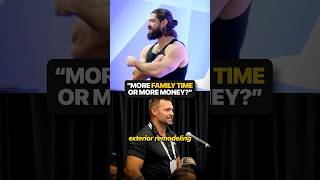
In this brief YouTube excerpt, a roofing and exterior remodeling business owner (Speaker B) reports $6 million in annual revenue and expresses an ambitious goal of scaling the company to $100 million. He reveals his primary concern: the fear that such growth could erode his family time. The coach (Speaker A) asks a direct, open‑ended question about what actions the owner is not taking and would like advice on. The owner admits uncertainty, stating he does not know what specific guidance he is seeking.
I sell roofing and exterior remodeling. We do close to $6 million this year. Amazing. I would like to be at $100 million. Okay. What's stopping me? And I'll be a little bit vulnerable. I would say the fear of losing family time.
So what do you think you should do that you're not doing that you want me to tell you to do?
I don't know what I'm looking for you to tell me to do.
I'll say this differently. I think regrets come when we imagine the upside that we don't have without taking into account the cost that we didn't suffer. If I like cookies and I'm good with that, and I also want a six-pack, I just prefer cookies to a six-pack. It's just, that's the trade. And I think the dissatisfaction comes from wanting both. In terms of like, is there a path where I can work no more than I currently am to go from 6 to 100? There probably is. It depends on how much you're willing to pay other people. And so you might have to take a short-term hit in terms of profitability to bring in the level of talent that you want to expand the business on your behalf to where you want it to go. The question is, which thing do you value the least? Do you value having more profit or more time with your family in the short term? In the long term, you can make it up. You won't make up family time in the long term. You can make the profit up in the long term, right? So if you're willing to give up short-term profit, you can bring in high-level talent and then they can lead the growth. And so either want less or trade more.