Why Doing More Is Actually Making You Less Money
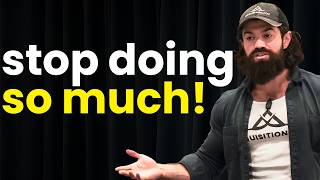
Alex Hormozi coaches Kira, who runs six businesses but feels scattered, on why spreading yourself thin kills growth. He argues any operational change causes a 20% performance dip, so it needs to promise 40% upside to justify the risk. Focus beats portfolio.
Chapters
Remember that friend of yours who got rich dropshipping, day trading, buying crypto, and wholesaling all at the same time? Right. Me neither. And so today you'll watch a single mom of 5 who could potentially be making much, much more, but she keeps launching new businesses and she's incredibly spread thin and overwhelmed. If you've ever been in her situation where you have constant FOMO and you keep chasing new opportunities, this video might save you years of your life. Let's just start with playing the clip.
So last year my company made $1 million. I've already made $1 million this year, so I think I'm on track for $4 million, but I hope to hit $10 million. So here's the deal, okay? Is that I get really bored, right? And so I'm also a really amazing visionary. And so I've built a lot of different things. And what I'm needing right now is I need clarity. Okay? And I need you to— I would love for you to help me focus. Okay? I'm going to share with you what I've done. I'm going to share with you what I have, and then I would love for you to show me is how do I get clarity?
Okay, what do you sell?
Yeah, so I have a publishing house, okay, but really what I've sold is that I take people on these 5-day adventures, like luxury adventures, and I can help people channel their books in 5 days. And that's what's filled my pocket, but it's also just not scalable.
And so why is it not scalable?
Well, because one week a month I'm on these adventures, and I love it, but it's like there's like a ceiling And so then I like rented this island in the middle of the British Virgin Islands. I took 15 people there. We all write their books for 5 days. And so that was like scalable, which that landed me a TV show. So now I have like this TV show, but then I have like, like my publishing house and then like I have this business school for women. Yeah. And then like I'm also like a single mom of 5 kids. Also, I like write books on the corner. Also, I did a live event in January and closed $1.25 million in 5 minutes to a crowd of 30. So it's like I have all these things, I just like, I just need some—
so she's got a lot going on, as you can imagine. But the thing is, is like before I had kind of like my big entrepreneurial breakthrough, I had my 6 gyms, I had a chiropractor, uh, agency, I had a dental agency, and then I had the turnaround launch business where I was flying out and doing done-for-you sales. So I had 9 different businesses and I was doing around the same revenue that Kira says here. I was doing, you know, a few million dollars a year. I was so spread thin and so overwhelmed. The thing is, is like if you want to unlock like super, super success, in my opinion, you have to concentrate your energy like you have a magnifying glass from the sun. Think about your potential or, or your intelligence or your work ethic is like the size of the magnifying glass, which is the more, you know, sun it captures. So you have potential. But it doesn't matter how big the magnifying glass is that's capturing the sun. If it's not focused on one point, it's not going to do anything.
Yeah, you got to pick. You got to pick one of your 5 kids.
The 10-year-old, all day.
There you go.
So you just got to, you got to think about which one's the 10-year-old of your businesses. The thing is, is the more talented you are, the more opportunities you know you could crush. Which just means more things you have to say no to. And it's just like, it's the reality of it. I mean, the thing is, is there's a price to that, which is if you continue to do what you're currently doing, you pay a price on either side. If you continue, you pay the price of how big the impact you wanna have and how big of a business you ultimately build. That's the price. What you get for that trade is you get to have the novelty and the excitement of new things happening all the time. On the other side, you build something really big that has teams and systems and it just grows really large, probably maybe not bigger than your vision, but large, much larger than what you have right now. And what you give up for that is all of the novelty that's associated with doing new things.
Yeah. So which one?
Well, it sounds like you know which one you should do and you want to do something different.
I feel like when I, when I've been looking at, okay, well, what has brought people to me? It's always the books. And I keep trying to get out of it because there's so many people and there's so many things and all these systems in publishing. And I'm like, but if I just ran the business school, like, I don't have to have all these like editors and formatters and book covers and— right? But then I look at like, well, what do people always come to me for? It's always books.
Yeah, this is, you know, Alex's two cents. Well, you're on my channel, so I guess, I guess it's okay for me to share my two cents. There's big visionary stuff, and then there's just kind of like real everyday business. And so I'm gonna give you the real everyday business perspective on this. Go where the money's at. If everybody comes and says, hey, I want to give you money to do something, or hey, I want to buy this thing from you, over and over again, listen, that's feedback from the marketplace, to use the, you know, fancy business jargon. If everybody comes to you and says, hey, please solve this big problem for me, you're really good at it and I don't know anyone else who can do it, it's like, that's amazing. It means you can build a business around that. In my business career, every business I've had has not been like the thing that I thought it was gonna be when I started.
Almost every time.
I have this idea of like, oh, wouldn't it be cool if, right? And then what happens is I end up going to the marketplace and people are like, I actually want this. And I'm like, really? Huh.
Wild.
Okay. And so I have to, sometimes it's massive pivots that end up happening. But it's like you need to be a bloodhound for value. And the way that you are a bloodhound for value is you solve other people's problems, which they give you, which you know you've solved them because they give you money to do it. If I have 3 different doors that people can come in and they keep knocking on one, and I'm like, why don't you buy 2 or 3? 2 or 3 are great. It's like, well, they're like, I just want one. Instead of just being like trying to get them into 2 and 3, just crush one. And then remove all the other doors and then go all in on that.
So you run the business school, right?
Yeah.
So imagine I come to you and I'm saying, hey, I've got this business that everybody wants to buy from me. It has good margins. I sell it like crazy, but I have like 4 other businesses that I want to start. They don't grow as quickly as this other one. What should I do?
Weird. Sounds so easy when you say it. Yeah, obviously. Right, right, right.
Yeah.
Yeah. Okay.
What you're encountering is a problem I think everybody in this room has dealt with, right? It sucks. It's like you have to realize that, like, you can't pursue every opportunity. Not only can you not pursue every opportunity, you basically have to say no to every opportunity to be able to make one opportunity worth pursuing.
If my TV show is on Amazon Prime and I'm helping people write books, And then I'm like, but I'm pushing my business school. Like, that doesn't even make sense.
Yeah, I wouldn't push the business school. Just have the media asset of Prime that pushes you writing books, and then help people write more books, and then have a second season of Amazon Prime helping you, you know, people writing books, and then sell more people writing books.
Yeah, all right. That's my financial advisor in the front shaking her head. We got this, Julia.
Yeah, Julia's like, I've seen the financials on the book one. Like, do more of that, right? I had these massive multi-year plateaus where I just stayed stuck because I wanted to pursue every single thing. And so you have to trade novelty for loyalty. And so it's like you become loyal to the business. I also think that occurs with relationships. Like you make the trade, the new person every one, you know, every week, every month, every whatever for somebody that you know that you've built something meaningful that's deeper, right? And I think that you, it's kind of like, I think business in a lot of ways is like a fine wine where like, you understand it at a different level as the years go by and you go through different seasons. And I think that you miss out on that opportunity if you're going after one-night stands and flings from a business perspective.
Do you know my life?
Yeah, you have to.
Life will not give you what you want if you want everything.
Ah, damn.
We have to make trades or we get nothing. And it's tough, and I think there was a big— I had a big realization, I want to say a few years back, where once I realized how much work it takes to make something truly great and something big, I had this moment of like deep sadness where I realized that I could only do a few things throughout the rest of my life. I was like, oh, I only have like 2, maybe 3 entrepreneurial seasons left in me, which is kind of like crazy to think about. It's like I only get 2 or 3 more big swings. That's it. And the real real is that if the swing just keeps going, which is what I plan on doing at Acquisition.com, it's like, this is it. I'm going to do this until I get too old to do it, and that's it. That's all it is. Now what I want to do is give you something tactical, all right? Because this is— we were all the way up here. You have to take your creative energy, and I have a lot of that too, and you have to channel it into something that is accretive to the business, something that adds value rather than something that detracts value. And so what are the components of the business that need novelty on a regular basis?
Um, I think I can give you a hint. What?
Marketing.
Marketing. I was just gonna say sales.
Lead magnets. Yeah, like, so if you want to build and you want to create, I have the same itch. Yeah, I put all of my ADD into content. I've become a significantly better entrepreneur by making content because it distracts me from fucking up my business.
This is legit. I just wrote a book about— I just wrote a book about when leaders get bored, they fuck it all up and burn down the city.
Yeah.
And I just keep doing it over and over.
So instead, just like, just paint the city.
Okay.
Just paint it. Don't destroy it. Just paint a different color.
Got it.
And so that, like, and that goes for everyone. Like my, my ADD, like I put it into ads, I put it into like the reason I write books is mostly for me. Like Layla's like, can you just write another book? Because she's like, you're just getting into all of these things that you should just not get into.
Right.
Yeah. And so the thing is, is that when I am in writing mode, the business does exceptionally well because I do so little.
Yeah.
Right?
I feel this.
Yeah, I don't normally talk about this, but I think this feels incredibly relevant. So this is gonna feel real for you and everyone else. So let's imagine the business, like everyone's revenue here represents this line, your revenue, not aggregate, but that's your business, that's normal business that's happening. What I realized, this is me, so this is anecdotal, is that whenever I decide to make a change in the business, I see about a 20% decrement or decrease in performance from whatever that change is. So I change a sales process, I change a lead nurturing process, I change an onboarding process, I change something that I have to train people up on something new. Now even if that change is something that I think is superior, I'm still going to have an immediate decrease in performance. Now, if I assume this to be true, which in my experience it's been about 20%, so if you're like, what's the data research behind it, it's Alex, doing this. All right. Now, if I think that this improvement is going to make, let's say, a 5% improvement in the business, like I think this will improve our closing rate by 5% or something like that, then I'm going to take a guaranteed 20% loss for a potential 5% increase. Bad trade. Now, how many months is it going to take me in order to make up for the 20%? It's going to take 4 or 5 months, right?. Now here's the really fun thing is that on an alternate timeline you have this thing, but when you leave people alone they tend to just get better at their jobs. So you'll get the 5% improvement. And so what's happened is that I've actually created this rule which is that if I don't see a risk-adjusted 20% improvement— so let me explain what I mean by that. Which is I need to see a 40% improvement that I think has a 50/50 shot at happening for me to make any change at all.
Damn. Let's say that you are going to run a test of some sort. You want to change your sales process, change something on a landing page, you want to, I mean, change anything, right? You have some belief that it's going to improve, right? You wouldn't do it unless you thought there was a chance that it would improve the business, right? Of course not. But the thing is, is that what is that chance? And so your ability to estimate— I think we have a 50/50 shot, I think we have an 80/20 shot, I think we have a 20/80 shot that this actually works— then allows you to over time get better and better at estimating what the potential upside is for a given intervention. And so if I know something is going to go down by 20% no matter what because I changed something, and that 20% decrease comes from training team and people kind of dealing with change, that's the price tag. Of trying. So the thing is, like, you don't have unlimited shots. So people talk about testing all the time, test, test, test, test, test. Yeah, but there's also a cost to test. And so if you think you can maybe run only one test, like even on something that's automated, like landing pages, if you change multiple things at once, you don't know where the correct attribution is, like what actually made the benefit or the decrease, right? And so you really only have like 52 tests a year. You've got about one a week that you can maybe do with sufficient volume of traffic. Right now maybe you have 2 or 3 different areas, you know, funnels that you could do it on, but even then there's actually significantly fewer tests that you can run. Now in the people side of the business, it is way less than 1 a week. You're talking, okay, maybe you think 1 a month? I don't know, it's like we just did this this month, are we gonna really change the process again? So maybe you've got like 1 a quarter? So you've got like 4 shots, maybe, that you're gonna change in a department in terms of a true change that's gonna occur in terms of process. The thing is, is most entrepreneurs, number one, don't think about it like they've got a punch card that only has 4 changes on it. And so I kind of like this from Warren Buffett's perspective of like picking stocks and investing. He said if everybody just had a punch card where they could only make 20 investments their whole life, people would do it exceptionally well because it forces you to actually think, am I really buying this company? Am I really doing it for the long term? Do I really believe in this? And so to the same degree, you as an entrepreneur, we've got like 1 punch a quarter and the bigger the company is, sometimes it's even fewer than that. And so if you only had, you're like, all right, is this the bet I'm gonna make? Like this is the shot on goal that I wanna take of all the different bets, all the different ideas that I have. This is the one that I think has the highest upside and highest likelihood of happening. And so by me shifting my perspective on this, and when I have, so I have this big massive list of ideas which we'll talk about in a second in the video. I put an estimated value next to it. I think how much do I believe this could improve and how likely is it? And so when I have that, I can rank order these. And then when we do have bandwidth, I'm like, okay, I think it's time to try this one, but it better be worth it because the price tag, no matter what, is that your business gets worse.
And so I have a list right now. It's Alex's big list of ideas.
Yeah.
Which I encourage you to have. Okay. And I have it, it's on my phone where every time I think of something else that we could do to improve this business, Instead of messaging the team and saying, "Hey guys, emergency meeting. We're going to do this. This is such a great idea." I just write it down and I just keep living my life. And every once in a while, I'll have one where I'm like, "This is actually a 40-50% potential move." Then I'll go to the team and say, "Here's my reasoning behind this." And then they'll say, "Cool. You have 4 other 50% return moves that you've told us about in the last 30 days. Is this better than those ones?" And then I'll look at it and be like, "No, it's not better than those ones." And so then I'll keep it on my list. And in the event that the entire team has bandwidth and they're all breathing a little too easy, then I can go destroy their worlds, right? But what's ended up happening is that my businesses have improved so dramatically by me just saying, let's just let people do their jobs. And so I'm gonna be crude yet again just to emphasize this point, which is that I have grown to accept that some shit stays fucked. And so there are tons of things about the experience that you guys went through today. Hopefully it's been really positive between yesterday and today. I hope it has been. The team was great. But there's probably 100 things that I want to improve about it. But every time I want to go improve one of those things, 4 others drop. And it's not worth the cost of change. And so most of us just don't factor in the guaranteed 20% decrease for the potential, which we're usually overly optimistic on. I think this will be 40%, but then after it's all said and done, it's 5%. Was that worth it? No. And so hopefully this is not, you know, this is not— I'm not just talking to you.
I see a lot of heads nodding.
This has been one of the most useful razors that I've used as an entrepreneur, and it has made all of my business significantly better.
I realized that there was this decrease in performance every time I changed something because I have had enough fast feedback loops across different departments. And so, like, if we have something in sales and I want to change the sales process, I know that the first week we change something, the scripting, even if we think it's better, the team's going to take a second to adjust, right? Like, they have muscle memory. They got to rebuild that muscle memory. When we would even change an onboarding process, like, I know that people are going to drop the ball, they're going to mess something up in the beginning, but then they got to get their reps in and they can fix it. In the advisory practice, which has been super successful at Acquisition.com, helping businesses scale that aren't necessarily ready for investment, we've been able to tweak many things about the process, but I do know that every time we do make a change, I can see the decrease in performance before I see the increase. Now we do get to the increase, but every time I have to bear that cost, I'm like, ugh, I don't know if I wanna change something again. And I think a lot of reasons that entrepreneurs don't realize it is 'cause they don't track. And so we are, I will say, like one of the things that we're pretty good at is like we're very good at tracking data at Acquisition.com, and so we have a very, I have very good metrics that get pumped to me. And so I can see the pain. And if you're too far away from it, you don't see the change in customer satisfaction, the change in NPS scores, the change in ascension rates, the change in churn, the change in whatever it is if you don't have real-time metric. If you're looking at something on a monthly basis and you make a change, and then the next week, again, nothing happens, next week nothing happens, then you get numbers in reverse, you know, 1 month or 3 months later, and they're not even necessarily accurate, or they're very vague, or they're fudged, or there's multiple data streams that are conflicting, right? All those things make it very difficult for you to see clearly the cost of the things that you're doing. But the real, real underneath of this is that the vast majority of entrepreneurs are changing so many things so often that they never know what was the thing that broke besides them.
And so tactical takeaway for you is number 1, channel your ADD into the stuff that benefits the business by being creative. Number 2, make make a list of all your crazy ideas when they come up and don't tell anyone about them.
Okay.
And if it seasons for 2 or 4 weeks and you still think about it, it's like maybe when you go to the store, you're like, maybe I'll buy this dress. I don't know, I'm just pretending to be a girl for a second. And then you decide not to. And it's like, if you still think about the dress a month later, then go back and buy it.
Yeah.
But in the moment, if you buy it, then it's usually a terrible decision. And so it's the same thing with this. Put the list down, sleep on it. If you're still thinking about that idea a month later, it probably has some legs.
Yeah.
Right? And then number 3, if I am going to pull something off of my big list of crazy ideas, it better be worth it because I'm going to absolutely detonate a bomb in my business and it better be worth what's going to happen when the dust settles.
Wow.
This was hard for me to hear and like everything I needed.
Thank you.
Cool.
Thank you, guys.
Hey guys, so if you're seeing, uh, Kira, who's the lovely lady in this, um, video, and you see kind of the people around, that's at our actual headquarters here in Vegas. And so if you're a business owner and you're, you know, feeling stuck or you're not sure what the next step is, uh, to maybe have to pivot the business, or you're just scaling well and you're like, I just want to make sure that I can pay down my ignorance tax and just keep the scaling going, uh, we'd love to help. We'd love to meet you in person. And the reason that I even decided to do this in-person thing at my office is that, like, it's not scalable, um, and it's almost like purposely not scalable. And so it's just very cool for us. I think it's like, it's deep, right? Like, we get to actually meet you, like, I'll meet you, um, and really get to know the business, right? And get to know you and, um, and provide the, the highest value I possibly can. Um, and so the reason I was willing to do that is because I think word of mouth travels faster than the amount of people that I can fit into a room. And so we try to make it, you know, absolutely exceptional experience. And the reviews seem to indicate that people really, really like it a lot. And so, yeah, so if you are a business owner and you have been like on the fence or debating, you know, a big decision that's coming up or like what the missing link is or, you know, where you need to focus in the business where you can get the most returns, that's our bread and butter. That's what we do every day. And yeah, we'd love to have you out.
So I'm sure there's a link somewhere.
You can probably click it and get stuff and book all of us, and then maybe I'll see you out here in Vegas.










