Panel: Pitch Perfect: How to Raise Funding from Investors
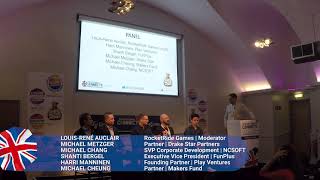
Five game investors discuss what founders get wrong when raising money: confusing publishing deals with equity, failing to explain what makes them different, and asking for too much or too little capital. They explain how due diligence works at different stages and share deals they passed on and regretted.
Chapters
All right, good morning everyone. I hope you're having a good second day. We're going to talk today about how to raise money. Everybody here in the front brought their checkbooks, so please be sure to come say hi to everyone go on afterwards. Guys, let's just start with a quick intro. Who you are, what you do, and which side are you on the investment right now?
Awesome. Hey, Michael Chung. I'm a partner at Makers Fund. We're a global fund. We do seed, Series A, Series B, $200 million, and we've invested in about 47 companies so far, everywhere around Europe, North America, Asia.
Hi, my name is Harry, or Harri if you can roll your Rs, hailing from Helsinki, Finland. I am the founding partner of PlayVentures. We are an early-stage global gaming fund. We mainly invest pre-seed and seed. We have a $40 million fund and we've done 16 investments around the world.
Hi, my name is Shanti Burgel. I've been in the game industry about 25 years, the first half of which was as a producer, the second half of which has been in corporate development. Most recently, I focus on investments. I'm an angel investor in any number of game companies. I'm also a corporate venture investor on behalf of FunPlus, which is a large mobile gaming company. We invest primarily in seed and Series A.
Hi, I'm Michael Chang. I work at a company called NCSoft. It's a large public Korean game company. We have about $1 billion or so that we do investments, acquisitions, third-party publishing investments and funds like the panel before us. We're 10— we were 10% of London Venture Partners' last fund and we're slightly less today as those funds grow in size.
Hi, I'm Michael Metzger. I'm a partner at DrakeStar Partners. It's a global investment bank with about 100 professionals across the US, Europe and Asia. And we partner with companies on mergers and acquisitions and the growth stage financing.
All right. Thank you, guys. So we're 5 guys in the front. Well, you are 5 guys, 3 Michaels. Let's not answer all one after each other. So if you have something to add, add whatever you need. What are your thoughts on the current market, right? The evolution of investment changes. Like 7 years ago, everybody was talking mobile. Then VR became the new flavor of the year. Where do you see the market being right now? Shanti, start, please.
Absolutely. So, for me, I'm very excited to be an investor in today's climate because I think this is one of the most exciting times in games to be a founder. So, the availability of capital has never been better and there's a reason for that. And that reason is that the opportunities have grown to a point where, you know, like even like traditional venture investors are paying attention to this space. You see the— unlike a lot of other media businesses, the layers of our business stack on one another. So, like old platforms don't go away. They actually stick around. So there is a PC business, there is a console business, there is a mobile business, there is a coming cloud business, there is a nascent VR business. And so, you know, like the ability to drive content plays through that ecosystem is unprecedented. So there is now an ecosystem that supports multi-platform IP development in a way that we've never seen before at scales that we've never seen before. And from an interesting perspective on all of this is that the technology is commoditized to a point where it's mass market. That's never really been true in our history. I think when I started in games on the 3DO, you know, like we had to worry a lot about each successive technology wave. And we had a very limited addressable market. And so now, you know, the addressable market is literally everyone. I mean, almost every human on the planet of age has a cell phone in their pocket that's capable of playing games. And then there are other platforms that truly enthusiastic people can choose to be part of whatever fandom that might represent. And there is a spectating market in the form of esports. So all of all this kind of— or kind of an unprecedented market for, you know, digital entertainment overall, but gaming specifically which drives a lot of the ancillary bits of that entertainment market. So for me, that's what's interesting.
Can I jump in for a minute?
Yeah.
10 years ago, I had the chance to work with Shanti, first time ever in games at EA. My first meeting was with a small Finnish game company that made a game about birds and pigs. How much do you think it cost them to make that game? 10 years ago today. Any guesses? How many millions of dollars? Not even.
Okay.
We got Paul here who worked at DOTS. They had the DOTS game. Paul, how much did it take you to make that game?
[SPEAKING IN FOREIGN LANGUAGE] Yeah.
I don't see a title today on the mobile side that doesn't have a $10 to $15 million budget for development, $23 million in marketing. How many of you guys play Roblox today? Any of you? You, your kids? Last round they raised was $150 million. I haven't heard anything about fundraising from them in about a year, a year and a half. I think we can easily predict that they're going to raise something soon. All the companies that have raised money have been a little quiet. They've come back requiring larger and larger amounts of dollars. The markets have never been larger for us. We enjoy the benefit of more sizable markets, but the ability to win, is also becoming very expensive.
So, yeah, so a lot of early-stage investments in the esports side and a lot of really late-stage investments, as Michael just mentioned, specifically over the last 6 months. But for any of you who are looking for money, it's also worth considering some other options. There's a lot of new platforms and distribution platforms out there, and some of them, you know, for smaller studios might make sense to work with them, like whether it's an Apple Arcade, they've been pretty generous, Stadia, getting in there, as well as getting publishing on Epic versus Steam, significant payments. So that's one option to consider. And another option I think is pretty interesting is on the blockchain side, companies that develop something adjacent to their current games. And there's significant investment from different blockchain funds like Forte and others, which not with a lot of effort can produce a good amount of of good amount of cash and funding other initiatives.
I think from an investment climate standpoint, I mean, piggybacking on what Shanti said about a golden age of gaming, I think from a talent standpoint, there's been so many people now who've been working on free-to-play games at the very highest level for almost a decade. And now it's cyclical in a way where a lot of these people are now leaving the incumbents and setting up new companies of their own. Maybe they see a corner of the market which is underserved. Maybe they found a new way to sort of tackle the same audience. And I think for somebody like us who invested in the very early stage, basically just purely on teams, this is a very interesting opportunity to see all this founding talent. And I think it's cyclical that we're seeing more and more of great operators branching out, building their first companies.
Yeah, thank you guys. Talking about early stage or first time raising money, I think My opinion is that the first time you raise money is the most difficult time because you've never done it before. It's like getting your first publishing deal. What do you see the common mistakes of people coming to pitch you for the first time, or they've never raised money and they're like, "Hey, Michael, I want you to invest in my company. Here's my pitch." What's the common mistakes?
I feel like a few things. A lot of people can get a lot from just talking, I think, with their friends and kind of fellow colleagues in industry just to learn what are the basic 3 things that they want to know. So I've met a lot of people who, for example, would have benefited a lot from understanding the difference between the structure of a publishing deal and the structure of an equity investment deal, right? In that publishing obviously focuses more on revenue share, and equity investors care more about the long-term growth of your company and what your ambitions are for the company and where you want to be. 5 to 10 years, right? I think that is actually, for a lot of developers, a key one. And then secondly, I think it's also really important to understand kind of how much money do you need, what do you need it for, and be very clear to yourself, kind of, is this enough money to get me where I need to be in the future? Because don't just think about what you need today, what you need in 18 months' time, in 24 months' time, and beyond that, because you'll be at the same discussion in a year and a half from now, or a year, asking for the same thing but more money, hopefully, right? And then the very last thing, which has been alluded to by kind of a few people on the panel here today, which is what are you doing, and in a very succinct way, why is it different? Why is it interesting, right? Because I feel like we're in this time of the market where, you know, by virtue of self-selection, everyone here is bullish about the gaming market and the interactive entertainment market. I think that is not an issue. But what is an issue is now, I think in 2021, right, there's going to be so much content in the market now. There's just going to be so many games, and it's great. Yeah, we've never been in a better time in the industry. But that also means that maybe that very unique PvE/PvP game, maybe like MOBA-inspired, that you thought is really unique, it's one of 10. You just haven't seen the other 9. And that's the kind of thing I think people should really kind of either by speaking with those in the industry, speaking with other kind of earlier investors, just try to seek to understand that and therefore refactor it into what your differentiator is, right? Like, how are you different? What is your different kind of go-to-market? What's your difference in content? And how are you really going to kind of change the game?
Anybody have something to add?
So, I hold the record for the most number of venture capital firms in the least number of years. It's a dubious record, but it worked for me. Every firm trained me actually in the same trinity of things to look for. Management, market, and at the time it was called technology, now it's differentiation. Management, no company, no startup who starts what they're doing ends up doing the exact same thing they planned at day one. So, management teams who can adjust and change to the changing market environment and dynamics and face all the issues that they face, that's very important to us. You've heard this from the last panel, talent, management talent. Market, a leader in a small but rapidly growing market so that when the market becomes discovered by larger players like ourselves and we try and move in, you can keep us out. Think about Supercell back in the day. Leader in a small but rapidly growing market in free-to-play games and they're the— They are the juggernaut today that can't be beat. And then technology or differentiation, competitive barriers to entry. What is it that lets you stand apart from everyone else, have unfair competitive advantage? It can be talent, it can be distribution, it can be any other things. But we're looking for those key aspects, that holy trinity, so to speak, to back you with if you can find those things and take money from us.
Yeah, thank you. I think— One of the biggest questions when you're trying to raise money, especially initial funds, is how much money do I ask for? Some people will tell you just ask for the maximum amount you can and then take it from there. What are your thoughts on this, especially, Hari, which you do early investments? What are your thoughts on how much should I ask for?
Well, you need to raise for, like Michael said, for what you need, right? And also look at a longer-term perspective than a very sort of what we need right now. And also think of how you structure your fundraise going forward. But I would say, like, in general, over-capitalizing too early, raising too much too early, rarely leads to great results. I mean, you know, usually diamonds are created from pressure, and so when you have a sense of urgency around the early days and you need to make quick decisions, if you're over-capitalized super early and you don't feel that, you know, you don't have that the pressure of making quick decisions, you're too much in the comfort zone, that can be bad too. So I would say, you know, raise for what you need, but don't try to— and also on the valuation side, don't try to optimize valuation too early, because then if you don't perform in a way which allows you to— or it makes it hard for you to raise follow-on funding, that's going to be difficult if your first round has been at a high valuation. That would be my advice.
Shantanu, you have something?
Yeah. Just to nuance that, I think that's right. So raise for what you need is kind of directionally correct, and you should do that. But be realistic about what you actually need. So, I mean, it's the games business, and so there's a lot of things that don't work out. And so if you basically create a plan that has you raising on a very strict set of circumstances where everything has to go correctly, then you may find yourself kind of behind the 8-ball when it comes to, you know, kind of figuring your way out of that hole if your first kind of effort doesn't work out. So, I mean, there's, I think, a little bit of an art to determining, you know, what that needs that really is. So I think there are a lot of, you know, kind of famous stories about how many tries were necessary to get to the one that worked. And so, you know, like there's a bit of a balance to strike in terms of determining that, you know, that initial capital number. And to be honest, some of it is a function of who your team members are. So, if you have, you know, somebody on the team who either has got an amazing hit in their past, you're going to have a lot easier time of raising more money and you have the luxurious kind of perspective of like dialing that in to your specifications. Whereas the reality for some people who are first-time founders and don't have that kind of track record is that, you know, you will basically be level set by the market. But whatever it is, you need to have a strong view of your own capital needs going into that equation. So that you can kind of dial it in with what you hear back from the marketplace. But if you kind of expect that everything is going to go right at every single milestone, I think that's a dangerous place to be. So, like, I live in San Francisco. It's a very expensive place to build a game company. I frequently have interactions with founders from Europe who raise completely differently than what we see in my native market. And I'm always super impressed by how far they can get on so little money. But I worry greatly for their future in many cases because I see them bumping along with a couple couple hundred K and they have to last the rest of the year. And that feels like a very dangerous place to be. And so, understanding what your real capital needs are, I think, is very important.
I can echo that. Raise what you need, but at the same time, there's also a correlation to the valuation. And it's always good to keep in mind that investors are looking for, like, a Series A ownership of 20% or 30%. And, you know, that valuation then reflects also the amount of capital raised.
Thank you, guys. One of the things that I realize when people raise money, first round, second round, whatever, they always undervalue the pain of due diligence. You know, you're the creative, you're the CEO of your company, and you're trying to keep your game going, your production, or your even if it's your early phase of development, and all of a sudden you have to turn around and say, okay, let's talk with bankers and investors. What are your thoughts about due diligence process? If somebody here is in the— getting ready to get into it, what would you recommend to these guys?
Oh, I guess I— we tend to invest so early that there's rarely a product even. Sometimes maybe even in the very early stages of actually setting up the company. So I think for us, like, a lot of the due diligence is on the teams themselves and on the founders and doing a lot of reference checks. And luckily, you know, both me and my partner Henrik, having been in the industry for 20-odd years, we tend to know a lot of people that the founders know too, so we have mutual connections. So for us, it's a lot to do with sort of personal due diligence and founder due diligence. It's definitely different in the Series A stages, but in the pre-seed, early seed stages, it's more about the—
Team, team, team, team. Yeah.
Yeah, I'd say it's a continuum. So, you know, like starting with kind of fairly light due diligence, mostly around the team members at seed and pre-seed, all the way up to, you know, what Michael will put you through in a corp dev process at the end of the cycle in an acquisition is the other end of it, which is they need to see everything, every contract you've ever signed, you know, like they want to have contracts on every piece— person in the company. It's a very, very, very kind of like different level. But it scales up in every step in between. So, like, as you go from, you know, seed to Series A to Series B, you know, like that level of diligence is always going to ramp up and it's going to be the most serious at the end.
I mean, I actually compare budgets. When I was doing early stage investing, I had to allocate $30,000 or $40,000 for legal fees to close a deal. Today on the larger deals where I'm looking at companies that are $200 million up to $1.2 billion, so my last bid was $1.2 billion for something, I need to reserve $3 to $4 to $5 million in legal and advisory fees, right? So, that's a relative sense of the complexity of diligence as you go from early stage up, at least from the advisor standpoint. So, it's crazy these days how expensive it's getting.
So—
[Speaker] And for really late-stage financing, like $30 million plus, it's actually, you know, similar to an M&A process, and it's really getting your financials in order, having them reviewed, maybe even audited. I think that's crucial. It's going to save you a lot of pain and time later on.
Yeah, so, so Michael, maybe I can ask you this one to get started. So there's a lot of movement where people invest, right? So when, when VR became very popular and a lot of money was being thrown in there, you saw a lot of people move from mobile from mobile to VR, because mobile is being so difficult. And as you said, Michael, $10, $15 million budgets to make a game all of a sudden. You can't make Angry Birds for $300,000. Michael, where do you see— nobody has a crystal ball, but what are you looking at? What gets you excited right now in the gaming market where there's room for growth?
Sure. Yeah. So I think this is an interesting question because we all ask ourselves this every 6 to 12 months. And frankly speaking, if you were to look at this panel, last year and the year before, the answers will kind of wildly fluctuate depending on the kind of the flavor of the day, right? But I think essentially what I'm more interested in is the fundamentals behind it. So if we look at— interestingly, if we look at PGC London, exactly the same event last year, I would say there is probably about 100% more Turkish companies here, right? And why is that? That, right? So it's because we've had some great successes in the market, not just Turkey, also places, you know, Israeli companies, Ukrainian companies, Polish companies, and that's for a reason, right? So these are places where they've essentially built up very talented developer hubs and communities who traditionally worked as outsourcing houses or worked together with some of the bigger well-known companies, and now they're kind of in the place where they can take this experience and build on from it, right? If you take it to a more meta level, it's also the fact of, say, if you look at Israel, why did Playrix, why did Playtika grow up, blow up out of nothing? Because they had this insane pressure to monetize really early on, very aggressive, and take essentially what is a very unique skill set in the market and hone it to a very fine skill where it's trying to now kind of pivot that into learn more about gameplay, learn about mid-core beyond just social casino. So I'm really interested in these kind of themes of where a country or city can take its kind of spike or uniqueness and apply it to another industry, right? So I think this is a pretty unique point in the market to be, to be doing something like that versus, say, another free-to-play game out of Helsinki, which is great, but I think statistically it'd be a lot harder because the competition is there.
Anybody has something to add to this? No? All right. That was like one-shot answer. It rarely— it doesn't rarely happen, but it happens sometimes that a new studio, a new group, what they're pitching is so interesting that it turns around and all of a sudden everybody wants to invest in them. In mobile, you're seeing it a lot in M&A because there's so many few studios that make it. That there's almost a lineup of all these real success facts trying to buy studios at the door and knocking one after the other and you, you high-five on the way out. How do you guys differentiate yourselves to be one of those investors and be picked as a partner when it's a very, very hot new studio or product? Shanti, maybe if you want to start.
Sure. I think a lot of that is self-selecting in a way and that, you know, like different teams Different types of help. And so, like, my background, for example, is half production, half corporate development, you know, like with some investors sprinkled on top. And I speak Japanese. I have a long history in Asia. So if that's a particular background that maps to, you know, like your team, then there's probably, like, a better fit more natively than, you know, like if you have a direct duplicate of me in all of those buckets. So, you know, like, what is a value-added investor? Was asked in the last panel. And so, like, what is the value that you need, I guess, is the question that, like, I'm answering. And so there's some of that, and then some of it has to do with, you know, like, the fundamentals of the actual deal. So, you know, like, how competitive is the term sheet? These are all kind of, like, part of the picture. But in terms of, like, what differentiates different investors, I think it's a self-analysis from the team side about what they want from their investors, and then looking at people and trying to understand like how they could potentially fit in. And so, like, there's a lot more interest in games these days from a lot more players. So, it's a longer process. It's a bigger conversation than it used to be when there was like, you know, kind of 5 folks to talk to. So, I think that's good. I think choice is good because as we all know, there's more than one way to win in the games industry. And so, there's more than one good fit. Like, otherwise, otherwise there would be fewer of us up here. But, you know, like, that's my perspective anyway.
And to piggyback on that a little bit, when we talk about, like, we do founder due diligence, we definitely, you know, encourage all founders to do due diligence on your investors too and on potential investors. Just to, you know, ask around if what the investor is doing is a good fit for what you're looking for, just like you said. So I think there has to be sort of a mutual mutual understanding and a mutual great fit. I think when we look at great— the teams we look for, I think what they appreciate with a fund that's run by ex-gaming entrepreneurs is what Paul was saying in the last panel, is the empathy side. So I just think that you having been on the other side of the table and having, you know, raised money, having been through those same conversations, I think that's I think that's something that where we can add a lot of value in terms of like having that empathy, understanding, having walked through the same path before, and that's, you know, where we feel that we can add value.
Actually, you're all in great positions of power. At some level, you're selling to us for cash that we may be able to give you, but frankly, quite the converse is the case. We're selling to you if we want to get into the best deals, right? For the best entrepreneurs, for the best games, we're having to find a way to go in when you may not need us. When I started off in early-stage venture capital, companies were coming to us desperate for cash. They were burning, you know, tens, hundreds of thousands of dollars a month. They needed the cash. My first interview in a job in private equity where companies don't need your cash, I failed the job. I had someone throw me a pen, said, "Sell me this pen." I said, "Oh, it's a beautiful pen.
It's blue.
It feels comfortable." He said, "You failed immediately." "Why?" "You didn't ask questions. You didn't listen. You didn't learn. You didn't understand what the other side wanted. They don't need your money. You've got to find your way to sell in. And so, I've never forgotten from that point in time that in one sense, while people are coming to me, I'm also always coming to you. The best companies don't need your cash. So—
[FOREIGN LANGUAGE] We have about 1 minute left. Michael and I do these panels quite often together, and I really like to put people on the spot towards the end. and I like to talk about the deals that got away. You know, that one that got away that people didn't want and they feel really bad about not getting in at a certain level investment. So guys, if you are willing and able to share some of these stories, maybe 2 or 3 of you guys could say something.
I'll share one.
This is super painful.
It's not from PlayVentures Fund. We're a year in, so I'll have more of these stories later from the fund. But from an angel investment side, so I've done plenty of angel investments. I passed on Huge Games in 2013, I think. We sourced that with my current partner Henrik. He decided to invest as an angel. I passed, and I learned a lot from my reasoning to not pass on the similar types of characteristics that I thought back then were red flags. But in the end, it didn't matter. So I'll carry on to that for, I think, the rest of my life.
Because you're the one who has to go to panels now, and he doesn't.
Yeah, exactly.
There you go.
I'll tell a funny one from EA. So for 3 years, I was the number 2 buyer of companies for EA. In 2010, 2011, do you guys remember a company called Riot Games and League of Legends? So I was playing a lot of League of Legends personally.
This is October.
It's a GDC Austin. I get to meet Brandon Beck, the CEO of Riot Games. And I come back home to EA headquarters and I'm like, "We've got to meet these guys." So I send this email to John Riccatella, who's now CEO of Unity, Frank Gibeau, who's now the CEO of Zynga, a few other folks. I have a quote. I still have the email where basically no one wants to meet the company because they think it's going to be too expensive. And it's a copy of a good mod is what the current— is this taped? I still have the email where the current CEO of Zynga says League of Legends is a copy of a good mod. That's one that definitely got away.
All right. We're out of time, but maybe one more if somebody wants to jump in the pool. No, you don't want to? Okay. So, if you want to hear their stories, buy them a beer. Or a coffee, and there's plenty more to tell. Thank you guys, thanks a lot.
More from Shanti

Panel: 2020 M&A and Investment Overview, Expectations & Consequences PG Connects Digital #2