Lead Like Elmo: The Power of Whole-Person Leadership
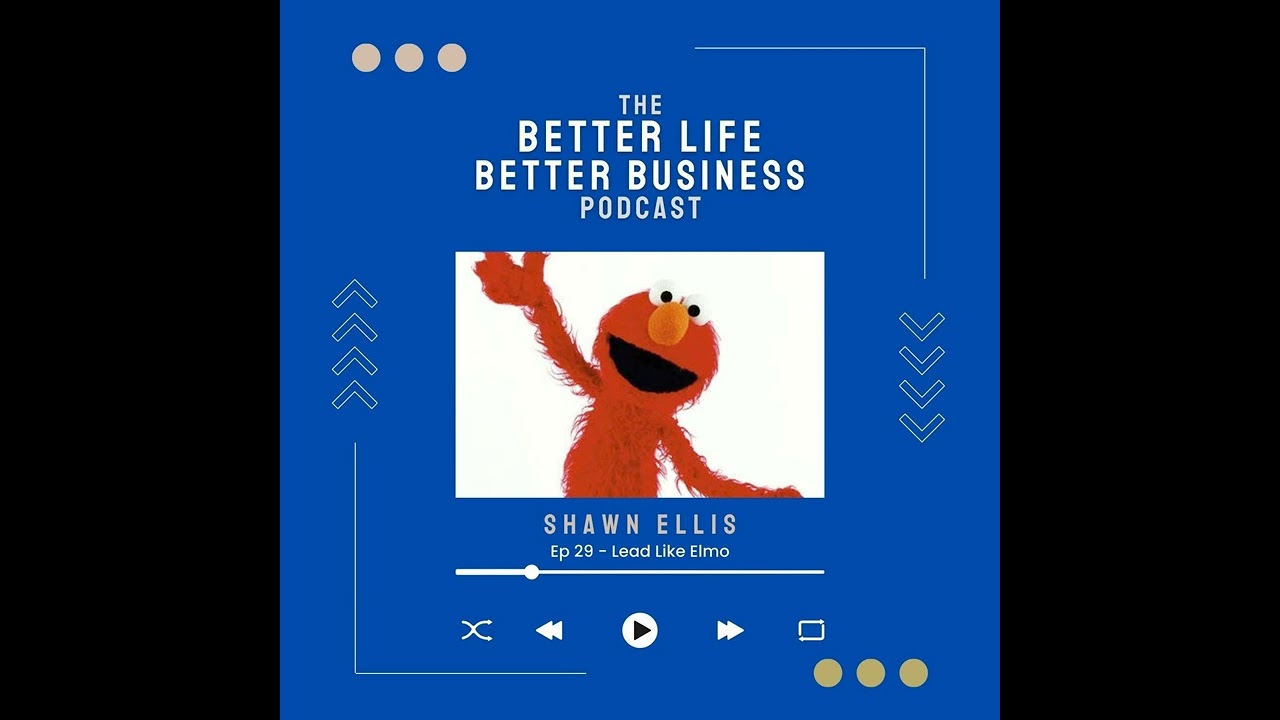
Shawn Ellis uses Elmo's viral "How are you doing?" moment to argue that leaders need genuine connection, not toxic positivity. With 57% of employees burned out and only 48% believing their employer cares, he offers a 5 Cs framework and teaches leaders to listen without fixing, letting people feel what they feel.
Chapters
Hello, my friend, and welcome to the Better Life, Better Business podcast. I'm your host, Shawn Ellis. I'm so glad you're here, whether you're back again or whether you're here for the first time. I don't take it for granted that you clicked play, tapped play, whatever the current verbiage is. I don't take it for granted that you're here listening, sharing part of your day with me, and I want to make it worthwhile. The title of this episode is Lead Like Elmo. A few days ago, I started seeing people talking about Elmo on social media, just little references to Elmo. So I thought something— what did that little red monster do? Something has happened. And as I dug a little deeper, I realized that a few days ago, Elmo, the Sesame Street character, asked people on social media platforms. He just came on and said, how's everybody doing? And people responded. It just blew up. There were hundreds of millions of views and comments, people responding. There's a great profile on the whole event on the NPR website. I'll put a link in the show notes if you want to check that out. But some highlights. Somebody responded, "Not well, Elmo. They done raised rent and everything at this point. I'm coming to live with you on Sesame Street." And Elmo responded, Elmo would love that. #Neighbors. Somebody else said, Elmo, I'm having a rough time. Love you though. Elmo responded, Elmo hopes you doing okay. Elmo loves you today and every day. And doesn't it just— it just warms your heart to hear from a beloved character like Elmo speaking to people. It's like that just— those words just bring comfort. They bring a smile. Little side note, by the way, a little trivia here. In college, I dressed up like Elmo to do kids' parties as a way to make some extra money. I was working through a company that did these costume kids' parties, and the costume wasn't licensed by Sesame Street, so I wasn't technically Elmo. I was just a little red monster. But anyway, there's my connection to Elmo. But I want to talk about this idea, leading like Elmo, because Something struck a nerve with just saying, "How is everybody doing?" and giving a platform for people to speak, to share their experience. And I think there's something really meaningful that we can all take away from this, or a few things actually, but it ties in very much with the theme of my speaking events this year, as I'm talking about how to adapt and thrive in the midst of the constant uncertainty, disruption, and change, it, it demands that we, we develop our skill of adaptability. How do we adapt and thrive? And I've identified 5 keys or 5 Cs. And on a previous episode, I read through my quick guide to adapt and thrive. So if you wanna learn more about the 5 Cs, you can check out that previous episode. But one of the Cs is community. Or we could say connection, or in the workplace we call it culture. But the idea that we, we can't do it all on our own. Yet when things get really challenging, our tendency is to go within. The nature of survival mode is to isolate, to look out for ourselves, because if I feel like I'm just surviving, then I can't look out for anyone else. I've just got to take care of me. And it puts a lot of added stress on ourselves when we isolate like that. I think that's one of the things, just seeing how this blew up, just Elmo, a recognizable beloved figure like Elmo that we trust coming on and saying, "How is everybody doing?" It's like it opened a space for everyone to say, "Oh man, I'm not doing so well, just waiting for somebody to ask and to give us, give us safe space, just providing a space where we feel like we can say, man, I'm not, I'm not doing so well. And, you know, it speaks to me on different levels, but I would say this, first thing I would say is, is I get it because as a motivational speaker, what I am by title, you see me on an event program, it's usually as the motivational speaker for the day. That's the title, but, but I'm a human first. And on any given day, there are challenges, to state the obvious, whether it's in work or business, relationships, parenting, money, health. In any given day, sometimes it's all out of whack, sometimes it's just one or two, but either way, it can get heavy. And then when we do go into survival mode, we feel isolated. Then we think, man, if they only knew 'What I'm going through,' whether it's 'they' being our partner or 'they' being our coworkers or our boss. 'Man, if they only knew, but no one understands. No one knows what this feels like.' And that is such a dangerous trap that we fall into, thinking nobody understands. But what this whole Elmo event, if we want to call it that, what this has done is just remind us that no, you're not alone. You're not the only one who feels like this. And so when I speak, I always start the presentation somewhere early on in the introduction of the presentation. I start by acknowledging that, to acknowledge that, hey, a lot of people aren't feeling so good right now. And it's sort of an odd thing to talk about in a quote motivational presentation, right? I'm there to bring some positivity, but it's dangerous I think if we give the impression that we should just be positive, like, hey, I know there's, there's a lot of stuff going on, but put a smile on your face, cheer up. Maybe you've heard the term toxic positivity. Susan David, who's the author of a book called Emotional Agility, she said on a recent podcast with Adam Grant, she said, when we tell people just to be positive, what we were actually saying to them is that my comfort is more important than your reality. When we tell people just to be positive, what we are actually saying to them is that my comfort is more important than your reality. And that also is another reason that we go within and we feel isolated. We feel alone because, well, you know, apparently nobody wants to hear this. They just want to, you know, stay comfortable. And if I share what I'm feeling, it's going to make some people uncomfortable. Which is why when somebody asks, how are you doing? And they really mean it and they give that space, it's like a release valve. It's like, man, I've been holding all this in, man. I've just been waiting for somebody to tell me it's okay to share with them. Because a lot of times, you know, people say, hey, how's it going? How you doing? And what do we say? I'm okay, man. Okay. I'm fine. Pretty good. Right? Because we know, at least we think, that's what people want. They just, they're not really asking. They just, you know, they just want the quick answer. They're just being polite. And I don't know about you, I've had some experiences where some colleagues that kind of I work with at a distance, when somebody would check in with me and be like, how are you doing? And I would share, like, man, there's some stuff going on right now. It's this, this, and this, not really feeling too good. And then I realized, oh, I see. He didn't really want to know that. It was just the polite, how are you doing? But when we really ask, how are you doing? It lets somebody know that, hey, somebody sees me, somebody cares about me. So that, I think just this whole recent experience with Elmo just brought that to the forefront. And I love Elmo's responses. When somebody says, "I'm having a rough time," Elmo hopes you're doing okay. Elmo loves you today and every day. Just somebody say, "I see you. I love you. I care about you." And that's where, as a speaker, again, I'm brought in to bring some positivity. I'm very aware of what my role is, but the first thing I want to do is acknowledge that, hey, Number 1, I know you're feeling some feelings right now. And then I often share one of my journal entries from 2008, which is sort of the beginning of what was a 10-year period of transformation in my life where I learned a lot of the lessons that, that now I, I share. But I have this journal entry where I said I feel lost, empty, and depressed. And at the time I was writing in my journal. In response to the movie Dead Poets Society. And if you've seen it, Robin Williams' character Mr. Keating is inspiring these young men to live their best life. He tells them to seize the day. And I wrote in my journal, seize the day, my days count for nothing. It's again not where a motivational talk usually begins, but I, I want to let them know that number one, they're not alone. Number two, I'm human. And then As I share this 10-year period, I came out on the other side with a very different journal entry that just said how grateful I am almost exactly 10 years later, how grateful I am just because, with the reminder there being that, that the feelings can change, that they will change, that what you're feeling right now is temporary. The circumstances you're experiencing right now are temporary. So that's where we can bring some hope and encouragement, but we start by acknowledging the feelings of what you're feeling right now, acknowledging your present reality. And there's some stats that say that as a whole, we're struggling right now. Just look up stats on mental health. A recent report from AFLAC said that well over half of employees, 57%, are experiencing at least moderate levels of burnout. A survey from Slack found that burnout is on the rise globally, most significantly in the US, where 43% of middle managers reported burnout, which is more than any other worker group. So we're burning out. Then employees' confidence in how much their employers care about them has declined significantly. 48% said they have confidence that their employers care about them. That was in 2023, which was down from 56% in 2022 and 59% in 2021. So in other words, people are burning out and then also getting the sense that their employers don't care about them, or fewer and fewer people are saying they've got confidence that their employers care about them. And if you think about that, like, notice those years. If you remember, in 2020, of course, it was the global pandemic and companies were rallying around their people. All the spotlight was on how are people doing? What do we need to do? Companies taking care of their people and great examples of companies doing great things. So then in 2021, 59% of employees said they had confidence in how much their employers care about them. Because again, we're coming out of the pandemic. 59%. Yeah, my employer really cares about me. Then 2022, it drops down a bit to 56%. In 2023, takes an 8% drop down to 48%. We'll see how that trend continues. But if employees are saying they're not so sure their employers care about them, then when a beloved character like Elmo comes along and says, how are you doing? It's like the release valve to say, oh my gosh, thank goodness you asked. I'm not doing so well at all. So I, I just wanted to highlight this power of connection, power of community. And if you are a leader, if you're in a leadership position, the reason I say lead like Elmo is we all need to take note here and realize that, hey, people are hurting, people are struggling. And if you can be the leader who shows your people that you care it gives you a tremendous competitive advantage because it's going to create or help to create a culture that's truly built to thrive in the face of whatever challenges come up. And I know that that's an uncomfortable thing for, for a lot of us because we're just focused on, hey, let's just, let's get the job done. Let's, you know, let's focus on performance. These are the business things that's easy to talk about, easy to do, easy to measure. I love something Brené Brown wrote. She said, leaders must either invest a reasonable amount of time attending to fears and feelings or squander an unreasonable amount of time trying to manage ineffective and unproductive behavior. Because as I'm sure you know for yourself from your own experience, when we're not feeling good, we're not doing too good. A simple, simple line I have is when you feel better, you do better. But if we're struggling, if we're burning out, and then on top of that, we feel like our leaders don't care, then we're not going to perform at our best. Morale is not going to be so high. Employee engagement is not going to be so high. And we wonder, well, what's going on here? And then we think, okay, well, I'm going to— we've got to tighten up these working hours. We've got to keep a closer eye on our people and try to shore up these ineffective and unproductive behaviors. But what Brené Brown reminds us is, no, first, as leaders, we need to attend to the fears and the feelings of our people. Because, you know, it's— no longer can we say that, hey, leave your personal life at the door when somebody comes to work. Because for one thing, in a lot of cases, personal life and professional life are all jumbled up. If somebody's working from home, doing remote work, it's all right there. But also, this is 2024. It's a new day. We're better than this. We're better than saying, hey, you got to leave your personal life at the door. We've got to recognize that, no, the whole person shows up. There isn't this compartmentalization that I know that's from a previous era, but the whole person shows up to work. And I think as leaders, that's what you want, right? Because we ask people, we ask our people today. To give their entire selves to whatever it is we're doing. So if you want them to give all of themselves to your endeavor, then you need to welcome all of them into the workplace. Again, this is what creates a resilient culture that's built to thrive. It's what creates an organization that's truly special, where people feel cared about. I mean, imagine if your employees, if your people felt you cared about them as much as Elmo does, right? Lead like Elmo. And this is where talking about how we have to adapt in order to thrive, this is where leaders and managers have to adapt because it is a different way of leading. But those who lead learn this lesson and they are showing their employees that they care about them. And so I know we dove into the business piece there, but maybe leader isn't in your title. Maybe manager isn't in your title, but are you a parent? Are you a partner? Do you have friends? You can lead by asking, how are you doing? And then really listen. Don't try to change their feelings. Don't try to sugarcoat it or find the silver lining, but just sit with them. Allow them to feel what they're feeling, because then they'll feel seen, they'll feel cared for, and they'll respond accordingly. Lead like Elmo, and when you do, you unleash the power of connection, the power of empathy. But before we go here today, let me just ask you How are you doing? I hope you're doing well, but if you're struggling in some areas, then number one, know that you're not alone. Go read some of the responses to Elmo and just see what people are going through, whether it's family challenges, relationship challenges, financial challenges, health challenges. We've all got a lot of stuff going on. You're not alone. And then the second thing I would say to you, and this is something that I tell audience members, is that you are not your feelings. I think that's the other piece of this when we talk about, okay, how do we, once we acknowledge our feelings, how do we, how do we work with them? And the key is to know that you are not your feelings. You're the noticer of your feelings. See, those feelings are valid. They're real. You should allow them. You should feel them. But also know at your core, know that your feelings will pass. Just like clouds in the sky. If you look up in the sky and you see these beautiful cloud formations, if you keep your eyes on them, those formations will shift. They'll be gone in seconds or minutes. Your feelings will pass just like those clouds in the sky. Your circumstances will pass. I remember last time when I went to my barber to get a haircut, we were talking about some of the stuff that was going on in life and some of the parenting challenges I was dealing with. And he had been through some similar things, so he was offering that connection, that community, just listening and sharing. But as I was getting ready to walk out, he said, "Hey, just remember." This is temporary. It is temporary. Always. One of my grandmothers used to always say, "This too shall pass." I bet you've heard that too. This too shall pass. So as leaders, we can ask people, "How are you doing?" As individuals, just know that you're not alone. And know that you are not your feelings. You're the noticer of your feelings. Sit with them, allow them, be curious about them, even put a label on them. This is one of the things I learned early on. I mentioned my journal entry back in 2008 and how that kind of started this 10-year period of transformation. And early in that 10-year period, one of the key shifts for me was, was when I enrolled in a mindfulness-based stress reduction course and learning the power of of labeling your feelings. Like, you know, if you're feeling anxious or angry or sad or whatever it is, to name it and notice what you're feeling and then say, oh, this is what anger feels like. Instead of saying, I am angry, you can say, oh, this is what anger feels like. Do you notice how that detaches your experience? Not I am angry, because angry is not who you are. Angry is what you're feeling. So if you say, this is what anger feels like, this is what sadness feels like, and this is how you can claim your power as the noticer of your feelings, because just naming them diminishes their strength. And again, we're not trying to, to deny our feelings. We don't want to suppress them. We want to allow them, to feel them, to acknowledge them, but also remember your true power. One of my mantras is, "I am the creator of my experience, not a victim of my circumstances." So you always have the power, no matter what's going on around you, no matter what you're feeling, you have the power to create your experience by shifting your thoughts, by shifting your behaviors. You can change your experience. And one way you can change your experience is just by labeling your feelings. So here's a little talk about leading like Elmo and the power of connection, empathy, hopefully a little shift in perspective. But I think the key lesson or key takeaway here is that what this whole Elmo experience online, what it's shown us is, man, as a whole, maybe we're not okay, but we're not okay Together. And when we're together, we're better. Together is a path to a better life and better business. So I hope something here has made you feel a little bit better today. A reminder that you're not alone. A reminder that you are not your feelings. But that you should feel your feelings and to remember that feelings will pass, the circumstances will pass, but you don't have to face it all alone. Let's do it together. So thank you for listening. If you'd like to learn more about the 5 C's to adapt and thrive, as I said, I read my quick guide to adapt and thrive on a previous podcast episode. You can also download the PDF shawnellis.com/ebook. That's shawnellis.com/ebook. E-B-O-O-K. So feel free to download that. And if this podcast speaks to you, share it with somebody. Tell somebody else who, who maybe just needs the reminder that, hey, you're not alone. And if you're in a leadership position, remember to lead like Elmo. Ask somebody how they're doing this week and reach out to me on social media. Drop me a message or a comment somewhere. Let me know how you're doing. I'd love to hear from you. Thanks again for listening. I'll speak to you again soon.
More from Shawn


Shawn Ellis | Choose Your Ending™ — Radical Adaptability Keynote Speaker Highlights