Rev. Greg Johnson shares a three-word caregiving framework—awareness, acceptance, action—and urges listeners to follow public-health measures during COVID-19. He highlights Sheila Warnock's Share the Care approach and encourages forming care teams in churches and workplaces to check on seniors and share meals.
Chapters
Good morning and welcome to Friday with the Rev. I'm Greg Johnson. I'm the president and CEO of GJP International and the chief advisor to the CEO of Emblem Health here in New York City for family caregiving. And I want to welcome you to this broadcast. I want to thank you for being with me. And I want you to know that I have the iPad at the ready Should we have the same problem as we had last week where for some reason the, the computer closed down on us, I will try to go immediately to the iPad and continue. But no matter where you are this morning, and we're very blessed with this program to have people from all over the world, our theme has always been our oneness and our oneness in caring, our oneness in sharing the care. And we're going to talk a great deal more about that this morning. I want to welcome you in a pandemic as we are all experiencing. Yesterday we in New York went on state of emergency, and New York is reacting as New York would, but they're pulling together. There are lots of positive things. We are one, and we are sharing in that. And I want you to know more than anything this morning that you are not alone. We're blessed to have technology like this where we can talk, where we can share, where we can be together in a safe environment. And we will continue to be doing that throughout this and beyond, because we're going through it. It doesn't mean it's here to stay. I like that word "through." You know I have talked about that many, many times. So I want to welcome you, and in our tradition during this pandemic, we have been using a prayer to begin with, a prayer for each and every one of us, and one that we are seeking comfort. So please join me as we take a deep, deep breath. Oh Lord, thank you for the promise that you will never leave me. No matter what is happening, no matter the difficulty, no matter the situation, you are there. Your love surrounds me and all for whom I care. Underneath are the everlasting arms, and into those precious arms I surrender myself and my loved one. Together with you we walk forward. We will grow through each and every experience, knowing that you are with us through it all. I will trust and not be afraid, for you, Father God, Mother God, are ever near. All I need to do is close my eyes, take a deep breath, and reconnect with the precious gift of life, the breath of God with which I was born. I now claim your divine presence in my life, in every situation and circumstance, and all is well. Now and always. Amen. That prayer, I hope, blesses you as it indeed blesses me. These past weeks, we have been talking about the mission statement that I originally used for, and continue to use, for the creation of the program Care for the Family Caregiver at EmblemHealth. And that was a 3-word statement— awareness, acceptance, action. And the last 2 weeks, we've spoken of awareness— I mean, yes, of awareness, of acceptance. Let's do that again. Awareness, acceptance, and today we speak of action. And there is much, much action happening here and around the world. Action. I can't help, here in New York particularly, but though it was a world pandemic during the AIDS crisis, Each and every one of us needed to do our part. With this present pandemic, pandemic, there is far less prejudice. We had the issue of prejudice, but we all grew through that, and we all did the things that we were asked to do. And such is the case right now as we are, I pray, listening to the medical experts. This is not a political issue. We need to listen to the medical experts all over the world because each of us in the world is at a different place within this pandemic. For some, there has been a longer acceptance of it. There has been more that has been being done, and we can learn from these people. We need to listen with love, and we need not allow fear to rule. There are many things that each of us can do. It is an epidemic situation, meaning that a pandemic, if issue. So it is happening all over the world in various ways, and people are reacting. We are being asked to do some very practical things: the washing of hands, the avoiding large crowds, of self-quarantine. And each of those is extremely, extremely important. But we also need to take time to be still. For in any situation, and particularly in a pandemic, we need to deal with the physical, the emotional, and the spiritual. The physical things: washing the hands, avoiding big crowds, being careful to care for oneself, to bring in the medications that you may indeed need, the over-the-counter medications, because there is no vaccine. And with that, I want to particularly say, let's remember how many people are surviving. And there are more and more stories. This is one of the gifts of Facebook. We are hearing stories of people's journey of surviving, of what they went through. I mean, right now you hear a great deal about washing hands, don't get into crowds, those sorts of things. But what about once someone has that flu? It is not all terminal, and we can get so involved in thinking of the terminal point that we forget to realize it's something that others are going through and are more than surviving. They're doing it very well, using in most cases the things we would use for flu. Now, I'm not a doctor, and I don't presume to be a doctor, But I have been asking questions because I haven't heard enough about what do you do if you get that type of flu. So yes, there are the hospitals. Yes, there are the ER rooms. But there are also things through telemedicine that we can be doing and really and truthfully caring for ourselves as we go through this experience. So I want to urge you to be reading actually on Facebook because it's a wonderful means of communication, and more and more people are sharing their stories as they have been going through, and I think that's extremely, extremely important for us. There are a number of things that I also ask you to consider. It was very interesting last night after the state of emergency had been declared, and I wasn't aware that it had happened because I was coming up from Emblem Health on the subway when that all occurred. But I thought, oh, I have to pick up a few things, and I went into the grocery store, and it looked like it was the eve of Thanksgiving. New Yorkers were shopping. There's going to be a lot of people eating a great deal of pasta. There was— as the shelves were beginning to empty, it was sort of like eating the leftovers. These were the sorts of things, but I chose not to do the panic. There were things that I was able to get. But I also bought things with the idea of how can I help those who are here in my apartment house. Now, many years ago, I started a caregiving committee within this apartment house at 300 West 23rd Street, which is where I live here in Manhattan. It was not called a caregiving committee. It was called Know Your Neighbor. But it really came out of, frankly, what we went through at 9/11, where people couldn't get here, or people needed to use their passports, and we felt we needed to know one another. And as I've said to you before, it was including pets on the enrollment that we got the biggest share of this apartment house to fill out the form so that we knew who, what were in each apartment and what the needs were. And when Hurricane Sandy came, because of that, we were able to get out all of those who were on using electronic or electric respirators and that sort of thing. We were able to get them out to a place where electricity was, and while we sat in darkness, they were being cared for. This was part of a share of the care. I personally cooked, and I am not a cook, but what we did do was I knew that there were many seniors and there were several who were quite ill, and so I simply Made casseroles. I know how to do that. You know, that comes from a good Lutheran boy out in the Midwest. We know casseroles. So I did casseroles. I did meatloaves. Those were practical things that I could do. And then because I couldn't walk the steps as a multiple stroke survivor, members of the staff here came each morning. I gave them packages made up and we knew to whom to give that. And so I thought in this particular situation, perhaps I need to have things of that nature. So I've stocked up on those things. That's something I could do. There are things that you can do, and it is extremely important that you think of those sorts of things as we think of others. Also, emotionally and spiritually, get on the phone, use the email, check in on people, let people know that you're thinking of them. I know I'm blessed each time someone sends me a note. Or makes a call, even to leave a message. I know there are those who are in the hospitals. They need to be sent love. I normally visit a great many people in nursing homes. I'm not doing that presently for their sake and for mine, but I am calling them. I'm texting those who have that ability. Reach out. Be in contact, because as you reach out, you are also blessing yourself and you're centering yourself and you're allowing that spirit of the divine to work through and with us. For in these times, as always, we are the hands, the feet, we are the arms, the eyes of the divine. How— whatever word you use, whatever precious name is yours, we use it to be of help to be of service and to guide other people through this time that seems such an enormous crisis. So there are things that we can be doing, and I urge you to be thinking of each of those that you might do, things that are particular to your particular life, your particular village or community, because right now we are all one village, and we need one another now more than ever. Also, time to pray, to meditate. When you feel fear coming on, you're getting ready to say, "Forget everything and run." No, face everything and recover. Spend a moment, go within, and know that within you is that healing light of love. Let every cell be filled with light going through your body, your mind, and your spirit so that you in turn can be a light to others. Yesterday they closed Broadway. I think that's the first time in my life for an extended period that's ever happened. But I want you to remember one thing: on every stage right up here— that's where Broadway is, I live blessedly in the middle of this wonderful city. But on every stage on Broadway, there is one single light standing on the stage. Of course, it's for safety, but it's also a light that shines in the darkness. And you and I can be that light for other people. And you know, as you give it away, you too will receive it. Now there is a special prayer that I want to use. It's, it's one from the book that I did with Marian Gambardella, and I'm going to invite us to pray it together. And then I'm going to share with you a wonderful resource, a wonderful resource that in this time where many people are being asked to remain home, this can give you a wonderful opportunity to to learn something that you will have for the rest of your life. So let's have this prayer and then we will go onward. Again, let us take a deep breath, connect with the divine within each of us. Oh, divine friend, creator and sustainer of life, thank you for this promise and blessing of support strength and a constant present. At times the burdens and challenges of my caregiving duties seem too much. At times the burdens and challenges of life seem too much, too overwhelming, truly impossible. But with you, oh Father Mother God, All things are possible. I picture a mountain, tall, solid, and majestic. I see in nature a live portrait of You, my Rock and my Redeemer. I breathe in Your loving presence and power. I release my fears. And I am renewed. I remember fear means face everything and recover. I give thanks and then move on. I do not dwell on the negative, the fear-filled ideas. I acknowledge it and release it to you. I turn my thoughts to you. I rejoice that for me and for my care recipient and all others, we claim in faith, "The Lord is my shepherd, I shall not want." And it is so. Amen. And amen. Now this month has also been the month celebrating women. And I am particularly pleased to share with you through this month some of the great women of family caregiving. And one of them, whom I have been blessed to know and to work with for many, many years, is the brilliant author and the person who has given to all of us one of the greatest texts ever, Her name is Sheila Warnock. She lives here in New York City, and she's an incredible blessing to all of us in the world of family caregiving, for out of her life, out of her experience, out of her journey has come Share the Care. When I first began my journey in the world of family caregiving, I was introduced to Sheila Warnock. She came to me talking about what she was doing, and I really, I didn't need to hear her whole story at that time because the essence of this was a group of people coming together to help the caregiver and the care recipient, building a group support. Now, as a multiple stroke survivor, I had lived through that, not in an organized way as she has done it. But I immediately was thrilled to hear what she had experienced and this wonderful book, which I call the Bible of Family Caregiving. Now, by the way, it's sharethecare.org on the computer, sharethecare.org, and you can order this book. It's available, and I urge you to take advantage of it. And I particularly urge you in this time— now, people will say to me, why would I read a book in a crisis? Well, one of the things we're being asked to do is to isolate more. Isolate means to, in many cases, be alone, to be by yourself or with just a loved one. I urge you to use this time to augment your understanding. Turn that time into a positive. Turn it into a learning experience, and you might be amazed at an idea that will come to you, a page to which you will be turned that will give you an idea that will help somebody right here and now. But I'm really looking at it from the further perspective. Now, Sheila's book resulted from her own life. She was a very noted advertising executive, and yet she was also very busy caring for her mother. And then a friend came into her life with terminal cancer, and the story of Share the Care is such a powerful story, and I will let Sheila share that with you through her own media and through her own writing. But once again, This great ministry, this great gift, is the direct result of her life and her calling, which she has generously accepted, and the lives all over the world that she is helping. For as I speak in many, many parts of this world, people will often say to me, Do you know Sheila Warnock, or do you know Share the Care? And I'm very honored, pleased, and blessed to say she's one of my best friends. I cannot urge you enough to take a look at this book, to look at it not only from your own personal life, but I urge you to consider your faith community, to consider an organization to which you belong. Because if every organization, if every faith center had a Share the Care team at the ready, this country and every country would be so much better prepared. Because there would be people ready to implement what is here and to go into action with the specific group that needs it. Now Sheila does many trainings, and she has done trainings in many parts of the world building Share the Care teams, and you will read about that when you go to her site. But as you read this book, I urge you to consider forming a Share the Care team within your organization, within your corporation, within your hospital, within your faith community, within your local organization. Be prepared. And also, if you are having a major event, I urge you— Sheila is a brilliant speaker. She doesn't just write brilliantly. Remember, she was in advertising, and she is a very brilliant speaker who is passionate and loving, and we are blessed to have that talent. I urge you to be in contact with her. No, I'm not her agent. I am just a friend who's so grateful that I was blessed to know and to have Sheila Warnock in my life and in my ministry as I talk with you and as I talk with others all over the world. And one of the great gifts that she has, and it's available to you also online, the Seven Principles for for team building. Now, yes, it was designed originally with the concept of family caregiving. These apply to any team. So instead of big team building exercises that cost a fortune, here's a card. Take it, learn from it, and be blessed from it. Share the Care by Sheila Warnock, the website sharethecare.org. And never have we needed to do that more than right here and now. This is a wonderful tool. This is a wonderful woman whom we honor in this month of International Women's Day. I'm going to continue sharing because it is women who began the world of family caregiving for us, and each of us has learned greatly from that wonderful work. And now, as we conclude our broadcast, and I'm grateful to say I have my eye— you've been noticing perhaps I'm looking down— that's the little box down there, but all the lights are green, so terima kasih tuham, thank you God. I want to remind you of a very special prayer that we've used before. It's the prayer of loving-kindness, and this is how it goes. First, we picture ourselves surrounded in the divine light of the universe, and we pray: May I be safe. May I be happy. And at ease. May I be healthy. May I be loved. May I love. And now we picture someone for whom we're caring, someone very, very special to us who may have a need, physical, emotional, or spiritual. May you be safe. May you be happy and at ease. May you be healthy. May you be loved, and may you love. And finally, let us all pray. For one another. Let us pray for the entire world in this pandemic, that this may indeed be a moment of united love and caring. And so we see the whole world, yes, in his hands. I can't help but say that I hear the song as I'm speaking to you. And we say to each and every person in the world, our brothers and sisters, may you be safe, may you be happy and at ease, may you be healthy, may you be loved, and may you love. Amen. Thank you for being with me this morning. Blessings to you wherever you are, wherever you are in this journey. And let us always remember, love bears all things, believes all things, hopes all things, endures all things. Love never ends, and it is so. God bless. I'll see you next week, Friday, with the Rev.
More from Sheila


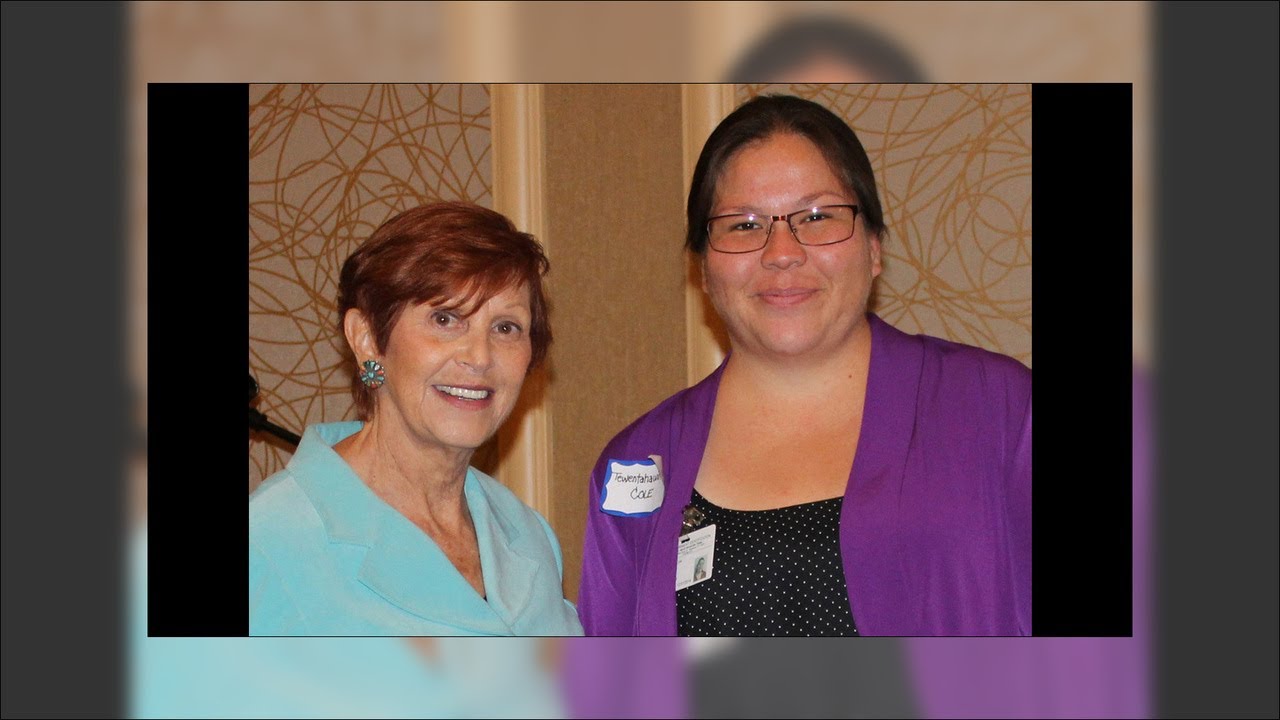
Akwesasne Radio Interview Reen Cook with Tewentahawih'tha' Cole and Sheila Warnock


Lori Miller of Kawaii Hospice in Kawaii Hawaii - Share The Care - Sheila Warnock