The Fintech OG Series: Neetika Bansal and Shivani Siroya
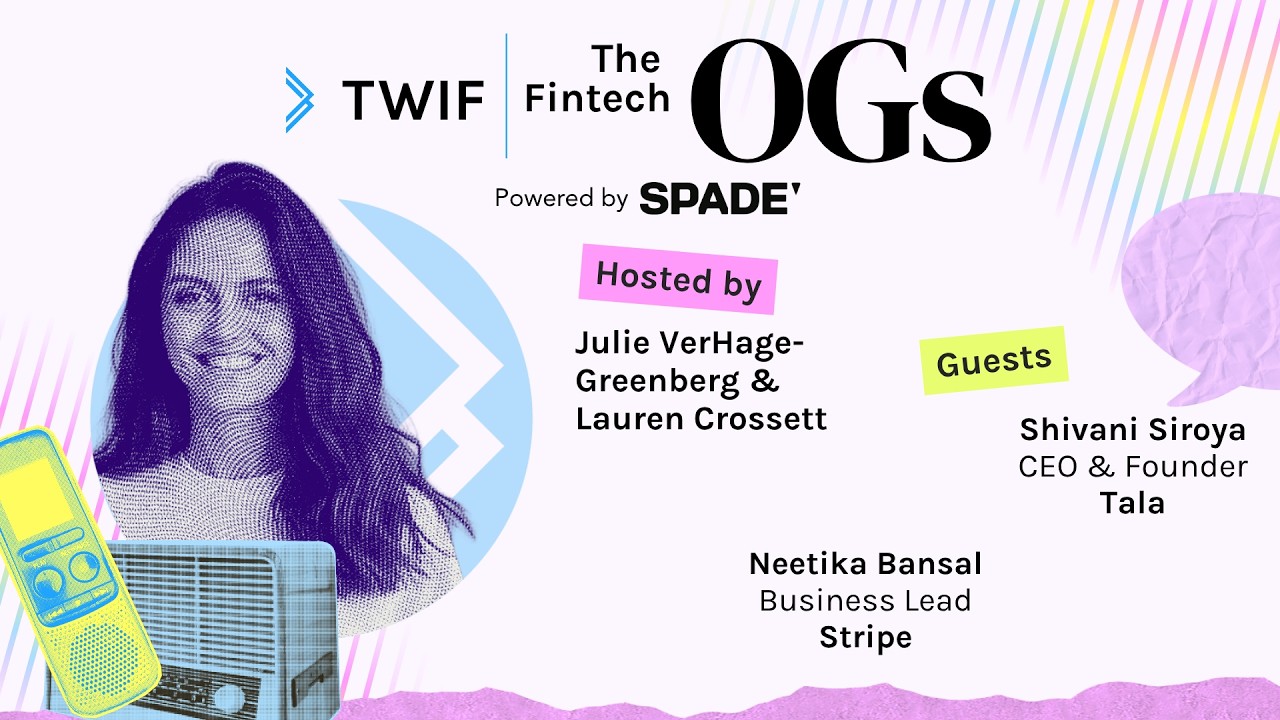
In this episode of the FinTech OG series, host Speaker A (with co‑host Lauren Crossett of Spade) interviews two fintech leaders: Nitika Bansal, business lead for Connect and Money Management at Stripe, and Shivani Siroya, founder and CEO of Tala. The conversation opens with an introduction to Spade’s real‑time transaction‑string cleaning platform, then moves into each guest’s background. Nitika outlines Stripe’s decade‑long evolution from a simple payment API to a global financial operating system that now includes Connect, Money Management, crypto, AI‑driven products, and stablecoin‑based cross‑border payments. Shivani describes Tala’s mission to provide credit to the underserved using alternative behavioral data, mobile‑phone signals, and AI‑powered “world models,” emphasizing the concept of agency for customers. Both discuss the current inflection point in fintech driven by AI, stablecoins, and real‑time micropayments, highlighting recent collaborations such as Meta paying creators with stablecoins via Stripe and Tala’s launch of a stablecoin wallet for Latin‑American digital workers. They share personal career narratives, noting how curiosity, user‑centricity, and a “cockroach” mentality (speed, resilience, rapid iteration) have kept them motivated. The episode also covers challenges during COVID‑driven growth spikes, transitions between roles, and the importance of supportive teams. Finally, they celebrate recent milestones: Stripe’s Money Management suite and financing impact (27% revenue lift for loan‑receiving merchants) and Tala’s rapid expansion into five new countries with a largely turnkey infrastructure, underscoring metrics of financial confidence and shock resilience among users.
Chapters
Hey everyone. Even in 2026, when fintechs can spin up cards in minutes and move money across borders in real time, it's still hard to decipher transactions. That's why financial institutions turn to Spade. Spade is the data and AI platform that turns messy transaction strings into structured, verified records in real time. To learn more, head to spade.com. That's spade.com. Hey everyone, welcome back to another episode of FinTech OGs. I'm here with my co-host Lauren Crossett of Spade, and we have two— another all-female episode. I love this for— and we have one more on the docket too. This is great. So we have Nitika Bansal is at Stripe, and then Shivani Siroya, who is the founder of Tala, both very much in the payment space, stablecoins, all the things. So I'm sure this episode will steer a little bit more that way, whereas like last one was more lending. We've had other ones that were more consumer behavior and everything. So I'm glad we're getting a full spectrum here. And there's so much going on in payments today and every day. So I'm really excited to have you guys here. Nitika, why don't you give us a quick background on you and then Shivani, we'll have you do the same.
Hi, super excited to be here. Thanks for having me. My name is Nitika. I've been at Stripe for the past 8 years and in my current role, I'm a business lead for Connect and Money Management. So what that means is that I manage product engineering, operations, strategy, basically responsible for 2 of our key businesses. One is Connect that serves the largest platforms or marketplaces in the world. Think like a Shopify or DoorDash. You know, these are users with really critical money movement needs around the world globally. And I also manage our Money Management business. So these are This is the entire infrastructure at Stripe that moves money to many different countries in many different currencies and does it cheaply and effectively. And also all the products that we build on top of it. So our banking products, our products to do card issuing, our products to do financing. I'm excited to chat with you, Shivani, about that. And then also I'm responsible for our crypto offering, which is now in this year, crypto is how money moves. So just, that's, that's my agreement.
Excited to be here.
Yeah. Especially internationally and stuff too. Did you guys know each other before we organized this episode or no? No. Well, it's about time that you guys met then. So I'm glad we did this.
I know. I think our teams would've made us meet probably in the next couple weeks.
So this is kind of amazing.
Amazing. Well, Shivani, I'll let you give your background too. You started Tala, what, it's been, I wanna say it's like 12 or 13 years now. It makes me feel really old.
We actually just crossed our 10-year mark.
Congratulations.
Thank you.
Yeah.
Yeah.
I don't feel as old anymore. 10's better than 13. So thank you.
Well, and I think sometimes, you know, I think especially when thinking about the opportunity we're going after and what I think of as like, you know, I think Nitika and I can probably agree on this. I think the structural kind of complexity of this and how a lot of what we've all had to be doing for the last 10 years is really building that kind of foundational infrastructure, it's like, okay, now we're at that inflection point where all of this actually becomes possible to unlock. So I'm super psyched actually to kind of be at that milestone 10 years in because I think the hard work is paying off. So on my end, my background, started Tala 10 years ago and really started it to solve a problem. The problem we're solving is affecting at least billion people around the world. Because I actually think that, you know, when we think about access to credit, it is not only centered on the underserved customer anymore. And it's really about, you know, how do we offer, again, the right credit product at the right time to individuals all around the world in any experience that they're in. So prior to starting Tala, I worked across different 2 investment banking experiences on the equity research and mergers and acquisitions side, studied data science and econometrics, went to go work at the UN Population Fund. And over that 5-year period, got very close to this problem that we're solving and interviewed about 3,500 individuals in person and really got to, in some ways, become like a walking QuickBooks, shadowing how they used money, how they made money, and what those mental decisions were. And then realized, okay, this is where they feel stuck. This is where the purchasing power is. And so how do we really use daily life data, which I think puts us all on the same playing field, to actually create a new kind of credit score or decision engine, as we like to call it, that anybody can use? And I think that simplicity is what has enabled us to now work across 8 countries and and serve 14 million customers and deploy close to about $9 billion in access to unsecured credit to a customer base that's been largely overlooked.
That's amazing. And when you mentioned that you feel like you're at this inflection point or moment 10 years later, we'd love to hear more about that. And if, like, is there a specific tailwind that you think is is changing the situation right now that's evolved over the last 10 years? Like, certainly, you know, at Spade, we think a lot about data and how now that's like a valuable asset. And so maybe that's one of the tailwinds that you're seeing as well, is that there's this openness to consider alternative data. But I'd love to hear your perspective.
Yeah, I can start. And then I think, Nitika, I think even on the— I think so much of what I'll say is The data actually always existed. And I think some of this is, how do we capture that data? And, you know, 10 years ago, I think the insight that I had was, you know, systems like Android, they were open platforms. And if we start to think again, not about the more macro databases and what, you know, traditional data is, but instead put the power in consumers' hands, I think we open up actually what's possible. And so that was that first insight and that existed. So I started to see that customers were moving from feature phones to smartphones. And then that kind of behavioral data and how we could think about cash flow in a different way and actually think about, okay, when I think of a credit score, right, my credit score is made up of 2 things or actually just, you know, creditworthiness is do I have the capacity today to make that payment, or in the future, will I have it? The second is, do I have a willingness or kind of character aspect that has shown consistency? And so I am likely to repay that. And I think that's where we started thinking about, okay, could we use, you know, cell phone data in terms of how someone might even use a cell phone plan as a proxy for how they use income? And I think having those kinds of insights, that's enabled us to really think about contextual data and not build, I would say, static models, but actually now building what everyone's calling kind of world models or more the causal inference models. So I think we all have new terms for it, but I think the data has always existed. And then I think the second piece I think that you're alluding to is on the infrastructure side. I think a few things have really changed. I think one, the deployment of infrastructure in terms of the similarity across geographies is now there. And so when we look at opening up multiple markets in LATAM, we can actually use the same global infrastructure. And it's not always as bespoke. I think on the cash rail side, it's still somewhat customized. But doing identity doing kind of, again, the underwriting, we've actually seen there's a lot more structural similarities. And then the last piece is on the currency side, stablecoins on the backend are becoming something that all of us are much more comfortable with.
So we've seen a similar, I would say, you know, if we have to describe the 10-year arc at Stripe and what we've seen there, I've also almost been there for a decade. So we're giving you decade stories here. So Stripe's Stripe now builds global financial infrastructure. And if you look at our mission, it's to increase the global GDP of the internet. And in that last decade, we've seen this happen via, you know, like these seminal moments. So, the first one is, if you remember how Stripe started, we started with serving the startups. You know, we started with giving them an API to accept payments on the internet. It was a very simple I think the beauty of the product was that it was very simple. It was like 7 lines of code. Anybody could insert it in their app and start accepting payments. And that was the discovery of the problem. And then you look at the second trend, which is SaaS became really big. And so, we started working with all of these platforms that I described. We have 70,000 of these platforms in Stripe serving 11 million businesses. And Shivani, I think they're serving a lot of these like small SMB businesses that we would not serve directly. And so Stripe started building infrastructure for these platforms that were enabling these SMBs to a great scale. And also almost like every corner of the economy is impacted by these platforms that are serving these SMBs, you know, whether it's travel, whether it's healthcare, whether it's spa businesses and whatnot. And then I think the next phase that we all saw was the rise of fintech. If you all remember where like now everybody was becoming a fintech company, everybody was sort of embedding financial services in their app. And then this last, last, just in the last 6 months to a year, we are seeing the rise of the AI economy. So, so we are building the economic infrastructure for AI companies, which means, you know, we're accelerating the growth of the AI companies. So something like almost every company on the Forbes AI 100 list is on Stripe, which is, which is fascinating. And these companies are changing what they need from us and changing our roadmap. So for example, all of these AI companies tend to be global from day one. So they have great need for, you know, if you look at Lovable, they are selling to something like 150 different countries. And it's just so fascinating that their products are far more digital than what has come before and they can be sold to anyone. And so they have great demands of being global from day one. So something like stablecoins that you mentioned are a really critical way of how money is now moving cross-border. Or if you look at a bunch of these companies, they have need of running their operations globally. So how do you move money cross-border is meaningfully changing and accelerating with stablecoins, with having this technology which is instant, free, And sorry, instant, cheap, and cut out the fee and work 24/7. Right. So I think just these are like AI and stablecoins are 2 fundamental shifts in this industry that have happened just in the last year. It feels crazy to say this, but just in the last year, they always existed, but just in the last year, the ramp has gone from like this to this, which is, which is pretty incredible. Yeah.
One thing, I mean, Spade isn't a global company as of now, and Tala obviously does do lending and stuff around the world. What's the difference in different countries and whatnot, just about how easy it is to digest the data? Because I think what Lauren was referring to is that Spade has made it a lot easier to like clean up the data and really make true, accurate decisions based on what you're seeing. And I mean, like the data has Technically always been there, but it might not be the easiest thing to read through and make decisions off of.
True. I would still argue, though, that I think when you— we've been working with alternative data since the very beginning. And so to your point, the data has always been noisy. I think maybe what I would say is I think you're right in that, okay, there's more tools to clean up the data and speed that up. So even our speed of decisioning has increased in terms of how fast we can actually approve a customer. It's like in seconds at this point. I would say the second piece is actually adding in multiple data sources. So I think in the very beginning, we really thought of it as, okay, there's our own kind of application and our proprietary data. And then there's this kind of information that we can gather behaviorally from our customers, from the device. What's kind of sped up is now our ability to integrate and actually bring in, again, using AI, new unstructured data. So that can be things like video, it can be voice memos, it can be pictures of a store, it can be anything. And so your ability, again, to underwrite in a very dynamic manner across the spectrum has also increased. And I think that's the aspect of just the availability— I wouldn't say the availability, but the actual ability to ingest and Totally, totally.
Question for you guys. So like, what— why stay in fintech? Obviously, Shivani, you've founded a company in this space. But Nitika and Shivani both, like, what makes you excited to work in this space every single day? And like, do you still think if you were just starting out fresh today, you'd still choose fintech? Or do you think there's something else out there that might be more exciting? Obviously, there's, you know, there's a So lot of opportunities. Yeah, I mean, much going on in AI. Stablecoins, I'll still consider fintech, but not all of AI is fintech. So I would love your thoughts there. So we get some younger folks that are watching the podcast too.
I have a super embarrassing journey about how I landed in fintech, so I'll start there and then I'll tell you why I've stayed.
I feel like most journeys are a little embarrassing though. Like something random got you into it and then you just sort of like stayed.
Totally. So I was, before this, I was at Google and I was doing consumer, and so it was just completely different than than what I do today. And I remember interviewing with Stripe when it was like 500 people, you know, it was not, it was not small, but it wasn't, it wasn't the 11,000 company that we are today. And I remember interviewing with them. I really enjoyed my interviews and had like no idea what they did. You know, I was just like, it's a company to interview with. And my husband was, or back then he was a huge fan because they had this excellent engineering reputation. They've always had this like excellent engineering reputation. So that was one reason. And then the second reason was just the mission really deeply resonated with me because I was like, oh yeah, like the fundamental concept of economy is that somebody is selling and somebody is buying. And that means that money needs to move. And that's what Stripe does. So even as like a complete fintech noob, I was like, okay, I can understand why this needs to exist in the world. And I think that mission resonated with me. And again, to continue the embarrassing story a little bit, I joined Stripe and my first question was, what is ACH? And then I learned money moves via wires and I was like, oh my God, I've made a mistake. But here I am 8 years later. And then to your question on why I have stayed, I think this is the most dynamic industry that's out there. It's just, I love it. Every year something changes. Every year You know, it's like a, especially payments. If you look at it, I describe it as like a forever optimization problem. You can go through the entire stack. There are new ways of payments coming out almost, you know, the pace of innovation there has accelerated. There are more buyers coming online around the world. There are more merchants going online around the world. And so I just think it's like the most dynamic space to be in. Every year something new happens that makes me sort of recommit to the space. And again, as I mentioned, just in the last year, the fact that you get to play a part in building infrastructure for agents and even sort of conceiving of this world that doesn't exist yet, right? Like, just look at this thing. An agent, we believe that agents will become primary actors on the internet of how money is spent. And we believe that That's sort of the buying side. And then we believe that on the selling side, you really have to figure out how to like safely sell to these new economic actors. I think it's just super fascinating. So the fact you get to play like all of these different hats and roles as part of fintech is just, it like deeply resonates with me.
Totally. And Shivani, even though you're a founder, you could still find a way to leave fintech if you really wanted to. So what keeps you doing what you do?
Well, I think actually similar to Nitika, I mean, I didn't start— I mean, I started, of course, in investment banking, so maybe financial services broadly. But I would say, you know, I really, I studied public health and that was really what I thought I was gonna do with my data science and econometrics background was I was gonna go get a PhD in economics and stay focused on, okay, how do we actually from a public health standpoint, how do we help individuals, the global majority, anyone actually spend money on preventative health? And that was really what I think I got stuck in, where I realized, okay, well, how is anyone to actually spend money on their health or, you know, go and actually have adherence to, you know, malaria prevention or HIV and AIDS medicine when they don't have money. And I think it kind of, I think it shocked me not only to understand the magnitude of that and to realize, okay, we have billions of dollars going into these social, you know, programs, whether it's education, whether it's healthcare. And at the end of the day, we can continue to deploy money that way at the NGO nonprofit level, or we could also think about how do we fix the system to make it possible for individuals to actually be able to have increased purchasing power, improve their businesses, improve their quality of life. I think right now we estimate that the kind of market opportunity in terms of purchasing power to unlock is about $5.7 trillion. And so it's a massive, I think, opportunity and problem that still hasn't been solved. So I came at it from really saying, I mean, as a naive founder, I was like, well, I really want to work on fixing public health issues. So I guess I better go fix the financial system first. I was really naive in that I just really looked at it as saying, I need to go do this thing. And so I guess I have to go fix, you know, credit first. And then that kind of led me on that journey. I think along the way, what's made me stay is one I still believe, again, to Nitika's point, access to customized financial products that are fair and flexible is the underpinning of our entire society, right? The ability to not always have to, you know, be in emergency or in shocks. We need these instruments. And I think, again, with where we're going, I think it gets so exciting when agents can actually help you make better decisions as well. And so, there's that aspect of it in terms of the innovation space is just like so awesome. The last thing I'll say that I think touched me along the way is when we again think about money, it is such an emotional thing. And when I think about the customers I've interviewed or our own customers we've served, one of the things we've seen change the most and us seeing or measuring our impact has been this aspect of financial confidence and decision-making. And we've really seen that, you know, customers report, over 80% of customers report, you know, that improved financial decision-making and more than 70% of people report the ability to now withstand shocks. And so for me, I think that's that aspect of it ties back to public health for me of saying at the end of the day, if we can move people even if this might sound woo-woo, from scarcity mindset into this ability to actually have choice and control over their financial life. That's ultimately what's really made me stay.
This point really heavily resonates with me, Shivani. It's this concept of, you know, whether it's via financing as you're doing, or, you know, via stablecoins where we're enabling money movement broadly. Just this fact that you're empowering individuals and entrepreneurs in all of these geographies to participate in the economy is just such a huge deal.
Yeah. And I think, you know, I think it's so interesting because the word that we use internally at Tala is agency, right? And that's why I think it's so cool to now start to think about how do we last mile, again, through infrastructure, the ability for anyone to have an agent that is much, much smarter and I think capable of, you know, of helping them kind of further that financial life. Yeah.
And we spend a lot of time getting different perspectives on this podcast, especially about like your career story. And so one of the things that I'm really curious, uh, Nitika, you, you mentioned that like, um, you know, every year you kind of like recommit. I don't know if that was just a phrasing or if that is how you think about it, but it resonated a lot with me. Like, I know that's kind of— I I think in chunks and sprints. And I'd love to hear if that's remained consistent for you and maybe how that approach has helped your longevity at Stripe even.
Yeah. I think one of the things I would describe in the decisions I've made in my career at Stripe, or most of it has been at Stripe, so at Stripe, is I think it's just so critical to work on something that you're passionate about. So I'd say that. So, you know, like it is, it is just so important to make sure that the problem resonates with you, that you want to. And the way it happens, in my opinion, is by— and I think Shivani said this a few times now— is by spending time with users. You know, it's like really trying to deeply assess their problems and understand the root of those problems and Stripe's great at this. So I take no credit, but even beyond just talking to users, we have like 3 or 4 different ways in which we gather feedback from our users, you know, because we are a large company now. And even at the size we're at, our founders interview a user every week. And as a leadership team, we then look at our users. We also, in addition to that, interview users. Every 2 weeks as a leadership group to just understand the thematic problems or thematic opportunities. And then we also, this is one of my favorite things. We have customer advisory boards where we bring our users together and then we understand what problems they're facing. So the reason I described that is because I think that's where the longevity comes from, where you have to care about the problems and you have to care about what do the users want from you. And the thing that I've found is like every year I'm like, there's so much more to be done. We're not done yet. There's so much more to be done. There's a phrase that Stripe repeats very often, which is, we have not won yet. And we truly believe that, which is there's so many problems to be solved and there's just so much demand every year that we have to focus on. And then from a career perspective, I feel, I think one of the things that has been really important for me is just, I find Stripe has leaders that have pushed me into roles that have pushed me into opportunities that I did not feel ready for and then have supported me to do them. You know, and I think that's something, there's something really wonderful about that. Like I take this example where I came back from my mat leave. And I was, you know, for a couple of reasons, I, my manager and my manager's manager were leaving at the same time. And they were like, here's the payments engineering org, 1,000 people that we think you're the best person to manage now. And I was, you know, you're coming back from mat leave. I don't even have like childcare figured out yet. And so it's just going through an intense period of, okay, how do I do this? And then having people who sort of supported me. And just fintech is like a multiplayer game. So you sort of get support from not just like your product and engineering leaders, but then also your cross-functional partners, but just like having that crew around you has been really valuable.
Yeah, I mean, I think if you would have started there and like the team hadn't been as welcoming and willing to answer what ACH was and stuff, I don't know that you would still have the desire to work in fintech anymore if you had this connotation now, like, oh, these people are so mean. They don't like me. I'm so like, this isn't for me type thing.
So I do think that has a big impact.
It's a huge impact. You know, curiosity is encouraged. So that is great. Very cool.
One other thing I want to ask, both of you seem very passionate about what you're doing. And I wonder if there's something from your childhood that you think kind of like helped bring you towards this path. You know, what you were interested in. Obviously, Shivani, you said that you thought you were going to go into public health, but this is a form of public health, just a different— it's a financial health versus medical.
Totally. I totally resonate with the idea that it is financial health. And again, like I said, that idea of like the confidence, right? And how we think about the mindset of the consumer. I would say, you know, my background or my childhood, you know, I grew up between India and New York City. And I think I was exposed to, you know, I think populations that didn't have access to the same opportunities. very early on. I think the other thing, you know, maybe I'll say is I'm an only child, but I have 27 first cousins. And I think there's another aspect of, again, as I think, you know, founders or the resiliency or whatever you want to call it, similar to what Nitika said, I honestly believed anything was possible. I don't know. There was this aspect that nobody ever really kind of sugarcoated it or kind of handhold it. And, but they all just kind of made it so that whether it was a thing I wanted to do, you know, starting like a magazine or, you know, helping people update their resumes, you know, it was a random kind of job I had for a while. And I was like, you know, 10 years old helping 30-year-olds. But it was sort of this aspect of like, you know, if you really have something you want to go do, there's a way to go do it. And I think I say that because what I realized was I believe that, and that was because of, you know, the environment I was raised in, you know, both from an income as well as the people around me. But not everybody had that. And that's that piece of, I think, what I always come back to is, you know, what I hear from our customers is it's not just about the access to credit, it's about dignity, it's about agency. You know, we've heard from our customers, hey, this is the Kenya we want. And so, it's cool to be part of something where you feel like you're fundamentally changing the culture of a system.
There's a couple things that resonate with me there, and I'm tying it into, you know, not just how you became a founder, but how you've survived as a founder too. 'Cause it's not just like easy every single day. In fact, 99% of days are not easy. So, the fact that you were always taught anything is possible, Both makes it so when you're pitching investors that you're very sold on this idea. And if an investor says no, you're like, okay, your loss. I'm going to go to the next one. And 2, anytime something bad happens, it's like, well, it's still like, let's just get through it. Everything is figureoutable. Let's figure out how to get through this patch and we'll keep going on that upward just with the downs in there as well. So I'd love your thoughts on that.
I describe it as you've kind of got to be a cockroach. I think the greatest— no, honestly, right? Like, I had an investor who is on our cap table and he was like, gosh, you guys, you— I mean, it is, you know, and he was— the greatest compliment that he gave our team was one, this idea of like, we're a force of nature, right? And cockroaches can withstand even nuclear attacks. And so—
It reminds me, isn't it Despicable Me 4 that the villain is a cockroach and like, they can't defeat him because Cockroaches are indestructible.
It's exactly like that. No, no, no, that's exactly it. And so during COVID you know, we worked already globally at that point, right? And it was this moment of just like, oh my God, we have to rethink everything. We rebuilt our infrastructure, we rebuilt all our models because we needed to now think about different data if no one's moving, right? And, you know, we did all of that in a span of 2 weeks. And I think it was, we, you know, we had a Slack channel that was called Cockroach Mentality. And it was just all about what could we do to, one, get back up and running, but also what could we do to build in that further resiliency to prepare us for a whole new future. And I think it goes back to what are you doing it for? And then also to your point, what were you exposed to early? That kind of gives you that, maybe the real value and your why.
Shivani, you mentioned something really important there, which is that you did it in 2 weeks. I feel like that's—
That's one sprint. One sprint.
It's an overlooked point where speed matters. Speed really matters. And Stripe's a much bigger company, but I think we have the same philosophy that the speed with which you move matters and it matters even more with the speed with which our entire broader industry is moving. We're seeing so much change happen with AI and to be able to even capitalize on all of these opportunities or create new opportunities, you just have to put things out there with speed.
And I'm curious if you agree with this and I'm sure other industries are like this, but I think, you know, in fintech right now, you know, this like aspect of everything coming together. whether it's AI, whether it's stablecoins, whether it's, you know, the agent side of things, the rails, etc., I have been just amazed at the collaboration across the ecosystem. And it doesn't feel like we're in this moment of— not to say, of course, everyone wants— they're competitive, they're driven, those things. But it really feels like everyone is like, hey, let's go realize the opportunity. And in that sense, really being willing to partner and bring different things to the table.
Yeah, 1,000%. I have actually a great example here that stands out to me where we just had our industry conference sessions, I wanna say 2 weeks back. And 2 of my favorite moments from that were, you know, we announced this work that Meta is doing with Stripe where they are paying their creators using stablecoins. And to your point, Shivani, it's like, with Stripe and they're using Tempo as a chain. And so just like, there are so many use cases that were not possible without the collaboration that's happening right now, which is pretty awesome. And I think the second one I would highlight is it just, there is so much, so many things to our original point of how it's taken decades worth of infrastructure to get us to this point. Now you have all of these again, new business models emerging where, because the marginal cost of tokens is not zero, then if all of these AI companies are charging via tokens, can you— we demoed this thing where you can pay down that with streaming payments using micropayments and stablecoins. So again, there's just this economic model was perhaps not possible without actually having an instrument that would let you do real-time micropayments. And so just, I think it's like collaboration is happening and there is a lot of net new use cases that are possible now that were just not possible even a year back.
Yeah, I would totally agree with that. I feel like it really resonates for me because I think the next step for us is we've actually asked ourselves that same question of if it's not our app, how would we actually move faster? And so this idea of, I don't know what they say. kind of, if you— I think that question of like, if you killed yourself, how do you like go faster? I don't know. There's something about that, right? Whatever that analogy is. Let's not use that.
Sorry.
But essentially, you know, we've really— what we've done in the last quarter, again, with the speed of innovation and what's capable of— what we're all capable of now is, you know, we've productized our infrastructure. And, you know, going back to an inspiration, you know, the Stripe inspiration for us was, how do we make that something that is so simple that any ecosystem that wants to offer access to credit in any form to their customers can actually just take? And so we actually just launched that live last week with a stablecoin wallet that focuses across Latin America on digital workers. And You know, they have an account, they have a payment mechanism, but what they don't have is the ability to underwrite the risk of the consumer. And so, we said, well, we don't care about our brand. We actually just care about solving this problem. And I think that's that piece of, again, if we start to think differently and not have it all be, you know, on us, I think one, we get faster at solving the problem. But again, it presents I think the best of all stakeholders.
Nitika, I wanted to ask you, thinking through a career low, and I'm just thinking through timing and stuff, you've seen a lot happen in payments and Stripe since you joined less than a decade ago because you went through COVID, which was crazy in a good way for Stripe in many ways because so much spending shifted online. Mom-and-pops had to use Stripe, but I'm sure it was also a lot of I don't, you didn't have a cockroach Slack channel, but a lot of all hands on deck to just manage this increase in volume, figure things out. So I'd love to hear more about your journey there and maybe a low, and then we can end on career highs as well.
I would say definitely, definitely was, you know, eventually great for just how quickly e-commerce came. I think it pulled forward a decade worth of growth in one year, COVID, if I remember. I remember the stats from that time, but that's not how it started. You know, it started with everybody panicking and like not knowing where this is going. And so I think we just went through an intense period of all hands on deck, all figuring out how do we move through this. And also I remember, you know, again, it's just so nice. There are so many similar themes, Shivani. I remember this period where in a period of 4 weeks, new products needed to be built. Because our users did not know how to deal with all the increase in demand, or they did not know how to deal with increase in risk as well in that time period. And so, we had to build like 3 or 4 net new products in a constrained time period and ship it out there. We had to ship out support articles and functions for our users in a way that you need to run your business in this intense period of growth and change. And so, I think that was a very interesting time period, and I think some things similar at a grander scale is happening with AI and how fast the economy is evolving there. I think from a career low perspective, not to give you like an HR answer, you know, where you like interview in your— when you give an answer in your interviews and weakness is actually a strength, but like, I truly believe that I think my like career lows have been the big periods of transition because I feel like you go through you go through this like loss in identity, you know, you're like, you were doing this job and you were doing it well. And now you took over this new job and you're not doing it well because it's a new role.
You don't know what ACH is.
I shouldn't have told you that. Now I do.
Now you could probably write a book on how payments in e-commerce work. So you're good.
But it's like, even, you know, like the first transition period I went through was like going from being a line manager to managing other leaders. Then the next transition period I went through is like, okay, now I'm managing our payments engineering org. And then the next transition period I've recently gone through is I've grown as an engineer and now I sort of became a business leader slash a general manager of Stripe's businesses. And so, the way you think, the way you partner with the sales teams, the way you partner with cross-functional teams is all very different. And again, I would say that I love this job, but then the first period is a period of intense doubt of whether you can even survive the change. And then the way you're working, the way you're operating has to completely change from day one. I think the lesson that I've gone back to, and again, it takes me a while every transition, but the lesson I've gone back to is you have to understand it's a different job. You have to understand that you're going to suck at it. And then you have to find your people that will help you. Again, I come back to this. I think I am deeply grateful to the people that I'm surrounded with at Stripe who go out of their ways to make sure that you're successful in your job. And yeah, that's what I would describe as where I felt the intense period of doubts.
Even though HR people always like, you always want to give an answer where like a weakness is a strength, I feel like most of the time weaknesses do turn into strengths. It's just the framing of it.
That's where growth comes from. That's how I would describe it.
Totally.
Yeah. It has to be uncomfortable.
All right. So let's end on a high note. Career high. If you're thinking back to an amazing moment in this space, what would that have been? It might be launching a new product, many new products in the 4 weeks in such a short timeframe and you hadn't even been there that long yet. Could be a new funding round or a new partner or a new global expansion. What's something that comes to mind first and describe that moment a little bit, what it felt like.
Yeah. So, I would say I'm in it, I'm living in it, which is nice. So, Stripe, easy to remember. So, Stripe's been a payments company, you know, that's how we think of Stripe. And now we're getting to build this business, which is money management, which is, you know, okay, you process your payments, it's not pass-through, You can do more with your money. We essentially are becoming a financial operating system for our users. You can send funds. You can— we also have our financing product Capital. You can borrow money. And then, and I love the stats, Shivani, users that on average accept a loan from Stripe, we see 27% increase in their payments revenue. Isn't that wonderful? Like, it's like, you know, they're growing. They're truly growing with the with the financing that they're getting. And so how do you move money? How do you give them cards? And this is a pretty meaningful shift in the set of capabilities that we can provide to our users. And the fun part is that it's not that we're just doing this in the US. We are doing this in a large number of geographies from day one, US, UK, Europe, Australia, Singapore, Canada. And so the fact that we're able to do this, it's built on, again, a lot of work has gone into building the right infrastructure, building the right you know, across fiat and stablecoins, building infrastructure that can support this geo expansion. And I think it's just, it feels like a great time to build this. That's right.
Yeah, totally. Shivani, what about you?
I would say similar. I would say the last 6 months has probably just been kind of the pinnacle. At the same time, I think it took 10 years building across, you know, the globe, 3 continents to get here. So of course, I do think about the impact we've had, the infrastructure we've built. But in the last 6 months, we've now opened up 5 new countries and we have no footprint in the markets. And again, you know, while it might seem like, okay, that's not a big deal, it's to the customer we're serving. Nobody has been able to move at that speed because now 80% of our infrastructure is deployable without any customization. And so, it's really software-led. And so, I think proving that we could open Panama and India in the same week, that was something that, for our team, was a big deal, you know? Because I think, again, regulatory, you know, data security, some of those things, right? It's— I think we had to completely change our thinking and really push the bounds on saying, well, no, we're going to go do it. You know, and how do we make this something that is so simple to do that it's turnkey? And now this idea of which market no longer becomes the question because you can operate anywhere. Then the second piece I would say is this idea that I think similar to what Nitika is saying around, you know, we've always believed in agency is really about access, choice, and control. And we need to help customers with the money they had yesterday which is really, again, savings, protecting that money. The second piece is around payments. And then the third piece is around opportunity. And, you know, we are excited now to partner with others that are already doing those other products. And then again, thinking about the feedback loop around that. And so this new approach around saying, hey, can we embed ourselves into a Privy? or be on Tempo so that any of the family of apps that are actually working on those platforms can just use us, right? And I think that's where, you know, some of what we are now starting to launch in Q2 becomes really, I think, that next trajectory for us of saying we can be anywhere where that customer, that transaction needs to move from You know, the money you earned yesterday into now thinking about your future self, um, and giving customers choice and control.
Sorry.
Yeah, they'll want to stay. Once we hit stop recording, they'll want to stay on and have a conversation.
Oh yeah, we are actually having one. I need to talk to you about it.
Oh, too funny. Uh, This Week in FinTech, constantly bringing people together.
I love it.
Uh, well, Lauren, I love this episode. I learned so much, and I, I love hearing the background stories and everything too. I always find so fascinating because we often, like, you see the headlines about companies doing news and stuff too, but knowing the people behind all of that news is fascinating.
Yeah. And then when it's 2 women who are going to continue to do great work together after this, even better.
There we go. There we go. I agree. Well, thank you so much, you guys, for joining us. I appreciate it. And I'm excited for people to hear this episode. I think they will share Lauren and my sentiment.
Thanks for having us.
Yeah, thank you.
More from Shivani

Grounded Insights: Shivani Siroya on Building Tala to $300M ARR (Founder & CEO)


E681: Tala founder Shivani Siroya on transforming microfinance & loans in emerging markets