MTR Panel for Housing Providers Supporting Families Displaced by LA Wildfires
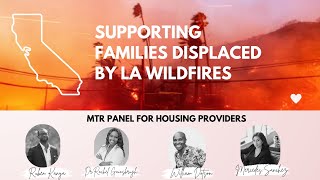
The panel, moderated by Shawna and featuring industry experts Mercedes Sanchez (MBX Homes), Ruben Konya (Invested Escapes), Will Dotson (Nova Havens), and Dr. Rachel Gainsberg (Short‑Term Gems), convened to educate and coordinate housing providers on how to assist families displaced by the recent Los Angeles wildfires. Participants described the scale of damage (≈10,000 structures lost), the pre‑existing housing shortage, and the urgent need to move families out of hotels into suitable rentals. The discussion covered insurance mechanics (loss‑of‑use, dwelling rebuild value, Coverage A/D, ALE limits), the distinction between public adjusters and insurance adjusters, and the role of relocation agencies (e.g., ALE Solutions, CRS, Alacrity). Strategies for making inventory visible across platforms (Airbnb, Furnished Finder, Zillow, niche databases) and for rapid, proactive communication (pre‑filled proposals, clear rates, pet‑friendly policies) were emphasized. The panel warned against price‑gouging, highlighted California’s legal caps, and advocated for ethical, relationship‑focused service. Practical tips included double‑listing properties, flexible lease terms, accommodating special needs (no stairs, pet‑friendly, remote schooling), and leveraging community networks (WhatsApp groups, Instagram, email lists) to match families with available homes. The session concluded with a call for continued collaboration, sharing of resources, and compassionate, human‑centered assistance.
Chapters
Let's just officially kick this thing off. Everyone, thank you so much for joining us today. This panel is all about what's going on in California. It's really terrible. It's completely devastating. And our goal here is to help educate you and help families out. We have an amazing panel that we've gathered. They've donated their time. They are industry experts. They really, they know a lot. So I'm going to do a really short intro. Normally I would do a longer intro. These people are amazing. They are. The thought leaders, they're doing this, they're helping people out. We have Mercedes Sanchez, who's actually in LA. She is in Santa Monica, which is really close to Palisades. She's in it helping a lot of families. We help Will Dotson, Nova Havens. I'm sorry, Mercedes is MBX Homes. Will Dotson, Nova Havens, also helping a ton of families. Amazing operator. Ruben Konya, Invested Escapes, is amazing. Another really big player in this space. We're all just here to help you guys, to help educate. Dr. Rachel Gainsberg, Short-Term Gems. That's who we have on our panel. So we're gonna kick it off with Mercedes. Just give us your boots on the ground, what's going on there, and just kind of an overview. And then we have some specific questions and we're gonna dive into some really great education.
Yeah, of course, Shanna. Thank you so much for getting us all operators together. I know it takes a village and you did it so quickly and there's great turnout with a lot of people who want to help, which is awesome. Yeah, so I am an LA native. I've lived here my whole life, so I'm used to fires, but I've never seen anything like this before. I do live in Santa Monica, which is a city next to Palisades. We've lost power, we've gone through it. So Palisades is very near and dear to my heart. I have clients who live there. We've lost 3 properties in our portfolio there.
Mercedes, you just got muted.
Sorry. I'm sorry.
I'm—
one second.
Okay.
My bad. Okay.
There we go. All right. Thanks, Durbin. Um, and then of course we not only do we have Eaton fires up near Pasadena, Altadena area, which is even worse than the Palisade fire in regards to, uh, damaged structures. We do have pop-up fires all throughout Los Angeles. Um, so we have lost 10,000 structures, that being single-family homes, apartment buildings, commercial buildings. We already had a housing shortage. We already have an unhoused neighbor problem. So this has just added a whole nother level of how we could help our communities here. So we have been working very long hours trying to get families outside of hotels right now. So I think all of you, who have reached out to us, obviously not only asking about me and my family, how we're doing, but also asking about my clients, our guests. We had 30 guests when the fire started. We were on evacuation orders and then everyone else just sending over all of their inventory. It's been super helpful.
We really appreciate it. Okay, so I think, you know, this is a— insurance is always complicated and I think this specifically, I want to unpack the insurance process also in light of what's happening with pricing. I think we should— I want to just assume we don't— someone doesn't know about insurance. Who wants to take the, like, how does insurance work and with the claims and all that? Because it's complicated. Reuben, you want to take that one?
Sure. I'm happy to. It's very interesting. I think to summarize it, insurance, when we think of what insurance we're referring to, it's not to be confused with The insurance that you have to, on your home, it's the, or the mortgage insurance. It's, it's actually tied to that. So let's talk about it. The insurance that we're talking about is like when you have a, whether it's a single family home, could be a condo, anything of that nature, your mortgage company typically is asking you to pay for it upfront because they have to insure the asset for when something does go wrong. And so you typically maybe lose sight of it because it's typically baked into your mortgage, right? Your PITI, right? So it's in there. You're paying the interest, you're probably the mortgage insurance, and then it's annually, but you're paying for that. And as part of the insurance, when you are a homeowner and you have a mortgage, is you always have the opportunity, or at least if something does go wrong, to lean on the insurance. It could be an unforeseen event. In this case, it is one. And when that does happen, a disaster happens, the insurance, or at least the niche that we're in, and that we cater to is being able to be eligible to have either if you're living in the home, it's loss of use. If you're renting a home out, it's loss of rent. So typically as a homeowner, you, or a policyholder, because you have a policy on this home, you're eligible for what we're really looking at right now is not only loss of use, but in this case, it's sometimes the entire dwelling rebuild value. And we're having a very different kind of conversation now. So what we're used to talking about in situations is it could be a tree falling on a home, a fire, and now there's loss of value, which is the coverage D, which is if you look at your insurance policy, that's what you're eligible for as a homeowner. So the reason why Sharna brings up a very good point is we're actually in the position now to educate a lot of homeowners because in this situation, they're not used to what happens. What am I actually eligible for? There's a difference between loss of use and now also rebuilt value. And I was having these conversations with When you're talking about Coverage A or Coverage D, there's the dwelling value, how much it's worth. Whatever you're looking on your policy, that's how much that rebuild value you have, if you even have the luxury to get into that conversation, which for LA, for some of these structures, we're, we're talking about rebuilding, which is a whole nother conversation. But that's phase 2. For phase 1 is what is my eligibility for being able to relocate? And I think this conversation is very prevalent right now is because if you have, let's say, a $400,000 home, you might have a loss of use that is ranging anywhere from 25 to 30%, uh, percent of that dwelling value, which means let's say it's $100,000. Now you, that's your budget for being able to relocate in an alternative solution. And typically maybe it's a hotel or maybe it's a like-kind home. But the reason why this topic's so prevalent is right now there's a lot of folks who are, or at least need to get familiar with this. And this is where we can come in because their insurance company is— should be in line if they do have insurance, which is another conversation to then pay for them to relocate in another home. And so the way the insurance industry works, it can get pretty tricky because you might be facing folks who have their insurance, great, but how long are they going to have that loss of use and how much a landscape and how much runway do they have to be able to relocate into a home, which I think is a topic that you brought up, Shona, which I think is very important for us to understand that, that we might be looking at folks relocating for the next 2 years. So how do we make it a win-win? As a matter of fact, I spoke with one of my relocation agents that I work with, and they're giving out 5 years even for folks to even relocate and rebuild, which we need to talk about because I think we hear insurance and we want to charge a premium, but we really need to think about what it means for these folks, which I know we have an amazing group of panelists here that we can really talk about how we can solve that issue and meet them halfway where it's a win-win for everybody. So I hope that covers it. It is a complex topic, but we are talking about the policyholder, the homeowners that have been impacted, how their insurance company can step in and essentially give them a stipend that they're eligible for by law under their policy. And how we can step in as investors and understand that's where that money is going to come from, not to include all the FEMA that's— we can talk about that steps in when someone does not have insurance, which I think is actually a very interesting topic that I was even looking to myself because what happens when you don't have insurance? There's a lot of insurance companies that pulled out, but I'll pause there because I know we have, we have Will, we have Dr. Rachel here who can provide so much insight along with Mercedes and Shrona. So I don't— what do you guys think? Did I miss anything? I think there's a lot to cover here.
I think you're spot on, Ruben. I like especially what you talked about in reference to is how we as investors and I would say advocates and educators, we can navigate this really delicately and really pair that balanced pricing and helping these families in need and still run a profitable business because we gotta look at both sides of the coin. So you're absolutely right. This is not the season for price gouging, and that's something that's going to be top of mind. And so I'm hoping that all the investors are really being empathetic to the current situation. So I, I think you hit it spot on. Uh, I do know, so it is a two-prong situation. You have quite a few residents who are not insured. And so that is where the FEMA will step in. That's the whole government contracting side of things versus those who have insurance. So it, it's really important, I think, that we are recognizing that at the end of the day, we're dealing with families first. And I think that's very mindful. We have Mercedes right here who's a part of the Midterm Rental family. And so when someone is in crisis like that, we wanna make sure that our long-term reputation is essentially intact. And so this wouldn't be the season for price gouging for sure.
And price gouging is the topic of the week. I think I would say something we have to be very careful with and how Ruben said, we are seeing claims 2, 3, 5 years. So we have to make sure that they're policy can expand until the 5th, until the 5th year. And that's, it's really hard right now because again, like I said, we're very short in inventory. There are, there's bidding wars going on. We can't put a blind eye to it. There's, now we are also dealing with traditional long-term leases in the mix of this. Not, these are not midterm rentals at this point. These are long-term rentals. So now we also have a whole nother side to it where we have to also educate other agents, other landlords, self-operators who maybe have heard of insurance claims before, but have never actually welcomed a displaced family, especially for this length of time. Yeah.
I really wanna walk, if someone can just walk through how it works, 'cause there's a lot of parts and it's very complicated. So Will, do you wanna tackle like how that works?
Yeah, I, I was even just thinking of the fact that who in here knows their own policy? 99% shaking their head no. Start there. That's your homework for today. That's your biggest takeaway from this. Start there. Look at your own policy, get familiar with it. Call your agent, ask them, what happens if my home burns down? How much do I have for loss of use? Meaning that is your budget that is going to have to span for how many ever months, right? If it's water damage, 3 to 4 months normally, depending on where it was. Um, but when you're talking about fire damage, you're talking about a completely different animal. I signed my first ever 3-year contract, 3-year contract. The first thing I said, what is the ALE limit? What is the budget? We, we need to protect this as much as possible. Oh, I need to reduce my rate just a little bit to make it happen. Let's do it. Never did a 3-year before. There was a couple of 2 years, same thing. And, and whenever, you know, when you're working with an adjuster, who is, I call him like the boss of the situation. The adjuster is the one doing the math, making sure that there's enough runway on both sides. And there are different types of adjusters. Maybe Ruben could speak a little bit more on that, cuz he's brilliant with that whole subject. But the adjuster is doing that. The adjuster's looking at it and it's going to approve, hey, could, will this house, the budget, the fees and everything make sense for this duration of claim? And normally whatever they approve, is the bare minimum and keep that in mind. So if they say, hey, we need a 6-month, it's usually a 6-month ILT, initial lease term. That means month-to-month extensions afterwards. So when you sign a 2-year, they're saying, hey, it's going to be a minimum of 2 years. And that's something to really take into consideration. You're dealing with something— normally these companies, relocation companies I'm speaking with, speaking to particularly, they receive, let's just say, 1,000 claims a week on average, right? Right now they're receiving roughly 2,000 to 3,000 in 3 days. No one is prepared. No one was prepared. Everyone's reacting, even the biggest of the biggest companies you could think of. So when we're in this situation, you think of these companies that weren't prepared for this, right? Who can foresee something like this ever happening? But the name of the game right now is move quick. The only way you can move quick is by having the knowledge. The only way you can have the knowledge by asking those questions that you don't, that question that you don't know, finding out those answers, look at your own policy, get familiar with it. Now you're educated. Now you're not only an investor, but now you're a human being ready to help the person that is in need. Visibility. If your property is only visible on one site or one database, you're doing a big disservice to the families in need. Even if your property is out of state, if you're— even if your property is further away in California, in Northern California, the amount of families that have been impacted is beyond LA at this point. People are, are looking at different— they're getting creative. They're saying, I can't— normally when a claim happens, this 8 to 10 mile radius of the home is what we're looking for. That's gone. It's time to get creative. Time to help them get creative. They can stay at your place for 6 months and then go to another rental of yours. This is where the investor meets the human and we're really solving a bigger problem than just keeping your place occupied. I know I said a bunch of little things in that, but that's it in a nutshell. Think about, build the relationship right now. It's a beautiful opportunity to build relationships. It's the most amount of claims. Everyone's reaching out. Everyone's reaching out. Get those emails, figure out how you can help. We know you don't run a nonprofit, you run a business. So just think about building that relationship. It's the key opportunity right now is the hot, hottest time to do that.
I just want to chime in because all the hundreds of leads we're getting every single day have the same zip codes, same family type, same the sale value. So when you do get these claims, know that those zip codes are still fire zones. The fires are not out yet. I have a ton of properties we can't even book right now because we can't even get to them. So just ask the family, if you are in contact with the family, ask them, are your kids working? Are your kids remote still? Because school's not— only half the schools are back in session right now. So ask yourself, are the kids remote? Can you guys go somewhere else? Do you have family in other parts of Southern California? Are stairs okay for like little kids? And maybe you have like your mother-in-law lives with you, maybe she can't go upstairs. So there are so many different questions you can ask your policyholder to really help just find them a home as quick as possible. And we just, we don't have time to waste and to go back and forth at this point. I love that.
And I, and I'll chime in as well. I, I want to double down on what, um, Will shared as well as, um, Mercedes. The one thing that I keep hearing again and again is the value of relationships, right? The value of recognizing that The fact that you're in this room, your expertise is 10x, 50x, 100x what that family is going through. So, I don't know is not going to be an option. Hopefully you can recognize that you have a treasure trove of resources. You can ask any of us and we're willing to help to guide you on the what next best step is for that conversation because you already know more. So becoming that go-to resource for these families, I think is really gonna, you know, help you to get those bookings. Help you to work properly with the insurance companies who are going to need those partners, those adjusters like Will had mentioned a little bit earlier. So they'll really appreciate your ability to connect them, become that connector, and help them navigate through this process. So I think it's really important to value the relationships that you're making along the way, and I believe it'll go a long way.
Absolutely.
Even if you have your property, I ran into this several times. If you have your property listed, for example, on let's just say Furnished Finder, which I would say majority of us probably do at least one of them. A lot of us just have one property on Furnished Finder, but you may have a portfolio of 15. Mention that when people reach out to you. If someone reaches out to you for your particular property, like Dr. Rachel mentioned, Saying no at this point is not the answer. If your property is booked for 8 years and someone reaches out to your prop for you, for that property, and it says available, say, hey, you know what? I have other properties. Or, hey, I know— give a resource because that is how you become remembered. And that person will come back to you and say, you know what? You didn't have it at the time, but you helped me find someone who did. You are now part of the solution. Thank you so much.
Reuben, I think as part of this education piece, the, the public adjuster, I can tell you, I, I've heard you say that. I didn't know that was a thing. So I think that's a really valuable bit if you want to take that one. It's a little—
Yeah. Yeah. So actually I like telling stories because I think it, it helps paint the picture. Let's say today, heavy winds, half of my home gets burnt. Maybe I can still live on the other one. Tree also fell on my home. I think there's two adjusters that we need to be very familiar with. The first thing I would do, and it's important that we also educate these homeowners because most people don't do that, first thing they do is call their insurance company. You can actually find a public adjuster. And the reason— what is the public adjuster? What a public adjuster would do in that case, the public adjuster would take your file. Now I'm sure they're super slammed right now. If they are, but they also might not be because not everyone knows that I should reach out to a public adjuster. I think a public adjuster is like the equivalent of an attorney for your real estate claim, right? For your claim. And the reason it's important is because the adjuster is going to help you maximize the amount of dollars you can get for your policy in order for you to get more out of it for not only the claim of the damage, but even possibly the loss of use, right? That you're eligible for. They're negotiable just because when there's a certain amount there, you can always go back to your insurance company and negotiate for more with respect to your terms and your situation. So I think it's important for us to understand what a public adjuster is, not to be confused with the insurance adjuster, right? A public adjuster is representing you. This is my client, a tree fell on their home, half the house burnt. They need a place to relocate. We'll take it from here. They typically handle all the communication with your insurance company, almost like an attorney would, great. And they help you get top dollar because remember, these insurance companies also have their own interests. And sometimes, just like any other venue, you can get denied some coverage that you're eligible for. So that's important to educate homeowners that sometimes if you're not getting relocated where you should be, or you don't— they're telling you to stay at a hotel, or they're telling you that this is your only option, a public adjuster can help. So what happens is my public adjuster would then Relocate me, or at least help me get the funding to relocate at a hotel. And what will happen is typically the insurance companies, they don't have the bandwidth to find individuals like you and I on this call, because just like a big corporation, they got tons of files open and therefore they depend on relocation agencies, which we've heard of, right? The Ailey Solutions of the world, the CRS, the Alacrity Solutions. Those are essentially the middleman or woman in the middle that help these insurance companies at scale relocate or find homeowners like us. So these relocation companies, literally all they do— I just spoke to one of my top relocation specialists who works at a relocation agency. She has 25 files that she's working on herself this week. And she's like, Ruben, whatever you can help me with. I'm like, I have a network. Going back to what Will said, being— fostering a relationship is even being able to help when there is no— when you don't have a need, right? It's how can I help you? Can I connect you to a realtor? Can I connect you to an operator in that state? That's how you help. So just to go back to the story again, these relocation agencies have relocation specialists who are scouring everywhere. Airbnb, Furnished Finder. Their own database. Database is just a fancy word for you putting your property on their website. It's actually in your best interest for you right now to know what those websites are. There's a ton. Do a Google search. I always say, go to LinkedIn and type in one of these companies. You'll see a bunch of other referrals on the right-hand side. Go to those companies. It's important for you to get familiar with these companies because when you're in their database, you're letting them know that, by the way, I understand that your business model and my property is open for business, right? And so going back to my story, a relocation agent reaches out to me and they can give me two options. Either I go on Airbnb, I go on Furnished Finder as the policyholder who's been impacted, and I find for a solution myself, and/or they're also helping me find something that's in a like-kind neighborhood. Now, love what Will said. I love what Mercedes said because now it's beyond— the boundaries have been lifted. And here is the biggest key insight that I want to share with you guys that I asked because I had this question myself yesterday. I said, hey, listen, typically we're relocating people in like-kind neighborhoods, but if I have family in Arkansas and I was impacted in California, can I use my ALE to relocate there? The answer is yes. So that to me is where this is bigger than California. This is all of us. And what do we do? Marketing 101. I come from a marketing background. It's important for us to raise our hands and speak in the terms that make sense to the people who are looking for us. That's the relocation agent. Remember I said that? And/or some homeowners, because we're saying, hey guys, we need to find you a new home, Ruben. Therefore, you can look for yourself. And if you find us, find options, let us know, or we'll find you an option and we'll reach out to you on behalf of the homeowner. And those homeowners are investors like us who have inventory. So I just wanted to paint the picture that once an option is found, if I find the option, then it goes to— not to be mistaken with the public adjuster— it goes to the insurance adjuster. On the insurance side, there's an adjuster that's going to then either approve or disapprove. And this is where the price gouging is key, where we don't want to be overly priced because then the adjuster might look at it and say, hey, for a 2-year runway, There's no way that we'll be able to afford that with respect to the budget that they have. So therefore decline. Don't always take no for an answer though. This is where the conversation opens. What would make sense? So that's just the story I wanted to paint of my house. Something happens to my house, God forbid, right? I know Mercedes is in this kind of reality right now. These are what happens. I call my public adjuster, then the public adjuster reaches out on my behalf, then the relocation agency. Is working on my behalf, trying to look for an alternative solution. And then their insurance adjuster is getting the, like Will said, that stamp of approval to say, hey, by the way, approve or disapprove. And now we're in business to serve. I hope that helped.
I just want to say, thank you. That was amazing. That was really helpful. And anyone listening to us who got value from this, please chime in the chat. It's really helpful for us. So I think Yes, it's all really timely. I wanna move on to, yeah, we touched on this, but how to find housing, and especially if you're a short-term operator, you may need to move guests around. I wanna highlight that. Will mentioned that on the call, so I think that's an important topic to address. Whoever wants to take it.
I, I wanted to circle back and take a step back if that's okay, Shawna. And let's just talk about how these, um, conversations are getting started. What has Mercedes seen? Ruben, if you want to chime in, I know this past year, 50% of those inquiries have come into us actually through the Airbnb platform. So if you're in here, you're not leveraging Airbnb and positioning your listing in a way that there's visibility, you're potentially missing out. So that has to do with setting up your calendar in a way if someone's searching in your market, you're found because you don't have those 2-night bookings peppered all over your calendar. That's one of the number one ways that we're being found through the Airbnb platform. Now, there are other ways that we're found. I'm sure some Facebook groups have been stood up in that particular market to address the need. Ale Solutions is another platform that we leverage that is that middle person that Ruben shared with us, that intermediary between the homeowner and the insurance. They find the housing. They're, they're that third party that finds the housing. So ALE Solutions is one of the most prevalent ones. There are many others out there, but I would love it if Mercedes and those who are currently serving this current ecosystem there in LA, if you can paint the picture of what you're seeing in terms of where the volume of the inquiries are coming in. So that everyone's informed and they're able to better leverage themselves to help.
Yeah, I could chime in. I just wanna piggyback what you said about the 2-night stays that could hurt you from maybe hosting a family or getting a, a nice big rental. I have double listings for all of my properties. I have a monthly and I have the short-term one, and the monthly is not on Instant Book, but I get inquiries on there all the time from people who work for ALE, who work for CRS, who work for MyKey, a lot of times they just don't have time to even go on their own database. They'll just pop it in the map and here's my property and it's available and I'll move around guests or we'll make it work is what I'm trying to say. So that's a great little strategy you could use. But most of our claims are 90272, which is the Palisades. Nobody wants to go further than Beverly Hills at this point. Because again, there's schools, they have work, they have their doctor's appointments. It's very hard, especially the Palisades. It was such an affluent neighborhood that they're just used to one thing and they wanna stay there. However, very soon inventory's gonna run out and that's when they're gonna— people are gonna have to go more south, maybe to other beach cities, maybe up north to Ventura County. We are also seeing people who want to go to Palm Springs. As a little getaway for 3 months, and then 3 months they'll figure out they'll come back to LA, or they also have summer homes somewhere else, so they only really need it till June. That's a huge thing that we're seeing right now. A lot of families are gonna be gone for the summer anyways. And then for the Altadena fires, where nobody really wants to go more than 30 minutes outside of Pasadena. So again, like Burbank, Glendale area. Pasadena, that's really where the need is right now. We're not seeing anything really in like Central LA, South LA, and I'm not really seeing too many things in Riverside. But again, this is only day 8 of fires. These claims are going to go on for months.
Yeah, that's actually— I was speaking with a couple of specialists this morning about just that, and they said, Will, it's not going to stop for months, they're overworked and the claims aren't stopping. Just this morning I was talking to a couple of families and the family member, the family who I helped this morning, her other family members were being affected. So we got their contact info and it just seemed like it just, it's not stopping. It's not slowing down right now. Sometimes it takes about a week in a hotel before their policy even comes across the desk. Is the fire contained, Mercedes? No, the fire—
No, it's not.
What is, I think, what was it called?
I have ash on my car right now in Santa Monica. It's only 45% contained.
And everyone's already so busy. The fact that everyone's here just showing that you're all humans, right? We're all healing together. We're all humans. We're investors, but we're humans at this point. Even getting creative right now, right? If you Mercedes says with the double listing, fantastic. Availability is the magic word. If your place does not say available, you won't get a phone call. I know that may sound very duh, but I'm going to say it again. If it's not available, it's not visible. It won't be seen. Specifically, the specialist that I work hand in hand with on a day-to-day base in the different companies that I work with. They love Airbnb because it's just a big open map and it's so easy, right? Money loves speed, right? And if they have something that you're just trying to move real quick, boom, they press to buy. They don't have to sign a lease and all that. Maybe a little contract, show an ID, great. Move in. The second place, Furnished Finder. What I've been doing even with my properties that I manage and I own, and I've been telling people on your first page, list that you have other properties available. Hey, like signage is key, right? We're all, we know how to operate an MTR, STR is like signage. You're speaking without having to speak directly to someone. So in your, in your listing picture, list it. Say something about you. Say something about your portfolio. Hey, I have 15 others. If I could build the perfect insurance housing, obviously we do apartments and condos and it's creative time. No stairs. I've been hearing No stairs. Why? Because a lot of these families are taking care of their elderly parents. That's a common thing. You're looking at the demographic, what's going on out there? Who are these people? These are homeowners who've owned homes for 30, 40 years. They probably bought them in their 30s, so they're 70, 80 years old. No stairs is an enemy. So having no stairs or having a solution, if you say, oh, my property has 2 steps to the front door, I lose my brain when I hear that because I say, Let's get creative. You don't build a ramp or figure out a way insurance could cover that. Let's figure out a solution as fast as possible. At the end of the day, it's just being a human. You're creating, you know, you're solving human problems and you're trying to serve as many people as possible, but make sure your property is pet friendly. Even if you hate pets, even if you're allergic, even if you can't stand cats, you voice that and you have that be part of the negotiation. Everyone there, if your property's in California, you have to say I say that you accept big dogs, cats, everything, you will get a phone call because as soon as they say, as soon as it says small dogs and cats acceptable, no big dogs, I go, the dog is like a 75-pound snitch property.
We took a goat.
Take a goat.
I swear to God, we have taken a goat because there's lots of ranchos in Malibu and in Palisades. There's baby goats. There is like mini horses. I don't know what the proper name is for. We have not taken a mini horse, but. There is so many animals too that obviously need homes, which is so sad too.
But yeah, no, that's, I, I've been seeing just, um, with different trailers, like people at the end of the day, it's so many different problems and so many different people are coming up with solutions. And that's really the biggest thing for me is however you do things, change it if you're trying to assist what's going on right now, because there is no clear-cut way to go about anything. Just. Open it up, open it up. Say in your listing, people don't really read these days. I've been noticing like you can have a great breakdown. I got gig Wi-Fi. I have this and that in your bio and your Airbnb, but people are just looking at the pictures. So write things down in the pictures. That has been such a great way to just, people look at the picture and they go, oh wow. If you put king bed on the bedroom photo, they, their brain goes, hey, that's a king bed. Now it's just one less question that they're going to ask you. And you put pet-friendly and fenced-in yard forever. So just keep in mind those things. If your place has stairs in it, then if your place has stairs in it, make a note, hey, I can find a place without stairs if need be, or you're trying to just serve as many people as possible, really to just build more relationships and help more people.
So I want to talk about inventory, right? What if it's unfurnished, long-term, short-term? Let's talk about that. There's a lot there, right? Who wants to take that? Rachel?
Certainly.
As far as the demand for short versus— you mean the demand for furnished versus unfurnished, Shawna?
Yeah.
Or I think if someone's short-term that has bookings, like they need, might need to move things around, will they take unfurnished? Yeah. Because I think people don't know, but they probably will.
Yeah.
So in terms of moving things around, the main strategy that I use is the relationships that I have within a certain market. I will do everything in my power to judiciously move that 2-night booking to another date if for some reason I'm caught, right? But typically we manage our calendars in such a way that our far-out bookings, we're just leveraging tools like PriceLabs to ensure that we're not getting those 2-night bookings peppered on our calendars further out. Within a 10-day window, we can grab a couple two-night bookings if we have some vacancy, but you're not gonna catch— I'm not gonna be caught dead with a two-night booking in March because I just anticipate that. And in our suburban markets, our primary strategy is the midterm rental strategy. If I'm caught in that particular situation, actually a member of our community— get a little tissue— was caught in that particular situation. And what we did was we reached out to several other members of our community, such as some neighboring short-term rental hosts, and creating a WhatsApp channel with some of those hosts is going to be, I think, an important play. And I know that's something that Ruben and Will endorses heavily, to have that network of other hosts that you can pawn off those 2-night bookings to. And strategically negotiating with that with that guest to go ahead and cancel their booking. Because at the end of the day, you do want to preserve that listing if that listing is important to you and you have quite a few reviews on that listing. Shawna, I don't know that I answered your question because you asked about furnished versus unfurnished and I'm having a hard time bridging that gap.
That's perfect. I just want people to know if they are in the short-term space, like this is more important. Clear your calendar. That's got you. Yeah. Thank you. But I think unfurnished versus furnished, that's a question I don't know in this, the pace that we're moving at. Is that an option?
Yes.
Every, everything's getting booked. There is not one home that's not booked right now. Furnished, unfurnished. If you have an unfurnished rental that maybe you usually do long-term rental for, but it's by some way it's open right now, it's vacant, it hasn't gotten rented. it could very well get rented by a fire victim. There's regular realtors and leasing agents that are still working with families who have been displaced, who are working with these adjusters. It's not just people in the midterm space right now. It's truly just anyone in the real estate industry. At least that's how much demand we have. We have to remember 10,000 structures were lost in 24 hours. That's huge. This is not A rainstorm that it's been okay in a few days and a few days and then there's a mudslide. This is like all in one day. I've been talking to a lot of agents who I know who have never dealt with a displaced family or they've never even done a lease. They're strictly sale by and now their clients are displaced and they're like, I have no idea what to do. This is also where you could come in and be a resource to your agent friends as well.
Yeah. And that's a great point, Mercedes. You just reminded me of something because the homes that have been damaged, right? You're ranging everywhere from $200,000 to $30 million, right? Those insurance contracts, they're completely different. So when I think, when I hear unfurnished, I'm solving a problem for someone who may have a small ALE budget.
Yeah, absolutely.
Their budget may not be astronomical where they can ride it in 3, 4, 5 years. They may have to have it so tight just to make it for one year. And that's where the humanity side comes in and you're saying, okay, my property won't be the best fit, but there's another one. Actually, we could do unfurnished, have them rent the furniture. Matter of fact, if their whole home burnt down, Why not let them know that in their policy they could actually get a waiver to buy it? Maybe let's take a look at their policy.
Yeah.
Better yet, direct them to someone who could take a look at their policy, tell 'em they could buy XYZ furniture, get an unfurnished rental, move them in. Now they're peaceful.
Yeah. And I know a lot of realtors who have been doing unfurnished leases and their brokerage has been donating mattresses, donating baby gear, donating the pots and pans. I mean, It's gonna take a village, to be honest. So don't get discouraged for unfurnished rentals right now. Definitely, if you could reach out to somebody or if you know somebody who has a home that's unfurnished, maybe they're planning to sell it, planning to put it on the market for a long-term rent. This is an opportunity to, you know, not only get their business, but also make a difference.
I just want to highlight too, I've been hearing that listed properties are being used for this use case too. So I'd love to hear more about that.
Yeah, a lot of, I would say, larger scale homes that have been on the market, we're talking north of $3 million purchase price, have now turned into luxury rentals. A lot of homes that have been on the market are now for rentals. So the market's changing every single day. I wish I had a crystal ball to talk about the market here. I cannot really reference that. That's a whole nother conversation, but Yes. Or they're also doing a lot of rent-to-purchase options right now, which is fantastic. Creative way.
Yeah. And Elaine mentioned a great point that right now that California has in place that the, the price gouging law where in, in this case, this state of emergency, and once that is declared in California, they're not messing around. And when you increase your rates overnight from 10, and I, you know what, I focus more on the positivity in all this because I think love heals everything. And because that's at the end of the day, what's going to get things back together. But there's been some ugly situations. There have been people that we've reached out to and one second it's $10,000 a month. The next second it's $25,000 a month, just because when you put that on record or in Zillow and they see that, just know that California is not playing around, that the fines will come. That you will be noted, and at the end of the day, you're just being ugly. That's not— who does that? So just, it's bigger than— think about, I think that's such a short-sighted thing to do when it comes to price gouging in this moment. If you could look yourself in the mirror, I don't see how you can, but think of more than just, oh, I'm gonna make a, a bigger profit in a couple of months, maybe a year. but you think of all the relationships that you will be burning and losing quickly, even if it was to go through, which we're noting those people who are doing that, not only individual companies, but just period. This is an MTR community, LTR community, STR community, California, the nation. This is the time to come together and not try to take advantage of anyone, but just be aware that it's beyond just. What I'm saying, it's actually, if you increase your rent more than 10% over just one day to the next, or I think it's a week to the week. And this is not to include PriceLabs, because we understand dynamic pricing does have adjusted rates and all that. We are taking that into consideration, but just know that California is taking, they're watching. At the end of the day, just be fair, understand what your pricing is. And when you get that contract, think about helping the family more than helping your pocket.
Yeah.
And with Price Labs, sorry, Rick Dell, I said there's a burn book going around, so you don't want your name on that burn book. That's like legal action could happen right now.
Yeah. I was going to say in consideration of Price Labs is going to take into consideration the rapid demand in that market. So it may actually price gouge inadvertently. So whatever you need to do to keep a cap on it, to make it reasonable, I would consider adding a cap on it so that you do not exceed that 10%. So take that into consideration. Don't let the AI put you in jail. I would definitely look at that.
Yeah, I have one of my things that I always say, it's focus on the contact versus the contract. And to what we've been talking about, it's about the long-term game, which is solving the need of one family. And then you have that re— whether it's the relocation company, it's a small world, by the way, guys. It's like a— we talk about 6 degrees of separation, 3 in this world. And so it all it takes is one good contact to helping them. Now, not only are you helping a family, but then you're also fostering a long-term relationship of volume because guess what? This is what these people do for a living, right? So if you're looking to be an investor long-term and keep your properties occupied and you have a, and you're doing a service and you're helping even when you don't have anything to help, but you're connecting them, et cetera, that goes a long way. Cause then you fostered a relationship and it's not only them, it's with their colleagues, it's with the entire office and they keep, will continue to come back to you. And I've had conversations with people where we actually had a family recently who moved out, a fire. The woman had lost her husband in the fire and we actually adjusted our rate for it. And it was like, and I'm not saying that to get a pat on the back, but I'm saying it goes back to the, okay, what's the need here? Not only is there a need, true, and obviously we're a for-profit business, but I'm okay not only adjusting it because I know it's going to be longer and yes, it's fulfilling a need. Yes. It's not the top of the market. Price that I had, but it's a win-win, you know, long occupancy. And they took that into consideration. Thank you, Ruben, for adjusting that rate. And obviously I've gotten more business over time for doing that. So don't be penny-wise and a dollar-foolish. And one thing that I'll say, because I like just, I think it's easy to remember these things, right? Okay. Contact is bigger than the contract, but then you also think about, I think what we're saying here is When I think of marketing, because I always think of marketing as, or even your brand, it's how you put yourself out into the marketplace and it's all about making it easy. And I love about, you know, what Mercedes said about making yourself available, because that's one way to make it easy for people to find you. But also what Will said about when you think of really good copywriting or really good marketing is stating the obvious. And it's also money loves speed. If I'm clicking through pictures and I'm seeing what you're saying in the pictures, I'm seeing the, oh, by the way, flexible extensions, then I'm going to click that. Right. I think a big tip I'd love to leave here is stating the obvious might mean that, hey, listen, while you might see that this is the current rate, we're open to being flexible with respect to different terms. If it's a 3 months versus 6 months versus 2 years, Let's just have a conversation. And there's nothing more obvious than being able to just put it out there. And Will, I'm actually taking this from you, not even just in the copy, but even in the images, flexible extensions, reach out for a conversation that opens up the conversation because you don't want to just have someone or a family who might be looking and say, oh, they told us our alias, this budget might not work. State the obvious, say, hey, We're open to being flexible. We're open to figuring out solutions. We're open for a conversation. Even if you see, call it out, very flexible on Furnished Finder. I'm always available. I'm always available on Zillow. But if let's say you're not for whatever reason, call out that, hey, we got other homes. You might be flexible. We might be able to move some dates around for you. Just because it's not available now does not mean it might not be available to— we'll make some things work, as Mercedes said. So I love that. I think great marketing is making it easy and making it obvious. And I can't stress that enough. I'm even taking notes myself. I'm like, oh, this is so good. I have some reviews in our pictures, but it's like, why don't you even state the obvious and go even a layer deeper? So I think it's all— these situations all force us to be better operators, and better operators gives a better experience for those who are looking for us.
That's a great point, Ruben. And has anyone ever broken their arm or been hurt and you go to the doctor and the doctor's trying to quickly fix the problem. Let's say you popped your shoulder out. Well, the doctor's trying to pop that shoulder back in and you get mad at the doctor, right? You're like, hey, what are you doing? It hurts, right? And so when you're dealing with fire claims, I really want to keep, keep that in mind. This is a traumatic trauma, like Ruben said, uh, more than, man, You, more than memories and some pets get lost, lives get lost. This is not a game. When you're helping them, sometimes they're not nice, but that's okay. They're going through a lot. So keep that in mind. Once again, I'm gonna stress it, just be a human. If they call and they're antsy or whatever, try to help out as much as possible. It's, it sucks. And I know Mercedes, you've seen this and you've Been on multiple conversations with people, really keeping that in consideration because a lot of times for the people who aren't being fair at this time, I don't want the families to go to them. Their family's not going to take care of them. Just be nice and understanding. They've gone through a very tough thing and best thing you could do is just share the love, help out as much as possible. My bad.
No, you're so right. You're so right. We have to remember the big picture and why we're doing this. Obviously it is a business. I always say, I'll come back to you. And these people who are price gouging, karma will get 'em. Karma doesn't forget anything. And I don't, if somebody is price gouging or maybe isn't the friendliest, maybe I don't wanna send a client who is going through the absolute worst in their life there. You know what I mean? I'm not saying anybody here on the call is like that, but there's definitely operators or just people who I've encountered this week and high stress and there's a lot going on. So just remember to be human. And I thought I had a relocation done with a family and I thought she was for sure gonna take it. And then we realized that it was the same style home that she lost and she's like, I can't do it. It was like too traumatic. She's like, I I can't. She's like, I thought I was gonna love it. And then she was like, I can't do it. And now we're start— we're starting all over again. But that's okay. That's okay. She doesn't wanna put her family through it and we're sticking with her and that's it. That's our jobs.
Yeah. Thank you for sharing. I think that's the message here is community. We're for families. So thank you. It's really powerful. I just, I wanted to circle back a little bit to the speed of how this— is it faster than it normally would? And what— just tips in general. We're wrapping up here, so maybe give some top— this has been so valuable. Again, tips of just the process again, and maybe how it's different in this situation than a normal insurance claim. Yeah.
Yeah. Serving, service. You, you're a servant. You're a slave to the claim is what I've been calling it. If they want to look at 3, 4, 5 properties, Maybe you, maybe two of them are in your portfolio. Maybe they're not. You're a slave to the claim at this point. We're being the biggest servant has been just the greatest return. As Dr. Rachel, I love the term that she coined, uh, return on energy. Just be quick, be quick with it. Understand that they're looking for properties. Oh, I think we got a hot mic. There we go. A lot of these families, they're looking on their own, but they don't know what they can look for. They don't know how big. And so just to help out in the confusion of it all, just be quick with options. And so I know Mercedes has the link to her database. I'll be dropping my database in the chat. Visibility, not just being on the OTAs such as Airbnb and Furnished Finder and Zillow, but There's a lot of smaller databases that we're right there. We're shoulder to shoulder with these companies, helping them out. We're all trying to put this out together and it's going to be a long time. Being in these smaller boutique databases, I know Shona, you're going to have a list. There you go right there, the Google form. That's going to list some of the databases as well. Take the time to do it. It's one of the, it's going to be the greatest return in this moment just because We're sharing our databases with each other. I get a list of properties from Mercedes that are from vetted people, vetted properties of hers that are ready to go. And I'm sharing those with all of my relationships, all of my contacts from different insurance companies and just saying, hey, here it is. And so right now it's visibility and it's relationships. Those are the two biggest words. You could take away from all of this. So I know Mercedes has it in the chat. Shona's gonna drop it in the chat. Take the time, put your properties in those databases. They're not invisible to us and we're blasting them. We spend a lot on marketing and putting them in front of these people because right now that's what they're asking for. They're saying, hey, give us a list so that they can just go through and match up and then they'll call, hey, these 5, can we do a walkthrough? Yes. So if you don't do it today, you're already slow. Move fast, put 'em in there, get visible. Let's help peel 'em.
And if anybody wants to be added to our daily email we're sending out every night, you can just DM us on Instagram your email address and we'll add you to it. The thing is inventory's moving so quick, right? And the last thing I want is for anybody to waste their time with a home that's already been taken. So we're literally just updating it every single night. And these are properties that We co-host, right? One of the larger co-hosts here in Los Angeles, or properties that are, my clients have multiple properties, they're all vetted, they're all ready to go, or they have the date that they are ready to go in. Prices are there, photos are there. All you have to do is copy and paste it to your adjuster or to the family you're helping.
Yeah. Uh, and if I may ask too, and, um, this is a good opportunity because we're going to talk about, I think the, concretely how to be quick and how you can help. Number one, being quick is also being proactive. It's not like, yes, I'm available. It's yes, I'm available. Here is my rate. Here are my fees. Here's how the next time you can walk through the property. Like those are very concrete. Pet fee is included, et cetera. You don't want the back and forth. We don't have time for that. There's so much volume that being proactive and just setting the terms upfront is going to make it so much easier for you to work with rather than saying, yes, it's available. Another email that you can see the property on this day. Then another email, by the way, here are my rates. That's 3 exchanges that could have been done in one. So being quick right now is going to help everybody. It's going to help the family. It's going to help you. It's also going to help the person on the other side who's working on behalf of the family. So making sure you already, we already have all of our properties, whether it's rates, cleaning fees, admin fees, move-in dates, availability, all ready to go, pre-populated. It just pops up. Yep. This one. Got it. Now they can take that away. They have links. They're not asking for pictures. Even if maybe it's in a Google document or if it's on your website, whatever you have, right? A Houffee Furnish Finder link, whatever it is, just have it ready to go as an option. That's the best thing I can say, because that helps everybody. And then the other tactically, if you're on the phone with someone like a relocation agent or even someone within this network, having that Excel document ready to go, like Mercedes just said, or having, or asking them what's their list. I've asked actually relocation, some of my relocation, hey, send me your list so I can help you just tackle it with you. And then sending that list over to someone like Mercedes who has a large network, someone like Will, who's— someone like Rachel, who's literally has an entire web of so many investors that she's helped, sending it to someone, the who, not how. Just because you can't help him doesn't mean you are not resourceful enough to give it to someone to then be able to help. Because that's part of the task, right? Being able to help collectively. So I think being creative, you speak to someone, by the way, is there an exhaustive list I can help you? I've literally, yes, Ruben, I got literally a list of 25 on my desk right now. Send it over to me. I know people who might be able to help. That's helping, right? So I just want to give those kind of, I think action items are helpful. And one, we didn't, we maybe, I don't know if we talked about Zillow is a big one. Just make sure you're coming with that exact same energy, right? The availability, the pictures, the copy, the flexible extensions, et cetera. Put that on there because that's another place, right? If they can't find you, they can't flow you. And there's an opportunity to get flow and also help, right? At the end of the day. So everybody wins. Just thought I'd shoot those concrete nuggets for you. Hopefully that helps.
Yeah, Ruben, that was so helpful. Come up with the proposal template, right? Because the more efficient you are, that, that was brilliant. Yeah, we're getting close to the hour here. Is there anything else that we didn't cover? Mercedes, I know you're boots on the ground. Anything you would add? How can we help as owners or like just, yeah, what are some other things, takeaways we could maybe share with How do we share the message here that we're all getting?
Yes. Honestly, just asking your sphere of influence, your network, seeing who maybe has a property coming up. We've had properties, like I literally hosted a family, there was no shower door. I said, I'm so sorry, the shower door has not arrived yet. We'll put a curtain up, but you have a fabulous home ready to go. And they were like, that's fine because it was in the perfect area for them. So just because your home's not perfect at this time, it's— hate to say it— better with what they have right now. Like they're in hotels and they'd rather be in one, one roof for all the whole family. So it's okay. And then just adjust your schedule. If you have people that you need to relocate for a reservation in June, July, we have 80+ properties you can move them to. Maybe we could upgrade them. As Dr. Rachel said, off the record, we could upgrade them, we could maybe purchase their parking, buy them a few dinners on their stay. It's worth it. And I really appreciate you guys all reaching out to us and seeing how our clients are doing, and it's been very supportive. So thank you all so much.
Yeah. And even one of the easiest ways to connect with any and every one of us besides having our phone numbers is on Instagram. We have websites. So, um, definitely just because I know this is going to end and some people are going to feel, oh, I missed this or I missed that. How do I get in contact with this? You have all 5 of us, our Instagram handles, we dropped in the chat as well. I know Shawna has collected the email, so we'll make sure that the information gets to you one way or the other. But it's just that, it's ask, ask beautiful questions to get beautiful answers. Right now we are extremely busy. So I appreciate you, Shawna, so much for putting this together. Mercedes and Ruben, Dr. Rachel, I'm So happy to just be in this room and share this space and time with you guys and girls. This is what I'm talking about. This is the community. There's been so many gems dropped in it. Even if you can't help in this moment, your listing will be elevated just by applying all the different strategies because we're constantly nerding out and finding out different ways to just stay one step ahead. To be able to help because we know that we are offering great products. We know that we are offering great service. So that's the beauty of this right now. Everyone here, you want to be here. You want to learn. Great. This is the community that we're, we're wishing just grows and grows because we know it's the best thing for the nation, for anyone who, who wants furnished accommodations. So continue to grow, continue to be a human. You need to be professional and don't be a, don't be shy. Don't be a stranger. Reach out, ask those questions.
Reuben, any last thoughts? And thank you so much for joining us. It's so insightful. Thank you. Really appreciate it.
No, I honestly just want to thank you because, uh, takes a leader to assemble a group as such. And I think we have an amazing group here collectively, folks who are showing up for this. With this kind of panel is how we can help. It's just, I was just really happy and proud of you, Sean, for putting this together. So thank you and a big round of applause to you, or else we all would not be here. And I think like Mercedes echoed this, Will echoed this, I know Dr. Rachel echoed this, we stand on the shoulders of giants and on our community. And don't feel like you have to have it figured out because I can say in this, there's a lot of experts. Even if you're speaking to someone who's a relocation agent or anything like that, they'll help you. They'll let you, they'll ask you what you need. Obviously in a best case scenario, exactly what they're looking for. But in the case that you don't, when you forget, it's okay. They'll let you know, right? They're partners. They'll let you know what they need and they'll let you know the next step. So don't feel overwhelmed, even if it's your first. In my mastermind, I teach a lot of new homeowners who have never done this before, and it's a partnership. Partnership to, to be able to help. And then it's very fulfilling. It's, uh, it's very different and it's very fulfilling to be able to help. And of course, uh, you're getting compensated for it as well. So to me, that's a win. And I would encourage everyone to, uh, just continue to learn. I'm constantly learning. Will's been, uh, helping me so much. Dr. Rachel. I know Mercedes, you came on my show and dropped some knowledge. Some gems constantly. So it's just, just being a student and then being an action taker and taking action based on the knowledge that you have and then continue to seek for more.
Amazing.
I just wanted to, to give, I, I just want, I saw somebody in the crowd, Elaine. I just want to say, can we unmute Elaine real quick? Elaine is one of my favorite people on the planet. She has a heart of gold. She's been in this industry for, what is it, 35 years?
36 years.
36 years. Do you have any words for the crowd, Elaine, please?
A couple of things. I would say, as you said, you never stop learning. Every deal, just when you think you have it figured out, the next one you learn something. And that's why I still plug in and attend these things is because I will learn something tonight that I didn't learn in the last 36 years. And I come, excuse me, I come from the corporate housing side. So some of those are large deals, big deals, but even after thousands of rentals, it really is just, you work with each one individually. And I think when Will, you got a little emotional about what people are going through. And I think I would say that's the one thing You never want to lose. The day that you lose that is really the day you shouldn't be in the business because this is about taking care of people. I've always said about whether it's corporate housing or midterm rentals, very few people want to be here. They want to be at home with your family. Maybe they're relocating, maybe on a project, maybe it's insurance housing. A lot of them would just rather be home. And so we have to always remember that. And remember that sometimes they're, they weren't happy before they got on the phone with you or whatever. They're just having, it's a difficult time, but it's such a, it's such a privilege to help, to be in an industry where we are constantly helping people, whether it is insurance, housing, or anything else. It's, it really is. I think that's what keeps us coming back to this industry and wanting to keep plugging in is that Just when you think you've seen it all, you learn something new and there's somebody new to help. This is, they are saying, cause I did a lot of work with Katrina back in the day. And they're saying this, it has not yet surpassed Katrina, but they're saying it probably will surpass Katrina in terms of the size of the largest disaster we've had in the country. The ripple effect is going to be, is going to be huge. There's going to be So much, so much learning if you've never been through a disaster as a mid-terminal operator. So much learning and, but so much, so many opportunities to help. Yeah. So thank you, Will.
No, thank you. Thank you so much. I, I, I've been just a fly on the wall, just learning so much from you. And I think just hearing that is something that history repeating itself, but learning, learning from just the experience in the room. This has made my day. We've all been super busy, but I'm so happy to be here. This is, you all just gassed my tank and, um, I can go, I can keep going. So thank you all so much. Thank you for all your service, Elaine. Thank you, Shona, for just being an action taker. And I really think that's what she put this thing together in 3 days, and I think That is just testament to how fast we all need to move right now in, in helping. And let's say you don't have a home. You just learned something in this, in this meeting that you can share with the ones who want to buy or who do. Share it.
Share.
If you know somebody who does have a home, tell 'em about the OTAs. Share the, the different databases. At the end of the day, join the Facebook groups and just learn from the people who you should learn from. Learn from those who are actually, I call it in the weeds. We really wanna learn how to be of service as much as possible. So just, yeah, continue to build a great community and I love you guys. Thank you.
Amazing. Thanks everyone so much. I'm honored to have been able to put this together and everyone's time. We're all so busy. Thanks everyone for coming. There'll be a replay, so just go out there and serve and let's help people. I'm getting teary-eyed now.
Thank you so much, Shana. You're the best. Round of applause to everyone. Elena, so nice seeing you as well. Thank you for all that you do for us. And thank you everyone for showing up. Strength comes in numbers. So let's get after it. Let's serve.
Amazing.
Thank you guys.
Bye-bye.
More from Shona

Choose categories and add 15–20 services Google Business (She's Got Assets Podcast w/ Trevor Mauch)

Why long pages beat short ones for big decisions and SEO (She's Got Assets Podcast w/ Trevor Mauch))

The 1 website element that drives 80% of conversion (She's Got Assets Podcast Trevor Mauch)

3 things your business must do for you (She's Got Assets Podcast with Trevor Mauch)

MTRO PRO - The Midterm Rental Operations System MTR Operators Have Been Waiting For with Dre Galaviz




MTR AMR — average monthly rate for midterm rentals on MTRO PRO platform (She's Got Assets Podcast)

