Scale up event hosted by Shadow Leaders online webinar 2025 02 20
The webinar, hosted by Stefan van Eerde of Shadow Leaders and featuring co‑presenters Andreia and Paul Wainwright, guides founders and scale‑up leaders through the challenges of moving from early‑stage growth to sustainable scaling. The session opens with a discussion of common founder growth questions, strategic forecasting gaps, and market‑position erosion. It then examines go‑to‑market inefficiencies, customer value creation, retention strategies, and the transition from niche markets to broader ones. A key theme is the danger of a reactive culture and the need for proactive innovation, illustrated by Andreia’s “dinosaur principle” that links failure culture, psychological safety, and team dynamics. Paul presents a 9‑step roadmap and the Alignment Accelerator, emphasizing disciplined planning (1‑, 3‑, 5‑year horizons, and 30/60/90‑day sprints) and right‑timed hiring to avoid the “Silicon Valley lie” of over‑staffing. The discussion also covers cost‑reduction tactics, especially for technical founders who tend to over‑invest in development teams. The webinar concludes with an invitation to book one‑on‑one appointments or join Shadow Leaders’ three‑month accelerator program, with QR codes and follow‑up materials promised. Throughout, the presenters use slide‑driven visuals, live chat interaction, and practical frameworks to deliver actionable advice for scaling businesses.
Chapters
questions. We will also share our contact details. So the recording is just getting started now. If you have any additional questions, you need to use the chat primarily, but you can also mute or unmute yourself if the, you know, the technology that you have allows that. And feel free to mingle. Let's first start with a bit of an introduction. My name is Stefan van Eerde. I am the founder of Shadow Leaders. Initiative that I started a little over a year ago. It's meant as a community of experts with around 20 years of working experience or more, former founders or people working for consultancy firms or for larger teams, larger corporates, who will share their growth and innovation expertise with fellow founders. So that's a bit in a nutshell about Shadow Leaders. I'd like to hand it over to you, Andrea, to do a bit of an introduction, please.
Absolutely. I'll, I'll, I'll keep it quick as I will introduce myself properly then when I present. So I'm Andreia. I am the Portuguese living in Switzerland presenting with two people from Portugal today. I'm passionate about leadership and strategy. I bring more than 20 years of experience now in really making team works, supporting executives, be it in a scale-up or startup environment, but also big corporations, uh, also there, if they have like, um, uh, intrapreneurship, uh, it, it's also usually quite a different process than from how they work. So, uh, this is where I'm passionate about and what I will be telling you more. And I hand over, uh, to Paul. Uh, yeah.
Hello everyone. I'm Paul Wainwright. I'm originally from the UK and now I live in sunny Portugal. Um, I owned and ran a business for 10 years in the UK. And sold that business to allow myself and the family to come and live in the sunny Algarve. So a background in business and ownership as well. So I'm now doing business coaching and consulting for other businesses, helping people gain more profit out of their business and a better lifestyle. Okay, thank you.
Great, thanks Paul, and thanks Andrea for the introduction. Yeah, let's dive into the good stuff and into the slide deck. You're here because you are a founder of a company, right? Because you want to grow your scale-up company. Before we do that, let's ask us the questions that are maybe very easy to forget or very easy to skip in your journey. And that is what this professor at Columbia University, Professor Hess, calls the smart growth questions. And it sounds very basic, but actually, if you really let this question sort of sink in, it's quite important and quite good to be aware of the consequences of the outcome of these questions. So the first one would be: why should you grow? Why should we grow as founders of companies?
How much?
Are you ready? What are the best ways to grow? And what are the risks associated to the growth? And how can we manage those risks? So all of these questions combined are very good to ask yourself every once in a while to also fully comprehend why it is that you're growing and what is your objective, what are you trying to achieve through the growth, because growth as such is a means and not a goal by itself, right? So you want to achieve something through the growth of your organization, either a societal impact sort of need or challenge that you want to address, or maybe a financial need or another need that you, that you're aiming for. As a founder, you also face several challenges, right? And throughout the conversation that I've had in the, in the past couple of years, I noticed a couple of challenges that are very much in common regardless of where you're from, regardless also of your background, and also regardless of the industry that you're in.. And one of these key challenges is what I would call strategic and forecasting gaps, right? So you may struggle to predict revenue accurately, which can give you some sort of anxiety, right? Financial planning might be hard, dealing with your investors might be hard because they expect a predictable outcome and a certain revenue stream from you. It could also be that within your executive team you have conflicting goals and conflicting ideas about how to achieve the objectives that you set. And with that, there could also be inefficiency of resource allocation, right? So if you want to put a lot of money on building a superstar sales team and another member in your team thinks, hey, actually I'm really focused on more of a self-explanatory product-led growth approach where the product should more or less sell itself through a good website, that is a completely different approach, and then you could be wasting your resources, right? So is this a challenge that sounds familiar to any of you? And feel free to leave your ideas or comments also in the chat if this is something that resonates with your own situation. Then the second challenge would be what I call market position erosion. It could be that you're still in a stage where you're not super clear about your, your offering, where it's also hard to differentiate the offer that you have as your company and the products that you offer compared to, to others that are entering the markets. So maybe there are some new competitors coming along and they get some market share quite quickly, or they have particular new technology and maybe some AI enablement or other things, and all of a sudden you see things changing, or you, you end up late at the party, right, when, when it comes to the deal cycles and when you get involved into certain tenders or certain processes. That could be, could be also something that is familiar to your situation. So is this something that is familiar to, to you? And then the third challenge, and this is also in chronological order, not in order of importance or in order of frequency, is what I would call go-to-market inefficiencies. And that means that in your sales and your marketing and your customer success persons or your teams, even if you are already a bit bigger, they operate in certain silos. They have their own systems and their own ways of doing things, and with that you actually miss opportunities, or you also create confused messaging for the customers out there. Different people put in the, the focus on the different aspects. That could make it quite hard. And one thing that often happens also in this, this stage is that you have an over-reliance on a particular number of salespeople hey, your superstar salespeople that you have in your team, and they could also mask a bit the growth trajectory that you have. So they might be able to land a couple of good enterprise deals, but not really, it's not really repeatable, it's not really scalable. So it's more that you've come to a certain level of annual recurring revenue mainly through a few big, big deals instead of that you have a repetitive model that you can apply over and over again and get repetitive sales. Is this something that is also familiar to you? Do you have already a bit of a repetitive system in place where you can predict your potential revenue, or is it more like a bit of a hit and miss and you have a few people who are really good at it, maybe yourself, yourself, and you're the specific salesperson? I see a question, can you give a specific example?
Yeah, sure.
So you have, for instance, this amazing sales lady in your team She's really good in explaining the benefits of the service or the products that you're offering, and because of her, you make a lot of revenue, right? So she is very, very successful. But next to her, there are also two other salespersons, and they're absolutely not successful, or not to the extent of your superstar salesperson. And that could be an example of go-to-market inefficiency, because what happens if she moves on, if she gets an offer from from a bigger company because they notice like, wow, she's really good in selling this stuff. And that could be a particular problem in your go-to-market because then all of a sudden you will lose maybe half of your revenue, for instance. So that is an example of inefficient go-to-market because you cannot really repeat it and you cannot really scale the activities of that particular superstar. Yeah, so best practices in the structure where you can help. So I think what really comes down to is that you will find a way for your organization that you will set up a certain repetitive model that works and that can be applied, and that you all work in one, one particular system so that everyone works from the same system. With the same mindset and the same KPIs and objectives to make sure that you need to meet the objectives in a more predictable way instead of bigger sort of hit and miss kinds of approaches. Yeah. Then over to a fourth challenge, and that is customer value and retention. So you might have high churn rates, which means that you're pretty good in getting customers in, but on the other side, they're already dropping off. So you also lose a lot of customers over time because they do not clearly see the value of the product that you provide, or they just don't really understand the complexity of your solution. It might be a bit too complex for them. Whereas you could also lack concrete data to showcase your product's impact, and data both internally to understand together with your product management team what you need to fix in your system to get more, more results. But also externally, that you can use that into case studies or in use cases and put it out there for, for your audience. Is this maybe some, something that sounds familiar to you? Is that a particular challenge that you have, that you're pretty good in getting customers, but it's pretty hard to keep the customers? Yeah, I also see another comment in the chat about the political situation in many places and the consequence on business are hard to anticipate. Indeed, that could be internal politics, could be hard to get through that or get through a certain mindset of companies like, hey, we always used to work with Company X, it's not great, but at least we know what we get. And it might be hard as a new entrant. I see another comment. Currently have a client that just lost 3 key clients due to economic reasons. The startup is about to go bankrupt. Yeah, indeed, that is also something that could also be economical impact or political unrest or uncertainty that's happening on a global scale or in your particular market or industry.
Yeah.
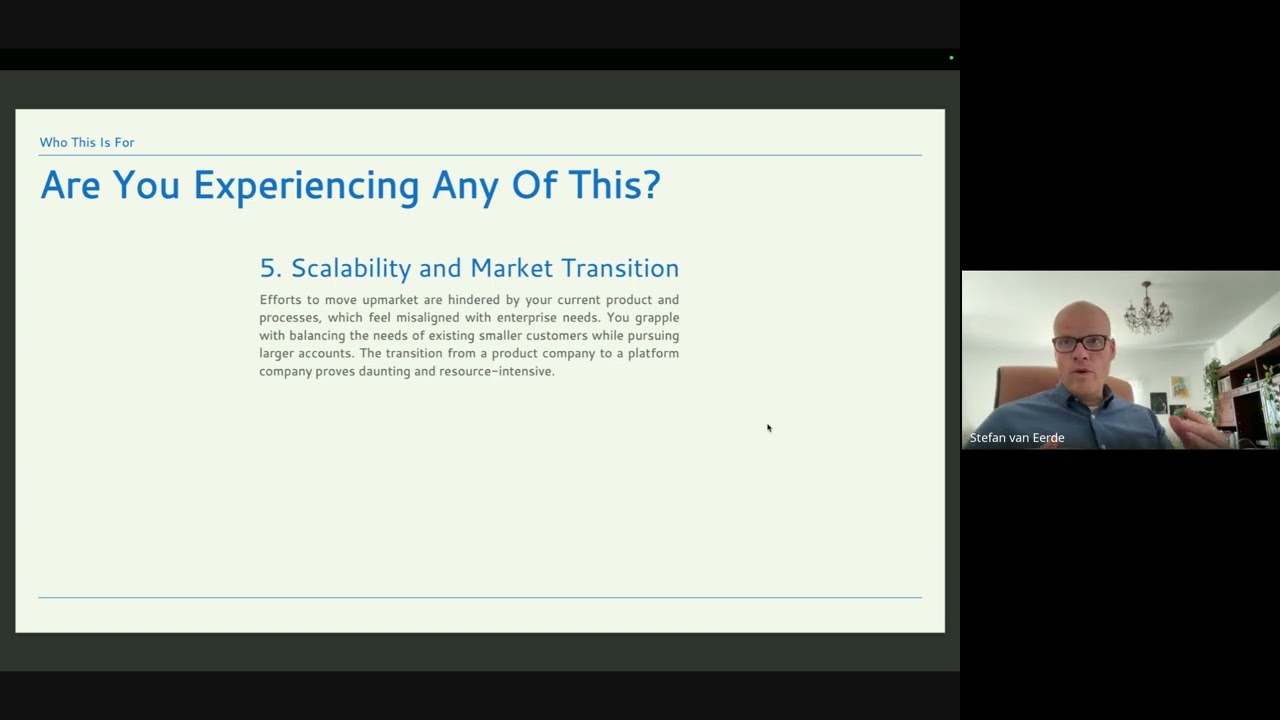
So that brings us to the fifth challenge, and that is scalability and market transition. It's pretty hard often to move up markets if you, for instance, have now relatively small deal sizes of $5,000 or less to actually really move into, for instance, enterprise sales where you would have bigger ticket sales.. And from moving to smaller to bigger ticket sales, that transition is also quite hard because the people in your team need to change. They need to have a different mindset. They probably have to be a bit more patient before these deals land, more intermediate steps in between, more calls, more thought leadership activities and other activities to really get to that level where you could sell bigger ticket sales. And it could also have to do with the transitioning, that you transition from having one particular product to a platform of products or platform of services. And that again requires more explanation and more efforts and a longer sales cycle. And yeah, sometimes it is the question, as the example that Andrea gave, do you have the runway and the bandwidth to actually transition into an enterprise sales organization? Do you have enough money in the bank and enough patience before the bigger tickets come in, or do you need to have the the smaller deals in order to survive in the here and now. It is difficult to maintain customers based on brand value. Yeah, indeed, that is also a very, very good one. Thank you. Yeah. And then the sixth challenge that I see is a reactive culture and lacking innovation. So your team constantly puts out fires rather than driving strategic progress. And with that, I mean, a lot of people are busy, busy, busy and very operational, but sometimes it lacks strategic thinking or it lacks strategic direction. You as a founder probably have a very clear idea where you want to go with your company, but maybe people within your team, they do not necessarily agree with that, or they, they don't find it that clear, and they struggle with getting that clarity. There might also be some sort of a fear of disruption. From more agile competitors or in the technology. And what if the competition uses AI for this and then all of a sudden in 5 minutes they can do what we do? Sometimes that might be a legit fear, sometimes it could just be an exaggeration and an overestimation of the fear factor as such. But these things also happen, that you are really ready to go, but maybe the people in your team are thinking like, I'm not sure if this product is really going to survive in 10 years from now, or I'm not sure if what we're trying to do is really working with the audience that we have envisioned. And it also brings us to another part of interaction, like what other challenges do you face as a founder? Like what kind of challenges do you run into? And feel free to share these as well in the chat again. So I'd like to learn more about those challenges.
Stefan van Eerde, one of the key challenges I, I hear from time to time is, of course, you know, uh, technology being taken over by AI solutions suddenly. I think that's, uh, something that, uh, many tech scale-ups, if they didn't remain up to date, also fear.
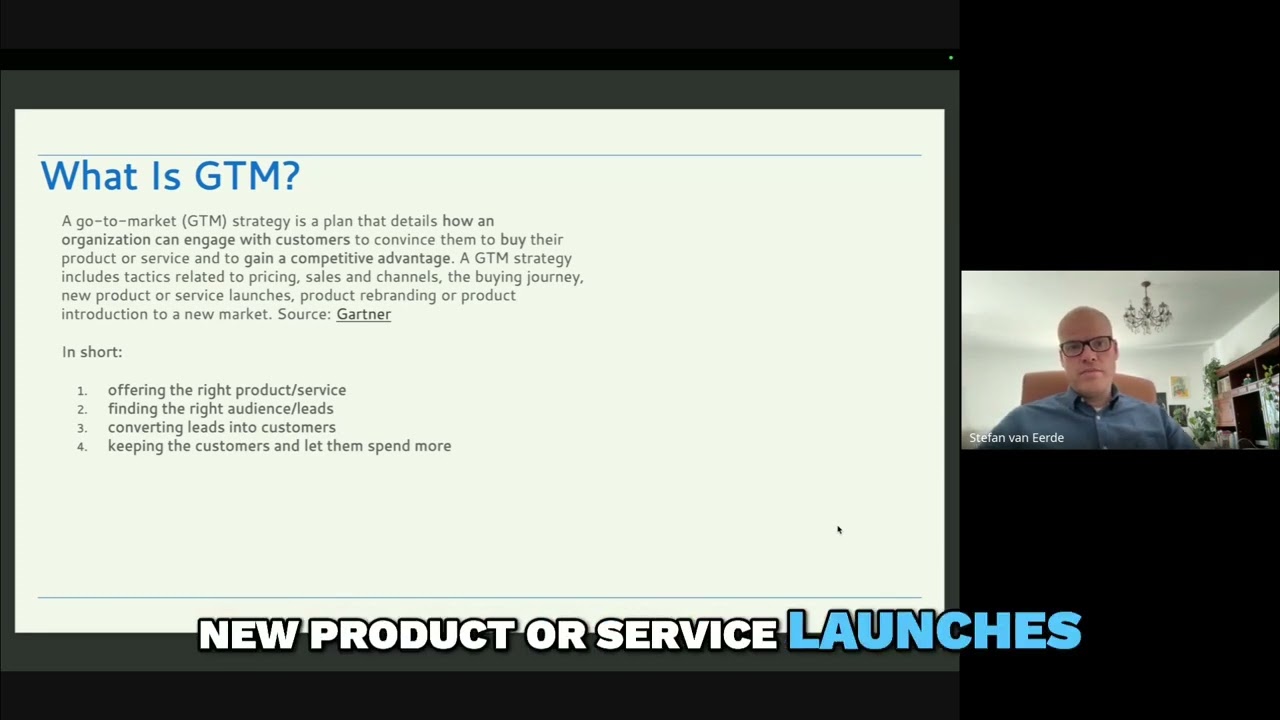
Fair point, yep. And I see capital expenses are always higher than expected. That's also, I think, a very fair challenge that you come up with an over-optimistic estimation of what things will cost and the revenue you will generate with it, and then in reality the costs are higher and the revenue is lower than you anticipate. Yeah, and sometimes also the sheer volume of the capital expenses. If you need to buy new machinery because something breaks down that you really need it, you need to replace it, but it's going to be expensive. Yeah, because that's the dark side of AI that we also see, right? The energy consumption, but also the LLMs attached to it and all the learning that it requires to build something really from scratch can take billions and billions Yeah, good. Um, have we already tackled a bit of this? Like, do you recognize these challenges? Feel free to also share your challenges afterward. We will also have a Q&A at the end. Um, and yeah, feel free to also discuss this among the other founders in this, in this event, or later on feel free to reach out to any of us if you have any additional challenges or questions. So this is also a nice overview of the different stages of startups, all the way from problem-solution fit on the, on the left side to business model market fit. And I will just very briefly touch upon the different, different side of things. So often it starts with a problem-solution fit, right, where you as a founder, you, you either have a problem yourself or you run into a certain situation Do you see someone else struggling with something and you think like, hey, I probably have a solution for that particular problem? That is the problem-solution fit. Then you would work that out into a concept. You will try to form a team maybe, and that's the vision-founders fit. Like, do you— are you able to connect your vision or the vision of someone else that you believe in with a team of founders and maybe your first employees and get into that vision-founders fit? Then you start validating, which will lead up to that product-market fit. And then you go from scaling all the way to establishing sort of yourself in a particular category, and that is a business model-market fit. And my assumption is that most of you will be anywhere between 1 and 3. Am I right with that? Anyone still in another stage? And of course, these things could also go in parallel. So maybe with one business line and one product line you're already in, number 2 or number 3, and maybe you're starting something new which is still in the ideation stage. So feel free to also share that in the chat and we can look into that as well. One of the challenges was go-to-market inefficiencies and Of course, that is, that is a mouthful, but just to make sure that everyone is on the same page, Gartner has a very good definition of go-to-market, and they define it as such: a go-to-market strategy is a plan that details how an organization can engage with customers to convince them to buy their product or service and to gain a competitive advantage. The go-to-market strategy includes tactics related to pricing, sales channels, the buying journey, new product or service launches, product rebranding, or product introduction to a new market. So there are quite a few different components into, into go-to-market there, but in short, it comes down to offering the right product or service, finding the right audience for that product or service, or product or services, converting those leads that you will get out of that into customers, and making sure that these customers stick around, right, and that they spend more over time so that you can grow your business through upselling and cross-selling, and at the same time to getting new customers in. There's also a very interesting study done by OpenView, uh, back in 2023. They did a software as a service benchmark report, SaaS, and the number one challenge— founders were able to select up to three challenges— so the number one challenge that founders have and what keeps them up at night is go-to-market execution, followed by product execution, followed by burning too much cash. There are more, more reasons in here: competition, fundraising, hiring the best talent, and so on. And as you can see here, back in 2023, AI strategy was pretty much at the, at the bottom of this, uh, of this study. I reckon that nowadays that one is probably going up quite a bit. So, but it's interesting to see how things change rapidly in a short period of time. Do you also agree and do you recognize the go-to-market execution as being one of the top pains that you experience as a founder, that you really know how to move into new markets and how to put your products out there to generate revenue from it? And that is also where we come in, uh, working with Shadow Leaders. You work together with experts who can help you optimize your go-to-market strategy so that you can grow your company faster, become more productive and more profitable. I already talked about deal sizes and different motions. There are actually 12 go-to-market motions, and of course this is a bit arbitrary because if you would classify the deal size bucket from $50,000 and more into $50,000 to $100,000 or anything like it, you would generate a new line in this table. But the purpose of this table is really to show you that for the different deal size that you have, so often a lot of companies start in that up to 5,000 or 5,000 to 5 to 50,000 deal size buckets with what you try to sell to your customers, is that you have different strategies, different go-to-market strategies for that. So if you would focus on a product-led growth or freemium model, that is very common that you have a website where people can go through a certain process, maybe engage with a chat function or anything like it. And then do the acquisition of the products all without the salesperson being involved, so that you can do the transaction through your credit cards on a particular website to buy business software or anything like it. That is very common, right? So that is for deals up to $5,000. That is a very common thing to see. It's already becoming a bit less common for the mid-sized deals between $5,000 and $50,000. And it is very rare to see this for 50,000 and more deal sizes. On the other side of the spectrum, you have account-based marketing and enterprise sales. If you would give bonuses to salespeople and you have this whole machine with the big marketing automation things and a lot of subscriptions and costs out there and you focus on deals up to 5,000, having that sort of account-based marketing approach is close to insanity, right? That doesn't really scale and it doesn't really happen that way. You will not really focus on selling smaller deal sizes, smaller amounts to a smaller group of people. But this is a very common thing for the larger deal sizes to do. As a company, you generally speaking can have 3 of these motions at play at the same time. More will become confusing. So that is something that a lot of companies are also not fully aware of, that you can only pick 3 out of these 12 more or less.. And a lot of companies, they also get stuck on the top left side of the, of the model where they stuck. They started one day with smaller deal sizes and now actually they want to migrate to larger deal sizes, but they're struggling with hiring the right people, investing in the right tooling at the right time. So that is pretty tough as well. Again, a question from my end, if you recognize this, if you also have some difficulty of clarifying what the right strategy would be to do the right things for your deal size. Hopefully this framework, this table, can help you also identify the best ways of doing it for the deal sizes that you have in mind in your own organization. So my question is, do you have clarity on your go-to-market motions? Is this something that you're fully aware of, or is this a bit of an aha moment, like, oh, Crap, I didn't know that you actually have to make choices between all these different options, that you actually have 12 options available. So looking at the time, I'd like to wrap things up and also hand it over to Andrea almost. So we're almost there. I just want to give a bit of a quick executive summary. What is Shadow Leaders? Shadow Leaders is a community of experienced experts who help you grow your business faster. This is a group of over 50 experts who have been where you are, so often former co-founders or seasoned practitioners who are now consultants. We work closely together with a Swiss consultancy firm called Kinetic Consulting, and through that network we also offer additional experts that can help you as a scale-up founder grow your business faster. Because without help, without experts being involved, it's really hard to make the right decisions all by yourself as a founder. And this community offers experience-based insights to avoid costly mistakes and help you make better informed decisions and make better choices. So it's a combination of Diversity of expertise, people from different organizations and different backgrounds, where we will give you one-to-one support. And I will be also your main contact person, so you will deal directly with me, which is good or bad depending on if you like me, if it works out that way. And we also give you clear recommendations leading to tangible results. We're not a consultancy firm as such where we just advise you to do certain things. But we also help with the implementation of particular tooling and particular processes and particular strategies. So we, we always wrap it up as people, processes, and tools, and we try to optimize the combination of the people in your organization, the process that you already have, and the tools that you have at your disposal, and try to educate you also about other tools out there. And indeed, it's not just AI. There are a lot of old-school tools out there that are still very, very valuable and very effective. And it's really about the combination of AI with relevant tools to bring you that success. So we've done this for several organizations. We also have several examples. For the sake of time, I will scroll through all of this. And how does it work? Well, you will join us on a 3-month journey, what we call a 3-month accelerator process, where we will do an audit of your organization and we will really have a lot of discussions and sessions together where we will set goals and evaluate goals and make sure that we meet your— that together we meet the objectives that you set for yourself. And you will also get access to an extensive resource library with all kinds of frameworks and models that can help you from successful companies that have gone through the journey before. This is a framework that we use, and I will not go into too much detail because I know that Paul will also really focus a lot on this, so he will tell a bit more, and so will Andrea. But this is, I think, a very clear framework consisting of 9 clear steps in the scaling roadmap process, and this is something we can guide you through to make you more successful, all the way from alignment to to planning, to the operations and systems, revenue marketing, profit and cash, your financial and KPIs, to innovation leadership and team and culture. Just one thing to wrap things up for those are in here, like these kind of programs are quite common in the US, but I just want to stress that this is not an exclusive for Americans by Americans program. It's also not some sort of a free educational experience or something like that. You work together hands-on with experts from the relevant continents so that we make sure that also within your industry that we team you up with an expert in the same industry so that the industry expertise but also the general expertise is there, which we call Swiss quality combined with UK critical reflections and American eagerness and a Dutch direct approach. So that's a bit of a way of putting it all together. And I end my part with the question: when do we start? So if you think, hey, this is something that I recognize, I have similar challenges, yes, I do need some help with my go-to-market implementation and my strategy, and I could use someone to educate my team or help my newly appointed CEO or help my new marketing or sales director, Please do reach out. At the end of the slide deck, we will also show you the contact details and information. And without further ado, I hand it over to you, Andrea.
Thank you very much. So I will just share my screen now. Just one second. It looks like everything is working. I just need to select the Shadow Leaders presentation. Just one second, which you should be seeing now. I hope it's working. Yeah, okay, just one second. Let me choose Okay, I will be just sharing my full screen and go on presentation mode, which should have worked now. Okay, it's not taken over yet, right?
No, no, in that case I can, I can guide you.
Exactly, sorry, I, I just tried twice and it would just work before, so when we tested it worked, and now for some reason it's not going to take over. But yeah, I, uh, if you don't mind, I just let you do it.
Gladly so. Yeah, I gladly do so.
No, okay, good. Can't share your screen. Yeah, you must grant permissions to screen share. So you, you took away my permission then. Okay, I'm sorry to you. You may go on then, uh, to the next slide, Stefan. So, uh, I will introduce you to, um, uh, what we call, uh, the dinosaur principle. And basically, when you look at the customized scaling roadmap— next, please— you will see that I really focus on step 8 and 9, really on innovation leadership as well as the team and culture. And when we think of what Stefan van Eerde was just telling us with that study, so hiring and finding talent was quite a big chunk as well. I think it was 5th or 6th place— you, you can go on, Stefan, next, please. And basically, I really try to focus here, and here is also where the dinosaur principle basically applies. In the end, you will also see how this really has an effect, of course, on all the other steps. So basically, by really working on the people aspect, on the innovation aspects of scale-ups, I really try to also backward engineer your You can go on, Stefan. Thanks a lot for clicking for me.
I asked the team quickly to update the right, so can you try it again? I think they now changed the host.
Okay, let's share. No, okay, let me try this now again.
Otherwise you make the audience crazy.
Yeah, probably exactly. By always saying, uh, next, next, I will probably— so, um, now you should be seeing the screen also in presenter mode, right? Perfect. Okay, yeah, so I, I go on then, uh, exactly. So we really stick to step 8 and 9, uh, and very quickly, well, whom are you talking, uh, uh, to? I have a portfolio career, uh, for more than a decade now, meaning I have my own company, Seabrand International, really focused on strategy and leadership topics. But I also have a failed venture, a startup that did not work out. And honestly, I also draw lots of learnings from that. I, by the way, also wrote the book chapter on what we will look at now, the so-called dinosaur principle, which really is focused on, well, how can we make companies implement a culture of failure, a culture where failure is also an option? Because it's it's there and we know it. The statistics say it, you know, after 5 years, uh, maybe 80% of the startups do no longer exist. Uh, so I also work as a coach and I lecture a lot at universities where I really work around that topic of entrepreneurship but also leadership. This is really the link that I have. So what will we look at in those, uh, two, uh, steps? Really failure culture and the mindset. How, how can we hire By the right mindset, how can we create a culture where also psychological safety is part of it? And having all that also helps you easier onboard new employees, which is also a key part when you're scaling, right? When you have to hire too quick, too many people. So much here. I am going on and I'd like to ask, maybe you can type in the chat, when was the last time you made a mistake? First of all, let's see if we have some funny mistakes. Um, just, uh, yeah, maybe there is something. I'm looking at the chat. Nothing yet. So, um, yeah, I mean, I, I can bring, uh, my own example, uh, as well. You know, like, um, I had a funny mistake actually last week. I had a horrible flu, uh, and I had to send out that one offer. And, um, it's really a funny mistake because I switched numbers in my favor, and it looks like they will just accept it. So that was, well, for once quite an interesting mistake. What did I learn from it? On the one hand, I'm usually quite careful unless I have fever and know this one thing has to go out, but that still also think about mistakes also in that way. Well, what can I learn from it when it goes to processes, right? And what can we do with it? You know, also when we observe other people making mistakes, because they happen all the time, how can we use them in a more constructive manner? This is really something that has kept me busy to see how can companies really learn from things that happen. I mean, especially in the tech area, you know, You have to try a couple of times. Sometimes the customer journey changes and you have to adjust your things to make sure it's right. So maybe another question now: what do you think is the optimal error quota in terms of percent? How much percent of something do you think you have to do wrong to still feel motivated and want to learn? What do you think? Just type in the chat how many percent do you think, uh, it is. 20%, 25%. Mhm. Mhm. Who thinks it's more? Ah, 50, 30%. Okay. 40%, 20%.
Yeah. Okay.
So, uh, Merit, nice to see you, and Paul, uh, you two were the closest actually. Uh, they say when it gets to learning— so it's a study from, from education, but still there's a lot, uh, transferable, uh, they call it the 85% rule, and basically it means that, uh, 15% error rate, uh, still keeps us motivated and still keeps us, well, in a space where we look forward to get there. There is, of course, failure and failure. You know, some errors are natural, and we actually need to make mistakes in order to actually learn. I mean, imagine all of us would have thought after the second time that we tried walking, "Ah, that's too difficult." I mean, you know, we see it from babies, right, that you really have all that learning, but We really can transfer that. And in environments where the culture doesn't allow you to actually make mistakes, where admitting a mistake is really hard, well, also less innovation will happen. People will also be scared to even suggest improvement. So that's very important to keep in mind. And also, yeah, what do we see in the end, right? It can also be quite a dangerous aspect when you only see the tip of the iceberg because there is no, no trust in, in your team. Sorry, uh, so much for, for this. And, uh, yeah, what do we see? We look at the tip of the iceberg, and I really like this, this example. Um, has someone of you already heard of the CV of Failure by Johannes Haushofer? So maybe you may want to type in the chat. This is really one of the Best examples I know. So he's a German actually, but Princeton professor. And a couple of years ago, I think it was 2020, he launched his CV of failures where he has a 4-page document where he puts everything he has ever failed at. And as I said, looking at the tip of the iceberg, well, Princeton professor, he made it, right? And he really, if you look at just those 2 pages, He lists all the scholarships he didn't get, the research funding he didn't get, academic positions he didn't get. And I really think we need to look at it on, on the meta level for startups and scale-ups. Hey, what are the things that haven't worked? But also, what are we learning from it? But also on an individual level, right? Because all those things contributed to his success. And, and all the things that don't work out for us in some way give us lots of learnings. And that's quite an important part. So that gets us in the first step to the dinosaur principle. And I usually call it the U of learning, where it really is, well, the y-axis is how you feel emotionally, and then you have time. And obviously when you start, you think it's a great project and it's going well, then you get started, you start to see it's actually not that easy. Okay, the clients don't like the product as I thought, the market maybe isn't developing as I wanted— topics we just had from Stefan van Eerde— then you really, uh, rock bottom. And yeah, a couple of scale-ups, startups, or individuals give up at this point, and some really make it, um, out of— I mean, we also talk about the valley of death in, in the startup or innovation, um, environment, then you really start to go over. And now it's also actually the critical phase starts, because if you keep going, um, just the same way you were before, it will not help you succeed. Uh, it's really about, uh, getting out of the comfort zone and into that learning zone where you see, okay, I— we cannot keep doing the same thing also in our team. How, how can we get that evolution? How will we evolve? From there, you will see another critical phase because, yeah, if you keep going, keep going, keep going, you just end up in a plateau. So you will just end up on top of phase 2. So it's really about finding the right momentum where you embark in a new learning cycle again, which is this new Next, you curve and you already see it's not that extreme because it's kind of a controlled learning environment. So that's an important aspect. While yeah, you will have moments that are difficult, they're not as hard as the first time. And identifying critical phases is, it's quite important. So, you know, what does it mean? Well, the earlier you take that decision to embark on, on, you know, when to adjust your product, when is it time to, to work on the portfolio and all that. It's really about, okay, uh, the more we know about something, the, the smaller the consequences are from it. So it's really about also being early and good in timing to do that. Um, yeah, uh, maybe you also know that feeling, you know, uh, when you're just working outside of your comfort zone. Um, is there any adjective that comes to your mind? When you think of that feeling, you know, when you're just stretching because you have to work on something you don't know, how would you describe that? Maybe you may want to type in the chat quickly. Let's see if someone has some adjectives. Excitement and nervosity. Yeah, exactly. It makes you nervous, but also Except, oh, Paul, yeah, imposter syndrome. This is definitely the one thing I, I have in my coachings when, when we speak about— absolutely. Uncertainty, thank you. Yeah, Anirudh, absolutely. And, and all those feelings, adrenaline. Yeah, Claudia, thanks. Also that, right? Uh, and, and it's really about embracing all of that. And if, if we manage to, to create really that that culture of, of, uh, you know, having mistakes that we learn from, you even enlarge the learning zone. And at some point, you know, you really feel those small highs and lows, which was the initial U-curve, uh, in, in some way. You can really feel, oh, I'm out of my comfort zone, but I know I have the right tools to still navigate through such a phase. And I know I have enough tools that I use, well, to just prevent that it ends up in a total catastrophe or that you lose track of things. Well, that's how the dinosaur principle actually was born. You can see it could also be, of course, the multi-bellied dino, meaning that phase 2 happens more times. And well, now you may wonder, well, what the hell? What's a dinosaur got to do with growth and failure, and what is she even talking about? And I always say, well, I wrote a book chapter on it, but the idea is so simple. Uh, it's really a beer tap idea. That's how, how it evolved actually, based on lots of coaching conversations. And well, if you have this attitude, as you can see, being on, on, on the bottom of a learning experience is actually even higher than being on top of, you know, when you end up in the plateau, and that's where the growth happens. That's really where you see, okay, although I have that phase, that feeling of discomfort because I'm outside of my comfort zone, that's exactly where you are growing and where maybe also your team culture, your startup is really getting better and more confident as well. As well in, in what you work on. I mean, what does it mean for you in practice? Uh, it really boils down to having psychological safety. Uh, you may know about Amy Edmondson, who does a lot of very valuable work on it, and I really like, um, how they describe it because, yes, startups are environments where you eat the one or the other pizza. So I really like that, and Yeah, what does it mean in practice for you? And working with me really means to fill your toolbox, to really have various tools around building your team in a confident way. So, so as a startup, you know, you can iterate and really use those tools. I mean, there's of course also the agile working, but I'll introduce you a couple of tools. And what's probably important to understand is Yeah, they're all out there. You can go and use the tools, but sometimes it's really helpful to use them in a guided way because there are some traps. And if you don't use them correctly, of course, um, there can be misunderstandings on the tools. One of them can be, well, mistakes already happened. How can we do a so-called post-mortem, you know, where you can really factually look at what went wrong. What are the facts? What, what was the original ask? What happened then? You know, was it the environment? What, what led to it? And can we adjust processes, especially when scaling up, to, to prevent it? Of course. Can we look into potential solutions? What was missing? So this is really a very nice tool that I like to use when things already happened. It's also a starting point to, by the way, then introduce a tool called pre-mortem, which is even more effective. The so-called pre-mortem is a valuable tool. I learned about it when I was in Stanford and really applied it. And not only does it help you bring certain facts on the table in terms of risk assessment, You get also the more quiet people to talk in your team. You really get a holistic view of potential risks. And yeah, it doesn't mean that no mistake is going to happen, but you will do different mistakes and ideally not those really hard ones. Yeah, so you see, I work with a framework for premortems where there's also lots of topics we can, Usually it means kind of, well, we go 6 months in the future, we fucked up this project. How did it happen? Why? So we really go through those questions one by one. I adjust them depending on, on the product, depending on the team as well. Sometimes there's also team questions that are important to include the dynamics and really look at it. How, how can work with it. Then once you have the failure part, it's, it's of course important to have, um, something where you look at, okay, what type of team are we? Uh, I have been working on this culture design canvas, uh, in, in many aspects, in small teams, but also then bringing together those small teams to the actual organization. So I've, I've had One year ago I was doing a project where we really brought that together and we had 50 participants bringing in all their topics to look at. We really elaborated what does it mean in your team? What does it mean as a whole in the organization? It's not just something for the existing team. Usually you do it, let's say every 6 months you dedicate maybe 2 2 hours with your team to it. Hey, what has changed? You know, uh, what, what needs to be changed in terms of rituals maybe, or norms and rules? You know, have we evolved? Are there certain mistakes we no longer want to tolerate because we really have to have outgrown that? That's also important, of course. One of the really important questions also, you know, what behaviors do we punish? What behaviors do we not want to tolerate because yeah, especially in startups, the pressure is high. You may have someone that, yeah, is excellent, you know, with his knowledge, but is not contributing to a good team environment. And if you have one person that is really like killing the whole mood in the team, yeah, that really can have a big spillover effect. I was just today having lunch with someone and she was like, yeah, the person doesn't feel appreciated, is not happy, and either I fully embrace it, you know, what does it mean with the whole team, or it will fall back on me in a couple of months. So this is really, really worthwhile. And of course, it also means, you know, you have to have awareness of you as a founder, maybe, you know, how— what do I need? How, how do people get me best? But also my team, you know, how How do we communicate with each other? Of course, also, you know, streamline the process in terms of which, which channels to use. That's a topic nowadays. How do we work together? Uh, and so on. These are all things that, you know, sound very wishy-washy, but once you start digging deeper into it, uh, it's really worth it. I was just, um, doing a workshop in Germany yesterday, uh, with a team that is half on site and half of them are virtually, and they met each other for the first time. And we really had some outputs that were like, oh, I wasn't aware you don't like this, or you prefer this way. And they're really getting closer together as well. So you see, there's a lot of tools. I also work with the so-called IDGs, with the inner development goals, as you can see here. These are the, the 5 pillars. Um, they are also the follow-up of the SDGs. And basically, um, I don't know, does anyone of you know about the Inner Development Goals, the IDGs? You can just type in the chat if you want, if you, if you ever heard of them. Um, so basically, uh, people thought, well, the SDGs are nice, but there will not be any outer development without inner development. So they're really focused on, on skills we need to have. And having a positive psychology background, I also work with Character Strengths, which are the 24 strengths you see on the other side. So that's really— they are powerful tools if applied correctly to really enhance the team's power, the team's energy. Of course, I like to work in one-on-one coachings, and I like to do that before you're almost underwater. And as you see in this picture, uh, which I took in New Zealand, where I really thought, yeah, that's a situation you often find yourself, that the water is, is knee-deep, right? Uh, so I really, I try to have a plan, uh, so you don't get, um, there. So when you, when we get back to that customized scaling roadmap It's really looking at the innovation leadership and team culture aspect that has a spillover effect to all the other steps. Taking care of those really helps you not only generate value, but really also being faster and contributing to a long-term vision. I spoke a lot and now I want to— well, say thank you. And, uh, yeah, you, you can also write me, of course, if you'd like to have the, the book, uh, the ebook on, on failure culture. It's in German, but still, I'm happy to share it. If you would like to learn more, of course, feel free to book an appointment. We will show up the QR code at the end again. Um, and without further ado, I am handing over to Paul and inviting you to share your screen now, which should also work. And yeah, I see, I see question whether you will get the templates. Yeah, you can. Exactly. You're welcome.
See me and hear me all good?
Yeah, yeah.
Right, hello everyone again, and I'm just going to show you a brief outline of something that I use called the Profit System. This is a shortened version of my webinar, and I'll just quickly run through. The first thing that I do run through is the 5 levels of business owner. So as founders and business owners, you'll pick yourself out in one of these 5 levels, and then I'll run through The 3 key pillars of business and the 9-step roadmap. So I'll list these 5 really quickly, then I'm going to go through each one individually. So there's no need to take too many notes. And the first level is overwhelm. The second level is overworked, which is where a lot of owners feel that they're stuck in the business. Level 3 is organised, and this is absolutely critical. Very few owners ever really do this, but most people overlook it or know where they need to do it, and many have thought about it, but they never make the time to put this level in place properly. So if you actually get the business to this level, it has a massive impact on your bottom line and starts to free yourself from the business. So Level 4 is the Overseer, which is— if you've ever truly experienced this level, even temporarily, you'll know that it feels dramatically different than any of the previous levels. But we estimate that less than 4% of business owners ever build a business that runs at this level.
Sustainably.
And then the last level is owner. So let's go through these and I'll explain the systems at each level so you can figure out where you are, and then we'll discuss how you move yourself forward up the levels by focusing on the most important things. Because if you try and do it out of order, it's like trying to build floor 100 of the skyscraper before you've even put in the foundation, and that building is going to come tumbling down. So Level 1, overwhelm. Owners who experience this level don't know what they want to do next. There are too many fires to be put out, and they cannot even run day-to-day operations. For some owners, this may just be at the start of the business when they are figuring everything out, But for the vast majority, this is a recurring level for them, especially when they're trying to start new projects or grow the business. One of the primary ways they try to tackle this is through sheer brute force and determination, which may work briefly for a period of time, and then you can move yourself up to the next level, which would be overworked. So when I ran my business, I was obviously started at Level 1, I moved into Level 2, and we just had to head down and just battle through things because we didn't really know what we're doing when we first started out. And this system really helps me explain to you where you can get to. So Level 2, this is exhausting because the owner is trying to micromanage everything because the team is not properly trained and they do not have the right systems in place. And we estimate that 90% of businesses owners fall into Level 1 or 2 most of the time, and maybe only brief moments in some areas of the business move into the next levels. So the business is completely dependent on them at this level, and if they stepped away from a time, the business would fail. So like when you're going on holidays, you're constantly getting phone calls, you can't have breaks without worrying because there's not a system in place or the right people in place. So in many cases, the owners would have more freedom and income if they went to get a job and work for someone else. And can, can people resonate with this? Because I certainly can from my previous experience. So if you can't take a 4-week vacation without checking in with the business, you probably fall into this level. So for most people on the workshop, it's going to be trying to move yourselves up the levels, especially to this one. This is the next one. So Level 3 is Organized. This is where the owner has started to focus on the two things that you need to do in order to create a robust, profitable, sustainable business that runs without them. The two Ps. Processes and people. The aim is to create the processes and then have the people run the process and the processes run the business. So however, this requires strategic thinking and planning and requires you to start working on your business rather than in it. And this is easier said than done, but it's well worth the rewards. Because in doing this you are showing, sowing the seeds that start creating real freedom. And that, from what I can tell, is what most people start businesses out for. You've got an idea or a vision and you want to get somewhere where you've got a business that runs for you. So at this level, you'll be able to take a few days off from the business without taking calls, and when you come back, things will still be running smoothly as when you left. This is the foundation to move up to the next one, which is the Level 4, the Overseer. So owners at this level are really starting to make the shift from being an operator to an owner. They spend more time working on the business, improving the processes and people, managing the teams rather than working in the business. Very few business owners achieve this level without reading, learning, and being mentored by people who know how to create a business that can run without the owners. It's just too much to figure out on your own most of the time. You can't achieve this level through just hard work, grit, and determination. You just get stuck in the cycle of more and more responsibility, everything being on you, all the calls, until you can't handle it. And then everything comes tumbling down. This is why many owners who try to free themselves from the business end up having to step back in because they don't have the proper structures in place. So you need a team that you can trust, that is 5 steps ahead of you and invested in the business vision. Once you arrive at this level though, it's worth the effort, and this is the level that most business owners think of when they first start the business, and it certainly was personally for me. The freedom to come and go with all the money still coming in, and they're there to lead and inspire the team. However, it's not the highest level. So we've got one more, it's the ownership. And this is where you've created the people and the processes that run the business for you. And then hired and trained someone to be the overseer for you. They continue to improve and grow the business for you, requiring minimal input and effort from yourself. So this is where the true freedom exists, because now you have the ability to enjoy time with your family, pursue passions, or you may still love working in the business, but this is 100% a choice. You know the business will still grow even when you just show up on quarterly meetings and the team barely needs your input, just to ask you the big strategic questions. You've built, truly built something of value that runs and grows without you. So these are the 5 levels, and it's all about going from chaos and trapped to control and freedom. So this is what we've covered so far. Now I'm going to show you the next level. So this is the 3 key core pillars of business. So the first pillar for you is vision. You must clarify vision. If you don't know where you're going, you'll never get there or be able to communicate to your team so they can help you. Getting clarity on where you are going means that you can efficiently put in the right things in place and have the amazing business and lifestyle you deserve. The second pillar is velocity, and specifically being able to control velocity. If you don't have control, you'll spend your time crashing from one cash flow disaster or operational disaster to another. Trapped in a business that you can never escape. Having the right system in place, place means you can deliver consistently and gain predictable income. And then finally, it's about value and creating long-term value. Without clear financials and a team you trust to grow, not just maintain the business. Without you, the business will stagnate. You'll never be able to sell it for a handsome profit, or if you prefer to stay and work on it, because it's your choice, not because you have to. So if any of these pillars are missing or underperforming in your business, your ability to earn more profit, reduce stress, and have the business run itself without relying on you will be sealed, severely capped. In fact, let's look quickly at what happens if you only focus on one or two areas instead of all three. So if you're missing the velocity pillar, you'll be in cash flow chaos. A clear vision but constantly in danger of either not growing fast enough or growing too fast that you can't cover short-term needs. Then if you have the vision and velocity but not thinking about creating value, you'll know what business you want to build but are constantly busy and everything is still reliant on you. And finally, if you're missing the vision, and this may just be because the plans haven't been communicated properly, then the business may be growing but there are always issues arising because there isn't an alignment in the company of what everyone is aiming for. So when we combine these up, instead of a 3D, we have a 3V business growth model. Maybe you have a vision, but how well is it articulated and shared with the team that they brought into it? But let's say it's level 4. And what if it wasn't translated at the speed at which you are growing? And that, that's only Level 3, or the value section, because you don't have clear financials in Level 2. So this is why it shows you the most important bits of each structure, and you've got to work through each level, and then you'll get the business that you want. So most business owners have the strengths in some areas but weaknesses in others. And businesses will always fall to the lowest level, as it shows in the, in the key pillars there. So just as a chain is only as strong as its weakest link. So this is the first two frameworks, brief frameworks that I'm showing you today. I'm just going to show you the main one, which is the 9-step roadmap, and this helps you to plan out how you're going to move up the levels. So this roadmap— sorry, this is the roadmap you need to move from where you are now to your ideal business. So in the Vision pillar, there are the first 3 steps. We have the Alignment Accelerator, Driving Growth, and Dynamic Planning. So the first step, the Alignment Accelerator, is making sure that you're building a business and it's aligned to your personal goals. It's amazing how many times business owners are just blindly trying to grow without even a sense of what their business needs to look like to give them the lifestyle that you want. So this is getting your 1, 3, and 5-year plans in place for the different areas of your business, plus some other really important aspects. Then we have the detailed strategy step, so you know how you're going to drive the business forward with your offer, sales, marketing plan, and operations, etc. Otherwise, you'll just be making things up as you go along and not be able to apply the later steps. Then the final part is the dynamic planning. So how does that alignment, long-term plans, turn into actionable strategic annual and 90-day plans and even weekly and daily activities for you and the team? So you've all got focus on where you're going. So this is where so many businesses owners struggle. They're full of great plans, but the ideas, a dime in a dozen. It's the execution that matters. And don't worry, the very first strategy I'm going to share in a minute is the best strategy I have for helping with that. It's a vital link between the plan and it's actually going to be implemented. So that's the first pillar. So you can see how all three pillars join together on this 9-step roadmap. So now the velocity pillar. The first step there is you've got to manage the profit and the cash. Otherwise, you're either not growing fast enough or growing enough to make any money, or you're growing a business that is actually a cash-eating monster. And you definitely don't want to be working harder just to earn the same, or in some cases even less money than you would working for someone else. So many owners get stuck in the idea that growth is the only way forward. And you'll see from the second strategy that I'm gonna teach you, it's not just the case, it's in fact where you might have the holy crap moment. And then after profit and cash, you've got to be able to drive more revenue with better sales and marketing, optimizing conversion, and able to generate a more higher quality leads and convert them in larger amount than you have previously. Though there are not other important levers that you can pull, which means that you often don't need more clients to grow. I don't think we'll have time to cover that today, but we can certainly discuss it on a one-to-one call if you find you would like to. Then as you grow, in the final step, controlling the velocity is making sure that you have the right operations and systems in place because at a certain point it's just too much for you. And even you and the team, you don't need to start having the processes that are running the business just not consistently solving the next problem that comes up, like firefighting each time that there's an issue. And you can get those in a great place, you'll be vastly ahead of most business owners and in a great place to start tackling the final big pillar. So the value pillar, which is made up of the financials and KPIs, innovation and leadership, team and culture. So the reason the financials and KPIs come in first is how can you value a business, let alone increase the value, if you don't have the measures in place? So this is vital if you're starting to move, going to move up these levels of ownership. You need the right dashboard and to understand what metrics you should focus on. And what your team should be focused on together. This gets more, even more important the faster you grow, so it's especially great for founders. Think of the dashboard on a bike, on a bicycle versus a fighter jet. You know, you need more control the faster and the more agile you want to be. Then at a certain point, you hit plateaus like Andrea said, in growth. So you'll need innovation and leadership to overcome those and keep the businesses competitive, sustainable. And finally, it's about getting the team and culture right, and then something that's bigger, and then you can just have a life of its own. And if you get those steps right, then you're well on your way to having a robust, profitable, sustainable business where you can choose to be working in it or free to enjoy the life that you want. Now, ideally, if you've got a pen and paper, you can draw 9 boxes and then we can go and score each step for your business. And we'll simplify our 5 business owner levels, just a traffic light system for now. Or what we can do is if you just score them out of 10, even in your head, that's fine. You can put all your answers in the chat box. If not, you can just, uh, listen to us. So for each area, we're going to go through whether things are perfect. So this is in your business for each person, and you can give it green tick, or you can just give it score out of 10, and then we can add them up at the end, and you can put them in the chat. So step 1, the Alignment Accelerator. I'm gonna ask you a few questions, and this will provoke whether you think you're a 10 out of 10 or a 1 out of 10. So how clear are you on the business that you need to build to satisfy your ideal lifestyle? Have you worked out exactly how much profit your business needs to generate for you to enjoy your ideal lifestyle? What does that mean in terms of revenue and expenses and the growth plan to achieve that over the next 1, 3, and 5 years? And quite often this is incredibly powerful because business owners who are just blindly growing now realize that the goals are actually much more achievable or in some case realise that the current business model can never get them to where you want to be. So step 2, driving growth. Do you have a clear marketing plan? Is your sales funnel and offer completely optimised with testing and measuring in place? Do you have the quality of services and offering new business so that people feel stupid to say no or too compelled to say yes? And are all your customers A-grade customers? Step 3: Dynamic planning. Do you have a clear strategic plan with 3 to 5 goals for the year that translates into your next 90-day plan for each member of your team so you know exactly what you're doing day by day? Is that planning process easy? And are you in a routine of doing it every quarter and you're checking the progress and course correcting if things do come up? Moving on to step 4, profit and cash. Do you have a 90-day weekly cash flow forecast? Updated every week? Do you have monthly profit improvement and containment strategies? Do you know what the profit margins are for all of your services? And do you know what the most— what your profit margins are for all of your departments? Is everybody making money in your business? Step 5, revenue and marketing. Do you have a written marketing plan with testing and measuring metrics to proactively grow your business? Do you know where all your clients have come from? Do you know the client acquisition cost per department or service? Excuse me. Do you know the lifetime value of a client? Per department or a service? And are you maximizing cross-selling opportunities? Some people have a department that's selling a system. Are you then selling the system support on the side of that? Now you can maximize your business. Step 6 is operations and systems. Are all most common businesses processes documented? Business development, client onboarding, finance, operations. Do all of the team follow the processes that you've created? Have you mapped out all the processes that need documenting in your business? And do you review the effectiveness and sustainability of the process? Are there some in there that you can remove, or there's some that you need to add in? Step 7: Financials and KPIs. Do you have a business dashboard with information for each department covering marketing, business development, finance, operations? Do you use the information to track your progress, make good business decisions, and adjust if necessary? Do you clearly, regularly monitor cash flow forecasting, profit and loss, balance sheet, and use this information to make business decisions. Step 8: Innovation and leadership. Are you proactively improving the leadership skills in your senior team? Are you regularly looking at how you can achieve more with less? And are you considering different ways of doing businesses doing business, or emerging markets, diversifying your business to move into better market if you can see an opportunity for growth. The last one, step 9, team and culture. Can all of your team clearly and accurately articulate your company's vision, mission, values, purpose, and culture? Do you have a recruiting process in place that has A-players constantly asking to work for your company before you even advertise a role? Obviously you get a lot of that with the bigger companies, Apple, Google. Do you regularly assess employee engagement scores and take action to improve it? And are your team totally aligned to your company's vision and actively looking for areas to make improvements in the business? So if you want to score them out of 10, you can put your scores in the chat. So anyone with a 90 probably doesn't need my help. Okay, so you now have a rough score out of your 9 steps. You circle the 3 areas you want to focus on. You could of the Alignment Accelerator if you, if you want anything on there and you can name it and use that as a process of what you need to focus on next. So just to do a quick review and I'll show you the three frame— how the three frameworks fit together as one. So we've covered the five levels to determine where you are and where you want to get to. We looked at the 3 pillars and they're the 3 main categories. And then we saw the 9 steps. And here I've shown how they relate in certain stages of moving up through the levels of business owner. But you can tackle any of these at any point, but there's usually a benefit doing it in the right order, as you can see how it all stacks to the top. So these are the 3 brief frameworks I've covered today. I'm just going to show you one last little thing, um, it's a little golden nugget as I like to call it, in the Profit Maximizer. So before I share the strategy, a quick metaphor When aerospace wants to make a plane fly faster, you may think that they try to get more power from the engine. And obviously the equivalent in a business would be more sales and customers. But they actually spend over 90% of the time on the aerodynamics of the plane, reducing the drag because they know that additional power that they'll get from the engines may, will be multiple by reducing drag. It's exactly the same in your business, and that's what the Profit Maximiser is about. So the fastest path to maximisation is to reduce the drag of the expenses, not building a bigger sales engine or pushing the growth throttle. So it's much easier to explain with a quick example. So here we have two businesses with equal profit and expenses. I've made the numbers simple so you can see the change, and both have a profit margin of 10%. So we want to increase their profit by 30% next quarter. Business A decides to do it by pushing down on the growth throttle and increasing revenue by 30%. Obviously, expenses grow in line with revenue, so the They do achieve the 30% growth, but they need to find more clients, make more sales, and fulfill more orders. Do the marketing to find the clients. All stuff that takes time and adds to the stress. So Business B, they take a different approach. Any guesses what they did? So they want to achieve the same 30% growth in profit. They reduced expenses by 3.3%. It's exactly the same result, yet all they had to do was focus on things that they could fully control and implement immediately. So which do you think is easier and more likely to work and faster and with less stress? So you see the having the power of the right questions and knowing what to focus on. So now at this point, there are usually two reactions, and I'm here to tell you that this is right. It's just that the business owners get stuck in the narrative promoted by the false gurus of, you know, having to times 10 hustle harder. Do more when actually you can build an incredible business much faster just by having a different perspective. The other reaction is usually excitement and holy crap. Just let me show you how it gets even better. So remember the engineers? I never said they didn't focus on the engine. So imagine that you do the expense reduction first and now you go and apply more power. And this is where you get to. So now Business B increases revenue up to 130, but now their profit is 70% increase instead of a 30% increase. And if you solely focus on growing revenue, making Business B's strategy more than double as effective, 133% if we're being exact. By having a different perspective and the right questions, you get to work less, do things more in your control, and get 133% better results. In fact, let me summarize the results so you can see it in your business. So think about your profit margin. And locate the nearest one in the top column, and then move down that row and see how much profit you would gain if you decrease your expenses by the amount in the light blue column. So if your profit margin is 20% and reduce— you reduce your expenses by 30%, your profit margin would look more than double by 120%. Just let me show you the example visually to make it a little more clear. So let's zoom in on your business with 20% margins, as that's quite a common denominator. So I've made the numbers simple for this example. So revenue would be 100, the expenses 80, that gives a profit margin of 20. So if you reduce, if you reduce the expenses by 10%, a 10% is 8, here's 8, you end up with 72, which means your profit went up by 8, or what the equivalent is, is 40%. So how many of you would like an instant 40% increase in profit in your business? What if you reduce your expenses by 20%? Well, now that's 16% or 80% increase in profit, and you've nearly doubled your profit just by cutting some of the fat that has been accumulating in your business. There's some obviously higher increases, more unlikely. So the 30% reduction would be 120% increase, and a 40% reduction would be 160%. And 50% would be a £200 increase in profit. That would be a tripling of your business without a single new customer or extra sales. Now, I'm not saying that you can cut half your expenses out, although you'd be surprised to see what you can do with the two right questions. But I just wanted you to see the power of this. So I hope this is getting your brain in overdrive.
Oh, just jumping in there for a second, like, what is the most common cost category that you normally see that can be reduced quite easily based on your experience with, with companies you work for?
Um, it's— you've got to cut the fat off. So there's a couple of questions that I'll, I'll ask in a minute, um, but most businesses, especially UK businesses— this might be different for tech and and startups and things, but most of them operate on, on the 20% margin. But I'm happy to, you know, share the table with everyone afterwards. Obviously, each business is completely different, so their expenses as a whole, you know, staff, um, having lots of different things that they're spending money on, marketing that's not working, things like that. You've got to do a what we call an asset audit, and you asset everybody. It's not just an asset audit as in how many computers do you own, it's who's in your business, what are they doing, is everyone earning money. And from there you'll be able to see what you can cut out. So, Ro, if you're struggling as a business in profit, you're then going to be able to cut some of the fat out straight away and instantly you'll get a massive increase in profit.
Yeah, in B2B, uh, SaaS companies, I think generally speaking it's, it's about technology as well. So it's about—
it's, if it's this, this system, it works for absolutely everybody. It's a system that's used, uh, by 200 coaches and they use it worldwide. And I can't— like, some of the results that they, they get are phenomenal. If I'm quite honest.
Good, thanks.
Work with lawyers, SAS industry, construction industry, and people, every, every man and the dog, as we would say in Yorkshire. So I'll just finish with a quick case study of an example of a client who used the Profit System. We'll call him Dave. I'm not sharing his full name because he's a little embarrassed, even though his results are amazing. And because he'd been in business for 8 years, and he used something that's called the Power Plan as well, which I've not shown you today because I've just not got the time. And when he looked at his numbers, even though his business was doing 30K a month, it was only actually taking home 4,000 a month. So Dave felt after 8 years of hard work, he deserved more than this, and he had months and years previously where it had been more. He wished it had been more, but he tried to grow and he's just taken more and more expense without actually seeing the impact. So he was trying to grow to get more money out of it, but obviously he was doing some of the right stuff but some of the wrong stuff. So it just moved, everything just moved forward and he wasn't getting any more money, any more profit for himself. So during a power plan in a profit and cash session, he got his expenses together and I asked him 2 questions for every expense. So the 2 questions are: does this expense help me or get me customers? And if it's a no, immediately eliminate it. And if it's a yes, the next question would be: how can I eliminate or reduce this expense. So just for a quick example, I was telling you about the marketing. You might have 3 different avenues of marketing. If you're not doing the KPIs to see which avenue is working, you just still might be just wildly spending under the full marketing budget, but 2 of your marketing avenues might not be working. You might instantly save £20,000 to £50,000 a year. Just from removing the two that aren't working and focusing more on the one. More focus on the first one that's working might mean more customers as well, so you might double bubble it. So at the end of it, he was able to reduce his expenses by over 30%. He let go of external contractor after asking the questions. He realised he didn't need him. Cancelled some subscriptions that he'd forgotten about and weren't adding value, and renegotiated with suppliers to reduce costs, and a few other things. And it took him less than 10 days. So before the Profit Maximiser, his profit margin was 13%, and after it was nearly 40%, and went from taking home £4,000 to almost £12,000 a month. So that's a 195% increase, or a near tripling of his business. From one strategy he was fully in control of. And he was able to pay off his credit card, go on holiday, and have that luxurious 4-month, 4-week holiday without a phone call. So this is me, Paul Wimmer, and I'm a business coach and consultant. And that was a part of the system that I use called the Profit System. And we welcome any questions, and I will hand back Stefan van Eerde.
Thank you, Paul. So, Andrea, you want to share your screen again? Thank you. Yeah, so it's time for a bit of a Q&A. Feel free to unmute yourself. I think if you want to, you can take the stage and ask your question with a bit more elaboration or context by unmuting yourself and just speak up. If you don't feel comfortable with that or you'd rather do things in writing, feel free to use the chat as such as well. To kick it off, I already have one question as a bit of a warming up, and that is a question to both Andrea and to Paul. And it's something that requires a bit of thought, of course. So I think that's a nice one to start with. Like, how do you tie the dinosaur principle to the 5 levels of business owner.
So for me, um, it goes back to the roadmap, um, where the dinosaur principle came from, with the team and culture and innovation and leadership, which is in the value pillar. And that's where that all brings in and all ties in together. Um, and I'll leave Andrea to explain a little bit more about that as it's her principle You're muted, Andrea.
So yeah, sorry, I'm muted. And I see, while I'm on presenter mode, it's not showing the presenter mode on your side, right? But I think everybody can see the slides, or should be able to see.
Yeah, I can see it in the corner.
Yeah, but fairly small.
Yeah. I hope it works. Sorry to the other participants. For some reason, the rights of presenting were taken away again, Stefan van Eerde. I don't know. It's like I don't have the right, so I just, I'm pragmatically sharing. You should see the 3 QR codes. Well, I really think, you know, it ties in on several levels, right? I was, as I was saying, I think having a good methodology, what do we do when failures happen? Yeah. Oh, you take over. Over even better. Thanks. Uh, um, can really also take away that stress from, from the employees. So I really think this is the employee level, not as much as what Paul was talking about on, on the founder or CEO level. So I really think that's, that's how it ties in that, you know, even when you take your 4-week vacation, you know, okay, if something happens, they will call me still. So probably That's one of the— yeah, but very good question, Stefan, how, how we combine it. Yeah, well, maybe some of the participants, uh, do have questions. We're happy to, to take them.
There is a hand.
Claudia? Yes, please.
Yes, thank you. I am not an entrepreneur, I have to say. I work in finance from my whole life, and I have seen so many business, like personal SMEs, etc., that fail more than from execution, from lack of financial awareness in any of the points of their projects, let's say.
Which is the—
I mean, the level of literacy that you have encountered in the entrepreneurs? In finance. And from when do you believe that the owner needs to embark or bring someone that is literate in finance? I mean, because it's a pity that a good idea— and I do see also here in Switzerland in the ETH, that is a very important hub, I speak with geniuses no, but they have no idea on cash flow and capital use, etc., etc., and they are only wanting to onboard investors and they don't even have an idea how to manage them, etc.
So yeah, thank you.
What is your opinion?
Yeah, that's a great question, Claudia. Um, I'll just answer a brief answer on that. Um, a good friend of mine, he works with lawyers and solicitors And a lot of people work, you know, with the profit system, with accountants and themselves, and you wouldn't believe that none of these people do a cash flow forecast. They don't project anything. Solicitors and lawyers basically work on hourly rate, and they just think, well, we're getting £500 an hour, and you know, it's all going to work itself out in the end. And you wouldn't believe how much money you can find that they're just wasting. Because they've got the different departments and they're not monitoring anything. So they might have one department that's making £100,000 a month but one that's losing £100,000 a month, but they just don't realize it. A lot of it is, uh, yeah, people, even high-level IQ people, accountants and solicitors and lawyers, they don't— they're not necessarily business people. So they're very, very good at the job and they do, but they don't actually take care of some of the basics, which is the cash flow and forecasting and business plans. And as you'll know, that even profitable businesses go bust because they're just not managing it. They're not tracking their invoices, they're not calling the money in when it needs to, and they don't know if they've got loss-leading departments. So great question, Claudia. Thank you.
Thanks, Paul. I'm happy to add on. So I also have a portfolio of investments. And there's two things I see. I think one is really— I mean, I'm biased, but the team aspect. And the other is, especially as soon as— I also work with the ETH and university environment. The other is really, you know, as soon as you, you involve venture capital or private equity firms, that the decision who is the right person to handle those stakeholders is super important because exactly who is that one person that is financially literate enough that gets the spreadsheets right and so on. And this is also really a focus, you know, in terms of who do we hire or who do we develop to really take on that role. So that's definitely an important part and really, you know, define that person. And if you don't have it on board, either an expert, which can also be a way, right? Ideally, you have a venture, a VC or angel investors that are on your side and guide you through the process. That can be the other way.
Yeah, to complement both speakers, I will not duplicate anything that has been said. I think it's all wise and true. I think what's really important as well is the two different angles that Andrea is describing as well. So you could have either a private equity firm or a venture capitalist stepping in, requiring particular expertise. And I think that is also where we often come in play. So they need additional expertise to help out the founders that they invest in, the portfolio of companies they invest in. And second of all, also requests often come from founders who are more aware of this. But as Paul also mentions, this awareness, or being aware of what you don't know, is not necessarily a natural thing, especially not if you already are very successful. Then you have the tendency to continue doing what you do and think, hey, it's great, right? So yeah, that's part of the deal that my profit margin is fairly thin because I'm growing fast. But I think you need, instead of just focusing on the engine, the nice metaphor that Paul also gave with the jets, jet fighter, make sure that you also focus on traction and focus on the things that are slowing you down. So that you can actually optimize for that. And that often also requires expertise, asking people who have done this before, that you can relate to them and ask them for help and advice. And they could, you know, that the investment of the cost associated with having an expert in could pay back at least tenfold with what I've seen with other organizations.
Yeah, thank you very much.
Also, probably not getting distracted by the financial aspects because you are the owner and you founded the company for a purpose and with a vision.
But yeah, agreed.
Perfect. Thank you very much.
Do we have other questions from the audience? Anyone else wants to raise a hand or put something in the chat? Yeah, I've one more, and that is indeed from the cost reduction point of view. That's a question to Paul. We already addressed this a bit. I think having a strong and a big development team or a product management team, I think this is also a bit of a challenge. I think there are a lot of technical founders that I've at least met. They have the to some sort of, to some extent, sort of bias. Like, okay, let's hire as many developers as possible and we build this amazing product and then we'll just put it out there and then the whole world will come and it will just go automatically. That, that's what Apple did and that's what Google did, which is by the way not true. That's called the Silicon Valley lie. Um, but, um, that I think is a tendency that a lot of technical founders have. They think, okay, if I build this amazing cool products that I am in love with because I'm the founder and I know that there is this problem between— this problem-solution fit is definitely out there and I have product-market fit. How do you convince them that they might be wrong, that actually they might need to cut down on systems or might need to cut down on the manpower that they allocate for development because it is a huge cost factor? How would you bring that across?
It's a great question. It comes in part with a load of bits of the 9-step roadmap, obviously. The Alignment Accelerator, you want to see their vision of where they want to go. It's okay saying, you know, a lot of people are brilliant and brilliant what they do, and I'm guessing over time lots of ideas have been lost because people have just gone too big too quick and they've gone bust, then no one ever has picked it up, or there's been different iterations of it. So when you're driving the growth, you've got to have the plan. If you've got the 1, 3, and 5-year plan, and lower than that you build 30, 60, and 90-day plans, you should then be employing people in the right areas at the right times. And I think a lot of that comes when people, especially startups, will have a chunk of money and then they'll just say, yeah, let's get 10 people. They get all these 10 people in, you know, a few months down the line you realize all your money's going because you're not tracking the right things. You've not built the company, you know, step by step using all the right, uh, like the roadmap that I've shown. And so I think it just gets a bit lost, uh, everyone gets a little bit of excitement on the idea and you just want to get it out there. I've had, you know, same, a lot of people have the great ideas and they just, they want to push it out there as quick as possible. But like I say, you can quickly lose lose that and it'll never get to the open market, unfortunately. So planning is key, where I'm going with that, Stefan van Eerde.
Great, thank you. We have 5 more minutes left, so I think room for one more question, so either from any of the speakers or from the audience. Anything from your end, Paul, or your end, Andrea?
Okay, mute the participants. And I mean, we're happy to also take the conversations, um, off, off, uh, this evening. That's why you can also like book us for an individual, uh, appointment if you have any question. And I mean, on my side, maybe Stefan, Paul, you can clarify. I always say, you know, if you have something something and we can discuss it in like 10 minutes, it's also, I mean, book the appointment and, and we talk, absolutely no, uh, no topic. And of course, whatever takes longer than half an hour, then we really turn it into a coaching consultation. But I guess that's also kind of a clear thing from startup and, and scale-up work. So yeah, and I'm, I'm happy to, to see any of you again and, uh, yeah, help you.
Yeah, I'd just like to say thanks to everyone who's managed to stay on till the end, and hopefully they've gained something from our three experiences and presentations. And if, if there is anything else, then yeah, our appointment QR codes are up there and you can catch us from there.
Indeed. So feel free to reach out either through email or through the QR code to schedule an appointment. Stefan van Eerde: Again, thanks to everyone as well for all your contributions and making this as interactive as possible. There will be a recording of this session. We will also send out a short follow-up deck with some additional information for those interested. Do reach out to any of us, follow us on LinkedIn, connect with us one way or another, and thanks again. For your time. I think that's it, so let's wrap things up. I will give a final sort of call, final shout out in the room if there is a question, anything else that really cannot wait, and otherwise we'll call it a day and wish you a very good evening or afternoon depending on where you're based at.
Exactly, thanks a lot for having joined and all the best. Bye everyone. Goodbye!
Thank you, Stefan van Eerdeerdeedeeredeerdee— thank you everyone, thank you Andrea.
Bye-bye!