You Can't Scale Dysfunction (Why Most Founders Aren't Ready to Go Viral) | Remy Davenport
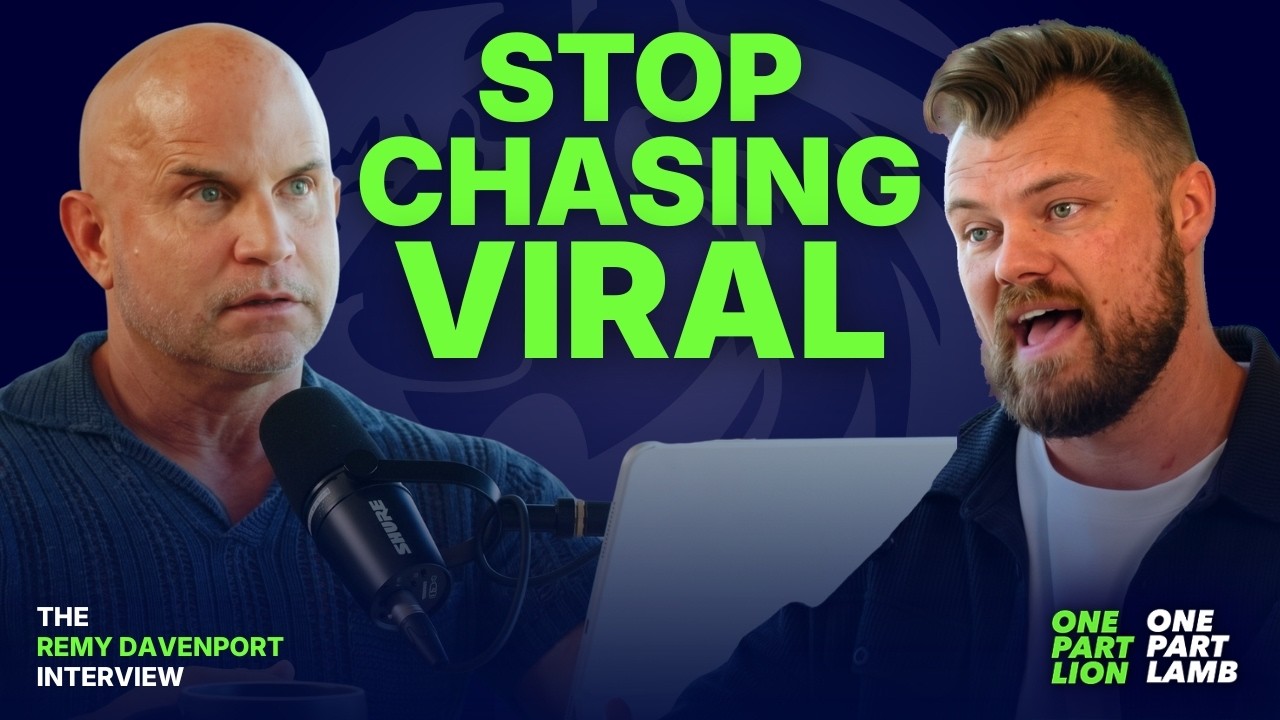
In this interview, host Stephen Scoggins and guest Remy Davenport explore why many founders struggle to turn viral content into sustainable business growth. They argue that content must be treated as a secondary business with systems, SOPs, and a team, rather than a solo creator hobby. Davenport introduces “SMART Sessions,” a proprietary, high‑velocity content‑creation framework that leverages Pareto’s 80/20 rule and Parkinson’s Law to produce complete, viral‑ready pieces every five minutes. They discuss the shift from chronological to interest‑based algorithms, emphasizing evergreen content, the power of Instagram Stories and Carousels for follower reach, and the need to focus on trust over vanity metrics. A core theme is “alignment before acceleration,” broken down into leader identity, message, and implementation, and how coaching (as a two‑way interview) differs from consulting. Metaphors such as an F1 race car illustrate that even the best systems need skilled drivers—i.e., master communicators. Davenport shares personal reflections on humility, servant leadership, and the tension between lion‑like drive and lamb‑like service. The conversation ends with rapid‑fire insights on platform choice, the primacy of the hook, content volume versus single pieces, and the importance of leveraging a clear, purpose‑driven brand bible for founders seeking scalable impact.
Chapters
Both of those being shut down at the same time, having no income, $7,000 worth of monthly expenses, no savings, you can be a little terrified. But I definitely felt that God was calling me to do something bigger and different, and I had to take that leap.
Our guest today builds megaphones for founders. However, they are faith-led founders that are actually doing the work that needs to be done before he amplifies them. Guys, please welcome the one and only Remy Davenport.
A lesson that I've learned in the past few weeks for myself that has really stuck with me is that God cares so much more about who I am becoming than what I am doing. Because in my mind, I'm like, man, I'd love to scale this business even faster because we can have more impact and do this and X and Y and all these things. Yeah. I kind of had this question where I'm just like, God, like, why has things not happened the way that you wanted— I wanted them to happen? And yeah, that message just keeps coming back to me of, I care more about who you are becoming than what you're doing. Because all I'm going to do is amplify whatever is inside right now. The reason I'm going on social media or building this brand is because I need validation, because I grew up in a home where I didn't get validation or I didn't have success that was recognized in my household growing up. But if I go out here and do this, the world will recognize that success and they'll tell me, and therefore it will fill that void that I have since my childhood.
Welcome back, family. One Part Lion, One Part Lamb. Super excited you're here. Can't thank you enough. For all that you're doing to like, share, and subscribe. You are really getting the word out. Our downloads and views have been drastically increasing, and we have you to thank for that. We do try to give you the best possible content we possibly can to help you rise, lead, and last, and learn what it really means to carry strength and surrender simultaneously, which is the one part lion, one part lamb way. Today's no different. Today I want to talk about when is the right time to actually have visibility. When is the right time to know that you're in the cleft of a rock, so to speak, learning what it takes to mature and gain the character that essentially you need in order to carry a sustainable calling, a sustainable organization, sustainable leadership, a family position? And as you've learned more and more, as we've been doing more and more of these shows, so much of it comes down to alignment, integration, and heart posture. And you've heard me share about that before, about the constraints, the 5 constraints: ignorance, are arrogance, ignorance, impatience, fear, and insecurity. Each of these different areas, these subconscious patterns, control our behavior patterns. What we don't get to talk a lot about is how do we see them in the first place and why that authenticity matters. Now, what normally is interviewing this next guest that we have in tactics and strategies, and I'm sure we'll get there on what it means to have amplified growth across all platforms, across all channels. I think what I'm most excited to talk to him about, and I think you'll get the benefit from, is actually when is the right time to be amplified versus when is the right time to sit still. So guys, please help me welcome a really good friend. Our guest today builds megaphones for founders. However, they are faith-led founders that are actually doing the work that needs to be done before he amplifies them. He, you know, as you guys know, I rebuild leaders from the inside out before they— after they get the megaphone. He gets to them before I can, which is amazing. After generating over 8— Yes. All right. Listen to this number. Okay. This is He won't say this. He's too humble for this. I'll tell him. I'll say it for him. Generating over 850 million plus views for his clients as of the time of this recording. The reason is because I look at the ticker and the ticker just keeps going up, right? He's also shut down 2 businesses, walked away from it, looking at his third. Now, out of the many things that separate him more than anything else, he screens his clients for character. before he decides whether or not he wants to amplify them. Guys, please welcome the one and only Remy Davenport. What's up, buddy?
What's up?
Yeah, dude, we're gonna have a great time.
I'm pumped.
I, you know, it's funny. I know in this world, right, there are— I get hit in my DMs literally daily.
Do you need an editor?
Yeah.
Do you need an editor?
I get pitch slapped all day long.
Yeah, I can make content so good.
One thing that'll help you with the algorithm. And
I made this video for you. Do you mind if I send it over? I was like, just send me the video.
You know what's really funny is I started— I just started applying. Hey, look, I appreciate what you're trying to do. I have no problem with you hustling to generate a lead. Yeah. But I'm not your ideal client. And the reason is, is because I don't care about metrics anymore.
Yeah.
I don't care about followers. Not that I don't care about my people who are following. Right. I don't care about, I guess they call it vanity metrics. Yeah.
Right.
It's exactly what I was gonna say. All the algorithms now are, are saying, are, are you of someone of substance that's putting something out that's meaningful?
Right.
Right. And part of that I think is what you're actually doing with your clients, which I think is amazing.
Yeah.
Because you're not just accepting everybody even though you could.
Yeah.
So I'd like to understand why it is you're so passionate about, more than anything else, about making sure the megaphones you're creating for people is actually one that's worthwhile.
Yeah. I don't know if people really understand the weight of how powerful their words are. Right? Like, I think that at the end of the day, you have the power with your voice to either influence or manipulate. You've either created revolutions or you've tried to commit genocide.
Yeah.
So the voice is the most powerful instrument in the world. And my job, I guess what we do now is like we platform people. Like, I can literally go get millions of people to take interest in the things that you talk about. The question is, do I want that to be the thing that they're interested in? Is that adding benefit to their life? Because at the end of the day, like, I don't want to bag on like entertainment content. I love entertainment. I think it's amazing. But if I'm going to do any type of content, I want content that's going to better people's lives because we're already dealing with social media platforms that literally distort.
Yeah.
the brain.
Yeah, for sure.
Hijack your amygdala. Yeah. So if I'm going to get into this industry, at least I want to be on the right side of it. And I want to know the tools, assets, and skills to where you find the right people who are actually changing lives. You start doing that for millions of people and you have chain reactions on legacies for generations to come.
That's so good. You know, I had this interesting epiphany. It's about 3, maybe 4 years ago. Myself, Rory Vaden, a few others assisted Ed Mylett with his Power of One More book launch, right? He held it at my facility in Raleigh. And I didn't build that facility for Ed or any other thought leader, right? I built that facility for ourselves, for our own events and all the things. And I had this interesting epiphany, like literally running around the hallways and, you know, the people he brought on to speak alongside of him were just like,
yeah,
the most incredible people in the world. And I can tell you that everybody in that green room was amazing. Like they were just amazing humans. Most— here's what I know. There's 2 epiphanies. First epiphany is everybody in that green room, Marie Forleo, Jenna Kutcher, Eric Thomas, Andy Frisella, Ed Mylett, Dean Graziosi. The list goes on and on and on, right? They all get to celebrate what winning looks like now, but behind closed doors, they're all talking about the sacrifices they paid to get there.
Yeah.
Right. Which is a, which is a really powerful one. Second thing that happened during that event that was surprising to me is by leveraging my team that we had at the time, and I had, I, you know, I've got world-class talent handling videography and sound and all the things and the technology in the building. Looking in that room, 100% full. Like, I think we had— we maxed out at 4, no pun intended, 408 people, which was over capacity for the rule we were, we were supposed to do. And an entire airplane of people didn't get there from California.
Oh wow.
Right? So we literally pulled everything. There's, there's video of me and Pete Vargas and Rory Vaden like pulling chairs out of offices just to— it was crazy, dude. But that, that whole event had like an energy to it, right? We then had like 37,000 people watching streaming via the customized platform.
Yeah.
And Ed, I think, moved— he hit Amazon bestseller during the event. I want to say he had 36,000 or 37,000 books sold at that event.
Wow.
Right?
Yeah.
And I had this interesting epiphany. I was like, all I did was give God my yes.
Mm-hmm.
All I did was show up to serve. I was like, okay, here's every tool and every resource that I have.
Mm-hmm.
And yet this entire time I've been focused on changing the world by myself. Like, just find my message. Just find me. Yeah, I can help you. And, you know, I definitely help a lot of people, right? But it's an interesting epiphany. It's like I just had a compounded impact in a man who was out there changing lives. So every life that Ed touched that day and the other speakers, we had a role in putting those people in front of them and having that energetic exchange. And it was one of the first times I realized that sometimes the greatest gift you can have is actually platforming the right voices.
Amen.
You know, our mutual friend Rhonda, who was on the show not too long ago, that connected us, you know, she knows that I only want to deal with real people doing real things. And she started sending me some of your— some of what you were making in content and You know, the strategies and the tactics, which we can totally get to. But I'd like to know more, first and foremost, uh, one, about why you care about the character-driven capacity, and maybe some of the earlier stage adversities that you faced that taught you how important this is.
Yeah. When I think about the parable of the talents, and you think about the king who gave 3 of his servants talents, which is, I mean, it's symbolic, but also it's a ton of money.
Yeah.
One of them goes and puts it in the dirt. One of them goes and gives it to a banker, doubles it. One of them goes and 5x's it. King comes back and the person who put it in the dirt, he called him a wicked servant. It wasn't just like, dude, you kind of wasted your time, man. Like, you could have done— he literally called him a wicked servant.
Yeah.
And when you think about the people today that answer the calling from God, which, by the way, just a Caveat, God does not call the equipped. He equips those who answer the call.
Yeah.
Right. When people choose to answer the call and be a good steward of literally the gifts, skills, and opportunities that God gives them, he amplifies it. He gives them so many more rewards. And so for me, it's one, always comes back to stewardship. In this moment, in this opportunity, what has God presented to me? And is this something that I'm stewarding well? If I'm not stewarding it well, Why would he want to give me more? Yeah, right.
How would you define stewardship? I'm going to cut you off, but because stewardship is something I'm, I'm very passionate about.
Yeah, man. I don't know if I have like a perfect definition. I wish I had it for you. But in my experience, stewardship is making the most of what God gives you right now.
Sounds like a perfect definition to me.
So, yeah. Yeah. And so when I think about, when I think about the people that I want to work with or the opportunity that God gives me right now with these skill sets we're building and stuff, He's what I, what I believe according to the scriptures and according to how I feel God has communicated to me is he's really trying to test right now, like, where are you going to go with this thing? Because this is a skill where, like, if you go down the right path, you can just make a ton of money.
Yeah.
Yeah. If you want to make a ton of money, if you want to, you know, go viral, you want to get millions of eyeballs, you want to hijack the amygdala, you know how to, like, hack into people's brains. Sure, you can go down that route. But if you go this route where you steward this and you let me guide this opportunity and your skill sets and let me put you in the front doors of the right people, we can literally change the world. And so I actually started this business to work with churches, ironically.
Okay.
Because have you ever heard of Ikigai before?
I have.
Yeah. Yeah. So Ikigai is beautiful. If anybody doesn't know what it is, it might actually be the most revolutionary thing that you learn, maybe even on this podcast.
It's like a Venn diagram, basically.
Yeah, it's like the Venn diagram. So like, if you're, if you're someone where you're trying to figure out what to do with your life or you're not sure in this next chapter what to do, Ikigai is like this Japanese framework where it's like, what are you passionate about? Or like, what do you love? What are you good at? What does the world need? And what can you do to make money doing that? Very simple convergence.
Yep.
I took all of that from my past and we can talk about my past if we want to, but I took all that and I was like, content and Jesus. So my first thought was churches. They need it. They're like the worst at social media. Like, unless it's like your megachurch down the street that has like a team of 15 people, most of them don't get around to it. And so I wanted to work with them as I started really learning business, the economics for how I built my business wasn't working well. And so we actually had to pivot and we started working with founders. Not, not every founder is faith-based per se, but most of them are, 'cause that's who we attract.
Yeah.
But we just found that the systems that we use started working really well for them as well. And that's where, for me, it came back to, man, if my heart was already to work with churches, 'cause it's in alignment with faith and it's alignment with the most important message I personally believe people need to hear. Yeah. It's like, yes, you need to better yourself. Yes, you need to, you know, love on your family. All those things are incredible and they're scriptural. Yeah. But at the end of the day, like, good people don't go to heaven. Saved people go to heaven. So if there's a message to get out there and you can amplify, I want that message.
Yeah.
So regardless, if that's the core fundamentals of like what we're trying to build, then regardless if we're going into the marketplace, I want the messages and the alignment of the people I'm working with to be people that I know that if I'm platforming them, these are people that God truly believes is worthy of that platform.
Yeah, 1,000%. Oh, we're gonna have a great conversation today. Yeah, I, um, one of the things I've been more public about recently, because, you know, I started realizing I always got this— I was gonna have to communicate what I really believed in theory to attract the people I really can serve.
Yeah.
Right. And one of the things that I believe is that there's been far too much marketing and not enough message, like real attainable, actionable message. Um, I've seen And I would say in early, early seasons, I've probably been a little bit of this as well. People trying to attract people based on assets or assets they rented or borrowed, whatever, just to make themselves—
Check out my house, guys.
Yeah. Feel and look at, look at as if you're, you're something bigger than you actually are. And I've— what I began to see is I began to see a lot of people getting hurt. Like with the marketing world, the digital market, they call it a high-ticket offer, right? You got to have a high-ticket offer. Right. I'll sell, sell a really expensive thing to people who can pay for expensive things. Right. I think that's one of Hormozi's big things.
Yeah.
Um, and maybe that's where he and I diverge because there's a lot of brilliance that he has for sure. Um, but I'm like, so let's say that, so I, my life ends. Nothing that I own is coming with me. My soul literally can't carry it.
Yep.
Right. You have to need the physical body just to pick it up. Right?
Yeah.
and my soul can't carry it, will I have actually done good work?
Yeah.
Right. And those are things I began to wrestle with a long time ago, which then led me into this belief. And the more and more I looked at the comp— because I have, you know, I've had thought leader clients that we tried to help build infrastructures for and all kinds of stuff. And it never failed that this incredible human being would struggle to build out the infrastructure they needed to fund the thing that they were called to carry.
Yeah,
due to other people in the industry that they were trying to mimic and like, well, it worked for them, so let me do that. And then that created like a shiny object syndrome, like it was nonstop.
Yep.
Right. And then let's just— let's say for a minute that they get it to work.
Mm-hmm.
Right. And they go from having this, you know what God told me one time? He said, you've been operating like a Saul. I called you to be a David.
Mm-hmm.
Right. That's a very distinctive heart posture.
Yeah.
Right. Very distinctive. And since he said those phrases back in New Zealand, the river in New Zealand, I've I've had this epiphany, if you will, of this is really what's holding leaders back. Because even these great, wonderful leaders came in with a heart posture of a David.
Yeah.
Over time, he became— carry more of a heart posture of like what we would call biblically as a Saul.
Yeah.
Um, now granted, we use Saul as an example of what an unintegrated, uh, leader looks like from a lion and a lamb perspective. Um, Saul served his purpose, right?
Yeah.
And so, and God loves Saul, right? But in this grand scheme of things, what I, what I see is this, you know, they start marketing and then they start caring more about the marketing. It's more about the money, less about what they were trying to accomplish.
Yep.
And I'm a big believer that if the service is rendered, then value will follow it.
Yeah.
So it's like the— you want to get paid for certain things or you want to get noticed for certain things, but why?
Right,
right. Do I, do I need to be famous? No, I don't need to be famous. Do I need everyone to know my name? No. Why? Because that will get me off course in theory. Now, if it happens, it's a God thing, not a Stephen thing, right? Only God can magnify what he put inside of me.
Yep.
But I've also discovered in order to magnify what he put inside of me, he had to crush a lot of stuff out of me. Yeah, a lot of things. Um, you know, we didn't get a chance to talk about this at dinner last night because your flight got in a little bit late. 1:00, guys. This guy's a legit, like, bad boy.
I'm
tired. Cranking some coffee before the show. No, but in the grand scheme of things, like, you know, I shared a story last night about how I craved the stage for, for an extended period of time. And then I went through— well, we'll call it a suspected embezzlement for camera purposes— of losing a bunch of money, being betrayed by people I loved. And then a few months later, going back to this one woman who told me, she's like, there's a cost to every calling. You can't go where you're going without going through this door. Like,
4 months later, I go back to her.
And I remember sitting, I was sitting across from her. She was at her desk. Dee Wilkins. Um, I sat across from her and I was, and I was like, you can, if this is what God requires for me to go do that work, he can freaking have it. He can have it. I hadn't seen my family.
Yeah. I
didn't know if my business was gonna survive. Um, you know, I was, we were, we were the fastest growing company in our industry of that area. And it all started from a trash pile. Right? So here it was, I thought I had made it. I built a team. I could start to step away from it, start to do these things. I took my eye off the ball. My leadership allowed for this thing to happen to begin with.
Mm-hmm.
Right? And here I was, I'm being told from an early, early childhood that, no, you're supposed to speak, teach, write books, New York Times bestseller, potentially fly private, all these different types of— all these types of things. Like, all these things have been by multiple people that don't know each other saying this stuff. So I believe that hype.
Hmm.
Right. And all of it sounded awesome. I'm like, New York Times bestselling. Yeah, that sounds amazing. Yeah. Flying private. That sounds amazing. Vacation. That sounds amazing. And then I had this. And again, I sit down with Dean. I'm like, if this is what it requires, you can have it. I'll never forget this for the rest of my life. She stopped me cold with her little, oh no, honey. Oh no, honey. Mm-hmm. She said, oh, now you're ready for it. The reason I want to bring that up is because I find that adversity is the precursor to someone who has an authentic voice.
Yeah.
So credibility. Yeah. I'd love to hear your thoughts on that.
I'm reading a book right now. John Maxwell. I'm sure you've heard of him.
Yep. He's a friend.
Yeah. 16 Undeniable Laws of Communication. First one in his book is credibility. And credibility isn't just about your credentials. It's not like you have the PhD or the MD that's in your title. Credibility comes from truly having lived the experiences that you teach.
Yeah.
He talked about a story and I love this story. I was gonna do a video on it soon about Gandhi, about how a woman with a child who wouldn't stop eating sugar came to Gandhi. And she said, Gandhi, you got to tell my kid to stop eating sugar. He looks at the child, looks back at the mom and says, come back in 3 days. So she leaves. 3 days pass by.
Mm-hmm.
She comes back with the kid. She brings the kid to him. She says, Gandhi, it's been 3 days. Tell my kid he shouldn't eat— he shouldn't eat sugar. And he looks at the child and he goes, don't eat sugar. And she's like, okay, why did I have to wait 3 days for you to say that? Nothing, nothing changed. And he goes, well, 3 days ago I was eating sugar. So the moral of the story is, if you're gonna tell people something, if you're gonna teach something, if you're gonna live it and you're gonna platform it, it should be something that you already have the credibility of. We talk about imposter syndrome all the time. Yeah. I feel like I have imposter syndrome. Yeah. One, it could have to just do with insecurities, but 2, it could also come because maybe you're talking about things that you're really not experienced in.
Yeah.
Maybe you're talking about things that you haven't lived yourself or that you don't carry the convictions of or the values of. And if that's the case, then yeah, you have imposter syndrome, but that's not what you should be talking about. So there's this temptation in content. I want to build a platform, build a personal brand, go viral, do all these things. It's like, great, sure. But then, like you said, you look at the people that are already at the top and what they're doing. And so I must do what they're doing if I want to do it. And so then you start speaking out of of authenticity.
Yeah. Counterfeit almost.
And yeah, you, you build into something where even if you build a platform, you feel like a fraud. You feel like this isn't you because you can read a script and you can make a good hook. And all of a sudden this community follows you and it's like, but dude, they don't know the real me. Yeah. They don't know that this really isn't who I am. So authen— like authenticity, credibility, it's the same thing. Like if you focus on the things that you live by, your beliefs, your convictions, your actual skills, All of those things, when you speak from that, you carry a different presence, which makes it so much easier for people to believe in you because you believe in yourself.
Yeah. I also believe that presence precedes authority.
Yeah.
Well, we talked about my, the, the group that went out, all of us sort of all now family friends, right?
Yeah.
Um, we, we had this and then, and that was like a really, like a through line for me. Um, one of the things that happened when I was early days trying to build this content, you know, build a content machine and whatever, I had everybody in my ear.
Oh yeah.
Like I want all being right. And they would say, well, you should— we think you should do this. We think you should do that. You should do this. You should have this type of funnel. You should have this type of that. This is your lead magnet you should get. I'm like, I don't even know, dude. I get overwhelmed.
Yeah, I get overwhelmed and I do it for a living.
Yeah. I mean, well, the crazy part is, is like I understand how necessary it is.
Yeah.
But I'll be— I'll just be honest with everybody right here, right now. Okay. And 100% authenticity. Can I help someone build and scale an organization and sell it?
Yes.
Is that really my superpower? I don't think so. I think my superpower to offer, the value to offer high-capacity leaders, is teaching them how to carry what God is actually wanting them to carry.
Yeah.
Properly.
Yeah.
Right. Um, there's 1,000 sales hacks. There's 1,000 marketing hacks. There's 1,000 ways to generate leads. There's I mean, you name it, I have frameworks for it all, right?
Yeah.
Things that I learned the hard way, right? So in theory, saving some of my time and energy. But what I genuinely care about is, can that leader carry the thing that they've been called to carry?
Yeah.
Do they have the ladder against the right wall? Right. Are they building an amazing business but not being kind at home?
Yeah.
Do they feel abandoned in their own soul? Do they feel like they're an orphan? Right? Do they feel like they can lead?
Yeah.
Right? Because I can tell you at every stage of leadership, we didn't start to talk about— in fact, another fun story, and I'll shut up and let you talk because this is your show.
This is the Scoggins Show, last I checked.
Well, you know what I mean. Um, one of the things that happened about 9 months ago, I was with my team, and we've been putting out business content for a long time. Uh, we had rebranded from, uh, from being— the show used to be called Unstoppable. then build, right? And it always felt close, but not 100%, right? So I'm sitting down with my team one day, and I assigned the team. I said, guys, I'm having a hard time figuring out what our core identity is. And which means I'm also having a hard time figuring out what my core identity is, right? I've been trying to pay attention to what happens when I'm in the room, like when I show up and the room shifts, right?
Yeah.
What has God done in that moment? Who's he done it for? What type of leader is that? Historically, it's always been like really passionate, high-capacity leaders.
Yeah.
9 out of 10 were faith-led.
Yeah.
Okay. Because I could be the fullness expression of myself and I could talk honestly about where these concepts and where these strategies and tactics come from. Right. So when I go and look at that, I started looking at that. But the team came. I came with the team. I was like, I need you guys to help. So just take the next month, review our materials and just tell them, just be honest. You know, no one's getting fired. No one. Like, there's— I just, I needed— I'm trying to figure this out. I need your help to do it right. So open myself up to my team. A week or so goes by, we have our next meeting, and Kyle, who cuts up a lot of our social and does even edit the podcast now and all the things, he's been with me for a long time. Great guy. I'm super proud of him, um, because even he's grown by consuming our own content, which has been incredible. to watch. But he says, he goes, I'm curious, how come you never talk about leadership? And I was like, well, that's easy. He's like, what do you mean? I'd say, well, it's easy because I sucked at it for so long. Like, I was, uh, you know, I didn't have the language at the time, but I was like, I was a very immature lion at times, or a very immature lamb at times.
Yeah.
Right? So either I was overly aggressive, domineering, controlling, egocentric, um, very driven
Yep.
Right. So my intention, my intent of my heart didn't match my actions.
Yeah.
Or I vacillated to completely the other side. It's like, whatever you guys think, maybe we should hold on to it just a little bit longer.
The whole spectrum.
Yeah, the whole spectrum, you know? And, and I, and I would— the moment I said that, the entire team perked up like this. Right. And they were like, that's exactly— almost in unison. That's exactly why you should talk about it. So we began to come from that place. How do I help high-capacity leaders carry the very thing and steward the very thing that they're called to carry, knowing that they are the main bottleneck in their business, just as I was?
So
I'll shut up.
Well, how did that— you went through that epiphany, went through that whole change. How did that change your mindset towards all of the content you created now operating under—
Yeah.
Real authenticity.
Well, a couple different things. First of all, I can help anybody scale a company, right? If they're, if they're teachable.
Yeah,
that can happen. They could be— I've— we got people in this house right now that are, um, socializing while we're doing the show, um, that I literally— they were on death's doorstep with their business, and now they're generating $60,000, $70,000 a month in MRR.
Yeah,
right. Um, and just by small little shifts, right? So I have a proven— I have that proven track record, but Even with the example I just gave you, um, that particular leader, what I love seeing more is seeing them become more of them, more of what they already are.
Yeah.
Without the baggage that most of us carry through it.
Yep.
Right. I like seeing them show up better at home. Right. Be very intentional. Um, I love, I love it when they have big milestones they win in their business. Right. So how did it shift the needle for me? It shifted the needle based on what I focused on, hyper-focused on. It became less about how can I build a— help you build a great company and more about how can I help you build the best version of yourself, right? Because that's what— that's when I was in those moments. That's what God was downloading.
Yeah.
They don't see this about themselves.
Yep.
Or they don't see how much I love this about them.
Yeah.
Right. And, and, and we've been trapped in this comparison syndrome.
Yep.
Right. And social media just amplified that as a problem.
Does it not?
You know, that kind of thing. So it's like, how do I teach them? How do I teach them truth? Because truth is truth.
Yeah.
Without having to be stated.
Right.
It just is.
Yeah.
It's kind of like, oh, the sun is the sun because it's bright every day, you know?
Yeah.
That kind of thing. So how did it shift the needle? It changed them. It changed the entire core message. Right. So if I had to put my problem down in one word, which my good friend Rory Vaden teaches his brand clients, The word is dysfunction.
Okay.
Now, I had another friend come alongside of me not that long ago and was telling me that, well, dysfunction and chaos are very similar, but I think it's— I think what you're actually solving is chaos.
Hmm.
And I'm like, well, chaos is a byproduct of dysfunction. So we went around this rabbit hole, and then I had this little jerk in my spirit said, go see what the word chaos means in Hebrew.
Always a fun time looking something up in Hebrew. I love that stuff.
Well, because it has phonetic value, numeric value, and even— I mean, yeah, it even has color. Yeah,
everything.
Yeah. Um, it's the most— yeah, my— that's one of the things I love about my Jewish friends is like, it's beautiful. Like, we get jamming on like Hebrew and they're like—
and then it's so cool, dude.
Yeah, it was funny, my, my Hasidic friends that are, that are, um, rabbis and stuff like that, they just light up when they get to tell you what something means. Yeah, like from their studies. But anyway, I digress. I'm gonna go back to
So you look it up in Hebrew.
Yeah, look it up in Hebrew. And the word is spelled almost identically to Baal.
Baal, like B-A-A-L.
Baal. Oh, like— In English, obviously, you have to go back to the Hebrew version of it. I think it's like one letter different. So then I said, well, what did Baal do when it conquered? It tried to integrate everything without changing anything, but also having control of everything.
Yeah.
And it created chaos. So I started seeing chaos as a spiritual principality.
Wow.
And that was like, that's it. You can't scale dysfunction.
Yeah,
you can't. I spent millions of dollars trying.
Yeah.
Tens of decades— or not tens of decades, tens of years trying.
Yeah,
right. Oh my God. And I remember dropping that one line out about a year and a half ago online on Instagram. They say, hey, we need you to go create some reels for us. I'm like, talk about whatever's on your heart.
Yeah.
And I was over at the apartment before I bought this place, um, and I was like, here's what I realized: you can't scale dysfunction.
Yeah.
And I remember, I remember like sending it, sending that video to Kyle. I'm like, that's it. I helped them root out dysfunction, which starts with them.
Yeah.
And they don't see it. I didn't see it. I couldn't see it.
I
was too close to it. Right. So that became, okay, well, the— if the, the problem that we solve is dysfunction, the message that we carry is you can't scale dysfunction.
Yeah.
What does it take to change the, the frame of reference to root out dysfunction? Oh, you have to become one part lion and one part lamb. What does that mean? You have to have the ability to mature into such a person that can carry strength and surrender simultaneously. Wow. Okay, well, what will that do for people?
Yeah.
It'll help them rise. It'll help them lead. It'll help them last. And I was like, all right. And then I was like, does this leader exist? In history, yes.
Yeah.
The complete embodiment of it is Yeshua, Jesus.
Yep.
And I could go all day about different versions of where you can see it clearly. But I was like, this leader may have existed in the past but doesn't exist now. Most leaders are unintegrated and dysregulated.
Yeah.
So I said, you know what? What I think God is doing with what we're trying to accomplish now is I feel like what he's supposed to be doing— or not what he's supposed to be doing, what he is doing— is he's raising a new breed of leader, the integrated leader, the Davids. And David— and when I say Davids, it's not gender related.
Yeah,
it's an embodiment of posture and presence. So that's my long-winded response.
How long, how long did it take for you to come to that conclusion?
A decade.
Yeah. See, but everyone wants that overnight. That's like the problem.
Yeah.
So it's like, oh my gosh, I love your frameworks. I love your— how do you think like that? How do you do it? It's like, You know how long I spent trial and error building, doing things? Yeah. Just being consistent because I know that that's how you come to discovery. You dig.
Yeah.
You dig and you dig and you dig, and sometimes you find gold, sometimes you find other raw material, but you dig nonetheless.
Yeah.
You don't dig because there's potentially just a promise that like, oh, maybe, maybe there's gold or maybe there's— you know that there's something there.
Yeah.
But you have to dig.
Yeah.
But like, you, you embody what most people want in 10 months that takes 10 years. And that's one I deeply respect you for that.
Well, thank you.
And I think that a lot of people need to be reminded that, like, you got to be— got to be patient.
Yeah.
Things don't come overnight like this.
Well, here's the other thing to that is 2 things. First of all, resistance is what's keeping it from coming.
Yeah.
Okay. So resistance in that you are I say you because I'm, again, I'm just, I'm speaking in myself as well as other people. You are trying to force something into existence.
Yeah.
Rather than allowing it to come. And you're resisting the forge. The very things that need to change inside of you to make the very authentic message inside of you valuable to other people.
Yeah.
Has to be eliminated.
Yep.
And because you resist going that direction and letting God work in you and on you, you can't carry the message that he's called you to carry. Going all the way back to what you were starting we started the podcast with, you're like, well, yeah, I want to help people that are, that are ready. Like the— if I'd— if God had anointed, if you will, that first stage of me.
Yeah.
Like I would be like every other guru on the planet. How much money can I make and how much— how famous can I be?
Yeah.
Only to find out it's all worthless. It means absolutely nothing. I know people myself that have done that side of things. And I've had my own version of something like this. Got everything you think you want on paper and been miserable.
Yeah. It's so funny.
Yeah.
The irony of it. I, to double tap on, um, what you were saying about being ready,
I
think that in my experience, the 2 things you have to battle is one, knowing when you're ready and also still preparing to be ready.
Yeah.
A lesson that I've learned in the past few weeks for myself that has really stuck with me is that God cares so much more about who I am becoming than what I am doing. Because in my mind, I'm like, man, I'd love to scale this business even faster because we can have more impact and do this and X and Y and all these things. And we've gone through some different shifts and we've been building a team and doing things where, you know, we're planting roots, which is great. To spare you all the details, but I kind of had this question where I'm just like, God, like, why, why has things not happened the way that you wanted? I wanted them to happen.
Yeah.
You know, the last like 6 months.
We love to control the outcome.
Right.
Yeah.
And yeah, that message just keeps coming back to me of, I care more about who you are becoming than what you're doing, because all I'm going to do is amplify whatever is inside right now.
Yeah.
And so if your desire for growth, your desire for achievement is for something other than what God and you have an alignment that's one, I would say, aligned with God's values, but what he desires of you, but also that it doesn't— you don't worship it.
Yeah.
Right. You don't worship money. You don't worship fame. It's not this deeper insecurity that, well, the reason I'm going on social media or building this brand is because I need validation, because I grew up in a home where I didn't get validation or I didn't have success that was recognized in my household growing up. But if I go out here and do this, the world will recognize that success and they'll tell me, and therefore it will fill that void that I have. since my childhood. Most, most of our insecurities.
Just create dopamine hits. Yeah. Yeah,
literally.
Yeah.
But yeah, at the end of the day, it's, you know, being ready isn't about being in a physical state. It's about a mental and spiritual state more than anything in the world. It's about what's your posture towards this? Why are you doing this? Are you just doing this for money? I literally wrote an article. I'm doing a case study right now breaking down. By the time this either gets posted or in the next like month or so, we'll cross a billion views. And I'm doing a case study breaking down all the different communication models, techniques, strategies, things that stemmed from that because I don't script clients. I don't. Yeah, I don't. I'm not going to tell you like read from a teleprompter. Yeah, we just have a conversation. Yeah, but I know what things to say. And I wrote into like, who is this for and who is this not for? And my who is this not for is a much bigger list than who this is for. And in that it's like, if you're just trying to do this to make money, I don't want to work with you. What avoid? Like, if your one metric of success in doing this is that it puts more money in your pockets, I don't want to wake up every day knowing that, man, my mission is being accomplished, that I'm making pockets deeper for people. Again, you can't take it to heaven. You can't. You can bring people, but you can't bring money.
Yeah.
Can't bring stuff. So when you're, when you're thinking about building a platform, you're thinking about bringing your message out there. The biggest question you have to ask about whether I'm ready or not is what is my heart posture towards this? And is this in a way where I feel like I'm answering a calling and that I have a message that can change people's lives, or am I doing this for a deeper insecurity that will eventually get uprooted anyways?
Yeah, man. So good. Hey there, I hope you're enjoying the episode. Look, I love making great content for you, but more importantly, we like creating great resources. So before we get you back in the episode, I want to make you aware of the Aligned Leader Index, which you can find at stephenscoggins.com/leadership.
This is a one-of-a-kind tool that I wish I had when I was actually building and scaling my own organizations. Why? Because a lot of times the bottlenecks that we think are actually in our way are not really the bottlenecks that are actually in our way. And what the cool thing about this specific thing is, it's gonna let you know what the number one constraint is internally, the number one driver that's actually in your way or being disrupted, where chaos and dysfunction are showing up.
And number 3, probably most important, where your leadership blind spot likely is. So if you're tired of your business actually running you and you wanna take operational control over your own organization, make sure you take complete advantage of the Aligned Leader It takes 5 to 7 minutes and it'll give you instant clarification on the thing that's holding you back right now. Let's get back to the show. You now have a— you now rebuilt, you know, a beautiful, wonderful, well-operating, great team, 7-figure company now, well on your way to whatever that next level is going to be. At the same time, you also made the difficult decision at one time or another to shut other businesses down.
Right? Yeah.
When you made that decision, what was the first conversation you had when you went home?
Mm-hmm. Like when I went home to tell my wife, you know, the— for context. So I ran, I ran a faith-based apparel company for like 6 years. I started it because as we were talking about, I used to run mission trips to Zambia, Africa. So I was the missions director. I would recruit the teams. I would train them on how to share the gospel. We would fundraise together. And in that process of helping college students fundraise, I was like, oh, we could do t-shirts. And I didn't want to do t-shirts where it was like you put like the country or whatever and it's like, send me to Africa. It's like, Africa is a continent, dude. It's not even a country. Just say the name of the country.
Yeah.
But like, I didn't want to do something tacky. And so one, the root message of what we did was evangelism. And I didn't want to make t-shirts that did anything less than just become the exact thing that we're going to do anyways, because evangelism isn't a 2-week trip. Evangelism is every single day.
Yeah.
So I created shirts that were conversation starters. Ask me why I, you know, feel loved. I am loved. I have joy. I am enough. All those things. And then it would say, ask me why, on it. So we started this, this mission to help people have conversations. And it was very impactful. Like people all the time saying, like, I had conversations with people that literally I got to pray over them. Some of them literally came to Christ in those moments. Absolutely impactful. Hardest part about all that, Is that I literally could not feed my family. I was a broke missionary.
Yeah.
Trying to do— but Paul was still a tentmaker. So I knew that I needed to do something and I had a family to provide for. And I was trying to do so much good in the world, but at the same time, I couldn't even hold my own family together. And when we had our first son 5 years ago, whenever it was, uh, or we got pregnant and then, then we're expecting, I had to face really hard decisions about what am I building right now and what is best for my family first and foremost. Not necessarily about like trying to make tons of money, just like literally just consistent income. Yeah. And one, my piece of advice to anybody out there, don't start an apparel company. So freaking hard, dude. It is not as sexy as people think it is. It sounds cool on the outside. It's like, what do you do? I'll run like apparel companies. Like, wow, that's awesome. It's like, I bet you have razor-thin margins and you do sales every weekend. to just get by. It's like, yes. So I, uh, can you hear the trauma coming outta my voice?
Yeah, a little bit actually. I was, I was trying to get there cuz I want, I want founders to relate.
Yeah, literally. So I, yeah, I had to, I had to come to a really hard decision. I, I told my wife, I was like, I think, and this is my baby.
Mm-hmm.
For anybody that can relate, when you start a business like that is your baby. Yeah. That's your first child. Yeah. Before you have kids or anything. So for me to, to, to sacrifice that and to give that thing up, it was hard. The Lord had to put me through probably about 12 months of pain to come to that decision. So it was one of those things where it wasn't like this, you know, I woke up one morning and all of a sudden was like, you know, I think I should shut this down. And all of a sudden just collapse everything that I had built for the last 6 years. It was like death by a thousand cuts. And I finally hit a tipping point where I said, I gotta do something different. That's cool. And so, yeah, we, we sold off the rest of the, the apparel. We donated the rest of it to churches, gave all the, the equipment away and everything. And I also had a wedding business at the time, was in content. And also wanted to shut that down. And so both of those being shut down at the same time, having no income, $7,000 worth of monthly expenses, no savings, you can be a little terrified.
Yeah.
But I definitely felt that God was calling me to do something bigger and different, and I had to take that leap. But that decision was one of the more painful decisions I've ever had to make in my life, giving up something that so many people saw that I said, hey, you can't fail if you don't quit. And for me, that was kind of like quitting.
Yeah.
You know, and so for me to, to try and be a role model for other people and to live that example and say, I don't give up, it's like I had to, to put on my hat of humility and—
well, yeah, and choice. So in my— from my perspective, and this is why I wanted to talk about this a little bit, because I do feel like there's a lot of— a lot of founders, um, who don't realize that certain, certain business endeavors are for a season.
Yeah,
right. Some are for a reason. Mm-hmm. Right. I don't think you find your lifetime business or your, your one you don't really want to sell, but maybe I always build it as you afford it because you can sell it anyway. But
yeah,
because you'll build it better. Um, but that business doesn't come along, along the way until you've learned the lessons that the other business, that the other businesses are only teaching.
Yeah.
And, uh, you know, statistically right now, most businesses don't make it
right
out of their infancy. Right. Some say 2 years, some say 5 years. And, um, you know, my larger company that I did later sell, there was definitely times where I wanted to like let that joker go and God wouldn't. God kept getting in the way of me doing it.
Hmm.
Right. Because he had a— he knew much better than I did. There were also, if I'm honest, like I've, I've get a lot of credit for scaling and growing companies now. Um, but there's probably half a dozen or more of what I thought were great ideas that I put a lot of time, energy into, a lot of money, a lot of resources, um, that didn't pan out.
Yeah.
And part of me is like, I want people to fully appreciate— one, you're in the journey and you're gonna— if you're looking at, oh, I'm gonna learn something out of this.
Yeah.
Right. Because my guess is this has changed how you built this new business.
Oh, 100%.
And for— to, to take that into the equation, I don't want people to Continue risking everything.
Yeah.
When God is literally saying, this is your ladder's against the wrong wall.
Yeah.
Just move your ladder and it'll be okay.
Yep.
Right. But then the fear comes in of not, not of what will people think of me? The fear comes in on, well, how am I going to make money? Right. Provide. Yeah. Whether you have a family or not, you're still like, I got to make money. Yep. Right. Do I go and start a new thing? Do I go and get a job? I mean, I know you had access at one time, but you literally had an offer on the table. Like, walk me through a little bit of that because I feel like that's, that's a unique experience, um, that doesn't get a lot of light, uh, around it. Because to me, that's why your, your current business and your current methodologies are so successful.
Yeah,
personally,
well, I heard it said not too long ago that Um, it's not just about failing that becomes the best teacher. It's that you learn the right lessons in failure that become the best teacher. Because you can learn the wrong lessons and you can get remarried 6 times, you know, and be like, I'm learning. No, you're not.
Clearly you're missing a pattern, bro.
I did, I did one wedding for a couple and it was their 4th remarriage. And they were like, this is the love of my life. And I was like, man, I feel bad for the other 3 people who got told that before this one. Yeah. It's like, oh yeah. So yeah, it comes to learning the right lessons and I I, yeah, I'm definitely more of a testimony of all of the mistakes, uh, and the failures that I've had more than the success. I'm still so young in this journey. I'm sure I have a dozen more massive failures coming my way, which is fine because you do it for the love of the game. That's the reason you're in it. You're not in it because you're like, I'm just trying to be successful. I'm doing this because I learned that if I fail and as fast as possible, I'm really good at not making the same mistake twice.
Yeah,
it's got to be a fundamental rule for your life. You just Because if you make a mistake with your partner where like you did not communicate well and it really hurt them, great. Learn that lesson. Don't make that mistake again.
Yeah.
If you do it over and over again, then you clearly don't love learning. Like you have complacency in your— in the life that you live, which is fine, but you're just not going to grow.
Yeah.
So for me, yeah, I had an opportunity to be a co-founder with a fast food startup. Again, I don't know how, but I get into— I got into all of the worst industries with the worst success rates. It's like apparel. like fast food. It's like I had not only a market where you had extremely razor-thin margins, but now I was in a market other than apparel where the food was perishable.
So
it wasn't like I could keep inventory
or run out of time.
It wasn't like I could keep inventory for 6 months. It was like I got 6 days on this, this, you know, green leaf juice and then it's gone. So I got to be a co-founder in that too. And, and man, I'll just say this. You mentioned it briefly about experiencing betrayal. I've seen that theme so much. I've talked to so many founders now and worked so closely with so many of them. And I swear it's almost like in the world of Marvel, because I'm a big Marvel nerd.
Yeah, me too.
It's, it's an anchor point or an anchor being. There's a specific moment that happens, and I swear betrayal just seems to be the same. And look, Jesus was betrayed by Judas. Like, it's, it's unfortunate, but it is part of like life's journeys and In that season for me, I learned what it would be like to have co-founders in a business. And I was sold a dream. I was sold this dream that if, you know, I didn't know a lot about business. I still, honestly, don't know a whole lot about business, but I learned that a lot of private equity companies were buying up these fast food chains. If you really built out a franchise model, 10 to 15 locations, they were getting a 10 to 15x EBITDA on their valuation. So they were selling for a lot of money. Yeah. So this guy sold me this dream. He was like, oh, I financed for BlackRock some stuff. If we could figure out how to do this ourselves, like we could sell this thing for $150 million. $50 million. And it's like, I got sweat equity in this deal. And I spent about 12 months having so much fun doing the sexy part of business, which is building at someone else's expense. I had a lot of fun spending someone else's money.
I've been on the— I've been too many times on the other side of the table. I'm the one funding the building.
Yeah. And you're like, man, this is awesome. Another thing we have to buy. Do we need to buy that? Okay. So I get 3 or 4 months into the launch of the business and Man, there was just so much like you talked about dysfunction, dysfunction in the body of our leadership, dysfunction in our communication, dysfunction in how we all showed up, our commitment levels, everything. And it was really hard. And I was 4 months into being married and we already, my wife and I had a conversation about it like 4 months in. We were just like, we kind of suck at marriage. Like, I'm not happy in this already. What happened? Like, I thought they said that there was a honeymoon phase that started right after you got married. It went away pretty quick.
Yeah.
Because I ended up doing too many things and I committed to this startup and it was 9 to 5. And then my other businesses were still the other times after that. And I also had to make a really hard decision to leave that business too. Mm-hmm. I just, my, my story more than anything else is just being a part of tons of opportunities, saying yes to a lot. Mm-hmm. And learning really hard lessons in how to move past those things.
Yeah. That's so good. I mean, one of the things that I'm, I'm constantly trying to tell the audience is there, there's an element where your ambition is going to basically dry out your soul.
Yeah,
right. That, you know, you're gonna— again, I didn't— I didn't learn this till later, but you're gonna get everything you think you ever wanted.
Yep.
And you're gonna look around and the people that you quote unquote built it for are not even with you.
Yep.
Right. Not part of your life. So I'm, I'm grateful that you got to experience that before that happened.
My, my kids never asked me to build a business. My kids didn't ask me to make my company 8 figures. My kids never asked for this. My kid asks if I can play Superman and Hulk. That's what he asks for.
Yeah,
that's what he cares about.
Hulk smash!
Literally. And the kid doesn't even know how to hit me. So yeah, at the end of the day, uh, I heard a quote a few weeks ago that stuck with me too. D.L. Moody: The greatest fear in life is not that we be successful, that we be successful, but that we be successful at something that never mattered in the first place.
Yep. Yep. That's good, bro. That's real good. Well, let's go, let's go ahead and switch to the business you're working on now, right?
Yeah.
Um, you're getting crazy results. Uh, what is the marketplace not doing that you are doing that you can discuss?
I would, man, I mean, everyone's creating, so I can't say that like we're creating different. I mean, we are to some degree. I think I think it's, it's all systems in the back end. I don't know if people think about— people will in the next 10 years. They will realize everyone, you know, everyone says right now like, you build a media company, like have this because you're building this media company. And that's what these are like. Alex Hormozi doesn't have acquisition.com, he has a media company. So everyone's saying it now.
Yeah.
Give it 10 years and people are gonna be like, oh, that makes sense. Because at the end of the day, you're building a business through content because it's all attention. You own that attention, you build trust, you have a community, you ask— you monetize that asset in a lot of different ways. And so when you build it, most aren't trying to build it like a business. They're just building it as an individual creator, which is great. Like, there's nothing wrong with it. But when you're talking about like, what are we doing wrong? I don't think enough people are thinking about this as like a secondary business that's within the brand of what you already have that has the ability to overnight success you, as they say, and generate millions. So Building, building content systems, a content engine, having something that's consistently producing, building a community. If you don't have those elements that are in place that can operate without you having to become full-time at that thing, then what you'll eventually have to hit those crossroads where you go, man, I've spent all of my time creating, but now I have no team and infrastructure on the back end. And that's no different than scaling a business. And then you're like, I have no team. And it's like, great. Well, now we kind of have to take a couple steps back. We got to build out SOPs. We got to hire the right people, A-players please. And then you have to kind of hit that reset button. So that will be the inevitable crossroads that any creator or individual has when they start doing content full-time.
What's a smart session?
Smart session is like our term we use because I was telling people for a while when we were getting a lot of success, they were like, what are you doing? Because I'm in a group with like 300 or 400 other agencies and they're like, well, we don't— we're not getting the results you're getting. What are you doing different? And so I explained that I was like batching content. I was like, we batch it, but I like run these sessions and here's how we do it. And they're like, oh, I do that. I do the exact same thing. And I was like, oh, okay, well, clearly I'm still doing something different because you're not getting results and I'm getting results. So I had to come up with a name that people call unique mechanisms. It's the idea of you give power to something when you give it your own name. It's your IP, right? So So we called it SMART Sessions because it was an acronym for how I pretty much structured a content session. And it only works for certain people the way that it really is designed for. It's really designed for the person who is an incredible speaker and communicator, who has tons of frameworks, stories, ideas. They are so good at what they do that you don't need to give them a script, but you also don't need to give them an outline. You just need to give them the right question or prompt and they just go.
Yeah.
But your, your job is it needs to still be concise. It needs to be within in 60 seconds or less is typically what we aim for. That's my struggle. Yeah.
'Cause I wanna tell the meaning behind the meaning.
Right? So I developed it as a structure for how I run these sessions with founders and it's based on leverage. So have you, you've heard of Tim Ferriss, 4-Hour Workweek? Yep. 2 principles he talks about in that for people who don't know, Pareto's Law and Parkinson's Law. So Pareto's Law is that 80/20 rule. It's like 80% of your output is usually from 20% of your input. So think of business, it's like most of my revenue actually comes from only like 20% of my customer base. 'Cause they're like my loyal fans. And then the rest is kind of trickling. So that's 80/20. And then the Parkinson's Law is that work fills the time that you give it. I love to use the example of when we were in school, we were always given that homework assignment and we were given it like a week and a half, 2 weeks in advance. And it was— It was still an hour before. It was still in the hour before class when we were in break at recess that we somehow managed to get it done. Amazing. It actually only took you about 15 minutes to do it, but somehow it took you a week and a half, 2 weeks to do it.
Yeah.
You know what I'm saying? So we, we falsely distort how much time something actually takes, and sometimes we give ourselves too much permission to spend more time on something than we need to. So I took those principles and I applied that into content is, well, what if I only had 3 hours with someone to work? I'm working with busy people. I only got a few hours. And how do I get to where I'm getting the 80% of the output from just that 20%? Yeah. So it's just like a highly concentrated session where the idea is every— our rule is every 5 minutes you're creating a new piece of content. But it's a complete piece of content and it still fits like a viral framework because then if you do 5 every— or you do 1 every 5 minutes, 12 an hour, 3 hours, it's 36. Yeah. So you at least have daily content to post that we have done hundreds of millions of views with because you just have to learn how to say the right things.
Yeah.
So SMART Sessions kind of became the acronym that we use that breaks down how we run that process.
I love it.
Yeah.
Yeah, it's super cool. I, you know, I get— like I told you before, I get approached nonstop on social media.
Yeah, do you need an editor?
Yeah, right. Do you need an editor? Do you need an editor?
My DMs are flooded too.
Yeah.
And I'm like, dude, that's literally—
The crazy part is, is my, my Kyle from my team has been doing my stuff for years and he's awesome. Let's go. You know, there's also so many hours in the day. And one of the ways that, um, this was going to be— this will frame a question. Uh, one of the things that I saw that Alex Hormozi looked like— it looked like that he did was he just produced a just a ton of content and released it.
Yeah,
like, you know, about every other hour is a new comp. Like Instagram back in the day and TikTok, it was just boom, boom, boom, boom. Yep. And I've been sitting with that because I've also been— well, people come and say, well, we can, we can clip farm it for you. I'm like, but I don't want you to own my stuff.
Yeah,
like, like, you will figure out some way to monetize something that I technically own as IP,
right?
And you can use that to then manipulate it. I mean, before we were verified on all the channels, you know, we used to get Bitcoin. Uh, I just signed up for your Bitcoin. Like, I don't do Bitcoin. I don't believe in Bitcoin. I buy hard assets, right?
Yeah.
You know, cause all the, you know, whatever. So it's like, yeah. But at the same time, we have hours upon hours upon hours upon hours upon hours upon hours of content that we've never used.
Yeah. Sitting.
Yeah. It's just sitting there. So, you know, take someone like myself who Uh, wants to serve people at scale. Yeah. Wants to give them very valuable insights in whatever time of need they, they got, whether they're having identity crisis or they're trying to scale a company, or, you know, they need to be— they want to be more present with their, with the loved ones, or, you know, anybody. There's— I have content for it.
Yeah.
You know, at the same time, I don't want to wait. I don't want to have Kyle spend all, all day creating content that may or may not be absorbed.
Right.
So it's how do you, how do you choose the right content for the right season to be cut up and distributed the right way?
Yeah, I think I would change the way you'd fundamentally think about it because it's not how algorithms work anymore.
Okay,
so algorithms are interest-based. They used to be chronological. It was like whenever you posted, try to post when your followers were on and active. Nowadays it's just interest-based, which means that content gets hit to your feed that could be years old. Yeah, every year when it gets around the season and we're getting closer to October and Halloween, My feed gets hit with the same videos of people debating, should Christians celebrate Halloween? Is this considered a pagan tradition? Is this demonic or is this just fun for kids to dress like Buzz Lightyear? Every year, it's the same videos over and over because the interest picks up. Political season takes off, Christmas, all of those things. So that's how algorithms work now. And so the timing of a message actually doesn't matter anymore.
Okay.
Because the second someone takes takes interest in that particular topic, if your content is good content, it will recommend it to them at that time for them.
Okay.
So it no longer matters about figuring out when is the right time for these messages, unless of course it's like your promotion is like for Labor Day or something. It's like, well, yeah, that's seasonal. Yeah. But if it's an evergreen message, meaning it can be used any time of the year, any year, you can do it any time. Yeah. Especially YouTube. YouTube's super powerful. I think it's even better when it's recommended on its recommendation engine than even like short-form platforms. So the long-form content, I get hit with stuff all the time that's years old. Yeah. But I will watch it all day because if it's good content, yeah, why would I not watch it? You know?
Well, and you're gonna go through different seasons of life, you know? Yeah. You're interested in now might not be the same thing. But my thing, how do I clean my feed out now so I can actually get the new stuff coming in? Yeah. Engage with stuff.
But well, there's, yeah, you could go a couple different routes with that. I think most people don't utilize trial reels enough today. Trial Reels is— we
are using those.
Beautiful.
We've had some growth with that.
Beautiful. Yeah. I mean, Trial Reels is your engine to post as much as you want, as often. I mean, that's a lie. I think they cap you at like 20 posts a day. But like, if you're doing 20 posts a day and you're capping at that, you probably have secondary accounts anyways because it's a lot. But point is, is that Trial Reels doesn't flood your feed. It just posts it to strangers anyways. But if you look at the algorithm or like if you look at your insights on your content and you look at where it's distributed, 90% of it goes to non-followers anyways.
Yeah,
it's insane.
Yeah,
literally. I had, I had a conversation with somebody.
Followers can't even— don't even see your content.
No, no, they don't.
We've got a friend of mine, she's a very well-known speaker, and she reached out to me about a year ago. She said, hey, you want to come on the show? I'm like, yeah, sure. I was like, hey, are you still posting? Like, I haven't seen your content in a while. She's like, I like post like 3 times a day.
Yeah, it's—
and I wouldn't engage with one post, and all of a sudden I see our stuff again.
Now it pops up.
Yep. Yeah, so
you put
all this emphasis on building your follower accounts,
your subscriber
account, and
they're
seeing your
The only way that you reconcile it nowadays is stories, stories and carousels. So for, for if anybody doesn't understand what like a carousel is for Instagram, it's like the series of images that you slide through and there's like 5 to 10 of them. Yeah, that is getting disproportionate distribution to your followers. Like we're doing it for clients right now. It's like 98% of followers.
Oh, wow.
Which is insane. I've never seen those numbers before. And it makes sense because it's on your main feed. It's not in the Reels tab. So like if you are going to scroll your feed, you will typically see more content that's from your followers or the people you follow.
Yeah.
Than a Reels tab that's just like, I'm going to give you whatever is going to distort that, you know?
Yeah.
Dopamine in your brain. So carousels is big. The second one would definitely be stories. So your stories is like on the highlights. It's like your bio picture up top and then you tap on that plus icon and you can post a story that only goes to your followers. And I have seen people People now run entire businesses teaching people how to maximize their stories. Because if you have, like, you have 100,000 followers right now, I don't know what your numbers are. My guess is you post a story, you might get 2,000 to 3,000 views, if that. Yeah. There's people who can train. Yeah. People who can train it and, and do the right things and kind of hack it a little bit to where you get 40,000 to 50,000 views. And how people monetize is once they can dial in their stories and it's hitting 50,000 eyeballs of the people that already know who you are and you make a more clear call to action for something.
Yeah.
Conversion rates are a lot higher.
Yeah. Yeah.
So there is, there is like a, there is beauty in the ashes, as I would say, in this dying world of social media that's turned into entertainment media or just business media where you don't get to see your follower stuff anymore. That's, that's where you typically have to lean towards into now.
Yeah. It's interesting watching there, just kind of looking over our social accounts like we spent spent the better part of 2 years chasing the freaking algorithm,
right?
It just felt like the biggest waste of time. Uh, we started just trying to produce the best content we could produce.
Yeah.
Um, with me being my most authentic self, which is typically— I don't even know if there's a camera aimed at me and I just— yeah, stuff just falls out. Um, and then so we use that now. We use their— our goals with, with media in general, um, is going to be one, to offer high-quality content and value to someone who's going to be watching it. Repeatedly build trust.
Yep.
Invite them into our— invite them into our world to learn our methodologies, our systems, how they work, all the things.
Yeah.
Because I know they get the results.
Yeah. Oh yeah.
You know, um, followed by, you know, share, share your— share, share those results. Like, yeah, talk about kind of how you got where you got. Um, and that's kind of— we've, we've been— at least I— this is me, I can't really speak for the team, but, uh, this is how I view social media. So when I get these DMs I'm like, I'm, I'm not chasing follower count. I'm not chasing overall, like the, the, the, the engagement services that you provide. Right. I don't need vanity metrics.
Yep.
I need real people who are getting real value for what we're creating.
Yep.
That's it.
Yep.
That is it. Which has me thinking a little bit. So I have this, this principle that I teach and it's always alignment before acceleration.
Mm-hmm.
Right. And the only reason I say that is because my story has been that it wasn't until I was fully aligned with who I was, authenticity, if you will, that I began to accelerate.
Yeah.
Until that time, I began to just bump into all kinds of different roadblocks and stress points and whatever. But part of what you've done with your organization is you have created acceleration.
Yeah.
Right. Where do those 2 frameworks kind of meet? From your perspective?
Well, when you say alignment, help me understand how you define it. Are you talking about alignment as far as like identity, or is it more alignment as in what is the objective of what we're about to do with this endeavor?
So for me, alignment is at the, at the leader first.
Okay.
Message second.
Yep.
Implementation third.
Yeah.
That's how I kind of look at
it. It's got to be
Yeah.
So
because otherwise you're not really ready to be accelerated.
100%. This is why I typically only work with like 7 to 9 figure founders. It's the dollar sign is, is more or less just kind of like if you have PhD in front of your logo, it's like, well, what you had to do to get that.
Yeah. Basically tested leaders.
Exactly. It's like the stack of proof behind you is you went to school for a long time. Yeah. You build a business that's successful 9 times out of 10. This is typically people in their late 30s and early 40s that have already gone through trial and tribulation. Made a lot of— well, I
had some of those,
a couple of those ones. And from there, they're typically on a path where they have a lot more clarity.
Yeah.
Like, I wouldn't want to service people where I'm at, like with what I do. Like, I could, I could help you, but like the way you would approach social media is so much different because you're not approaching from the lens of like, let me teach everything that I've learned from my mistakes and failures. It would be more of like, let me share the journey of where I'm going.
Yeah.
Now it completely shifts the frame of how you would even think of content. Yeah. Because alignment and acceleration, both of those things are extremely important, but it also depends on your strategy for content and like what you're going to do.
Yeah.
Because again, if I'm going to try and position myself as like I've mastered everything, I'm the guru that knows social media.
Yeah.
No, dude. Like, I'm still figuring this thing out, but I'm on a journey to figure it out. Yeah. And I want to invite you.
And you're getting great results on the journey.
Yeah. And I want to invite you guys into my learnings, the data, what failed, what worked, like what are we seeing? Yeah. So if I can invite you you into that, one, I don't get the imposter syndrome, but two, I don't have to stress as hard my alignment that I'm trying to have some message that's supposed to be coming back to credibility about me having already lived the thing.
Yeah.
My message to the beginning is like, I'm still figuring it out.
Yeah.
So when you, when you take that posture—
Which also takes humility.
Exactly. Yeah. A lot of humility. Sometimes, again, when you work with 7 and 9-figure founders, you don't always get that and it can be a challenge. But—
Well, they're really good at their thing, but this is a whole new— like, I discovered this, like, I'm really good at building organizations and companies. Yeah.
Yeah.
But when I stepped into this world, I was like, oh, I'm gonna get 10 people. I'm gonna— you're gonna do this task, you're gonna do KRAs, SOPs, all the things. And I was like, um, I was like, I'm spending a lot of money in payroll and we still don't have a lot figured out yet. Yeah, this is— I can't use a big team to build a big business.
Yeah.
Until I have a proof of concept,
right?
I totally skipped my own proof of concept, which is something I teach.
Yeah. So it's— I say this all the time. It's hard to read the label from inside of the jar. You can help everybody else. And the second you do it for yourself, it's like, why am I not like, I know these things. Someone reminds you and you're like, duh, I literally taught that to someone yesterday. And it's like, duh, I need this for myself. Yeah. So I agree. But coming back to the alignment question and to the acceleration, it definitely comes from when we interview. We call it interviewing instead of applications because it's a two-way street for us. Yeah. It's like, look, I want to make sure that this is a great fit, but do you know why you're doing this? And I need to understand your motives. motive. You want to make more money? Great. Why? Oh, okay. Because you have a family and you want to provide for them. Why do you want to provide for them? Oh, cool. Deeper, deeper meaning here. You want to spend more time with them. So what you really want is time freedom. Okay. Got you. Now I understand more of your belief system, but also your motives in this. And I align with those motives. Yeah. If I can get to the root and you, you're just telling me like, I just want to make money and I just want to— it's like, cool. I don't care how good your message is. Yeah. Because all I'm doing is actually amplifying some of the things that as a brother in Christ, I'd probably just call you out on Anyways, not amplify it to where it just ruins you.
Yeah.
Because you're, again, you're accelerating dysfunction. So, uh, extremely important to know your message, but at the same time, you won't always know your message. It takes time to figure out like, what are the core themes of my life and the things that I share? You can go through a lot of reflection.
I had to have help.
Yeah.
Just people looking at it, looking at things from the outside in.
Yeah.
Like I couldn't just, um, Again, I, I think the, the pivot point for us is when I finally stopped— when I finally said, you know what, I'm not going to just do this by myself anymore. Team, what do you see that I don't see?
Right.
Well, we see that you're really, really good with this, this, this, and this.
Yep.
We really— we see over here that you, that you want to talk about this because it's the fastest path to cash for the business, if you will.
Yeah.
But you don't really enjoy it.
Right.
I mean, you could do it, but you're not super passionate about it. But as soon as you get a high-capacity leader in front of you that's stuck in their own Yeah. Like you pull them apart and put them back together in under an hour.
Right.
Right. And, you know, so those types of things. So that's kind
of— That's the beauty of coaching. Yeah. It's, it's literally your job as a coach. It's different than consulting. Consulting is like, I'm going to tell you what to do. Coaching is I'm going to ask you questions that help you come to your own answers, which then is more effective in you actually taking action on the things that I want you to take action on.
Just so I don't forget, um, yeah, I know you've got some new systems or programs that you're allowing people to learn from what you're doing. Where can we find out more about information about that?
So right now we're still, we're still building it. So if anything, it's kind of starting off with just like a waitlist. It's a coaching program. Why we're building this is because I have found that certain founders that I've worked with, I've had insane success with hundreds of millions of views. And yes, the revenue, they're scaling to 8 figures and they just started the company a year and a half ago. But at the same time, the impact is insane. Yeah. Like, this is a family coach who is literally getting messages every single day of families that were saved, that were on the brink of divorce, children that were estranged, children that literally never wanted to talk to their parents, kids that were considering taking their own life. All of that because of content. He ran in— this founder ran into someone at an airport in Cabo and the guy noticed him. He's like, are you Scott? And he was like, yes.
That's just, that's just recently started happening to me a little bit.
Yeah. Yeah. And he was like, dude, I am literally at this airport right now because I watch your content and it convicted me to fly on an earlier flight home to be there to put my kids to bed tonight.
Let's go.
And he was like, that's cool. That's like, that's impact.
That's influence. That's manipulation.
Exactly. It's like, look, you can make the money, but it's like one person tells you that and it's like, wait, how much more is happening that I'm not aware of?
Yep.
That's actually happening behind the scenes for impact. So point is, is that we have founders like that that get insane results, and then we have founders who don't. It's like, but the same systems are being applied to both of them.
Yeah.
And the way I've articulated it recently is think about like we built the F1 race car.
Uh-huh. Still require a driver.
Just because you build an F1 race car doesn't mean that you—
We used to build some of the most comprehensive systems for people in this industry to take care of things when they're sleeping, basically, right?
Yeah.
And we tell them, we used to tell them early on, it's like, hey, we'll build this. Yeah, it's a machine, but you still have to generate traffic.
Yep.
We can't do that for you.
Yep.
All right. Which means you have to go, you have to be on shows and podcasts and speaking and maybe running ads. Like you have to go through that process. That is not, that's beyond our, our responsibility and/or control.
Exactly.
But yet I find that a lot of people want fast They
want everything without the
work. The problem is you can't build trust fast. Knowing that we, you know, just met each other this morning, like, yeah, like one-on-one time,
and
I can already tell we already have a trust vibe, right? But 9 times out of 10, yeah, you're, you know, you're meeting somebody for the first time, like, you're, oh, okay, well, they seem cool. Yeah, let's see what happens the next time we meet up for lunch, right? To me, social media and all content and all that is the same way.
Right.
Right. Can this person be, can I trust this person?
Yep.
To offer value to me. And that's the only thing they care about.
Right.
They do not care about how much I have or where I go or what. They don't care about that stuff.
Yeah.
Like, can this person help me?
Yep.
Period.
Exactly. It's exactly. So the, the idea of the, the F1 race car is you need a driver, but if you put a Lewis Hamilton in there, you're getting record lap times.
Mm-hmm.
You put a 16-year-old in there who doesn't even know how to drive a car, it might stall. You might go, you might go backwards. You might end up like Brad Pitt in F1, the first start. So the, the idea is that, uh, what I have found and what I'm building in this case study is it really comes down to your communication skills. It comes down to if I prompt 2 people the exact same question, one who's a master communicator who's built frameworks and stories and analogies and understands how to communicate to a broad audience, they can give me one answer. And someone who's just getting started with communicating in general is going to give me a completely different.
Yeah.
And they're going to get different Results, which is true.
Which is really wild because I mean, oh my gosh! Yeah, I just had this little epiphany. It's like I have watched very successful founders.
Yeah.
Answer the same question like in a dynamic, like with no cameras. They just hey me, it's like hey man, I'm I got this going on right now.
Yeah.
What do I do? What would you do?
Yeah.
And they were like you know what? You I would do it, right? And then. And then seconds later, if you will, almost verbatim, you point a camera at them and it's like, well, how do I— like, uh,
it goes away.
Uh, well, um, and so,
uh, and
I'm like, you just did it, bro.
Yep.
What do you— I mean,
it's because—
what is that?
Because when they look at a lens or they immediately feel the pressure of cameras on them, they feel the whole world is watching them.
They're
not You get one person on the other side of the screen at a time.
Yeah,
but you think it's to millions of people. It's like it's being broadcasted in Times Square off of the biggest TVs.
Yeah.
No, it's on someone's phone. Like, I was watching a video last night and it was me in bed by myself just watching the video. That's who it's to. So that's the problem is like you have to get over this mindset that it's not the world's watching you. It's like you're having a conversation with one person. Yeah. And if you can get more comfortable with that, you get better. So getting on, like, getting on camera is definitely part of it. But even like how you articulate your thoughts and communicate is so important. Like, Even me sharing the idea of an F1 race car. Yeah. Is me using a concrete example and analogy that is very simple for people to understand. Yeah. I could say, look, I've built incredibly integrated systems that function at the highest levels for people that cross-pollinate and operate. And it's like a, bro, what? Mm-hmm. No, just, I built a car and certain people can drive it faster than others. So what we're trying to do in this coaching program is essentially my favorite, one of my favorite quotes ever is from Abraham Lincoln.
Okay.
So give me 6 hours to cut down a tree. I'll spend the first hour sharpening the ax.
Yep.
First 4 hours sharpening the ax. Sorry. Because he understands that if you start swinging a dull blade, one, you're going to be exhausted, and 2, you might not even get the tree down.
Yeah.
But if you have a sharp ax, you only need a couple hours swinging. So the idea is you sharpen the ax by helping someone understand, like, one, the first answer you probably come up with if I were to prompt you with something, I'm probably going to say like, average. Like, I've heard that 17 times on social media already. Yeah. Give me something different. Give me a story.
Give me an analogy. unique experience that person's had.
Exactly. Yeah. And that takes time to build. And so the idea of this coaching program is like, man, how do I help someone sharpen that ax to where when they're ready for content, going back to this alignment thing, you have alignment in who you are? Because we build out brand clarity, we build out like a— we call it like a personal brand Bible. Basically, it's like your whole story. But on top of that, it's now you understand your frameworks, your ideas, your core beliefs, and then how those things bleed into it. Me talking about Marvel, me talking about Jesus. Yeah, I have more clarity on who I am, and I'm, I'm using that to explain concepts because that's how you become relatable for people.
Yeah, dude, that's so good. You know, first of all, um, I want to encourage everybody watching to go check this young man out. Um, when I look at the constraints, I look at, you know, arrogance, ignorance, impatience, fear, and insecurity. Uh, you've come across as earned confidence who trusts God deliberately, who's very patient and present with the people he's working with, who's willing to be taught and learning constantly, followed by humility. It's the embodiment of what I call the one part lion and one part lamb.
Wow.
It's the embodiment of those things coming together. And, the more you live that, the sweeter this is all going to get. And, it's my encouragement to anyone in the audience who needs this type of service or maybe you're on the fence because I think a lot of in today's economy, Uh, most of us need to have some form of front-facing content, uh, marketing machine, if you will, to even generate leads because people want to do business with people they trust.
Yeah.
And trust has been broken repeatedly. So, uh, dude, love that.
Thank you. Thank you.
In the few minutes we got left, I, um, I kind of— I'm curious, do you— where have you struggled the most, being more lion or being more lamb?
Oh, it's a good question. Lamb. I think lamb, man.
Okay. Why? Because you're clearly a very capable leader.
Operating in humility is not about thinking less of yourself. It's thinking less about yourself.
Yeah.
Which comes from like a servant attitude.
Yeah.
And I can get very selfish. Still focusing on the things that I'm doing and not focusing on other people. And it goes back to like how I treat my wife, like serving her without the reluctance, because I can serve her, but in my heart, Jesus sees it and he's like, man, like, I know you're being obedient, but like, I want to change that heart.
But you're being angry about it, yo.
Yeah, literally. And so it was like being up at 4:30 in the morning yesterday doing dishes for her because I knew that was like something that she would appreciate. She's third trimester pregnant right now. She needs everything. Um, but there's, there's still reluctance in my heart to, to serve others, uh, wholeheartedly in seasons because I can get so self-centered. I think I've— I personally, I think if you knew me 4 or 3 years ago, like, definitely a different person as far as like my, my selfishness. Yeah. But I still, it still bleeds into me. I think it's a vice that I still have to work through because I can, I don't try, I don't naturally try to think of myself as being more important than other people, but when you're the only entrepreneur in your entire circle that's trying to build something big, it can be easy for that to be a temptation. And so I'm constantly having to battle against that and realize like, man, their lives, what they're doing, just as important to God as what I'm doing. Doesn't matter if I'm building this empire.
And you'll learn this as a leader. If you're, if you haven't already learned it, you need them to do it well. You need, you need their love and support to build this other thing well. Um, and one of the things I've done with young leaders specifically, especially who wasn't like savants and super talented. It was like, you think you have all this work to do.
Yeah.
You're telling yourself a fib. It is not true.
Yeah.
You just need to be productive with the time you have and you need to, you need to shut— I call it brain dump, brain dump and go spend time with your family.
Amen.
One of the biggest mistakes that I made in building businesses outside of not building myself, um, was telling myself a lie, which was I was building everything for them.
Right.
Right? So I'm building everything for you. How could you not see how hard I'm working? Only to discover, no, I was building it for me. They were getting benefits of what I was building for me, but I was building it for me.
Yeah.
Right? And my oldest son— my oldest has heard it a thousand times, um, but he came to me, uh, as an adult and said, if you could just be more present when you're present, that would mean all the world to me.
Yeah.
Right? They didn't, they didn't care about vacations and not nicer And all that stuff. They just— can I lock eyes with you? Can I trust you?
Yeah, right.
So I know we're coming to the end of the episode, but I got a, I got a couple of rapid-fire things I want to run past you here. We started doing these for fun,
um, which, by the way, I'm just gonna say you're on to something here, okay? Sure. Because we, we're launching a podcast right now. It's called Office Hours. And at the very end of our segment— and again, I'm the guy that does the virality stuff— we have a segment called Real Talk. But it's R-E-E-L, like reels. And the idea is that they're all rapid fire. But what I'll tell you is that like how you ask a question and frame it as the hook is all the difference between if it makes millions of views or not, because that's what we do.
Maybe second guess all my little things. I'm going to rewrite all these.
I could, I could, but who knows? But you're on to something because this would be the distribution of the podcast and this is what would perform probably the best.
Yeah, because it's 60 seconds. Podcast has been doing well, especially with short All right. So on that topic,
let's go.
Reels, TikTok, or Shorts?
Oh man. Well, it depends on your audience, right?
You gotta pick one. You can't do it.
If you had to pick one that does all, I would say Instagram above all the others. TikTok is for a younger demographic. It's more for e-commerce. YouTube is— Shorts is really just there because they did it to copy everyone else, but it doesn't make you any money and it's false subscribers when you actually do long-form content. Instagram does everything the best. Okay.
The hook or the story?
Always the hook. Uh, but the idea, it has to go hand in hand because your hook is what makes or breaks whether or not someone even takes interest. No matter how good the story is, if they're not interested in the first 2 seconds, doesn't matter. But you can't go without both of them together.
90 clips or one great one?
90 clips.
Okay.
90 clips. Because I guarantee you that something
good might fall out.
Well, your definition of good and my definition of good is different. Yeah. So you might have one good reel and I look at the 90 and I go, there's 17 really good ones in there. They just need a really good hook.
Yeah.
And it might get 1,000 times the reach and impressions than the one video.
All right. This one's, this one, this one. So this was me talking out of my, my, both my ignorance and my past, um, frustration. Okay. Okay. Best camera in the room or best idea in the room?
Always the best idea, man. Always. Yeah. You have all the cameras. You have the most insane stuff.
You should see the stuff we used to do.
Oh no.
Oh no. Level it up.
Well, we ran, we ran really expensive gear for our first round of our podcast. And we already regret using it because the file sizes are absolutely over the top. It's, it's so many headaches. Tyler's nodding over there.
Quest 2, by the way. Yeah, the file sizes are massive.
Yeah.
Okay. Post daily or post right?
Post daily. You need data. The whole game of content, if you think about it differently than how everyone tells you it, it's all about data inference and collection.
It's also a rep.
Exactly. Exactly. It's like, it's like asking the question, go to the gym once a week or go to the gym 5 days a week? And it's like, well, you have to get the reps in. Like, you can't do 5 push-ups or just 25 extra push-ups in one day and think that that's going to make the difference. Yeah, it needs to compound.
Views or trust?
Always trust. Always trust. You talked about it, vanity metrics. It's got to be, it's got to be the first.
All right, well, I got 2 more for you.
Hit me.
One app you delete tomorrow.
Oh, one app I delete tomorrow. The irony is I would probably delete Instagram. It's, bro, I literally do it for a living and I'm like, can I just get all of the benefits and not have the platform even on my phone? It's just—
need editor.
What's that?
So do you need—
yeah, need an editor. Literally. It's, look, Instagram is a beautiful tool and it's for— a hammer can be used to build a home or it could take a life.
1,000%.
And so Instagram Instagram is not evil inherently, but what you feed into it is what it feeds back. And so depending on what your interests are and what you're doing in life or why you're getting on the platform, it could either be a blessing or a curse.
I'm gonna test your awareness as a leader with this final one.
Oh gosh.
You ready?
Uh, I think so.
The word your team hears you say most.
Leverage.
Okay. All right.
Leverage, baby.
That was quick. Yeah.
I say a lot of words all the time, but leverage is definitely like, probably I told, I told my team, if on my gravestone, if they don't change my middle name to Leverage, then they didn't do their job.
Well, dude, I've sure enjoyed having you on the show. I appreciate you being willing to be extra transparent and vulnerable. I know a lot of your content— for those of you who don't know, you need to go follow this young man, Remy Davenport. You can just go to my— if you can't find him, go to my followers and people I follow, you'll see him, right? You give a lot of wonderful strategic content. It's very to the point. You practice what you preach 1,000%. And, uh, yeah, you're doing great work, dude. I love seeing the fact that you want to help people who have amplifiable voices, right? That, that means the world to me because I'm— and, you know, one of our mutual friends, Rhonda, who just, uh, recreated MentorBox 2.0, um, we're all trying to like solve this trust economy stuff and actually start getting back to serving people, um, which is no coincidence that she connected us for sure. So
yeah, dude, thanks for having me on. Yeah, beautiful house.
Thanks, bro. Well, you're welcome here
I will be coming back.
Awesome. Okay, guys, that's going to do it for this episode of One Part Lime, One Part Lamb. As always, you probably heard someone, something somewhere in this episode that a friend, a family member, someone you love needs to hear. Please do us a favor and share it with them. And if you haven't done so already, please do us a favor. Go to any major platform, Apple, Spotify, YouTube, subscribe, like, share, comment, 5-star rankings. Occasionally we'll pull somebody out of the 5-star rankings on the audio platforms. And bless them surprisingly. You're no— you're obviously part of that journey as well. With all that being said, we love you to death. If you want more podcasts like this, obviously we do a lot of really good ones. You can click this video right here. And if you want more of instructional content where I'm just talking straight to you, hopefully getting into that beautiful heart of yours, you can click right here. Thank you so much. We'll see you on the next one. God bless. Take care. Peace.
More from Stephen


The $3 Million Mistake Most CEOs Make, And It's NOT What You Think | Rick Jordan