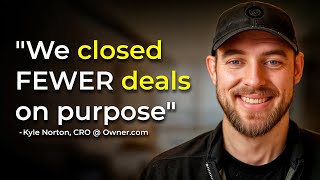
Kyle Norton talks with a founder about selling to skeptical restaurant owners. The two levers: month-to-month contracts with easy data export and no switching costs, plus radical transparency about what you won't customize. They also discuss helping restaurants earn more from direct orders instead of relying on DoorDash and Uber Eats.
Chapters
Restaurants are like a super tough market. I mean I started my career selling sales at Yelp and cold call restaurants and like, you know, and I feel like they've been burned by so many vendors in the past. They've been thrown, I mean, you mentioned a few weeks chow now, then you got doordash uber eats. Like, how are you able to kind of stand out and build trust, you know, as you work with these restaurant owners? Because as you said, like they're not amazing technologists who, yeah, I feel like they're skeptical of as you, as you reach out and be like, hey, we're going to solve all your problems and you're going to save you money.
Yeah, they've definitely heard all that before and they don't believe a word you're saying. Yeah, 100%. And they have every right to be skeptical because they've gotten sold a bad bill of goods a lot. So there's two things. One is the sales experience and two is sort of how we contract and interact with the customer. I'll start with the contracting because it's a little straightforward. We don't do long term contracts so every customer signs up with us month to month. If they don't like it, they leave. We can, we'll give them all of their customer data. They can one click export. We'll help them revert back to their old website. So we're really lowering the stakes of making a mistake for the customer and showing them. It's like, hey, we're going to put our money where our mouth is. If we don't give you a great result, we're going to make it super easy to walk away. And so you have to have some trust that we can deliver or else we'd get crushed as a business if we made it easy to walk away. And even in the early days we had a money back guarantee on top of that, we, we pulled that away because we don't need it and it reduced customer commitment. But we act with a lot of transparency and like customer centricity. We make it easy to do business with and easy to walk away. But then on the positioning side, going back to that point of view, positioning like I, I have a radically transparent sales style and so I want my reps to tell customers what's good and what's not good about owner. And, and so the trade off that I arc that we architect for a prospect was like, hey, look like no, no product is perfect. That doesn't exist. Every product has advantages and disadvantages. The disadvantage the trade off of using Owner is, you're going to get a lot less choice and customization. Your website is going to be like our core template. We're going to build the email journeys for you. You don't really get to choose the order and how those things work. Look like we're going to change the style and the copy, but you're going to have to fit into a box with Owner because we know that these are highly optimized templates and patterns that are going to work and deliver results, deliver revenue for you. But in exchange for giving up flexibility and choice, you're going to make way more money. You're going to do way less work, and you're just like, life's going to be better. And so if you care more about design aesthetic and you've got like a brand guide that you had some marketing partner do, and that's what you care about the most, don't choose us. Choose Bento Box. You can, like, it'll cost you way more, but, like, you can make it look super pretty and all this stuff. But if you just, if you just want results, if you just want to make money, then we're. We're the choice. And that level of transparency, again, just lets the right people opt in. Be like, that's exactly what I want. I don't want to do any of this crap. Okay, cool. So your trust goes way up and your buyer can opt in faster and vice versa. The people, it's like, oh, wait, so I can't do my custom fonts? No, you absolutely can't do your custom fonts. Okay, cool. Then it's not a fit. Great, cool. No big deal.
And it's such a compelling pitch to restaurant owners because probably most of them don't have custom fonts or don't care about design. They just want to focus on making good food and making their customers happy. And this is all sort of a necessary evil. And I also love how you, like, integrate so smoothly with DoorDash and Uber Eats, but while also giving them the ability to kind of have their own ordering system and can be profitable on there. Because I always thought how much those systems must eat into restaurants margins.
Yeah, they basically make no money on those orders. Takeout and delivery restaurants in general are making less money today than they were five years ago because they're giving a good chunk of that margin away to the apps.
I'm curious how you think about, like, both the, I guess the top of funnel at Owner. Like, are you doing cold calling? Are you going door to door reaching out to folks. And then maybe a second part of that question is like, does geography come into play? Do you think about kind of launching cities or different networks of restaurants? Or is it all just digital? So it doesn't matter.
We're all digital. Lots of our competitors have feet on the street and they knock on doors and, and there's an advantage to that. We have invested tremendously in our data infrastructure. So our ability to understand the highest fit, highest revenue potential restaurants across the nation is way more valuable than the potential conversion rate improvements you'd get by actually being face to face. And so we're a fully digital sales org. Yeah. Sometimes we'll have reps go in person. If somebody really wants to meet us, that's fine. But why we're able to win. And on a per rep basis, my reps close probably 3x the revenue on a per rep basis than a bunch of our competitors because we've relentlessly reduced low value work, bad data, and really just rooted out inefficiency in our system. And that can be better done remotely. You're not spending 20 minutes in a car driving somewhere and then they don't show up. That's obviously not a great experience. We've really leaned into the fully digital model and a fully optimized, automated go to market approach because again, there's trade offs. You get better conversion rates in person, but then you don't have the advantages of all of this digital infrastructure. And we've really made that work for us. Sam.