The Critical Role of Documentation, Dry Runs, and Structure with Kyle Norton, CRO at Owner.com
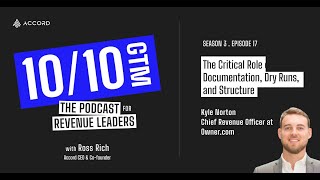
Kyle Norton, CRO at Owner.com, explains how to scale sales excellence through documentation and dry runs. He uses Replays and ChatGPT to script selling behaviors, runs mock meetings before client presentations, and builds repeatable structures so teams can iterate and improve continuously.
Chapters
Hey, everyone.
Welcome back to your favorite revenue podcast. I'm your host, Ross Rich, and we have a special guest today. We're joined by none other than Toronto Legend Kyle Norton, CRO of owner.com, who, if you're tuning in at our release, they recently raised a $33 million Series B. Not a lot of those going around these days. So, yeah, huge congrats, Kyle, and appreciate you taking the time with us.
Thank you very much and appreciate you having me.
Awesome. Awesome. Well, this is going to be a fun one. When I was reading through some of Kyle's tips for operationalizing deal excellence, I think a lot of this I can describe as kind of eating your vegetables. A lot of things that we know we should be doing and a lot of people don't. So, yeah, really excited to dig in. But before we get into those, maybe just to get to know you, how did you find your way into revenue leadership?
So I started selling in 2008, obviously when the bottom fell out of the economy. So the company laid off, I think, 40% or more of the sales staff, and I managed to hold onto my job. Not that I really realized the magnitude of what was happening at the time. I was too young. But we started building back the business in 09, and the company could only really promote managers from within. External managers didn't really work out. And so as we were, there was an opportunity for a leadership role, and I sort of forced my way into it. I would say.
Another sale. Yeah. Yeah.
I mean, I was a pain in the ass about it. I think if I'm really honest and. And tried to just, you know, put up the big number and. And then I gave a bunch of what I had built to be successful on my own to the people around me and made sure that my boss at the time saw that. It's like, hey, I'm gonna give all of my stuff away. You just watch their results. Like, I can do this and. And, you know, got that seat, you know, far too young. I was like, 22, with a year of. A year of sales experience when I got to manage a team. But, you know, it was a small company. We only promoted from within. So right place, right time in a bunch of ways, and figured it out, was successful. And then I had a second team and a third team. And so over the course of the next, like, three, four years, eventually ran sort of half of the sales org was. Was with, you know, three to four managers at the time, and. And then eventually made the pivot into technology, which is a whole nother story. But yeah, that was, that was the path to leadership.
Totally. Well, sounds like, yeah, a quick jump and probably in over your head right away being a year into selling and having to manage a team. But sounds like that's definitely your passion if that's where you wanted to go. So no surprise where you've kind of come from there. But maybe talking about the transition from being that maybe frontline second line leader to owning a revenue organization now being the CRO owner, what's the most challenging part of driving a whole revenue organization?
Everything. I would say, yeah, there's, there's a ton to juggle and be able to manage. I think the, the most difficult thing that you're, you're constantly pulled between is, is balancing short and long term. So you've got an. We're in a transactional SMB business. So every month the number, the, you know, the counter is going. So every month I have a number to deliver. Every month we're driving hard like till the end of the day to get to where we want to be just in terms of monthly attainment. But then at the same time, like in my role, I have to be able to look 6 to 12 months down into the future. And doing those things simultaneously can be, you know, can be tough. Perfect example is, you know, if you think the team is going to grow by 50% this year, then you need to have managers in place before then to be able to hire those people. And then you go, oh well, I need a second line leader before, before that. So all of a sudden, you know, something that's nine months out feels like it's a long way away on paper. But actually I need to be taking action on that today because, you know, finding that second line leader could take you 60, 90, 120 days potentially. So being able to try to see around the corner, know what those pitfalls are while at the same time being like in the deals, in with the team and really driving, driving things day to day is, is definitely a challenge in startups where, you know, you're a CRO, but I'm also, I have frontline managers rolling into me so I don't have that luxury of like a massive leadership team like I've had in the past at Shopify for example.
Totally. Yeah. If, yeah, if you're, if you're the CRO at an earlier stage company, you are the probably the best rep, the best coach, the ops, you know, leader, the strategy and finance leader for the team. Looking at the, you know, P L for the next year or two. And yeah, definitely a lot of jobs, but I think that's why people are drawn to it. Right? That's one of the, you know, it's the, the pros and cons, right?
Yeah, for sure. I love it. As Scott Barker from GTM Fund says, he's like, you got, we got the sickness. He's like, you know, you just, you just, you can't, you can't stay away from it. You know how crazy it is. I told him, I was like, yeah, I'm never going back to a startup. He's like, that was too crazy. I'm not going to do it. And then he was like, no, man. He's like, you're for sure going to do it. You got the sickness. And sure enough, I went back to a startup and way earlier than I otherwise would have chosen to, but too fun. You know, you get to build something and really like create. So I've never been happier, to be honest.
That's awesome. Yeah. It reminds me when I was, when I was departing stripe after five crazy years there, going from, you know, three of us reps to, you know, 500 plus global revenue team, I was like, oh, man, I can't wait to travel South America. I'm going to get in a van, I'm going to do all this stuff and happen to be working on this little idea in the back of my head in my last few months there. And then it's like, oh, wow, I got into Y Combinator. Like, I can't give up that opportunity. It's like he raced his first round, like four years later. The trip has yet to come, but.
I can give you the official, I give you the official diagnosis. You have the sickness, so just embrace it. Just embrace it.
Awesome. Well, to, to switch gears a little bit from kind of the, the career journey, to get into some specifics, you know, asked you for three tips around operationalizing, deal excellence and all of them I read and I was like, these are exactly the things that I need to be doing of again. Kind of the vegetables, like the things that are just tried and true, but are hard to get done on a daily basis with things popping up. So not only am I excited to go through those, but I'd actually love to get your tips for how do you build this into your culture and set these as standards that actually get followed. Because I don't think anyone's going to disagree with the value of any of them, but I think the real challenge is getting them done consistently. So, yeah, yeah. If you want to kick off with the first one. We're going to be talking about documenting absolutely everything internally.
Yeah. So if you want awesome deal excellence, people need a roadmap to follow. And if that roadmap is shared anecdotally from another rep or you in a meeting, it's not going to be very sticky. So just everything needs to be documented, especially in remote or hybrid environments like most of us are in today, and even in office, but especially remote where you have less learning by osmosis. Everything needs to be written down. So we will document the philosophy of how we run a demo and some of the principles of psychology that apply. And then there's training on the components of the demo. This is discovery training. This is how we present pricing, this is how we architect next steps. But then I actually write out word for word that entire, that entire script. And so I am a firm believer in, in scripting. Like, I, you know, you don't need to create a bunch of robots, but if you don't have a baseline of what does good look like that you feel any rep can pick up, record almost, or read almost word for word and get deals done, then, then you're sort of doing your reps a disservice. So documentation is massive. And then measuring and auditing, it is equally as important. So we use a tool called Replays, another great Canadian company. And Replays gives us the ability to compare our specific deal skills and the things that move the needle in my scripting with what is happening in the reps calls. And so we can give them scores, they get live feedback. And so whether it's that or it's just your managers in gong being really specific about guiding people back to a framework, I think documenting everything and then having a way to audit and, and give feedback is really critical. And so, you know, you mentioned taking your vegetables. I can give like a very tactical tip if people want documentation. Or is that too in the weeds?
No, let's do it. Yeah.
So one of the ways that I've really been able to scale my personal ability to document is through ChatGPT. So super easy. And this was like a big part of my first few months where I had no time to sit down and write. So I would hop on a call with an AE or even a BDR and I would just walk them through. Like, I'd write like a super rough framework of how I want this thing done and then I would just talk them through it. Like, I would coach the rep, but we would record that session, you export that entire transcript, the Natural language processing in Google is. Is awesome. Just use that and then you can dump that full transcript into CH GPT. Say this is the transcript of a sales training call. I need you to provide me a guide with sections and chapters and all the key takeaways and chat. GPT will get you like 70% of the way there. And so there have been writing jobs that should take me 10 hours that I can do in two because I'm taking just recordings of me. I have to coach the reps anyways at that time. So you just record it. That is most of your documentation. You touch it up and then I'll point out to, you know, the external assets that I think are important. Hey, this is the book, this is the podcast that you can refer to. And it's a nice, easy way to like, really scale documentation when it's hard and time consuming and it's hard to prioritize.
Well, especially as you're building the thing as you're going. It's not like, hey, Kyle, here's this thing that's humming and we're at whatever revenue, like, go out and document everything we're doing. It's like, figure it out at the same time that we're figuring it out and kind of teach the team to do it. I'm sure editing that stuff all the time too, right?
Yeah. And now it's part of our culture. People just do it reflexively and we have an incredible enablement leader who really makes sure that it's done and done well. So. But you know, earlier stage when you don't have those resources, that's a pretty, pretty easy way to do it.
Awesome. We'll love that. And yeah, definitely check out if it's another Canadian company here. Replays with a. With a Zed in Canada.
Yeah, exactly.
Awesome. Well, your next one is another one that I just feel like I need to do more and more of, but probably don't do enough of is dry runs for. For key meetings. And we're not talking about just discussing the strategy behind it. Right. This isn't a deal review type. This is actually having the mock conversations.
Yeah. And so this is all about like practicing the meeting that you're going into to get out the kinks, because oftentimes your slides look great. I know what I'm going to say on each. And then you start talking and you realize, oh, like that's actually redundant to three slides ago or that doesn't pack the same punch and you want to do your dry run with a couple different people. So Your rep is primarily doing the dry run but then the manager, maybe the VP or somebody from CS can be in the room and it's a great opportunity to get feedback and you want to have an open and transparent culture for this and know and really encourage people to be critical like put yourself in the buyer's shoes. What doesn't make sense, like where are the gaps? Where, where do you feel like this could be more concise or punchier or more impactful in terms of business outcomes. And so at, at league dry runs for our biggest deals was, was really important and it was a fun process too. Like if, if you have the right, right amount of trust in your team, like it can be a, it can be like a sort of a fun thing. And it always sharpened us, it always got us better. We don't, we're transactional so we don't dry run today. But for board meetings like our, our exec team will dry run the full board meeting, give feedback on the slides, how it's presented. So I'm still doing this today just in a, in a different setting.
That's awesome. Yeah, it's funny, you just reminded me of.
Yeah.
Some of the times that I learned the most when I was at stripe and pushing up into our kind of upper mid market enterprise team and a couple of the, the great reps on that team. You know, when I got some of these great meetings, they'd sit me down like hey, let's go through this. I was like oh, I think we got it. Whatever, go through it. It was awful. And they're like this three, this bit. And then I was in the meeting and I was remembering the coaching points from the, from the deck in the meeting and it just made it so much clearer and concise that. Yeah, that's why when I saw it I was like, okay, I need to go back to that. But yeah, that's a good, good reminder for those out there that know you should probably be doing this. Yeah. Building a habit. We actually did like a, maybe a good way to operationalize this that, that we did in the past was you'd have like a one on one buddy for like that month or the week and it would force you to like by the end of the week you need to have an important meeting that you need to run by them and vice versa and have like a mini kind of scorecard and we'd all be accountable to doing that in our kind of team wide meeting on, by the next Friday.
Yeah, that's a great one for sure. Awesome.
The Last one, which kind of ties it in a bit to both of these is provide a structure. Would love to hear your take on the importance of structure and process when it comes to revenue teams.
So this probably should have been the first one now that I'm seeing it here, but it's all coming together. Yeah. So the important thing, I think the differentiated point here, aside from documentation is having a structure allows you to iterate. And so if you have a predefined way that you're going to run your proposals and do the follow up and the environment that you want to bring your prospect into after the proposal for them to engage with, like through a cord, you know, is a perfect example of that. If you have that structure, then you have a baseline to test and iterate from. What is really challenging is if you have like three different reps who are all performing really well, all doing things in a different, in a different manner, but they're, you know, just talented sellers that is hard to scale. And so in your early days hiring Renaissance reps and you know, you're just hunting for unicorns basically for your first like two to five sales hires. But as you scale like that becomes much more challenging because the offer to those people, you don't get to work directly with the founder anymore. You're not part of that initial group. So the type of person you attract is different. So being able to provide that structure becomes more and more critical. So you need to transition from that sort of pathfinder Renaissance rep. Intuitive, just like out there making it happen to okay, this is the structure we're going to follow so that we can take a piece of it and say, okay, we've been running the post sales process in these ways. Well, what if we actually lead with the customer story instead of the proposal in my, in my buyer experience platform in like in Accord. And what if we do this and then we drip feed that and then what if we do this and over here and we then we engage this other buyer as a, as a secondary step. So once you have that structured then I can test because oftentimes people are a little nervous that my approach seems overly prescriptive. And you sellers get nervous about that. They're like, oh, I don't want to just be some like robot. But like Jocko says, you know, discipline is freedom. And so I think in this, so the structure gives you the baseline to then be creative on top of it. Then I know my structure and I can be thoughtful about the tests I want to run and how I want to iterate And I want every rep on my team to be innovating our system, but I want to innovate the system in general versus everybody innovating their own thing. That like may or may not make much sense completely.
And I was definitely one of those people that was super against the, like, heard of a script.
Script.
What are you talking about? Like, I love coming in, just trying to figure it out. And that was like the best part of it. But you take for granted the maybe intuition from some people. And that kind of like what you're saying around discipline is freedom is when things are second nature you can really be present. You can't be present if you have to be like, shit, where am I going to take this meeting? What is the ideal next step here? If you just know that and know that just subconsciously, then you can be creative with customers. Like that's the fun stuff I find. Then you can listen AE or as a CSM or anyone. It's like, I just know the shit. Like now where can we take things? How can we add stuff on top of, how can I really like wow them and provide this incredible experience? You can't do that. If you're thinking about like, where am I even taking this conversation?
Yeah, this is my whole pitch for why scripting is great. You know, like automate the stuff that's repetitive and basic and engage the seller's cognitive capacity to the things that are truly like difficult and challenging. Which is like listening super intently, finding the small cues and the areas where you think that there's a buying opportunity. Ask those second and third level questions. Having that structure and the framework underneath it allows that to happen. So that's, that's a point I very, very much agree with.
Totally. Definitely a misconception out there. I think for people that are maybe earlier in their career as either sellers or managers is like, oh, I don't really want to overwhelm my reps. Oh, I don't want to tell them they have to do this thing. Like it's the opposite.
You're.
If you, you should be, have conviction into the things that you're saying that work. And there's a problem if you don't, if you don't have things that you say that this is just the baseline that works. Make it your own. But this is the standard that we all need to be at. So actually the last piece before we move off this just reminded me of a conversation we had at. Was it Flo's Diner? I don't know, six, eight months ago, Incantations the magic words that you can say. This is another reminder of something you said to me that's like stuck out since then because it's so true. Would love to maybe spend a second on not just the structure of the sales process, but some best practices. Like there are just things and I know you're really big into like the human psychology stuff behind sales. Like there are just things that work and it's for some reason there's this lack of general best practice and understanding that it isn't just some charismatic, you know, good talker out there that does sales. There are just baseline things that you can learn to become a great professional seller, like an engineer, like a product designer, like a marketer. And I'd love for maybe you just spend a couple seconds on kind of your thought process around that and how you think about driving that to your team. Since I think this is one of the weirdly like least talked about, kind of like required things in sales that I think should just be the baseline standard for every team.
Yeah. And so I try to take a tops down and a bottoms up approach to this topic. So the, the tops down is scripting. Like I'm just going to give you the golden script, as we call it. The things that you can literally follow word for word and get the job done. We had a recent bdr, we've had two BDR to promotes in the last few months and they've both come out and just like ripped it like day one, hitting and exceeding quotas. I don't think either of them have missed quota yet actually now that I say it. And that's because they're, they've, they've come up through our system. They're, they're embracing what is there and they've followed, followed like the dedicated frameworks and taken feedback really, really quickly and like not tried to reinvent the wheel. And now they're developing the craft on top of it. So that's like the top down part of it and you have to have great craft and be thoughtful as a sales leader to build that and dedicate the time to it. But at the same time I'm trying to build bottoms up. So in all of those documents that I talk about, so in my demo script, in the top part of it, there's like the underlying psychological principles, then there's the skills they need to apply. Because if you can teach, especially this is an adult learning principle. If you can teach an adult learner the underlying mechanics of what drives, why things are scripted a certain way and why skills are taught a certain way, then one, the learner is going to be a lot more engaged in it. They're going to, they're going to be, they're going to believe what you're teaching a lot more. Adults need to know why it's a big difference in how adults learn versus kids. And then they can take the scripting and they can intelligently know how to test on top of it. And so, you know, a good example of that is something I talk a lot about, like psychological reactance. And so this concept of it's very innate in our human nature that we don't want people to force us into things. Self determination and free will is like a very important, like human characteristic. And so when we feel like we're being forced to do something our, even if it's good for us, our reaction is to resist.
Yeah.
And so we oftentimes when we push as salespeople, we're actually doing ourselves a disservice because we're triggering this reactance so, so significantly that even if what we're saying makes sense and is the right next step, your, your buyer just like wants to shell up. And so you teach somebody that and then you understand why. My closing framework is written in a certain way, like why I'm not like jamming down a close why. It's more questions based why. There's like a set of leading closing questions into, into that. And so people can really wrap their, wrap their heads around it in a much more meaningful way. So, so explaining the why to all of these concepts is, is really critical. You know, even negativity bias, you know, the, the, the desire to run away from pain versus run towards gain. Like these are very foundational things in psychology that if you can teach, you just create much more intelligent sellers. So I'm doing those two things at the same time. I'm trying to teach like the very most basic foundations of human psychology while at the same time handing you a script that you can read.
Basically tie them together, right? Then they see those things in your script and they're like, oh, that's why he's doing these things. And they can kind of get there both themselves. But also it's like, here's the plot, here's the thing you can start doing today. So you don't need to become, you know, an expert in this field like myself. It's like, here's the outcomes of some of that. I love that. And it also reminds me of something that I was reading the other day around like Elite teams and was reading, seeing about Coach K, one of the famous Duke football co. Duke basketball coaches and the US Basketball gold medal team. He was saying that elite teams have standards. They set standards, not rules. Because people want to break rules. People don't want, especially like the best of the best. They don't want to be told what to do.
Yeah.
They want to be on a high performing team that has an incredibly high bar.
Yeah. Yeah. And, and I don't know if Coach K borrowed this from Bill Walsh, but the super famous hall of Fame NFL football coach, but Bill Walsh has an entire book about this called the Score Takes Care of Itself and he, he calls them his standards of performance. And so it's, it's, it's a ferocious and ferocious work ethic applied to continuous improvement and then it's. It. Yeah, ferocious for a ferocious work ethic applied to continuous improvement. And he's got standards of excellence for everything. And it's not a rule. But like this is his assumption. If you want to be a part of this team, this is what you're opting into. It's, it's a different framework but yeah, it's, it's, it's really cool. I want to.
I've heard that title. I'm so glad you mentioned it because I've heard this title a ton and haven't checked it out and looking for another book.
So I'm definitely amazing.
Right.
It's one that I recommend a lot. It's, it's so, it's so great and because it's all about just focusing on getting better at your process day to day, focusing on your inputs and how you're doing your work and assuming that then the results, the results come. I think it's an important lesson for salespeople because we are in such a method metrics driven environment that we can get wrapped up in the outcomes and lose sight of. Hey, actually the outcomes is just about daily discipline. Are you, are you coming in and doing the things that you know will lead to results on a daily basis, in and out or are you, are you finding motivation and fits and spurts and sometimes you get the result and sometimes you don't. But like if you, if you learn to love the journey and learn to love the process, then it's a much more sustainable type of motivation.
Yeah, it's that balance of both being out outcomes driven culture, but understanding what the inputs are to get there. Right. It's not just like here's, here's the destination, go and do it. It's like and then here's how we're gonna get there. And supporting kind of those. The culture and standards around that. Yeah, for sure.
And it's not even like the call inputs. It's the, it's the, it's the mindset.
In intentionality behind it.
It's the craft. Like, what, what is. What is my day to day? And how do those things add up to being able to do the call and email and. And demo inputs? But like, it. It's the process. Like, do I control my day? Do I have a plan of attack every morning? Have I blocked the things in my calendars that I want to get done? Do I have a process at the end of the week to review what I've done and ask myself questions about like, if I accomplished things are not and why and how do I adjust the. The day after? Do I have control of my physical and mental health? Am I sleeping well? Like, those are. Those are the controllable inputs that I'm more concerned about. That's the process versus, like, hey, did you make 100 calls? Because like, you know, everybody knows calls can be like a range of different quality.
And do you train your team? I would love to maybe pause and go off on a bit of a tangent.
There's.
Because I think a lot of those things are. What I see in the top performers is the kind of that idea of controlling every top performer, whether they're BDR or you know, VP of sales. I see takes the ownership. They treat their job like the business. Right. They're like, this is my company and they think about their life. And all of those things and all the things you just mentioned around taking care of their. All those facets of life is that.
Yeah, we think about this, I think.
Is trainable and that you bring into your culture. Because something that maybe is a limiting belief for me, I have assumed is innate and it's something that's not coachable. I'd love to get. Maybe let's digress to this because I think this is so important when we're kind of tying it into structures and system and culture. You're never going to find, I guess it's going to be really hard to build a team of people that are 10 out of 10 on that dimension.
Right.
So how do you train that into your team and culture?
Yeah. So you're never going to find somebody who's perfect on all those dimensions or else they're going to be in the next role. So. So you're always trying to find people that have some strengths that, you know, you can bet on and have the right mindset and raw attributes. So, like, they have to have a growth mindset, they have to be resilient, they have to want to work hard and have a high drive. Those things I don't think you can really teach, but organization, some people just haven't really been taught how to stay organized. Like, we don't teach this in school crazily enough. And so when people start on our team, we're, we're really disciplined and we've got it all documented from the IC level all the way to the leadership team. Like, these are our operating rhythms. This is how you control your day. We have, you know, we do math of sales at the beginning of the month. Every rep sits down with their manager. This is where I want to get to personally. These are my conversion rates. If these are my conversion rates, this is, these are the inputs and outputs that I need to get to the number. And so this is how I'm going to go, like about my day to day. And then the manager and that person can stay in sync throughout the days and weeks and make sure they're on the right, on the right track. And this is all documented. So math of sales happens. And then we've got even like the detective work that needs to get done to get restaurant owners on the phone. And so a lot of, for us is about being really precise about when you're calling people back. Restaurant owners are sort of all over the place. And so you need to know, like, when that person might be free and to be able to get them. So a rep can't just like, go through their sales loft tasks, although they do. But they have to be like, really good at controlling their calendar to know, hey, I gotta call Ross at 11:45 when he's going to be in the car and I can get him for 10 minutes and get a pitch out. And so we do a lot to teach this discipline. And, you know, I don't want to say brainwash, but indoctrinate people to like, know that this is important and believe that they can do these things well.
Those are even things that you can control. And this is, this is the thing that's kind of blowing my mind is like, I just assumed that, that there's some people that are like, I'm going to think at that level. I'm going to think about exactly when I'm going to call back Steve and the cadence of these details. I love that you're, you know, kind of indoctrinating people to these best practices because I don't think most people, again, going back to like, these magic tricks and sales that the top people are doing. How do we standardize this? How do we make sure that this is generally accessible things for people to be more successful in? And not just for sellers, but also it's a better experience for customers if people are taking a more thoughtful approach. So, and this is our.
This is arguably one of the biggest changes for new hires that we make, especially on the BDR side where it's, where it's particularly relevant. And so we spend a lot of time in the onboarding and in the initial, like, weeks of coaching to get people to know how to run that playbook. And the results are, are significant. People go from getting like 8 decision maker connects a day to 15 in the course of weeks. All right, now, just like, you're already good at pitching, you just need to get people. So here's the discipline, here's. And that flows to everything. Like, we've got like a popping health and fitness channel, and I've got like an Instagram, like, DM group that's called the Stoic Squad. And I, I'm just, you know, like, everybody's just sending the cool things that they're, they're seeing on Instagram, like, no memes. It's just like this is, this is like videos from like Huberman and Ryan Holiday and it's motivational things. Like, so you just have to have an environment that, that gives people the desire to be great. And then like, you got to get those messages through. And so, like, that's a big piece of this. Just the operating model is dialing that in and getting people to, to know how to execute on it.
Totally love it. Well, I know we, we digress from a few other things, but honestly, this is stuff that, you know, I obsess over. And I think people listening there, I think the biggest takeaway that I have there is maybe there's more you can do, there's more you can control around the team that you're building in terms of culture, in terms of some of these things that we might assume are innate to certain profiles of hiring and going the extra mile to kind of set that as your standard. I absolutely love that. Well, we got, we got a few more minutes here. I know we had kind of a few strategic best practices and tips. I'm not sure if we want to kind of hit on those before we get to the, the rapid fire questions, but any of those that we thought through before, I know you're, you know, a big proponent of investing in RevOps and a couple other things maybe want to say a few words on on that before we before we wrap up?
Yeah, I'll combine the first two here. So one, invest in RevOps earlier than you think you need and you'll think thank yourself later and and whether it's just getting like a contractor, that's really great to work with you. But making the investments early in rev ops will make everything better. Every rep is incrementally 10, 15, 30% better that that investment. Trade off AES from your headcount plan, find the money somewhere else. But consistently one of the things I've done that's paid off in spades is like getting that getting that role in early and as a piece of that in the RevOps landscape, the thing that I would focus on dialing in as quickly as you can is data. If you because every organization I go into.
More from Kyle
E99: How GTM Revenue Leaders Are Operationalizing AI for Growth with Kyle Norton of Owner.com
On the Record #14: Change management made simple with Kyle Norton (CRO, Owner.com)
Scaling SMB to $30M, Investing in RevOps Early, and Stage-appropriate Sales Hiring with Kyle Norton

Building Repeatable Revenue Engines at Outreach and Catalyst with Mark Kosoglow