Why Sales Teams Need Better Coaching | Winning Through Adversity with Kyle Norton
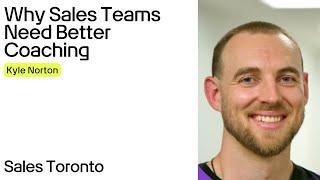
Kyle Norton, CRO at owner.com, says most sales managers skip coaching because they think it doesn't work. He recommends separating coaching from one-on-ones, using questions to let reps analyze their own calls, and running isolation drills with expert feedback. New reps should hit half quota in month one, full quota by month two.
Chapters
We're off to a great start. Yeah. Yeah. What's up, everybody? I'm too excited. We got David Primer's content. We got stoicism. We're going to talk sales coaching. These are all my favorite things in life. I have a very exciting life. All right. I'm Kyle. I'm the CRO@owner.com. we are a Series B software company. We sell into mom and pop restaurants. Think of us like HubSpot plus Shopify for little tiny restaurants that you order takeout from. And I spent three years before this at Shopify and lots of folks in this room I've spent some time with. So good to see everybody. All right, we're going to talk about coaching. David and I did not coordinate on slides, and it's going to seem like we did because we're going to touch on a lot of good stuff. My favorite part of the book was his longest chapter on sales. Coaching is the thing I am most passionate about when it comes to leadership. So we're going to have a lot of overlap here. So we're going to talk about how to win through adversity. I think in any market, this is what is the most critical thing you could possibly do to win. The stats back it up. However, most companies suck at coaching. David talks about prioritization as one of the problems of sales coaching in the book. And he just shared prioritization, I think, is part of it. And I think a large part of why sales coaching is not prioritized by the manager is because they're not very good at it. It doesn't feel good to coach because they're not walking out of that meeting feeling energized by the progress that they made when. With their ic. And so when you don't really like doing something when you're not good at it, it's easy for that thing to get shuffled off the calendar cause of other priorities. And I truly believe that if we were great sales coaches, if we were given frameworks to be able to know what great coaching looks like, we'd probably do a lot more of it. And there's a lot of good stuff in David's book. Funny story. Just before we jump in. So we're gonna be talking about his leadership book, and there's a lot of ICs in the crowd. If you haven't read David's first book, you should definitely read it. I texted this to him after I read it. I was like, I'm really happy for you. But also some jealous rage because this is the sales book that I wanted to write, this is how I want sellers to sell. And so of all the sales books that are out there, Sell the Way youy Buy is like one of the ones that I recommend most frequently now. I think it's an awesome book for modern selling and I really, really liked David's most recent book. I'm not just saying that because I'm a friend, but I really do think this is super applicable. So if you're a rep, go get the first one. If you're a manager or an aspiring manager, please pick up this book because there's a ton of really useful frameworks like stuff you can go and do tomorrow as a sales leader. And I'm gonna share some of my favorite takeaways and build a little bit on top of that with some of my favorites stuff as well. So most companies suck at coaching. Most managers suck at coaching. Nobody has been properly taught how to do it. So I'm going to share a little bit on how to do that better. So David already shared these stats on his slide. So this is the coordination I'm talking about. When you coach reps, they get better, they succeed. But most coaching is not super effective and most reps don't think your coaching is awesome. There's a disconnect between how great we think we are and as coaches and the experience from the reps. So we're going to talk a little bit about how to do that better. This is a big conundrum and David breaks it down into three key problems and a bunch of really actionable takeaways. And I think it's a great way to frame this whole thing up. All right. For some reason, my colors are all weird now. But David cites three main issues. One is that we don't prioritize coaching. I think that's because managers are actually avoiding it. They're letting it slide off their calendars. It's if you're asking me, there's not great frameworks to use. This is a lack of enablement. Enablement I would argue is probably 90% focused on the rep and 10% focused on the manager. I think 60% manager, 40% rep would leave a lot of companies in a much better place. So frameworks are significantly lacking for managers to be really effective. And there's some good ones, especially diagnostics in the book. And I'm going to focus on number three here is managers tend to tell. We get into a coaching meeting and we look at a deal. Your rep presents a problem and then you talk at your rep for 25 minutes. And that's not coaching if you look at the definition. And so I'm going to talk to you about what I believe is real coaching, which is not telling, it's not deal inspection, it's not forecasting, it's not. What do you got on the calendar? None of those things qualify as coaching and I don't believe that coaching can happen in that meeting. You should have your one on ones as managers and then you should have separate time and you never mix the two. So your one on ones can slim down depending on the cadence of your business. A one on one, your pipe review, what's holding you back? That type of an engagement can be a 15, 20 minute meeting at the beginning of the week. I strongly, strongly encourage everybody to separate their coaching meetings. If you want better coaching, book that on your manager's calendar. Take control, take control of your own growth and development and put a separate 30, 45 minute meeting on your manager's calendar or book if you're a manager, book that separate time for coaching. Not telling, not deal inspection. So that's sort of thing one here. Okay, so now I'm in my coaching meeting, I'm in my separate coaching engagement. 30 minutes separated from my typical one on one. What's happening in there? So I'm going to share two frameworks and I can get into a little bit of depth. But I was trying to keep the slides slim here. So in my mind, great coaching has to be questions based. We're going to talk about two different principles. Principle one is great coaching has to be questions based. And so Nicole, do you remember the first book that I recommended to you when you were becoming a manager shortly? That's probably the second one, but yeah, Talent Code and then the Coaching Habit by Michael Bunge Stanger we got there is my favorite book, one of my favorite books on coaching because it's all about how do you coach through questions. We don't learn much being spoken at. You're probably not going to retain very much of this tonight because this is the worst form of learning. There's a thing called Bloom's taxonomy. It's like Maslow's hierarchy but for coaching. At the bottom of the pyramid of effective coaching is just standing or sitting listening to somebody talk at you. The retention and recall of this information is going to be very poor. And then you go up Maslow, up Bloom's taxonomy up to the top of the pyramid. Things like analysis and creation are much better forms of learning. So if you put your learner in a situation where they have to inspect something of their own, that's going to be a much more effective engagement. And there's a bunch of principles of neuroscience that go behind this. The error feedback loop is a really big thing. Learning based learning, relevance is another thing. So you want to coach with questions and so an example of this, I'll lay out how this is going to happen in a coaching example. So I get in there and I want to audit discovery. David talked about his favorite part of the first book, Discovery. So let's go there. I'm going to play a discovery clip. So I'm playing the clip for the rep. I know where I want the rep to go because I've listened to the clip, I've done my own diagnostic and I know what the biggest problem is that this rep has. But I'm trying to lead them to that outcome. So I'm going to play the clip. Paul, what do you think you did well here? What do you think you didn't do too well here? What do you think is the number one problem with the discovery that you ran in this situation? And the rep will say one thing and another and they're going to struggle and, and you're gonna wanna bail them out because it's sort of uncomfortable and it's gonna feel like, oh, this person's really struggling to get to the answer. I wanna give it to them. The struggle is good. Going back to stoic principles. The struggle is where the learning happens. The struggle is where I build neural circuitry, where I'm building neuroplasticity. And so I'm going to just give the sales rep the most small breadcrumb to help them get to the piece of that call where their biggest problem was while letting them basically, or hopefully they get there on their, on their own. So through questions I can lead the, lead the sales rep to the, to the area of that call. That's the biggest opportunity. See, you heard the business problem. Our X platform doesn't connect to Y. But I didn't get down to a personal pressure like why, why does that hurt for you? As, as the director of it, VP of marketing, how do I make this problem feel personal so that it can be prioritized going back to David's session. And so I'm guiding the rep through questions to this place and when they get there, great. And what would you do about it now? And then we get into role plays and you can rep that, rep that rep that. So great coaching is questions based. We record a lot of Our coaching conversations with coaches gong so that I can pull some of these diagnostics. And we're a transparent selling organization. So I'm cool with all the gong transcripts floating around. But this is a great way to just pull, talk, listen, ratio the same way as a seller. You want the buyer talking a lot. The manager should only be talking 30 to 40% of the time. So really easy like tip for you to implement to be better at coaching. And, and then what I do as a leader is I then listen to these coaching conversations with my managers and give them feedback on that. So great coaching is questions based and I'm letting the rep get to the right answer and struggling to do it. That's where learning happens. Okay, could have used this slide there. Start really wide, go narrow, use breadcrumbs, let them get to the answer, don't bail them out. There you go. What other slides do I have in this deck? Okay, thing number two, great coaching is focused. So I like to use a golf example here. If I show up to, if I'm a golf coach and I show up and Nicole is my student, I say, okay, Nicole, we're going to do 10 putts, 10 chips, 10 pitches, 10, nine irons, 10 drivers, and we're going to call it a day. How much better is Nicole going to get at golf in that session? Not better literally at all. There's not enough repetition happening. And repetition is where we form that neural circuitry. Repetition is the heart of neuroplasticity, the heart of the myelination process that Nicole was talking about when I asked about the other book. So we want to be massively focused. So I take discovery. I never, ever want to listen to a full call. I don't like saying never. Almost never listen to a full sales call. I'm going to narrow in on one thing. So we're just going to look at discovery, if that's what your diagnostic and David's got great diagnostic frameworks in the book. Your diagnostic says your discovery is not very good. So let's go into discovery and find the one thing. And we're only going to do one thing in our time together. And I'm leading him there with questions or her there with questions. And, and I'm going to spend an entire coaching conversation just on this single topic. So I lead with questions. We get to the thing we've identified in the first five, 10 or 15 minutes what that opportunity is, because now they are analyzing themselves, one of the good parts of Bloom's taxonomy. And then I'm Going to get into reps and I was going to put in a slide on how to do this, but didn't have time. I got LinkedIn content on it. You can find you're gonna be really tempted because you're super eager awesome managers who love sales to coach on 10 things. Don't do it. That's the worst thing you could possibly do. So I'm gonna take that one thing. I'm gonna lead, lead the rep there, and then I'm gonna do rep after rep after rep and I'm gonna, for us, I take the clip of that call. So we listen to that clip of the buyer saying whatever the buyer said. And then I pause. Okay, now go for it, Paul. Go like you heard, you do it the wrong way. We've talked about what the right way is. Now go for it. And then I let Paul do it and then I jump in and pretend to be the buyer and then we go maybe like, you know, another one or two back and forth and then I stop and then I go back to the beginning again. And I'm going to go through that same jumping off point over and over and over in that coaching conversation to give hopefully like 10 plus reps at executing that exact same skill until they are awesome at it. And that is focus. And so what I'm doing as the manager is I'm slowly dialing up the progressive resistance each and every single time. So the first time the rep does it, we play the clip, you go as the rep, and then the feedback I give to you as the mock buyer now is like pretty easy. You get it right, we do it again a little bit harder. Do it again. Now I'm doing a harder variant of that thing and I'm just going to be mixing up those inputs, mixing up the pattern, but we're doing the same topic over and over and over again. So that in that 15 minute, I call them isolation drills, in that 15 minute isolation drill assignment, we've done many, many reps of that thing. And they've actually built a new skill so that when they're ready to do that on the playing field, I'm good. I've like shot my hundred shots. I feel like I'm ready to execute. I can do that on a call. If you give somebody feedback on 10 different things, you talk at them for 25 minutes and you're like, go do that on demos now. You're never gonna make any progress. And this is why most sales coaches, sales reps don't think they're getting coached because that's not coaching. This is coaching. Questions, focus reps. Isolation drills. Probably been going on for more than five minutes. So let's wrap up. Go buy David's books. I already plugged them at the top. I'm gonna plug them again. I do really like them, and I'm hiring for a whole bunch of roles. So if you're a top 5% performer and you want to work really hard, but sell an awesome product and get a shitload of coaching, I would put our volume of coaching against anybody in this room. I'll throw that out there. Come hit me up. Thanks, everybody. Awesome. Any questions? Just quickly. Okay. Yeah, one second. I'll just run this to you.
Kyle. Thanks for that talk.
That repetitive isolation drill can get a little bit grinding. How often are you doing that isolation drill? Like, let's say, I don't know. How many times in a month? Let's say. Are you doing every week? Yeah. Oh, yeah. This is the core. This is the core learning experience in my sales teams. Because how else do you get better at that thing if you don't do it? So you have to, like, just giving somebody the advice. Oh. Instead of this question, it's that question. All right, go do that. I get into the line of fire on actual sales calls, Everything goes out the window. Cause you're thinking about a thousand things like that repetition is what you need. And to make it not boring, it's progressive resistance. And I make it harder and harder until it's basically as hard as a prospect could make it. And then if they're, like, acing it, I'm like, okay, every time, then we move on. If that's 5 minutes, 7 minutes, 15 minutes, we'll just keep going until they've baked that skill. Then they do that skill. Then there's an expert feedback step. So you go do it now. Send me one call where you execute this live, and then I can give feedback and tweak a little bit. That's the. That's the reinforcement. It's called expert feedback loop. Then if they're successfully doing it, then the next week, we move on. Or if you're still sort of struggling and you, like, it was okay, but it was a little scruffy, we'll do that same thing again. Repetitions, isolation drills for that same topic. Awesome. Thank you. One more. Okay.
Hi, Kyle. I just wanted to know, what's your success criteria for, say, like, a new sales rep who's just joined? They've just been there for about two or three months. How do you define success?
For them. So we are a very transactional sale. So our sales cycle is like a week and so and we are pretty aggressive. Like we have reps on the phone four days in because they go through like tons of isolation drills. Like our, our onboarding process is very activity driven. So you're doing a lot of stuff to get ready to hit the phones and take demos. So I want to see people doing about half of a full quota in their first month, full quota second month. But the leading metrics are are you building and moving pipeline? Are you learning? Like, can I tell that you're learning these skills and acquiring them and are you going about that with like an intensity and enthusiasm, like the results? There's a lot of luck. You know, a guy who a lot of people here worked for, Hunter Madley, said this at a golf thing that I loved. Sales is the least fair career in the short term and the most fair career in the long term. And so lots of stuff you could get like bad deals or a crappy patch. And so like the first 30 days I'm open minded about the specific performance. As long as I see the learning effort, the intensity and the right attitude. If two out of the three aren't there, then I'm pretty fast to performance manage. We're like a very performance centric environment. Awesome. Okay, thank you. Another round of applause please. Thank you.
More from Kyle

E99: How GTM Revenue Leaders Are Operationalizing AI for Growth with Kyle Norton of Owner.com
On the Record #14: Change management made simple with Kyle Norton (CRO, Owner.com)
Scaling SMB to $30M, Investing in RevOps Early, and Stage-appropriate Sales Hiring with Kyle Norton

Building Repeatable Revenue Engines at Outreach and Catalyst with Mark Kosoglow