AI-Powered Sales: How AI Is Redefining the Enterprise Selling Process
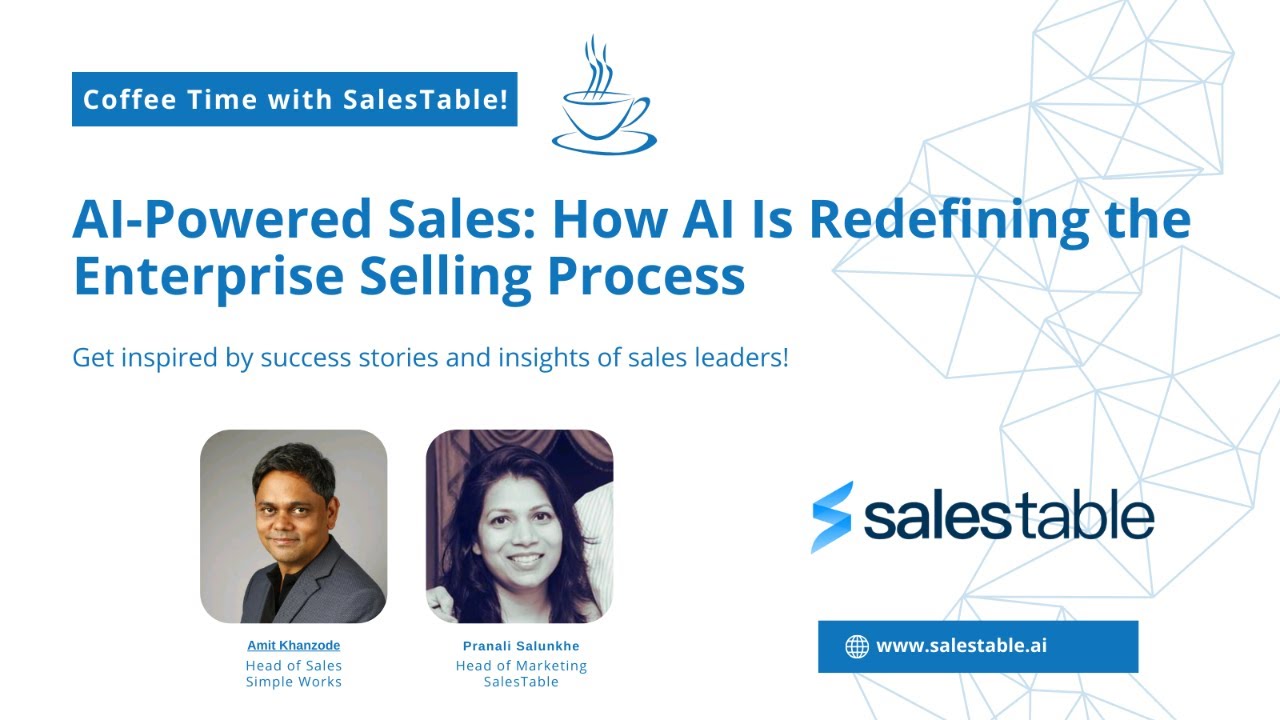
In this half‑hour webinar hosted by Pranali, head of marketing at SalesTable, the conversation with Amit Khanzade, head of sales at Simpleworks, explores how artificial intelligence is reshaping B2B enterprise selling. Amit explains that the explosion of data—structured, unstructured and dynamic—has turned sales from a gut‑feel discipline into a data‑driven science. He stresses that AI models can reach 95‑98% accuracy but still require human oversight for trust, explainability and ethical decision‑making. The discussion walks through concrete AI use‑cases: extracting insights from CRM databases, mining industry news, real‑time market signals, and using these to generate leads, personalize outreach, prioritize deals, forecast quarterly pipelines, and automate routine tasks such as proposal creation and lead scoring. Amit introduces five human‑centred pillars—intuition, compassion, collaboration, ethics and innovation—that salespeople must cultivate alongside AI. He outlines a hybrid approach to sales coaching, where AI‑generated training content is combined with mentorship to transfer wisdom that machines cannot replicate. The session concludes with practical advice for teams starting their AI journey: understand available models, master prompt engineering, and use AI for planning and accountability, positioning AI as a force multiplier rather than a replacement for sales talent.
Chapters
Good afternoon, everyone. Welcome to today's session. We discuss AI-powered sales and how AI is redefining the selling process at enterprise and all businesses in general. I'm Pranali. I head marketing at SalesTable, and I'm super thrilled to have you all here. As we narrow down on this topic, The primary trigger was like, you know, we see that the business landscape is changing faster than ever, and so is the sales function. You know, teams are getting drowned in CRM data, reps are chasing like, you know, deals uncertainly long, uh, the leaders at the other end are struggling to, you know, really predict future in these volatile markets. In midst of all this chaos, you know, is AI really the solution like, you know, to break true. So today, let's crack this open. We'll explore how AI is turning sales into science, where, you know, we, uh, use the human creativity and exactly decipher, like, you know, what our team needs to thrive in 2025. Uh, and we are doing this with someone who has seen it all in action. Joining us is Amit Khanzade today. Amit, uh, hi Amit, thanks for joining us.
Hi. Hi, good afternoon everyone.
Hi, uh, so quick brief introduction, like, I mean, you know, Amit's accolades are like quite long, but I'll try to summarize it in some time. So Amit heads the, uh, sales at Simpleworks. He leads the organization currently for the B2B enterprise sales for CRM application. Prior to SimpleCRM, Amit was a co-founder at Gropple Solutions Private Limited, where he handled strategy, product development, marketing, So like, you know, pretty much all of it as like a co-founder and leading the team. Earlier to that, he worked as a DGM at Tata Communications Limited where he led multiple projects within the banking sector, you know, where he was deeply involved in like, you know, enterprise-level applications and payment systems. Uh, beyond like all his full-time professional roles, Amit is also super active in social initiatives and passionate about, you know, skill development programs and youth. He works for NASCOM and Catalyst India, to name a few. Uh, so Amit, I mean, amazing to have you here. We couldn't have done this topic any— with anybody else apart from you. Let's jump right into the topic now. Uh, since you have been at the forefront of this entire shift, like, you know, with AI and everything, uh, what's that one transformation which you think, like, you know, AI really triggered which even the seasoned leaders might not have seen coming?
Yeah, so AI as a concept is not so new, right? So I did my B.Com, passed out in 1998, and we used to have AI as one of the subjects during our final year, right? The concept started with basically to start with the pattern matching to a greater extent, right? Right? And being that particular point in time, the data which you required was, was less. Today, what fuels the entire AI game is the data availability across the places, right? Data coming from all across is what we are looking at it. And that is where once the data is there, then the possibilities start increasing to a great extent by you do analysis out of it, you do inferences out of it, right? And when you have this data from, from a sales angle, It also helps sales leader to a greater extent to devise the strategy, what, what is there, right? Uh, typically, because that been, uh, traditionally sales has been done on a lot of gut feel, a lot of intuitions to a certain extent, because collating those data at one particular point in time, even sources-wise, was very difficult to a level. And that is where it was based on a lot of your experience, past experience coming from the industry. The various cycles, the various seasonal fluctuations was only known by the veterans, those who worked into those particular industry, right? So today what sales leader was not expecting and what is happening is that today your entire 2 decades or 3 decades of experience is also not work if you are not in tune with what's happening in the world, okay? With the AI capabilities, even the junior-most guys are now knows what's happening in the industry. Right, true. Uh, so the entire earlier in tech industry, it was already proven that, uh, the youngsters are much better than the mid-level guys or senior guys because they grasp the technology very fast, right? Now similar things have started looking at that perspective, that youngsters may catch up very fast, uh, from giving their technology know-how, uh, the fluency with which they use the various tools primarily coming from a lot of places which has specific AI use cases within sales, right? So, uh, as a leader, leader per se, now, uh, is, is you cannot say that, okay, just because you have experience in a certain industry, uh, you are a leader, right?
Got it.
Yeah. So to be a leader is basically now it's more towards how you have that wisdom coming in from your experiences, not from only a technical know-how, or maybe not from the product expertise, or not from industry expertise. But how you translate that expert experience and knowledge into a wisdom, which, which has its own cycle, which cannot be, uh, come through a very fresher guys having a couple of years of experience, right? So that is what is— I think sales leaders will try to understand, and that is what everyone from, uh, that leadership perspective also has to understand, that today's generation can give much more better insights than what we know. earlier, right? So these are the surprises which we are coming across.
Absolutely, Amit. I think, I mean, you really summarized it well. And then, yes, I mean, you spoke about, like, you know, initially about, like, the traditional approach of sales of, like, you know, relying more on the gut feel and stuff. But definitely with so much of data processing, data analytics again being like another buzzword today, along with AI, they work pretty like hand in hand. How do you— what's your experience? And, you know, how do you feel that what kind of accuracy really all these tools bring, uh, and, you know, enable sales teams to really perform better as compared to what we used to do traditionally, right?
So, uh, no matter how the AI models are evolving, there are a lot of foundation models also getting built up, right, from various places. There are different parameters they are looking at it. There is a lot of parameters that everyone is trying to see that, okay, whether you need to have a huge number of parameters to be considered, or whether you want to look at the small LLMs or maybe mini LLMs to look at very specific use cases to refer those parameters and points, right? Based on what is— what you want to achieve through that particular AI model is what you are going to use that, right? Uh, considering that also, uh, no matter what you say, uh, but you cannot just blindly trust whatever output coming from AI, okay?
Yes.
So accuracy level could be 95%, could be 98%, could be 96%, But can I give, give 100% trust on AI? Uh, today we have not reached to that place, right? So I cannot just take my decision based on just, uh, AI provided. So human intervention, human overlook has to happen on, on that particular whatever output. Because today when we say AI is giving you accurate answer, uh, the first thing is that because I know that answer is right, I believe it. AI is giving me right answer because I already know that this is the answer.
Okay, so I think that's where exactly the experience and the wisdom that you just like referred like couple of minutes back really comes into picture, right?
Absolutely. Yeah, so great, because I know already I can say that okay, AI is giving the right answer. But if the answer comes which I don't know, then it creates a problem for you whether I should trust or I should not trust, right?
True.
But then, then I'm— I also don't know, and then how it came is also explainable question. So a lot of debate which is happening on AI side is that whatever outcomes are coming, how you will explain that, how that outcome has come, right? Do you have really a thought process, or do you have really logics behind it to prove that, okay, whatever has been given by AI— because while AI gives an answer, it consists a lot of data points which we are, we are not aware, right?
Right.
So that is where, uh, the explainability comes a big question. And when you are at a higher positions, or maybe at a regulatory compliance side of it, to a certain level, or you are giving commitments to a board in terms of a sales target, uh, this has to be very, very carefully looked at it that, okay, what exactly, uh, I am going to say it here. And even if I am using an AI tool, uh, I should take it as a baseline, but I need to apply my mind by saying, okay, how much should I trust this data and that. But as the engines are improving, I think accuracy levels are increasing to a greater extent and people are using different models based on their use cases.
Great, great. So then just like a minor continuation to this point, like, you know, uh, what according to you, which are the data sources like, you know, one should really consider or like, you know, which are then relevant, or since we have so many of those?
Yeah, so, uh, there are 2 to 3 types of data sources, right? So typically if you look at it, uh, You are, uh, if you are already established organizations, has done the business for quite a few years, then you definitely have the structured data which lies in your databases by saying, okay, how many deals has been closed last year, at what price I have closed those particular deals, uh, right? Which are the customers, those who are looked at it? What is my churn rate? What, how many new customers? What do you say is how many customers I lose, uh, lose in last year, right? So past historical data is one of the points which comes from structured data, right? Which is to a certain level is easy because you have typical statistical models to do that. The beauty of AI comes when it comes from unstructured data, basically from, from industry level, okay? What level of different articles coming on industry side of it to a level, right? And how you analyze that in conjunction to structured data. Right, so now again these two data are to a certain extent static data where I have a structured data which is lying in my database. Then there is a data which is in my basically the white notes or maybe PDFs which I need to relate to this. Then third is which is dynamic data coming from your different websites or different resources. That's what's happening on the industry, what is there dynamically, what's happening every quarter or every month or every week, what's happening in a particular industry. How the stock markets are performing. Is my target market company is also doing good in the good into stock market, right? It means they are doing really well. So should I go as a prospect to them from from that perspective? So they have money to spend to a certain level. So this kind of data sources are primarily so past performance is is one seasonal fluctuations we need to see depends on the industry which we are in, right? Then you have a customer basically looking at why what is their buying patterns consumer behavior. We need to consider. So different sources, we need to look at it when we thought through our sales strategy, and it has to be combination of all three. It's very difficult as of now because when you want to relate and send a particular query to AI by saying this is what I want to answer, right? So tell me that, okay, what is what will be my sales in this particular month, right? So yes, the AI has to get to a lot of data, which is structured data, unstructured data, as well as the dynamic data. And then combinedly, it has to give you the answers, which is not hallucinating the answers, right? So because today, if you ask anything to a particular bot, it tries to give an answer even if it does not know, right? Because it's like, I need to give an answer irrespective of whether I don't know or I don't know, right? So, uh, how to then collect clear out that particular noise basically and have particular insights is what most of the organizations are doing it. And so all, all kinds of data are there, but 90% data still is structured because you, you based on the past performance which is in a database level, and then you have a 10-15% coming from unstructured and dynamic data.
That's really insightful, Amit. I mean, it was quite a learning for me and you really made it so simplified, simply segmented it. I mean, really great. And frankly, as you said, these numbers of 95% accuracy, 96%, 98%, even as a marketer or a layman who is just getting into this whole digitization and the AI revolution, these numbers look really staggering. Uh, so, um, like while we are at it and, you know, you really, uh, spoke about like, you know, uh, how we really use those AI engines, can you, uh, can we really quickly dig into any of your like, you know, a case study so that, you know, the listeners can really like, you know, relate it from a real life example? Like, you know, how AI engine like with all the, uh, tools and the engine, the product, the forecasting accuracy and everything has really boosted the sales प्रोडक्टिविटी ऑफ़ द ऑर्गेनाइजेशन। सो आई इज़ नाउ, विच इस अ पार्ट ऑफ़ अ लाइफ, राइट?
सो बीट एनी प्रोफेशन, आई इज़ इज़ वर्किंग इन योर डेली लाइफ। सो इट हैज़ बिकम अ पार्ट ऑफ़ डेली लाइफ फॉर एवरीवन, इरेस्पेक्ट ऑफ़ योर जॉब प्रोफेशन। और व्हेन वी लुक एट फ्रॉम अ सेल You go into nurturing the lead and then you get into sales closure, basically negotiation and all. At every stage, if you look at it, the AI is going to work, right? So now today, if you look at it, what we are trying to do primarily with our organizations, you see that when I'm creating a particular lead, right? So as a particular prospect, now depends on what industry I'm targeting. There are certain sets of accounts because we are working. Pardon me if there are B2C people watching this particular webinar, but my experience comes from B2B to a certain extent, right? So any segment or any sector within B2B will always have named accounts to a level that which you want to target, right? Which definitely has 2 aspects. So besides your existing account which you want to just nourish and flourish over the period of time to increase your pie to a level, then you have a greenfield opportunity where no one is present. And then you also look to look at, okay, how I'm going to churn from the competition to your side of it, right? So these are the 2 ways you look for those particular leads. Now once you have that particular account and when you know that, okay, this is my account, now you can use the AI engine to find out basically, okay, what is that organization is right now, you know, what positions they are in, how they are performing, uh, in as of now from a financial perspective. Right? You can get the definitely the connects from the LinkedIn to see that who are the top decision-making people there, right? Now you have those connects, you know that organization. Now you can based on that you can create a pitch which is very customized to that particular account, right? Maybe with respect to account that if they have recently won a very large deal from from markets and you know that okay they won this particular contract, you can congratulate them to whatever. Secondly, if a person whom you are reaching out to, he has already put a LinkedIn post by saying he has just received an award from someone on this particular category, you can just congratulate them to a level, right? Now once you do that kind of interaction with him, it immensely gives a very personal touch to a customer by saying he's aware, or the person who is reaching, trying to reach out to me, is aware what's happening in my company, right? He's much more involved. Yes, he's not one of— he's looking at a transactional level, uh, dealing from a customer perspective. So that involvement with, with that particular person or organization start building up a trust, okay, that, okay, he's interested. And once— and as a human being, someone is interested in you is, is what you started dealing with that particular person more and more, right? Then you want to talk to them, you want to interact with them because you believe that you are interested in, and you are not just sending a very standard email by saying, okay, these are my product features and this is my, uh, right? So that is from a lead perspective. Now similarly, you can take it to every level by saying, okay, from a negotiation side, what should be my product pricing? What I am doing? What is the competition offering? Where should my benchmarking is there, right? From a sales targeting, what is my quarterly? So compared to last quarter, last year, same quarter. So, you know, we typically have a focus area in banking side of Now banking, if you look at it, April, May typically go slow because they just open with the March ending, right? And the planning. So that's the cyclical nature. Now you cannot have— you have experience of that by saying, okay, so your pipeline has to build accordingly by saying, okay, this quarter will— may go slow.
Correct.
But then I need to build a pipeline by saying, and my talk has to go, because there's no point in pushing for a deal in April when just the March ending is happening.
Right?
So customer will also. So you need to start building, and that is how your conversation has— because if you start pushing a person in April or March ending period for a particular deal, he may get irritated. Customer may get irritated by saying these people don't understand the industry, that when it's not ending, how the banks are under pressure or any financials under pressure, right? Now you cannot talk deal on, on those particular that time, or new deal opening. If you are already on a closing stage, that's okay, which is just as a part of a process, right?
Yeah.
But to start a new direction in that process, then you cannot. So these all stages, if you put it into data and, and if you have data resources and come back, I think this greatly helps you to see that how your planning works. So, and then how you need to build a sales team, how you want to manage your, uh, day-to-weekly activities, monthly activities, uh, how the sales team has to have your travel plans, right? Uh, travel. Uh, if they have to at all travel, then which period is better for travel? Uh, in Mumbai kind of cities, if there's a monsoon, then you need to consider those factors also, right? It's very difficult to catch up in monsoons to a certain extent. So these all factors has to be considered. And, uh, being AI in place, I think, uh, this, uh, all data— so simply to put it in 2 buckets: wherever data, use AI; wherever humans, use humans, right? So it's how the segregation has to happen.
Fascinating. Yes, absolutely. So I mean, definitely it's just not about predicting the future as it is like picking from the data, uh, but definitely these insights help us align the entire ecosystem. I mean, not just from a sales team perspective, but then there are so many, as you mentioned, the travel thing. So, you know, the entire, uh, you know, the planning can happen at a much optimal level. Absolutely using these tools. Uh, so, um, like we spoke pretty much like, you know, like marketing, sales, like some aspects of marketing which opens up the funnel for the sales teams. But, uh, when it comes to very targeted approach of like, you know, deal prioritization, especially because you have such a strong B2B background, uh, like, you know, how AI-driven prioritization really is like, you know, helpful. Because I mean, these days with so much of noise around, like, you know, the consumer is also getting, like, you know, pushed, and the sales cycle, as we hear, keeps extending, right? So how does AI really play a role in this? Like, you know, beyond the intuition and the gut feel, uh, like, what are the risks that a sales guy really runs if they are not really using AI in their approach today?
So, uh, see, typically in old days, what used to happen is that information was key, right? Even in old days when there were no mobile phones, also reaching to a right person was like an achievement, right?
Yes.
During the, during the day, right? That I met a certain person at a certain level, and that also has to happen in physical because there was no mobile phones to do it.
True.
Right? So those, those were the times when the achievement was lies in a very, very small अच्छुमेंट्स, समवन एस यू कॉल समवन एंड ही पिक्ड अप अ फोन एंड से यू कम बैक वाज़ वाज़ अ वेरी डिलाइटफुल मोमेंट राइट? तो देन हैविंग सर्टेन लेवल ऑफ़ कंपटीशन इनफॉरमेशंस कमिंग फ्रॉम क्लाइंट, देर वाज़ यूज़ ह्यूज़ अच्छुमेंट फीलिंग बाय सेइंग ओके आई नो ना व्हाट कंपटीशन those all things does not matter, right? When there's a classic debate is happening is whether it's a 70-hour or 80-hour or 90-hour week, right? Uh, typically if you look at it, because your day-to-day activities in terms of, uh, the routine activities which a salesperson has to do, it has been automated to a greater level or has been easily been there, right? The next stages come is that how you innovate and how you basically bring innovation in the entire process. Now, when you want to innovate something which is a human element to it, because AI may not innovate to a greater extent, it can give you what has happened and what could happen just based on the, uh, extending or extrapolation of the existing data.
Correct. Yes. Yeah.
But then innovation is not about extrapolation of the data. Innovation is something which, which no one has done before, or even have done before, maybe the way of done has to be differently there. Now, when innovation is there, then your mind continuously has to work on that. So whether you are physically working or physically not working, right, your mind is working 112 hours. 8 hours sleep on a week, you can leave that. Your mind has to work 112 hours.
Correct.
No, actual debate is 70, 80, 90 hours is okay, but it's not a physical work to a level, right? It's a mind work because we all are now on laptops to a level where we are actually not working factories or physical work is required, right? Or even if we talk about coding is now, if AI takes over the coding part of it, now what remains is basically beyond that. Now beyond that is all about mind, which if you have to work best, because this data is available to everyone now, you are not the only privileged person who is receiving that data, right? AI is only property, is not some something which you only you can use. While you are using, your competition also using.
Correct, exactly.
So they are also getting the same information, same insights. So now your job comes, what beyond that, right? When everything is at equal level, what is being— is getting done is basically beyond that data points, right?
Correct.
So that innovation basically may be relationship, may be empathy to a level. So that is what a sales guy has to bring in. So this is where I think from a real life experience when we are looking at it is how you work smartly more than hard work. Hard work has been taken over by AI now.
Yes, so true. And yeah, actually, because I mean, then there is this whole debate about AI taking over the roles. and, you know, uh, cutting manpower requirements, etc., etc. But then, uh, as you're summarizing it well, like, you know, and even something just referring to some, uh, reading that I had done before, it's like AI can really process what already exists faster than us as a human, but anything new, uh, is something that only we can create, right?
Yeah.
So, uh, taking by that, obviously, like, you know, when the question comes is like You know, will AI be replacing the SDRs or AEs, like, you know, or simply taking over the initial scoping work, the prospecting and everything? Or you— I mean, you know, how do you really see, uh, the roles of a sales rep being redefined with AI now?
So as we are discussing is basically, uh, whatever the routine work, right, uh, in terms of, uh, the business as usual, uh, total level, making maybe, uh, leads to a certain extent, qualifying the leads Lead scoring, right? Correct. Maybe creating proposals, maybe creating the PPTs to a level, right? Where, as I was saying, that was an achievement during the day because if I have to spend eight hours in a day, I today I made a PPT was was like kind of an achievement earlier. Now today ten minutes you just put up the details and then the PPT is ready, right? So your time what we are used to happen on a very regular activities or business as usual. Will not be expected by today's account executives or sales development representatives, right? More of now will is going as I said. So I always believe in five pillars of basically is called human-centered innovations to a greater extent, right? So when you do that, so one is we will discuss on intuition, but intuition is what defines humans, right? So it's always in earlier days also, and I don't know whether today's interview is also the sales leader. मैं आस्क क्वेश्चंस तू अन्य सेल्स गाइस डेट कैन यू सेल बेसिकली फ्रिज टू एन एसपी मोर राइट ओके सो दैट इज़ दैट राइट सो योर डेटा सेज़ दैट एसपी मोर डज़ नॉट नीड फ्रिज बट अ रियल सेल्स गाय विल सेल स्टील फ्रिज टू फ्रिज टू एसपी तू इस इनोवेटिव यूज़ तू टू अ लेवल र Business schools of case studies in Punjab, they are using the washing machines, the typical old washing machines for making the lassis in Dhabas. Right now, consumption of those washing machines in Punjab Dhabas were much much higher than household use to a greater level. Right? How you really go against that particular whatever the market is saying, right? Or how you सेल कोम तू अ बाल्ड पर्सन, राइट? वेर देयर इज़ नो राइट?
राइट. सो करेक्ट. यस. दैट्स अनदर क्लासिक पॉइंट किसी ने.
एंड दैट इज़ वेर द क्वेश्चन ऑलवेज़ कम वेर द सेल्स इज़ साइंस और एन आर्ट, राइट? सो यस, पूरा लेवल इज़ साइंस, बट समवेर यू रिक्वायर दैट आर्ट आल्सो. एंड द Then you required, you call it a compassion. I call it more than empathy compassion because in empathy also like you are relatable to that particular person. You also understand his situation, but you are not strong enough to make him come back from the situation. Okay, but compassion is something that you are strong enough to make him come back from his situation. So that is where the compassion, the collaboration, the teamwork. Because today when technology is, is getting— and there are a lot of collaboration tools are there, but if you look at on a physical environment on one-to-one basis, uh, collaboration has been missing. And that is where a lot of organizations now insisting people to come to office because they understand that online is okay as long as you are doing business as usual, but when it requires a brainstorming, uh, we need people in the offices. Right? Because collaboration real fosters in in real environments to to a greater extent, right? And then last one is ethics. So that AI cannot define what is right for that. What is integrity and what is ethics, right? That also cannot be defined by AI. That has to be defined by by the person, right? So any sales executive or any SDR or account executive will have to keep this in mind. So his routine job has been done now. He does not have too much about creating the PPTs or proposals or Lead scoring, which lead I need to follow. No, but when you call a customer, how empathetic and compassionate with that particular person, right? How you talk to that particular person, right? Even if you have to do a collection for that particular person, how well you spoke— speak to that particular person, right?
Right. Correct, correct.
And how basically different ways you approach when you have to lead. So if you ask me today, if For a sales guy, if AI can do cold calling, I think that would be the best day, right?
Yes, but soon, soon those will also be there. But I mean, how effective is the question?
Today we are very comfortable when I call to a bank and then try to get through IVR my bank account balance and everything, right? But I'm not sure someone bot calling me and asking for cold calling and asking for an appointment. Whether I will like human or not, because when I am a buyer, my ego comes into a picture and a machine cannot satisfy that.
I mean, that's basic human psyche, right? You need to feel important, right?
I mean, so I think I will be most happiest person when the bot calls for cold calling and then gets an appointment for the sales guys, right? Because that is, that is the biggest, biggest hurdle for most of the guys in today's world. When she got to—
yes. I'm sure, I mean, that's an ask which most of the sales folks will be really hoping for, that AI should really go to that level. But I mean, this is really amazing. I think, Amit, these 5 pillars are truly insightful beyond the topic. I mean, I think, and it goes beyond sales teams also. It's pretty fundamental to any professional in today's times. I was actually going to ask you like you know about like the key skills managers should look out for, but I think I mean you have really like already given me that answer. But again, like you know since we are talking about AI in specific, so I just wanted to like you know take that point further. So sales coaching and enablement are also evolving right with this AI-driven insights, the ongoing part, the upskilling part of things. So how do you really see AI, like, you know, playing a pivotal role there? Like, just beyond forecasting or deal prioritization, the operational task of it. Like, you know, can AI really help me build on these softer skills and, you know, make me better at sales?
So definitely means, and, uh, so when you ask that which activity has to be given to AI and which activity has to be given to sales, right? So training and coaching comes as a hybrid, uh, work. Right? So it's just a hybrid approach which we need to get it. No one single approach will work there. I cannot say that I will do entire coaching and training through only AI. Not possible, because so many times the junior people learn from the lot of things from observation on the field which happens. How how that those things happen? Yes. And simultaneously, I cannot say that I will start from ABCD of sales by by coaching myself to. to a greater extent, right? So we need to differentiate. In typical L&D language is basically training separately, which is one-way process, vis-à-vis coaching or maybe mentoring to a certain extent. So coaching may be on a higher side, maybe you require certain level of experience to get coached, but mentoring definitely can be looked at it. So training is basically a standard, your training schedules from a sales side of it. Where how you approach from the cold calling stage, how you approach the leads, how you, uh, do a market segmentation, the positioning part of it, right? What company offers, the matching to requirements of a person. So these are all very standardized processes. Those all can be— you can create the videos, you can create course materials, you can create the modules, and you can create the knowledge repositories, uh, from that. And every time you learn something, you keep updated on that particular stuff and you make that engine more and more as you— because a lot of AI now goes to learn on their own from the modeling side of it, right? So you keep uploading that content so that AI engine gets more and more trained on certain— and you keep asking the frequently asked questions coming from our customers. That way also you can more train to that particular engine, right? So any new guy who is joining should definitely use AI-based training models and approach because for him, like as I said, the 25 years of experience does not matter because today's days even one month a person is good, he can come to an equal level of knowledge understanding, right? Knowledge understanding because you have already created a knowledge repository. As long as someone is ready to capture it, all is all things are here.
Right.
There's no time required to go through that. What is more important from a coaching side of it is, or a mentoring side of it, basically to make them understand the nuances beyond what is there in the training, right? As I said, that's where the wisdom comes into a picture, right? Which cannot come from the typical training models to a level. So it's a combined approach. In fact, our organization also, we are trying to look at it a combined approach to both the things where something which can be done through automation, we should. Something has to be done human, then we need to have a human. And something which is there where we can use both, we should use both. So there is no one approach to it which you can say, okay, this is only going to work. No, it coexists to a level.
Great, great, Amit. I I mean, this has been like super helpful. I'm sure like, you know, there's so many insights in this like half an hour session. I mean, it was power-packed completely, uh, and it's going to definitely help a lot of sales folks like, you know, to really view the whole AI revolution in the right perspective. Uh, just to quickly recap, like, you know, I mean, taking the crux of the entire conversation, uh, definitely AI is not here to replace anyone. But it is more to equip you and really make you unstoppable in its true sense, right? I mean, where we are speaking about pairing the predictive power, the analytics power with human intuition, and which takes care of your tedious task but doubles your uniqueness as an individual and collectively as a team, right? So all of everyone who has been a part of this session today with us, I think, I mean, if there's one thing that, you know, we can take from today's insights in this session that Amit shared with us is like, I feel the future really belongs to the teams who can embrace AI as a force multiplier. You know, whether it is about auditing data or forecasting tool or upskilling reps, like, you know, I mean, AI is seen running in every aspect of business. In sales functions and like, you know, across the different, uh, operational elements of like, you know, any organization. So like, you know, it's more about like, you know, but then I think it's again inevitable, the same wave as we saw with digital marketing few years back. It has become like a mandated and an implied, uh, activity, right? It's no more an optional or a skill. So I think the same has been— will be adopted with AI. So, you know, the sooner we start, it's better for all of us. So let's start small, uh, I mean, you know, but do plunge into it to just experience the power of what AI really brings to business and to us as individuals.
So yeah, basically putting in a very summarized way, see, we have a left brain and right brain, right? So left brain typically is the logic, which has been now supported by AI. Now we have to start more and more using the right brain of it. तो तो लेवल राइट? That is where all sales guys has to now start learning it. So typical engineering mindset which is based on a logic is has been now supported by AI. Now and that is where science has been taken care of by AI. Now art has to be taken care by the sales guy.
The art has to be taken care of. True, true. So just on the ending note Amit like you know if post this webinar if one has to start leveraging AI I mean somebody who is starting what would be the first step that you would recommend?
Yeah, the first step is basically to start understanding the different models which are available in the market, which are helpful to you, because it's like evolving every day, right? And you cannot cope up with everything which is happening on every day, right? So understand which use cases you want to do it, which area of you want to improve upon using the AI. Typically, as I said, if you are in a sales profession, uh, it's a great tool, uh, to understand the industry. Uh, it, it gives you a lot of— you can do— and it's, it's the art of questioning is very important in this, right? So today, if you look at it, the entire prompt engineering based on the art of questioning, right? Uh, so, uh, we need to have right— if you ask the right question, you will get the right answers kind of Otherwise it will get a lot of junk to you, right?
True.
So, uh, from that side, uh, even if you are young, don't think that you are a young sales executive or you just started from, from that side of it, because the kind of inputs you can get from today's AI or various bots coming into picture, uh, I think that can give a lot of learning in terms of how the plans can happen. It's not because I also tell to my team, right, why the planning is important. Because the planning gives you an accountability. If your sales leader is doing a planning, he is accountable for that, and then you are just executing that at the transactional level, right? But if you want to really take an accountability, you should be doing a planning, because once you do a planning, then the accountability comes with that particular planning. And these tools can help you to do those kind of planning, and whatever help you require from inputs, I think That's all available on net, all available on the industry, right? Uh, maybe you don't get exact details, but on a broader level you can do it. And there is always a sales coach, sales enablement process is there to help you in terms of how you accurately reach to your own plans to greater heights, right? So I think it's a part and parcel of life now, like a mobile, and everyone should use AI for its benefits.
Absolutely. So again, like, thanks a bunch, Amit. I mean, this has been an amazing session. I mean, thanks for sharing like your expertise and like, you know, really helpful insights with all of us today. For all of us who did join or who will be looking through this recap, I'm sure this video will be like, you know, revisited for a lot of content and takeaways. Everybody, do like— thank you again for joining us. I mean, do follow Sales Table for more such insightful discussions. We will keep this conversation going on on our LinkedIn page, like when we talk about #AIinSales. Thanks, Amit, again, and thank you everyone for joining. This is Pranali from Sales Table signing off.
Thank you.
Good day.
Bye.
Bye. Bye, Amit.
More from Suresh

TV#4: Why "Great" Products Fail: The Hard Truth About Selling with Suresh Madhuvarsu

Beyond the Dashboard: Leading Sales Teams with Emotional Intelligence in 2026

Sales Uncharted Podcast: Suresh Madhuvarsu, CEO of SalesTable: The Founder’s Dilemma



🔥 From Sales Enablement to Revenue Enablement | Suresh Madhuvarsu on the Future of AI in Sales


