Building Sales Teams: From Hiring to High Performance
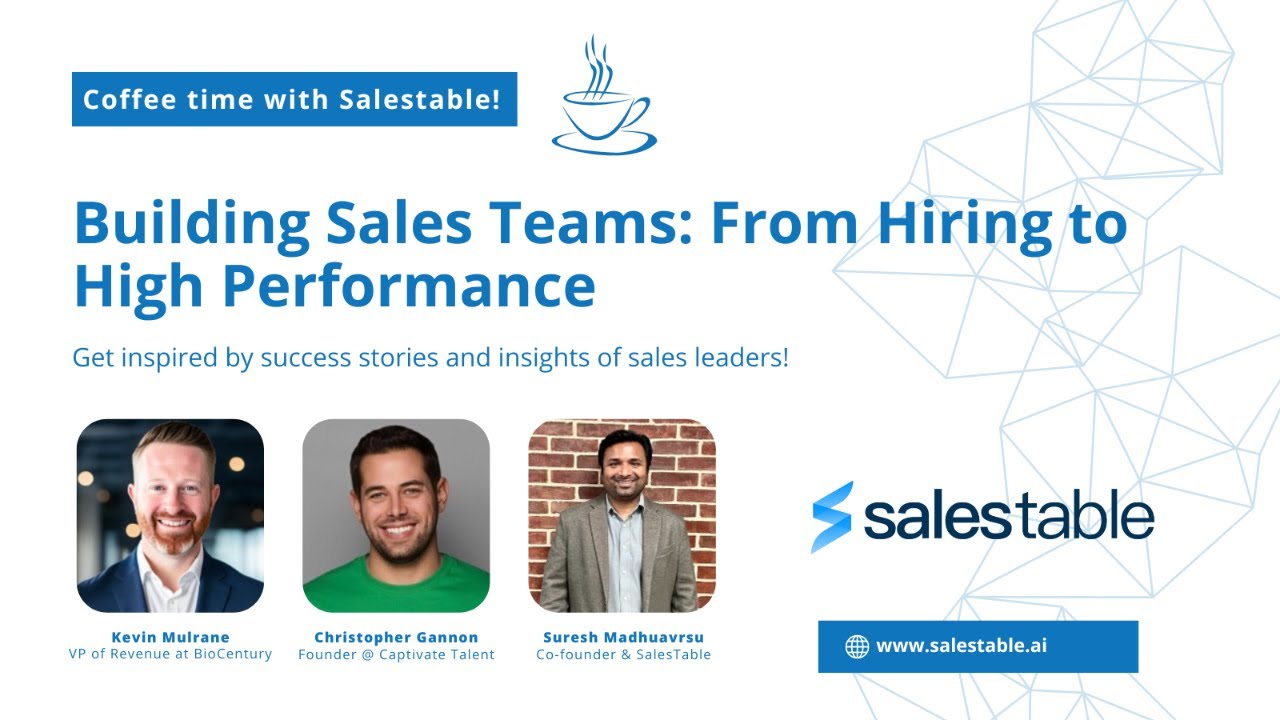
In this Coffee Time with Sales Table episode, host Suresh Madhuvarsu talks with talent‑leadership expert Chris and sales‑leader Kevin about the full lifecycle of building and scaling sales teams in startups. The conversation begins with the need for founders to conduct a rigorous self‑assessment before applying generic hiring advice. They stress that cultural fit is fluid and must be deliberately defined and revisited as the organization grows. Chris outlines a structured interview process that relies on quantitative scorecards, consistent metric verification (quota, ACV, deal size, time‑to‑close) and alignment among co‑founders to avoid hiring mismatches. Both guests warn against the allure of big‑brand hires, noting that the skill sets required in early‑stage companies (scrappiness, adaptability, limited resources) differ sharply from those in mature firms. Kevin describes a two‑stage onboarding model—first building confidence through role‑playing and discovery‑call practice, then developing competence over time—while emphasizing the need for support mechanisms and gradual release. Retention is linked to providing adequate resources, clear growth paths, personalized incentives, and a 360° feedback loop where leaders both give and solicit feedback. The panel also discusses balancing proven past performance against future potential, using tools like a 9‑grid matrix, and cautions against over‑hiring or making reactionary headcount decisions. Throughout, the tone remains conversational and pragmatic, offering actionable frameworks for founders and sales leaders to hire, onboard, and retain the right talent for sustainable revenue growth.
Chapters
Hello everyone, uh, welcome to Coffee Time with Sales Table, the podcast where we sit with the industry-leading experts and coaches to really dive into the art of sales and mastering quota. And today I am beyond excited to welcome Chris and Kevin to the show. Hey Chris, Kevin.
Hey Suresh.
What's up, Suresh? How are you?
Pretty good. Pretty good. Again, so this comes at a great time, by the way, right? Because we just finished the SASTA conference and a lot of discussions that went on. But the one aspect that I always really think through is, Chris, you've been into the talent leadership for a long time. There are a lot of insights that I want to kind of, you know, really get from you. And Kevin, you are on the other side of the sales leadership and the execution. So this is a great combination that we are seeing today. So thanks for taking the time though.
Yeah, thanks for having us. This is great.
Yeah, absolutely. So we'll dive right into it. So Chris, one of the biggest challenges that we kind of really hear from sales leaders is everybody is aware of the 80/20 rule. Which is unfortunate. And everybody says, oh yeah, I mean, you know what, I know that there are some rock stars that I have in my team, but the rest of the ones, yeah, probably not doing so great, but that's okay. But that's a challenge, unfortunately, as much as we want to kind of accept that as a fact. But I think, you know, from the talent standpoint of view, they're all individuals, they all have aspirations and whatnot. Really starting off with you, Chris, what's your perspective on bringing the right people for the right companies and the right roles? How do you really have that mental model when you are working with some of the startups, founders, or even sales leaders?
I think the funny thing you just mentioned, we're in conference season. And lots of people go to these conferences, they watch a presentation or listen to a blog or a LinkedIn, uh, live like this, uh, and they take one piece of advice and they just blindly apply it to their company. So the thing that we really look out for, um, at Captivate is when we talk to founders, we really want them to go through a self-assessment of really what's going to be the right fit for them versus taking this piece of content or advice that's usually just very prescriptive and just blindly applying it to their company. 'Cause, you know, we all read these blogs and they're written by usually very successful people and stuff, and they're written with good intention. But the reality is, is very few times are you in the exact same situation as the advice that's given in these forums and blogs. So it's really about running yourself through a really structured and stringent self-assessment. And looking at the goals that you need to achieve for your company and your sales team, and then applying that to a hiring methodology.
Yeah, um, you— that's pretty interesting, right? So, uh, one of the things that we see is, especially in the startup arena, everybody has their own network for sure, you know, all the founders. And then they'll be like, hey, I have this friend, I have this family member, and then they're VP of Sales or Director of Sales, you know, can I bring them in? And then again, there is nothing wrong in that mental model, but then the question really becomes, what do you need at this point of time? And then where do you want to, uh, take your company to in the next, let's say, 6 to 9 months, right? I mean, again, I'm talking about strictly from the startup's point of view because that's really where we are.
Yeah, yeah, we're in startup world. Uh, so, Suresh, look, there's nothing wrong with bringing your, your friend in, your ex-colleague, your, your brother, sister, family member, whatever it might be. I think you just have to be realistic about like what the longevity of that person is in your business, how far they could take you, and understand or have a mutual understanding of when you need to shift and maybe go find somebody who's more professionally aligned with the goals that you need to reach.
Yeah, yeah. So, uh, from that angle, Chris, I know, uh, it's really about the right person for the right role, uh, aspect of it really. Now, Kamen, just coming to you on that. Most of the times when you get into the leadership roles, we often inherit the team and very less often, I would say, is where you have the opportunity to completely build right from scratch. If that is the case, how are you thinking about really bringing the right people for the right roles?
Yeah, it's, it's a tricky one. And it's, it's, it's a balance, right? But I think when, you know, I think similar to what Chris said, it's, it's, it's doing an audit of where you are today and where you're trying to get to. And really creating those milestones of what it's going to take to get to that final destination, right? What are the skills? What are the behaviors? What are the traits that you're looking for, right? It's, I I think a lot of what you think about when you inherit a team is part of it's like, what's the culture you're trying to build or maybe possibly trying to transform, right? Is the culture great that you're trying to build and lean into more? Um, you have the right methodologies, the right sales process. So like, again, kind of like Chris said, like there's not a cookie-cutter approach to all of this. Like you really have to go in and audit where you are today and what are those kind of milestones or checkpoints That's going to get you to where you need to be, and you can align certain metrics with that. So, you know, if you're, if you're building your sales team, right, you're not going to just continue to add headcount because quota equals revenue, right? It does in a spreadsheet, but not in reality. So what are the, like, the demand gen goals or the pipeline goals?
Like, what are the different kind of key benchmarks you have to hit as an organization that's going to signal, yep, it's ready to kind of to add more headcount or build Yeah, thanks for saying that, because one of the things that we see sales leaders often do is they come into the organization, they see people, and then sometimes even without really looking at the strengths the current team has or not, they try to bring in completely new team and from their previous organization or the network. And then the sales machine that is probably running fine all of a sudden just kind of, you know, gets dismantled, and then they try to kind of really, um, ick a lot of people out there. And that's what we don't want, correct?
Yeah, like the, the best advice I was given was don't do a cannonball into the hot tub, right? Like, you don't want to come in and just like blow everything up. A lot of the times I see sales leaders wanna start putting like their fingerprints on everything, right?
Mm-hmm.
And I think to your point, look at the things that are going really well that you wanna lean into more and try and maybe squeeze a bit more out of. Identify some of those things that you're looking to improve or optimize, but you also have to understand when you inherit a team, there's a whole element of change management that has to happen, right? And making sure that you're thinking about how you're communicating things, why you're changing things, what's in it for them. So just making sure like you're putting your fingerprints on the areas that you can truly impact. And then, you know, don't, don't try and fix something that may not be broken.
Yeah.
So Kevin, in the couple of things that you talked about, the one aspect that I deeply respect is the culture aspect of it, right? Because whether it is about the driving behaviors or what they are doing, and how people are responding to the current organizational aspect, I think, is deeply rooted in the culture. Probably this is more for Chris. When you are thinking about bringing the right people, how do you think about that cultural aspect of it? Because it's not as though that somebody can exactly define, you know what, this is the culture for me, these 1, 2, 3, 4, 5 bullet points, But it's very difficult for even somebody to articulate that cultural aspect, right?
Yeah.
So culture is a funny word because, you know, quite a few years ago it was like we have a ping pong table. Like you thought, like you're like, oh, we have this amazing culture. We play ping pong on our 15-minute breaks after you make 150 dials. It's great. It's literally a place I worked. So that really did exist. You know, early stage founders, like the reality is, is your culture is going to shift and change with every employee that you hire. So you have to be really thoughtful and careful about those people. And I think you have to define what your culture is. Culture isn't this broad word that just means, hey, we have a good working environment. Like, your culture might be a bunch of younger people that are working 15 hours, 20 hours a day. Like, that's cool. That's your culture. Just be very careful when you hire somebody into that culture and make sure that they're going to fit that mold. Or understand when it might be time to adjust your culture to open up the aperture to hire different people from different types of backgrounds or skill sets. So culture is a really finicky word. I think founders and leaders really have to sit down and they should sit down probably once a year on their kickoff or reviews or whatever it might be and say, hey, what's our culture? Has it changed? Have we hired anybody who has impacted our culture? Is that— is anything different? Companies go through very different cultural shifts. I mean, 5, 6 years ago, 7 years ago, actually, when Kevin and I first started working together, I, you know, no one at our company had children.
Yeah.
Now half of our company has children. And I think I have one person under the age of 30 now. That's, that's a huge difference from where my company was from a cultural standpoint and the things that are important to some of those people. And even the types of benefits that we have to offer to people.
I think what's really interesting too on this one is, and I've seen Chris do this, where if you ask 5 people in a company to explain or define their culture, you get like 7 answers, right? Culture is this funny thing. It's really hard to articulate and it's really hard to get alignment. I think the one thing that Chris and his team do really well though, Is that they can kind of make a bit of their— and I don't want to speak for you, Chris, but you get to know the founder, the executive team, the leadership, right? Folks in that organization, you get to know them well enough where you can start to kind of envision that culture yourselves, right? Even if they can articulate it, you're building those relationships. You understand the people in those organizations and their values and what they care about. That helps you see into that culture as well.
Yeah, Suresh, Kevin brings up a good point. Like, we do that, and as part of our process with, with various hiring managers, or if there's co-founders or stakeholders in the business, we'll ask them questions out loud on a call together or sometimes separately, and we'll see how the answers align with each other. We also do it when we're building job descriptions with them and looking for different types of profiles. We'll put a profile in front of them unprompted, not give them any reason why. And then we want like the co-founders to talk out loud, because if they're not agreeing at the beginning of this process when we're engaged with them and interviewing with them, there's no way they're going to get to hit pay dirt with an offer for a great candidate. They're not going to find the right person. They might find someone, but then there'll be disagreements all throughout the process and it'll be really painful.
Yeah.
So yeah.
So just following through that, one of the common complaints that I always hear from founders and even from the sales leaders is to say, I have, as a startup, I have a specific need. I really, I just got funded, let's say Series A, Series B, and then I really want this great CRO. And then there is this mental model that a lot of founders have. You know what, you know, I need to go bring somebody from the big tech companies because those guys have done billions of dollars or multi-million dollars and whatnot. Then clearly, uh, the one of the biggest thing for me is, again, no disrespect to anybody that is out there, but based on the company that somebody is in, these companies have a brand value. There is a high demand because of the product and the brand and everything. So there is a lot of inbound that happens. And it is relatively easy with the brand and the inbound for somebody to actually make an impact in terms of saying that, oh, you know what, you know, I've been responsible for, let's say, $100 million revenue per quarter in some of these companies. But it's very difficult for you to say, okay, the same person, bring them out, put them in a startup, and then now they need to start everything from scratch. That's a skill on its own. Chris, probably I want to get you as well.
I have some opinions on this one. Kevin, make sure I don't get in trouble. A couple of years ago, there was this blog circulating that was like, Find the best companies, the Gongs, the Brexes, the Snowflakes of the world, and hire an up-and-comer to be your sales leader. In theory, that sounds great because, you know, they're probably pedigreed, they probably worked with some really good people and have been exposed to like lots of different technologies and change at a company. In practicality, there's some issues when you do things like that. One, you mentioned it already, the brand value. Like if you work for For Gong, like, there's very few people in the tech world, if you say where you work, you have to even explain what you do. They understand it. They know what your product is. They've seen your brand. They've seen you sponsor the biggest booth at Dreamforce before. Like, there's a lot that goes with that when you're a salesperson, when you don't have to evangelize who you are and what your product does in the first 30 seconds of a cold call. or an email, or when you're meeting somebody at a conference or a trade show. So you have to be really careful about that and also understand how many resources, how many millions of dollars of resources are available to those individuals versus your seed stage startup that's going for funding where your onboarding is going to be giving somebody a laptop and maybe giving them a Zoom Info license or a LinkedIn Sales Navigator license. Like, that's the resources they're gonna get. There are stark, stark differences from those 2 environments that very few people can translate into from one to another. Those people do exist. There are cases where they have transferred from one to another successfully, but you have to be really careful about that because that brand power— yeah, you don't, you don't know it until you don't have it.
Exactly. Thank you. Yeah, absolutely. Kevin, any thoughts on that?
Yeah, I mean, the skill sets are just radically different, right? And that's what it really comes down to. I think if you're selling behind a big brand, to Chris's point, like you don't have to go and evangelize and fight and defend who you are, but you're probably also like having the ability to differentiate your product. So a Gong versus a Chorus, right? On the surface, you can say a lot of these products look and feel the same. So you have to be great at differentiation. So the skill sets in terms of what you need, whether it's, you know, IC, individual contributor, or from a sales leadership perspective, they're just very, very different skill sets that you need. And I think what tends to happen is the shiny logos all of a sudden bring this huge credibility to you that isn't necessarily transferable in the early startup days. So, you know, when I'm interviewing and hiring folks, I am so transparent about what we need, what the job is today, the good things, the challenging things. Like, I go through all of it because I, I made that mistake of early-stage startup building a team. Oh my gosh, this person from LinkedIn. Oh my gosh, this person from, you know, Salesforce. And then they came in and they were like, how— what's the, what's the process? Where's my onboarding? And I was like, oh crap, we don't have that, right? So, you know, you just got to be like— again, that's where it's like you got to be real about where you are and where you're trying to get to in the next 12 months if you're early days. And you've really got to hire for that, uh, because again, like the big logos, all that, it comes with a lot of clout and perceived value. But more often than not, the skills are just not transferable. One's not better or worse, it's just different. And you have to recognize that.
Suresh, Kevin brings up a really good point for founders and leaders. The temptation, that forbidden apple of being able to post, like, I just hired somebody from this big name company or competitor, makes us feel good. It gives us clout. I remember when I I hired my first person at Captivate away from a big company. It made me feel so cool and good, but in reality, like, their skill set probably— it wasn't a good fit for us for where we were at in the stage we were at. And like, it was really challenging for both me and them. So like, really, really test through an interview process if that person from that bigger company or brand name has the scrappiness, the adaptability, and the the brute force to like work in a much smaller environment that they're gonna have drastically different resources in.
Thank you for that. So the one challenge that I definitely see in these kind of situations, right, Chris, Kevin, I think even for a lot of founders, when we think about, oh, there is a sales leader from a big company versus a small company, the way they interview these candidates also differs, unfortunately, because on some parts you will be like, oh, this is a big brand sales leader, so probably they know everything, versus the other one, oh, maybe they don't know as much, so let's kind of, uh, ask more questions. And the reason why I keep bringing the topic is I have a bunch of friends who did that mistake for the first time, which is you go bring in some big brand. I think, you know, Chris, to exactly your point on LinkedIn, oh, I'm super excited to share that I brought in my VP of Sales from XYZ, right? This is great. And then a quarter, 2 quarters, 3 quarters, nothing happens, right? The frustration, internal frustration keeps growing because On one, for example, simple things like, hey, do you have an email copy? Oh, I thought there is a team for me to actually do the email copy. Hey, we don't have the inbounds. What do you mean you don't have the inbounds? I need inbounds to really get started. Sorry, you don't have inbounds. Some of these very detailed expectations are so lost for some of these roles. Unfortunately, everybody gets really frustrated. And at the end of the day, that's really where I feel, Chris, I think, and especially in the role that you are, to identify those right people is so critical for the sales leaders who are really looking to bridge that gap, right?
Yeah, we actually get a lot of those people that made that mistake. And now they're on to like, hey, this is what we did. And we're like, oh, you hired somebody from your biggest competitor and that felt really cool, but It didn't work. Um, you know, in terms of— look, going from 50 to 100 is really, really hard, but going from 2 to 10 is— the amount of landmines and things that could just, just kill a company are, are so much more. And it's, it's so much more challenging that we have to really look at that as— that's a skill set.
Yeah.
Like going from 2 to 10, there are people that sit in that bucket and they rock and they do it all day long and they've done it 2 or 3 times and they like it. Like, celebrate those people. They'll never have the giant logo on their LinkedIn, but they're gonna get you to where you need to be on the journey. And most likely, if they've done it 2 or 3 times, they're gonna bow out at a certain point or they're gonna move on, or you move them into a role that's just like different. And you hire somebody over them. So I think people have to be really, really conscious of that. And again, it's why when we get all this prescriptive advice and we go to lots of these conferences where they have VP of Sales at Notion, we have to be really thoughtful about what that person's saying on stage and if it is truly applicable to what we do.
That's great advice. Thank you. So While I'm thinking through this discussion, I'm really thinking about hiring and retention. I think, you know, are really the 2 critical aspects for any sales leader, right? Because at the end of the day, the ability for somebody to even forecast or even think through on how fast can we grow is really dependent on the team that they have. So Kevin, from that angle, How do you really think about— assume that let's say we have the great team based on the current circumstances and whatnot. How do you really think about retaining the talent over a long period of time? I mean, what are those some of the discussions that you really think through? I mean, what's the process?
Yeah, I think some of the things that I do think through when it comes to, you know, hiring people and ensuring that we can retain them, make sure that we're building a great career for them. One is like, do we have the resources to make them successful, right? Like, do we have the— whether that's capital, whether it's other, you know, supporting teams— but do we have the teams to continue to support? Like, building a revenue team, and if you're going to do it properly, it's not just throwing out headcount, right? between tools, between marketing, between— and as you grow, you think about revenue operations, you think about sales enablement. Like, these are all different kind of parts of supporting cast that are gonna continue to make your existing sales team more effective and more successful.
Yeah.
So really think about the resources it takes. I think the other part I always think about, kind of more generally speaking, is I think particularly in sales, the team is either growing into the business or growing out of the business. There's really not too much of a middle ground, right? Like, you might find a small or a little percentage of your team that's like, I'm content doing what I'm doing, I'm good, I don't need crazy promotion or advancement, like, I'm happy, I'm content. And but that's not going to be the norm. That's the— that's your exception to the rule. So Uh, whether that's promotion paths, growth paths, finding different ways to continue to grow them and keep them engaged within the business, continue to challenge them, continue to motivate them. Um, but every person on the team, like once you get micro, right, every person on teams have a little bit of different motivations. Some might be super motivated by money, and so you want to make sure you have the right, you know, commission schemes, incentive plans to, to, to keep them fulfilled and engaged and challenged. At the same time, other people may not be so much motivated by money. Maybe it's like personal or professional development and growth. So finding ways for them to continue to get better at their craft. So that's when you kind of get onto the micro level. But I think people just, they want to feel like they're winning and they're being, they're successful, right? And so just making sure that you're really thinking about how do you make the team successful, how they're finding wins, and making sure that you're just leaning into that motion more and more.
Yeah, sorry, it's like, Kevin, I, I agree. Like, no one wants to suck at their job. No, like, no, no one wants to— like, like, people that aren't performing, like, no one wants to not perform. Most people, I should say. Like, there are some people that just like to graft and they're just hanging out. Like, most people don't want to, like, underperform at their job.
And I think this kind of— again, this all ties back to the culture piece a bit, right? But I also think this Creating a continuous environment of providing feedback and not just, uh, oh my God, Chris, you're great at your job. Because after a while, hearing you're great so, so often, all the time, like, it loses luster, right? Like, it starts to not be so effective. And so again, it kind of goes into the personal development piece, but you have to be giving feedback to people, right? They have to find areas where they can improve, they can get better, they can be challenged, because that's what's going to for your A-players, for the people you probably want, they're going to crave that feedback. They're going to want to get better. They're going to lean into personal development. So, um, but it can't be, Chris, you're killing a great job, right? You've got to find ways to, you know, provide more constructive feedback on where they can improve as well.
I'll, I'll plug a book right here, and I don't plug a lot of books, but, uh, the Arbinger Institute, um, Leadership and Self-Deception. is it's, it's a good, like, 360 analysis about how you show up as a leader, and how you might be making other people feel. And like, you know, can you move those Bs to As by just changing how you make other people feel? Yeah, yeah.
Well, one other point, I think, to that too, right? And it's, I think it's people start to feel really good and engaged when they also, when they feel heard.
Right.
So it's not just you giving feedback, but you also asking for feedback from your team members. And that can be on how you're performing as a leader. It could be on the strategy of the business, of how you move forward. It could be on anything, right? But I think that people want to feel like they are— they're contributing, they're moving the needle beyond just the dollar signs you're bringing in, right? So having a feedback loop 360 is super important.
Yep.
Yeah. Yeah. So Kevin, I think, you know, talking about the feedback loop, clearly a lot of leaders are not— are good at giving some feedback, even if it is crappy feedback, but they are really bad in taking the feedback because they feel that, oh, you know what, I know everything. I'm here for a the role because I deserve this role and whatever that might be. One of the advice that I got early on is to say, for any sales rep that is out there or anybody in that sales role, the first win is going to be the crucial win. Because that's the one that is giving them the confidence that, yes, I can do it. yes, I can do it in this organization. I know the ICP and all that good stuff. For me, I'm just wondering, Kevin, from your point of view, how do you typically help the— let's say we brought in a new rep or sales executives, and how do we really help them to get to that first milestone of saying, yes, I closed the first one?
Man, how much time we got left? Um, there, there's a lot you can unpack here. Um, I think the way I'll try and answer this question though is, um, uh, onboarding sales reps, I think of it kind of as 2 stages. One, there is getting them to confidence and then getting them to competence, right? And being fully competent in your job and the product and your personas, that takes a very long To know it like the back of your hand, to be an expert in it, it does take a lot of time. My goal is to get them to— first get them to confidence. So making sure that particularly in the early parts of the job, we're focusing on training and practicing role-playing, like the most crucial elements, right? And breaking that down to really consumable parts. So for example, If I'm gonna coach somebody on our sales motion, right, I'm not gonna go through every single step of the sales motion. I'm gonna start with, hey, let's talk about that initial discovery call.
Yeah.
Right, here's how the discovery calls, right? So we'll talk about the sales process in consumable parts. We'll break down our ICP and personas, and then we're gonna practice the hell out of it, right? I very much think of sales, it's very much like a performance, right? If you have to go and perform in any, whether it's sports, it's dance, it's singing, whatever, if you don't practice and you go out there, you're gonna feel very uncomfortable, very nervous, and you're probably gonna stumble and fumble, right? So getting them to a place where they do lots of practice, not just, you know, me and that rep, but also hearing what everybody else in the sales organization is doing and saying. Right, so jump on sales calls, listen to discovery calls, go on demos, hear how we close calls, hear the objections. So as much as possible, give them game speed practice.
Yeah.
Right, and then, you know, part of what I also like to do, it's like, then we're not just gonna throw you in the deep end and say good luck, right? We're gonna kind of create some support mechanisms in place, whether your first, call it 10 discovery calls, myself or a senior member of the team, they're going to join you and you're going to lead. And maybe you take the ball— I'm going to use a football reference here— but like maybe you get the ball to the 50 and then someone else has to pick up the ball and run with it, right? And then the goal is, all right, we're gonna get it to— now we're gonna try and get it into the red zone, right?
Yeah.
But you just keep making progress and slowly but surely you take the training wheels off, if you will. Throwing out a lot of crazy analogies that don't align, but The point is it's like get them feeling good and confident, support them, and then gradually release them into the wild on their own.
I love it. Thank you. So it's really what the confidence and competence looks like. Yeah, Chris.
I wanted to jump back. We talked about feedback and people giving feedback. I think hiring somebody that will give you feedback as an earlier stage founder or leader is so helpful for your organization, for you as a leader. Like, the best people on my team are the ones that give me feedback, and there are times where I hate it. Like, I, I just do not. It's like a Tuesday morning, I got off a flight, I'm cranky, I'm tired, I haven't been in my own bed. Like, I don't want to see that Slack message come through with the feedback, but I have to take a step back and be like, this is really helpful, and I should be really fortunate that I have this person on my team. So you really have to recognize that because, you know, you don't always want to hear it, but you need to, and you need to hire people that will give you that.
Yeah.
Thank you, Chris, for that. Chris, a lot of sales leaders and the reps themselves, I keep hearing this, they sell into these roles themselves when they're doing the interview process, right? What I mean by that is because of the craft that they know, they know exactly what role that they are getting into. And then they kind of really get into that. I mean, again, from your point of view, when you talk to these roles and the people, at the end of the day, how do you cut the bullshit?
I love this one.
So we actually deal with a fair amount of international clients. And I tell them, I say, every salesperson in America can sell one thing no matter what, and it's themselves.
Yeah.
They might not be able to sell another thing on this planet. They can sell themselves, especially in an interview process. So you have to break down an interview. And first off, if you're not going into an interview with a quantifiable like scorecard and structure, you're already gonna like, you might get fleeced by one of these people that just might not be that great. So you have to have a quantifiable structure, a scorecard, A metric, a rubric, whatever you want to do. Like, we break these down with our clients. We base them off of competencies and we build them out. So like, hey, if somebody's a 20, you should probably move them forward. If they're a 10, it doesn't matter how much you talked about the Yankees and how much you and your brother-in-law will get along with them if you go to a game together. Like, you probably shouldn't hire that person. The other thing that's really important and something that we do is we tell our clients the devil's in the details. When we interview a candidate, we're going to get all the numbers for you. We're gonna ask them about ACV, quota, average deal size, time to close, what their performance looked like. We're gonna provide you with that information. We want you to ask them the same questions on the next interview because if they were lying, they might not remember all the details from when they told us. If they were telling the truth, the truth is the easiest lie to tell because you don't have to make anything up. All the numbers should look the same through every step of the interview process. So be really, really careful, especially when you're interviewing people in performance performance-based roles, don't be afraid to ask them similar questions throughout different stages of the process about their metrics. Hey, just checking in, what was your quota again? What did you achieve? What was your average deal size? How many deals did you sell? Those are very quick questions that aren't going to eat up a lot of time that every step of your process you could ask, and different people could ask in different ways. Check with each other, make sure those numbers are at least close to each other, because if they're not, somebody was fibbing, or somebody might have just asked the question really wrong. So you have to be careful for that too.
Yeah.
So Chris, I mean, is it fair to say that I think, you know, from the recruiting process point of view, let's say, I think, you know, probably somebody comes to you and then, of course, I mean, you vetted them, you went through all the good background and everything. And then we all need to be very conscious of who we are bringing in, what kind of questions should we be asking, and What does this particular role really need from the KPI standpoint of view? That's the entire mental model that we need to bring in as to say, hey, you know what? I'm not just going and talking to anybody just because somebody has Director of Sales or VP of Sales, but I'm really looking into these outcomes and whoever can bring in these outcomes are the ones that I'm really talking to.
Look, Kevin and I have worked together in the past and We've— Kevin's a startup guy, so he's worked at a lot of startups. We've jumped on the phone with each other and had the conversation. A job title gets thrown out there at the beginning of the call, and as we work through it, you have to reverse engineer all the objectives and then make sure it aligns with the person that exists on the market. 'Cause we all want a product marketer that could also do some engineering and coding and maybe really talk to our customers and maybe do some upsells too. That's great, but that person doesn't exist.
Yeah.
And we get really caught up in that in startup world. Like, we're like, oh, we need a utility player that could do a lot of everything. You have to be really careful that you're not creating a job spec of somebody that's gonna be like great at nothing and do a little bit okay at everything. That's not gonna be really helpful for getting— that might be helpful for a very short moment in time, but hire a few consultants. Honestly, don't waste your time making a full-time hire and then burning somebody and then just burning resources at your company with that.
Yeah, yeah, yeah. So Chris, from— we talked about probably, I think, you know, multiple topics on the talent and retention in a way, but I'm thinking from your standpoint of view, what would be one advice that you give for a lot of founders, uh, or even, I mean, the later stage companies who are really thinking about, hey, you know what, I'm getting into the Q4, I'm getting into the new year after. So what should be my recruiting strategy? Is it like, you know, just, hey, you know what, today I think I need a leadership team, let's go build somebody or bring somebody? Or I mean, what's the kind of one advice that probably you would like to give?
So I think we've said it a few times, it's about like reverse engineering goals. When we talk to people about leadership hires, we ask them what the 18 to 24 month plan for this person is and what the 12 month plan is. And if they can't give us both of those, they're probably not thinking about the role with enough thought. And then just finding out, you know, why you have those needs. As Kevin mentioned before, I think we all learned that sales reps don't equal quota. Like they don't necessarily equal, hey, just if we throw more bodies at it, we're gonna have more revenue. So don't be hiring under duress.
Yeah.
Like if you're saying we need demand and you're like an early stage founder doing founder-led sales and you're like, I'm gonna hire an SDR. If you think a $60,000 a year college grad that's 23 years old is gonna save your company and generate demand and you're a founder and you can't do that yourself, like you are, you're in trouble. You're just in trouble. You have to be more thoughtful about how— you can't just be reactionary to whatever your need might be. You have to be really thoughtful about it.
Gotcha. Uh, thank you, Chris. So, uh, probably Kevin, a last question from, uh, my side would be, as we get into the Q4 and, um, all that, how should we be really thinking about when we consider some of the roles, some of them would be really great when we look at their background and then there is a lot of things that they would have done versus it's very difficult to understand their potential, for example. It's always the question of should I hire somebody for the results that they have already brought in the previous companies versus the potential of a candidate in the future. How do you kind of balance that when you are kind of bringing in people?
Yeah, it's a good question. I think if you're— again, part of this depends on the stage of where you're at with revenue and where you're building and your teams and things. But I mean, look, their previous experience has to have a proven track record on what you need for the next 12 months, right? You can hire for all the potential in the world, but they can't do the job today, you're going to waste a ton of time and money, right? So I think that that's the first thing. Um, however though, if you are building an organization, a revenue organization, and you're looking for people that can be your future leaders or continue to grow within the organization, a big part of what I do to tap into that is understand what's their why, what are their motivations. Right. And, and how important are achieving certain goals or milestones for them? How important is that aligning to their goals? And so, um, I mean, look, the potential piece, like, we all want to interview for it, we want to feel good about it. Um, you want to have people that can come in and have an impact for, for many, many years. Um, but like, that's sort of— that's like a, a bit of a lottery ticket in a way. Right. If they can't, if they can't just do the job of what you need today, and that may be— again, break it down. What are the, the top 3, 4 most important things you need this person to do in the next 12 months? If they can't do that, they have all the potential in the world, right? Um, but as you have a team, as you're evolving and you're growing your team, performance and potential, the 9-grid box, like, that's how I tend to look at my team. And start thinking about you to grow. How do we evolve the people? What roles we put them in? So you're gonna be constantly looking at current performance relative to potential. It's a great kind of 9-grid box to plug people into. But from an interview perspective, they can have all the potential in the world. If you need results in the next 12 months from this person, potential's just— it's a wish, it's a dream.
Yeah, Suresh, I have, I have a lot of— not— I have a thought or two that I will share.
Please.
Um, I think we, we hear a lot of the rhetoric out of there of like hire young, like up-and-comers. Um, and it's because we're just cheap and we want to try to get a discount on talent and save $20,000. And it's— look, it sometimes works. Like Derek Jeter was a draft pick out of the Yankees, became an All-Star, but Do you know who Chad Matola is? He's the guy who was drafted before Derek Jeter. Like, you can miss really hard on that over-indexing for potential.
Yeah.
Like, is it going to be your future VP of sales? If they haven't done any parts of the job before, you're really, really opening yourself up to quite a bit of risk. And sometimes the delta's like $20,000 or $30,000, which for a startup seems like so much money. But when you're thinking of somebody who's going to impact and drive your revenue, $20,000 or $30,000 could be the drop in the bucket against like a VP that's going to bring you a couple million dollars in revenue or build the infrastructure the right way because they, they've already made those mistakes. They've picked the wrong software, they've made the wrong hires. They have a metrics and a rubric system now for their hiring methodology. Like, you don't want somebody to make those mistakes on your dime. you want them to make them on somebody else's dime.
That's a great way to put it. Yeah, absolutely. That's a good one. Because I know we come to the end of the episode, but Chris, Kevin, I love chatting with both of you. Super candid but super helpful as well. But again, any last insights or thoughts?
Just be thoughtful about your hiring. Just remember that you're hiring people, people have lives, people have families. So don't be transactional about it. So just truly, truly design your jobs right, try to hire the right people and do the right thing.
Absolutely. Thank you.
More from Suresh

TV#4: Why "Great" Products Fail: The Hard Truth About Selling with Suresh Madhuvarsu

Beyond the Dashboard: Leading Sales Teams with Emotional Intelligence in 2026

Sales Uncharted Podcast: Suresh Madhuvarsu, CEO of SalesTable: The Founder’s Dilemma



🔥 From Sales Enablement to Revenue Enablement | Suresh Madhuvarsu on the Future of AI in Sales


