How to build amazing products and find your ideal customers! w/ Suresh Madhuvarsu
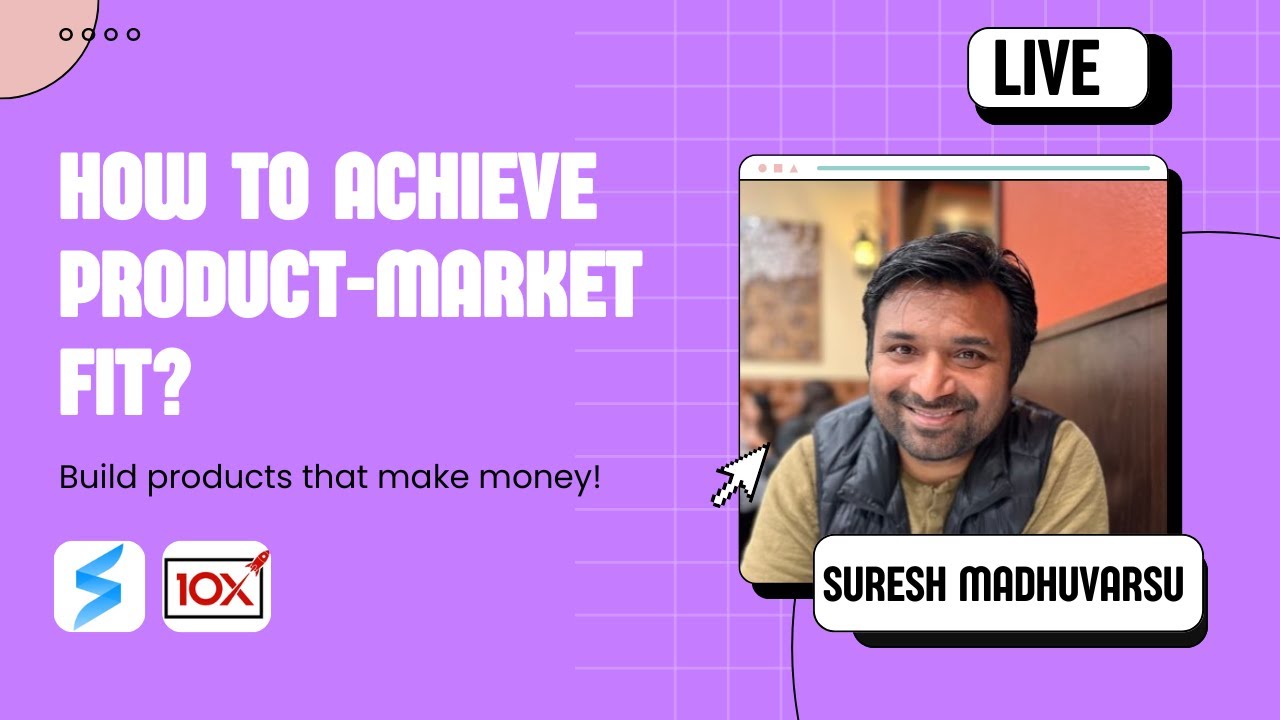
In this podcast, host Kushal interviews serial entrepreneur Suresh Madhuvarsu about turning ideas into market‑ready products and acquiring early customers. Suresh shares his 18‑year journey from embedded engineering at Bosch to founding multiple startups, two of which were acquired by Software AG and Oracle. He emphasizes curiosity, deep problem understanding, and relentless customer listening as the foundation for any startup. He outlines a practical approach to building an MVP, validating demand, and iterating based on feedback while avoiding analysis paralysis and feature bloat. The conversation then dives into his current ventures: SalesTable, a revenue‑enablement platform that tackles sales‑team onboarding churn, and the Product 10X Accelerator, which supports pre‑seed/seed founders—especially in health, education, and HR tech—through product, technology, go‑to‑market strategy, and funding connections. Suresh discusses defining a precise Ideal Customer Profile (ICP), segmenting VP‑of‑Sales personas by company size, and scaling responsibly. He also contrasts bootstrapping with venture‑capital routes, stressing revenue‑generating customers and leveraging extensive networks to accelerate growth. The interview concludes with Suresh offering himself as a sounding board for founders.
Chapters
Yeah. So hi, Suresh. Thank you for joining in firstly today. I found you on LinkedIn and I really wanted to talk to you about how to, how can startups sustainably grow their business, go from concept to market initially as well. So we'll be talking about that. But before we get into it, tell us a little bit about yourself first. What do you do? What have you done so far and everything about you?
Yeah, absolutely. First of all, Kushal, I'm so grateful to be joining on this call and thanks for inviting me for this podcast. Really amazing, by the way. And first things first, I really feel great joining this podcast for multiple reasons, right? One is I've been an engineer, product manager, and then entrepreneur. And for the last 18 years or so, I've started about 4 companies, and 2 of them have seen successful exits to Software AG and Oracle. And as part of that, one thing that I really learned is really building a community, really giving back when people see their growth in their careers. And that's exactly the reason where when you reached out, I was so happy to kind of, you know, really talk to you and then your audience and then share whatever I can from that angle. So really briefly, from my point of view, I really started my career as a software embedded engineer. I worked for Bosch for about 6 years in Germany as well as in Bangalore, India. And then when I came to the US, of course, I mean, I moved from more of an engineering deep technology role to more of a product manager role. Again, I'm talking about this almost 15 years ago. When we think about the product manager now, there are, of course, brilliant number of resources on product management, but that time not. But then the whole evolution from engineering to product management and then really going in as founding product member into some of these startups and then really see the growth of these startups and then exiting has been an amazing journey for me personally. And currently I run 2 companies. One of it is actually called Product NX Accelerator. We bring in pre-seed, seed stage companies into the accelerator and we help them throughout the journey on product technology strategy, fundraising strategy, go-to-market strategy. And then that's really what we do with Product NX. Right now we have 16 portfolio companies as part of the Product NX portfolio. And then secondly, I also run a startup called Sales Table. So as I was running this accelerator, the one thing that we realized is there is so much of the white space to be solved and in the sales enablement space, that's when I started SalesTable. It's been an amazing journey and that's the short and sweet.
Perfect. So let's just get into the questions in the beginning because, because of your experience as an engineer and then as a product manager, you know how to like do from a concept and an idea, uh, to, uh, actually launching it to the market. So tell us a bit about that. How can someone, uh, who has an idea, who has a concept about their product, uh, first build their MVP and then, uh, launch it into their market and, uh, try to get some feedback from their initial customers?
Yeah, absolutely. So first things first, uh, people get into entrepreneurship or, um, building companies in multiple ways, right? There is no one path, honestly. But however, the one characteristic that you will see in every founder typically is curiosity and the problem-solving skills. Those are the 2 things that I put it as a very high valuable characteristics of any founder, because at the end of the day, yes, it is important to create MVP, yes, it is important to go out and then validate into the market. But the most important thing is to really understand what is the problem, who is the customer, what is the market, why is that customer facing the challenge or a problem, and how can we solve it? Most importantly, if we solve it, can they pay for this? Would they pay for this? That's going to be a very important aspect for us to think through. Because unfortunately, 99% of startups fail.
True.
That's a hard truth that everybody as founders, we have to take it through. So that's why it's very important to first things first, to understand your customer really well, the problem space really well, and then you can create whether it is about the Figma designs or maybe paper napkin designs, doesn't really matter. There are multiple ways where you can actually talk to these prospects or the customers that you believe and say, hey, I know you guys are going through these challenges. What kind of challenges are you facing? If I solve this, would you be happy? Would you pay for a service like this? And then that's really the start of the journey for many of the folks. Because even when you think about it, even Airbnb started as a photo sharing business initially to really come to Airbnb, right? So there are always these kind of things that you need to start and experiment initially. But again, coming back to my original point, the first and foremost thing is curiosity and your ability to learn as quickly as possible from the market, your customers, and then use that feedback to continuously build the product.
Got it. So I also believe in that because my theory, anytime I start a new business or someone is talking about starting a new business, I'm like, first go and listen. Listening is the best thing that you can do. Talk to your customers, listen to their problems, listen to if they're willing to pay for that problem if it is solved so that you understand what you need to build. But let's say once you have figured out like, okay, this is the problem and this is a solution that I'm going to provide, right? And let's say people are even willing to pay for it. How do you first initially get your customers? Because even if you are providing a solution, there's a lot of iterations that need to happen to make it a good solution, right? To make it a viable solution for a lot of people to pay, right? A good product, basically. So how can you first get your initial customers so that you can start getting that feedback loop from these customers?
That's actually a fantastic question because that's really where we get stuck, right? What I mean by that is we build a product, initial set of advisors or the market basically says, oh, you know what, yours is a great product. And then maybe 1 or 2 or 10 of those customers start paying you. And now it really becomes, okay, now I'm getting a little bit of money, but then we don't want to go into the analysis paralysis. I think is really what my advice would be. What I mean by that is there is a lot of decisions that you as a founder need to take on a day-to-day basis. especially on the product side. Is the product good enough? Do you need to add a new module or do you need to add a new functionality? And all these discussions and all these decisions are very crucial for any founder. And what happens is we kind of really dig deeper into each and every decision in a way that the decisions are getting slower and then product is not moving that fast. That's one thing that we all get into the trap. One of the things that I always think about is when you build a product, have that mindset that the product needs to be improved every single time. There is nothing like a perfect product. There is nothing like a perfect feature. But what we need to really think about is whatever I built, is it solving the customer's problem or not? That's really the first lens that you would want to take. As long as that is happening, customers will of course drive some of the feature sets that you have. Because let's think about this. If you have feature A and then they start using it and then they might say, hey, you know what, I need integration to, let's say, a CRM or I need integration into a pipeline development company or whatever that is. And then you will automatically build those features. That, that's fine. But what you don't want to get stuck is to say, hey, you know what? I want to build a perfect product. I want to build more features. I want to build more modules. Instead of taking that approach, we should take, am I solving the customer's problem currently? Yes, that is good. And then as you are speaking to more customers, Then I'm sure the customers will ask you about, do you have the right security? Do you have the GDPR compliance? Do you have this? Do you have that? So those are the discussions that you need to be listening to your prospective customers. You will anyway be able to bring in all that together.
Well said. Uh, so in the end, it's about the customer and they'll drive the features down the line, but the core product, the initial idea, if it's solving the problem, then you're going into the right direction. That's what you're basically saying. Okay, perfect. So, uh, let's talk about Sales Table for a second here because this is your company. This is a sales readiness company, right?
Yeah, that's true.
Okay. So tell me about that first. Once you launched that initial product, who were your initial customers and how did you then start scaling from that? Because there is a point where, you know, like, okay, you have a good product, you're solving a problem, and you also have made a good enough product that if I start scaling this now, it won't be a bad thing because there's a time where scaling is a bad thing, right? Because if Your product is not ready and if you start scaling, it won't, it will get bad reputation. And then if once you have bad reputation with someone, they won't buy it again, right? So, but once you have a good product, how you can start scaling from it? And if you can give us an example from SalesTable as well.
Yeah, absolutely. So first things first, SalesTable is a revenue enablement platform that is focused for the mid-market companies. to assist sales enablement managers. That's really what we do. And our mission really is to make sure that every sales rep is actually hitting their quota in a very consistent manner. That's really what we do with Sales Table. And for us, when we really started, it's the same question for us as well, which is Who are the customers? What is the ICP? And who are we going after? Do they appreciate what we are trying to solve? That's really the lens that we had, which basically means we had an MVP we built for sure. It took about 3.5 months or so to really have the basic infrastructure to really solve one specific problem, which is Are we able to do sales teams onboarding? That's the problem that we wanted to solve. Onboarding is actually a huge problem in the sales teams because almost 80% of the companies don't have a structured onboarding for sales teams. And then what happens is salespeople come in and then their VP of sales or the sales manager says, okay, now you guys go meet the quota. And then these guys are doing the complete outreaches, whether it is inbound, outbound, or whatever. And unfortunately, because they don't have the right training, they don't have the context of the company, they don't have the product training and whatnot. They do what they can for sure, but at the end of the day, they get really frustrated and then they leave. And the staggering amount of 40% of the salespeople actually leave at the end of the year. In most of the companies, right? That's why unfortunately we keep saying salespeople have the highest churn from the HR point of view because of these specific reasons. So coming back, we actually looked into that particular problem for VP of Sales saying if they don't have a structured onboarding, then there is a high churn that is associated to that. What we actually looked into was from our own— we are 2 founders and then we actually went to our own network of people that we have in our circle. Then we set up the meetings with them, we showed the product, we got the feedback really about, is this something that you would use right now? It's not about saying, oh, you know what, if I have all these features I want to use. No, no, no. Right now, this is the product that you have. Can you and would you use this? That actually gives you very solid feedback because some would be like, oh, wow, this is too rudimentary, it doesn't really solve my problem. Then there are some that would say, yeah, I think this might be okay. I want want to give it a try. Right? Or some might say, hey, this looks great, but this is not for me. I mean, I'm an enterprise VP of sales, and then you guys need to build a lot of things for me to even consider. Right?
Mhmm.
So once we get this kind of initial feedback, then that really gives you a very good idea in terms of what features and what kind of customers that you want to really target. Because think about it, right? Just because we define the ICP as saying, oh, you know what, the ICP for me is VP of Sales. But think about it, VP of Sales are there in every organization, right? From a billion-dollar enterprise to a $1 million enterprise, right?
Mm-hmm.
So we need to really further define as to say, who are those exact customers? What is the characteristics of those VP of sales that are willing to take a chance on you? And that's exactly where we focused on. And then now it is really about the conversion, right? You talk to 100 people and then see how many of them get converted and then why there is a conversion at that point of time, right?
Mm-hmm.
And then I think, you know, that's really the trap that we will get into. When I say trap, when you're talking to these 100, let's say, potential customers, there will be some of them who might say, hey, if you build this feature ABC, then I will buy your software. While that is a good thing, the challenge that really happens is you will get into this constant building cycle of the product. And that's going to be a never-ending process. But instead, what we need to really focus on is who are those prospective customers who would take your product as is, start using it, and then build on top of it? And that's really how, you know, we've taken that feedback and then really identify those customers who are willing to work with us. And then add-on features as part of our own roadmap, plus the features that are driven by customers.
Got it. So you don't want to— because if I reach out to an enterprise VP of sales and then maybe medium-sized business VP of sales, right? So these are the— so probably they are making like $20, $30, $40 million a year, and this particular business is making like $5 million or $3 million a year, right? So their feature stack and what they want within their organization is completely different. So if you don't define what size of business, what type of business, and basically whatever your ICP is, and then who you are reaching out within these organizations to try your products, then you won't have a good enough answer and feedback for your product as well. Because if you are reaching out to these enterprise companies, They will require some different features and a lot of other features that probably these medium-sized companies don't want, right? And if you're building that, then you are not targeting— maybe down the line you have an enterprise edition as well, but in the beginning it's good to like focus on one specific avatar and one specific person and build for them, right?
Absolutely. Absolutely. So I, I'll give you one example, Kushal. You touched on a great point. So think about the 2 different kinds of VP of Sales, one who is working at a small business that is generating about $5 million per year. And then there is another one which is generating $500 million per year, right?
Mm-hmm.
They both, when you think about it, they both are VP of Sales. Let's say for me, they both exist in the US. But then the challenges that they have are very different, right? For a VP of Sales at the $5 million company, he or she might have maybe 5, 6 sales reps that are directly reporting to this VP of Sales.
Mm-hmm.
And there is probably not too much of a tech stack. They may have a CRM, they may have, of course, you know, a couple of pipeline development tools, but that's about it. But for a VP of sales that is at a $500 million company, they might have a big hierarchy of directors and senior managers, the sales trainers, and probably the sales operations people. And then there is a big tech stack, and the ability for them to integrate the marketing tools and the sales tools is very high, and they're probably operating in, let's say, US and Europe as well. So The data transparency, the security aspects are very different for them. So now you can imagine when you go to the same VP of sales, what they are looking for is very different.
Right.
So that's exactly, I mean, to your point, this is something honestly, you know, we didn't know it day one, to be honest with you. We were, I mean, we were everywhere. I mean, we were going to small businesses, we were going to medium size, midsize. enterprise. But then over a period of time, that is exactly where I keep talking about curiosity and learning every single day. See what is working for you, think about what is not working for you, and do more of what is working for you, and then learn from the things that are not working for you. That's exactly the operation that we really are in, and it really worked out for us from that point of view. on a continuous learning basis. Got it.
So let's talk about now P10X, this Product 10X Accelerator specifically. Uh, what do you guys do there? Like, give us a bit about, uh, that and what type of companies do you take on? Uh, how do you like analyze these companies and everything about that?
Yeah. Um, so as part of my previous, uh, startups, What the one thing that I realized is not everybody wants to go the venture capital route. Not everybody wants to raise money. There are a lot of startups that are out there who wants to bootstrap. And one of the biggest challenge that comes with the bootstrapping your own business is the resources are limited, the funds are limited, and you still are responsible for really the payroll as a business owner, as a founder.
Which is a good thing, right? Because I feel like having limited resources is a good thing for me because, uh, when there's limited resources, you have to be creative. You don't— you can't overspend on stuff, uh, that doesn't really matter. So you focus on the essentials.
Absolutely, absolutely. So that's the thing, right? Again, uh, there are definitely the reasons why somebody should be taking venture capital. There are definitely some reasons why it is good for some founders to be on the bootstrapping mode. I mean, there is nothing like one is good versus the others, but it is really for the founder to decide what they want to do with their company, right? And that's exactly the reason why we founded Product NX. And the idea is super simple. We want to be that sounding board and a co-founder capacity for these startup founders where we don't, of course, I mean, go as full-time founders with these startup founders, but then we actually work with them. We help them with the product strategy, technology strategy, the entire go-to-market strategy, and then invest in them. And we also find the other funding partners who can put in the money into these startups. And as such, we actually become their complete, the strategic as well as the execution partner with these founders. And we have very meticulously looked into 3 different verticals. The way we think about it is everybody should have great health. That's only the reason that anybody can flourish. So health tech is the number one priority for us. Once people have good health, they should be able to actually get good education. We believe that good education is needed for everybody to thrive at the end of the day. So education tech is a very important thing for us, followed by when you have good health, good education, you need to get good work out there. So the whole of the HR tech, is really the third vertical that we really look into. And so far we've been real proud and lucky that we've exited about 2 startups in 2021. And then we have 15 startups in our portfolio really across the health, education, and HR. So that's something that we do with Productize. Got it.
And these are early-stage companies, right?
That is correct. So we typically bring these companies in pre-seed, seed stage, and they have the product, they have at least one customer, and they're able to demo the product. There is a full-time founder that is working on the startup, and then that's the recipe that we look into to be able to help these startups.
Got it. So once you find these companies, how do you— do you help them Uh, become profitable as well? Or do you also believe like sometimes you need to burn cash, uh, to grow? Because these are bootstrap companies, right? So they can't probably afford too much burning.
That's true. So the way we think about, uh, the growth at a— especially the bootstrap company— is every customer that you get should be a revenue-generating customer. That's going to be the most important thing. And what that really means is it doesn't really matter even if somebody is a small customer paying $100 versus a big customer paying $500,000. The idea would be to say, what is, what is your product? Who are you surveying? And then are they generating enough value and enough revenue for you to sustain your product development and the company development?
Right.
That's really the core thing that we look into, especially when somebody bootstrapping. And then on the top of it, we have extensive networks in, of course, in the US and as well as in India for somebody to actually go talk to the ICPs that they are selling to. Let's say if somebody wants to get into a hospital network, then we have some of the biggest hospital networks in the US that we can actually have a call with and then get the introductions done for some of these founders so that they can go validate and then see if they can become their customers. So we've built that extensive set of network for ourselves. And that's really where we want to make sure that we are helpful for the founders, really bringing those connections, industry connections, technology connections, so that they can actually go build their revenue as part of that.
Perfect. Thank you for joining in, Suresh, because I really wanted to talk to you about like early-stage companies and how they can grow from concept to market. And you really define all of these things really well. Because it's all about listening to the customer. It's all about getting feedback from them, building your initial product, get your feedback, define your main ICP and not like stray away from them by listening to like some other ICP as well, because then you'll keep building the product and never launch it and start getting revenue out of it, right? So a lot of these topics that you touched on are really valuable for a lot of people just starting out. So grateful for you to join in today and talking about these.
Absolutely, Kushal. As I mentioned, really humbled to be part of this podcast. And my goal is super simple. Even if there is one founder that I'm able to inspire, my job is well done. And I hope I did that today. And for any founders out there or technologists who is really planning to start a company or you started a company and then you are planning to grow, I am always there as the sounding board. I would love to meet with the founders. I would love to kind of understand what they are building and I'm always here to help. So please feel free to reach out to me. My emails and everything is publicly available on my LinkedIn profile, so please go find it and I'm always here to help. Thank you for having me here, by the way. Thank you.
Thank you for joining in.
More from Suresh

TV#4: Why "Great" Products Fail: The Hard Truth About Selling with Suresh Madhuvarsu

Beyond the Dashboard: Leading Sales Teams with Emotional Intelligence in 2026

Sales Uncharted Podcast: Suresh Madhuvarsu, CEO of SalesTable: The Founder’s Dilemma



🔥 From Sales Enablement to Revenue Enablement | Suresh Madhuvarsu on the Future of AI in Sales


