Sales Coaching Excellence: How to Inspire and Elevate Your Sales Team
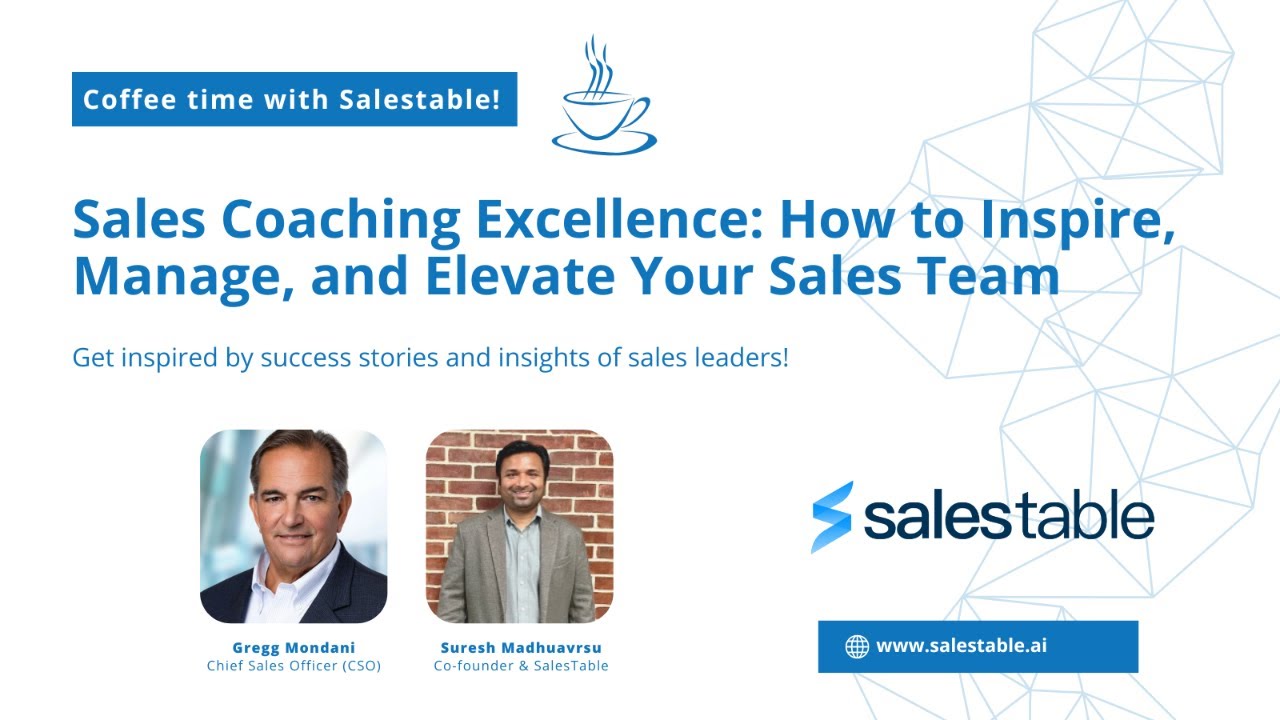
In this episode of the "Coffee Time with Sales Table" podcast, host Suresh Madhuvarsu interviews seasoned sales leader Greg Mondani (formerly of Oracle and Amazon) to explore the twin challenges of hiring great salespeople and, more critically, keeping them motivated and productive. The conversation covers a range of practical leadership tactics: the foundational need for leaders to demonstrate genuine care for their reps; avoiding the “mini‑me” trap by tailoring coaching to individual strengths and account types; institutionalizing continuous learning through regular "Sharpen the Saw" sessions and role‑plays; collaborative objection‑handling that pulls insights from product, marketing, and sales ops; preparing discovery calls with hypothesis‑driven research; using data‑driven performance management that focuses on early‑stage input KPIs (emails, calls, demos) rather than waiting for quota outcomes; setting SMART, co‑created goals; handling under‑performance with empathy, early identification, and data‑backed action plans; maintaining CRM hygiene to prevent pipeline bloat and ensure accurate forecasting; and leveraging tools such as AI‑driven sales analytics, automated note‑taking, and disciplined forecasting. Throughout, Greg emphasizes a culture of empathy, transparency, and continuous improvement as the engine for sustained quota attainment and team retention.
Chapters
Hello everyone. Welcome to Coffee Time with Sales Table, the podcast where we sit down with industry-leading sales experts and coaches to dive into the art of sales coaching and mastering the quota attainment. Today, I'm super excited to be with Greg Mondani, a sales leader who has seen it all at companies like Oracle and Amazon. My discussions with Greg has always been centered around team building, coaching, and performance, and that's what we will discuss today. Greg, welcome to the show.
Well, thank you, Suresh. I appreciate that, and I always enjoy our conversations. I'm looking forward to today's as well.
Absolutely. So one of the things, Greg, I mean, last week I know there is the SASTA conference in the Bay Area, and then This week Dreamforce is happening. So we are definitely talking at a very interesting time, by the way. And one thing that I realized going to SaaStr, speaking with a lot of sales leaders and the founders, is they always talk about in the dinner discussions, lunch discussions, 2 topics invariably come.
Mm-hmm.
And those 2 are, one, it's super hard to hire a great salesperson. no matter which level they are? I think that's the first challenge that everybody talks about. The second one is, how do you keep them? How do you motivate them when they are in your organization in a way that they are hitting their quota, they are being a good citizen of the company and all that stuff? Just from that angle, I think today's focus is definitely to say, Let's kind of, you know, really assume that we brought in great folks at all levels, and then we're really trying to see how to best keep them within the company. That's really the topic of the discussion today. Does that sound good?
That sounds great. Let's talk about how to inspire them and engage them and elevate their sales. Their sales. I like it.
Absolutely. So One of the things that you've been there building large sales teams and then managing a lot of Fortune clients and all that. One of the biggest things that I realize is when you have this team of sales leaders and Director of Sales, AEs, Account Managers, and SDRs, and sales reps and all that, How do you really coach them and bring in that culture together?
Interesting. Okay. So somebody once told me this early in my career. And so I think a key cornerstone to being a great leader, and it really is about leading a team versus managing a team, in my opinion, is that nobody is going to care about you or your company until they know how much you care about them. So that's like fundamental, like bedrock. They have to know, and the way you're going to keep them and the way you're going to motivate them, etc., they need to know that you're in it with them and you care as much about them as they do about you and your company. So I think that's kind of fundamental. If you can't get past that, then you got some challenges. Beyond that, one of the things I see folks often do, particularly new sales leaders, is they want to make a team of kind of mini-mes, if you will, right? They know what worked for them. A lot of sales leaders started in sales and they worked their way up and they became the number one sales rep. And particularly if you're talking to SaaS kind of people where they're, you know, they've got the sales guy that's been there for a while and they're going to make him a sales leader. Sometimes that works, sometimes it doesn't. But one of the reasons it doesn't often is because they want to have everybody do exactly like they did. And the reality is there's a variety of different styles, etc. So as a sales leader, you need to adopt your style to the people, and you got to meet them where they are. So sometimes you have technical reps, sometimes people are really good at the financial sales pitch, other people are personal relationship, but maybe they're not as great technically. So as a sales leader, you need to adopt And fill in where they're not as strong. And then I think it's important at that point also to help them get stronger where they're not. So if they're not particularly great at putting together proposals, maybe you help them at first and then you coach them along. So as long as folks feel like they're getting better along the way, I think your retention rates are gonna go considerably. Some other things that you probably want to do that I found successful in my career, Suresh, you want to make sure you're always doing learning. In one of my companies you mentioned earlier, at Oracle, we used to do a regular scheduled meeting we called Sharpen the Saw.
Wow.
If you believe that sales is a tool, right? I mean, it really is. You would never go into a tool like a saw and have it dull. You want to have it sharp as possible. So sharpening the saw, and that was honing those techniques and those skills on a regular basis. Objection handling. We take some of those things for granted, but what we would do is we would get in there and we would list all the objections. That everybody had, and then you put them up on a board and everyone would, you know, rank, you know, give me your top 3 or 4, whichever one's got the biggest, uh, scores. Then those are the ones we learned on how to figure out the answers to. And we wouldn't do it like just dictating, here's the answers. It didn't come just from product management, it didn't come just from marketing or just from sales. It's that whole team, and we all came up with our best answers at that point. So I think that if you're going to build a team and you're going to have success in just coaching the team, but making sure they're, they're engaged and they're inspired, they need to know you're with them. You need to adapt to their style. And you need to start this continuous learning and developing. To this day, I still read sales books and all kinds of different things to make sure that I'm, I'm staying on top of my game as well as a leader.
So Greg, that's a great couple of points that I'm taking from that. Number one is really you talked about the continuous learning. I think that's one aspect. The second one is when we talk about the objection handling, it's not just about sales teams sitting together and saying that, hey, you know, what should we kind of respond to this? But it's really about a team exercise across the functional organizations across product management, sales, and marketing, because at the end of the day, everybody brings in a very different, unique perspective. And how do we bring that together looks like, you know, one of a great insight from that.
Yeah, I think, you know, sales is a team sport and everybody's got their position to play as a sales leader, as an individual contributor. But there's the rest of the team too. Product management built these features for a reason, right? Right? So they should be included in those discussions. Marketing has insights about our clients and our customers and where the market's headed that maybe we don't have, right? Sales is kind of narrowly focused on deals right in front of us. Marketing, product management, those kind of things, they're looking out in the future. You can even bring in sales ops to see if there's opportunities to make things better. But at the end of the day, Come up with an answer to the objection. You know, we always used to get banged on the head around the cost of support, and we came up with some great answers for that that we could feel confident. And then the second thing to that, Suresh, gotta go practice it. So role-playing and practice, and practice in an environment. Nobody would ever go out for their very first time at an at-bat in a baseball game and just get up to the plate and start swinging. Yet as salespeople, we do that, right? We practice, we know the answer. And so we go out and visit the client right away. Practice it in a safe environment, no matter how awkward it feels, but just get the pattern down, try it out, see how it works.
Yeah, yeah, absolutely. So the one thing that I want to double-click on, Greg, is this, right? Which is a lot of sales leaders who went through their own sort of experience for decades, for example, I'm sure they have the kind of luxury and the opportunity of learning through their experience, and then they are able to contribute back. But we're also seeing the other leaders where, especially a lot of sales leaders who would have probably started their journey in, let's say, 2017, 2018, there is a hypergrowth that has happened to every company that is out there, which means they, they were responsible for revenue no matter what. I mean, in a sense, even if their strategies worked or not, revenue increased because at the end of the day there was very high demand and then people were just buying software, for example. And then now in the last couple of years, I'm sure, you know, we've all seen a different reality on its own. And the reason why I bring up the topic is a lot of leaders, or rather who are in leadership roles, for example, they may not have had the chance of really looking through the complete life cycle of sales itself in multiple companies. They would have worked in 1 or 2 companies and in the last 8, uh, 6, 7 years or so, and that's what they know. And the challenge over there that we are actually hearing from the reps is when the reps come in, the sales leader themselves, they do not understand how to coach them, how to mentor them because they haven't themselves been through that process.
Right.
And that's becoming a lot of disconnect these days where the sales leaders are expecting something. And to your earlier point as to say, I'm doing something, this worked for me, and I expect all of the teams to work the same way. So again, just coming back to the topic, Greg, if there are these leaders who probably didn't have too much of experience being with the high-growth companies and whatnot, what would be your advice as to say how should they be looking at the coaching and mentoring to their teams?
Okay, so interesting question, so thank you for it. I think If you're going to, if you're really going to coach the individual reps, I think you need to start off with, you know, identifying the reps. I always was big on matching a rep's skill set to the account, right? So particularly because I was mostly in enterprise accounts. And so sometimes in the general business, you can't do that. But what you try to do is if the account was an account that was more personal, right? They wanted that personal touch. They wanted to go out to baseball games. They wanna do that stuff. Others are super technical. They just want the information. So you gotta start off there and make sure you're matching the right people to the right accounts. The other thing is everybody needs a different type of coaching, Suresh. So if I'm new, I might need more basic kind of coaching.
Yeah.
An understanding about the value of CRM and why I even need to bother with that. Maybe they need help on just introductory calls, those kind of things.
And then on the other hand, you have a seasoned person.
And, and I think sometimes as leaders, we forget that even seasoned people, people that have been successful their entire career, also can use coaching. So the thing is, as a leader, you need to adjust and adapt your coaching style to the level that person is. And again, I think you play to people's strengths. And then you also, if you're in this new world order, right? So now all of a sudden things are difficult. You got to rely a little bit heavier on MQLs than you did before, right?
Yep.
Customers are so much more informed today. Suresh, than they ever have been, right? By the time they're talking to a rep, they know a lot about your product. So it's not like the old days where we had to go out and teach them what the product did, right? They kind of know it or they're not going to talk to you. What you need to do is adjust the product and tell them what it's going to do for their company. And I think that's the biggest change post the pandemic and why things are kind of flattening off. is that, you know, we've got to make extreme use of all those MQLs and SQLs that come across and adapt our talk track to that customer associated with the value that they're going to get from the product and not what the product does. By this point, they know what the product does, especially if they've read all the blogs and the white papers and those things.
Gotcha. So the one aspect over there, Greg, is you mentioned about know your team, know who they are, and then really provide that right coaching and mentoring for them. To get a bit more specific into it, I'm sure probably there are these director of sales, account managers, AEs, and reps, and all of them with very different seniority and different experiences that they'd have come through. If that is the case, from your point of view, How do you kind of— let's say you got into that role, and then you inherited a team of 10, 15, 100, whatever that is.
Yeah.
How do you make a plan to say, how should I really think through on setting up a nice coaching and training? I mean, not a formal or official kind of coaching, or what I mean, but then even if it is one-on-ones or a group kind of coaching methods, How do you even devise something like that?
So I think if— so I've taken over a bunch of teams because that's normally how it happens, right? I've had to build a few from scratch, and that has a different aspect to it completely. But if you, if you walk in and you're a first-line manager, right, and you're taking over a team of 10 or so, something like that, I think it's important upfront to kind of learn the team, learn them as a group. And talk to them about the challenges that they're having and where they're seeing success and where they're seeing failures. And you need to have that open and honest conversations about them, right? And then after you do that, I think that's when you start devising these individual plans. Is there, is this sale more account management because I'm going to work the install base as much as possible, or is it all about new logos? And if it's a new logo, then how do I do those? introductory calls? How do I get the, you know, how do I make that elevator pitch as clean and as tight as possible? Those kind of things, right? And then I think that it's really important that you have set time to meet with each one of your reps on a regular basis, right? And that's got to be open and honest, transparent conversations. I remember one of my reps walked into my office one day and said, I think I've got this massive deal. Which was $10+ million. And he goes, I don't have a clue how to move forward. And, you know, rather than get upset, like, what do you mean? You're one of my senior reps. I was thankful because this individual came to me and said, I need a strategy, I need a plan. And I think that's a lot of what we need to do as managers is plan, whether it's a territory plan, an account plan, or even planning down at the individual sales call level, right?
Yeah.
Right? There's a line in a Rod Stewart song where it says, you know, the ad-lib lines were well rehearsed. And, you know, especially if it's a team sale and you got pre-sales with you and a pre-sales engineer, make sure that they know their role, what your role is. And the last thing you want to do is be that sales rep in the meeting that says, you know, coffee, tea, and bathrooms down the hall and go. Right? It needs to be interactive. We've all been in those meetings, right? Yeah. Yeah. Your question? Yeah.
So, Greg, I mean, you talked about the 2 specific things I'm super interested in. One is playing to their strengths. And which basically means, as leaders, through the initial set of discussions and whatnot, we need to know exactly what their strengths are. And many times, sometimes even I don't know what my strength is until my mentor or advisor tells me, hey, you know what, you're really good at that.
Right?
A lot of people, for example, I never considered it that way. But then they said, hey, Suresh, you know what, every time that I talk to you, you come out as a very authentic person that I'm talking to. And that's what we love about you. But then that's not how I looked at myself that way, right? So really, yeah, yeah, yeah. So it's one of those things where, can you talk through on as a leader, how are we really looking at other people's strengths? And how are we really communicating those strengths to the people in a way that they're actually able to use more of them, and probably not wandering all around? Because I do know, especially talking to sales leaders for the last couple of years, I always think about the 80/20 rule, Greg, which is 20% of the reps, they always do the right things and they're always kind of meeting or exceeding the quota versus the rest of the 80% of the people, you really need some kind of coaching and mentoring to really get them to the next level of their performance. If that is the case, I'm just wondering, how do you identify those gaps typically?
Yeah, so, um, no, no secret sauce here. You just got to be with them, right? Yeah. So, um, you've got to spend time with the reps. You got to make phone calls with them. You got to make sales calls with them. And a lot of times, if I'm in a sales meeting, I've got a a huge advantage because I'm not the one on stage, right? And so I can observe both the client and my rep at the same time. And really what you're looking for there is opportunities to coach later on. And you always want to coach those opportunities in a positive light, right? And, and so you can talk to them about, here's the things you did really well. Right? I loved how you did the intro, blah blah, those kind of things. But then you also need to coach them about the things they didn't do so well. Like a lot of times as reps, we've got in our mind that script that we've got to get through. I need to hit these 5 or 4 or 5 key points, right? Because we practice that, you know, we, that's what we talked about. And yet sometimes you got to sit back and listen to the client as well. So I think a lot of it is coaching on an individual basis based on what you're observing, right? You can also do observations from their peers. The peers know who's doing what because they want to emulate the good things, right? So if you find out that one of their peers is continually going to them to figure out how to write the proposals, then that's probably one of their strengths, right? Those kind of things. So, yeah, I think there's a lot of things you have to take in to make that happen. And I totally agree with everyone that talked to you. You're very sincere and authentic, so I can see why people gave you that feedback.
So, Greg, one of the things that kind of struck me with your example is, especially when in the previous startups and with SalesTable, one of the things that I realized is that discovery calls are the goldmine for everyone.
Absolutely.
Because at the end of the day, to your point, let's say as a sales rep, I know the script, I know what to talk. I know how to pitch the product. Let's say the product has 4, 5, 6 modules, for example. It really feels as though that when I go in front of a prospect, I have to talk about all the 6 things that I have because it naturally feels as though the more features and the more modules that I show to my prospect, the more they will be wowed. But we actually figured out it's actually the other way around, which is talk to the prospect, understand their pain points, and then based on their pain points, sometimes you tweak your pitch in a way. Maybe based on the pain points, not all 6 modules are relevant for them.
Yeah.
Only 1 module is relevant for them. If so, then don't waste your time and their time by showing everything. Just focus on that one specific problem. That's as simple as I said that, but that's such a hard skill even for me to obtain. It took years, to be honest with you.
Yeah. No, it's critical. That's a big difference now versus 5 years ago, 10 years ago. Right? I think that when you go into a discovery call, of course, you're going in there to learn. And as you pointed out, it's a gold mine, right? It's where they open up. But I would go in there knowing as much as I possibly could about that account before I show up. So I'd go in with a hypothesis. So rather than kind of go in and say, well, tell me where it hurts, right? By this point, if you're going in and you have a product which has a semi-high price point, I will have gone through their 10-Ks. I will have looked at what announcements they've had recently. I would go in with a hypothesis that my product can help with your new product launch because of that kind of thing, right? And tell them that you know something about their business. Before you even start the discovery call. When you do that, Suresh, I think what it does is it earns you the right to go deeper on your discovery call. If you go in and say, you know, so tell me, what keeps you up at night? That's so generic and everybody's doing that, right? Like, so tell me, what are your— what are the 3 things that are most important to you? That kind of stuff. You should come in with a premise, you know, based on what I know about your company. I think you've got some competitive challenges. You're releasing a new product. And, you know, you just went through a price increase or something. You start off knowing something about that client. Let me tell you that the whole dynamics of that conversation changes. So as a sales coach and as a sales leader, one of the things I want to do, particularly with newer reps, is teach them how to prepare for that discovery call. When I go into a discovery call, whether it's in person or online, I've got a set of questions that I'm going to ask, and those questions are specific to their company, not necessarily generic to any call we're going to make. Right. And I think that's the difference in the year 2024 versus 2014, if that makes sense. Got it.
Yeah. So, Greg, I mean, now let's say at this point of time I got my team and How do you really think about— yes, coaching is one aspect of it, but how do you really do the accountability aspect of it and the goal-setting aspect of it? Because I'm sure it's not like a one-size-fits-all because there are different levels of reps that are out there, the sales leaders that are out there. And along with the personalized coaching that we talked about, How do we, or rather, is there a kind of framework that you typically think of when you're setting the goals for your team?
So goal setting is an interesting one. There's usually some that are handed down from sales ops or management, right? Those kind of things. And I always get a little frustrated when people say that sales is a numbers game, right? You just, more sales calls you make, the more you get. Well, not if I can make the most out of every sales call, right? Those kind of things. So I think first off, you know, you need to establish goals that are SMART. We've all known those, right? The specific, measurable, achievable, relevant, and then time-bound. So everybody has a clear understanding of what your goals and objectives are. Whenever possible, those should be in collaboration goal setting with the reps, right? So if you turn and say you need to do, you know, I was talking to a rep the other day that said that they had, that the company had said, you know, you have to do a certain number of onsite meetings, which from a company perspective makes a lot of sense. But from her perspective, her clients were virtual. They were all over the country. So I couldn't meet my online. I couldn't meet my face-to-face because I would be on planes all day long, that kind of thing. Right? So you wanna kind of do those types of things. And then I think the, the key to this is you gotta, you gotta measure them. Right? So any kind of, of, of, you know, establishing any sort of expectations has gotta be measurable. And to hold them accountable that you want them in the boat with you when they get created. And then just be transparent about it. Right? Find out and make sure that everyone knows where you are and, and what things you're doing. And then start using, make sure you're using tools like CRM, etc., to track those things. and avoid hearsay kind of things. Yeah.
Greg, I mean, these days, especially when we think about the accountability and especially quota attainment has become one of the mostly talked about topic in the last 3 years. In a sense that, yes, I mean, for companies that are doing great, I mean, that's nice, but We've seen a lot of companies where quarter after quarter they start missing the goals and then unfortunately people are let go and at every level and in all the many departments that we know of. And especially in the sales, the one rhetoric that I don't personally like is, oh, you know what, salespeople, just let them in. We will look into their performance for a quarter and then we let them go.
Right?
And that really feels like a very inhuman way of treating people and the talent. And if that is the case, let's say we have 10 people out of which probably 3 are not really doing well from whether it is about the quota attainment point of view or even on a day-to-day basis, the inputs that they're providing into the sales. How do we as sales leaders be thinking about how in a very human way, in a very high empathetic way? How can we deal with those kind of situations?
Okay, so 2 things there to unpack. So I will answer that about how do you, how do you address performance issues with empathy and effectiveness. But you also touched on something else. Quota attainment is an output, right? And too often as, as companies, right, Particularly if you're in finance, a CFO or a CEO, that's all you look at is the output, right? Did they make it? Yes or no, right? And that's all that matters. The reality is, as sales leaders, if we're creating the right environment, there's a whole bunch of input KPIs that we should be looking at to predict whether or not we're going to be successful. And that's where there's a bunch of new tools. Right? I'm sure you know all about them, but you need to take a look at the inputs as well as the output, because if you look at the output, it's too late to fix it by the time you're starting to miss quota. So that's one thing. Addressing these performance issues with empathy and effectiveness, I think the first key is early identification. Don't wait for the company or sales ops or somebody else to come to you and say, your rep isn't doing very well, what are you going to do about it? You need to identify it early. And then I think you need to be looking at the root cause. You know, a lot of times people don't realize what they're doing wrong or right, or maybe there's a deficiency in why they're not being successful, right? So you got to look at the root cause and be positive about what you're looking at at that point. And I think it's really critical And this, I see a lot of sales leaders miss this one, Suresh. I think it's really critical that you listen to your rep when they're having a performance issue, rather than telling them either A, that they've got a problem. If we've hired right, if you and I have got the right reps, they're harder on themselves than we ever could be, right? And so you need to listen to them and figure out why are they having challenges, and then again, start looking to help them.
Yeah.
The other 2 things I would do is be data-driven. So if you do have a performance issue, show them in data. It's not just in quota attainment, it's in all those KPIs and the things that they're doing early on. And the other thing that I would avoid are either kind of biases that you might have. So try to, unconscious biases and also avoid hearsay. Nobody wants to, nobody wants to go, well, I heard that, you know, You didn't do very well on this. And you go, well, who'd you hear from? Well, I really can't tell you. That doesn't do anybody good. So keep it real, keep it data-driven, listen to your folks. And again, if you've hired the right people, they don't feel good about their performance either. And then look for a way to— a clear action plan to get it back to performance. And if after all that it doesn't, then we all know the inevitable. But give it your real sincere But do it in private and make sure it's empathetic when you do it. Don't be accusatory.
Yeah, yeah, yeah. I mean, it's, it's one of those things where we see in the sales where at the end of the quarter, it's kind of we sit, we go on a one-on-one, we say, hey, you know what, things didn't happen. And the biggest challenge that I always felt was why wait till end of the quarter? Whether somebody will hit the quota or not, you will absolutely come to know based on the pipeline, the conversion rates and everything, the month 1, the month 2, the month 3, and there are so many weeks in between. That's exactly where, especially from Sales Table point of view, the one aspect that we have taken, Greg, was really about the data-driven performance management.
Absolutely.
Because at the end of the day, yes, the CRMs are very important, how we are doing the deal and the deal management is very important. But at the same time, we also believe the inputs to the day-to-day sales are critical, right? How many emails are you sending? How many LinkedIn messages are you sending? How many conversations are you having? And how many demos have you done on a daily basis? If the demos are zero for month 1 and month 2, clearly you know that probably things are not moving well for that particular rep. Then it's really the question of saying, yes, you haven't been able to, let's say you are getting a lot of conversations, but you are not getting a lot of demos, for example. In that case, maybe there are ways that we can coach them to say, how do we impactfully provide that whole value proposition in the discovery call or in the first call that you're having with the customer? And then go back, get that coached and trained, and then come back to your day-to-day activity. So those are the kind of things, it so well resonates with what we are doing at SalesTable. Greg, thanks for highlighting that. I really appreciate it.
Yeah, no, it's critical. You've gotta have all those key, those KPIs, all that information early on, and we should never be surprised when we lose a deal. And the other thing is, if you do lose a deal, you need to learn from it, right? The only thing worse than losing from a deal is not learning from it. But all of those KPIs early on, like you said, if somebody is 2 months and they're having all the conversations and they're doing all those types of things and they're 2 months without a demo, then you need to go back and really start analyzing Those calls, right? And that's where using some automated note-taker kind of things during your conversations so you can go back and analyze where there was opportunities to implement a demo and those kind of things to ask for it. Maybe they're not asking for it. Maybe they're thinking that demos are not very valuable. I don't know. But you're absolutely right. It's all the kinds of things that you get from Sales Table AI that help us identify those things early. The last thing you want is a surprise at the end of the quarter. or the end of the month. It's now monthly. Yeah, yeah, yeah.
And especially, I think, Greg, that's the challenge, right? At the end of the quarter, let's say, even as a sales leader, I identify that a rep didn't meet their expectations, or the rep realizes that they didn't meet the quota. But the point really is, we've missed the mark. You know, we are now looking into the rearview rather than looking into the future. And that's exactly where If we do these things right on a daily basis, on a weekly basis, we want to avoid the disappointment for the team as a whole. Because I'm sure as sales leaders, nobody is really happy to provide that bad messaging to their reps.
Yeah.
Or the reps are not happy to get into the PIP process and then they are like, I mean, nobody likes to go through PIP. That's really the whole challenge that We all want to avoid at the end of the day, right?
Yeah. No, by the time you get in the PIP, it's too late at that point anyway. So it's continual coaching and it's coaching throughout the entire process, throughout the entire month, throughout the entire quarter. And you need to take responsibility. Again, nobody's going to care about you until they know how much you care about them. And you need to be in the boat with them all along the process, particularly when they're struggling. Yeah.
So about the care, Greg, I think, you know, that's one thing that It's funny, sometimes I talk to sales leaders, they'll be like, hey, you know what, you know, we really want to improve the team's performance. And then I would be like, so at this point of time, who is coaching them? Who is mentoring them? They'll be like, none. And then I'll be like, why not? And then the response, the usual response is, I don't have time.
Right. Yeah. But then, but you don't, you don't have time for no sales either. Yeah. Yeah. I'll let you finish your thought. I'm sorry.
Yeah, no, no. So that's the kind of thing where sales leaders intend, they have the right intention that yes, they want to help the team, they want to provide the right guidance. But I think we need to provide the right guidance to the sales leaders, right tools to the sales leaders, which actually brings to my last topic for today. What are some of the tools and processes that you think of when we are really trying to coach or optimize teams' performance?
So I think that first off, you have to have a philosophy, a mentality, or whatever you would like to call it, a culture that says everything starts in CRM, right? So do not have an off-the-books forecast. And everybody's favorite forecasting tool is Excel, and I implore you, do not do that. It's got to be out of— it's got to be out of a CRM system because you can't learn unless it's all in the CRM system. So when you do pull up your forecast during a monthly meeting, quarterly meeting, whenever you do your forecast review, You know, stop the PowerPoint and don't say I'm gonna close X millions this week, this month, this quarter, this year, and instead pull up CRM and say these are the specific deals. And then that's where you can start utilizing other tools like Sales Table AI, etc., to help understanding do I have all the right inputs to ensure that. As an example, if I know a deal is supposed to close this month and nobody's spoken to that client in 6 weeks, I'm gonna call foul. You're not gonna close a deal this month, even though, you know, forecast says it's supposed to, and they said it's gonna be, you know, I can get my budget on September 30th and we'll close the deal. You need to be talking to them weekly right now or daily, right? Those kinds of things. Those are the inputs you need to be looking at to make sure that you're gonna hit your number at the end. So it's kind of, you have to make time. If you're not doing that as a sales leader, what are you spending your time at? And I would look internally because if I don't have time to help coach and look at those inputs and again, look at the forecast, be honest with yourself. Is this deal really going to close? And, you know, make sure that you got input from the presales engineers. Make sure you got input from everybody else. Do we have the contract in place? Has legal seen a draft of it? All of that kind of stuff you want to get done really early on. So that you can hit your forecast and know that we don't have those performance issues. So those are the kinds of things that go through my head, Suresh.
Yeah, yeah, yeah. So, Craig, the moment you talked about the CRM, um, the one discussion that I had with one of the sales, uh, leaders came to my mind, which is, um, she mentioned, uh, something very profound. She said the CRM bloat happens bottoms up. Not the top-down. And what she meant by that is it's one of those things where we as reps, I go in, I talk to 10 people, and then maybe 3 of them are interested seemingly. And then I immediately open into the CRM, I put in the ACV out there, and then from the pipeline point of view, it just looks as though, oh, you know what, you know, $300K pipeline. Then my manager looks at it and then even though the manager is like, hey, are you sure really is this happening? But then the manager wants to look good in front of the VP of Sales. Then they're like, yeah, okay, maybe it's fine. Suresh is still working on it. Then now it goes to the VP of Sales or maybe CRO and whatever. At the end of it, it looks like from the top line point of view, Oh, we have $10 million pipeline. But when you really look into it, to your point, you know, when you look into each and every deal that is there in the CRM and look for what is the probability of closing this deal, some are at zero.
Yeah, no, it's got— you got to inspect the pipeline, you got to inspect it early, you got to inspect it often. But it's not just the, just the dollar amount. It's like, are we doing all of the right things To ensure that that's a real deal. Do we have? You know, you can go back. We can have a whole session on whether it's medic or whatever you use, right? Do we have an influencer? Do we have a decision maker? Do we know the budget? All of those types of things, right? And it's really critical to get that done early and often, and be honest, and be honest with both yourself and the rep. And if there, and if we don't have those things, pull it out of your forecast. I'd rather do that on the. the 5th and 6th of the month than the 28th or 29th when, as you said, it's gotten all the way to the CRO and they've counted it, right?
Yeah, yeah, absolutely. Uh, Greg, I mean, I know we delve into a bunch of topics today, but, uh, super useful. And, um, any closing comments, uh, from your side?
Well, I just, I appreciate giving me a chance to, to, uh, to join you and your team on On this particular pod— this particular podcast. And I think you got a lot of great sales leaders out there. Hopefully somebody picked up something along the way then. And again, it's all common sense, but, you know, it's always good to have that reinforcement going in, right? We haven't done a sharpen the saw. We haven't done a role play in a while, those kind of things. So thank you for giving me the opportunity to meet with all the folks out there on the podcast.
Yeah, absolutely. Again, Greg, really appreciate your time. I always learn a ton of things, and today is actually— my brain is coming with all the new ideas on what I should be doing personally. But thanks a lot for the time and appreciate all
More from Suresh

TV#4: Why "Great" Products Fail: The Hard Truth About Selling with Suresh Madhuvarsu

Beyond the Dashboard: Leading Sales Teams with Emotional Intelligence in 2026

Sales Uncharted Podcast: Suresh Madhuvarsu, CEO of SalesTable: The Founder’s Dilemma



🔥 From Sales Enablement to Revenue Enablement | Suresh Madhuvarsu on the Future of AI in Sales


