Winning in Manufacturing & Supply Chain Sales: Overcoming Complex Deals
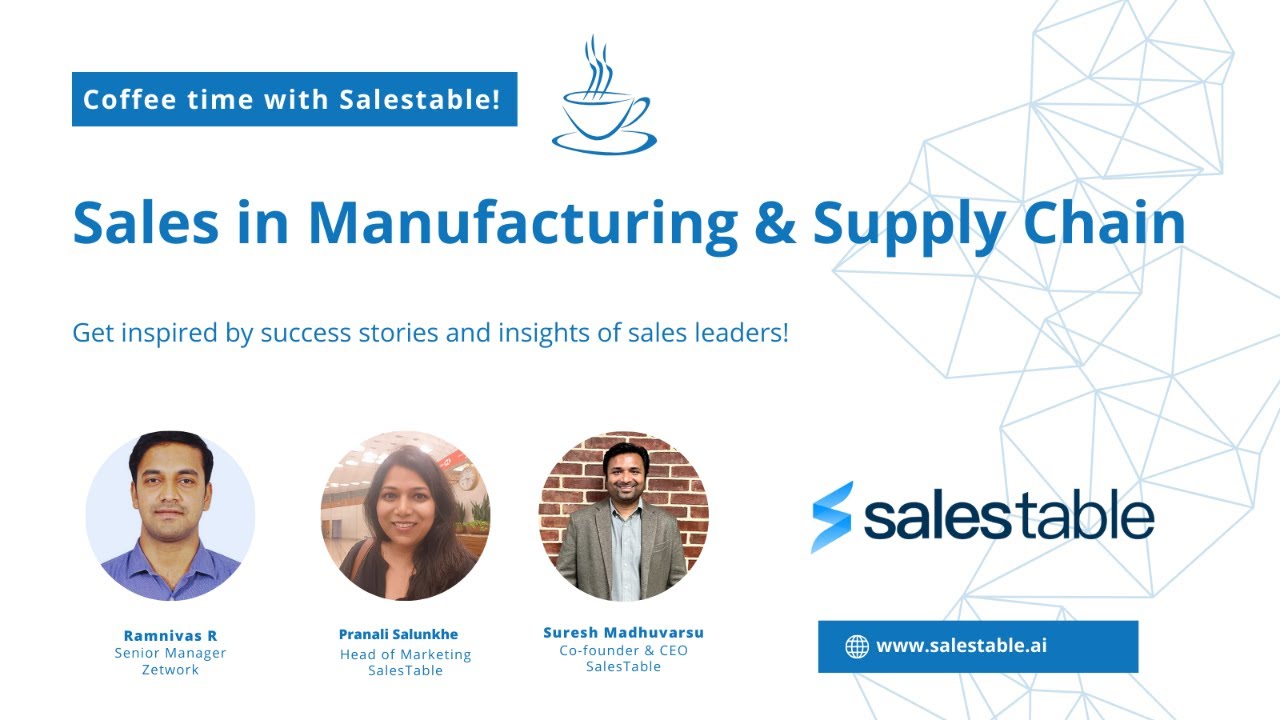
In this 2025 webinar, host Suresh Madhuvarsu chats with Pranali (Head of Marketing at Sales Table) and Ram Niwas (sales leader at Zetwerk) about the unique challenges of selling in manufacturing and supply‑chain markets. They explore how post‑COVID disruptions have reshaped supply‑chain strategies, making manufacturers more open to partnership and extending sales cycles from weeks to months or quarters. The conversation covers how to build a broader yet high‑quality pipeline, the importance of expanding the funnel, and the need to accept longer sales timelines. Onboarding and training are discussed, emphasizing that understanding internal processes often outweighs deep domain expertise, and that a hands‑dirty, physical‑world mindset is critical. Technology’s role is highlighted – AI‑driven prospecting, LinkedIn, ZoomInfo, and other digital tools dramatically shorten research time and improve funnel quality. They also detail contract design that indexes commodity prices to mitigate volatility, and stress that regulatory compliance and certification are non‑negotiable, table‑stake requirements. Finally, Ram offers a 2025 outlook, noting India’s stable, tech‑adopting economy, the continued relevance of efficiency, and the need for sales leaders to focus on cost‑consciousness and adaptability.
Chapters
Hello everyone, welcome to Coffee Time with Sales Table. I'm Suresh here. Today we are actually joined by 2 of my super favorite guests, by the way. One is Pranali. Pranali is our Head of Marketing who joined us recently. I will let her give the introduction, and then we're also accompanied by Ram Niwas here, and he's actually a great friend of mine. How we met, I think, you know, we will talk about it in a separate one, but really been impressed with what Ram Niwas has been doing on the entire sales leadership and how he's able to bring a lot of knowledge in building the sales teams as well as especially he actually works in very tough industries like manufacturing and supply chain, and that's exactly where we are going to spend our time today. So without further ado, maybe Pranali, if you can go give a quick introduction about yourself and then followed by Ram Nivas, that would be amazing.
Absolutely. Hello everyone, so Pranali here. As Suresh introduced, I head the marketing with Sales Table. Couldn't be more excited to be part of this team and it just like, you know, brings my passion area marketing being applied to sales, which is like a very critical space for any organization. And talking about today's session, I couldn't have done this first webinar without anybody else like Suresh and Ramnevas. I think this is like the perfect stage for you know me to do this with the very first time. So super special, super excited, looking forward. Yeah, Ramnevas, over to you.
No, absolutely.
Yeah, thank you, Pranali. Thank you, Suresh, for the invite. And I would say like when we are friends first and you know let's say colleagues or And I would say professional comes later. So that's how I know both Suresh and Prenly. Yeah, so I work with Zedwork Manufacturing. We are Bangalore-based, or I would say we are headquartered in India. We are a startup that is into manufacturing. So think of us similar to Foxconn. So where you give us your designs, we'll be able to manufacture and give it to you. And we do this across multiple segments. We are in the industrial segment and geographically we are there in India and US as well. We are into electronics where we manufacture hearables, wearables, and we are slowly and steadily getting into— I mean, going up the value chain as well. Yeah, beyond the industrials and electronics, the company is also into defense. It is also into, I would say, commodity trading as well. Yeah, by and large, so at the end of the day, so manufacturing is exploding in India and globally as well. The supply chain is sort of getting realigned with the China Plus One strategy. And I'm not sure if it's too early to call, but I would also say that we are seeing signs of you know, early deglobalization as well. So supply chains are getting realigned across countries and geographies. And Zetwerk as a contract manufacturer, so we are able to leverage our manufacturing networks and provide solutions for the companies who are actually going through all of these disruptions. Yeah.
That's amazing. So probably we'll just get right onto the topic, by the way, Ramnivas. So I know especially after the pandemic, there is so much of disruption on the supply chain angle throughout the world especially, and a lot of manufacturing prowess is there in Asia. And we know there are several instances where the supply chain got stuck and then there are the prices went up and all that stuff that happened. And especially the manufacturing, of course, is very much the deeper network that we have as part of the supply chain and manufacturing. So when we think about the supply chain manufacturing, the one thing that really comes to my mind is it is actually backbone of any industrialized country at this point of time. And without those 2 things together, it's super difficult for any country to thrive in a way, right? So I wanted to probably give a little bit of sense of, I think, you know, what you have, what you are seeing in the manufacturing industry and supply chain, especially in India, and how you are thinking really about sales that is really helping the companies and the strategies together?
Yeah, I would say like by and large, if we see the world around us, so that's broadly built on the physical world. I mean, that's the bread and butter. On the physical world, let's say all the IT, everything can actually work around. I think I would say the pandemic has been a blessing in disguise where companies have understood that Without these physical infrastructure and whatever could be your advancements that you do in terms of technology, that cannot exist. So I would say the pandemic has again— so it has re-emphasized manufacturing as the bread and butter of an economy or for any company to thrive as well. So I would say that's been the uh, you know, largest, I would say, takeaway from the pandemic-induced supply chain disruptions. So the companies— I mean, leave companies, uh, so even now countries are thinking of supply chains as a very strategic, uh, uh, you know, or national security, from a national security perspective.
Right.
So yeah, supply chains and manufacturing, so I mean, globally it is— it has got the prominence back. And from organizations to countries to provinces. So everybody is working on making sure that supply chain is future-proof for to handle any kind of disruptions that will come in the world. So let's say in last 5, 6 years, we have seen multiple disruptions in terms of COVID Let's say we had an incident in US called Baltimore incident. Let's say there are now geopolitical tensions that are happening in Middle East, then there was a Red Sea crisis, then there is, let's say, leadership changes in multiple countries after elections, which are again changing the way the countries look at supply chains, manufacturing, and global trade. So the key word is disruptions, okay? So, and disruptions is creating a lot of it is giving a lot of focus to manufacturing, and that's good for companies like us and people like me.
Yeah, no, that's a great, great one. So one aspect where we always think about when it comes to disruption is especially when we think about the sales cycles. I'm sure, I think, you know, we are also talking about how has the sales cycles have changed or moved previously from the pre-COVID to now. I think that's one top of the mind that everybody has. But more specifically so, to really get through the complete lifecycle of sales is really where I want to make sure that I get some insights from you. Typically post-pandemic, how are you, especially on the manufacturing and supply chain side of it, How do you really think of building the pipeline? Because especially I know for sure on the SaaS and the tech side of the business, nobody is picking up, nobody is opening emails, nobody is picking up the calls. So it is becoming super difficult to actually reach to the right, I would say, ICP or your target audience. So how do you see in manufacturing and supply chain that happening?
Yeah, uh, uh, just continuing from where I left, uh, the prominence to manufacturing has improved, the prominence towards supply chains has improved post-pandemic. So, uh, let's say pre-pandemic, I would say it was more transactional, uh, the companies were more transactional in their approach towards, uh, uh, you know, other manufacturing organizations. So I would say post-pandemic, the transactional approach is not there from most of the customers that we work with today. So that means that the intent to speak to us, the intent to lend their ears to companies who are into the supply chain has dramatically improved. So which means as a sales guy, we are able to get better time from them in terms of explaining explaining our solutions, explaining our— the way we work. So that's a key, uh, I would say that's a broad shift that we are seeing where companies are open to speaking to, uh, you know, their own supply chain partners and new supply chain partners potentially as well. So that's a big change from a sales side. So which means that for us to approach, uh, as you said, in the SaaS world No, people are not opening the emails or people are not picking up the calls. So it's a different world on this, on the other side where people are now more eager to speak to their own supply chain partners and understanding if they can handle the disruptions. So that's a key takeaway. So in terms of how do you build the pipeline, for sure, No, the sales cycles are definitely longer in the manufacturing industry because it has to go through a lot of internal approvals and it involves a lot of physical activities as well where companies— let's say we are approaching a client and he has to come to our factory, audit the factory, and he has to give the approval. And that approval has to come from multiple internal teams within that organization. Definitely sales cycle is longer in the manufacturing industry. So as a sales guy, I think we should accept that fact that sales cycle is going to be longer.
Yeah.
So a customer acquisition, let's say for example, in a D2C industry or in a consumer goods industry, so the customer acquisition is probably a day, minute, or it is counted in days or minutes, or let's say even at the max weeks. But in manufacturing, we have to talk in terms of months or we have to talk in terms of, I would say, quarters.
Okay.
So we have to accept the fact that sales cycle is going to be longer in manufacturing industry. And what can I do as a sales guy to actually, I would say, to offset it? So I can just make the funnel broader than being longer. Anyway, it is longer, the funnel is longer in terms of timeline. So I can make the funnel broader. So instead of just speaking to one company, I can speak to 10 companies and understand if they have interest. So I would say that's what we do, where we keep the funnel broader.
That's amazing. So as a follow-up to that, I'm very curious, right? So at SalesTable, we actually work on some of the very non-tech companies in a way, or industries where there is a lot of need for that onboarding, training, the role play, objection handling, making sure that reps actually become better in what they are doing. It's really about the craft. So my question would be, when you bring in your reps, I mean, even manufacturing and supply chain is not as though that, you know, it is anybody can come in and then start selling right away from day one. I'm sure, you know, they need to be well trained or just given the right amount of knowledge on the industry and the products that you guys are kind of really providing the value. How do you think about that whole onboarding and training process in the manufacturing industry?
Yeah, I think it is a little different than, let's say, for example, consumer goods or a SaaS organization. So there is a lot of domain knowledge that is needed in manufacturing, uh, to come in. So I would say that's a large entry barrier in, in many sense as well. But on the other hand, manufacturing is also to do with, uh, you know, how How much of common sense that you can apply in your, you know, in your, in your sales process. So the lifecycle of a sales guy and his, you know, daily activities when he's actually getting into the organization is all about can he understand the whole process? Okay, so one is the process-oriented, you know, knowledge. Second is the domain knowledge. So domain knowledge Definitely it cannot be grown overnight, but if he is able to understand the process that is there within the organization and externally to the company that he is pitching to, I think that will probably solve like 60-70% of the problems. Even if domain knowledge is not there, If he's able to go through the process, if he's able to understand the process, I think that's going to make life easier for him and for the team that he's working with and for the company as well. So I would say if he's able to understand the process, that's going to help you.
That's amazing. So probably I want to double-click on what you just said right now, which is through your experience, for example, when you built the sales teams in your previous companies, What did you learn the most about, let's say, the best ways or better ways to train onboard sales reps? Are there any kind of insights or tips that you can probably give to audience?
I think so. Whenever we actually come into a new entity or a new organization, I think most of the time has to be spent on whether the person is able to understand that organization better. So I think that is the biggest, uh, you know, area that, you know, I will work on personally, okay? Which is like, am I able to understand the organization that I am working for better? So because organization's goals also, uh, you know, keep evolving from time to time. And unless otherwise, our own vision and organization visions are not aligned, I think we're not adding value to each other. Okay, so I would say, so, so when a new guy joins, so I think that's the largest or that's the most fundamental thing that has to be done, which is like, can he understand the organization? Can he understand what organization is aiming for? And in that broad picture, so what is the work or what is the value addition that he can do, even if it is very small? So what is the value addition that he can do? And if he's able to understand this, I would say this macro picture better, I think other things can just fall into place.
That's amazing. I'll say this. I think you are actually one of the category of sales leaders that I've spoken to where they said, hey, we want to invest in employee or the sales rep onboarding and training. Because I mean, clearly, I mean, there is nothing like a right or wrong aspect of it, but every sales leader has their own methodology and then through their experiences and whatnot. And for them, some are like, hey, you know what, we just bring in the sales reps, we throw in the water, let them swim or sink, is one method. And then the second one, I think some of the most successful sales leaders really go through that angle of, hey, people are the most important asset to your own strategy. So if they are not equipped with the right amount of knowledge, whether it is about the product, process, competitive understanding, the battle cards, whatever that is, then you are just leaving them for a chance, right? And especially in this economy, leaving them for a chance, probably I don't think any sales leader can, uh, afford to do that. So that's an amazing insight, Ram. Pranali, I know you have a few, uh, questions as well for Ram Nivas. Probably I will let you, uh, take it from here.
Thank you, Suresh. Uh, so, uh, Ram Nivas, I mean, knowing, having like, you know, a little exposure in the B2B manufacturing space, uh, myself, I knew, I mean, it's pretty traditional setup, like, you know, especially when it comes to sales, uh, we see it's all like, you know, relationship-based. How do you see technology playing a role in this entire reach out? You know, as a marketer, obviously I am more curious on that front. And also, if you can like, you know, help us give some insights in terms of the adoption as a salesperson yourself being in the industry. Like, uh, one is the whole digitization that, you know, has been there post-COVID especially. I'm sure the manufacturing guys are also like, you know, pretty much going and riding the wave. But then when it comes to the on-ground sales teams, like, you know, how is the team looking at the technology advances? How are they utilizing the tech support to better their outreach and, you know, conversions? So if you can just help us understand that.
I think, you know, the day-to-day work of a sales guy is, I mean, to be honest, I would say like, can he find customers? Can he find the potential customers? And can he find the right person to reach out to in that potential customer? And, and he— can he actually reach out to that customer? Okay, I would say the— that is the basic of a sales guy. I think these 3 areas— identifying the companies, identifying the person within the companies, and identifying— I mean, how do we communicate with that person? I think everywhere technology is being used. Okay, uh, so for example, which are the companies that, uh, you know, I would want to target? Okay, so today a lot of AI solutions are there, uh, where I can just key in my target audience's profiles. Okay, or I can just tell what is the company that I am currently working with and let AI tell me who could be the potential audiences for me.
Absolutely.
Definitely, technology is making our lives easier. I myself, I used to take notes from newspapers, other websites, whatever I read through to understand the names of the companies that I should target. But today, if I use any of the AI tools that is available, it is able to give me the target customers that I would have to work with. So for example, you know, I cannot go into specifics because of proprietary, but we wanted to build one category of customers that we wanted to target. So the first question in everyone's mind was like, who are the companies that we should ideally— what are the names of the companies that we should ideally target? Okay. So this question, answering this question earlier would have taken probably 3 to 4 weeks, which means that we should talk to relevant folks, and the relevant folks should actually have time to answer our calls, then probably they might give a relevant answer or they might not give relevant answers. So this process would take probably 3 to 4 weeks, but today I'm able to get that in the click of a button. Okay, so that's— so I've saved like 3 to 4 weeks of time, which is— I mean, and time is money. Second, Identifying the correct point of contact within the organization. Again, today we have a lot of digital tools that is available. For example, LinkedIn is a great medium to actually explore. Beyond LinkedIn, a lot of solutions are there that build over and beyond LinkedIn. Definitely for sure, you could use that. Again, identifying that if I've identified the correct person, So I mean, getting their phone number or email ID would be the Herculean task that used to be there earlier.
Yeah.
Okay. Or I would have to physically knock the doors of the company, and, and each company will have different protocols of entry, and, uh, it is very humongous to get their attention today, but I'm able to get their coordinates through different applications very easily. So I would say the life of a sales guy has been made much simpler by a lot of technology tools that is available in the market. And even identifying the customers as well, which are the companies that we should target I think there even a lot of datasets are also available today and we can use that.
Okay.
I would actually connect this question, this to what Suresh was asking. So one is to have a broad sales funnel, but what is the quality of that funnel? Okay, so that is also important. I think these tech tools greatly enhances the quality of the funnel that we will have.
Excellent, Ramya Vasu. I mean, you're like spot on over there, and I think you've summed it like absolutely well. Like, definitely with AI, I mean, that's the buzzword today, and, uh, I mean, it is making lives easier and better across different functions and industries for sure. And as the traditional industry as manufacturing and supply chain, if we can see the applicability and, you know, really bringing in efficiencies, technologies is the way going forward, right?
And I would say, like, I mean, post-COVID, uh, at least in India, so companies are not, uh, even manufacturing, traditional manufacturing companies are not, uh, seeing technology as, I would say, some sort of ghost or demon, okay? Now they are, they have started to embrace it. Even traditional companies have started to embrace technologies. So when I— when, when the word technology, let's say if it was 6 or 7 years ago in manufacturing, it would have ideally meant can I buy better machines on the shop floor? So can I buy better, I would say, drill bits on the shop floor? So these were the thought process, uh, that was there. But because of COVID and because of all other, uh, you know, technological advancement that is happening So there is a layer of— I mean, even within a manufacturing company, the physical layer exists at the shop floor, okay, where again, so a lot of technological developments are happening, advancements are happening. But beyond this physical shop floor, uh, there is a lot of tools that the companies have started to use which are making their operations much better and which are making them, you know, much— I would say like much better in terms of cost as well. So companies today don't see technology as, I would say, like as probably, you know, third or fourth item on their agenda, but they see first on the agenda. So I'm not sure if you have seen it. So Larsen& Toubro, that's one of the largest manufacturing organizations, I would say like manufacturing and construction companies in India. So, uh, their own, uh, you know, messaging has, uh, changed. If you see their website, they have changed from manufacturing to tech-enabled construction. So now everybody is, uh, saying how can technology improve their operations. So, so, so manufacturing companies, the, the they have started to embrace technology in a very big way. And I would say India as a country, I mean, I think we have, because of the IT systems and because of the IT ecosystem that is there in the country and the necessity of those IT systems have been emphasized because of this COVID disruption. I think people are embracing technology like anything. That's what I can say.
Yeah. So one quick thing on that, Ramnivas. So these basically going back to, I started my career with Robert Bosch Bangalore, by the way, even though I'm on the software side, but I know the MicroBosch especially had a lot of tech that they were looking at, but to your point, it was really like either it is ERP or MRP. Those are— I mean, when we talk about the tech in the manufacturing, it is really about the planning of the resources or the material, but that's really it, right? But now I think we are coming to a point where every department within these manufacturing companies, whether it is about the operations, finance, and sales, marketing. Now everybody is getting their own tech stack in that sense. I think that's— I'm sure that's what you were alluding to.
Yeah.
Because previously, if you had to really go out and say, hey, you know what, I need to know the, let's say, manufacturing or our customers in $5 million to $50 million range or crore range, whatever that range is, and then in, let's say, Northern India, Southern India, whatever that is, it's a Herculean task. You have to go by the list and then you need to manually check and everything. But now with the— I'm sure there are multiple tools. ZoomInfo and Apollo is something that we use, for example, very often. I'm sure there are everywhere the localized tools. But the point really is that has become much easier. But that is also making it very complex because everybody else have the same tools.
Agreed. But I mean, even in the absence of these technological tools, still those manufacturers used to approach the same customers, right? That world was still there. So that doesn't change the competition.
That's amazing. We want it that way.
So the tools is available with everyone. How smartly one actually puts it to your use is where the game changer really lies. I mean, I believe that.
So yeah, maybe you have other questions.
Yes, so, uh, one quick thing since we have spoken a lot of the internal side, uh, Ramnevas, if you can just like, you know, help us understand like, you know, how amidst all these things, uh, you as a salesperson set the right balance in terms of, you know, or setting the realistic client expectations? You know, on one hand, like the team always have such high sales targets, but then obviously the actual sale is complex and, you know, there are demands that the client has. So all put together, like, you know, it becomes like a little tough situation to manage. So how— what's your take on this?
Yeah, yeah, I think there has been a lot of change in the perspective from the client side of how they look at supply chain partners like us. Okay, so as I said earlier, it was more transactional. Today it is not transactional. Okay, and they also understand, which is like, to get a new partner for them, and the partner has to understand the company, and the company has to understand the partner, and that is going to take a lot of time. And changing the supply chain partner is going to be disruptive not only for the company as well, it is for even for their own customers, it is going to be disruptive. So today companies are less transactional in their approach towards their supply chain partners. So I would say the expectations from the customers are not sky high, okay, when they talk to different manufacturing partners, okay. So that's been, that's That's, I would say, again, if I go back, because of COVID because in COVID they lost a lot of supply chain partners. So they also want to now make sure that whatever supply chain partners that they have, they are taken care of.
Okay.
So that their own company survival is not in question. Today, expectations are not sky-high, frankly, to be honest. But as a sales guy, from my perspective, I also do not want to see the customer as a one-time, I would say, transacting partner. I would want the customer to be with me as long as both the companies exist. I'm also thinking from a long-term perspective when I approach a customer. Which means that I'm not setting sky-high expectations that would be delivered from my side in the first instance that we work with. Because both the sides are not expecting sky-high requirements from each other, so if we're able to do the basics well, which is like we're able to decently deliver the job in time, in the quality that customer wants, I think we're okay. Okay, both the sides will be very happy.
That's excellent. I mean, yeah, that's a fair point. So I think, I mean, the people do understand that it's a collaborative ecosystem. It's no more just like a client-partner relationship, like, you know, typically. So they both, I mean, once the basics have been taken care of, they both work together towards the And it's obviously the lifecycle value of the customer. Definitely, I mean, it's not a one-time sale. So yeah, so but then just sticking there, like, you know, when it comes to again, see, all these are high-value deals, like, you know, with my little understanding again, there are price fluctuations, especially if you're talking about supply chain, right? So I mean, how effectively again, like, you know, while we understand that, you know, customers are also equally appraised in terms of these scenarios and stuff, but then still when it, uh, when it actually comes to handling these scenarios as a salesperson, because you are the front end into the relationship, right? You handle the account and stuff. How do you really manage, uh, communicating these kind of fluctuations across?
Oh, uh, so again, uh, companies like us, we have also become more aware of the situations that that could, you know, go wrong while we execute. So I would say the contract today is created in a way that is mutually beneficial for both the organizations, okay? Both for manufacturer like me and for the buyer as well, okay? So when a contract is created in an even-sided manner, I think it can take care of, you know, all the disruptions that could come in. The disruptions, as I told again, so it could— You know, we cannot predict what disruption could come, but once a contract is created which can take care of whatever disruptions that we could— that could come, and what is the process in which we are going to handle those disruptions, it is going to be a win-win situation for both the, uh, sides.
Right.
Okay, I mean, as an example, so today, uh, uh, in a manufacturing organization, the cost is actually divided into the commodity cost and the overheads. Okay, so since commodity cost is not in anybody's control, today we create contracts which says that commodity prices are actually indexed towards some, uh, you know, indices. So when— if it is an international contract, it is a London Metal Exchange. If it is an Indian contract, we have a lot of indices in India. So, so, so I would say the contract creation is where, uh, we make sure that we create a template which can handle disruptions, and, and, and the template can also let you know the process by which the disruptions should be handled between both the organizations.
Great, Ramnivas. Thank you so much for these insights. Uh, over to you, Suresh. I mean, you can—
Yeah, no, that's a great insight. I mean, by the way, I never knew about the indices and, you know, how you do those contracts. So thanks for the insight, Ramnivas. So Hearing from you, the one thing that I am thinking through is these typically, when we think about the supply chain and especially on the manufacturing side of it, the regulatory aspect of it, the quality aspect of it, I'm sure is pretty critical because I'm sure, I know from car point of view, there are about 100,000 parts that actually make a car. So as a manufacturer, it's not just about saying that, hey, you know what, this is my small parts, or, you know, 10 of the parts that I'm supplying, but you are actually responsible for that much bigger safety angle and everything. So how does that play a role in terms of how you talk to your customers in terms of the regulatory compliance or maybe even the quality angle of the product?
I think regulatory compliance is something that cannot be wished away. Okay, so, so when we talk to customers, uh, and customers also, uh, you know, they also cannot play, play around on the regulations. So, so I would say that's that, that on regulations there are no areas where we can discuss or we can actually, you know, discount as well. Okay, so regulations are there to follow for both the manufacturer and the customer as a buyer as well. So I would say regulatory requirements are not part of the discussions because that is for sure has to be followed 100%.
Right. Okay.
From a quality aspect, for sure there are, I would say, a lot of certifications that are needed and the certifications are different for different, you know, verticals of manufacturing as well. Okay, so, so for example, if it is an aircraft, say it's a different certification. If a part is— I mean, for example, take a, take a screw. So if that screw is going and sitting in a car, that needs different certification. And if the same screw is going and sitting in an aircraft, that needs different certification. Okay, so as a manufacturer, if I have to tap all the market potentials, I will have to be compliant with most of these certifications if I have to tap the entire market. So again, that is also, I would say, like, uh, uh, that is, I mean, without that I cannot even approach the market.
So that's a very interesting thing. So, um, especially I think on the quality and the regulatory aspect, I think, you know, what you were saying is it's basically a table stake, it is given And without that, I mean, you know, there is no point in even probably outreaching to your customers.
Yeah, for example, let's— let, let me make sure. Let's say if I'm exporting something to US, okay, I will have to comply to all the regulations that are there, uh, from let's say Customs and Border Protection in US, okay. And, and can I actually negotiate on these regulatory requirements? No, I cannot negotiate at all, okay. And So that's why I say that, you know, these are areas where there are no discussions at all.
Gotcha, gotcha. Yeah, that makes sense. So I'm just wondering, let's— I mean, there are a lot of young sales reps who want to kind of really come into manufacturing because honestly these days manufacturing actually has become high-tech. aspect of it, whether it is about the electronics, robotics, cars. I mean, everything that is out there, we're actually seeing, for example, Tesla— after everything is manufactured, the Tesla basically drives on its own for the docking station, right? So the manufacturing, the supply chain now are becoming much more of a high-tech. There is high demand for the people to come and join and everything. So What would your advice be for some of those reps or people who want to kind of, you know, come and join manufacturing and supply chain industries, especially from the skill set standpoint of view?
I think much more than the skill set, I think the mindset is more needed. I mean, this is a physical world that we are operating in. Manufacturing is a physical world that we are operating in, okay? And in any physical world, unless otherwise, we are, we are not okay to put our boots on the ground or get our hands dirty. It is going to be difficult for us to understand how that ecosystem operates. Okay, I think, I mean, across the value chain in manufacturing, it could be a sales guy, you could be a quality guy, you could be a manufacturing— I mean, production engineer, or it could be, let's say, Marketing guy. Okay, so if you are in the manufacturing industry, so you should be ready for, I don't know, getting your hands dirty. And unless otherwise you get your hands dirty, it is going to be difficult for us to understand that industry. Okay, so I definitely remember, you know, I again started my career with Larsen and Toubro in the valves division. The vice president of marketing was, I would say, I mean, let's say 10 years ago, he was like probably like around 60 years of age. So whenever he comes into, uh, uh, the plant, okay, he will never sit in the conference hall, okay? So he will leave all of it, uh, roll up the sleeves and come into the shop floor and look at what is happening in the shop floor, okay? Because he says this is more important than what actually happens in the conference hall or in the discussions in the conferences. Okay, so I think we will have to, from a mindset, you will have to make, I mean, you will have to come in with the right expectation that you will have to get the hands dirty. And physical world, it is definitely not a laid-back, you know, environment. It is very demanding physically as well. So I think that mindset is needed.
Okay.
But once you have that mindset, okay, all you need is just common sense to survive in this manufacturing industry. Okay, it could be any technology. Okay, it could be like robotics, it could be what I mean, on one side you have a lot of electronics and integration that is happening with mechanical systems. It could be anything. Okay, but if you have common sense, you can survive in this industry.
That's amazing. Hey, common sense is the key. That's the motto for now, right? No, I mean, looking at the time, Ramnivas, I mean, probably a last question from our side would be 2025, especially I think, you know, a lot of sales leaders, They have, I mean, everybody has mixed feelings about what 2025 could look like. Again, to exactly the same reasons that you talked about, whether it is about the geopolitics or the economic situation and all that. What would be your advice for some of the sales leaders who are probably just got promoted or they just kind of, you know, really started in their sales leadership roles? I mean, how do you kind of, you know, really give them a perspective in terms of how to think about having a framework for the execution in 2025?
Uh, I think my answer would be more inclined, uh, to the environment that I operate in, which is India. Okay, so I mean, I mean, by and large, if you see the, uh, uh, you know, happenings across the world, okay, So over last 5 to— I mean, I would say even last, uh, even from the 2008 crisis, financial crisis, okay, India has been a very stable country from an economy, uh, perspective, okay. I mean, but for the disruptions of 2008 or 2020 or whatever it is, so I think we have been a very stable economy, okay. And, uh, and the consumption in India is actually growing, okay. And, and, uh, so the market is going to just, uh, you know, keep, uh, enlarging. Okay, so there is a lot of— I mean, I would say there is a lot of domestic potential as well, but externally, even externally, uh, if you see, uh, India, we are one of the youngest population across the world. Okay, we are also a country that is okay to actually adopt technology, and and there is I mean globally as well because of lot of factors like let's say China plus win and let's say even you know whatever U.S. is trying to do against China or trying to rebalance itself. against China. So these are all creating enabling environment for India to grow, uh, even externally as well from a manufacturing standpoint. Okay, so, you know, so both internally and externally, so we will have favorable environments. Uh, I mean, definitely disruptions are going to be there, uh, and, uh, I don't think— and, and there is always a, I would say, the invisible hand of economics that is going to operate. Okay, that invisible hand is going to say wherever there is efficiency, you should go there. Okay, and I think if you are able to be efficient, we are able to be cost conscious, I think in whichever environment that is going to be there, I think we can survive.
That's amazing. Hey, you know what, there are a bunch of things at least, you know, I learned from Today's discussion, Ramani, was, you know, really about the disruption. I guess, you know, is a big thing that happening everywhere. And you talked about, you know, just mindset over the skill set. I think, you know, that's going to be a very important thing for people to operate in the industry. And then again, I think, you know, lastly, that the whole aspect of the stable economy and making sure that you follow the opportunities seems to be the right thing for the sales leaders. So without further ado, I respect your time and thanks a lot for showing up today. And Pranali, I know this is the first one and many more to come. And really, thank you both.
Thank you. Thank you, Suresh. I mean, it was an excellent discussion.
Thank you, Suresh. Good discussion. And I think one person, Mr. Neeraj, is mentioned that logistics is going to be key. I think when we said about technology, uh, I would say a lot of technology, uh, uh, I would say upgradations or technological advancements are happening in logistics side as well, which is actually building on the physical trucks, lorries, buses, whatever you would see. Okay, so, uh, definitely, so technology is going to be there in every part of the, the value chain of a manufacturing industry. And and that includes technology and logistics as well.
No, absolutely. Again, thanks a lot, Ramnevas. You have a good rest of the day.
Thank you. Thank you, Shreyas.
Thank you.
More from Suresh

TV#4: Why "Great" Products Fail: The Hard Truth About Selling with Suresh Madhuvarsu

Beyond the Dashboard: Leading Sales Teams with Emotional Intelligence in 2026

Sales Uncharted Podcast: Suresh Madhuvarsu, CEO of SalesTable: The Founder’s Dilemma



🔥 From Sales Enablement to Revenue Enablement | Suresh Madhuvarsu on the Future of AI in Sales


