April 1 & 2 | 730AM ET | Live Trading Floor w/v Suen
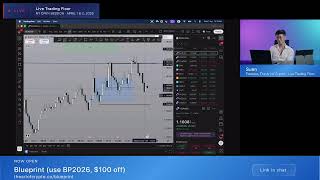
Suen walks through live trading on oil, gold, forex, and Bitcoin using order-flow concepts like order blocks and fair-value gaps. He grades each trade idea as full-risk, half-risk, or no-trade based on timeframe bias and news timing, then executes on a $50k account with 1% risk per trade. The two-day session covers position sizing, stop-loss placement, and trader psychology, showing both winning EUR trades and losses to emphasize following the system.
Chapters
Are we live? Reading the chat here, it's absolutely insane. Like, there's 200 of you here already waiting. But yeah, you guys see me? If the audio works, let me know in chat. Also, if we can make the latency as fast as possible, let's do that. The lighting's terrible, makes me washed out, bro. Better than Bali? Oh man, yeah, that's insane. Yeah, like everything, everything, no matter what we do, it's only going to be a step up compared to Bali. That was, that was an absolute disaster. This time we actually have Wi-Fi, and to everyone that's new here, what we're referring to is that last year, back in November, we actually did a livestream similar to this, and for the first like 45 minutes, we ended up just kind of fixing technical issues because Wi-Fi went out. The microphone also went out, and ultimately we realized we weren't even on the right channel. And back then the latency was like a solid minute. So the time it would take for me to see a message on the chat— the time it'd take for you to send a message into the chat and for me to see it was like a solid minute. So yeah, I think anything above that is going to be be better. And like, clearly this is a way better setup compared to last time, so we'll take that. No flying spiders as well. Oh yeah, that was another thing. So audio is cracking a bit, or the mic— it's either I'm cracking or that the voice is soft. You're seeing this, right? I'll let the team know about the audio, but once the audio is solved, we're gonna get right into it. But otherwise, guys, good to see you all. If you're like— in fact, while we're waiting for the team to just work on the audio real quick, if you're like brand new to this channel, let me like just type new in the chat. And if you've watched like more than 5 videos of mine, like type. I mean, I do know most of you. I see quite a lot of familiar faces and familiar names, but if you are like new, just say new. Like, I'm just curious because that'll kind of dictate how like deep I get into the nitty-gritty. Obviously, if you've watched some of my videos before, then you know kind of like how this works. So like, yeah. I see some of you are saying old. Yeah, if you, if you guys are old, say old just to get an idea. I can see quite a lot of new ones here. The crackling isn't that invasive. Do let me know, like, keep me posted if the crackling is still a thing. We have this time around, as you can see, not only have I invested in a proper studio for this livestream, but we have also invested in a team, like some people in the back just working on the audio right now. So yeah, right, so we've— I can see right here that we have a lot of new people, so that, that's good to know. Like, we'll definitely— I'll be— I'll definitely be happy to do a lot of explaining throughout the livestream. So yeah, with everything said, the audio is good. Then I think we should dive right into it because we have a pretty meaty presentation that we have to go through because ultimately I still have to teach you guys exactly what it is that I am looking for before I can start going onto the charts and explaining, you know, all the nitty-gritty stuff. So yeah, if you guys are ready, just type ready in the chat and we're gonna rock and roll. Sound is good, image is good. Could be noise interference from laptops. Alright, seems like audio is good for most of you. So yeah, let's rock and roll. And here we are. Alright. First of all, welcome to the live trading floor. Now, over the next couple of days, obviously we're going to be doing a lot of live trading together, but before we even step onto the charts, you guys need to know what we're looking for specifically. And most importantly, you also know— you also need to know why we're looking for those things and why things are structured that way. Now, the two things that we're going to fix, or like the two most important things that we're going to kind of COVID throughout this presentation presentation is, in fact, I'll show you. It'll be easier if I show you. So anyways, both days, this is gonna run throughout both days, and today's presentation is gonna be like, probably gonna last an hour or so if I'm predicting it right. But honestly, I'm not setting too big of a time limit for myself. Obviously I'm gonna try to get through it at a relatively reasonable pace so that by the time we hop onto the live chart, it's still going to be a good timing for trading. But otherwise, if there's anything that I've not covered, then we're definitely going to touch on it tomorrow. And most importantly, we're very likely going to be spending a solid like 4 to 5 hours together today. Maybe not 5, but definitely 3.5, 4 hours. So outside of the presentation, there is going to be a lot of empty space and a lot of time where we're going to be able to just, you know, chat, do a bit of Q&A, and That includes also tomorrow, where we're going to have another few hours together. So if you have any questions at any point, feel free to just kind of like note it down on your notebook and like we'll get to it later. So for now, let's get into it. So just real quick, here's what we're like, here's some things that we're going to cover today. The first one is, you know, like a very important thing that I'm going to be covering today is why most of you are stuck, and most importantly, like what what's causing it and how to fix it. Besides that, I'm gonna teach you, or rather, I'm gonna break down my entire entry model from start to finish. Obviously, like, barring some very minute details, because again, we only have kind of an hour here to deliver this presentation. Otherwise, we're gonna be a little bit late getting into the live markets. So I'm still gonna stick to the 80/20. Besides that, you're gonna get the full entry-exit checklist. I'm gonna break that down in kind of like a list of 1, 2, 3 that you can just kind of like check off, and there'll be exact parameters and all of that. And of course, we're going to do a bit of live trading. I have just signed up for 2 fresh funding accounts literally before, like, literally before the start of the live stream. If you have followed me on Instagram, then I think you would have seen that picture on the stories. And if you haven't already followed me on Instagram, feel free to check it out at AOC Trading. We're sharing a lot of alpha over there. So if you like what you see in this livestream, you're probably going to like what you see on the Instagram page as well. But lastly, we're just going to do a lot of Q&A throughout the entire livestream, as I've already mentioned, because after this presentation it's going to be like live trading and it's going to be quite a lot of empty space. So that gives us a lot of room for just, you know, straight up Q&A. So before we begin, I would like to draw your attention to this picture over here. And essentially, this is a survey that you guys filled in when you signed up for the event. And first of all, we'd like to thank you for taking the time to fill in that survey, because like inside we ask you, you know, what are your main pain points that you're dealing with, and some just other problems that you're dealing with in trading that's kind of holding you back from where you want to be in trading. And without you guys filling in that survey, or without you guys taking the time to fill in that survey, this would have just been a very general presentation of like, oh yeah, this is how my system works. But thanks to you guys filling it in, I now see that, you know, with very, you know, just a lot of clarity on exactly what it is that you guys are dealing with. And so that's how I was able to kind of like tailor the presentation to just help you guys more. So if you take a look over here, the majority of you by far are dealing— like, the main problem, right? This is— this question here was, okay, what is the primary pain point that you're dealing with when it comes to trading? And for the most of you, it is overtrading when nothing clean is there. And then number 2 is that you break your own risk rules. Either you over-risk, like you put on too much risk, or you under-risk, where you know that this is an amazing setup but for some reason you only went like a very small size. And even if the trade ends up winning, you don't end up getting much out of it. There are about 300 of you that do not have any sort of clearly defined system, which, don't worry, that's what this presentation is here to do. There is surprisingly 250 of you that are not trading live yet. If that is you, I would really love for you to just take a little bit of time, type it in chat on, like, just type it in chat on, like, you know, what it is that you're trying to get out of this. Because I would assume that if you are here to— like, yeah, it's still going to be super useful for you. Maybe you're just here to kind of like see how it works, like how real trading is done. And if that is the case, then that's fantastic. At the moment, I'm seeing also still a lot of comments now that I'm looking at the chat that audio is still an issue. Apparently audio is super bad. Apparently there's background music. I'll just let the team know about the audio in general. Probably it's a little bit low. So I think generally most of the comments here are where the audio is pretty low. So we'll just try to increase it by a little bit just in case. But there's also background noise. Interesting. Audio is just good? All right, awesome. All right, sorry about that. Part of the small hiccups of a live event. Obviously this is, I mean, we've already tried to control this as best as possible by getting a studio, but sometimes there's still gonna be a little bit of hiccups. And lastly, we have people hesitating on valid setups. Now, one of the important, like the TL;DR of why I show you this is that you can clearly see that that, you know, 70% of all the problems here are executional problems. Like, you can boil it down to that, which also means that, like, you already probably know that trading could, you know, achieve a lot of things for you in your life. But right now, I can tell you right away that the only thing holding you back from, you know, whatever it is that you want to achieve is not more knowledge. It's not, you know, it's not anything interesting. It's just execution, which is why this presentation, one of the core problems that we're gonna solve, is gonna be execution. And so before I share that solution, I wanna take a little bit of time to share what this event is and isn't, because again, I'd wager that a solid half of you here are probably, it's probably one of your first times seeing me, and chances are, You don't trust me yet, and that's perfectly fine. So let me just share real quick what this is gonna be. So again, I'm going to share with you the one and only method that will allow you to fix your executional problems and to finally kind of like unlock that bottleneck. Secondly, you're gonna learn my entire proven AOC model, and I am going to share more about why I say that it is proven later, and of course, I'll share about the AOC model later as well. You're gonna see the full process of trading, like from start to finish. Um, in fact, you're going to see everything from start to finish and everything in between. So basically the ups and downs and the parts where there is absolutely nothing going on, which is most of the time in trading. And then I've already mentioned this before, um, I just signed up for two fresh funding challenges literally right before the start of this live stream, um, and I'm going to try to hopefully pass it in these couple of days, and you guys will be able to kind of see every trade that we're taking alongside this. And And of course, we're gonna do many hours of deep Q&A. Now, what this isn't is going to be some sort of prerecorded webinar, you know, masterclass where, you know, the presenter is just sharing like, oh yeah, this is my childhood story and that's how it's gonna impact your trading. Because the truth is, like, you already know, we're live, hello. And what this isn't going to be also is just really surface-level info where, you know, I'm gonna withhold all of the alpha just to end up selling you into some, very overrated program. Now, I also understand that, and the reason why I kind of clarify this is that I understand most of you here have been burned by these live events before, where you take the time out of your day to join it just to end up realizing that, yeah, it's just really surface-level information, and potentially half the time is just the presenter trying to pitch you something, to try to get you into their program. And most of the time, it tends to be a combination of both. Now, that's not what I'm trying to do here. And in fact, I'm here to assure you that I will do no such thing. I still laugh every time I look at that picture. So the reason why I just don't want to do this kind of BS live event kind of model is, truth be told, in the trading industry, the trust is just absolutely shattered. And in fact, I'm even gonna go, like, between the Lambos and, you know, the kids, you know, going absolutely balls out with partying and, you know, showing girls and all this stuff, and to the point where, you know, the majority of gurus never show anything beyond their highlight reels, and to the point where, you know, when you do even end up buying their programs and the programs essentially promise you to the world and essentially gives you nothing in return. If anything, the moment you give them the money, then they kind of disappear. So chances are at this point, if you're new here, you don't trust me, and that's a good thing. If you don't, it means you're smart, right? You shouldn't just trust any old random guy from the internet. And so instead of doing the traditional thing that you're used to, I'm gonna do something different, but at the same time also understand that I'm gonna also be just upfront with you, right? I'm not running a charity here. I do in fact have a program, which is fantastic by the way, because like to the point where I can genuinely go to bed and have good sleep every single night because I genuinely know that I'm doing good work with a good product that is genuinely changing people's lives when it comes to trading. But at the same time, I refuse to just kind of like use a live event, get you guys to spend couple of hours with me just to, just for you to end up with a sales pitch, right? Personally, I hate that. I believe you guys do as well, or at least I hope you guys do. And so I'm gonna do something different, right? Instead of that, I'm gonna try to accomplish 4 things with this event. First is just provide such insane alpha throughout these couple of days that you're gonna be absolutely mind-blown that, you know, all of this info and all of this knowledge is being shared for free. Second thing is that I'm gonna, as I've mentioned already, I'm gonna try to pass a funding challenge alongside you guys and hopefully document every single trade along the way. Third, as I'm doing that, I will hopefully be able to demonstrate that whatever I'm about to teach you and whatever I talk about and whatever, yeah, just whatever I talk about, it in fact works. And lastly, like, this is just going to be a bonus. Like, if it happens, it happens. If it doesn't, it doesn't. Hopefully be able to make you a decent chunk of change from, you know, you know, just this live trading, or at the very least just give you so much info and also like focus on like the actual process that you're gonna have the tools to be able to do this yourself. So all I'm doing with these things is purely so that, you know, over the next 2 days, by the end of the next 2 days, you're You're either gonna reach a point where you're gonna be super confident that you can take whatever it is that you've learned from this live event and you can go apply yourself and you're able to just get profitable, which is, by the way, genuinely a result that I'm hoping for. If that happens for you, fantastic. Like, I genuinely do hope that for you, and that's why I designed the event in this way. Or you look at everything that I've shown you so far and you're probably gonna think somewhere along the lines of, hey, you know, I'd maybe like to the full system. I like what I see. I like the full roadmap. And, you know, maybe some coaching and accountability so that I can get to the next level with my trading. Now, if that is the case, then all I'm going to do is I'm going to share with you a link and you can check it out in your own time. Absolutely no pressure, even if you don't decide you want to go forward with it. But one thing's important is that I'm not going to be pitching you, right? Because at some point you'll also realize that you know, amongst this sea of trading scammers, you'll hopefully be able to tell who's, you know, genuinely trying to help or not. But anyways, by the end of the next couple of days, you'll probably have seen that, you know, you probably have seen firsthand that, you know, A, I know my stuff, B, I'm genuinely not trying to scam you, and C, the system that I teach, which I'm about to get into, works not only for myself but chances are for you as well because we're going to be taking trades together over the next couple of days. So if that sounds good, like, we're going to get right into it. So firstly, before we go any further, I'm going to share a couple of just like credentials as to, you know, why this is like why you should be listening to me basically. Like, I'm going to go through this pretty quickly, and essentially the reason I'm doing this, like, there are some of you here that I can see, who have been following me on Twitter, who have been following me on YouTube, you guys already know that I'm not ex— I have some qualifications as to why I'm doing this. But to those of you that are new, first of all, welcome. Over the last 12 months or so, I have publicly documented every single Bitcoin trade that I've taken on Twitter. And throughout the kind of 185 trades or so, I have about a 75% win rate. Now, this is only on Bitcoin. I do take trades on forex as well. Like, am I documenting that? No. But not only that, this same system that you're about to learn has, you know, more than acquired like about $5 million. And I think at this point it's just growing every single day, but it's allowed a lot of people to get funded for $25,000, $50,000, $100,000, $200,000, We have someone that got funded for $500,000 recently, and this is across many other people, because at some point you can think, oh yeah, I've been doing trading for a while, of course I would be able to make it work, but then this has also been tested and proven with many other people. In fact, if you're from Blueprint or Bootcamp and you've seen good results from this, show some love, type it in the chat. Not like give a positive statement, but like just, you know, show some love, you know. But just to also show you a little bit of proof and like some specific examples, Vincent— shout out to Vincent— basically an ex-professional poker player that went from, you know, barely making a couple hundred bucks a month from trading to, once he applied the frameworks that I'm about to teach you, like he went from where he was to $10K, close to $10K in payouts in just the first month, and at this point he's funded for about half a million dollars. Besides that, you also have Assam, who went from like years of inconsistency and not really making, or just not really seeing much results from trading, to basically turning $300 into $10K within like a single month of once he started applying the frameworks. The most interesting thing is that, and I can't really show you this here because like I did an hour-long interview with him, so It's not like I can just put a video clip here, so you have to just take my word for it. And also, if you guys want the clip or if you guys want the interview link for proof's sake, you can have it. But otherwise, one of the most interesting things that he said was not necessarily the thing that kind of like made it click for him. It's not more knowledge, it's not more technical analysis, something a lot more fundamental than that, which is something which is the exact thing that I'm going to get into later. Because the fact of the matter is that the majority of you here, and I'm talking like more than half, closer to 70%, you guys are not dealing with a knowledge problem. You guys are dealing with an execution problem, and that's exactly what I'm gonna share in just a bit. Besides that, we've got Martin. This guy is making an absolute killing, like to the point where I don't, like he's got way too many wins that I can even count. Like if I were to put just his screenshots, it would take up a few slides easily. Making money even on days where I'm not. Srikant, the moment he applied this framework, he managed to pass not one, not two, but three funding challenges within the last, you know, just 90 days or so. That's about one funding challenge a month. Now, if you pass it once, you can say that you were just lucky, but if you do it twice, you do it three times, clearly there is a systematic process involved here. And then Dylan, who has gotten funded multiple times as well, gotten many payouts, and this guy is also an absolute legend. By the way, the reason why I'm sharing all of this is not to— again, like, I'm not gonna pitch you on anything. Just showing you that this is a proven process that you guys are tapping into, and it's not like I'm just pulling this out of thin air, right? This is already tested. If I myself am not proof enough that this works, then hopefully the results that these people have gotten are proof of that. And lastly, shout out to Clarence. He doesn't actually know that he's on He doesn't actually know that he's going to be on the slide, but Clarence, he's my video editor. Every single video that you've seen on YouTube from like the last few years have all been edited by him. And a few months ago, we thought it would be interesting if, you know, we could teach our video editor to just become profitable as a trader. And this was around the time that we started bootcamp, and so like we kind of used him as a guinea pig and Really happy to say, and shout out to you Clarence, in the last month alone, he managed to pass a funding challenge within 2 weeks, and he managed to get a maximum payout on that funding challenge in just the next 2 weeks. So we might even, if you guys want to see it, we might even bring him on for a little client, for a little interview at some point during this livestream, since we're gonna be spending a lot of time together anyways. But yeah, you'll also see him in the chat. Clarence has been moderating the chat, so show some love. But otherwise, I could go on and on and on and on about the amount of people that this— it's not even that we help them. It's more of like this framework, right? This process that you guys are about to learn, that's what helped them kind of get, or It's just the systematic process that kind of gets people funded and gets people profitable trading. So yeah, you know, with that said, hopefully I have, you know, given you enough credentials, or at the very least you trust me enough to believe what I say now. So let's get into the nitty-gritty of it, right? Just to get into the theory of it. And one of the reasons why I took some time to show that, by the way, is that there is a solid half of you here that probably came to this livestream based on on a meta ad. In fact, say yes in the chat if you've watched more than 5 videos of mine, and say no if you're basically new to the channel. I already did this just now, but there are now about double the amount of people coming in, so I'd be really curious to know as well. But otherwise, just going back to that survey, if you remember what I said from earlier, that all of these problems, or the majority of these problems, means that you have some sort of executional problem. And the reason why I bring this up again is that, you know, let me ask you a question. What do most people do when they have an execution problem? Chances are, A, you're going to think that, you know, if you run into a losing streak of like 3 trades or so, you're going to think, oh yeah, you know, this system sucks, right? There's something wrong with the strategy, you know, let me, let me, you know, let me do something new. So you go on YouTube, you start searching up like, oh yeah, the best trading strategy or like the best scalping strategy. Some of you even take it a step further and you think that whatever is missing is just like, okay, I've seen this guru online and I think that his strategy is the one for me or like his strategy is super profitable. And so you end up buying their course just to end up realizing that no matter, as long as you are trying to fix, like, and what all of you will end up realizing and you probably already kind of went through this, is that trying to fix an executional problem with more knowledge is like pouring harder or pouring more water into a cup when you realize that it's not filling up, but then you don't realize that there's a hole where water is leaking out from. Executional problems cannot be fixed with more knowledge. Executional problems can only be fixed by systems. And at this point, there's gonna be a good number of you who are probably thinking like, hey, bro, I already have a system, man. Like, my— I have a MACD RSI system, or like, I have an ICT trading system, but I'm still struggling, you know. What gives? Well, at this point, we're gonna get into, like, gonna be, you know, breaking a belief here, because what you guys have are— chances are what you guys have is a strategy, not a system, because the system involves more than just entry criteria. The system involves more than just technical analysis. In fact, just based on this simple picture here, you don't have to look too deeply into this, but a system consists of an input, which in the case of trading is just price action. Now you have to take that Sorry, someone's phone is ringing. You have to take the, you know, raw market data, put it through some sort of process, which again, when most people think of process, they think, oh, I just need a trading strategy. But the process is also made up of more things than just a trading strategy, right? You need a framework to, you know, kind of like analyze that raw data to come up with a potential trade idea. You need a framework for deciding, you know, whether or not this trade idea qualifies as a setup and if you should take it. And then you need some sort of, you know, rule when it comes to risk management. All right, based on the quality of the setup, how much am I going to risk and how little am I going to risk? And 4, you also need some sort of framework for, or rather, you need some sort of system for trade management, because it's not enough to just open a trade, right? In fact, most of the time, opening a trade is the easiest part. The hardest part is once you open the trade and you go into the red, you know, what do you do? Or if you go into the green, do I stop this out? Do I take profit early? Do I, you know, move the stop loss, whatever, right? That's oftentimes what you struggle with, especially if you fall under the camp where overtrading is a huge problem for you. And then that's the process, right? Most people have the analysis, and I don't deny that. You probably have the analysis down, but if you don't have these other parts of the process, that's probably also why you're struggling. Which is why I say like you have a hole in your cup right now where it's not like trying to learn more technical analysis, it's just like, sure, you could 100% max this out, but if these other 3 parts are kind of empty, then you still only have a quarter of what makes a complete process. So you take raw data, which is price action, whatever you see on TradingView, bring it through a process, and ideally this process should be something that gives you an output, which wins or losses, you made money, you lost money. Ideally that should give you, you know, more money than you lose, which is just the output. And lastly, a feedback loop, right? Not lastly, but then next, you need to have a feedback loop. This is why, you know, it's so important to journal. That's why people talk about journaling. I'm not going to talk about it here, but just understand that the last element of a system is your environment, which is your market conditions. And this— and one of the very important things that I need you guys to understand here is that there are only two things that— in fact, there's— yeah, there's only two things that you can really control. One is your process, the other one is your feedback loop, right? Outside of that, everything is like— you do not have control over it. So trying to get angry at the fact that, oh yeah, uh, bro, I, you know, I had this trade, you know, I analyzed it, and you know, it's an amazing trade, but then it didn't end up playing out because price moved against me. Like, that's not in your control, right? All you can do is kind of trust that your process is good enough and that your process is a sound one, that it makes you more money over the long term. You know what, I'm getting too deep into this. Um, or, you know, in another example where, you know, a lot of the times, and I speak about this from experience, which is that when it comes to trades that I, you know, kind of like share on YouTube, one of the very big problems that people tend to complain about is like, oh bro, you called this trade, but then the market just kind of chopped around. You know, it's not really something I can predict, you know, and that falls under environment, which is market conditions. So volatility, is there not? Like, just because you do everything right does not guarantee that you will have a good result. And for those of you that did not hear that clearly, in trading, because this is a game where you always have some level of uncertainty, you can do everything right and still end up with a bad result. You can also do everything wrong and still end up with a good result. But what's important is that we have a sustainable systematic process where based on the sample size of every 100 trades, we can be confident that we're going to make more money than we lose. That's ultimately how we build trust and kind of overcome our executional problems. But that's just kind of like a brief primer on systems theory. I could go really deep into this and kind of like really break this down. In fact, I already have. My clients, like my guys, you guys will know what I'm talking about. Within the context of this presentation, just understand this is what you need. So how would a system fix your executional problems? Well, here's what you need to understand about executional problems, right? They can be basically boiled down to 3 things. One is that you either have— like, the definitions, your definitions are unclear, or there is none in the first place. And I'm going to explain what that is later. Number 2, is that, you know, in fact, now that we're on the topic, might as well explain it. So unclear definitions literally mean that you— that if I ask you right now, okay, what makes a trade valid and what makes a trade not valid? If you can't answer that, or at least if you can't answer that with, you know, clear kind of like wording, then that's what it means when you don't have unclear definitions, right? Because when you have unclear definitions, your trading tends to be based on feel. All right, I feel that the market is going up, I feel that the market's going down. Oh yeah, I'm feeling a little bit afraid. That's why you make decisions that are completely random. Second is that you don't trust your system, right? Remember what I said earlier, that your process should be systematic and also profitable over time. You don't have to trust your system. Like, basically, you need to be able to trust in the numbers to the point where, all right, as long as I execute everything in my system the way that it's intended to, in the way that it was built for, then I am confident that I will make more money than I lose over time. That's what it means by trust. And lastly, it's a fear of losing money, right? When we have real money on stake, when we have real money at stake, that, you know, for most of us, we work hard for our money. And when you have that money on the line, or you could potentially lose that, then, you know, that introduces the level of fear into the subconscious where you might make certain decisions purely like— you might make certain decisions where you wouldn't have otherwise made if you were, let's say, backtesting or even forward testing, right? If you guys relate to that, then you know what that means. So a system completely fixes the first one because your definitions are gonna be fully clear. It'll give you the framework that you need to fix the second because, you know, once you have a system, you can actually test that and get a lot of data, 50, 100, 200 backtests, and just get data that, hey, you know, as long as I execute it the way that it's supposed to be, I'm gonna be profitable. And then once you fix the second, the third will naturally resolve itself. Because when you have a fear of losing money, it usually stems from you lacking confidence in your system or in your skills. But ideally, trading should not be like— your performance in trading should not be brought down to your ability as a trader to read the markets. It's a very big misconception in trading, by the way. So, but nothing, you know, nothing can really be done until you at least get clear on your definitions. So, for— and again, like, 40% of you say that your biggest, you know, problem in trading is overtrading, right? You take trades that you're not supposed to. Well, when most of the time when this happens, you know, we tend to tell ourselves like, oh yeah, you know, I just need to be a little bit more disciplined, I just need to be a little bit more patient. But the reality is, like, we have all tried this, but it doesn't seem to work out. Why? Well, because it's really hard to be disciplined or patient about something if you don't know exactly what it is that you're waiting for, right? Think about it. So at this point, I've just shared kind of— I've just kind of like broken down like the main solution to the main bottleneck that most of you are facing. If that resonated with you, like let me know in chat. I haven't, I'll definitely get to a lot of the questions down below here. Just understand like right now as I'm in the flow, it's really hard to, it'll be difficult for me to read the chat. But if that kind of gave you an insight, type it in chat and I'll be, it'll mean a lot. But anyways, now that the main insight is over, let's get into the nitty gritty of the system. Essentially, this is going to be what most of you are probably more excited about, which is the technical analysis, or we're getting into the actual system, right? Most of the time people do think that the systems theory stuff is really, really boring, but like, guys, I'm telling you, if you take to heart what I just kind of shared with you, that's your solution. It's not more shiny technical analysis concepts. It's something as simple as systems theory. But otherwise, one of the things that I want you to focus on when it comes to, like, as we put all of this together, is I want you to focus on how I put everything together into a system, right? Not just the entry criteria, like not just a strategy, but a system. So the overview of the system is that if I can just give you kind of like an elevator pitch, is that if I see a 5-minute CISD after tapping in— by the way, like, don't worry if you don't understand any of these terms— if I see a 5-minute CISD after tapping into a 1-hourly PD array in the direction of the daily bias during a kill zone, then I will take a trade targeting 2R or a relevant liquidity level. Now that's my one-liner. Now for those of you that are already trading, I highly encourage you to break your system down into a one-liner as well, because if you cannot chances are it's either too complicated or that you are not clear enough on what it is that you're looking for. If, as long as you do not have the ability to put your trading into a one-liner with specific kind of wording, it doesn't really matter what you add on or what you change, it's going to be really tough for you to, you know, stay consistent because the truth is you will not have any sort of process. So to you guys that are already trading, highly encourage you to fix this. And this is one of the foundational things where it seems really simple, but simple is what works. So now that you have the overview, here are some of the things that we're going to be covering. We're gonna have liquidity concepts, fair value gaps, order blocks. Don't worry if you've never heard of this before. If you've heard of this before, like, you're gonna learn something new as well. Multi-timeframe analysis. In fact, you know, I'm not even gonna go through all of this. Just, this is kind of like a, like, if you had to take a screenshot of like what the strategy kind of boils down into, then this would be kind of that screenshot thing. But none of this is gonna make sense unless I explain kind of like the individual components. And so that's what we're about to get into. Now we're gonna start things off with, you know, ah, also if you followed me before, you also know that this is not the full picture. Because the actual entry checklist that I use has 8 criteria, but there are only 3 here, as you can see over there. Now, that is not me trying to withhold the alpha from you guys, but just understand, like, we only have about an hour to kind of like do this presentation. And once I kind of like analyzed every item on my entry model, I realized that, you know, you could theoretically remove everything except for 3 and the system would still function the way it is. Like, don't get me wrong, It's fun and games, and it's really nice to know about, you know, volume profiling. It's really nice to know about, you know, what is AMD or SMT. If you guys know what that means, fantastic, it's only gonna help you. But if you don't, like, doesn't matter as well. Like, chances are I'm not even gonna talk about it throughout the live trading floor. So just understand, like, this is the 80/20, right? If even if you only have this, chances are you're gonna be successful. In fact, When I get into it later, you're gonna see it firsthand at how simple, simple's great, simple's better. More does not equal better. In fact, if you're already struggling to be consistent, if you're already struggling with overtrading and like all of these other executional issues, more will only, like when you add more things on top of like what you already have, it's only gonna cause confusion. Does it make you feel smart? Absolutely, right? Feels really cool when you say, oh yeah, I can, I can game tape read the, you know, the volume profiling, can look at the value area low, the value area high. Like, it's really cool. But you can either be smart or you can make money in trading, and you don't often need to be smart in order to make money trading. So let's get into it. Starting things off with— oh yeah, we already talked about this earlier, so we don't have to talk about that. But one of the things that you come to realize about these rules that we set for ourselves is that these are not restrictions, right? The rules that we've had are what makes this boring. I'm sure you guys have heard of the term before where, you know, if your trading is not boring, then, you know, you're not really a trader or something like that, or that you'll never be consistent. And it's true because a lot of the times when people get into trading, they believe that, okay, their ability to make money is completely dependent on their ability to do technical analysis or like their skills in reading the market, or they need some special secret sauce of alpha. But that's not true. As I've already kind of like explained just now, the only thing preventing you from where you want to be in trading is literally a systematic process. And so when you have rules, it removes decision-making right? It removes the need for you to make decisions. Because when you are, you know, in doubt, when you're wondering about what to do, like, you've already, you've already lost. The correct answer every time you have some sort of emotion, or every time you have some sort of question of whether, you know, oh, should I enter here, should I move my stop, it should be all purely based on the system, right? You don't need to come up with the answers yourself, just refer back to the system and naturally the answer will come. So instead of relying on your own skills, you're literally relying on whatever the system dictates. So that's what I mean when I say that there are no restrictions. That's what makes it boring. So just to start things off with first individual concept, we start things off with a higher time frame. And the reason why we're starting with this is because this is the backbone of the entire system. The higher time frame basically tells you direction. If you don't even know if you should be, you know, looking for longs today or if you should be looking for shorts today, kind of tough to do anything else, right? Like, cool, like, go into the 5-minute, but what direction should you look for? Now, just a fun fact, I guess, is that most people, even without figuring out the direction, they start walking anyways. Like, before deciding where they want to go, they'll start taking steps, they'll start walking, and that's how most of you end up, you know, getting lost or finding yourself in a very weird place. In the middle of nowhere and potentially getting robbed. I know it's a— that's just an analogy, by the way, but just understand that is something that happens when you do not first determine direction before you start walking. So nothing else matters until you determine direction. And the way you do this is through— and also the way we're gonna call this is the daily bias. Reason being, the system that I use has 3 time frames: the daily time frame, the hourly time frame, and the 5-minute timeframe. So in this case, the higher timeframe bias is literally the daily bias. All right, so it's kind of interchangeable. Now, if I do get into a different model, then the higher timeframe will change, and— but the concept still remains the same. And a lot of the times when you get into trading, it's like when people teach you how to determine direction, it's usually some super convoluted, like, wow, 10-step kind of like process for you to determine direction. But the truth is is 80% of the time, and I say 80% of the time because we tested this not only for myself but also every single person that has went through this framework, we go through backtesting and we figure out that the rough estimates of the number is anywhere between 70 to 80% accuracy rate when it comes to using this method to predict the daily bias, which is if your previous candle closed green, you look for longs. If your previous candle closed red, you look for shorts. I know, very simple, to the point where it doesn't seem like it should work, and yet it does. I'm going to show you that later, but for now, this is the only rule to keep in mind. All right, on your higher time frame, as long as the previous candle closes green, you look for longs. If it closes red, you look for shorts. And then next, we go into the middle time frame, right? Right now I'm still kind of like in the multi-time frame analysis part, and in this case the middle time frame is going to be the hourly. And in the hourly time frame, we're going to be looking— or in the middle time frame in general, if I can break it down, what you're looking for is areas of interest. If the higher time frame's purpose is to tell you direction, then the middle time frame tells you where you want to be taking trades from, not where to— like, it doesn't mean that you're just going to place a trade on the hourly. It means that you're looking for price to come back into these hourly levels so that you can start framing a trade, all right? Very important distinction there. So what we are going to be specifically looking for is going to be PD arrays on the hourly chart. Now, if you don't know what that means, don't worry, like, I'm going to break this down. But essentially, it's a price delivery array. TL;DR, these are zones where institutional or smart money orders are likely sitting. There are 3 main types. You have an order block, you have a fair— oops— you have an order block, you have a fair value gap, and you have a liquidity level. Now, the 1-hourly is where I identify this, but on a different model. Again, the middle time frame changes. Like, doesn't matter what the number is, what's important is the purpose of the number, or rather the purpose of the time frame and how you're using the time frame. So again, this is not where we trade from. These are simply areas where we look for trades in. Next up, like, first up in the, you know, kind of like PD array kind of trilogy, we're going to break down what is an order block. And these are essentially where, you know, institutions have potentially left orders behind. So the way this works is that when price— and I'm going to show you an example of a picture later— but when price moves too quickly, right, if you get a sudden impulsive movement out of anywhere, chances are there are going to be parties that were trying to accumulate or distribute or just get their orders filled at that zone where now they do not have— like, even before their order has completely filled, price has already moved away from where they are. What ends up happening is that the open orders are still there. So at some point when price returns to that area, all those orders are gonna be filled and price is gonna bounce out of there, right? Like if I could just kind of like really boil it down, it's that. And so when they return to these order blocks, they tend to act as just really high probability support resistance levels. And the way that you identify this are simply the last candle or last series of candles before an opposing move, or rather an opposing impulsive move in the other direction. I know that was a bit of a mouthful, I'm so sorry. Like, essentially last bullish candle before a big impulsive move, that is— that makes it a bearish order block. So when you return back into it, they're going to be orders there that are left unfilled, and then you're going to bounce. Same thing for bullish, right? It's the last bearish candle before an impulsive move to the upside, that makes it an order block. Now it can also be a series of candles, which I'm going to show you later once we get into the live trading. So as you can see here, when it comes to this order block, you can see that this is— I marked the order block out not as a single candle, but rather a series of candles before an opposing move. And the moment price comes back into it, that's where you use it as a potential entry model. Now besides that, you also have fair value gaps. Now this is essentially an imbalance in the market, and the market hates imbalance. It works very similarly to an order block, where a fair value gap is kind of like if price moves too fast, right? Chances are you're going to probably get orders that are unfilled. And so when price returns to that level, orders are going to get filled and you're going to bounce. And most of these orders that we're looking for, by the way, we're not looking to follow like retail traders, right? We're specifically hunting out for potential smart money, you know, smart money money and institutional money. And both, like the order blocks and fair value gaps that I just talked about, is something known as an institutional footprint. Now, we cannot say with 100% certainty that, okay, yeah, definitely Goldman Sachs is in this position, but we can say for sure that based on the way, like this pattern, right, it gives us an indication that there is potentially a larger party at play. Because the fact of the matter is is that price does not pump impulsively or dump impulsively without some sort of huge kind of like order, or at least a larger party to step in. Retail traders, we have potentially a couple thousand bucks, a couple 10,000 bucks, and that is nowhere close enough to move a market that is worth multiple hundred billions or, you know, multiple trillion dollars. So just to show you what I mean by that, essentially when price price moves too fast in a certain direction, you're gonna leave behind an imbalance, and that imbalance is gonna be the gap between the low or high of the previous wick. Basically, it's just that gap between the wicks, right? Notice how there is no wicks here. Now, you will see this later once we get into live trading, but just understand this is an FVG, and when price returns back into here, it gives us a high probability level to kind of like get in on. And then the way that you use FVGs very similar to order blocks, where that's the fair value gap. Once price returns back into it, you can see that there is a pretty impulsive move. Now, some of you astute, you know, viewers might be able to see that there are multiple fair value gaps within this same picture, as you can see. Now, if you're able to see it right here, this right here is a fair value gap. Price retraces into the fair value gap, and then boom, continues to move. This is something that we're going to be executing on later, so just like keep it in mind. Over here you have another fair value gap. Big aggressive move returns into the fair value gap, right? To the untrained eye, you're going to be looking at this chart and you're going to be like, whoa, you know, why is price dumping or pumping from these levels? Why is it that it looks so random? But once you understand fair value gaps and order blocks, that's when you unlock a kind of like a new kind of like lens for the market. And that's why I'm sharing this. So we don't need to get into this too much for now because we're going to be executing this later. But just one thing to note, these are fractal concepts, which basically means that just like, like you're going to see order blocks and fair value gaps on the daily, you can see on the weekly, you're going to see it also on the 1-minute chart, right? They all work the same way, right? The mechanism is the same. They can be applied to every single timeframe. Before you start asking me like, oh, can this only be applied to the middle timeframe, or can this only be applied to the daily? No, it can be applied to every single timeframe. It's just that the purpose it's going to be different. And as an example, on the higher time frame, you could use order blocks and fair value gaps to determine the direction that you should be trading in for the day. In the middle time frame, you could be using it to determine the, uh, areas of interest that you should be looking for in line with the higher time frame bias. And on the lower time frame, you can use them for execution, which I'm going to show you guys later. So next up, we move into the 5-minute, which is where we're going to be taking trades. Now Once price returns back to these hourly PD arrays, which most of the time tends to be a fair value gap or an order block, we're going to be looking for a trade. Now, 5-minute chart is where we actually take a trade once we are in a key timing zone, which I'm going to get into later, and once we have a CSD. So what, first of all, um, at this point you're going to be wondering, like, if you've never heard of this term, what is a CSD? Well, CSD is a change in state of delivery. Commonly used to describe that order flow has changed. Now, at this point, what is order flow? Well, in the traditional sense, this is the real-time step-by-step record of all buy and sell orders executing in the market. And but for our case, it literally refers to just how order blocks are being respected. And don't worry if this is not enough examples, we'll have plenty of time to kind of talk through this later. So as an example here, you have a bullish order block, price makes a new high, goes back into the order block, respects it. All right, boom, makes a new high. And right now this entire thing here becomes a new bullish order block, comes down, respects it. All right, makes a new high. This one, you have another bullish order block, price comes in, respects it. So in this sense, you can say that price is currently in bullish order flow. Now this changes once that order flow starts to get disrespected. I'm going to show you this now. So as an example here, prior to, prior to whatever happened here, price was actually bearish. Realized I should have probably zoomed out a little bit more. Now, once you go from a bearish, you know, kind of state of order flow, CSD happens when, for example, this candle here— remember, an order block is a candle or series of candles before an opposing move, right? So this here is an order block. At some point you realize that this order block gets closed through, gets disrespected. Okay, that gives you an early sign that, hey, a change in order flow might be occurring. Now, the biggest confirmation comes when this entire block here, like for example, this entire block here gets disrespected, price closes above, and now this entire thing becomes a new bullish order block. So At that point, price retraces back into the CSD and continues onwards. Now you will also see another example of CSD here, right? Technically, in this part here, it's bearish. But at some point, price closes above this and turns it into a potential bullish order block, breaks above it, retests it, and price flies. If you've ever been in a situation where you look at the market and you're like, what, why is price pumping and dumping from these points specifically? CSD is the secret, right? Over here, bullish candles gets closed below, and prior to this, like, you could argue that price was in bullish order flow, and then at some point that changes, right? Because this order block now gets disrespected. So this is an early CSD, and then over here you have another order block that gets disrespected, and that becomes the undeniable CSD. So there are two types of CSDs. You may have already heard it. One is early and the other one's undeniable. Now, they're both valid, meaning not one is better than the other. It simply means that, you know, there are different conditions when you would use early versus undeniable. So early, when you're in a hotspot timing, right, specifically news window. When you have news, wait for the news specifically. The news window is the hour before news to the hour after news. That's when you use early. Undeniable is when the market conditions are a little less ideal. For example, if you're trading on a non-news session or not news day, that is when you use undeniable. And I'm going to show you later, and I'm going to talk through my thought process when it comes to live trading so that you understand exactly which ones we're going to be using. Now, most of the time when you get a CSD, you're never just going to want to be market ordering in right on the spot, because especially if you're trading crypto, like, let me know if you guys are, you know, crypto-exclusive traders, or if you guys also have some access to forex. Because on crypto, the fees that you're going to be paying on market orders are usually anywhere between 5 to 10 times that of a limit order, which is insane if you think about it. Because, you know, you're potentially going to run into a situation where— I just faced this last week actually— where I opened the position and what was supposed to be a $2,000 P&L and then I'll be coming $1,000 because I paid $450 in fees opening the position and I paid $450 closing the position at market. So try not to market order when it comes to crypto. But anyways, the way that you would use the ISD is one, and this is most of the time, this is what I do, and you'll see that later. Unless you're trading on Forex, then market orders make sense. First one is limit order. At the area where the CSD happens. Like for example, back here, the way that I would trade this is the moment the CSD gets confirmed, I would place a limit. So I would enter here, potentially stop there, and then target to R. Now the second way is to trade with newly formed 5-minute order blocks, which I'm also going to show later. In fact, I'm going to show now. So with the limit, it's like, okay, over here is when the CSD happens. So prior to that, you were in bullish order flow. At some point the bullish order flow changes, and the moment the CSD gets confirmed, you place a limit, stop at the most recent swing high, and target 2R or some relevant liquidity level. In this case, it would be this one right here during the Asia. So this is the first method that you would use a CSD, which is using a limit. Now the second one is going to be momentum trading, and this is the part where I think a lot of you, or at least a lot of traders, kind of struggle struggle with, because oftentimes, like, the entire concept of momentum trading is that if you think that the market's going higher, you, instead of waiting for the perfect entry or like to buy the dip, you're just going to buy high and sell higher. The opposite is true if you think that the market's going to go lower. Instead of waiting for the perfect kind of retracement into some key level, you sell low and then buy back lower, right? That is the entire concept of momentum trading, and this is something that people struggle with. But like, as you will come to when we start live trading. You do not need to get a quote-unquote perfect entry in order to make money. In fact, what is even a perfect entry? You definitely don't need to catch the top or bottom either. And like, in fact, like, one of my favorite sayings in all of trading is top pickers and bottom pickers usually end up becoming cotton pickers, which is very true, by the way, because like, yeah, you know, not going to get too deep into it, but just understand that It's perfectly fine that as long as we're confident with direction, which is again why we do that higher time frame direction thing, as long as order flow and everything still checks out and the market is still going lower, we're going to follow that trend, right? Because this is ultimately going to be a trend trading system. Now, for example, all right, price does a CSD over here. In an ideal world, you would definitely place a limit at the line of the CSD, but ultimately price does not come back into the CSD. Oh, how do we adapt to that? Well, we can see that at some point a new order block forms. And so once that order block forms, as long as we're confident that the market is going to continue lower, well, guess what? We're going to place— you know, we're going to just take advantage of that order block. It gets confirmed on this candle. Very nice candle. You retrace back into it and off you go. That definitely gives us 2R, which by the way, all of these targets are 2R. So I'm going to show you this again. A lot of these things are just kind of like a primer for what about to get into. And then, and then next up we have timing, right? Just because it's a 24/7 market does not mean that you should be trading 24/7, because the reality is that most major moves, almost high probability moves during the day, are going to be concentrated within a few kind of blocks. And the rest of the time it's just noise, which means that even if everything else seems to line up in terms of price action, like, whoa, you've got the, um, you got the hourly PD array, you got the you know, the daily bias and then the 5-minute CSD and everything, like even though it adds up, as long as you're trading in the wrong session, you're still gonna end up most likely taking a loss. In fact, we have demonstrated this many, many times throughout my kind of like publicly documenting the trades and even throughout a lot of the calls that we've done with Blueprint and Bootcamp. Just understand like you wanna trade in specific timings because if everything in price action tends to line up and you're also in a very high probability timing, that's when you get magic that happens. Because at that point, like, you'll see, you'll see. It just so happens that right now we're about to get into a news window, so hopefully we'll go through all of this and we can start getting into the live trading. So these key timing zones, they're called kill zones, and they're basically specific time window— time windows within the trading day where smart money is most is typically going to be active, and they're going to be executing large moves. The beautiful thing about these kill zones is that they're not just kind of like someone's magical theory about, you know, when the market is most active. If you go through your chart, you'll see that these kill zones are in fact when the market is most active, and they tend to line up with the market opening timings of major financial centers in the world. As an example, the London kill zone, guess what, that is aligned with the 8 AM to kind of 10 to 11 AM of the London kind of like market. New York open, well, it starts before the New York market opens and it runs all the way till the New York futures open, right? So coincides with these like kind of like high priority timings. And one of the things that you will come to realize is that as long as we are outside of these windows, we are strictly not going to be trading, okay? Because when you're in the right timing, almost 'cause everything that you do is just gonna have a higher win rate, it's gonna move faster, it's gonna move cleaner, and you're not gonna have as much doubt. But as long as everything looks clean but you're in the wrong timing, that's when things get really screwed up for you. And I'm gonna finish the kill zones on this note. When it comes to the chart, right, there are two axes. It's not just price. Price is the y-axis, but you have time as well. It matters. Like, it doesn't just— it's not enough to just understand price action. If you haven't been consistent yet, chances are you need to understand timing as well. When both align, that's when you get the super A+ trades. When one of these is out of whack, that's when, you know, almost everything that you do kind of feels like an uphill battle. Hopefully that makes sense. So this is just a note of mine that I kind of put in because I found that it really mattered. It is a core belief of mine that trading should not be like— you should not conform to trading, right? It's not that, okay, I have to be in the markets at around these hours, and so I need to, you know, kind of like engineer my life around it. Now obviously, if you're happy doing that, perfect, go for it, all power to you. But there's a huge misconception with trading that, you know, you do need to be in front of the charts for many many hours a day, but the reality is like you can make a really good living from this with just under an hour a day. And when you are able to concentrate your trading where you know exactly what you're looking for and exactly the timings that you're looking for, that's when things really get— like, that's when you really unlock certain things. So that's just like, at the end of the day, like, we're all getting into trading, or at least the reason I got into I got into trading was simply because I wanted the ability to move around whenever I wanted and to basically work when I wanted to work, which trading gives you a lot of flexibility to do that because you have multiple sessions throughout the day and you can pick and choose whichever session that you want to trade. Ideally, I don't want to be spending all day working if I don't want to, so I get to choose how much I want to spend, like how much time I want to spend on trading. Now, certain periods I might go all in and I might spend, you know, 3 to 4 hours a day just scalping, and that's really fun. But it's at the same time, it's not something that I want to do every single day, 365 days of the year. And all I'm trying to get at here is that if trading becomes something that you need to spend multiple hours every single day doing just to be able to sustain a living, then you've basically, you know, in the event that you, let's say, quit your job, well, you just quit your job to get another job, because that's what it is, right? And if this kind of resonates with you, I'm gonna show you— I am gonna show you exactly how to utilize the kill zones, plus, you know, kind of like price action, in order to just make a really good living without needing to spend 8 hours a day on the chart. So the way we do this is we focus all of our energy in trading into just 1 to 2 high probability hours throughout the day. And like, yeah, I mean, I'm gonna demonstrate this later when we get into the live markets. And lastly, not even lastly, like, but we're getting definitely close to the end of this. Another rule that we have in the system is that we usually only take 2 trades maximum per day. This is for 3 purposes, and I want you guys to take this back home. Like, we're not gonna do it throughout these couple days because like, I do, like, for PR purposes, I do need to try to fast pass the funding challenge in 2 days, and I'm not going to get there by taking only 2 trades throughout this entire session. But you guys should definitely take this home. And the reason why you limit yourself to 2 a day has 3 purposes, right? And this also solves your overtrading problem for 40% of you watching this that said that this is your main issue, is that A, the fact that you only know you have 2 bullets to fire forces you to kind of like apply a filter to all of the trade ideas you are considering. If you only know that you only, you only have 2 shots to fire, chances are you're probably gonna look for, or at the very least you would prioritize the trades that you think has the highest likelihood of playing out, right? Basically only the highest quality trades. Now secondly is that the reason why 2 and not 1 is because in the event that, you know, you take a shot at a trade and you end up getting stopped out, but price is still moving in the direction that you already can see, me, then you get to try again. Because oftentimes that happens, and it's a perfectly normal part of the game where we might get stopped out initially, but then the move continues and then we get in later. Which is why I mentioned that thing about momentum trading earlier, because it's— there's nothing wrong with it to buy high and sell higher. It's just a part of the game. If the market's going to go there anyways, you may as well take advantage of that move. In fact, oftentimes it can even be better because once start getting into momentum trading, it also means that the trend in the direction is already clear and you just have to ride that. Oftentimes it's a lot easier than trying to predict the bottom or to call the top. Lastly, the reason why it's 2 trades maximum per day and not 3 or 4 or 5 is because at some point that is the sweet— like, at some point if you have— if you don't set a limit to how many trades that you can take a day, chances are if you've lose a couple, you're gonna get into revenge trading, and that's a spiral that you do not want to go down. So for most of you, like, like, within— after these couple of days, like, even if you just apply one simple rule, like, forget all of the other, like, technical analysis concepts today that I've just shared with you. If you're able to limit yourself to just 2 trades a day, even if you don't actually take strictly 2, and if you go for 3, just the fact that it filters and it kind of, like, forces you to filter for quality is going to move the needle a long way when it comes to trading. So again, I will break this rule throughout these couple of days, but just moving on. News. This is very important. News basically gives us a reason for price to move. Basically, if everyone knows that, oh yeah, President Trump is gonna come and speak in an hour, chances are the market is gonna move when President Trump speaks. We might not know whether it's going to go up or down, but we know that at the very least the market is going to move around that time. And that's what we use news for— not to predict direction, but simply as a catalyst for volatility. And in terms of news, the only ones that you want to look for is red folder news. And the way that you find this is on a website called forexfactory.com/calendar, and you only want to filter by red folder news. This red folder means high impact, which means not BS news. It's like actually news that matters, and only on red folder news does the market move like significantly. In fact, about 4 minutes ago, we just had a red folder news. Now I haven't opened the charts yet. In fact, I haven't done any, like I haven't touched the charts today whatsoever because I wanted to kind of like keep myself fresh and just to show you guys from start, like from ground zero, how to go about, you know, looking through multiple charts and how to go about filtering those charts based based on how likely they are to play out. And then also to pick which ones to trade and yada yada yada, you get the idea. So, like, really excited to get into that really soon. And we're kind of getting close to the end of the technical presentation. Just understand that if you have any questions, feel free to, we're gonna be able to do a lot of Q&A throughout these couple of days. So, don't worry, you'll have your chance to ask questions. Lastly, And I think this is lastly. Yeah, this is lastly. Strong high or strong low. Essentially, a strong high or low is basically just a swing low or high that forms after sweeping liquidity. And I do not remember setting an example here, so I'm probably gonna need to show you on the chart. In fact, yeah, you know what, let's take a moment to show you this on the chart. So, as an example here, This is a previous swing low. In fact, that might— so as an example here, right, just in the context of this picture, this is a previous swing low, right? When price sweeps out that low and forms this swing low, this is known as a strong low because it's a low that has swept liquidity. Now on the flip side of things, this low right here is not a strong low. In fact, this one is a weak low because it does not sweep liquidity, right? It just stops in the middle of nowhere without taking out any previous swing lows or swing highs, and it just goes from there, right? Ideally, we want to be trading only on strong lows and strong highs, and we want to ignore weak lows and weak highs. Okay, hopefully that makes sense. And if you also don't know what liquidity is, um, just understand that they are like— you can kind of break down liquidity like kind of like as a TL;DR, as previous swing highs or previous swing lows. I hope I don't need to explain what is a previous— I hope I don't have to explain what is a swing high or swing low though. So yeah, when it comes to strong lows, the reason why this matters, by the way, is that because strong lows have, or rather strong swing levels, have already swept up prior liquidity, it means that there is less reason for price to kind of return back to that level. And this matters a lot because we don't want to get into a trade just for price to kind of like sweep us out or stop us out and then move in the direction that we already price was going to go. But on the flip side of things, if you're getting into a weak low or a weak high, it means that liquidity has not yet been swept, you know, people haven't been stopped out yet. And so there is oftentimes a good chance that price takes out the stop losses before going in the direction that we already knew price was going to go in. All right, so hopefully that makes sense. So at this point, this is about the 80/20 of my full system broken down in just under 45 minutes. In fact, I think I'm ahead of schedule here because we started— no, yeah, in about 45 minutes. So that's great, didn't go overtime this time. Um, and the reason I say this is because the last livestream I did back in November, we went overtime by— I think the livestream was supposed to last for like 2 and a half hours or so. Um, we ended up streaming 7 hours straight. If you guys— if there are any of you that have joined that previous livestream from before, um, let me like show some love in chat. Chat. Like, I'd really love to, really love to connect with you guys again. But otherwise, at this point, you'll notice that when it comes to the system, it's not just about the technicals, right? There are, you know, for example, the checklist is how and when to look for entry. You know what, I'm not even gonna go— yeah, you know, how and when specifically to look for entries. We also have specific risk rules depending on the quality of the setup, which, if you guys remember that one-pager that you guys could have taken a screenshot. That's what I mean by that. How many trades we're allowed to take per day, how do we adapt to market conditions in regards to, you know, our risk percentage, and how much to aim for in terms of RR, which if you guys remember, we either go for 2R or a relevant liquidity level. I'm going to explain what that means later, but just understand that if your system does not cover all of these different processes, then you don't really have a system, right? You have a strategy, which a strategy Strategy is really important for trading success because you cannot really take trades if you don't have a strategy, but it is also not the be-all end-all and not the final boss of like, you just need a complete process, right? Again, goes back to that thing that I said about, you know, pouring water into a cup that has a hole in it. Like, no matter how hard you pour, how much water you pour, it's never going to fill up, right? So if you're struggling with execution, just understand, you know, strategy is not going to cut it. What you need is a system. And lastly, you might see me refer to something called a scalping model when I get into live trading. That is not a different thing. Fundamentally, it is exactly the same as what I just shared with you, except that instead of using the daily, hourly, and 5-minute, I'm going to be using the 4-hourly as my higher time frame, the M15 as my middle time frame, and the M1 as my lower time frame, which at that point you also get to see how I kind of switch between two different models and And just understand that the reason why I'm bringing this up, by the way, is there might be situations within today and tomorrow where we might not get a trade on the intraday model, which is a perfectly normal thing to happen on a regular trading day. Now, in my case, because I have access to another model that I can apply in cases where, you know, conditions might not be fulfilled for the intraday model, I'm not just gonna try to force things. I'm just gonna— I'm not gonna try to force a trade on the intraday model. I'm simply going to go into the scalping model. So that's what that's for. So with that said, so with that said, at this point you understand what exactly I'm looking for. And like, dude, and if you guys have any questions at any point regarding, you know, specifics on the technicals, feel free to just leave it in the chat. I'll get to it later. But before I get into live trading, there are 3 things I want you to understand. One is that there are going to be a lot of moments where we're not going to be doing much, and that's a perfectly normal part of trading. You guys will be able to see how I need to sit through an hour or two of price just potentially chopping around before hitting our target or our stop loss. Very normal. A lot of you struggle with this. You see how I do it. I will not win every single trade. In fact, I might even lose both the funding accounts that I just bought, which is also perfectly normal because like all it takes to blow a funding account is like, you know, maybe a losing streak of like 3 to 5. And one thing I want you to understand is this is not a, this is not a sign that the system is broken or like I suck or I'm a scam or that the strategy sucks or whatever. It's just statistics, because I want you to imagine that you have an 80% win rate system. Throughout the course of 100 trades, you're still gonna have 20 losses. Now, one thing that you cannot control is how those 20 losses are gonna come, because it's not guaranteed that, oh, every 10 trades I take, only the first and second one will be losses and the rest will be wins, right? That's not something we can predict. What if the 20 losses come all at the same time and And if that happens and you give up on the system, oh yeah, you know, this system sucks, let me find a new one, you're basically gonna miss out on the remainder of the 80 wins. I know it's a really simplified analogy, but truly that's how statistics work. Now, my win rate could be 70%, but I cannot control if those 30 losses are gonna come within the next couple of days. So what's important to understand is that you're gonna see me not lose conviction in my system. I'm not gonna revenge trade, but at the same time I'm gonna remain patient until the point where even if I go through a 5 losing streak, as long as like the conditions of my system are met and there is a valid trade setup, I'm gonna take it anyways. Because what losses, or like what I've been through personally over the, like, in happened in the past does not dictate, or at the very least, the market doesn't care about what happened to me in the past or how I feel, right? Market's just gonna do its thing. And that's where the system comes in, right? It prevents you from, you know, kind of going off track and essentially just, yeah, to keep you consistent both during the hard times and both during the good times. So lastly, common questions. I know some of you have already submitted some questions prior to this livestream. I will— it is humanly impossible for me to cover everything within this livestream, but I will definitely answer as much as I can. And one thing to understand is that this is a casual stream where, like, I'll provide as much commentary as I can throughout the stream, but I hope to, you know, kind of go back and forth with you instead of just this being a conversation with myself where I'm shouting in an echo chamber. So with that said, Yeah, I'm gonna take a sip of water and then we're gonna get into the markets. The last stream was awesome, it was super long. Yeah, yeah, that lasted way too long, man. That was like— I don't— I'm not sure how many of you have attended my past streams before, but you guys, like, you guys should understand how much value that I try to provide on the streams itself. And I guess I was really trying to, you know, just provide as much value as I could, which is why, yeah, even though it was supposed to last 3 hours, I just ended up going like way more than that. I learned your system. Yeah, nice. Last stream is awesome. Yeah, that stream is the start of my trading, bro. Congrats, man. Oh, is that you, Weber? Like, I see your username is Lee W. I only know one, like, Weber, if that's you, and if that stream was the start of your trading, this guy is a hidden success story. Like, I believe you're already funded a couple times, if I'm not mistaken. Only if you're Weber though. Oh, it's you, bro! I can't believe it. You're, uh, that was There was a really short time between when you started trading and when you started getting successful. I know I've seen your success stories before, but I never knew that was your start, that was the start of your journey. But we're definitely gonna, we're definitely gonna do a bit of an interview at some point. But bro, congratulations, and thanks for still showing up and spending time listening through the kind of like fundamentals. I guess, you know, no matter how good you get, you still have to kind of come back to the fundamentals, eh? Thanks for the heads up on USD/CAD yesterday. That was a good one for me. Bro, I know. I was like, if I wasn't working on the slides, like, I missed it by 5 minutes. By the time I got back to it, it's like the CSD happened, and then there was a huge pump, and that would have been an easy 2R, but it is what it is. Happy to see my win shown in public. Bro, Asam, Welcome to the stream. This guy is an absolute legend. SM, have you managed to hit your goal of 30K yet? But yeah, it was worthwhile. Ended up in Blueprint and now have a funded crypto account, bro. Sick, man. Yeah, appreciate all the wins. But yeah, let's, um, let's get into the charts before, before we miss any entries. 'cause USD/CAD yesterday was definitely a bit of a pity. So let's get into it. So first thing I'm gonna do is I'm gonna go, like what you're gonna see me do is I'm gonna go through a few charts because I need to get in. And by the way, I have not done any chart work whatsoever today. Like it's my first time looking at the charts today. So I'm gonna take you guys through basically the entire process and One of the main things that I will be doing is I'll go through a series of charts because you never want to just jump into one chart and just be like, oh yeah, this is going to be the trade, right? That's how you get into overtrading because believe it or not, no matter what chart it is that you're looking at, there is always going to be, or at the very least, there is likely always going to be some sort of reason why you should jump into a trade, right? In fact, I will demonstrate it right now, right? Let's start with the 5-minute chart on Bitcoin. Oh, Bitcoin, uh, I think we have a bearish CSD here. We have a strong high, so let's take a short. You see the problem? That if you struggle with overtrading, this is probably what you do. But the easy solution, or like the easy fix to this, is simply to go through multiple different charts, at least 5, before you decide on one trade idea to kind of pursue, right? So I'm going to start things off with Bitcoin. So far we have a bullish daily bias. I'm gonna kind of like run through the system and in a step-by-step manner. So in terms of Bitcoin, daily bias is bullish. Why bullish? Because previous day closed bullish. Now overall, we're kind of in a range, but at the very least for today, I know I should be looking for a long. Next, I'm going to the 1-hourly because I need to look for PD arrays that align with the daily bias. So in this case, I can see that there is an order block over here. Why is this an order block? Because there was an impulsive move towards the upside and price has now retraced into the order block, right? Again, price has tapped into the order block. It doesn't mean that I'm just going to take a trade right, right here, right now, and just kind of hope for the best. No, I am looking for a trade on the 5-minute, right? That's what the lower time frame is for. So if you remember earlier, my initial impression when I took a look at the 5-minute chart was like, oh, 'Oh, bearish CIST, strong high, let's jump into a short.' But that's what happens when you don't start from the higher timeframe. That's what— that's also what happens when you start walking before you kind of like identify which direction you should be walking in. Because in this case, if I were to have jumped into a short right there, I would very likely be stopped out. So, and the reason for that is because not only are we within the news window, but we're coming back into an hourly PD array. We're supposed to be looking for longs here. So what I would personally love to see in order to confirm this long, so right now, like we already have most of the conditions fulfilled when it comes to a Bitcoin long, but for now, I would really love to see two things. One is just to show you some news. Right now, we are sitting at the first piece of news, right? 8:15, 8:30, right? Both of this has already passed. Test, but we have another one later at 10 AM. Now this one's really important because you guys may not be familiar with this, but when it comes to days where you have dual news, especially on Wednesdays where you have 8:30 and 10 AM, that 8:30 AM tends to not be like the final move, right? Like 10 AM, that move will oftentimes be a little bit bigger. And sometimes we might enter a little bit early and Bootcamp Blueprint students, you guys will notice you have seen this firsthand where we'll jump into a trade at 8:30 and for the next hour and a half we're going to be holding true like chop fest and then 10 AM boom. Ideally we don't want to be getting in too early because, you know, we don't want to risk ourselves getting stopped out for no reason before the true move happens. So in this case I would really love to see an undeniable CSD before I get into this and also the fact that I'm fortunate enough to jump into the charts at a point where, you know, we're already kind of close to this swing low, which means that there is a chance that this gets— this ends up getting stopped out first before we end up moving. So for now, this is already— don't get me wrong, this is already a strong low, right? So, so far, based on the conditions of the system, this is looking like a pretty decent setup. Now, all I would like to see instead of jumping in right now based on just like, oh yeah, the market is going to go up. I'm going to wait for the market to give me signs before I do so, and that will come in the form of an undeniable CSD. Once that happens— and notice what I'm doing here, I'm already planning the trade out in advance— once the undeniable CSD happens, I'm going to be taking a trade at 2R. Now, for now, I'm going to set the target at 2R because I haven't zoomed out yet to see if there are any other liquidity levels from the past that I can take advantage of. And right Right now I can see that there are a couple, right? So I will target for 2R, but maximally, like just maximum, I think this realistically could go for a 3R. But for now, we already have an early CSD, but I would just like to wait for an undeniable one. And so what I've also done is I've already set an alert here, which means that when price crosses this level, I will be notified that, hey, time to trade, basically. So that's the analysis of Bitcoin so far. Where are— yeah, if you guys have any questions at any point, I'm just gonna like check back on the chat every now and then. All right, now that we have Bitcoin, let's take a look at euro, which I hope you guys took my advice to at least come with some sort of a profit because like we're definitely going to be taking a look at Forex charts for sure throughout this event. So in terms of euro, we are looking at a bullish daily bias. We can also see that we're quite close to a prior liquidity level over there. And in terms of the hourly, do we have any PD arrays that we can take advantage of? Well, yes, we have this bullish order block that price seems to be bouncing off of. But not only that, we have this other candle as well, which we can just kind of clump together as one big bullish order block. Secondly, we also have had an M5 CSD. Now this could be pretty worth taking in the sense that we have a strong low over here where liquidity has already been swept out, and then now we're having a CSD. Not only a CSD, but we're coming back into this 5-minute order block. So right off the get-go, I am tempted to take this. Right away because like it checks out most of the conditions that we have within our system. The hourly is aligned, the daily is also aligned, and then the 5-minute is also aligned. Now, is there any potential causes for concern? Potentially timing, because I've already mentioned that we're still a little bit ways, a little bit away from the second piece of news. But at the same time, and at At the same time, you know, we have relatively equal lows. But for the most part, in terms of most of the criteria that we will be looking for in our system, I think this checks most of them. Last thing I'm going to check for is some sort of a relevant liquidity target, and that's already present on the daily chart. So yeah, we're going to shortlist this as a good one. I'm going to quickly run through the rest. Do we have CNT? We do not. FSMT, at least not on the 5-minute, potentially on the 1-minute. Oh yeah, you know, I already mentioned I wasn't going to look at SMT on the stream, so we're going to avoid that because while it's good to know, it's not absolutely necessary. Um, I'm going to, I'm going to ignore SMT simply to keep things simple for you guys. Uh, oh, one other thing to keep in mind actually is that today is the first of the month, which usually results in a little bit added volatility, but at the same time it also results in some potential weird moves, right? Shenanigans, if we can call it that. So in fact, I'm going to lock in for a moment, going to go through the rest of the charts just in case I don't miss anything. So if my commentary is a bit lacking here, I will catch up on it later. So in terms of the NASDAQ, you are bullish. In terms of the hourly, you are at the moment potentially forming some sort of bearish CSD. So right off the get-go, NASDAQ does not seem to be the best one unless you don't close below this order block. Then that would be, that would be great. Then that means we can still potentially take something on the NASDAQ. In terms of gold, let's take a look. Starting things off on the daily, as usual, we have a bullish daily bias. We have of overall bearish order flow, which means that as price comes into this level, we're coming into a bearish fair value gap. We have to keep in mind, like a lot of the charts that I'm looking at so far in terms of the daily, they are bullish in terms of the buys for today, but we're in some sort of higher time frame of like bearish PD array. Now gold is potentially interesting because you're coming back into the key level. The thing that concerns me about gold is the fact that you have relative equal lows over here, which is not ideal. If you guys remember from the presentation earlier, relatively equal lows means that there are weak— these are weak lows, which means that there's a chance that if we do end up taking a trade here, liquidity might get swept out before price moves in the direction that we already knew it was going to move in. So there's something good to keep in mind. Like, I think there is potential for gold, but it is not like— compared to euro, I think there is definitely a little bit to be desired. Now, oil is also in a very interesting situation where on the daily you are bearish in terms of the daily bias, but in terms of the, like, if you just look at the overall kind of like structure, you're coming back into some sort of bullish fair value gap, which technically also means that you should be looking for a long. And right now I think the conditions that we're starting off here is quite interesting because today is not one of those days where a lot of these assets look immediately clear, and that's also, you know, potentially a good thing because you guys will be able to see how I navigate this. And then in terms of oil, so far you're still in bearish order flow, so still in bearish order flow, but you're not coming back into any sort of bearish PD arrays, at least not yet. So with oil, it's just a keep in mind, but for now— so if oil is just a keep in mind, so, so far, if you guys recall Recall, gold is potentially interesting in terms of euro. Definitely we will be looking for a trade there. In terms of Bitcoin, once the undeniable CSD happens, we'll be looking for a trade there. Now let me just look through a couple of more charts before we start deciding if we want to take a trade and where and when we want to take a trade. And I encourage you to do this process by yourself inside your own trading as well, which is just look through multiple charts. At the very least, kind of like mark them out and grade them so that, you know, you're not just kind of taking the first thing that looks good. It's not a very smart thing to do. And then in terms of the Australian dollar, again, the overall kind of like order flow is bearish in the sense that you have now a bearish CSD. So overall you're bearish, but today, just purely on today, you are bullish, which again, kind of, it's a little bit sketchy. But either way, we're in some sort of an hourly order block already. And one of the things that I did not mention throughout this time is that we're already in timing, which means that this is already the ideal trading window that we can take advantage of. So, um, if as long as the conditions for a trade happens here, then it's going to be all good to go. Now, in terms of the hourly, you're already in the PD array. Now, in terms of 5-minute, uh, I think you're going to come back to sweep out these relative equal lows before we even consider anything. So I've set an alert there. Basically, when the lows are swept out, we're gonna be notified, and then we can come back and take a look at the Australian dollar. But so far, I don't think this is the strongest in terms of just the overall alignment with, you know, all of the different time frames. Now, same thing, like, again, this— I think you guys are starting to see a recurring trend here where the majority of the charts that we're looking at so far, yes, your daily bias is— or rather, you know, you have a very bullish kind of like overall structure and then daily-wise is bearish, which is usually not what I like to go for. In terms of euro, it's different. Now, one of the things that I will break down in terms of why I like euro more than USD/CAD at the moment is because euro is kind of like at this point of where the USD/CAD chart is, where you have like, you have a previous daily target that hasn't yet been hit, and you haven't hit it yet, and the trend is very clearly heading in that direction. That's what gives me a little bit more confidence at the very least, like price is moving cleanly towards the direction. And what's very important to note here is that with euro, we have a very clear narrative, right? We can kind of paint the picture, we can kind of paint the story of why we think that euro is going to be going in that direction. And that's something that you guys can kind of do as well, which is narrative is something that you can kind of consider when it comes to grading trade ideas. The best trades are oftentimes the ones that have a very clear story, that have a very straightforward kind of path where you can immediately say like, all right, price is going to this because of this. Now you may not always be right, but at the very least you can be certain that that is pretty much what's going on. And that's what I mean by narrative. So in terms of USD/CAD, I'm gonna get into this later. Right now I'm just kind of going through the initial motions to— yeah, just going through the initial motions to just kind of like have everything marked out just in case I, you know, end up missing any trades, you know what I mean? So in terms of USD/CAD, the hourly chart, you are in bearish order flow already. Over here you have a bearish order block, so right now you could potentially look for price to go down. The only problem that I can see immediately is that in terms of the bearish order block, you have a bunch of relative equal highs over there. You do have relatively equal lows down below though, or at the very least some swing lows that we can potentially take advantage of in terms of a short. We can ultimately set our target there, but for now, um, 5-minute is looking incredibly choppy. So yeah, after doing like the initial kind of like chart prep, we can see that most likely euro is going to be the best trade, um, just out of all of the reasons that I've just explained. There's an If it doesn't make sense to you guys so far, like, especially if you're new, don't worry about it. But based on all conditions kind of like observed, I think this is going to be the highest quality setup in the sense that you have a clear target. Go down into the 1-hourly, you have a clear PD array. Go down into 5-minute and we have a clear strong low and price tapping into the PD array. We're also in a good timing and we have a clear target. So for now, based on all of these conditions, I think we have checked out the conditions for a potential— I'm going to say A+ trade, but like the official terminology for this is actually a level 3, where based on the conditions of the system that we have, when all 3 conditions, or rather when all of the conditions are kind of checked out, that's when it meets the criteria for you to take a 1% risk trade. Now, in the event that only some of those conditions are checked out, then that meets the conditions for potentially a half-risk trade. And of course, like, underneath a certain amount of conditions, you have the conditions for a no trade. And so just because you are— and notice one of the things that I'm trying to do here is I'm not trying to predict where the price is going to go. I'm— remember what I said earlier about system theory, where you take raw data, which is the input, like just whatever is showing on the chart, and you take that through a process. Right now I'm trying to apply that process. I'm not trying to predict, I'm not trying to use my skill or anything. I'm simply taking raw data, putting it through my system, and hopefully, ideally, I end up with a quality output. That's all I'm doing, right? There's no predicting, there's no— there is no way too low or far away. People are still complaining about audio being too soft. Just a heads up. One of the things that I'm definitely hesitating on so far is the fact that— now, just to show you a bit of hesitation, like, just to explain the hesitation that I'm having at the moment, and I promise this is based on, like, theory. Now, when it comes to every order block and fair value gap, what you will realize is that I have a 50% line on, you know, whatever the order block or the fair value gap is. Now, when it comes to order blocks, and this is something that nobody's really going to tell you, when it comes to PD arrays, the best ones usually, like, if you're planning on going long on something, like, you should not spend too time underneath the 50%. If you do, that's a sign that, you know, maybe this order block isn't as strong as you think it is. And I'm also just taking into account that we are, we're within the news window, but at the same time, like, I should not be feeling any hesitation here. And notice what I'm trying to do here, like, I might be feeling a bit of hesitation, but now I'm going to trust that, hey, this already meets most of the conditions of my system. And so, like, honestly, there is no reason why I should not be taking this. So right now I'm gonna calculate the position size. Fun, just to add a piece of information, my funding account is 50k, which means that I'm gonna be calculating everything based on a 50k account size, which means that, which means that I'm gonna teach you guys how to calculate your position size later, especially on forex. I know a lot of you here are pretty brand new to forex, and so like, I'm definitely gonna walk you guys through this process. So right now, based on the position size calculator, I'm supposed to be opening a position worth 5 lots, and my stop-loss in this case is going to be down here at 15131. And so just going to set the position first, and then I'm gonna get back to you guys. So there is a potential that this could get stopped out, but one of the very important things that I'm not focusing on is that it's not about the individual trade itself. It's more of like, you know, as long as you follow this process over the long term, that's how you end up, you know, kind of like focus on the long term basically. Again, like I've already said, I could very well end up with a losing streak of like 10 over the next 10 trades. Is that a problem with the system? No. And to those of you that have followed me before, hopefully I've already demonstrated that, you know, this is like over the long run this makes more money than it loses, and it's not about the individual— kind of like, it's not about the result of every individual trade. And lastly, I'm gonna set the TP just at 2R for now, and then we're gonna get into it. So yeah, if you guys got— if you guys got— if you guys are new to kind of like forex, by the way— oh yeah, if you guys are new to forex, type it in chat, or at the very least if you understand how to open up a position. But yeah, I'm just gonna take some time to read the chat here. Oh, and also feel free to not follow along my trades, especially if you are new to this, like, or especially if you are new to this channel, period, because there are a lot of things that kind of like go into trading outside of just the technicals. And as I already mentioned, biggest bottleneck for most people is psychology, like potentially their lack of understanding of statistics and probabilities and how that works, a lack of understanding of like systems theory. I've already kind of gone through that and I've kind of touched briefly on that earlier, but just understand like me going through a couple of losses is not going to affect me the same way as it might for you. If you're someone someone that isn't able to stomach going through losses, I highly recommend, you know, going through a few more hours of this live trading floor first before you start diving into trades. Because like, fact of the matter is, right now trade is already kind of in the red, right, based on where we entered. Am I panicking? Absolutely not. And am I worried about the outcome of this trade? Absolutely not. Of course it would be fantastic if this ends up as a win, but When you start to get too attached to the outcome of like individual trades, that's when you start running into problems. Because, you know, like, in fact, let me paint a picture, right? Oh yeah, I definitely need this to win. If this doesn't win, then, you know, I might potentially get tilted. You know, the more expectations that I set on this trade, it's the more likely that I'm setting myself up for disappointment in the event that it loses. And again, the only thing that is within your control when it comes to trading is that you execute the system based on what it's intended to do, right? You follow the rules of your system. Whether you win or lose is completely out of your control. You can only trust that as long as you execute the system as it was intended to be, you will ultimately win more trades than you lose, or at the very least, you'll win more money than you lose. That's ultimately the only thing that matters. If you guys new to forex and Tradovate is confusing as hell. Yeah, it is, don't get me wrong, I agree, and I am in full, I am in full agreement with you. If you guys are on Tradovate, I assume it's because you've watched the, or at least you've seen my message about Apex. In this case, we are— one of the core things you need to understand first and foremost if you're using Apex is that you cannot trade EUR/USD. Right? You cannot trade the forex version of EUR/USD. You have to first go to 6E, right? Once you connect to Tradovate, for example, if you're like on TradingView, if these buttons do not light up, you are not yet on either the right chart or you have not yet connected it to TradingView. I don't know how many of you are trying to connect to TradingView, but like in this example, you will also see that the EUR/USD price compared to EUR/USD is a little bit different, but the chart should look almost the same. In fact, I will just open this up and you'll be able to see, right, the chart is mostly the same. The numbers are going to be slightly different, of course, they're two different charts, right? One is the futures and the other one is forex. So same structure though, because they're still ultimately the same asset, it's just, you know, different brokers is going to, you know, display different prices. So you just kind of want to adapt your trade and just kind of like eyeball it. So when it comes to EuroFX features, what you'll also notice is that the position sizes are going to be a little bit different, right? Because same exact position, by the way, right? Same exact position, but over here it says 500,000 units, and over here it says 4 units. So it basically just means that if I want to have an entry here and I want to have my stop there and I want to have my TP over there, then I would need to have a position size of 4 in order to achieve 1% risk. If you guys don't know how to calculate risk, or at the very least calculate your position size yet, key in your account size, whatever account size it is that you're on, risk, set it to 1%, that's the standard, and boom, right? If I move my stop loss, then that number is gonna change. Obviously with a tighter stop, it basically just means that if I enter here, and price hits my stop here, I'm going to lose $500. Obviously, the tighter the stop, the bigger that number is gonna be because, well, smaller move, right? So bigger the number is, now it's at 4 contracts. So when it comes to your FX futures, or when it comes to any chart in particular, like any chart in fact, all you have to do is to follow this number, right? Once you have your entry and stop loss set, follow this number. And once you have, you know, let's say, 4 selected. I'm not actually going to take this trade because I already executed it on my other platform. It's kind of pointless to kind of like take 2 trades at the same time, but just for the sake of demonstration, I will go down to 1 contract and I will simply like— okay, now price is already kind of moving away from where I originally wanted to enter. So in this case, if you wanted to place a limit order, you would place here, right? Buy and then set limit as an example. Or you can also just add order. Once you add an order in, and this is assuming that you have it directly trade— like, this is, by the way, assuming you have it directly connected to TradingView. You set a limit, right? Whatever your entry price is, right? This is your limit. How many units do you want to enter? What is your stop loss? And what is your TP? And you can even— like, beautiful thing about doing it on TradingView is that you can kind of like drag things around. So for example, I can frame my trade like that. And I can set my TP. Whoa, that TP is really high. So I can set, for example, my TP like that, and then boom, once I click the button, now you can see that, oh wow, I have a— I have an order. And yeah, this is how you use TradingView trading in a nutshell. Now, in the event that you press this button right here, you will basically get into a market order, which I hope you guys understand what a market order is. Basically, if I click there, then I would be in a position. Okay, hopefully I don't need to understand— hopefully I don't need to explain that. So yeah, let me take a look at the trade real quick. Nice. Yeah, no, cheers, man. I'm always happy to help. Forex is such a— like, especially if you're getting— especially if you're coming into this event as a crypto bro, which I am a crypto bro, and I struggled with this for a long time as well. It's that because of how different the forex charts and the forex platforms— because of how different they look it can be pretty tough to— it can be, it can feel pretty foreign for you to just jump into this and be like, because it looks different, right? If you've never tried something before, obviously you're gonna be a little bit intimidated by it. It's a bit of a fear of the unknown, and for sure you're gonna be a little bit afraid. But I'm here to kind of debunk the myth that, you know, forex is difficult, or like forex is, you know, archaic or whatever. The truth is it's super simple, it's just a little bit different compared to how your traditional crypto exchange might look like. So there are a lot of benefits, by the way, for you to get into forex. Like, not only are you going to get way more opportunities to look at, because when it comes to crypto, if Bitcoin happens to dump, then it doesn't matter if you're looking at Ethereum, Solana, BNB, Dogecoin, whatever everything's gonna dump because Bitcoin's gonna dump. So with forex, a little bit different. EUR/USD pumping does not mean that NASDAQ is gonna pump. It does not also mean that USD/CAD is going to pump, right? They all move differently. And that's what makes them kind of like diversified in terms of like, okay, if you look at 5 different forex pairs, chances are you're gonna get 5 different charts. You're not gonna get the same thing where one move chart is gonna affect the rest of your positions. So, Definitely look into forex. Obviously most prop firms are focused on forex, but yeah, I will, I will try to execute a couple of trades on Apex as well, just directly on TradingView so that you guys are able to see the P&L. But just to, just to even prove that I am in the trade right now. Don't know if you guys will be able to see this, but like there is a number over there which— yeah, okay, I've maximized the screen. All right, there you go. So just to show you that I'm in a trade, I'm in fact in a trade. I tried to actually connect both— I actually tried to connect MT5 onto TradingView. Unfortunately, I which is why I ended up also with two different accounts. Like, I have three accounts actually that I prepared for this live trading event. One is euro, one is for forex basically, so EUR/USD and all of these other forex pairs that you're looking at. One is going to be for futures, so basically if we get into NASDAQ and oil or whatever, I'll be using Apex for that. And lastly, I also have a crypto one, although I don't really need a crypto prop firm because I'm a crypto bro at the end of the day, but still. Just for, just for the sake of this event, we're gonna be executing on a prop firm. So yeah, just to, just to prove that jumping into forex was a game changer for me, basically stopped trading crypto now. Yeah, bro, pretty much the same story as me. Crypto nowadays, it's like, I do still make videos every day and I I do try to still take a trade on Bitcoin every single day, but I cannot lie that majority of my trades nowadays are definitely coming from forex. They've just been moving so cleanly, the fees are so much less, and ultimately I am just having a blast on forex, to be honest. So now that we've kind of like stabilized, I don't think there is much else else that I need to look at. I will potentially start getting into the scalping in just a bit, just to see if there are any potential other ideas that we can kind of take advantage of in terms of a— we still need to see a TSD. So essentially, we need to see price go above this level first before we jump into a trade. So basically, it's not enough to just like— and this is a mistake I see a lot of rookie traders traders make. It's like they have an idea of where price should go, or like some key liquidity level that price should take out, and the moment price takes that out, they just jump right into a trade. Now, is that absolutely wrong to do? No, for some people it works, and if it works for you, fantastic, continue on. But for me personally, I have done that for many, many years, and especially back in my early days, I came to realize one thing: just because you have an idea about the markets or like just because you think that the market should bounce from this area does not mean that the market is actually going to bounce from that area. It's really important that you take into consideration that you need the market to also— like, it's important to have an idea about the markets, right? Because if you don't have an idea, there's nothing that you can really do in the first place. But just because you have the idea, you also need to wait for the market to confirm that, hey, it agrees with your idea. So Very important thing to do is to wait for confirmation, and that confirmation is going to come when you get the CSD, basically. And so yeah, we are starting out the trading floor on a very positive note where, you know, we're basically already, you know, more than 1R up. And at this point, now one of the rules, and by the way, some of the rules that I'm going to explain about, it's not that that I kind of withheld during the presentation part of it. But again, we had an hour to get through like 100 slides just now. I had to, you know, I had to kind of like deliberately keep a couple of things out. At this point, usually one of the rules that we have when it comes to trade management, because you guys remember from the presentation, a process also involves trade management. It's not just the entry. The entry is the easy part. How do you manage your trade, right? So in this case, what we can see here is that we potentially have a newly formed order block. And in fact, let me finish my train of thought first before I move on to— before I move on to another train of thought. So basically, when the trade is up 1R, for example, this number— the trade is up more than 1R, which in this case it's already up more than 1R, we tend to move our stop to breakeven just to prevent a situation where like we are already like hundreds of dollars potentially thousands of dollars in profit, and then we still somehow end up getting stopped out, right? If you've been in that situation before, like a good rule of thumb is to set a number, like whatever the number is, like for example, for me it's 1R. If I'm up 1R, I tend to move my stop to breakeven. And yeah, it just prevents you from losing money unnecessarily, especially when you, you know, price was almost hit the target and like, how the hell did I still end up losing money, you know? Um, and just to, you know, go back to the train of thought that I was having just now, um, when it comes to, for example, if you guys recall earlier on when I was doing the initial analysis and how I was like grading the ideas, I was putting it through the filter of like how many conditions and how many criteria it fit within my system, right? You guys recall that? Let me know in chat. Now, one of the important things that that I told you about just now is that Bitcoin was promising, but at the same time, I wanted to see an undeniable CSD first, right? This is a prime example of how, like, if we just ended up jumping into Bitcoin right then and there with a long, we would have likely placed our stop loss over here, and we would have gotten stopped out. And it does not matter after that if price actually does the undeniable CSD and price pumps to the target, like it's never too late for like, sure, it's important to have an idea about the markets, but you also need the market to kind of agree with your idea before you can do anything about it. This is a perfect illustration of that where you can be bullish about the markets, but you need the market to also show that it wants to go bullish before you take a trade. And yeah, we just prevented and easy loss over there. And by the way, my ability to, for example, euro is very much in the profit right now while Bitcoin would have ended up getting stopped out. My ability to do this is not because I am a better trader than you. It's not because I've spent longer than this, or sorry, it's not because I've spent longer at trading compared to you. It's mainly that I have a system that I can kind of put a filter through. Even on euro earlier on, I was like, I had my doubts thoughts on, you know, whether or not I should take the trade. But at the end of the day, it all comes back to one thing, right? Do you have a system? And in my case, when you have a system, you're able to kind of like override whatever emotions you might be feeling, whatever urges or impulses that you might have, and just say like, okay, does it match my system? Yes, I take the trade. That's it. As a trader, you trade when conditions for your system are met. You don't trade when the conditions of your system are not met. Simple as that. And in other cases, you know, even if I might have an idea about NASDAQ, or even if I have an idea about gold or Bitcoin or whatever, like case in point, I had an idea about Bitcoin, but I also understand enough. And because I have a system, I can prevent myself from overtrading because I understand what exactly needs to happen before an idea becomes a setup. And that's a really important thing, and that ultimately ended up saving us from a loss, and that ultimately put us up quite a bit on the other one. So if you're on this, like, I'm pretty sure already enough alpha is being dropped throughout this entire livestream, but if you're enjoying this so far, like, show some love in the chat and Yeah, just gonna try to take some time to answer a couple of questions. Do I also take news into account when I'm trading? Yeah, absolutely. Ideally, I take most of my trades during a news window, which means the hour before and the hour after red folder news. Right now we're already inside the news window. Because like, just to give you an idea, if you take a look at the Forex Factory, again, I've shared this website just now, but in terms of like, you basically have two news windows today, right? One at 8:30 and another one at 10. So right now we're in the point of kind of like overlap between this piece of news and that piece of news. So right now we're still within the news window, and so that's why I ended up taking the trade. Like, if we were outside of the news window that would not have been, and that would probably not have been a full risk trade. One other thing to keep in mind though, as we approach that 9:30 AM window, is that that tends to be a period of very high volatility for the markets. And like, it's often not easy to predict what the market's gonna do at around that period. But just keep in mind like that, like one of the other reasons why I've set the stop to break even on euro is to prevent any sort sort of like situation where price kind of like wicks aggressively down and then up. And it's something that happens during the 9 AM window. So if you guys have ever like gotten stopped out for no reason, for seemingly no reason before, might be worth checking out if you might have fallen prey to basically what I like to call New York futures open shenanigans. Now sometimes it, like for example, price could chop around from 8:30 to 9:30, and then the moment New York futures opens, boom, you should go straight to your TP. Sometimes it happens that way, but other times it doesn't. And again, it's impossible to predict what the market's going to do on a case-by-case basis. What's important is that you have a system, and it's something that generates more money over time than it loses you. And notice how, like, I've been, you know, kind of like looking at the charts for about 30 minutes so far. I've taken one trade just because, again, there are ideas, and just because you see something interesting going on in the markets doesn't mean that it is valid as a trade idea. So it's one of the important lessons that you take away from here. Now, right now, I'm gonna take a look real quick, because based on the charts that we've looked at so far, Basically outside of euro, we don't really have any other trade ideas going on. And so in moments like this where— in moments like this, I would just like to apply the scalping model to things. So basically where the intraday model does not give a setup, if I apply the scalping model, I might find something. And that's not because I'm looking to overtrade, or that's not because I'm simply looking to take trades to kind of like fulfill a dopamine but it's more towards the line of like, I do have to, I do kind of have to pass the funding challenge within these couple of days. So I'm not gonna, and I'm not gonna get away with, you know, I'm not gonna be able to accomplish that if I am not, if basically if I only take up, end up taking one or two trades today, that's definitely not gonna happen, if you know what I mean. So in terms of the scalping model, again, we're gonna be applying the exact same framework what we've already talked about in terms of the intraday model. So we'll start off on the higher time frame, and immediately we can see that we are bearish. And because we have a bearish bias, we're going to be looking for confirmations towards the bearish direction. So in terms of 15-minute PD arrays, we can see that we have potentially a liquidity sweep, and right now we are coming back into some sort of 15-minute, uh, the gap. So then I will go into the 1-minute, and one of the things that I will preface here right away with sculping model is that I don't encourage you guys to kind of like follow along with this because like one of the dangers about the scalping model is that if you look at enough charts, like the temptation to overtrade is going to be way higher compared to the intraday model just because of how many more opportunities there will seem to be. So right now I cannot quite make a clear argument of whether this is a strong high or if this is a weak high because you could make the argument that in the context of this low, it is— sorry, in the context of this high, this is a strong high. But in the context of this high, you have a weak high. So right now you've definitely tapped into PD arrays. Like right now I could definitely make the argument that, you know, you know, let's take a trade something like that and just place the stop loss something like that. And that would be a kind of like valid, validly framed trade. Potentially that is another relevant liquidity level as well. But you guys are starting to see, like, you guys are definitely starting to see the, with the scalping model, temptation. The temptation is definitely there. So I'm seeing now that a lot of you are talking about USD/CAD and that is having a short CSD. So Yeah, one of the earlier concerns about USD/CAD is the fact that yes, you have a bearish daily bias. In terms of the 1-hourly, you are looking at a resistance zone as well. And then in terms of the 5-minute, previously it was quite unclear. Now I think it is less unclear. So right now you're coming back into this PD array. Not only that, but we have a 5-minute CSD towards the downside, and this is a very clear order block which means that right now Canadian is now becoming valid for a trade. And this is— and at the same time, we are going to be quickly approaching that 9:30 AM window. So one of the things— so yeah, yeah, thanks for the shoutout, guys. This is the beauty of us trading together. Liquidity points have already been swept out, which means that USD/CAD is already— like, this is already a strong high. So that's one condition checked out. We have timeframe alignment in the sense that the 5-minute is pointing down, the 1-hourly is pointing down. Yes, the 1-hourly is pointing down, and we have the daily pointing down. So yeah, by all accounts, in this very moment here, all of the conditions are fulfilled, and that's why this is going to be a trade. So you guys are also seeing firsthand like how the kind of like patience aspect comes into it, and it's not really difficult to be patient if you know exactly what you're looking for. As long as the conditions are not met, you know, you don't end up taking the trade, and the conditions are met, then great, you have a trade. So yeah, at the very moment, in order for a 1% risk on this trade, we need 8 lots of USD/CAD. So that's what we are going to do now. Just a heads up to all of you who ended up taking the euro trade, we are already breakeven in terms of the stop loss. So even if the market were to come back, theoretically speaking, we should not be stopped out, or at the very least, we should not lose money on that euro trade. And to those of you that are wondering if I'm executing on my phone, yes, yes, I in fact am. Believe it or not, You don't need a 10-monitor setup in order to be profitable in trading. In fact, most of the time, simple's like, simple's great. If you have the ability to have like manage a trade from anywhere and, you know, just kind of like make changes, that is a fantastic thing. And to anyone that kind of convinces you otherwise, I don't know what to say. It's like, just understand there's nothing wrong with executing on your phone. If anything, the— if you're— any of you are using MetaTrader 5, you know exactly how much better the mobile app is, or at the very least how much more intuitive it is compared to the desktop app. And so, you know, don't let anybody tell you otherwise. Like, it's perfectly fine to trade from your phone. And of course, just a— just another thing, I would definitely love to take some trades on this TradingView one just to be able to show you guys is that just to be able to show you guys a little bit of live P&L, but I'm only able to do that if we are on a futures chart basically. And right now we are looking majority, or at the very least our trades have been taken on forex. So forex is not futures. And if we get a trade later on NASDAQ and potentially Yeah, if we get a trade on future charts later, you'll be able to see the P&L live over here. And also, by the way, to all of you guys that are taking, that are having Apex, I realize that completely, like, to those of you that are newer to forex trading, I realize I completely kind of left you out of the loop here. If you go into, it's not the, like, you can also trade USD/CAD, you can also trade euro, it's just that you're going to be trading the futures chart. In which case Canadian dollar actually looks completely different compared to USD/Canadian. You know, I actually take back my words. If you guys are looking into getting into forex, one of the core distinctions here that you want to make is when you go on a prop firm, right? In fact, if you guys would like me to break down prop firms, I'll be happy to do so, but If there is no interest, then I'll just continue on with the charts. USDCAD TP close, loss set. Dude, based on what you understand from the presentation, you tell me, what are the rules? Gold has not swept the lows, but it's moving up. Yep, that's exactly why we would avoid this. In fact, I am looking at it right now. Hasn't swept the lows, so right now you have left behind quite a few relatively equal lows, which again, as tempting as it is to jump into a trade, like for whatever reason, you could have a reason why you want to jump into the trade, as tempting as that might be, that's where the system comes into play, right, to kind of prevent any temptations or urges or kind of like impulses. So yeah, in this case we are 1 RR up EUR/USD, breakeven Yep, you got it, my man. Superb content. Glad you're enjoying this. I like trading on Funding Pips. Yeah, Funding Pips is great, man. Apex is also great. Definitely check it out. Also, Apex is running a 95% promotion, right? Like 90% or something right now, and you can pick up a $50K account. Like, this account that you're seeing on screen right now this one was like $50,000. You can get it for $35, which is ridiculous. Like, if you guys have ever looked into getting into prop firms but you are afraid of, you know, potentially blowing up the account and you don't really want to lose too much money while you're testing out prop firms, this is an amazing time to get into it. Euro is going well. Yep, yep, it is. Oh wow, that's wonderful. Thank you, ma'am. I guess we're starting off the live trading floor with what is likely going to be a win unless price kind of stops short here, and then, you know, I'm gonna eat my words. But so hopefully you guys took it That's the power of following a system, I guess. But also, at this point here, it's like, it's also nothing to get excited about. It's like, just like how any system goes through winning streaks— sorry, just like how any system goes through losing streaks, any system goes into winning streaks as well. And like, you're always kind of like, even if you go like really high, you always come back to the norm. And even if you go really low, you always average out back back to the norm. Nothing changes just because we win, nothing changes because we lose. We are, again, the key to becoming a profitable trader is consistency, where in a sense that you're taking raw data, which is the input, right, price action, putting it through a process, same process every single time, and over the course of 100, 500, 1,000 trades, that's how you ultimately make it, right, make it as a trader. So yeah, euro TP has just been hit. That marks our first 2 percentage points. No, in fact, I think it's more. Is it more? Oh, for some reason mine hasn't closed yet. Oh yeah, okay, it's stopping. Oh, all right. I am going to actually manually close out this position right now. One of the key things that I've learned over the years is actually taught to me by one of the students, one of my top students that I've ever had, who— and by the way, I've just closed out that position. We have a 2% gain. I think the— my actual position was a little bit higher compared to what is shown over here. So instead of 2.8R, which I was expecting, it is just 2R. So I made about $1,000 on that. And one of the reasons why I closed that trade out, even though the TP hasn't yet hit over here is, and this is something that's taught to me by one of, one of my top students, Will. I don't know if you will end up watching the stream or if you are here. Chances are you're not because I know you trade the 9:30 AM New York futures on NASDAQ. So chances are you're not here right now, but this guy is an absolute legend. I believe the last that I spoke to him, which was about a year ago, he was pulling in consistently anywhere between $30K to $50K a month trading exclusively NASDAQ. And one of his key mottos in trading is, and this is going to sound a little bit crude, but it's to never be a dick for a pip. Essentially, there are a lot of moments where, you know, price hits the TP on this chart, but then you are like one pip away. It's much better to just secure the profit anyways, because otherwise you risk potentially like the entire trade collapsing and price comes back to break even. Now obviously you can take this way too far and, you know, you close out your trade early every single time. That's not what I'm referring to. I just mean that in this case, um, you hit the TP on this chart, but on my other chart, you know, you hadn't hit the, like, the swing high. And so it's just a couple pips away, and I wasn't going to be a dick for a pip, so I closed it out. And that is the story. So yeah, wonderful. That's our— so we're like 1K, like, I don't even know how to keep track of all of this, by the way. And also, I think I'm just going to be doing— I'm not sure how I'm going to be keeping track of all of this, but I think, I believe streamers are supposed to have these like counters or something or whatever that kind of keeps track of their P&L throughout the stream. I am clearly not a streamer. All of this, you see, all of this fancy schmancy stuff that you see on the screen right now was literally made by the team. And yeah, but otherwise, for now, for the record, we're up about $1,000, or in this case, 2%. So any losses that we do take on after this is just going to be like kind of like house money in that sense. US to Canadian seems to be playing out well at the moment. As well. And crude oil. Crude oil is the one that we missed just now. So in that case, I guess I can kind of walk you through as to the crude oil trade that we missed as well. So if you guys recall, what, like, one of the reasons— sorry, if you guys recall, right, back when we took a look at this trade setup, we had the 4-hourly chart— sorry, this was the stock model. So we looked through the 4-hourly chart, it was bearish. We looked through the 15-minute chart, it was bearish as well. And price came into this PD array, and you were exactly at 9:30 AM, which was the futures open, which is kind of when these future charts get active. And then in terms of 1 minute, you also had a CSD over here. So at the time, I was like, man, all of the conditions are kind of fulfilled. But, um, my train of thought kind of led me to somewhere else. I believe it was Euro. And I couldn't finish my thoughts at the time, but one of the reasons why I did not take that trade was because I already had 2 trades active at that very moment. And perhaps it was just out of habit or something, but because in my actual live trading day-to-day, I don't take more than 2 trades at the same time. But at the same time, like, I should also be a little bit like— I need to remind myself to be a little bit more aggressive when it comes to, you know, trading during this live event. Because I do kind of need the PR statement of being able to say that I passed a funding challenge within a couple of days. So that was the reason for the hesitation, essentially. Like, I already had two trades going on, but at the same time, like, oil has no correlation to USD/CAD nor EUR/USD, so I did not need to be concerned over taking like multiple trades at the same time. It's not like, you know, this is crypto that we're looking at, which by the way, the alert has rang in terms of crypto. So we are not yet getting the undeniable CSD, but just to finish my train of thought before I move on to the next one, it's not like we're looking at crypto where, you know, if Bitcoin ends up dumping, then everything's going to dump. I just need to remind myself that we're looking at, you know, tradfi here. And so yeah, that was a valid trade. It was a missed trade. And I'm also perfectly fine with it. One of the core things that I want you to take away from this as I'm kind of doing this is like I'm also kind of like sharing a lot of the internal monologue that is happening. But what is going through my head at the moment is that I'm trying to catch myself, right? I'm almost trying to just bring awareness to the fact that these emotions are kind of like, that I feel these emotions or just the fact that I have these thoughts. This is going to be an absolute side thought, but your emotions— sorry, you're like one of the biggest strengths that determines whether a trader is going to be successful or not, at least based on my experience after having worked with like hundreds or thousands of students, is self-awareness. Do you understand yourself and do you understand your emotions? So it's oftentimes when, you know, something happens and you feel something and you don't kind of like take the time to process it or just acknowledge it, that's when it absolutely screws you over because you're gonna be, you know, feeling bad or you're gonna feel some urges or impulses to maybe like revenge train, but you don't even know where it's coming from or why it's happening. And then you just kind of like let your body kind of take control and you start pushing buttons that you're not supposed to. And the truth is when it comes to, and like, yeah, It's just if that's something that's happened to you before, then usually something that helps a lot is to just take a moment to acknowledge that, hey, this has happened, I potentially made a mistake, but at the same time I remind myself, all right, I have a couple of other wins going on right now, and like it's also perfectly fine in the grand scheme of things. We have many more days of trading left to go. In our case, in a live trading floor, I I've got 2 days, so I need to be a little more aggressive, but that's also my reminder to myself. And ultimately, so yeah, you know, once you acknowledge it, once you take some time to kind of like speak about it, then it's okay. It's not the emotions that kind of get you because, you know, you're gonna feel emotions all the time. And in trading, it's such a, you know, it's such a world where, you know, nothing you do will ever never be perfect, right? Case in point, you know, we had a good win on euro and US Canadian is going pretty well, but we missed this one on crude oil. Like, you know, never going to be perfect. And so what I mean to say is that the emotions are never what gets you. It's kind of like usually A, an inability to kind of like realize that those emotions are going on or to be able to process it, and B, Like when that happens, like your training just kind of goes out of control, that's when things become dangerous. So yeah, that's just what I was doing there, like just kind of taking a little bit of time to kind of like walk myself through and just talk through what I'm thinking, how I'm feeling, just in case I end up doing something stupid. So again, I am not perfect all the time. In fact, I rarely am perfect, but At the very least, I can say that I tried my best. What a dump, yo. That's crazy. So yeah, if you guys remember from earlier, I was talking about don't be a dick for a pip. Good thing we weren't, 'cause like, yeah, this would have almost ended up stopping us out at breakeven. In fact, I'm even pretty sure it will. And this is just something that happens happens very regularly at the 9:30 AM window where you tend to get a bit of kind of like a reversal move, right? And one of the reasons, and this is very much a hypothesis, I cannot say 100% that this is how it is because there are always gonna be conflicting theories and there're gonna be other theories about this kind of like timing window. But one of the core things about this timing window is that this is the 9:30 AM, sorry, 9:30 AM, 9:30 to 10:00 AM kind of coincides with the London close. And then close at that point, you can kind of imagine like, okay, if the rest of the day, or like if so far the day has been going in a way where, you know, price is going up, right? By the time you reach the London close, people are like traders on the London trading floors, they're potentially going to be closing out some of their positions. And they're going to look to kind of like rebalance, right? Just if any positions have not yet kind of move the way they wanted to, maybe they might close it out. And so that's why you tend to get these reversal moves during that London close period. But that's just a theory. It's not something that will absolutely change the game for you, but it's just something that, you know, if you end up seeing like big reversal moves, something that's really common. All right, let's take a look here. Yeah, I'm just gonna look through the chat real quick. Tattoo idea: never be a dick for a pip. I like it. I took EUR/USD and USD/CAD in small lot sizes. It's powerful. Thanks for the demonstration in life. Cheers. That's what this is for. Oftentimes, like, a lot of the times, like, people understand the theory, but then, like, actual execution when they struggle with. So there's just something that I'm hoping to fix during these couple of days. There isn't a trade log on the platform? Yeah, I do. It's on the phone though. Like, I wish I— like, if I actually took a trade on TradingView, like, fantastic. Fantastic in the sense that you guys will be able to see it. USDCAD stop BE based on 1-hour rule? Like, again, that is just— again, when it comes to the rule. Like, there are— it is— I don't want to say like it is situationally dependent, but it kind of is in the sense that— did it go 1 hour? Oh yeah, it's definitely gone 1-0. So what I mean when I say it can be situationally dependent is that, you know what, you may be right. I'll explain that thought process in just a bit. Yeah, no, wait, hold up. So one of the other things that I did not have time to go through just now, and Everyone here, you will know that I'm not pulling this out of my— I'm not pulling this out of thin air because like Bootcamp and Blueprint students, I know some of you are here, you know for a fact that 1R move to breakeven is not always the right move. There is also the situationally dependent double invalidation. Did not really have time to talk about that just now, but in this case, it would absolutely make sense. But let me just explain why I wouldn't necessarily I didn't necessarily move the stop to breakeven on USD/CAD and why I did on EUR. So with EUR, price actually broke above this line right here, which would make it a bullish order block, right? And in the case of EUR, if I wanted my bullish idea to kind of like stay intact, then ideally price should, like if you guys remember what I shared with you about order flow, ideally price should not be breaking below, or at the very least, if you're expecting price to go up, it should be in bullish order flow, right? Bullish order flow means that bullish order blocks are being respected. And if they're being respected, chances are you're not going to break below them. So in the event that you break below them, guess what? My long idea is invalidated. And so in that case, I was super comfortable kind of moving my stop to breakeven because I understood that, you know, the order block was probably going to act as support or support. Now, in the case of USD/CAD, like, my original idea is based on this order block. And so far, there is like— right now, I could still make the argument that price is just kind of like still retesting the order block. You know, potentially you're, you know, taking out this high, or potentially, you know, you come like filling in this fair value gap and whatnot before it actually moves, which in this case, it's a perfectly valid argument. Now, is it a— now, could I be wrong on this? Absolutely. But at the same time, I also think like the one of the core things to understand about trading is that A lot of the times people do ask me like, hey, you know, where do you place your stop loss? Well, it depends on what is your idea and at what point does your idea get invalidated. In my case, I have a bearish order block over here. I have a strong high and my idea is based on this, right? Which means that where I'm gonna stop, where I'm gonna place my stop loss is going to be at the point where my idea is invalidated. In this case, I'm expecting this order block to act as resistance. So in the event that price goes above the order block by any chance, it means that my idea was invalidated, and that is the point where I place my stop loss. So yeah, just to explain my thought process, hopefully that makes sense. Now again, I could come back to bite my words. At the same time, it's like, I would change my mind completely we had at the very least have a candle close below here that validates this as a potential bearish order block, at which point I would definitely move my stop loss to breakeven because by that point, you know, there is just a level of kind of like resistance to the point where, you know, if you are truly bearish, you are not going to kind of like come back into this order block, break it, and then go down, right? That's not how order flow works, or at the very least, that's not how our understanding of order flow works. So if that understands, like if that, kind of makes sense to you guys. Let me know. You stick to the Forex majors? Yeah, personally I don't really trade cross pairs. Let me see the point of it. Forex majors are definitely How do you stay patient when you're in the red? As I've already explained, or rather, I think a different way of explaining it would be as long as the idea, like, trades take time to play out. I know, duh, like genius. But the fact is, like, even though we understand that in theory, it's not always that, you know, people realize how long trades can take to play out. Now, we got lucky on the euro trade because because, you know, we were at, I mean, I say lucky, but we kind of engineered that. Trades take time to play out. When you are in backtesting or when you're watching a video or, you know, before you get into the live markets, trading feels instantaneous and it feels pretty fun because, you know, you take a trade and you can just kind of skip, skip, skip, skip, skip. And then within 5 seconds, you either know you get stopped out or you hit the TP. Not quite how the live markets work, because case in point, like, even a 5-minute candle requires 5 minutes to kind of like play out. So the way that you become, or the way that you kind of like remain patient, even though I'm in the red right now, is purely through understanding that, all right, uh, is my original, like, based on my original idea, has it been invalidated, right? If I just kind of focus on that That helps a lot. But secondly, it's also understanding that the— your performance on a trade-to-trade basis, like an individual trade basis, does not really matter. It's all about the long term, right? I understand that this framework that I'm using to trade right now has overall, let's say, a 50% win rate with a 2:1 risk-to-reward ratio, which you calculate that over time, that is very profitable. I make a lot of money even though I'm wrong half the time, or even if I lose half the time. Simply understanding the math behind this system helps me a lot when it comes to just letting trade ideas play out. And there's a lot of what I explained earlier, which is again, like a lot of the things that I've talked about in regards to just getting consistent and fixing executional problems is— has nothing to do with a new piece of knowledge, right? It's just about, again, fixing that hole that you have in the cup. And yeah, some people may be able to chalk this up to psychology, but at the same time, I don't— I think just chalking it up to psychology kind of underplays this entire concept. So yeah, like, and also, if you really think about it, if you manage your risk, then it doesn't really quite matter, like, if individual trades win or lose. Now, in my case, I would think that it matters because, you know, I kind of have to have a good track record over these couple of days because there are hundreds of you watching me, and, you know, this— again, you know, I'm supposed to feel something. But at the same time, it's like, I'm gonna use the example of, like, yeah, I'm just gonna use this as an example, just because there are hundreds of you watching and I am live right now does not change much about what it is that I do. At the end of the day, I'm still doing everything the same. And it's also one of the— like, fun fact, I didn't end up getting nervous about the actual live trading aspect of today's, or like these couple of days. The part where I got nervous though was the presentation, because like I feel like I'm supposed to memorize it. And one of the reasons Reasons that I didn't really get too nervous is not because, it's not because I know what the market is gonna do, simply that you have a proven process. And it's a process that I've done in backtesting hundreds of times, something that I've done in live trading also hundreds of times, something that I've done together with our students on kind of like live trading calls just like that hundreds of times. So there is nothing fundamentally different about what I'm doing. The only thing I'm doing differently is that I am speaking a lot more because otherwise livestream is gonna get pretty boring. But yeah, the only thing I'm really doing is like just speaking a lot more and, you know, kind of like sharing that internal monologue on, you know, what is it that's going through my mind. So yeah, hope that makes sense. Right, yeah, right now we are— right now, just a heads up, we are quickly approaching— okay, yeah, right now, just a heads up, we are quickly approaching that 10 AM news window that we marked out from just now. And yeah, let's quickly take a little bit of time to go through the charts that we had looked at already. I'm going to start off with Bitcoin. We do not yet have a CSD towards the upside. So yeah, right now still no trade on Bitcoin. Again, it is also perfectly fine, by the way, where, you know, you've done your analysis and you think that the market's gonna go this way, but it ultimately does not give you enough confirmations where you can jump into a trade. It's perfectly fine to also just say that that is no trade, right? And this is something that a lot of people who follow me, especially at the start, they struggle with this a lot because I'll say this on the YouTube video, like, oh, the daily bias is bullish today, you're gonna look for a long, you're gonna wait for price to come back here, and then you need— notice what I'm like saying there. It's not like I'm making a prediction about where the market's gonna go. It's more of like, okay, today we are likely going to go this way, but it is only valid as a trade if this, this, this happens. And as long as they don't happen, then yeah, you know, just let it go. One of the beautiful things about, again, having access to forex is the fact that you have other opportunities when Bitcoin is deciding to screw around like this. So yeah, Bitcoin so far still looking at a no trade. Euro, let's take a look. We are still bullish, so we might actually just start looking for another entry once we hit that 10 AM news window. Now in terms of the order block, right now we we have— is that a strong low? That is in fact a strong low. Not only that, but we have an order block. In fact, this entire thing is an order block. So yeah, we might be getting into another euro trade pretty soon, just because, like, again, going back to what I was talking about from before, as long as you are confident that the market is still heading in that same direction, then there is no reason why you wouldn't buy high and sell higher. Now, earlier we already won a trade, but right now we might potentially get into another one. And the only reason why I'm considering this in the first place is because we're about to enter into the news window. If you guys recall, we have news in about 4 minutes. And right now, this is the order block that we have in mind. That is not a strong low though, but— [NOISE] I have no idea. Wait, why did that just happen? What was I saying? Oh yeah, we're fast approaching that news window, which if you guys understand anything about news trading, it's that interesting things tend to happen around the news window. So yeah, so far based on what I can understand here, most of the conditions seem to be checked out and The only thing is that, you know, we would need some— we need some sort of a strong low, and that would be ideal. But at the same time, I don't really see a whole lot of reason not to take this. So yeah, you know, in fact, just to, just to play around with it and show you guys how it works on Apex, I am going to go on Apex in order to take this trade so that you guys can see how this works. So if you guys recall, this was the order block that we were working with. Technically speaking, we could even refine it down there just to be a little bit greedy with the risk to reward so that, you know, we don't need as big of a move in order to hit, um, in order to hit 2R. And right now we're about 3 minutes away from news. This is technically a strong low. This is an order block. And right now the only thing I'm considering is between placing the stop loss down here and there. Now the differences between the both is that there is a fair value gap down here which price could potentially fill before, you know, kind of like bouncing. But at the same time, if we go for this, then we have a much tighter risk to reward. So we're going to play it safe and place it below the order block instead. No reason to get greedy, especially because we've already won a trade. And right now, based on what this is telling me, I'm supposed to be risking 3 contracts on this trade. And so I'm just gonna— and this is super simple, by the way. You could even just click market. And once you have, you know, gotten your market entry, you're gonna place a stop loss. And you can just add— you can just kind of click the plus button here and like, okay, I am going to place a stop loss there. Then I'm going to take a TP over there. This is going to be in the form of a limit, and it is as simple as that. And, um, right now we are definitely being a little bit aggressive in the sense that, um, yes, the CIC has already happened. We're kind of retracing back into the CIC, but one of the reasons why we are taking kind of like two trades here is because we're about to have new in 2 minutes, and everything at least so far seems to still be adding up. The only thing that could be a potential concern is that we do not have a strong low to work with. Like right now the stop loss is over here, and right now that would be the main concern, right? And so we're just going to try to monitor this as we approach that news window. And let's take also a quick look at how USD/CAD is doing. Like, okay, At this point, um, at this point is where I would consider stopping the trade out, or at the very least potentially closing this out at breakeven. Uh, reason being, to the guy just now, like, said to close at breakeven, yes, you're right, but at the same time, like, I had my reasons, and I'm going to explain that thought process in a little bit. So one of the reasons why you would look to stop this out at breakeven is because you have now, at this point, even if price were to start dumping, you would have relatively equal highs. But since we're already that close to the target— since we're already that close to the stop loss anyways, might as well give it a little bit of room to breathe. It's not going to make a huge difference between losing an extra $100 here. And yeah, I think it's about to happen. So that trade was a no-go. Let's take a look at the euro one. So, so far it's dumping, uh, again, kind of like taking— again, one of the core concerns that I about just now was the lack of strong lows. So if we do end up getting stopped out before price pumps, that could be the reason. In fact, if we place our stop right below this low right here, we would have already gotten stopped out. So yeah, right now, one of the other things that we definitely keep in mind is that once you have like— notice kind of like what I was doing there where I just took the available information that the market had, I applied the framework to it, right? I put it through the process, and once I take the trade, it's like there is nothing else that can be done, right? Whether the trade plays out or if it stops us out, it's completely out of our control. And truth be told, whether it stops us out or not doesn't really matter. Obviously, we hope that we will be able— like, throughout this entire trading floor, hopefully we will be able to get wins each and every single time, but chances are that's not gonna happen. And secondly, it's also fine because, like, again, based on what I've talked about on statistics, even if I have an 80% win rate, I cannot control if those 20 losses are gonna come all at the same time, right? I cannot also— I cannot also predict that, you know, the 80 losses are gonna— sorry, the 80 wins are gonna come all at at the same time. So yeah, we get stopped. Just understand that at the very least, we had like criteria of the system were met, right? We're not trying to predict what the market's going to do. We're not trying to predict what the next trade is going to do. We're simply following the process and then trusting that process because this is— and it becomes easy to trust when you have data that this works, which in my case, I've done a lot of backtesting, which is something I encourage you guys to do as well. I've also done a lot of live trading using the system, which I have publicly documented over the last few years. Sorry, not the last few years, the last year or so. So yeah, that's the primary thing there. So now let's— in fact, before I take a look at other charts, I'm going to look at the chart real quick. Do I have a screenshot showing every checklist you check before placing the trade? Feel free to check out the pinned comment in the chat, by the way. That'll probably help you. All right, now one of the things that I'm definitely going to try to do at the moment is to let price kind of like stabilize in the sense that you are now within the news window. We've already entered the trade, and that initial couple of minutes, maybe 5 minutes after news and before news actually, tends to be quite volatile. So it's not always easy to catch something within, you know, when the market is that chaotic. Let's take a look at Bitcoin real quick though because I would love to take a trade on Bitcoin. I'm just not sure if it'll happen. So again, you're inside that hourly PD array. News has happened, but you still don't have CSD. And one of the reasons why I'm not looking to short this is, again, one of the core rules of the system is you have timeframe alignment, right? You want all of the timeframes to be pointing in the same direction before you take a trade. In this case, all of our timeframes are kind of pointing in the bullish direction at the moment. So it's not like we're looking for a short. Even within the scalping model, I don't think you would be looking for a short. So sorry, yeah, you wouldn't be looking for a short. So yeah, in terms of Bitcoin, nothing going on at the moment. In terms of euro, let's take a look at how it's going. And it's kind of struggling, but at the same time, like, our idea is not invalidated yet. Euro-Canadian probably— yeah, okay, this one definitely stopped us out. And so that puts us down by— so basically right now we're net 1R because earlier we made $1,000 in euro and then now that is a loss on Canadian. Now, funnily enough, I actually did not end up taking full position because as you can see here, that is supposed to be an 8-lot size trade, but I only ended up taking 5. And I will give you guys proof of receipts later on because I've executed that on my phone. So yeah, and also one of the other important things to take a note— like, to take note of at the moment is that, you know, for example, we have a clear idea on euro and, you know, there's news that just dropped, but at the same time it's not like the moment the news drops, you just fly straight to the TP, right? So still, it still takes time. And in the process, or rather in the meantime, feel free to look at different charts. But again, as long as conditions are not fulfilled— for example, Australian dollar, we were looking for AC/SD above this line this entire time, did not happen, and so we're not in a trade. Simple as that. And it's fair enough, like, it's perfectly fine to look at other trades, or other— or rather it's perfectly fine to consider other ideas. But as long as conditions are not met, don't get the itchy finger. That's how you end up overtrading. So right now I'm looking through different charts right now, just, you know, just to kind of like keep an eye and kind of like monitor what is potentially, or if I will potentially get a setup. But so far doesn't seem like it. By the way, Real quick, do you guys like— real quick, if you've been enjoying— like, if you guys enjoy this format, um, let me know in the chat. Like, I'll be really curious because this is the first time I've run kind of like a live trading stream like this. Um, fun fact, like, this is kind of how— this is like how the, um, student calls that I do kind of go within. And again, to those of you that are new here, I already promised earlier that I I'm not gonna pitch, but just sharing that, you know, this format is not really something foreign, right? Every week I do 2 of these calls where we just get everyone together and kind of live trade and kind of like share commentary and just kind of like, yeah, again, live trade with everyone else. So, but yeah, I'm also just curious because this clearly works with, you know, Blueprint and Bootcamp, but if you guys are enjoying this format as well, like, would be really great to hear. Yeah, this is ace, love the format. Fantastic. Love it, your studio looks great, lighting is excellent. Yeah, thank you, Mac. So with euro, it's still kind of playing out. May have potentially jumped the gun, but at the same time it's also fine. But yeah. So far, trade idea is still playing out. And again, like, there is a bit of time that is needed for, you know, trades to kind of play out. At the same time, there is also that uncertainty that you have to deal with when, you know, the trade goes into the red. And are you going to panic every single time that trades go into the red? Ideally not, because that's not particularly a good strategy. So at this point, it's like, you got to trust the strategy. Now, one of the things that are concerning right off the get-go is the fact that we just got a 5-minute change in state of delivery towards the downside. I can also see the same argument being made for euro on a 1-minute chart where, you know, we're kind of coming back into a bearish order block right now. So I don't know, at this point, do I stop out the trade at close to breakeven or do I let it play out? That is the question. And in times like this, it's good to kind of consult the higher time frame. Now, in terms of higher time frame, if taken out, sounds like this. Yeah, our time frame is still kind of going towards that liquidity level. Stop is pretty— yeah, no, yeah, you're still heading towards that liquidity level. I don't see a world where, you know, you would just stop and just kind of like— at least I don't think so— where you would just kind of have a world where you do something like that without at least taking out these highs first. Because right now these are considered relatively equal highs. So far the order flow is still pretty bullish. The only concern here would be the fact that I might be right on the overall higher time frame kind of direction, but I may end up getting stopped out before the move hits the target. That would be the only concern. I'm pretty confident in a higher time frame move, but higher time frame move doesn't quite matter if you end up getting— if you end up getting stopped out. So dilemma, dilemma, dilemma. All right, in this case, what reason would we have to potentially get stopped out? Well, we have these relatively equal lows over here. Just realized I accidentally went down into the 1-minute chart. So right now we have potentially a couple of relatively equal lows. We can see that a strong high has been formed and we just got a bearish change in state delivery. So yeah, based on, based on what I'm seeing at the market so far, I think there's a pretty likely chance that we might actually sweep out this low first before getting some sort of upside move. So I'm going to go off of a whim and say that we should probably stop this trade out at close to breakeven, or like a small loss. And in the event that price ends up going above this order block right here, it wouldn't be too late to re-enter. So I'm going to pull the trigger on just stopping this trade out basically at breakeven, which by the way, here, the— this is the account, 50K, $100, it's like 0.2%. So yeah, very minimal loss. And just to walk through that thought process again, it's like at the moment, at the moment, like higher timeframe bias could be correct, but there is again a chance that we could just end up getting stopped out first before the move continues. And for me, the biggest kind of like concerning factor here is the fact that we have that 5-minute CSD and the fact that we already have a strong high. Now again, it's not super obvious on the future chart, but in terms of the EUR/USD chart, you definitely have a strong high, get a bearish change there. So personally, potentially price is reaching for some sort of buy side— sorry, sell side liquidity, and it wouldn't be too late to get in. If price either sweeps this out and then gives a bullish CSD, or if price continues on above here, which would validate this as a new order block that we can jump into. And this is just a call that you kind of like— obviously you don't want to just kind of stop trades out at breakeven without, you know, giving them enough room to play out. But at the same time, if you have enough reasons— and again, I'm still kind of putting everything through the process of the system here, so it's not like I'm just kind of like pulling out because like, oh, I'm afraid or whatever. It's based on the system. So there's definitely a fine balance to this. So in fact, with that loss, one of the One of the interesting things that has happened is that, you know, on paper for today we have 1 win and 2 losses. But what's going to be interesting to note is that we're currently still up 1% even with that, right? Even though we lost 2 trades and won 1, we're still up 1%. Why is that? Well, this just also goes to show you that win rate is a lot more misleading than you might think. Like, a lot of the times win rate is kind of like In fact, I am not going to pretend like I don't kind of like advocate for this, because the fact of the matter is that when it comes to most people, when it comes to a lot of retail traders looking to get into this game, there is an initial perception that winning, winning more means that, or like the more, the higher the win rate that you have, the more money that you're gonna make. And that's also because usually people tend to associate being right with making money. But at the same time, like, and so that's also the thing that kind of gets people excited, like, oh yeah, I have a really high win rate system, you know, that gets people excited. But the truth is, like, as you'll come to see over, you know, these next couple of days, that even if I end up, you know, winning 4, losing 6 trades, chances are I'm going to be up a couple thousand dollars regardless, because like in this case here, the win that we had earlier was a big win. The loss we had here, even though it's a loss on paper, it's a very small loss in reality. So yeah, we shall see. For now though, I don't think I have anything else to do with euro, at the very least until like that CSD happens towards the upside, because everything else outside. Like, we already got a pretty decent move on euro just now. Now this could potentially be different for like if we get into a scalp, but like I'm not gonna count on it right now. I'm trying to just trade as much as I can the intraday model rather than the scalp, so I'm gonna try to stick to that as much as possible. But yeah, you're also seeing right now that we've been looking through the markets for what is now— let's see here. Yeah, I don't actually— I'm not able to actually able to see how long the stream's been running, but at the moment we've been looking at the markets for close to 2 hours at this point. We've taken a grand total of 3 trades. So, and we've been kind of like keeping a solid eye out for what the market is doing, like for example, every now and then, like, I'm just keeping an eye, kind of like scrolling through and just checking if there are any setups that are forming. But the fact of the matter is, like, trading is a lot more boring than, you know, a lot of people think. Just because I'm executing on the 5-minute doesn't mean I'm gonna have a trade every 5 minutes. It's more of like, set, like, you know, the criteria is not met, and so I'm not in it. And case in point, if you take a look at a lot of the trades trades that we kind of skipped through, Bitcoin would have ended up being a loss if we ended up being kind of like, like if we ended up, you know, getting a little bit too impatient. With Australian dollar, yes, we did get a kind of like bullish kind of level, or at the very least we did get a bullish idea. But again, if we got impatient, we would have got stopped out. Now USD/CAD was up a solid 3R. Now my mistake, I admit it, not closing the trade out. But at the same time, we couldn't really call it a mistake because at the time, like, I just decided to let the trade play out. And so it's a loss that I'm happy to take, and it's not necessarily considered a mistake because again, like, trade idea that I kind of based the trade off of was not invalidated. So we just kind of let it play out. And then gold has been just really choppy so far. Like, if we tried to get in on that impatiently, like, this is what we would have had to go breakthrough, right? Just an incredible amount of chop basically since an hour ago, and that's not particularly good, and it's not a fun place to be. Now in terms of NASDAQ, one of the reasons why we, you know, kind of like waited on NASDAQ is because we had an hourly change of state of delivery towards the downside over here, and one of the things that would have made this really difficult to trade is the fact that you had a lot of up and down movement. At one point, like, you sweep out the highs and then you come down to sweep out the lows, and then right now you're kind of going up and down and up, right? There is a very high possibility that even though there is movement, we would have gotten— like, just because there is movement doesn't mean that there is a trade. That's hopefully what I'm trying to get you to understand. And like, yeah, there are certain people here, and like, I don't know if that is indeed the case, but there are definitely people here that would have try to, you know, every chart that they look at, maybe they'll take trades on half of them, or they might even take trades a couple times an hour. But when you do that, you have to just make sure, like, is that really coming from a system? Or like, is that really coming from the standpoint of, hey, I genuinely have a trade here? Or is it more of like, I spent time and effort looking at the charts, So I feel like I should do something, but we all know that that's not going to be a profitable strategy. And so, and yeah, you know, just a little quick spiel. Love this, already up money. Fantastic, man. Are you going to look for a gold and silver trade today? Yeah, I mean, I'm looking for it. I don't see it yet though. So this is where I always get caught up, the endless chop. Yeah, that's a really important thing to, to understand, man. Like, it's not something that you can predict, but just like just implementing the framework, or rather the system that I've talked about just now, or just a system that you guys have learned, is something that will go a long way in helping with, you know, this problem. Because like, if you just are able to get in on trades where you have a confirmed kind of like strong high or strong low, that goes a long way in just ensuring that even if you do get into a choppy period, you're getting in at kind of like the range low, or you're getting it close to the range high. And right now it seems that I am about to— and yeah, right now it seems that I'm about to bite my words in regards to closing that euro trade at a breakeven. But at the same time, I have my reasons to do that, and that's a very important lesson again with trading is that in hindsight everything always looks easy, but it's kind of like in the moment, outside of like executing your system, one of the other like core philosophies that you do want to implement is simply you make the best decision that you can based on the data that you have at the very moment, which means that at any point if that data or like that information happens to change like you need to be quick to adapt. And obviously you need to have rules, you need to have, you know, certain kind of like guardrails to keep you objective so that you're not just making these decisions based on emotion or based on feel, or like, I feel like, you know, euro is going to go down and that's why I'm doing it. But a lot of the times it's like, yeah, to be a good trader you also need to be able to kind of like remain flexible and just to, you know, be able to objectively look at the facts and like, okay, is there a reason why I should close this? Yes, then I should do it. Even if I have spent a solid hour waiting for that trade to play out, or if I could potentially lose money, like, it doesn't matter. At the end of the day, the market doesn't care that you've put in time to look at the chart. The market doesn't care if you've, you know, potentially lost money, right? Market's going to do what the market's going to do. It's our job to simply read it and to, you know, make the best decision that we possibly can, right, with the information that we have at the time. And sometimes you're going to be right and you're going to be thankful for it. Sometimes you're going to be wrong and that's also perfectly fine. Like, you don't need to beat yourself up over it. Great format, great to hear the thought process out loud. Like, this decision is a shocking because there was so much news? Potentially. Like, nobody can really explain chop. Like, again, one of the core things that I mentioned in the systems theory kind of section of the presentation just now is the fact that the only thing that is within your control is the process and the feedback loop. Outside of that, like, whether the market decides to be volatile and give you a trade that immediately plays out, or if it decides to chop around for a solid couple of hours, that's completely up to the market, out of your control. And it's not like you can account for it, it's not like you can kind of predict it either. It just is what it is. And at the end of the day, you just again make the best decision that you can based on the information that you have, and that's about it. Hello, my class, my class. Hello guys, I'm back. Can you hear me? Hello? Sup? Yo yo. Yep, all right, we're back. Fantastic. Yeah, as I was saying, Yeah, with a coin flip. Yeah, you can at the moment, like, you can kind of make an argument for both euro— sorry, on euro right now, you can kind of make the argument that it's going to go up. You can also make the argument that it could go down. Right now, the argument is definitely pointing towards the direction of up, but at the same time, when it comes to trades that you want to look for, ideally the narrative is clear, right? You should not have conflicting arguments. Arguments. If you can make an argument for both sides of the equation, it means that it's not quite ready yet, because the best trades out there are the ones that are super straightforward. It's basically gonna go up and you just ride it on the way up, and that's usually about it, right? Those are the best trades. Crackling, apparently. Crackling. Mic test, mic test. A little bit static, but audio sounds cleaner. This is so surprising, like, livestream audio is never easy to crack. So NASDAQ has just went above the order block, which could potentially mean we might have an opportunity here. In terms of 4-hourly, still bullish. In terms of 15-minute, you're about to confirm that in the next 6 minutes. And right now I'm so tempted to just look through a couple of scalps during this event. At the same time, I know I shouldn't because I should be focused more on the intraday model So yeah, and again, right now, yeah, so it's definitely crackling. Are we able to use this mic? Let me know if the, uh, crackling goes away, guys. Like Hey, mic test, mic test, 1, 2, 3. I'll be using a different mic now, so let me know if you, uh, let me know if this crackling goes away. Got a question about Apex trading account instead of real account. Or just a demo account that's paid for? Yeah, it's a demo account, or at the very least in the challenge phase, like, definitely it is. There's a construction. Um, yeah, still sounding bad, man. I, um, yeah, so it's still crackling, still sounding bad. I think there's like static. All right guys, um, I think, um, I think we have to take the advice of the staff here. We're gonna take a quick, you know, 5-minute break. It'll be a good time for us to stretch our legs as well, or just head to the bathroom or something, and we'll fix the audio. We'll be back in 5. Cheers. 5, 5, 5. How's it going, guys? We're back. Let me know if the microphone is sounding good. And yeah, let's get into it. So, so far Bitcoin is pumping. No CSD yet though. Oh wait, I was looking at a 15-minute chart. Yeah, potentially we might get a CSD sometime soon, but like, we shall see. And you know, like, in that short break that we had just now, I'm definitely reflecting on a couple of things here. I should probably just chill out a little bit, because right now, like, in the time that I'm trying to— because right now in the time that I'm trying to, like— oh, apparently volume needs to go up. Apparently there's a bit of station in the background and popping. I generally don't know why this is happening though. This is like good equipment and obviously we're in a studio environment and it's pretty quiet. But yeah, really not too sure. We'll try to use a different mic for tomorrow. Also, we have double mics actually so really not too sure what's going on, but I hope that resolves itself in time. Oops. But I do apologize for the audio issues. Like, we kind of hired professionals this time around to ensure that there is no— like, I just— to ensure that what happened in Bali didn't end up repeating itself, but I guess there's still a little bit of issues. But yeah, otherwise, yeah, as I was saying earlier, I should definitely try to chill out a little bit. The— definitely, like, just the fact that I'm like talking so much is probably, maybe, I don't know, like, we're still dealing with a pretty small sample size. So far, but it was one of the issues that I had, like, that I was kind of thinking about coming into the actual kind of like event, which is, you know, what if I end up talking too much and I might tire myself out and that would— that might affect the decision-making. But I think so far so good, like, we've still been sticking to the system pretty well. The only thing is that I'm not super like this decision is going to take a while before we can understand it, but I'm happy with my decision, um, simply because, you know, we had signs that it was looking sketchy. So, but yeah, at this point we might need to hop on the scalping model just to be able to find a couple of more trades because at the pace that we're going with right now, it's like Market's not really moving. That's the first thing. Like, if you take a look at, you know, just the NASDAQ, if you take a look at euro, you haven't really gotten too much volatility ever since the start of the event. And then, but at the same time, it's like, you know, with the lack of volatility also reflects like the patience that we need to have, right? Just because there's no volatility doesn't mean that we need to force something on the day itself. And then taking a look at the other charts, this definitely ended up kind of like tapering off, which is interesting. But just to take a look at the scalp, so far we've got a new candle formation already in terms of 15 minutes. We do not have a bearish CSD yet. Technically, we are still on a bullish one. Technically also we could say that this is an early CSD towards the bearish direction, but I would have loved to see this one. So, you know, for now I'd even say like this is no trade so far. Your Australian-US dollar, you're seeing like really choppy conditions as well, like not a lot of volatility. By the way, when I say, you know, choppy, and the reason why I'm surprised at the lack of volatility in general when it comes to like I think one of the reasons why I'm surprised at the general lack of volatility so far is the fact that usually during these like hotspot timings, when I say hotspot timing, I mean like the fact that we have two red folder news today and the fact that we've got kill zone and we've got a pretty clear daily bias on a lot of these. Like actually we don't. Outside of euro, I'm pretty sure we don't really have too much in terms of like really clear daily buys. So that could be the reason why it's shopping around, but still when it shops around, it's not like, you know, we change our process just because of that. At the end of the day, market conditions is market conditions. There's not really much that we can do about that. So like, yeah, but at the same time, This is kind of the boring stuff that nobody really shows you. You don't see this on YouTube videos, and you only really experience this once you're, you know, live trading. And the truth is, you're gonna have many, many moments and many days where things end up like this, even though on paper it's supposed to be an A+ day. On paper, you're supposed to have a— you have a couple of red fault the news, you have like, you know, on paper Wednesday, you know, you're no longer dealing with like an opening range Monday. Like on paper today is supposed to be a pretty good day, but at the same time it's like just because the chances are high that it's going to be a volatile day doesn't guarantee that it's going to be a volatile day, right? The only thing that's guaranteed is that it's likely to be a volatile day. So yeah, at the same time you guys also seen kind of like the process of sitting on— like, this is, this is what was promised when you guys signed up to the event, which is if there happened to be a day where, like, within these couple of short days, if there happened to be a day where it was super choppy, it's like, this is how it is. What can I say? This is like reality of trading is essentially. It's definitely not as exciting as what you see on social media or on the highlight reels or even on the YouTube videos. Now, so yeah, like, it's boring, but at the same time, good trading is boring. So what's interesting right now as I'm looking at euro is we have just gotten an early CIC towards the upside here. And do we want to try to again, potentially. Like, but you also have, like, you also have relatively equal lows over here. They're not technically relatively equal, but you definitely have weak lows. So Yeah, just purely following the system. We're still within the news window. We have about 20 minutes left of like solid, solid trading before we kind of get into that New York lunch hour window. We also have another solid hour of trading before, you know, NASDAQ goes into the New York lunch hour window and the New York kill zone on the NASDAQ finishes. Um, yeah, it feels, uh, could definitely be a little bit anticlimactic if we were to just end the day just up 1%, but at the same time it's also kind of like the reality of trading. So yeah, let me see if we can potentially take some YOLOs at the end here. Obviously, um, YOLOs done responsibly, of course, like not recklessly. NASDAQ. I'm not trying to force something here, by the way. It's just— no, I actually, I in fact am trying to force something here. Not necessarily forcing something, but it would definitely be a little bit, um, like to you guys here who have kind of like spent some time with me on the live event, you will definitely understand that this is a lot to do with market conditions and it's not necessarily, you know, something that is within my control. But at the same time, to PR purposes, I don't think we can end the day at 1%. But still, regardless of how many people are watching and what the expectations are, I don't feel like I should take trades that are beyond the system or to just get itchy finger and to try to force something. So in terms of 4-hourly chart, definitely looking bullish. In terms of the 15-minute chart, you have about 3 minutes left before you get a bullish CSD on the 15-minute. So once that happens, actually, um, this would actually make it a potential, like, solid— like, this will make this definitely into a solid bullish order block. In terms of 4-hourly, would definitely make it, um, in terms of 4-hourly, you're bullish as well. And so right now, uh, we're gonna wait for 3 minutes for that 15-minute candle to close. On the 5-minute though, you already have a CISD. So technically, like, technically right here is already kind of valid, although my account is not big enough to open up 1 contract of NASDAQ. So yeah, in here we want to get into So here we definitely want to get into the micros, which by the way, if you've never, if you've never done NASDAQ before and you don't know what's the difference between micros and minis, this is it essentially. Like, you cannot open anything less than 1 contract when you are trading on NASDAQ, or in fact on any futures chart. So, you know, one of the— how do I stay calm during this crap? I feel like my mental capital is in the negative. Dude, I don't know, man. Like, there's a part of me that, there's a part of me that, you know, on a usual day without like 300 people watching live would have done things a little bit differently. But that's also a question that I'm kind of asking myself here. Like, am I being a little bit safer or am I thinking through things a little bit too much just because I'm on a live? Which is definitely something to think about. Like, how do I— like, that's a thing I'm thinking about. Like, how do I remain objective and how do I execute the system without hesitation, knowing that— I think it's not really the fact that people are watching. It's more of the— it's just more of the fact that in the event that, you know, people are kind of like copy trading and taking trades alongside with me. I want to at least make sure that— because a couple of percentage points loss does not mean much to me, but could be very different for other people. Don't know if I'm thinking a little bit too much into this, but definitely trying to kind of like take into account the— like, yeah, just to be a little bit more selective, I guess. But yeah, just to answer your question, the reason I'm able to stay calm during this crap is purely because I know what— I know exactly what I'm looking for, right? It may seem like I'm exercising a lot of patience, I'm exercising a lot of discipline here, but the truth is I simply understand what I'm looking for. And if the conditions for that are met, then I'll take it. If they're not, then I don't. And it's genuinely as simple as that. So right now we have gotten a bullish CSD on the 15-minute, so this makes it possible now for a potential trade. And right now, um, oh, and when I bring up the 15-minute, like, we're looking at the scalping model here, which means that we're supposed to be executing on 1-minute. In terms of 1-minute, we have potentially relatively close over here, but in the 5-minute, um, looks pretty good already, to be honest. So yeah, there is a world here where we might just YOLO and potentially go for a little bit of a half-risk trade just to see how this is— like, this is potentially going to be the final kind of like few trades that we're going to be taking today simply because we're approaching the 11 AM window. And a fun fact to those of you that But yeah, in the meantime, while we're waiting for this to play out, when it comes to timings, ideally you don't want to be taking trades outside of like basically after 11. Ideally, it's not that you will have zero chances of that trade playing out, but between like 8:30 to 11 is kind of like your, like the times when there is the most volume in the market. But after that You start getting into the lunch hour and, you know what. So yeah, this is potentially going to be less straightforward, the day even. I would even say, yeah, screw it, why not. Like, it's a valid kind of like, it's definitely not invalid. Oh, whoa, whoa, whoa, whoa, whoa. I just realized I opened 3 contracts of NASDAQ. That was not what I was— I was looking at the P&L going like, um, $165. Wait, that's no good. Absolutely no way. Um, what I meant to do was to open a contract on— sorry, what I meant to do was to open a position on micros, not the mini. Like, just to give you an idea, the differences between the micro and the mini is like 10 times. So essentially I opened the equivalent of 30 micro contracts, which is way too much because this position size is supposed to be 4 contracts. I'm going half risk here, and yeah, but I'm definitely going to be— I'm definitely going to be taking some time to answer questions. It's like, it's not always easy to kind of balance both things at the same time. We're trying to pay attention to the charts, making decisions while answering questions. But this has definitely been fun for sure. Just to give you an idea, that NASDAQ trade is most definitely more of a scalp. But yeah, would you say that scalping Oh yeah, just to answer that, you know, kind of previous question, like if you know what you're looking for, then you're able to stay calm because like again, if you know exactly what you're looking for, you act when you're supposed to and you don't when you're not. Would you say scalping is even more important to be in a trend? No, absolutely not. So that Euro trade would have actually played out. Insane, right? I definitely need to reflect on that because one of the things that I was definitely thinking about, and, and I don't even kid you, I kid you not, and it's not even like, this isn't even like I'm coming with an excuse or something, it's more of like, you know, when I was in the toilet I thought about it just now during the break. I was thinking, hmm, that euro trade, would I have closed that in a situation where I did not have 300 people live looking at the live trade with me? And the answer was no, because this would not have mattered to me. But I think at some point the expectation of like setting that expectation of needing to pass the challenge within 2 days completely clouded my judgment. So I'm definitely going to reflect on this, and we're going to come back and like definitely going to try to kind of adjust from that point onwards. And there are two things to keep in mind here. One is it is really easy to pass a funding challenge in a single day if I was not following risk rules. Meaning, like, for example, on this account right now, we're on Apex, and with Apex, all you need is a minimum of 1 trading day, and you can essentially pass an Apex challenge in a single trade, which I should definitely consider. Now, is that a genuine kind of like display of proper trading? Arguably not. So, so I'm trying to avoid but you can definitely try to do that. But also secondly, it's like, what was I talking about? Yeah, generally I'm just trying to show like the system like kind of like being executed properly. Really don't know how likely it is. Yeah, no, I'm just genuinely trying to show the system being executed properly. Maybe I should just kind of, yeah, at the same time, all of this is just kind of like self- monologue here, just sharing the internal kind of like dialogue. It's definitely not an excuse, but I'm kind of like adjusting as I go. Granted, this is kind of like my first time doing a live event, or rather a live trading event where I'm setting kind of like stakes. And I'm confident I can do it, and in fact I'm 100% certain I'll pass the funding challenge without blowing it up. But at the same time, it's like Market conditions is not something that you can— it's definitely not something that you can control. And so it makes it a little bit tougher to where, you know, I set an expectation and within a couple of days I have to kind of like do it. And that is again quite dependent on market conditions, or I could just YOLO and wager the entire account on it. So in hindsight, so like, yeah, that's That's the— that's definitely something that I kind of reflected on as I saw that euro trade. I'm used to staying hours staring at these candles doing nowhere. Yeah, yeah, yeah, it happens a lot. And again, the core thing you want to take away from this is like, you know, just because you spent hours looking at the charts doesn't mean that it needs to do something. Like, the market doesn't owe you anything. So just understand what you're looking for, and as long as you're clear on that, then patience becomes a lot easier to practice. You finally forced me to set up a prop account. Bro, congrats! Like, I was actually hoping to do this with this live event, actually, because the fact that you're gonna be coming on here and kind of be demonstrating everything is probably gonna give you the reason that you need to kind of like stop putting off starting a prop account. If you know what I mean. So yeah, genuinely happy that you're doing that. Mate, you give us solid advice 5 days a week. It's Sod's law that the trades won't go the way you want when there are tons of people watching. Don't sweat it, we're all here because you make us money. Dude, thanks for the kind words, really appreciate that. I remember back then I used to spend like 6 to 7 hours on the chart. Crazy. Yep. Learning so much. Fantastic, man. Really happy to hear that. In hindsight, we still had relatively equal highs and structure is still there. Not really. It depends on what chart you're looking at because on this one right here, it's actually a strong high. On the futures one, yeah, you definitely had relatively equal highs. But you definitely did have, like, in the perspective of EUR/USD, you swept out the high and then you got a CSD. So that's what was going through my mind at the time. Now, would I have given— would I have cared about this if I was trading by myself? Absolutely not. Like, the idea was still there and nothing changes about the idea. It's kind of the same thing that I did with Euro/USD Canadian, if you guys recall, where just because price came back to break even and like potentially got a 5-minute CSD did not mean that I just wanted to stop it out, right? So why did I do it on Euro? So I'm just thinking that there's definitely something else at play here rather than 'Cause again, if I wouldn't do something— like, yeah, there's definitely something else at play here. And it's probably the fact that— I don't want to say pressure, 'cause it's definitely not pressure, but a little bit more stakes, for sure. A little bit more responsibility, yeah. I think that's a better way to put it. I think seeing the thought process of a pro is way more useful than just seeing a lucky huge win. I agree, man, but at the same time, like, not a lot of people enjoy, or at the very least, like, it's not something most people enjoy watching. And yet this is kind of like what people need. There is, like, throughout every trading session, there are so many moments of, like, hesitation, fear, doubt, uncertainty, and there's just so much of these little micro moments that just gets completely lost when you're trading, or at the very least, it just gets completely lost when you're like coming from a YouTube video that is already edited, you know, the guy already knows how the market played out and you maybe, like, yeah, it's a highlight reel at the end of the day. So it's not easy for sure. Case in point, like this time around we have half the amount of people compared to last time during, you know, back in November when I was simply sharing like my 80% win rate system, right? It's a lot exciting, it's a lot more exciting for people to kind of like look at that compared to what we're doing here, because most of the time it's just been chopping around. And but yeah, this is definitely something that you guys need. Unfortunately not something a lot of people do watch. So if you're still here, huge congratulations. You definitely, you're definitely kind of like putting in the work where it matters. If you guys recall earlier when I talked about the cup cup and the hole. This is one of those things that kind of moves you towards filling in the hole rather than moving you towards just continuing to pour water and hoping that the cup fills up. I joined late, where can I see your system? You're going to get the replay of this potentially later, potentially tomorrow, but like we'll definitely share the replay. Is it Trade of Eight on Apex or one of the others? Yeah, it is Apex Trade of Eight, which should probably just show you the P&L here. Would you like me to lend you another $37? Bro, like I tell you, I can buy 10 accounts right now and we can just go










