Bitcoin: Is The Bottom In? Or Is It Going To Still Go Lower?
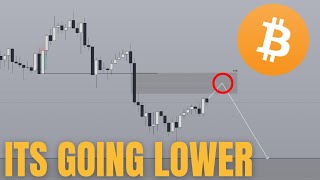
A trader analyzes whether Bitcoin has hit bottom or could fall further, examining liquidity patterns and market signals to predict the next move.
Chapters
What's good, guys? Welcome back to another video. Yesterday was absolutely spot on. Like, I could not have scripted this better. Initially we were looking at this level right here, but then I updated on Twitter that most likely it's going to be this level. Take a look here. This is the update. I drew out this line right here and ended up. Check out what happened. Kaboom. Price sweeps up into the level that I talked about in the video. And then boom, right down we go. And this is where we're currently at. So that marks the 93rd win over the last 116 calls that I made here on YouTube. So if you're new to this channel, just understand that you're probably in the right place because we tend to be right more often than we're wrong. And today I'm going to try to replicate the same result today, tomorrow and Friday we are going to have news days. So expect the trading conditions to be much better compared to the trading conditions that we had on Monday and Tuesday. Before I get into it though, if you would like my help to set up this system that you see on these videos so that you can also achieve. I'm not going to promise like an 80% win rate, but if you just want to get consistent, then, then feel free to click the first link in the description box below. But otherwise, let's kick things off with the daily chart. So taking a look at the daily chart yesterday, we were super bearish. Remember we talked about how every move that the market makes, there is always some kind of objective. Where over here we have swept out the buy side liquidity and right now we're heading towards sell side liquidity. This is Liquidity Concepts. This is Smart Money Trading 101. This is the reason why Breakout trading does not work. And above every previous swing high and below every previous swing low is what we like to call liquidity. The reason why it's called liquidity is because there is a concentrated pool of people that either have their stop losses set here or that once this level gets broken above retail traders are going to be like, oh yeah, resistance has been broken or whatever. Let's go long. The only problem with doing that is that when you go long on the breakout, you are buying high and most of the time you end up selling low. And when you try to sell the like sell the breakdown, most of the time what you're doing is you're selling low. And if the market reverses you to sell high and it doesn't take a genius to understand that the way you make Money in the market is ideally to buy low and sell high. And that's why if you're breakout trading, unless you are absolutely certain that you have back tested this hundreds of times and you have absolute data that this is something that works for you, like the odds are very much stacked against you. But anyways, above all of these previous swing highs and swing below the swing lows, you also have people setting their stop losses there. And so let's just say that the moment break price gets to this level, a lot of people are going to get stopped out or there are going to be a lot of people entering into the market at a very suboptimal place. And that is why every single time, or rather most of the time, once you get a liquidity sweep, boom, price reverses the other way. Why does this happen? Liquidity, right? The market always has some kind of objective and that objective most of the time ends up being liquidity. Because on the other side of your trades, like when you do take a trade like guess who's filling in those orders for you? It's the market makers, it's the exchanges, it's the brokers. And the thing about these exchanges and brokers is that they're in this market to make money. The way that they do that is to stop out as many people as possible so that they make the most money possible. How does that work? Well, to put it simply, any financial market is a zero sum game. Like sure, there's always new money entering, but within the closed system of what is known as the world financial market, or in this case crypto, it is a zero sum game whereby every dollar that you win, you're not just making that out of thin air, right? It's not like business where you say, oh Yeah, I made 100 GS this month. It's like that one is like you didn't take it from somebody else, right? You created value into the world and so you get rewarded in an equivalent amount. The same cannot be said for trading. This is a very competitive game. This is winner takes all and loser loses all. Like when you win a trade, guess where that money's coming from? It's from somebody else that has lost a trade. And most of the time that party on the other side of your trade, on the losing side tends to be the market makers. If you win a trade and if you lose a trade, gas fee is profiting the market makers. That's right. And that's why liquidity concepts are so important to understand and why they are the driving force of just Smart Money Trading 101. But anyways, now that we understand that price is still on route to this liquidity level right here, we can reasonably predict that today's bias is going to be towards the downside, not only because of the liquidity level, but yesterday's daily candle closed. Bearish. And so today our daily bias is going to be towards the downside. At the moment, we are still trading above the daily open. That's a really good sign because if you are bearish on the daily bias, you ideally want to look for an opportunity to sell high right above the daily open so that you can ride the true expansion downwards if you're bearish on the day. Ideally you want to buy, sorry, you want to sell above the daily open so that you can ride it lower. This is known as the power of three. Right now, this is the daily open. This is where we're at right now. Ideally we can ride this wave lower. And so that brings us onto the one hourly chant. In terms of the one hourly chant, we have this favorite gap right here. Remember, every single time frame has their own objective. That is something that I teach in my system. It's like a lot of people tend to get caught up over the fact that, oh yeah, the daily timeframe is more powerful than the one hourly timeframe. Or like the weekly timeframe is more powerful. Like which is the best timeframe. The reality is, guys like there, that question just doesn't make sense in the first place. Because to say that one time frame is stronger than another time frame, let's say the most common misconception, oh, the higher timeframe is stronger than the lower time frame. If that was really the case, then why wouldn't everyone just be trading from the yearly chart instead of focusing on the one hourly? Right. Making sense. So there's no such thing as like the best time frame there is, only the best time frame for the context that you're using it for. And in this case the one hourly. We are using this time frame for the context of finding PD arrays to trade from. And that is going to be right here on this ver gap and then potentially right here on this bearish order block. There is a little bit of overlap between the two. But let's just say that this entire area here is going to be a resistance point for when price gets into either one of these areas or expect some kind of dip. For example, right here, that is one of the PD arrays that we marked out yesterday. And then we had this liquidity sweep. Either one is A valid level. All that matters is that we like the. The job of US traders is not to predict what is going to happen next. It is mapping out a couple of high probability scenarios and mapping out exactly what we plan to do once price gets into those levels. And then once price actually gets into those levels and those conditions start getting met, boom, we enter a trade. And that's how you make money trading. It's not about predicting, oh price will get rejected from ex exactly this level. Like sure, if your goal is to just be right or if your goal is just to have that sense of superiority to tell people like, oh yeah, I managed to predict the bitcoin top. If that's what you want to do, great, stick to that. Guess what though, you're probably not going to be making much money because being right and making money in trading does not need to like they both don't need to be present at. You don't need to be right in order to make money trading. Like it's another common misconception. But anyways, heading into this private gap and this order button right here are going to be the levels of kind of like resistance that we're going to look for. Now let's take a look at the lower time frame. Now at this point, once we're in the 15 minute time frame or even the 5 minute time frame, what I'm looking for specifically is going to be session profiles and the order flow specifically. Right now we can see that this is the Asia session. The London session has traded above the Asia session for the majority of the period. And right now we have a prime, you know, just kind of set up potentially for some kind of a AMD where Asia accumulates, London New York morning manipulates towards the upside and then you got distribution towards the downside. This is going to be the setup that I'm going to be looking for. And specifically given the fact that we are so close to this previous high already, means that I do expect this FE gap to get filled and for this week high to get swept. What is a weak high? A weak high is a high that forms without sweeping liquidity. In terms of the one hourly chart, you'll start to see what I mean when. Oh no, that isn't even a week high. That's straight up just a favor gap on the one hourly chart. So given the fact that we're already this close, there is a pretty high likelihood that we do fill in the favor gap before any sort of change in state of delivery followed by distribution towards the downside. Another Thing to keep in mind today is that we have news. Specifically news today is going to be happening at 2pm, which actually now, like now that I look at the news timing, this makes a lot of sense because we have late news today. What tends to happen on FOMC days is that Asia and London ends up being just an extended accumulation whereby you might get a manipulation during the New York morning session followed by a New York late morning slash New York afternoon digest. True movement, like a true volatile move. And so that's what you want to expect today, right? Sweep into here or here and then once you start seeing the five minute order flow change, then that is going to be your trigger. Now what do I mean by a five minute change in order flow? Like I want you to picture this right throughout this entire move here, price is making higher highs and higher lows. But most importantly, bullish order locks are being respected time and time again until the point where in fact you don't really get it because this level here needed to be closed below before you get a change of state of delivery. But in the event that let's say this level right here gets closed below, then it will be a change of state of delivery. Because now this entire block here can potentially be a bearish order block. And especially if you go into this bearish order block and you fail to break above it, thus continuing the bullish order flow. If you fail to continue bullish order flow and you start breaking lower and you form new lows instead at this point, or like at this point that is changing state of delivery, it means that at least on the lower timeframe, specifically the five minute chart, that is the chart that this is the timeframe that we use for our videos, once that happens, it means that order flow is going to go towards the downside. And the fact that order flow only starts to go towards the downside after filling in some kind of higher time frame key level is the exact step by step systematic way that this system works. It's the exact same system that has allowed me to call basically like 90 winning trades over the last 120 trades. And again, if you'd like to learn this for yourself, feel free to click the first link in the description box below. But anyways, that is going to be the setup for today just to take a look at a couple of like contingencies which again, given the fact that at the moment the daily chart is pointing towards the downside, weekly is downside, one hourly is downside, the only contingency plan possible is that if you get a 1 hourly close above 115,500 until you get that and potentially flipping this bearish order block in into some kind of bullish support level. Until you get that, chances are you're going to be still very bearish and you want to prioritize shorts instead. Like, I've already been right, like for the duration of the last, I don't know, like, when did this happen? Thursday. I've been right for the past week so far. Like everyone is trying to predict like, oh yeah, 118,000 is going to be the support, 112 is going to be the support, 113 is going to be the support. Guys, the truth of the matter is that again, as traders it's not our job to try to predict where the bottom's gonna come. It doesn't matter. What's more important is to read what the market is telling you right now, which is the fact that it's going down, and then mapping out high probability scenarios to take advantage of it. Regardless of whether it goes up or down. That's what trading is, right? If you're investing short, you want the markets to go up and you ideally wanna buy low, but as a trader, you have the option to trade it lower. And that's what we've been doing ever since last week. And guess what? All of us have been making really good money following these calls. Why? Because we're traders and we're smart traders because we're reading what the market is telling us and then acting accordingly, not seeing what we want to see in the markets and then just falling into delusion and like, oh yeah, bottom's gonna come here, let's buy. And then boom, it suddenly it's blown up. So if you're new to this market and if you're new in crypto, just understand like the thing that you never ever want to do, especially during, well actually not especially. Like in any case, like the thing that you never wanna do is to just catch falling eyes, making a prediction about making an arbitrary prediction about where the bottom is going to come and then just placing your hard earned money, taking a bet on just some random thought that has not been back to my proof. Or maybe you just heard someone say about, like say something about it, oh yeah, some influencer or whatever and just do it. Like that's not responsible. Here's a closing question that I would leave with you guys. Just a little bit of food for thought. Would you bet your family's future on luck if you wouldn't stop taking random trades until then. I'll see you tomorrow. Bye. Bye.










