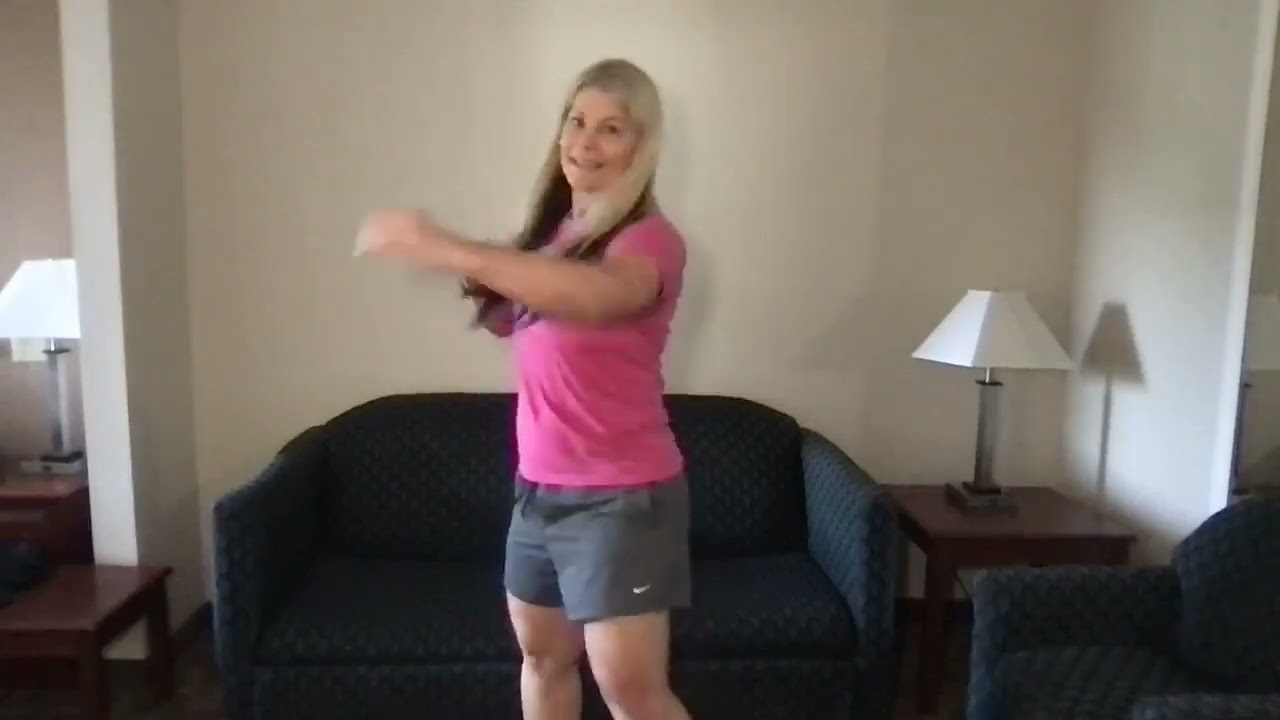
In this 15‑minute hotel‑room workout, Master T (Theresa Byrne), a 5th‑degree black belt and professional martial artist, guides viewers through a full‑body routine that requires minimal space and no equipment beyond optional resistance bands. She begins with a mindset framing, urging viewers to discard “justifications” for not moving and to treat the space they have as sufficient. The session progresses through rotational punches (jabs, crosses, hooks, uppercuts), knee‑tap drills, front and side kicks, lunges combined with punches, and compound moves that pair a punch with an opposite‑side knee strike. Throughout, she emphasizes core engagement, hip rotation, proper alignment, and listening to the body—distinguishing discomfort from pain and encouraging modifications. The workout ends with a brief core finisher and a gratitude practice, reinforcing both physical and mental well‑being.
Chapters
Hi. Hi. So if you've seen me do some of these videos before, you know, you know that I love working out and you know that I love movement. And I am currently in a hotel room. And so for many of you, you might be like, I can't work out, I don't have the space. You can, you absolutely can. And like when I travel, I bring these exercise bands with me so that I can do some resistance training. But let's get you warmed up. Let's get your body moving. And we will start with some punches across your body, making sure you rotate. And hopefully you've got a little bit more space than I've got, but this will do, right? How much do you really need? How much do any of us really need? And I think sometimes it will stop us. Like, I don't— it's not the right time. It's too hot. It's too cold. Take it up higher. I don't have the space. I'm tired. Like, whatever the excuses that stops you, or whatever the— and I'm not calling it— I'm not necessarily saying it's an excuse, but it's a justification for not moving your body, right? So my name is Master T, Theresa Byrne. I'm a professional martial artist. I have— I'm a 5th degree black belt. And I have other black belts as well. And rock over to the side. So this is slightly different than the one we did to the front and side. This is all the way to the side. So you're rotating your back, getting that movement in, getting that rotation in. Oh my gosh, I could do this for a while. It feels so good. 3, 2, and 1. Now we're going to do some hook punches. Your arm comes like a right angle across your body, and I really want you to kind of focus on going over to the other shoulder, but you're still rotating your hips. Boom, boom, boom, boom. Oh, it feels good. Moving bodies. So think about the justifications that, that you might have, that you might have taken on in your life. Sometimes for me, if my brain is tired, I'll think, oh, I'm too tired, I can't do that thing. And the funny part is, if I just start, my energy shifts. Uppercut. So even if it's something that I don't love doing, like, oh, I don't know, paperwork or anything that involves filing, if I set a timer and do it for 5 or 10 minutes, I'm actually more likely to do it for much longer because once I— I'm a transition person. Once I get transitioned into something, I'm much more likely to stick with it. So same for you right now. You might do this 10-minute workout. And then you might be like, I'm kind of warmed up. I'm going to go do a walk, or I'm going to go lift weights, or I'm going to get some, some different cardiovascular exercises in. You do you. All right, we're going to touch the opposite knee. Make sure that you make contact. You're crossing the midline of your body. So this might be your warm-up, right? So for me, spending 5 or 10 minutes on paperwork is kind of my warm-up. And if I decide after that, okay, I'm gonna go do something else, or I'm going to take a brain break, then I can do it. But I got at least some in. Okay, we're going to take the same move. You're just going to extend your leg, and if you can reach, you can touch Your calf. You don't have to touch your toes. Oh, that would be— that's doable, but boy, is that a hamstring pull. Good. 4, 3, 2, 1. Nice. Now rotate your hips, and you're going to notice a point. So you can do this quickly or you can do this slowly, but you'll notice a point of stress As you're doing this rotation, most likely. If you've got any soreness, just kind of note where that is. You might want to spend a little time there. Switch directions. And when I teach any of these classes, I will always tell you to do whatever you can. You never have to follow me directly. And if I go too fast or if I go too complex, modify it, modify it, modify it, no matter where you are. Push outside. Anytime you take an exercise class, listen to your body. And I'm not saying like, oh hey, this is hard, but I'm saying, oh, this hurts, I don't like it. In, in a way that pain is much different than discomfort. Discomfort is like, oh, my muscles are sore, or I don't love a push-up. I get that. However, they're good for you. Maybe 10, 15 are good for you. Maybe 20 are good for you. I don't know. I And not living in your body. All right, we're going to start. Let us go ahead and put your left leg forward. And we're going to start with jabs and crosses. Good. And punching. And as you punch, you can see that I'm still rotating my hips. Tighten your core muscles. So you're actually getting some activated abs. And core while you're doing this. Nice. Now here's what I want you to do. I want you to sink it a little bit more, and we're going to pump it a little bit faster. 8, 7, 6, 5, 4, 3, 2, 1. Nicely done. All right, we're going to move to legs. So I want you to think of front kick. We'll do left leg front kick, other leg side kick. You're going to go front, side, front, side, front, side. Both of these kicks involve you picking up your knee more so than just a straight leg kick. I think soccer kick, a couple probably other sports where it's a straight leg when you're doing a move, but for a lot of martial arts, it's an extension. It's a knee bend. Front, side, front, side. 4, 3, 2, and last one. Nice. Shake it out if that put any stress on your back. We're gonna go jab cross again, other side. So switch your lead leg, and this is whatever speed feels comfortable to you, but I do want you to focus on rotating your shoulders and your hips. Your back heel is off the ground. You can't really see my heel. Heel! Your back heel is off the ground. As you punch, rotate. Good. Now I want you to sink it a little further, almost a lunge position, and punch. Whenever you do a lunge or a squat, just make sure that your knee never goes in front of your toes. 8, 7, 6, 5, 4, 3, 2, and 1. Shake it off. All right, now we're going to do that same thing on the other side. A front kick and a side kick. To the front, to the side, to the front, to the side. And it's hard to see where my feet are planting, but when you do a side kick, you want to make sure your booty is facing that target. Wherever you're aiming for. Helps to keep you aligned and helps to keep your joints and your muscles stacked on top of each other instead of one of them, like your ankle, your knee, or your hip, taking all of the force. Front, side. A few more. Hopefully your heart rate is starting to get up there. I am in some Pretty high humidity, so I'm already sweating. 3, 2, and 1. Nice. All right, this next combination is going to— let me check my timer. It's going to look a little bit more complicated than it is. So I want you to think about this. Punch with the knee. So I've had you tap that opposite knee. Now you're going to punch, punch, punch. Punch, punch. So you're rotating using your core and opposite sides. So I'm using my right leg, my left hand, and on the screen it might be reversed. I'm not sure. Good. Now do this faster. 8, 7, 6, 5, 4, 3, 2, 1. Good. Take a breath. Same thing, other side. So punch and knee at the same time. The same time, Master T? You can do it. You've got this. Good. Punch, punch, punch. Good. And you're kind of rotating. This is a, uh, what's called a compound move because you're using a lot of different muscle groups. Let's speed it up if you want to. You don't have to speed it up. This, this move on its own It seems really simple. You'd be surprised, or you might not be surprised, how complex it feels when you're trying to do opposite things with an arm and a knee and opposite sides of your body. 4, 3, 2, and time. Nice. Nicely done. All right, we're gonna do something for your core. Um, uppercut, uppercut, uppercut, uppercut, uppercut. So on these, I want you to Sink your hips. Anytime you sink and you bend your knees, you stop using your hip flexors and you start using your core. So if you are doing any kind of standing ab exercise, I always have my students bend their knees because if you stand up straight, you're mostly using your hip flexors to do the rotation. Bend slightly, you disengage the hip flexors Not like in a gross way. Good. Now, same sinking motion over to the side. I want you to take a palm strike. Good. So you're in a slight squat. Strike. You should feel these pretty quickly. 4, 3, 2, and time. Nice. Shake it out. Shake all your body parts out. And the way that I end every class, get grateful. Hands come up, think about something about your body, even if it's just, thank you, thank you, thank you, body, for the next day of life, for the breath that I have, for the chance that I have to move. Whatever you can be grateful for, do that. Thanks for joining. I don't want to be alone.