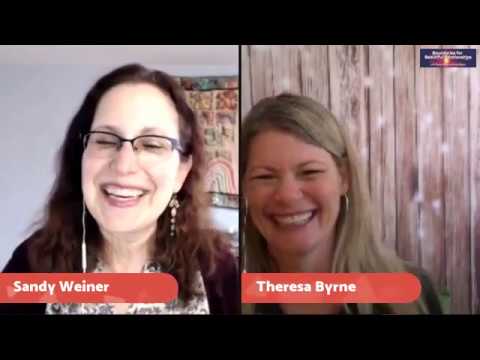
Theresa Byrne interviews coach Sandy Wiener about setting boundaries in relationships, work, and family. They discuss practical tools like clear contracts and saying "ouch," and share their co-created program Boundaries for Beautiful Relationships.
Chapters
Hi, my name is Theresa Byrne. Thank you for checking in. We are doing the Inside Scoop with Sandy Wiener. She's going to talk about how boundaries have changed her life. And if I haven't met you before, my name is Theresa Byrne, and I am also a huge fan of boundaries, teach a lot of boundary work. And Sandy and I have co-created a program called Boundaries for Beautiful Relationships, because who doesn't want beautiful relationships?
I do.
So I'm going to introduce Sandy, who is a magnificent coach. She is also the founder of Women of Value program, as well as Last First Date radio. Hi, Sandy.
Hi, Theresa.
Thank you for doing this interview with me today.
Oh, it's exciting to talk about boundaries with you, as always.
I love it. So Sandy and I met because we were both writers for The Good Men Project. And we found that we had a natural love of discussing how to use boundaries, what boundaries look like, and how important boundaries were. And we just, you know, sometimes you get a synergy with someone, and that's what Sandy and I had. It's been a pleasure to know you for all of these years. So thank you for your work.
Thank you. And for coming on my radio show where we first talked about Boundaries to the Public together, which led to an ebook, which led to the course. that we teach and to making tons of videos for people. So it's been great.
We are like boundary queens. Yes, we are. So, Sandy, I wanna ask you a question. What is, what would you say the role boundaries play in your life or have played in your life?
Boundaries have played a role in every aspect of my life and they really have saved my life, I would say. They have played a role in my family, first of all. So I grew up in a family with poor boundaries, as most of us have. And so I learned how to speak up with my family about phone etiquette, like, you know, don't put me on hold or I'll hang up. Or, you know, going to visit, the space and time boundary that we talked about in one of our last videos about how much time that I wanted to spend, or who would stay at my house and for how long, and boundaries around people coming late to dinners and whether we started on time and didn't wait anymore.
Mm-hmm.
All of those ways to help keep the family boundaries tight. And clients, uh, one of the ways I have boundaries with clients is by having a very clear contract that tells them who I am and how I show up for them and what I expect of them, and then we have a conversation where we actually design the alliance around how we both want to show up for each other. And I think it's really a fabulous way to start any relationship. Um, what else? You know, like if a bound— if a client forgets a session, what happens? It's very clear how I treat that.
I love the clarity that you have around boundaries, and—
Oh, thanks.
We all know how difficult they are to set with family, so thank you for sharing. Some of the— your secrets.
No, you and I have talked about this a lot, and we've done videos about it. It's part of our course. Um, I also set boundaries with friends, uh, around texting while we're together, texting other people, you know, getting on the phone.
Oh, so like when you're with someone and they're texting and you're like, hey, hello, I'm here, like that?
Yeah, like that. Like, uh, Yeah, but it's really important. No, actually it's not. You know, what happened before we had phones? And we don't have to take every text from our children and family members. It's really not that important. And it actually doesn't feel good when you're with a friend and they keep interrupting the conversation to talk to somebody else, whether it's on the phone, in person, you know. And that happens with family members too. I, you know, have had kids who pass a friend and they start talking to them while we're on the phone together. And it's like, we're talking here. So it's just Just setting those kind of boundaries about how you want to be treated. And the last place I want to talk about is in my work as an administrator of a Facebook group that, Theresa, you're a part of.
Oh, this is a huge group. How many members is this group?
We have over 2,200 members now, I think. And the only way to keep this group safe is to create clear guidelines and boundaries. And so I enforce boundaries regularly. I have 7 monitors in the group who I've trained in how I want the group to be monitored because we need to close comments when things get out of hand and we need to do things that people don't always like. But it's important because otherwise things get off, off the rails really quickly.
Yeah, the last thing you want in a big group is people going off the rails.
Correct. And, and one more place I said that because it's everywhere, um, is with dates. And so that, that happens when I'm dating, and, uh, maybe I'm dating online and somebody sends a message that's inappropriate. I'll set a quick boundary around that. Maybe I just block and delete, or sometimes I'll address something. Block and delete! Yeah, block and delete is like super magic pill that we can all take to help us in the digital age. Um, so boundaries are everywhere, and they are just fabulous because they keep us aligned with who we are, what our truth is.
Isn't that, isn't that something, ladies and gentlemen? And for those of you watching at home, yeah, boundaries help us keep our truth our truth. Now, for most of the people that you work with, they don't necessarily know how to set boundaries naturally. For you and I, we've had this conversation after working on boundary work for so long, it kind of becomes second nature. So when do you feel like boundaries became second nature to you?
Definitely after a lot of practice. So having grown up, you know, without clear boundaries and what it did to me, I spent a lot of time practicing and didn't always get it right. And still sometimes I get it wrong. But I think my biggest teacher was my youngest daughter. After my divorce, she pushed my boundaries a lot. She would call me names and get really angry at me for getting divorced and I ruined her life and blah, blah, blah.
Why did you get divorced, Mom?
What were you thinking? And I ruined her life. So one day she was in a particularly lovely mood yelling at me, and she had all of her clothes that she was taking to her dad's in her arms because she never packed them in a suitcase. So she was just like frustrated and stressed out and, you ruined my life. And so I just turned to her and I set a boundary and I said, you can continue to blame me the rest of your life. That's fine. I never set out to divorce to ruin your life, and I've done everything in my power to make sure that your life is as good as it can be post-divorce. So you have 2 choices: be angry with me the rest of your life, be a victim, or you can create a new way to be around this divorce. And when you're ready to do that, I am here for you.
And hey, and if you are in the comments section and you have ever found yourself playing the victim, Go ahead and own it because it happens to all of us. And Sandy's point is you can either be angry and own it or you can play the victim. Oh, nailed that one. I'm sorry, I interrupted you. You were going to say something to make that point.
It's a good point. And she actually just paused, you know, for the first time because I wasn't yelling at her. I was giving her options. And I was like, yeah, you can be a victim. You can blame me. I don't care. It's going to hurt you. It's not going to hurt me. And she started to create new ways to be in this divorce. I mean, it didn't have to be as stressful as she made it, but I certainly didn't want to be the one who was yelled at and blamed.
Right? That never feels good for anybody.
No.
I love that. Be angry and own it or be a victim. Big choices.
Yep.
You get your choices. So, uh, next question that I had, well, and I love this because, uh, for anyone else out there who's ever struggled, family is one of the biggest places that we struggle with our boundaries. So love, love, love all of the things you're sharing. Now, when you work with clients, um, are there any like cool nuggets that you like to give them? Anything you like to make them understand or help them understand?
Uh, definitely. So one of the areas that comes up a lot in dating today is texting. Women get so mad when men stay on text and don't pick up the phone and don't have a real relationship.
Mm-hmm.
And that's a real boundary that they can set early on and just say, I don't enjoy texting as a way to get to know somebody. It's just too many misunderstandings. So would you be willing to get on the phone and have a chat? Just say what you want. And if every time you engage in texting after that point, You have violated your own boundary. So get a boundary and stick to it.
Get one and pick one and stick to it.
Stick to it. I mean, because I used to set boundaries a lot in my past before I really understood this work, and then, uh, well, you know, I don't want to be mean, and I really understand this person's point of view, and so I'll be flexible. And every time you're flexible with people who push your boundaries, they push a little wider, and you get a little more are lost in the mix, and then you get pissed. And so we don't need to get pissed. So there's a lot of things that come up. So besides the texting, just somebody hurts your feelings, and maybe they don't know it. So simple things like ouch, which was one of my favorites.
Mm.
Just to see if you don't yet have the words for what you're feeling, just to say ouch, that hurt, that stung. And if you don't have the words yet and you don't want to talk about it, just say, I don't feel comfortable talking about it right now. I'm too angry and I want to be calm when we speak. And give them a timeframe as to when you will have that conversation. I think often we just get flooded and we start getting in our heads and making up a whole story, which is probably wrong. And so it's important to set those boundaries And then talk about stuff, because often we just, we're just making stuff up.
Wait a minute, we make up stories in our head? What? Anyone else besides me? And my, my thing is always, if we're going to make up a story, at least make up a good one. Like, why do we always pick the bad story where someone else, we're miserable, someone else is in shock, you know, the negative story?
Yuck. Yeah, really.
Right? You get to be the star of your own show. So the other question that I wanted to ask you is, what— when was the last time that you had to set a boundary? The most recent time.
So the most recent time, God, there's so many. The most recent time was somebody asked me If, um, I actually get a lot of requests from members of my group about sharing like a coaching situation with me in a private message or in a text, and is it okay if they can do that? And I have a very clear boundary around that. Like, I give information in the group, but if you have a private situation, that's something I do for clients. And yeah, can I hit you up for free advice? No, the answer is no. So when I do a discovery session, when I do a get acquainted session with a client, a potential client, it's really because they're a potential client, not a free session. And I'm really clear about that. So again, that's a point of boundaries and clarity. And no, you can't just hit me up for free advice whenever you feel like it, 'cause that's a paid service. So I do plenty of stuff for free. You and I both, Theresa.
We have so many videos. You've got a weekly blog that rocks. You've got Last First Date radio. So many resources.
Yep, yep. So my blog actually is more than weekly. I have over 800 posts on my blog.
You are prolific, dude!
Yeah, plus writing for other places like Good Men Project. And, you know, both of us, we give a lot of our material because we want to have people have a transformation. But we also do this for a living. And so I've had people say, can I pick your brain? Um, people— I— that was years ago. There was a man in my— who had lost his job and was trying to get into an online business. And he said, oh, can I pick your brain? Can we just have— can we have coffee and I'll pick your brain? I said, hmm, that sounds like you're looking for a consultation. And he went, Yeah, I said, well, so here's my hourly fee for a consultation if you'd like to set that up. And he did. So when the old me would say, I gave him an hour of my time and he didn't pay me for it, but now I don't do that.
You don't get, uh, the old angry Jewish grandmother on someone.
Was it a grandmother? It felt like more like a grandma.
I gave him an hour of my time.
Smoke a cigar, right?
So, I can't agree more. And one of the best boundaries I ever heard was, no, you can't pick my brain. I need my brain. But I have several other resources that are available to you, or we can meet for a consult. So the last question that I want to ask is, why do you think boundaries are so important?
They really keep you aligned with your truth. And when you, when you know who you are, when you know who you— what your values are— and this is really what my, my whole new focus in my career is, is to help people have life mastery, not just love mastery. And you get life mastery— my system involves showing up, standing up, and speaking up. So if you are showing—
Say that again, that was beautiful.
Show up, stand up, speak up.
Nice.
So if you show up, means you have to know who you are to show up in your full glory. And part of showing up out there as your beautiful self is setting boundaries. And when you stand up, you're taking a stand for what's important to you. But again, if you don't know who you are, you don't know what you're taking a stand for. And before I had boundaries, I took a stand for nothing because I was everybody's Everything, you know, so it was basically my nothing.
What is that saying? If you stand for nothing, you'll fall for anything?
Yeah, I like that. I was trying to think of that the other day. Um, yeah, exactly. And, and speaking up is also about communicating effectively, but that's— boundaries is a big part of it. So boundaries are everywhere in my life now. They— I think when you have boundaries and when you hang out with people who have boundaries, You have real relationships, everything's authentic, you feel safe with the person you're with, 'cause you know you can be yourself, you can talk about stuff that feel scary, but aren't so scary because you're both practicing boundaries. So it's a beautiful thing.
So what I keep hearing you say, and correct me if I'm wrong, but you and I both know we believe this, boundaries are a practice.
They sure are. And it doesn't happen overnight. I've been doing this for a very long time. I've been divorced 10 years and I started doing this work before my divorce. You've been doing it for what, 20 years?
Yeah, teaching it and doing it for, yeah, yes.
Yeah, so together we're like, you know, 30, 40, 50 years into boundaries.
It's a practice every day, every day.
Every day gives us new opportunities to practice boundaries.
I love that. Well, is there anything else? Oh, and thank you guys for your comments. Appreciate that too. And thank you, John. Setting and keeping your boundaries has helped you respect the boundaries others have set.
Beautiful.
And that's a very important piece because when we have boundaries that other people set, it's just as important for us to show them Respect, because we want respect back.
Yes, beautiful.
All right, thank you. And is there anywhere that people can go to find more information about you, or perhaps about the Boundaries for Beautiful Relationships program coming up this spring?
So they can find me at lastfirstdate.com. They can find my Facebook group at facebook.com/groups/lastfirstdate. And my, my group is called Your Last First Date, and it's for women only. Sorry, men. Um, that's, that's one of my boundaries. It helps to keep the group safe and keeps everybody just being able to really talk from their heart. There's a place for men in their lives too, but they don't— they're not part of the conversation. Uh, I have a YouTube channel. If you go on my website, you can connect to my podcast, my YouTube, my everything. I got lots of Lots of things.
My everything. Well, I appreciate you taking the time. And for all of you guys who stepped in, John and John and Andrew and Shannon, thank you so much for your time. And go check out Sandy, lastfirstdate.com. She has got many, many resources. And look for her Women of Value program coming out. And set those boundaries. Anything else, Sandy, that you want to add before we close? Just do it. Just do it. Boundaries. Just do it.
Just do it.
All right. Thank you so much. Everybody have a great day and enjoy whatever weather you're having wherever, wherever you are.
Thanks, Theresa.
Thanks, Andi.
More from Theresa

Higher Self Activation Meditation | Release Fear, Reclaim Your Power & Inner Peace