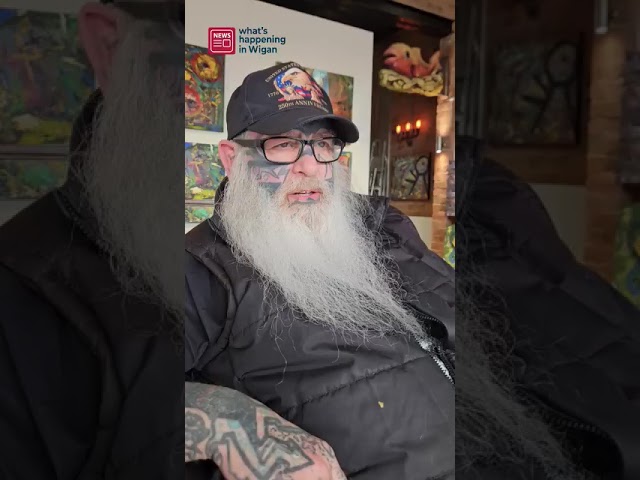
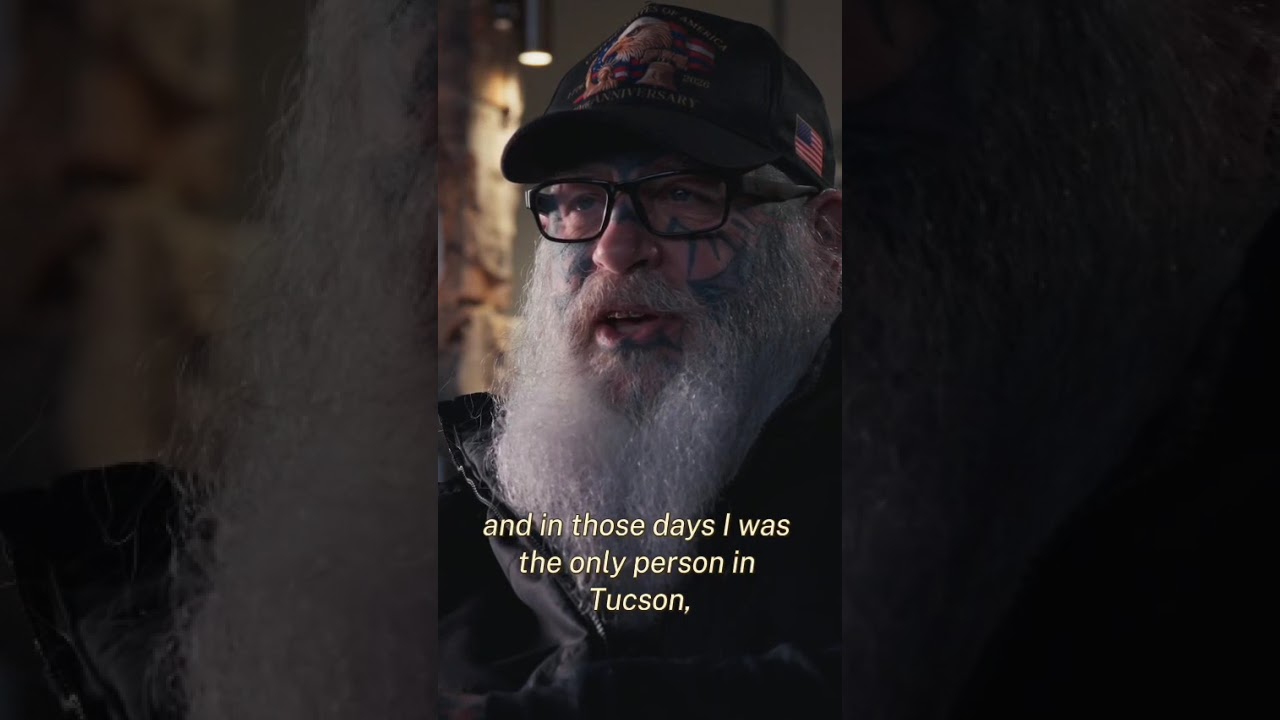
The Scary Guy talks with Sally about his transformation from a confrontational past into activism against hate and violence. He describes his 7-day challenge to stop name-calling and judgment, and shares how he's worked with schools, the military, and corporations on inclusion and empathy.
Chapters
the truth of what's really going on. And it doesn't matter if it's being recorded or not, and now it is, and that's great. And, and, uh, I have no problem telling it like it is. I mean, look at me, I look like I'm a rebellion kind of guy to begin with, you know. So truth is very important to me. And, uh, I get companies and high schools— I had a head teacher bring me into his high school with 2,000 students in it, and he took over the high school, and his first call was to bring me in because the ethos in the school and the teachers were all about anger and control, and there was a lot of frustration and upset. Well, that's a workplace too, isn't it? And so that would filter down to the students. So the students were always emulating that anger and frustration, and the school was out of control, see. So he knew what I did And his job was to upset the apple cart because I come in and say, speak it like it is about hate and violence and prejudice, and that you need to figure out a way to be different in your life. And I show them the tools to do that. But he knows that some of those teachers aren't going to like what I say. So that's perfect for him because then he can say to them, well, here's, here's our plan. We're going to— if you don't know how to educate people with love in your heart, and understanding, no matter where they come from, no matter what their background is, then you probably need to find another place to work. And so he'd turn over the teacher staff until he got the school he wanted it, and he'd let them figure out that this wasn't the place for them. And that's what— those are the kind of calls that I would get. And, uh, and, and so I have no problem telling it like it is.
So, so let me ask you, so that we can frame the conversation, can I ask you my first question that I ask everyone is what makes you so passionate about fighting this hate, violence, and prejudice?
Well, I am going to start off by answering that very, very straightforward. First of all, nobody makes me or nothing makes me anything. The word make is an extremely important word and you need to look at it in dialogue and films and how people use the word make. Because once you say the word, what makes you do this, and I say, oh, that made me this way, I'm giving up all my power to take full responsibility for my ability to be who I want to be. And that word is really key. So nothing made me anything. It was my own self-awareness where I became aware of who I was as an individual at the time. And it was 43— I was 43 years old, and someone in the tattoo industry, which makes to your viewers. I'm an ex-tattoo artist and I had 3 tattoo shops in Tucson, Arizona, and I thought that's what I'd be doing the rest of my life. And I ran ads in newspapers about my tattoo business, and somebody in the competitive business ran a full-page ad in the newspaper and it said, "Are you tired of dealing with Scary Guys with war paint facial tattoos?" So he ran an ad about me and I didn't even know the guy. Well, my previous life I was a computer salesman for Unisys Corporation, so I have sales background and we were taught to never speak negatively of your competition when you're out selling. Well, so I thought, first thought that came to my mind was, what am I going to do to get the guy back? Revenge. That's the first thought. And I thought, well, I'll jump in my hot rod Lincoln, I'll find out where the guy lives, I'll go over to his house and I'll run over his dog. And I thought, well, that'll get him, you know, that'll teach him a lesson. And I thought, no, I'm not a violent guy. I'm a good guy. That's why I said to myself, I'm the good guy, he's a bad guy. And then I thought, well, wait a minute. As I stepped up on my pedestal and I started bragging about how great I was as a human being, this was still churning away inside of me. I started to look at my life and I started to realize that I was no different than this guy. I would call people names, I would talk behind their back, I would gossip, I would laugh about people that were different, I would judge people, I would use humor to mask all of my negative. So I was— the only difference is I never used a newspaper. So I jumped on— this was me bragging, and I realized this is who I was. I was no different than him. And I jumped down off my pedestal and I said to my friends, I'm packing my bags. And they said, where are you going? I said, I'm going to travel the world to help people see each other differently, and from the inside out. And they said, how are you going to do that? And I said, I haven't got a clue, but I can tell you one thing though. And they said, what's that? I think I just lived 43 years of my life living a lie, calling myself a good guy. So I went about changing my life, and I'll tell you what, Sally, that was not an easy process. It took me years and years and years of looking in the mirror and asking myself questions. Why do I feel the way I do based on what the other person said to me or did? Rather than escalating to a conflict or judging them or being angry at them or taking on whatever they're creating. So I reverse engineered all of my thoughts and all of my brainwaves and who I was as a human, and I put myself on the 7-day, 7-night challenge.
Nice. Tell me.
Well, we'll put all your listeners on it. It's going to be difficult. Some of your listeners won't do it, and some of your listeners will give it a shot. But here it is: for 7 days 7 nights, don't say one negative word about another human on the planet. And for 7 days and 7 nights, don't call another person a name other than their own. So 7 days, that's it. I want 7 days without name-calling and 7 days without judging anybody about anything. And I don't care what happens, you know, this has— this works at work, this happens at home, this happens on the street, this This happens with your friends in the pub. Banter is negative. People think it's funny, but it's still negative energy. So all of that is part of it. So if you slip up on day 3 and you use a little bit of humor, because that's how I did it, and you say something really negative, you're going to hear it. So most people think this is about being a good person, but really it's not about so much about being— that could be a benefit. No, I want to know What are you doing with what you're hearing? Are you simply taking on everything that you hear, reformatting it, and regurgitating it out of your mouth in a different format, and then justifying what you've said and calling it okay? Or do you have the ability to hear people speak and not become what you hear? And that's, that's the answer. I want to know the answer to that question at the end of the 7 days. So if you slip up on day 3 Guess what you have to do? Start over on day 1. So I've got teachers that have been on the 7-day, 7-night challenge for 10 years.
Wow.
Well, because they can't go 7 days in a row. And this goes for driving a car too. So when you're in traffic and you're get— you get all upset about it all, I use— that was one of my best places to be negative is I just make sure my window was rolled up and then I could scream and yell at them and call them names, see. But that's just really negative energy. So you have to figure out, well, how is that using you versus you being in charge of who you are? Are you really creating you, or is what's outside of you defining who you are? And see, that's part of the problem. And that goes in the, in the workplace too. Managers do the same things. CEOs, all of them do the same thing. This is all learned behavior. It's not something that's new, or it's not something because that they're rich or poor. No, this just crosses over all boundaries, all different walks of life. People do it all the time. I had a contract to train the United States military Air Force, the Air Force Academy in Boulder, Colorado, and I worked with 4,000 Air Force cadets there. And then I also had a contract with General Vogelsang, the 4-star general in charge of the Air Force in all of Europe, and I worked with his troops over there in Ramstein Air Force Base. So I see, there you go. It says it's in the military, it's in— it doesn't matter, it's in the government agencies, it's in social services, it's in all the corporations. All these kind of behaviors and all these judgments and all these— the self-talk is all the same.
Um, it's a brilliant answer, and I take up the 7-day challenge. 7 days, 7 nights. I will tell you in 8 days how I get on, um, and I'll tell you if I have to start from scratch. But I take that challenge and I hope everyone listening takes that challenge. I think it's a great one. If you had one piece of advice for businesses about seeing people differently, and I think this is incredibly important in the workplace, how can we help people see people differently? And you've experienced what people look at you and take an assumption, make assumptions, make judgments. How do we help people see people differently?
Well, part of seeing people differently is to first of all look in your— look in the mirror and start looking at how you see people differently. I think that's the key. We're trained, and where does our training start? It starts after we're born, and our parents are our first teachers. So kids are— I say this out loud— there's no bad kids. And everybody looks at me like, what do you mean? I see them happening all day long. No, kids are a direct reflection of what they've learned. So if you see a kid that's out of control, they've learned how to be out of control from their parents. That's their first teachers. Then they take that baggage and they take it into school. And when they're in school, then they practice all of that baggage. And that same theory applies to the workplace. There's no difference in that whole thing. So I always say the first step to becoming a different human being about how you see people is becoming aware of how it works. You have to be educated and aware of the fact that this is a global issue, it's a human issue, and we're learning how to be this way. And once you understand, you're aware of this, You can then understand— once you're aware, you can then understand how to make some changes. Until you're not aware that it's really part of your life, people won't— they will say, well, it's the other guy that makes me— that— no, see, the make word, it's somebody else makes me this way, so I'm going to just go ahead and judge them so I'd have to deal with it. Well, that's not going to be true of everybody, is it? No. So they need to be aware of that. We're all involved in this. It's not just this group or that group. And then the next step, once you're aware, is Understanding that you have the power to make it different from within yourself. And then the third step is accepting responsibility. And, and you can't accept responsibility for what you create until you understand you have that power.
See?
And then the fourth step is love. So can you imagine, can you imagine if I've learned to judge people my whole life based on what I see And all of a sudden I go, wait a minute, I'm— I've learned to be like that. And everybody's like that in some way, shape, or form. I understand that it's really not necessary, that I have the power to create who I am no matter what I see on the outside of me. And then I can start accepting responsibility for what I create. So am I going to create the same energy that they've created? Nope. I'm going to try— I'm going to transcend and create something far more powerful, which I call love. So even in the heat of the battle, if somebody's being negative, I can sit here and walk through that with love and peace. I create my own world peace. People say, well, wait a minute. I ask them a question: are you going to see world peace in your lifetime? 99% of all the adults say no. I said, well, you must be an expert in world peace creation then, if you don't know. You say no automatically. And they go, well— I said, well, where does world peace begin? And then most of them go, well, it begins within me, themselves. I said, well, there you go. You've got the power to create it, and that's your world. See, you have to redefine world. Everybody thinks it's outside of them. No, that is the Earth. That's We live on it, you know, and we're lucky enough if we have a lucky life, we can live a long one, right? But we're actually here temporarily using this space. This— we don't own this. This is my world and I own it, and it's my responsibility to create my own world peace. So that's what I would say. Now, that's a long answer, and I apologize for that.
Don't apologize. I've got one question I really have to ask you because I think you're going to come out with a beauty. Have you got a mantra or a mission that you are living by? And it sounds like you've got one.
Well, now, if I got a mission that I live by— hmm, that's the question. Hmm. Well, I live by my, uh, my mission every day. And trust me, I had 43 years of experience of learning how to be a hateful, negative humorous, laughing at other people clown. I mean, that's who I was, but I never saw myself as a bad guy. But in truth, I was just as negative as the next guy. So every day I've learned, and I have to learn every day, that this is something that I have to practice. It's not something I was born and taught from birth. I was taught the opposite from birth. I was taught to fear the differences and hate the differences and judge the differences my whole life up till 43. So I have 43 years of training and I break that every day. I go, wait a minute, wait, you know, I ask myself, where did— oh wait, no, did I just see that? Yeah, I asked myself, did I just see it? Where did it come? Oh, who's that really about? See, so I ask myself these questions all the time so that I stay in focus of what it is I want to be and what it is I want to accomplish. That's the definition of you create you. So nothing outside of me that I see and nothing outside of me that I hear belongs to me unless I choose it for me. So if I tell you I hate you, Sally, Who's that hate about?
Um, well, I haven't done anything wrong to you.
If I say, Sally, I hate you, who's that hate about?
Well, you hate, not me. I love.
Well, it would be about me, wouldn't it? Because I came for me. If I say, Sally, I love you, who's, who's that about? Who's that love about?
That's still about you.
Yeah. So which one would you like?
Well, I'd prefer the second one, right?
Because that's your—
then I can love you back.
But that's your power to choose, isn't it? See, and so you have to have that power. And in order to have that power to choose, you know, we're all given that power. Nobody can take that from anybody, no matter who you are. Everybody has the ability to choose whatever it is they see in here as energy. Nobody has the power to put it in my body. Yeah, it's traveling and it goes in my ear and it goes in my brain instantaneously, but now I'm going to look at it and I'm going to analyze it, and I don't need to become it. And those are the things I do every day. And I think I'm not alone in this. I think everybody has that power.
Yeah, this is— this conversation has been such a blessing. And I think what's such a shame is that when people and you just said it so beautifully a minute ago, when they judge and hate and, and make assumptions really quickly, they miss that opportunity of having a conversation like this that's such a blessing. They miss that moment that they could have had. It's almost like they've, they've had it stolen away from them, but they haven't because they've done it to themselves.
Um, And I use that. I did some of the hardest times for me to use my ability to be who I want to be, and I work it every day, is when I run across homeless people in the streets. Now it's so easy to judge a person sitting on the street with a cup out and their dirty hands, and you know, then in their sleeping bag next to them, and they're, they're all over the place now, and and all over the world. And it's so easy just to go, eh. And I'm not talking about having to give people money to fix it. No, I'm talking about just being kind. Don't judge that. That person's got a story. That person had a life. That person's got a life right now. They're still there. And, uh, if you can just stop for a minute and acknowledge this, you're going to learn something, you know. And I, I do that. I go out of my way to learn as much as I can from people. And now the homeless population in Wigan, they all know who I am. They come by the front of my building here with great big windows and they give me the thumbs up and they wave at me. And, you know, and those are the people that everybody shuns and don't want to be around, you know. And if they do something I don't necessarily think is okay, like litter on the ground or urinate up against the building and I catch them, I'll tell them, hey dude, come here, and we have a nice chat. You know, there's people who live in this building, that's probably not an appropriate place for you to do that activity. You know, and I let them know. I don't let them off the hook, but I deal with love in my heart. There's a difference. Instead of getting all angry and ticked off and yelling and screaming at people, which I, I used to do, I— and still today, quite frankly, there's times when I wish I could. I want to, I want to be able to go because that's what I learned. I want to be able to get their attention, especially when teenagers go by and they act out. I want to go, yeah, you know, like I was taught when I was a kid. You know, but I don't do that now.
Do you know, I feel like the happy ever after to this story— and I don't know if this is true, but this is fictitious that I've created in my brain— is that the, the guy who created the ad in the beginning that, that was about you, um, I'd love to know that you've now got love in his heart, he's got love in you, you've become friends, he's seen the error of his ways too, you've trained him well this is the happy ever after, that he's become a good guy too?
Well, I can't really answer the question because I never met the guy, but I did hear, I did hear through the grapevine that he died a horrible death in the hospital because he had, uh, diabetes. So they, he had a, a death in the hospital that I heard was not a very pleasant one for him. And, um, I'm, I wasn't happy that he died. I, you know, I never met the guy. I didn't know him personally. And I, and I'm glad I never met him. I mean, I, I don't think that's part of my transition. Part of my transition is knowing that he was the catalyst. He was— I did hear that he was, he was upset about the fact that I took, I took it on and turned it into a positive. I did hear that. I did hear that he, he thought I owed him something because I gave him this, this ability to be who I was. But, but maybe I don't owe him anything but other than thanks, man, for waking me up, you know. He woke me up to the truth, you know. So that I owe him.
But, uh, I think a lot of people owe him actually, because he gave you a gift, but you've shared that gift all over the world now. And, and so I think actually thousands and thousands of people, uh, need to thank him in some way. That's how I see it. Oh, listen, this been, uh, well, just a blessing, a gift to me today. Um, and I'm so glad that I reached out to you. Um, I specifically really want to help workplaces understand how to, you know, take some— to see people differently, to give people a chance, to make sure that we reduce some of this prejudice in the workplace.
Um, uh, well, if any of the businesses that hear your your, uh, your video here and your podcast. Um, that I do work in corporations too. Yeah, yeah, they— and I just did a training session for a housing association in Exeter, and there were 300 people in the housing business, and it went over like unbelievable. It was really good. So if they're interested, they haven't— get a hold of you and you can send them my details.
I really want to introduce you to a guy called Rich. Uh, Rich has done a phenomenal job. He works with large corporates that are doing big-time advertising on TV. So we're talking McDonald's and Sainsbury's and people like that. And what he does is he puts their adverts before they go on air, he takes those adverts and he puts them through very specific kind of panels of, uh, of different people. Um, could be people from LGBT, people who are of different colors, etc., and gets that rich insight and feedback so that the adverts don't fall short of the mark, so that they're, you know, open. A really great example is one of the recent ads with Stormzy in the McDonald's ad, and this was a really inclusive ad that went down really well. It, it was a successful ad, but it had been through a lot of riches' panels first. Because, um, and the flip side to that is that Sainsbury's a few years ago made an advert about barbecues, and they put some token people of color in it. And when the Black community watched this ad, they went, that's not my barbecue, that's not how we do things, that, that doesn't resonate with me at all, that advert. And Sainsbury's realized that they're just not getting the right feedback.
Right.
So Rich has— I think you would be superb to be in one of his panels and giving those clients of his some great advice before they part with millions of pounds and then don't resonate with the audiences that they want.
Yeah, that'd be great. Yeah, well, go ahead and share my information with them. Yeah, it'd be good to hear about it. And then you and I could stay in touch too.
Definitely, definitely.
I had a podcast with 60 episodes on it and we've taken a hiatus from it. But once we gear it back up, we'll have you on as a guest.
Oh, that would be amazing. Yeah. I mean, my mission in life is to make workplaces fairer, healthier, and happier because I just feel like we spend so much time at work and work is so broken. And my experience early on in my career was in a very broken workplace. And that was just because I was female, you know. And there are so many people, so many people that are not having a great work experience or not even getting access to work. We got to make it better.
I'm with you.
Listen, thank you so much for today. What a blessing. That was such a great conversation.
Now, are you gonna, are you gonna produce this in a video format?
Yeah, yeah. So we'll edit this and, uh, and I will share it back with you before we publish it, and then we'll publish it on LinkedIn.
And will I be able to cross-post it on my social media?
Oh, totally. Yeah, totally. Yeah, I'd love you to.
I've got, uh, 80,000 fans on Facebook and about 8 pages with various people, and then my Instagram, of course, and my my ex and, uh, link, and then, um, LinkedIn and all kinds of them. So I'll cross-post it everywhere because, uh, you're doing a great job and I want to be part of that great job.
Thank you so much. Thank you. Well, I have love in my heart, uh, but do you know what I'm also going to do tonight? I, I've thought about this as I listen to you. I'm taking this raw video tonight and I'm playing it to my family over dinner. Because I have two— well, a teenager and a 21-year-old at home at the moment. And, and just this 7-day challenge tonight, I want us all to discuss over dinner how we can take the 7-day, 7-night challenge.
Well, can I ask you a favor then? If you do your production on a 5-minute piece, which is what your show is, that's, that's one unit. And then you've got the raw video, which could be a second unit, which might be a little longer. I would appreciate you giving me a copy of —too. Yeah, yeah, I think they're both— and then we don't— I don't post them together. I would post one, one social media piece for, uh, 2-3 weeks and then post the second one to follow it 2-3 weeks after. And I think it would be really impactful. Yeah, so if you get me a copy of it, that would be good.
And I'm definitely going to spread the word about your, your TEDx because that's what brought us together. I did a TEDx in the summer and I was looking at other people in Guildford that did a TEDx came across you. Otherwise, I would never have— of necessarily our paths wouldn't have crossed. So yeah, I'll be promoting your, your TEDx as well. Fantastic. Thank you so much. Have a great day. I really hope you do have a great day.
Oh yeah, every day. Well, it's my day and I'm going to make my day the what I want. And right now it's— I'm doing good. I've got a head teacher sitting in front of me who's been a head teacher for 15 years, and she's a good friend of ours, and And she's gone through the program and the training. And so it's going to be a good day because she's here too.
Fantastic. Have a great day together. Thanks.
See you later. All right. Bye-bye. Bye-bye. Bye.