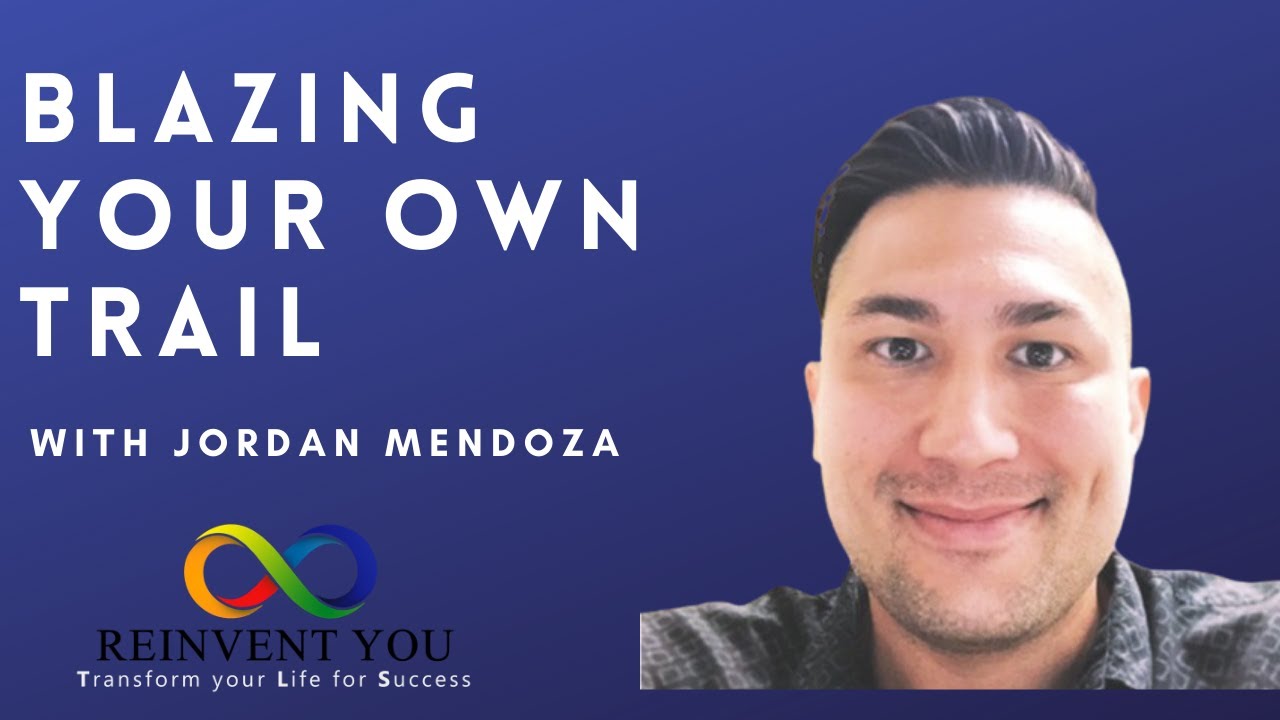
In this Reinvent You podcast episode, host Travia Steward interviews entrepreneur and coach Jordan Mendoza, founder of Blaze Your Own Trail Consulting. The conversation opens with Jordan’s origin story: a resilient upbringing in the Pacific Northwest, his mother’s one‑lung health challenges, and a formative police incident at age 12 that taught him to turn the other cheek. Jordan describes how his early exposure to empathy and perseverance shaped his personal and professional life. He recounts his rapid rise in corporate property management, moving from entry‑level leasing to assistant manager of a multimillion‑dollar portfolio, then transitioning to a learning‑and‑development role where he earned Myers‑Briggs certification and facilitated leadership programs. The pivotal moment came in 2016 when he realized his coaching impact, prompting him to launch the Blaze Your Own Trail podcast and later his consulting business. Jordan shares his sales philosophy—reps, embracing “nos,” and focusing on high‑ticket conversations—along with the FEAR acronym (False Evidence Appearing Real) re‑framed as a growth mindset. He explains his consulting framework: deep‑dive diagnostics, business‑foundations ecosystem building, a 12‑month mastermind (including a 12‑week LinkedIn coaching track), and a 30‑day content challenge. Practical social‑media advice is offered: prioritize a single top‑of‑funnel landing page (Linktree or similar), provide free value to capture leads, and systematically drive traffic to the next conversion step. Jordan also discusses his rapid LinkedIn growth to over 60,000 followers, the importance of relationship‑building, and his preference for Myers‑Briggs as a self‑awareness tool. The episode ends with reflections on legacy, planting seeds for future generations, and how listeners can contact Jordan via LinkedIn.
Chapters
You are listening to episode number 45, How to Blaze Your Own Trail, with Jordan Mendoza.
If you're someone who wants to make major changes in their life, someone who wants to achieve their goals, or maybe you're someone who knows this is not as good as it gets but you have no idea where to start, on the Reinvent U podcast, we explore different types of people, their successes, and and failures and how they reinvented themselves to create the life they love. It's our hope that from hearing their stories that you too may have more insight into what it takes to build a life that you envision for yourself. Here to help you do that is performance and life coach Travia Steward.
What's up, my peeps? I love that I have created a space of where I can share my thoughts with you. In the form of, you know, I just, I just finished the, the recording with, with Jordan Mendoza. And I like to share what I, what I thought about the episode. So not necessarily what I thought about the episode, but the insight that I got, because I want you guys to make sure you look out for the same insight and then some, right? But the things that really, really resonated with me was Jordan's origin story, his resilient upbringing, and how he was such a resilient, optimistic, empathetic kid who was able to see past the disrespect, the judgment, the poor behavior of other people. And literally turn the other cheek and want something better in an outcome, right? Just hearing that story was a lesson for me that so many times we go to the victim mentality. I know I have. So many times we want payback. His origin story is a great example of someone who was never seeking payback. He just wanted to move on with his life. And this is a lesson that was learned. I loved how he talked about how he got so good at selling. Because I know as a coach myself, sometimes it's hard to ask for the sale. Because what? Because we don't want to hear no. We don't want to hear that someone doesn't want what we think is priceless and invaluable. It's hard, you know, for sometimes for me to ask for the sale, to ask for, you know, someone to purchase something that I'm selling, something that I've put my heart and soul into, and then to hear no, because that does something to you. And so Jordan talks about how to kind of work through that and how to get better at that. You know, I love that. You know, I've always heard of the word fear in the acronym. You know, false evidence appearing real. I love how Jordan turned it around to mean something else. So you guys have to look for that as well. And then Jordan provides us with some great social media tips, you know, that I have already applied myself. And so if you stick around for nothing else in this episode, stick around for that because that's definitely worth listening to. All right, let's get into it. Today on the Reinvent You podcast, I have a very valuable conversation with the founder and CEO of Blaze Your Own Trail Consulting, Mr. Jordan Mendoza. Blaze Your Own Trail Consulting helps entrepreneurs grow their business through strategic coaching and training. Jordan has grown his LinkedIn presence to over 60,000 followers. In a very short amount of time. And he also hosts a top-rated podcast called— what? Blaze Your Own Trail. On today's show, Joe and I discussed the motivations in his life, his upbringing that created the empathetic yet resilient man he is today. Then we also delved into how he helps his clients blaze their own trail. And then we rounded off the conversation with How can other entrepreneurs like myself and others improve your social media instantly by making these few tweaks? All right. My man Jordan Mendoza is joining us today on the Reinvent You Podcast. Jordan, happy— today is a Tuesday. How are you feeling today? And just welcome.
I'm feeling amazing today, Travia. Pleasure being on the show. I know we got to, I think, meet over on— was it Clubhouse? No, it was Instagram, LinkedIn.
I don't remember.
No, I think it was a referral. It was, it was a referral, right? No, I've been meeting so many people, so many places lately that I— it was one of the three places, right? So it was a referral actually through a guest, Clifford Starks, who, you know, who I had my show. I think he actually connected us. So shout out to you, Clifford. What an amazing, amazing guy. But no, to Tuesday's going well. How about you?
You know what? It's going well. The beginning of the week is always my busiest time, but you know, I love to be productive like this and this is like my wheelhouse. I love podcasting. So, so cool. So as we get ready to dive right into it, Jordan, um, give the audience a little bit of context as to who Jordan is, what's been a little bit of his journey, because there's so many places I want to go, but let's give them a little context.
Yeah, sure. Well, I always love to start with origin story, right? I think it's super important that people know where we came from.
Absolutely.
Right before, before they know who we are today, because we don't get to today without yesterday, without all those experiences. So, so I actually grew up in the Pacific Northwest, and I was raised by a mom that had one lung. And, you know, when she was born in 1958, the doctors essentially told my grandmother, they said, definitely not going to live past 18, and she won't be able to have any kids because of what the capacity would do with one lung in pregnancy. And so my mom was a fighter. She did really well, didn't even have to use oxygen until after high school. So she made it on that one lung up through high school, and, uh, she did really well with the hand she was— she had 5 boys, and she ended up living to 54 before, you know, her organs and everything just started shutting down from overcompensating from all those years. But she taught us so many lessons as kids, you know, like she never treated her ailment as— she never looked at it like she was a victim. She always looked at it and said, well, even though I have this, there's still things that I can do. I can't work in a traditional standpoint, but I can go play bingo and make some money for the family. I go to the doc, you know. So she figured out and was kind of that side hustle queen, uh, even back then in the '80s and '90s, trying to figure out ways to put food on the table, you know. Yeah, when you grow up with somebody like that who, uh, has every reason to be a victim, has every reason to complain, but they just gracefully deal with their circumstance but also teach you about kindness and empathy— I've just learned so many lessons from my mom. And, you know, my dad, I didn't actually meet him until I was 12. Uh, he's from the Philippines. Uh, he came to the US in the, in the '80s, um, and started a landscaping business that he's had now for 40 years. So, you know, I have 2 incredible examples. One I didn't meet until a little bit earlier into my adolescent years, but I learned so much from them that I think have really shaped the person that I am today.
Oh, wow. Thank you for that origin story. I love that. So just watching your mom be so resilient, right? I mean, what was the biggest lesson that you took from her that when you notice yourself doing these things, you go, thank you, Mom?
Yeah, I mean, perseverance. You know, when I was a kid, there were a number of times when we thought we were going to lose her. Like, I'm sitting here, 8, 9, 10, taking the bus, the public bus, to go to the hospital to go write my mom notes to each other because she has the tracheotomy in her throat, you know. So like, I figured out what real empathy was like at an early age, you know. And then even when I was younger, my great-grandmother got got cancer and got dementia. So empathy was kind of driven in me based on that, those environments that I was put in. And so like, today I'm super empathetic for people, and it's, and it's a great, it's a great thing to have because it's almost a lost art, I think, in society because we're, uh, we're exposed to so much, right? And people get so desensitized, and so they lose that sense of empathy. But I learned it at at such a young age, and it was such a thing that, uh, I was inundated with, with my mom and with my grandmother, that I just have a deep care for, for people. And then, and that's shown in the workplace. Like, when I was a supervisor and somebody— I'd have to fire somebody and I'd feel so bad that I had to let them go, even though they made the mistake, you know. But that's where that, that empathy kind of shows up.
Oh, I love that. I love that. So something I want, I want to talk about— I pulled from your LinkedIn profile. I just love it. So many nuggets information there. You know, I look at you, and I'm sure, you know, this was when you were 12, when, you know, you were falsely accused, arrested and beaten by the police. But I look at you and I go, he looks like such a wholesome guy. You're talking about you have empathy, you're a bit of an empath, you know. Was it a case of the police, you know, falsely, wrongly judging a book by its cover?
100%.
Let's tell us about how that happened.
Yes. So, you know, between 4 and 14, we probably moved 14 times, like from birth to 14. So this was another move during the summer where we moved from a few towns down. And I begged my mom to let me take the 2 public buses so I could stay at my middle school. Because even though we moved those 13 times prior, it was always within the same school district. So I knew all the kids from kindergarten up until 6th grade. And so I just said, listen, I want to go. She went on the bus route with me. She took those two buses. We, uh, the halfway point was a 7-Eleven, and she met the lady that worked there named Rosa. And, and, uh, I was on that bus route. It was just a normal fall day, and I, I had a routine. I would walk in, I would say hi to Rosa, I would go to the back. They had Mortal Kombat 2. I put my quarters in and I would play until the bus came. Like, Travia, this is my schedule every single day. And on One day of this schedule, I was playing Mortal Kombat 2. I could hear the bells chime like somebody was entering the store. And then I heard a male voice say, hey, Daniel. And I'm not Daniel. So I just kept playing my game. Yeah. A minute, my body was lifted. I was shoved into the Terminator 2 pinball machine. The gun was the trigger. And I was beaten, like punched in my ribs, thrown on the ground and handcuffed and taken to a police car. And the lady— I remember the lady, Rosa, was literally yelling at them, and they were like, "You stupid bee, if you say anything, we'll arrest you too." And she's like, "His name is not Daniel. I know his mom, that's Jordan." And they just kept cussing at her and yelling at her and threw me in the car. And my only saving grace, Travia, was that in my London Fog jacket, I— my right pocket, I knew I did my homework that night. And I, I didn't do it very often, but I knew I did it that night. Right, right. And And when I tell you, he reached his hand in that jacket pocket, he pulls out— it was like slow motion— he pulls out this paper and it said Jordan Mendoza. And it looked like this man saw a ghost because he knew he, he screwed up. You know, they said, yeah, we are so sorry, this is a misunderstanding, uh, which he was super aggressive for a misunderstanding, right? And I had bruised ribs, I had bruised wrists, you know. My mom wanted to take this thing all the way. And even at 12, I said, listen, I don't feel like that all cops are bad. I feel like these people made a bad decision, so I don't want them to have their jobs. But I don't want to take this through this long judicial process. Like, I didn't want to have to deal with all that, and I just wanted it to be over so I could move on, you know? And I remember I could see the dollar signs in my mom's eyes a little bit, you know? Yeah, her son was like beaten, and, you know, but again, like, even then I had enough empathy to say, I just want this to be over. I didn't want something to be drawn and carried on. It didn't care about the money. It wasn't— that's not what it was about. I feel like they— an example needed to be set for people that made bad decisions, you know.
That's so crazy that you were that wise at 12, you know. If your mom— your mom is the example and she's got dollar signs in her eyes, you know. Where did— how did— why were you so motivated to like turn the other cheek kind of thing, you know, have empathy for the situation, let's learn a lesson? Where did that come from?
Oh man, went to a lot of Sunday school, right? Like, you know, okay, went to a lot of Sunday school, so I got some spiritual foundational principles, right, that I think, uh, you do learn that in Sunday school. Turn the other cheek, right? Yeah, yeah, that's something that you're taught. You're the golden rule, treat people the way you want to be treated. I mean, those— my great-grandmother used to harp that, the stuff on me all the time, and, and she was, you know, full-blooded Chippewa Indian, and this is this is a, a tribe that was just ostracized. And you want to talk about dealing with adversity, like back in the '30s, my grandmother grew up on the reservation, and in the '30s they came to them and they said, hey, we're going to give you this land, you know. And guess what land they get? They give them all the janky land where like nothing grows on this land. Well, in '86, something happened. The universe made a comeback because the reason why nothing grew on the land, Travia Steward, is because there are rivers of oil on the land. And so in '86, my grandmother struck oil and she got like $600,000 back then, which was worth a lot more, and was able to do some upgrades on her house and, you know, get things that she never had before. And so that was the first time I had experienced being spoiled by a grandparent, you know, because yeah, she now had all disposable income. She's in her, in her, uh, 80s, like late '70s, early '80s, and now she can spoil her grandkids. And so, uh, that was kind of a— it's, it's cool to kind of hear stories like that because again, it was almost a slap in the face. Like, here's $120,000. We just took the entire country away, but here's $120,000. It's kind of a, a good faith gesture for your inconvenience, right? Well, little did they know, they gave him the good land. That they thought was the Badlands. So I thought that was funny hearing that story.
How about that comeuppance? Oh my God, that's incredible. So are they still drilling for oil on her land now?
So they actually capped it. I think it was Reagan capped it back then. And so they haven't actually drilled. And so when my mom passed, me and my brothers, all 5 of us got that land. So now we each have we each have 20 acres. Yeah. So now we have this land that we'll be able to pass down to our kids if we want to build a home on it, you know, different things like that. But it's, it's so cool to have that part of our ancestral history, you know, absolutely have that land. It's pretty exciting, right?
Wow, thank you for sharing that. So I want to, I want to transition a little bit to your corporate life, right? Like, like, talk about what you did, your 9 to 5, And then what was that pivoting, that triggering moment when you're like, it's time to go out there and what, blaze my own trail? Tell us about that journey.
Oh, I would love to. Yeah. So my corporate journey kind of happened by accident, like things do, right? A accident on purpose, right? Accidentally on purpose, I guess. Yeah, we actually, my wife and I was 22, she was 21. And we had our first child. Actually, I think she hadn't turned 21, I think she was 20. We had our first child who's now, uh, 16. And wow, we were living in Georgia at the time and we were— we weren't up to any good. We had this new baby, we didn't have jobs, and it was like, my dad was up in Maryland and I called him and I said, listen, I know you need help with landscaping, can we come move with you guys? And we'll find a place pretty quickly, but we need your help right now. And it was the first time I you know, remember like asking for help because I always— I'm very independent. I'm the one that moved away and has never been home and always traveled and did those things. So to be able to do that, it took a lot to be able to ask him for that. But he did, and he let us move with them for exactly 30 days. So, so like, we got up there, I'm like, we're like, how— so how long do we have? I'm thinking like 6 months, whatever. He's like, um, how about April 15th? I'm like, like Next, like 30 days from now, April 15th. I was like, all right, got to grow up real quick here. We got a new baby. Now we got to find a place. So at least I had the job, right? At least I had the job in place. So we ended up finding this apartment. And while we were living at this apartment, I would always go and like get our packages from the office and I would communicate. And I'm just who I am. I just love talking to people. And they're like, man, you're always so happy when you come in. You had a great attitude. You ever thought about doing leasing? And I was like, no, what's that? They're like, well, do you know how we took you on a tour and we showed you the place, then you ended up renting? It's exactly that. You take people on a tour, if they like it, then they rent. I'm like, that's cool. Do you guys offer benefits? You know, because I didn't have that with my dad, right? I didn't have the benefits. So they said yes. So I interviewed, and long story short, I get hired. I end up crushing my first 6 months. They promote me to assistant property manager 6 months. I hold that role, worst role of my life, by the way. I was like, keeper was terrible. But I performed and went above and beyond. I became Assistant Manager of the Year in '07. And then that promoted me that same year, 16 months later, from hire— I don't know anything about property management— to managing multimillion dollars in real estate.
Wow, that's fast.
That the organization had seen. Yeah, they're like, what? What the heck is that? I, I didn't even know what the heck I was doing. I don't feel like, right, it was kind of trial by fire. I was figuring things out on the go. And man, like, I learned a lot in that 16 months, but I didn't know how much I needed those lessons later when I inherited another community. And then I inherited a lease-up, a brand new construction community. And so I got to really learn the ins and the outs of managing teams, working on a budget, variance reports, dealing with owners, you know, like all of those really, really crucial skills that you need. And so I did that for about 5 years. Then I had an opportunity, a position came open for learning and development manager, and it came at a hard time because my mom had just passed away about 3 months earlier. And I had actually been moved from a large community, 558 units, 17 employees, to a smaller one because I was underperforming my mom got sick and I was traveling back and forth to work and it was, it was a really, really hard time, but it was a blessing because I met some really incredible people at that community. And when that role came open, I had the clarity enough to go for it, to go for this new opportunity, which is the role I just left after 8 years. And so it's really in that role, Travia Steward, that the entrepreneurial spirit picked up again, because again, when I was younger, I had it from the baseball card days and selling sneakers and, you know, Costco and bringing the stuff to school and selling outta my locker. You know, I had all that entrepreneurial spirit already inside me and I've always had a passion for sales and, and getting people from where they are to where they wanna be coaching. And so training, it was a perfect role for me, but I had no idea what I was in for because I didn't know a thing about instructional design. I didn't know a thing about writing a video class or content or teaching or training. I knew how to sell.
Yeah.
So I had to learn this thing. And I got sent down to Florida for a week. They sent me to this advanced instructor training as a new guy. I was like, I'm not advanced in any way.
Yeah.
You know, and we had to be videotaped. And then we'd have to go practice and videotaped. And so I kind of went through a video boot camp that got me more confident. Okay, speaking on camera got me more confident in becoming a public speaker. And then from there, as I grew in the role, video changed, social media changed. So we started testing in all these different things. I learned how to do whiteboard animation, graphic design, video editing. And so a lot of those skills that's now get to translate into my new business because I help clients with all of those same types of projects. Um, which has been pretty exciting. But really, I think the turning point, which you asked me earlier, was in 2016, the participant in an internal leadership program that we were the following year going to get ready to teach. And this program was predicated on Myers-Briggs, the MBTI assessment. So we all took the assessment, took that introspective look, and then every topic session talked about like EQ and type, you know, change and type. And so we really took a deep dive in ourselves. And then the next year, we had to go get certified to— in Myers-Briggs so that we could facilitate this program. And I facilitated it for 3 years in a row. It rotated from Atlanta to DC. I've graduated 50 people, coached 50 people over that 3 years. And when I tell you, it is the most rewarding experience of my life because after 6 months, people were saying, my life has changed. I've changed not just professionally, but my relationships are better at home. I, I'm, I'm speaking to this person I haven't spoken with because of the content and the journey that I've been on. And man, that really showed me that like, I can do this thing. Why do I have to do this in the lens of a corporate world? And that gave me the confidence to launch my podcast where I now interview people from around the world that have blazed their own trail. And then it gave me the confidence 6 weeks ago to blaze my own trail and launch out on my own.
That's what I'm talking about. So, you know what, part of that I heard is that you got really good at selling, you know, that even as a coach myself, asking people to pay for something doesn't come easy for me. How did you master that so quickly and at such a young age?
Yeah, man, it started at 14. My first job. Yeah, I went door to door signing people up for the newspaper. Okay, you ever knocked on someone stranger's door? If you can do that 100 times a day for, yeah, 3 months straight, guess what? That's a lot of nos you're gonna hear, and that's— your skin is going to be a lot tougher because of it, right? And so I learned how to think on my feet quickly. I learned if it was a mom with a baby how to say, hey, so sorry, I didn't mean to wake your baby. Like, you know what I'm saying?
Yeah, yeah.
All of these skill sets, how to deal with older people, younger people, the kids, the gatekeeper of the business. So I got to learn all of it at 14, and there's people that are 34 that still haven't talked to 100 people and heard no and wondering why they're upset after the first one, right? But they haven't put in the reps. You know, it's all about reps. It doesn't matter what you're doing in life, right? You're working out, whether you're, you know, you want to get better, uh, with your mindset. Whatever you're doing in life, you have to put in the reps. You have to become a practitioner of that area. Yeah, because once you're a practitioner, now you can duplicate that and you can teach other people. And in Japan, they say teaching is learning twice. So now you just taught yourself again, and every time you do that, you get better and better and better. So The advice is you got to start, right?
Yeah.
And then you've got to also, you know, when I work with a lot of clients that are dealing with like high ticket, the questions are way different than low ticket, right? Like, absolutely exploratory. I've got to truly see what someone's vision is so that they can see themselves at the end before we start at the beginning. Absolutely right. And so you— so what happens is when you're going up in dollars, it's, it's It's not so much that it's more salesy, it's actually less because the other person should do most of the talking, not you.
Yeah.
Wow. Yeah.
That's, you know, and that's easier said than done because yeah, it's hard to hear no and just let that roll off your back, you know? And so that's something—
Unless you've heard it a lot. Unless you've heard it a lot, right? Okay.
Okay.
Yeah.
Yeah. I haven't heard it enough.
Gotta put in the reps. Yeah. How about this? Like I tell this to my clients all the time. Go out and look for nos. Yeah. Don't look for the yeses, look for the nos, because you get enough nos, you're going to find the yeses. Right, right.
That's true. And yeah, let it roll off your back. I love that. So I know you have a consulting business called Blaze Your Own Trail. So before we get to that portion of it, you left your corporate job. You were having a huge, a high level of success. You were able to jump. What do you think stops most people from jumping, taking the action, even though they feel it, they're unhappy with their 9 to 5? What do you think stops people from jumping?
An acronym I learned in 1999, which is FEAR, False Evidence Appearing Real. Yeah. So when you can change the definition from false evidence appearing real to face everything and rise, That's the unlock. Oh, right. So once you can get over that fear, when you can just literally take the same word but flip the acronym into a positively positioned trajectory of an acronym, guess what? Now you realize that you can, you can do it. But it's not easy, right? It's not, because again, there's one side of your shoulder that's singing about like, I've got, I had 6 weeks of vacation, I had a $100,000+ salary, I had all these great benefits, 401k, right? But my passion really did meet my purpose. Like, the company invested in me for 15 years, so what does that say about me if I don't invest in myself and go actually see my passion in action?
Yeah.
And I don't want to be 30 years older than today looking back saying, man, I wish I would have to taking that shot on myself.
Absolutely.
So for me, it was like, you know what, I, I'm on a podcast. I had 80 guests on the show last year, and it's called the Blaze Your Own Trail Podcast. How beautiful would it be if I get to go blaze my own trail and share with the audience that's been on this journey that I've been on with me for that year, and now they get to see me going and doing it? Well, that might inspire them to go and do their own thing. It's— yeah, right. Or to start to build it.
Absolutely. I totally love that. I'm on the same page with you because my whole thing, as you can see, is, is Reinvent You. So I, you know, also help people, you know, blaze their own trails because at any point in your life you can just kind of like switch and do something else, you know. I love that. So can you, without giving away, you know, your whole kitchen sink, How do you work with your clients? How do you help them blaze their own trail and set them up for success?
Yeah, well, you know, for one, every client's different, right?
Yeah.
So what I like to do is I like to take a very consultative approach and take a deep dive into their business because I need to know what's working and what's not working. Yeah, right. Because if everything was working, they wouldn't be on the phone with me.
Absolutely.
Is that fair enough? Right. So perfect. Yeah. Once I can identify what's not working, if it's an area that I can help fill that gap, then we'll continue the conversation. If it isn't, then I love to resource people because I've got a network that I've built of amazing people that might be able to solve their problem if I can't. And so whether or not, like, because I don't like to end relationships, meaning like if we're connected, even if we don't work together, I still want to resource you and connect you because one day you might need me, even if it's not today. It might be a week from, you know, 3 months from now. So when I work with people, there's a few different, uh, services that I offer. One, it's called the Business Foundations. And so what I do is I literally help people build an ecosystem that's sustainable, right? Um, because some people like, whoa, so you're, you're gonna just help me build a Linktree and just help me build Calendly? Well, I am just gonna help you do that, but I'm also gonna help you create a sustainable ecosystem that drives leads to you on a continual basis.
Mm-hmm.
Does that make sense? So absolutely, that part. But there's so much more than that once we actually dive into the integration side in the nitty-gritty.
Okay.
Additionally, I've got a 12-month mastermind. I'm excited about it. It's launching February 22nd, and that's a year-long deal. We meet twice a week. Mondays is an hour session. We do Q&A the following Thursday. And then all the content is housed in my, in my database so that anyone that can't make the sessions, it's recorded and uploaded. Perfect. And all the content gets housed there throughout the year. But we're going to— the first 12 weeks of it is my 12-week LinkedIn coaching program. And then after that, we dive into other topics like how to build a funnel, how to dial your calendar system in. We'll jump into Myers-Briggs, we'll jump into StrengthsFinders and conflict management. So a lot of the topics that I've got expertise in from my 8 years in training and development. I get to now bring some of these tools and systems and processes for my clients in a year-long setting.
Right.
Which is pretty exciting. And so there's that. And then in March I'm launching a 30-day Blazor Content Challenge, and it's a 30-day online challenge. Uh, the challenge is, is $199 and it's a lot of it's, uh, prebuilt content, but there's also live interaction. There's. A wall of wins. There's a daily journal, there's positive affirmation. So I'm super excited about that coming as well.
Wow. You have a lot of stuff going on. I tell you, busy.
It's busy.
You are busy. You know, what made you choose? And maybe this just kind of chose you, but what made you choose Myers-Briggs over like the DiSC assessment, just the regular Strength Finders? So many different ones out there. Why have you chosen to focus on Myers-Briggs?
I think because my company got me certified in it.
So there you go.
They got, they got me certified in it. And I taught it, so I am well-versed in it. I've got 4 years experience using the tool, so that's why I use it. But I, I don't ever, like, you know, even for clients, I'm like, listen, you can use me for Myers-Briggs, or you can go online. There's a thousand of them out there. I said, you know, the biggest thing is, is that you've got to take an introspective look at yourself at some point.
Absolutely right.
You've got to understand and, and start to gain that self-awareness. So whether it's Enneagram, DiSC, Myers-Briggs, the— yeah, any— it doesn't matter which one it is. Like, you've got to do something, because if you don't understand how you're wired, it's very hard to understand other people.
Absolutely. Yeah, I love that. What do you think it is about you that makes you so instantly likable? Because you are.
I think, you know, I think I've focused hard my whole life on building relationships. But not like, not like I want to know you so I can get something from you, but like I just want to know who you are and get to know the human being that you are, you know. And that's— it's funny because when I first took the EQ assessment, I was pissed, Travia. I'll tell you why. Because guess where my lowest score was?
What?
Relationship building.
Oh, okay.
Yeah, that's what I— that's what I was like, wait a second here. I went up to the lady, the that like, I'm like marching up to her and she's like really short. So I'm, I feel now I feel like I'm intimidating her. So I back up a little bit. I'm like, wait a second, what's all this? Like relationship building being the lowest thing. And she said, I've got a question for you, Jordan. I was like, oh gosh, here it comes. Here comes a coaching moment. She said, how are you when it comes to building relationships? I said, man, like I am, I'm the friend out of all my 12 closest friends that gets us all together for the reunions. I'm the one that texts people. I'm the one that keeps us all in contact, whether that's family, whether that's— and I start rattling all this stuff off.
Yeah.
She said, you do that naturally, don't you? I said yes. And so she said, you're the one that scored you low because it comes natural to you. You didn't see it.
Mm-hmm.
So she said, don't pay attention to that score because now you know the true answer, that you do a great job of building relationships. Right, right. And so for anyone that's listening that's maybe taken an EQ assessment, if you didn't have someone debrief it with you, you might want to reevaluate and go to those areas that you scored low on and think about, do I actually do this really well? And if it's scored low, it's because you just didn't see it in yourself, right? Because the areas that I needed to focus on were some of the self-management areas or some of the social setting. Like, self-awareness, I was pretty dialed in, and I think I truly believe that adversity in like heightens your EQ, right? It gives you this extra added layer when you go through adversity. It gives you strength, right? So I think my self-awareness was pretty dialed in, but there's definitely areas that you can build on. And that's the nice thing about EQ over IQ is over time you can develop those EQ muscles and strengthen them and they increase your ability to earn more, to, to be a better human. And it's just It's just all positives all around.
Oh, I love that. Wow. Yeah. I, cause I'm always doing different personality tests. I love that. So Jordan, I know that you work with people with their social media, you know, with getting, you know, lead gen. What do you think is the biggest mistake that entrepreneurs make with their social media? And then follow up with, you know, if you make these mistakes, what are like 3 of your best tips that you could give to combat that?
I think the biggest mistakes I see today, because I see this come across my desk like several times a week, is people starting with a website first, thinking that I need to spend 3 grand, 10 grand, whatever, on this website. I need to get all this stuff. So because once I've got the website, all these leads are just going to start piling in, right? Like, that's what— and again, I thought that the website salesman's job is to like pitch you on that so they could sell you a website. Yeah, but you know, I've, I've created— like, I'm a big believer in Linktree. I know we've kind of talked offline about this topic, and I have one that I've literally created when I launched my new business, which is like 4 weeks ago, that's got a 46% click-through rate. So what does that mean? That means that I'm driving traffic to the link and people are taking action and they're getting on my calendar, and those are turning into revenue-generating conversations.
Absolutely.
Important in business, not do I have this fancy looking website? Yeah, because the fancy looking website's great, but if the revenue is not coming in, it's just a fancy looking website.
Yeah, perfect. So, so what are your 3 tips if they're like, what can I go and do today? Because— and I'll tell you how you influence me just from our one call after you give that. Sure.
Yeah, my, my tips are this: I would evaluate the number one place that you want to send people. Like, figure that out, whatever that— it's— I call it the top of the funnel. It's like the number one place you want to drive all your traffic, right? Figure out where that is, okay? Make sure that you've got a landing page for that so that you can give away some type of free resource. I'm a big believer— I teach all my clients to lead with value. Make sure you've got something for free, and they'll give you their contact, their email address, so that way now they're, they're part of your active audience.
Yeah, okay.
And so that's kind of step one, is you need a place for people to go so that they can become part of your audience. Well, now that you've got an audience, what's the next logical step? Well, now I've got to engage with that audience. So now that you've built an audience— and again, it takes time if you're starting at zero, it takes time to get to 100, right? It's right, putting that out there, making sure that that top of your funnel is present everywhere that you want it to be. So that all the traffic is going there, right? Because now, now that you've got that established, now you're building an audience on the side that you can now start to share your other content with, share your tips with. Maybe you're on a podcast interview, now you can start to drip that type of content out to them.
Yeah.
So that's kind of the first place you want to start. Uh, the second place is think about what the next best place is. So is— does it make sense for them to go from there to your website? Maybe that's the second button. Does it make sense for them to go from there to a phone call? Maybe that's the next logical step. So again, I can't tell you what step's logical because I don't know your audience's business, but you've got to decide and determine that for you. And then guess what the third tip is? Find out what that next place is, right? So absolutely, but you've got to drive traffic to the important places that you want your audience to go so that you can have them take the actions that you want them to take.
Yeah. You know, I thank you so much for sharing that. I, you know, immediately remember we discussed Linktree and some things I could do to sort of improve my social media presence and the direction of which, you know, I wanted my clients to go or potentials. And like I said, you know, when I hear something great, I take action on it. And so immediately, I think it was 3 days later, I went and fixed my LinkedIn profile. And since then, immediately I had like 5 people, whether they were friends from, or people I'd lost contact with, people who were just interested in, you know, the things that I put on there because I wasn't so surface anymore. The first, the first one was just very surface, not really letting people get to know me, but on this, the one that's on there now is like, this is the real me. And it, you know, brought some more people here. I also went and got and created 2 LinkTrees. You know, love it. Send one to the, the, the tree of my podcast, the tree of my coaching. And so I love Jordan, that you were so giving of, you know, that time we just spent, what, about 30 minutes on a phone call. And you're like, Travia, what if you did this? What if you did that? What if you did this? You know, that kind of thing. And so I was like, oh my God, this guy is so giving, you know, instantly likable and so giving. And I know that is coming back to you tenfold. Because you're such a— I mean, I barely know you, but I feel like I know you really well. And I feel like you're such a giving soul. That's the vibe that I get from you.
And so I appreciate that.
I love that about you.
That's really where my heart is. I'm about— I want to give people way more value than I take back, right? That's— yeah, because, you know, it's always— you're always going to get value back. What's the return on value?
Everything.
You're always going to get it all back.
Plus, you know, that's true. That's true. So I know you listed a bunch of things that you're doing right now. Beyond those things, what is your next big, big thing? Like, let's say 3 to 5 years out, what do you see on the horizon for Jordan?
Yeah, well, I mean, I've got a couple that might be a couple weeks out, right? So I've got a— I've got right now a couple pretty big strategic partnerships in the work that are, you know, I mean, multiple six-figure partnerships. So I can't really talk a whole bunch about those right now, but I'm excited about these new relationships. And, you know, it's just such a beautiful thing when, you know, you think about my brand and my show Blaze Your Own Trail. Like, I've always been a big believer in, like, uh, a backer of trailblazers, you know, people that have gone against the grain, people like Martin Luther King Jr., people, you know, like Abraham Lincoln that did something that other presidents wouldn't. Like, these people are trailblazers. And so that's resonated with me so much. And then growing up in the Pacific Northwest. Being a hometown Portland kid, I got to bring my love of the Portland Trail Blazers into my show, you know, a dual-purpose meaning. And, you know, my mom, you know, had already passed on before the show, and I just, uh, if, if I could have her back one day, it would just be to show her all these things that I've built, because I knew it would mean so much to her that I represent the city and represent, you know, the people that have come before us and trying to blaze my own trail. So, you know, that's, that's what I'm trying to live now is just to make her proud and, and let people know her story because she's not around to tell it, you know. And that's one of the biggest lessons I learned a couple years ago is that telling her story actually gave me the courage to start sharing my own, you know. And I've, I've had a lot of people say that they've found healing in hearing it. And so I'm just making it my mission to just help other people blaze their own trail and tell their own stories through their content and with all the amazing things they're up to.
I love that. So let's say Jordan lives to be 100, right? What will it take? You know, you're 100 now, looking back, what will it take for you to know that you did all that you came here to do? How will you know that?
Yeah, so I'm actually taking this from a guest of mine. He was in season 1, and I will never forget that he said this to me. And his name is David Melter. He's the CEO and founder of Sports One Marketing. But he said that he wants to plant seeds for trees that he's never going to sit under.
Oh yeah.
And man, that's so powerful. And that's really what I want to do, is I want to, I want to ever, in an evergreen way, impact people. And if if, if I keep creating, if I keep putting my show out, you know, we've got listeners in 50+ countries now. Yeah. So, you know, we're trending in some of these places that I'm like, like, I ranked in Egypt, like, in Norway, and all these places. And I'm like, I didn't even know I had fans in those places, right? But just to be able to impact one person's huge. So to know that we're now reaching people in places that I've never even been before, I mean, that's, that's huge. And that's what I want I want to continue to do is inspire other people. Like, listen to my story, listen to my journey. You can do this. You can do— you've got all the gifts inside of you to do it. You just got to figure out what those gifts are. Yeah, strengthen those gifts and act on them and put in those reps, and you can do anything that you want to do. And so that's really the message that I want to share with people.
Boom! I love that. So just one last question: where is your preferred method of people contacting, getting in touch, and getting some of Jordan Mendoz?
Yeah, I mean, the best place is LinkedIn. You know, I've been on that platform for 20— actively, like 22 months, and I've built an audience of over 60,000 followers. It's just amazing. I still, I still wonder why people follow me around. Yeah, yeah, that number, it's like, that's like a whole football stadium full of people, you know. And yeah, I don't know if you've seen those T-Mobile commercials where the network follows you around. I like picture all these people being around you. And it's just like, it's kind of creepy, you know? Yeah. But I'm appreciative. I, I'm thankful that people want to listen to what I have to say. Right. Because I think all of us can get in our own heads and say like, what value do I really bring to my life?
Absolutely.
How do you think— You're never going to know until you start showing up.
That's true. That's true.
So you're never going to know until you start showing up.
Yeah. I know I said that was the last question, but now I'm so curious. How did— why, what was the deciding thing or the action that you took that you were able to build that LinkedIn so quickly?
Yeah, it's, it's a funny story because I actually started creating because it was a goal. I got a goal to go find a social media platform that we could bring our associates on and create content and they can engage with it. And so literally, this is gonna be hilarious because this was in April of 2019. My video, I asked a question and asked people if they knew anything about social media or social media marketing. Okay, that was the question I asked. Well, now my whole business is predicated on helping people in that space.
Wow. Okay.
Huh.
All right, perfect, perfect. Well, Jordan, thank you so much. You gave us so much in, in, in your time today. I'm actually gonna make a short from the tips for, uh, social media that I'm gonna put on YouTube because I just felt like it was gold. So thank you so much for giving your time. Thank you for, you know, helping to make this podcast better than it is today. So I appreciate your time, Jordan. Thank you.
Thank you for the opportunity.
Absolutely. If you're finding value in these podcast episodes, in these videos that I upload to YouTube, I would love it if you go to Apple Podcasts and leave a 5-star review. It helps other people find the podcast, and it also helps me to know that I'm on the right path. And so thank you so much for listening. If you would like some one-on-one coaching, my link is in the bottom of the show notes. Feel free to click it. It takes you directly to my contact form, and let's have a free conversation of how I could help you reinvent you and transform your life for success.
More from Travia









Remember the YOU Who Didn't Overthink Everything #personalgroth #mindset #selfdoubt

