Ep 63: When you're not expected to live past the age of 3 with Nathaneal Zurbruegg
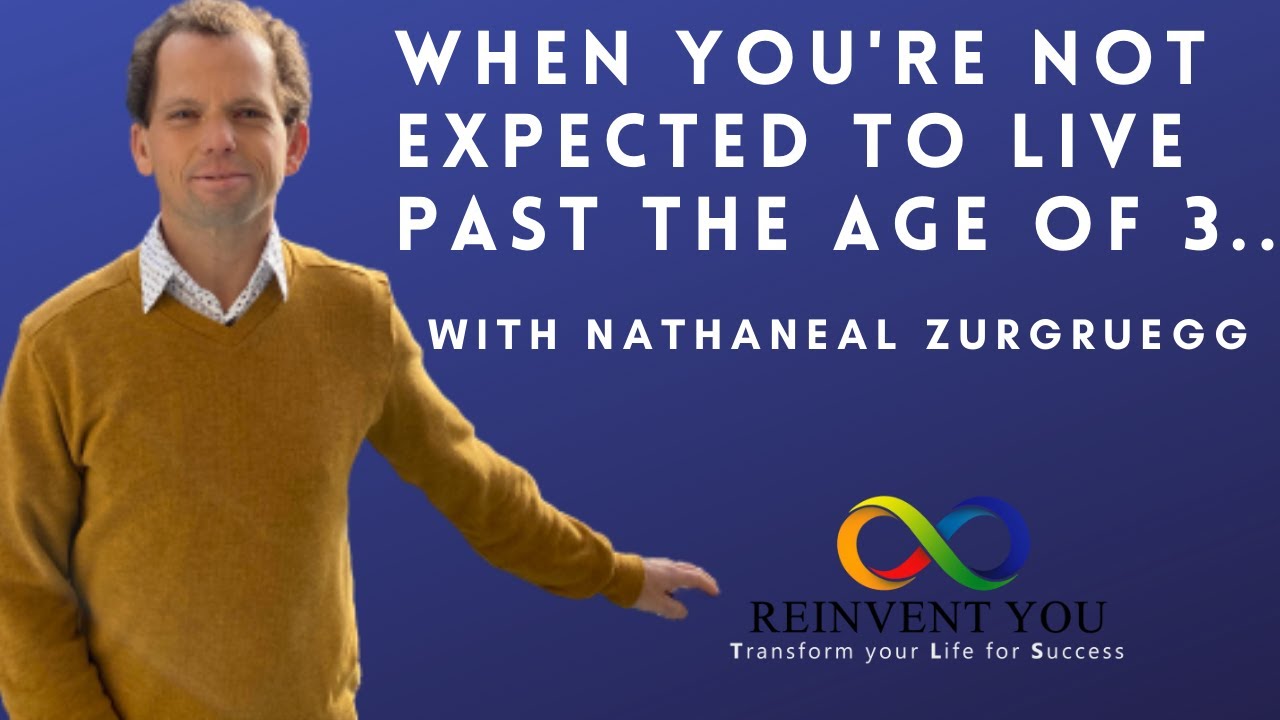
Nathaniel Zurbruegg survived six near-death events and over 40 surgeries after doctors said he wouldn't live past three. He now coaches others through what he calls the Victorious Mindset, starting with two questions: Who am I? What am I here for?
Chapters
This is episode number 63 with Nathaniel Zurbuchen.
If you're someone who wants to make major changes in their life, someone who wants to achieve their goals, or maybe you're someone who knows this is not as good as it gets but you have no idea where to start, on the Reinvent You Podcast we explore different types of people, their successes and failures, and how they reinvented themselves to create the life they love. It's our hope that from hearing their stories, that you too may have more insight into what it takes to build a life that you envision for yourself. Here to help you do that is performance and life coach Travia Steward.
My guest today on the podcast is a man who has lived a life that started with incurable chronic illness, a medical prognosis that he couldn't be able to walk talk or amount to anything, and that he should be dead 6 times by now. To today, he's an entrepreneur, he's an award-winning global inspirational speaker, and a Victorious Mindset mentor. And on the podcast today, we discuss how he developed his Victorious Mindset, how he helps his clients live an unlimited life, and the importance of never ever giving up Despite the odds, you're in for a treat. You are in for some inspiration and motivation, and this guy has it all. Welcome to the, to the Reinvent You podcast. My guest, Nathaniel Zurbuchen, my man. He's, he's in Switzerland, and I'm so excited to have this conversation. So I just want to take a moment and say welcome, Nathaniel.
Hey, welcome, welcome. Thank you so much. Thank you everybody for listening and you, Travia Steward, for hosting. I'm so excited to be here and, um, yeah, to just pack up the day today in Switzerland with an amazing podcast.
Yes, yes, I love to podcast. And, and, you know, guys, like, we are recording this, it's 10 AM for me, but it's 7 PM for Nathaniel, so But you know, the possibility that, that Zoom allows us to have is just incredible. So I'm glad and I'm so thankful and so grateful to be able to connect with Nathaniel, who's all the way in Switzerland. So guys, I was so enthralled by Nathaniel's story of overcoming every single thing that he's gone through, and so many of us go, oh, my fingernail broke today, so now I can't do the thing that I got up to do. I can't work on my business. Oh, I don't really have the energy. How am I going to build a business? How am I going to do this thing? And so, Nathaniel, I would love for you to begin by just introducing who you are and then jump right into your story of— my goodness, you have overcome so much. And I know it's going to be so motivational. It's already for me, and I know it's going to be so motivational for my listeners. So if you could just start with who you are and a bit of your story, I would love that.
Yeah, absolutely. I'm pleased to do that. So yeah, I'm Nathaniel, as you heard already. I'm living in Switzerland. I grew up in Switzerland. I was born in Switzerland, but I haven't been always here in Switzerland because I realized early on with all my difficulties that it's quite a small country, you know. I need big stuff. I need, I need a big horizon. So I moved to Australia. That was back in 2012 for 4 and a half years. And so I'm back here since 2017. It was a bit unexpectedly, but Sometimes life just, you know, goes the way it goes and yeah. But yeah, it's interesting, as you said in the beginning, my story is amazing, incredible and inspirational. I often feel not myself, that I lived in that too, because it sounds different to who I am today and what I do today than who I was and what I did in the past. And it's, it's sometimes, to be honest, even difficult to relate for myself for all the good things that happened, especially in the last 15 years. And I'm gonna share you a little bit about the previous first 15 years of my life. I was diagnosed with a complicated chronic illness with 1 year old, which affected my own kidneys. My kidneys had to be removed. I had to start doing, you know, dialysis treatment, which everybody has to do as soon as the kidney isn't working anymore as it should. And so But it wasn't, you know, it was a hard time, but probably the hardest time was when I was about 3 years old. And then there was the time when I had a stroke. All of a sudden I was losing literally my mind. I was at home, my parents weren't at home. My brother realized something was going on here with me and called my mom. And they brought me to the hospital, directly into the ICU. I was felt into the coma for the next 2 weeks. Wow. And the interesting thing was that at the end of those 2 weeks, my doctors called my parents and told them, "Hey, look, there's nothing else we can do. My brain has been a gray patch." It basically was, literally it was dead by that time. And so my parents come into ICU in expectancy basically to, to farewell my life. And as I said in the beginning, life goes sometimes the way it goes. And the doctors turned off the machines, all the life-supporting machines, because there was there was no reason to continue. And then all of a sudden, the moment they turned off the machine, I started to talk again. Out of the blue. Oh my God! Out of the blue, and nobody was expecting that. It was like, it was the biggest miracle, that especially, yeah, I heard, or experience in my life. And so it continued like that for a little while. I recovered, I had to recover, I was coming back, fall back, fell back into the coma, come back, and it took me about a couple months to recover. And things went on. With, you know, dialysis treatment. And I'm gonna make a jump a little bit. I had about 3 kidney transplant with 5, 7, and 11 years old. And for me, what that means is that I never experienced a life before that. Like everybody else did, or most of the children did in that time, because I had all the cells in my kidney and I realized that I can do anything, I can eat everything, I don't have to go to the hospital 3 times a week for dialysis treatment. And that was an amazing flourishing dream time. And So this happened 3 times, and I want to jump to one of the second kidney transplant that I had with 7 years old up to 9-year-old. And it was, um, crazy because after 2 and a half years of living the dream, of flourishing, of, of understanding that there's a different life, all of a sudden my kidney got destroyed again, and I had to readapt to my old life of getting into different eating habits, getting into different schedules to go back to dialysis treatment. And it was so depressional for me. I remember the time I come home after removing the kidney, realizing, okay, there's, you know, I just lost my best friend. That was my mentor. And so there was a time I was depressional for 2 weeks. I remember the time I was on the couch in my parents' living room. I didn't eat anything for 2 weeks. I didn't talk anything. And I just almost didn't move. Just was lying there on the couch and, and you know what, what it does with an 9-year-old boy, um, who isn't yet that much, uh, you know, hasn't had that much growth in, in his brain and all that, you, you realize that, well, everything is against me. Why does that happen to me? Why, why would I want to be still alive? And there was a time actually when all the negative talks had such a power that I had nothing else in my mind to take my own life. And I was so blessed with my parents, they realized that, you know, there's something not well going on. And so we had a lot of, you know, pastoral care and psychological stuff, and which got me back on track. And then So these were two events that always, that I will always remember, that I had the most transformational point, but as well it was the lowest point of my life. And I have to tell you, like, after, you know, I told you that 15 years were pretty bad, the first 15 years, and after age 15 everything becomes stable with a lot of growth, with a lot of potential. Now today I'm turning 33 in November, and if I look back, I can say after so many— 40 operations, 4,600 life-saving treatments— shouldn't be alive for 6 times by now, hearing impaired about 80 to 85%. I'm living fully the life and living the unlimited life that I believe God has called me to live. And I believe that there's so much more for everybody out there, whether you have, you know, a crazy medical story or whether you are just— you feel like you're a simple, ordinary person. It doesn't matter. There's so much more for everybody out there. And I believe that for you listening as well, because whatever is, um, psychologically seen below the brain, there are no limitations to the mind except the ones we acknowledge. And this is something that I could probably— probably the biggest lesson that I learned, that everything is possible and everybody has the potential, the unlimited potential.
Wow, I love that. Your story— good night. So I, you know, just to break it down a little bit, what was the age? And like, when you were like— they turned off the machines, you were brain dead. Like, how old were you then?
Yeah, I was about 3 and a half.
3 and a half. Wow. And did they use the words that he's brain dead?
Yeah, um, yeah, absolutely. And there's one thing that, that I, uh, realized, uh, it took me a long time to realize, but my parents once shared that before they turned off the machines, uh, especially my mom talks a lot of words to my life, words of faith. And it's one thing, you know, I believe that the words have power that can either destroy or build up a life. And I love that because words are simple and they just can flow. And that's one of the reasons I become an inspirational speaker, because I know Today for me it's like getting up that whenever I speak, I want to speak in an inspirational tone and build up people's life because I realize what it has done, um, in my life.
Right. So you think— so do you remember, like, so was your mother speaking the inspiration through her words, like willing you with the language to wake up, to let's, let's go, get up out of that bed, let's start talking right now. Would you say it was your mother?
No, I don't exactly what she said, um, but the weird thing is that when you're in a coma, um, you know what's going on around you, but it takes you a long time to, you know, it's like a puzzle in your mind where you, over years, you have to to put the different parts of pictures together in order to understand what's happened. And so you are there, but you are not there, right?
Right. Got it, got it. So can we now pivot a little bit to the age of 9? And so my question for you is, why— honestly, and maybe it's because I just haven't experienced it personally, but I haven't even heard any example of a 9-year-old wanting to end his life because generally as a child you think unlimited, we're dreaming, we're thinking of all these possibilities. Would you say that that was your lowest moment that you can recall in your 33 years? And what do you think was the catalyst for you going, I just don't want to do this anymore?
Great question. Yeah. It absolutely was the lowest point for me. Because when you realize that you dream about something and then you have to dream, and then you, all of a sudden the dream stops. And it was, at that time it was already the second time that I lost a transplanted kidney. So actually the third time I lost, firstly my own, then the sec— first one only lasted for 24 hours, and then the second one which for 2 and a half years, which was amazing. What kept me going is, I believe the faith, the hope of something bigger, of something better, of something You know, um, of something that I, I feel like hope is, it's probably the, the strongest pillar that humanity can have because it, it creates a strength to, to get up. It creates, um, a passion. It creates a purpose to know that that moment here is not the end, that if I keep hoping, if I keep dreaming, then someday, whenever that will be, it will, it will happen. And so I think hope has such a powerful, powerful aspect that, that, um, yeah, that it just— so someone has to to try by themselves to really understand what hope can do and having faith into a better future.
Yeah, it's just the optimism of that. I believe that, you know, for all of my life I've been a person who saw the glass half full rather than half empty. And so your resiliency as a child is so inspiring. Do you think if you were experiencing these things— I know you, that was your lowest moment, but let's fast forward and let's say Nathaniel is 30, 3 years ago. Do you think there's a difference between how resilient you were as a child compared to how resilient you might be as a 30-year man, 30-year-old man? You think there's a difference there?
Yeah, I think, I think so. Yeah, I think, um, resilience, as any other aspect of life, decreases when we don't train it. And it's the same, like, it's like a muscle in life. Of course, I still have, um, my, my difficulties today. I fully different than when I was a child. They might be bigger in some terms, right? But they are not that, you know, super difficult or deep that I will finish here and say, okay, I'm not gonna continue. Um, I think like resilience, I say, is, is almost like it's a muscle like anything else in life that has to be trained. And yeah, I think we have also a bit of control to choose the resilience. Like, I mean, if I will every day stay in bed and think I don't care about life, then I don't choose the resilience process. But if I say, okay, let's go up and do it again, even it took 10, 100 times, then we build our way to resilience.
Right, I love that. And so, because so many people, like, I know clients that I've worked with who experience, you know, depression, and they're like, you know, I just don't want to do anything. And I know that putting yourself, like you're saying, like, you are a testimony to this is what needs to happen. It's like, don't just and I know this is easier said than done, but it's like if you keep yourself in action, getting up and doing things, going through your day, doing things so that, you know, getting you into motion helps create that muscle that you're talking about of resiliency, would you say?
Yeah, yeah, I like that. Absolutely. And I think we, when we, uh, you know, when we have a flashback or anything that that blows us down, then we, we expect from ourselves that we want to, to continue on the same level than we were falling from. But that's, I think that's not quite the right attitude because, um, if you have difficulties, let's say, um, and you, you, you have any difficulties and you, you have difficulties to get up, um, I think the best thing is to do maybe weekly or something like that. Okay, the first week I'm gonna keep going up and then it slowly comes back and then I can think about the next step what I going to do. After getting up, you know what I mean?
Right.
Then I can make something else. And so I think we always want to, to go, it's, it's, it's just life. I mean, it's, it's the same with, with the blood flow, it's the same with, with stock market. If it crashes, you can't straight, um, start or be at the same as, as you it had time to, to go back on the, on where it was falling from, and then from there it gets even much stronger.
Right. So would you say that, like, if you were going to say what are the keys to creating resiliency, is it one step at a time? Is it not trying to will yourself to perform from that same level before you fell, but sort of adjusting and pivoting at the level in which you are now and still continuing to take action.
Yeah. Yeah, absolutely. And I think it's, it's a, it's a great thing to do to sometimes you have to go back to where we have coming from to realize that, well, maybe before when we were on the top or whatever, maybe we haven't enjoyed it as much as we should have.
Yeah.
Because we always wanted more, or maybe we weren't that grateful, or maybe we weren't satisfied when we were on the top than when we were on the bottom. And it's just, it's just, yeah, I think it repeats all the time in life that, We go up and then we fall down. We go up a little bit higher than before, fall down a little bit deeper, and it's just part of life to cope with that. That's good.
So I know, so right now I know that you are hopeful, you're optimistic, you are a very positive thinker, but I know something that's paramount and a foundation of the work you do with your clients is creating a victorious mindset. Because I feel like there's a difference between just being hopeful and optimistic. You call it a victorious mindset. What are the differences between just being optimistic and positive and being victorious? And how have you created the victorious mindset?
I like that question. Powerful. Great. Well, the difference is to be active and not passive. You know, you can have a dream, you can hope on things, but there's no, you know, there's no different when you lie in bed in the morning and you're hoping about things, but, and you never get up. But if you have, you know what I mean? Yeah, yeah. Or maybe, yeah, maybe a person will realize sometimes and will get too straight, but we never know. But anyway, I think it lies in being active, and by active I mean not in a way, you know, to strive or to be somebody else than you should be. It's just being active to be and do who you are in the moment and what you can do in the moment. Like as I said before, if you, if you get out of the bed and then the next step, that's your journey to get to the break— breakfast table. Somebody else might be already, you know, going out of the house, but it's not for you to, to control or to, to care about. So the days are different, and I love the Victorious Mindset because It's— I said previously, the mind is such a powerful tool of ours. I do, however, not believe that it only depends on us. I believe that also that there's a God, a higher power, whatever you wanna call it, that, that gives us certain injections, certain leading points where we can go to and what we can do. And I think so, but the victorious mindset in all that is about, you know, really having them setting the mindset or the perspective, focusing on being a victor and not a victim. In your life.
Ooh, being a victor and not a victim in your life. That's powerful. Absolutely. And so many of us, it's like, just will yourself to get up until you can continually take that action.
Wow.
Nathaniel, why are you passionate about this? You could be a 33-year-old guy who is like, I'm alive. I'm just going through this. I'm happy that I'm alive. And I just want to, you know, go and have my business and make money and provide for myself, my family, whatever that is. But why are you passionate on a broader scale? You know, because I know you're a speaker, you have this program, you work with clients. What is the basis of your passion to do this work?
Great question. Um, where should I start? I think the biggest point is, um, when I lost my third kidney transplant with 11 years old, I become a person of faith and wish, you know, that they say, I call it philosophy here, which says, "God will work all things together for the good." And I started to believe that and over the years I realized that, You know, I said before, there was a leading point. I do not believe that I always were choosing out of myself things, but there were certain leading points that, that got me to the passion to, to realize that any life, any difficulties, any hardship, any bad thing can be turned into something good.
Yes.
And so I started to believe that, and as many of you might know, that when you believe something, you become or you do it. And so I never imagined, you know, become a speaker. I was probably the, the shyest guy in my school. I never learned probably, you know, properly speaking because of my hearing impairment. And so it's just, it's blowing a mind when you start to believe that things can turn out for the good. Yeah. Then you realize that everything in your life can serve somebody else. I can take the bad things and make, live a life that turns it into something good. And so it wasn't, you know, the passion wasn't, yeah, it just come along step by step. It was never something that I decided from one day to another, I'm gonna do that. It just come and come and adapted to, talked about what else can I take from my life that looks negative or bad and turning into something good, and then help others to, to get into that as well. Right.
I'm a firm believer in that. I, you know, I relate to every single thing that you're saying. Do you— are you a guy who, you know, because I know the mind has to believe it, you know, it's the optimism. Are you a guy who practices visualization. It's like you see yourself doing it, you see yourself on stage, you know, speaking, you see yourself. How important is visualization with your work?
One of 100, two of 200, 99.
Got it.
No, I think, I think, um, yeah, I, I do it, and my, my wardrobe is full of pictures of future dreams. Yes, I had pictures in the past that happened, uh, exactly the way I imagined. Um, I do fully believe that. However, I learned that I do not, you know, fully depend on him anymore, on myself, that it happens. Okay, so I do, I do, I dream big, I visualize it, but then I know it's gonna happen one day. Um, I, I call it by God's help because he, he's bigger, greater than, than myself. Absolutely. If I— if he wouldn't be there, or he— if he wouldn't have decided to keep me alive, then I wouldn't be here. So, um, and it, it released me from a lot of pressure. You know, when you, when you visualize things and then you think like, oh, I have to finish that by this year, by that year, and it was stressing me out a lot of time in the last few weeks.
Yeah.
And so I started to, you know, to say, hey, look, God, you know what I would like to do, and, uh, but I know also that whatever I dream or imagine, you will do it even bigger because, um, I know you. Yeah, you are better than me, and, um, absolutely bigger things than myself.
And so, yes, yeah, so it's like, so you create the visualization, you create the targets, the goals, you know, all the outcomes that you want, and you release attachment to it. You give it to God. Yeah. Did I have that right?
Yeah.
Oh, that's so powerful because I also have felt that, that pressure And it's like, you know, because I do a lot of visualization as well, and I set these targets and I go, oh my goodness, I got 2 days left to do this thing.
And that is 2 days.
How is it going to happen in 2 days? You know? And then, yeah, and I stress myself out over it. And then I also learned that looking for the things in different ways helps because it's like sometimes I was so specific with my visualization that I didn't recognize that God, the universe, was still giving these things to me because I didn't— I wasn't opening my eyes to see it happening in so many different ways. I was like, oh, well, that is it, because it was— I was thinking of it so tangibly. It has to be this exact thing. But, you know, like, you know, like the example that I can think of is that, like, you know, I set a goal to bring in a certain amount of money Well, specifically, I was like, oh, that has to be just with my, my coaching, my clients. But I was like, no, I just— God helped to bring in more money. And I, you know, it took me a while to go, oh, it can come in so many different forms, right?
Yeah.
Oh my goodness.
Yeah.
Have you experienced that where you were asking for something very specific and it's like, oh, I had that thing last week and I didn't even see it.
Yeah, yeah, absolutely. Um, it's as you said, I, I think like if we are so specific, we don't, uh, expect the supernatural things.
Yes.
And, um, so for me right now, it's like, as you said as well, the best opportunities in my life were the ones where I stepped back from everything and let it come to me. And I tell you, I'm, I'm right now, I'm learning that again because I'm, I'm, uh, I get crazy about at the moment about all the marketing stuff that's going on.
Yeah.
And I'm, I'm the least you wanna, I want, you know, I'm the least person in this world that wants to anything do with marketing. And then I was like thinking, Beginning of the year, what's, what's the purpose of it? I mean, you know, why not just stepping back and believing for supernatural, uh, opportunities? Because they don't cost anything, right? And people, if I, I also realizing always more, when you grow, when you focusing on growing and, you know, being being authentic, being relaxed, being honest, then you, you are in this world a big magnet to the people because people are looking always for, for that, uh, how do you say that, for that specific resting place but still having a fulfilled life, right? And I see a lot of people today in this world getting crazy about hustling around, doing things, this and that, and, and so if somebody comes into the room who is just walking in, being yourself, it, it attracts. And that's what I realize, that's also where the best opportunities come, when people, you know, just come to you and, and then you still— or the person that comes to you, there's no, you know, there's just a simple harmonic conversation. And then it will, if it has to, it will lead into something bigger together. And I think that's the most, um, most released and relaxing way One can, one can live.
Oh, I love that. That was just beautiful. Yeah. Just release the pressure that we put on ourselves. So I know the thing that you have an ebook, it's a 4-step, right? To unlimit your life. And you don't just give the whole ebook right now, but what is a nugget that you can give my listeners to, like maybe one of the steps to unlimiting your life? And then they're motivated to go and get the ebook because it's free, right?
It's free.
Perfect. So, and I will put that link at the bottom of the show notes so you guys can get the rest of it. But how about maybe just the first step that you, that, that is that gold nugget inside that ebook?
Yeah. I like that. So the first step is nothing else than asking yourself the question, who I am.
Ooh. Okay. Okay.
Okay. Difficult question.
Who am I? I like that. And so when you ask yourself that question— and so that's a lot of the work that, that, you know, that I do with my clients, because you have to know where you are right now. And so for me, that is like taking responsibility. Who am I? How, how have I created the results that I have in my life today? How do you expand and expound on the who am I in your ebook?
Uh, yeah, I will be in a second step to go into what, what am I here for? I think the more you know yourself, the more you know why, why am I here? Like, what, what, what in the world am I doing in this world? Yeah. And this is so, such a crucial question that, I'm gonna tell you, it's, it's two questions that will follow you the rest of your life. They will never be a fixed answer there, they will always, the answer will change or the answer will be, need to be readapt depend on, on how old you are, or how old you get, or what circumstances you're in. And yeah, that's two, two, two steps. Yeah, okay. On my eBook.
Yeah, yeah, I like that, and I know you go into a lot more detail. That is so good. So, you know, it's kind of like, who am I and what am I here to do? And I always think of, you know, I, you know, as a coach, you know, we turn the finger back around on ourselves and I question that myself. And I, and I think every now and then I reanalyze that because like you said, it can change because I feel like I'm evolving as a person, you know, and, and My mission is, is evolving as well. Wow. So I know that this is part of your process of helping people flip the switch, right, from living a life by default to living a life by design. That's it. And so that's why— that's part of why I was so drawn to you, because that's exactly what I try to do, is flipping that switch from their conditioning, right? Because I think so many people are living a life that was molded for them from other people, by, you know, social media, their family, their, you know, their parents' morals and values.
Yeah, right.
So what is one way you help your clients flip the switch?
Great question. I, I always try to, to help them on, on the journey to, to get deeper into who they are. Because I think that's so, it's just the foundation of life, that when you know, the more you know, again, the more you know who you are, the higher you can build your life. It's like a fund, a big fundament, and the stronger that is, the bigger the house will be, the, you know, the stronger the elements can be on the fundament. And the same is actually with life, with Um, yeah, that's, that's all I can, can tell.
Yeah, no, yeah, yeah, we want to keep that, that little bit in the box and have them go. I love that. So, you know, as we begin to wrap up, Nathaniel, how do you work with clients? Like, what— how can people get their hands on and, and get in contact with you? I'm going to leave in the show notes, but just tell us how they can work with you and what you have as an offer. And how you work with your clients right now.
Yeah, cool. So you can go on my website, that would be the best place to, to go. It's NathanielTudberg.com. Um, so you have the opportunity to be there to, to check out my life story in detail, but if you scroll down a little bit, you also will be able to go my business website, which is unlimitedyou.co. Actually, on both websites you will get the ebook for free, and if you would like to, to have more, you can, you can get on a free call on the website, or, you know, on the Calendly Yeah, always have to think, write down. You can check it out, get in touch with me, send me an email. If you, yeah, get, get an ebook, you get 20% off if you get in contact, or if you are, yeah, tell me, tell me in the subscription if you, if you get on a free call. Then, uh, put in, uh, podcast Travia Steward, and then I will kick you into, uh, 20% discount as well. All right. Mentoring or whatever you need for you, yourself, your group, or your business.
Love that.
Okay.
So that's a 20% discount. Is that specifically if they buy— what is it that they're buying again? Or is it that they're setting up a call with you?
No, the call is free. Okay, the call is free. And then, uh, if, if we see, hey, whether you need me or I can give you something valuable, then I will kick you in into the 20% discount. Got it. And if you— yeah, and if you download the ebook, um, you will see in the description of the ebook that there will be a 20% discount 20% discount as well with a discount code that currently works on email. So if you want to reach out, please email me on the bottom of the ebook. I will redirect you directly to my email. And yeah, let me know if I can help you, if you feel like there's something— I need that. Yeah. Okay, okay.
So, all right, got it. And just so that I have it very specific, so, and that's the purchase, anything on your website, is that to work with you as well? Let's say they call, they get— you guys have that first call and you're like, hey, let's do this, I really want to work with Nathaniel. Is that 20% off?
The call is for free.
Yeah, right. But after the call, if they decide, hey, I want what you have Yeah.
I then on everything, 20%, whether you book a one-to-one session or you need me for speaking somewhere, or you want anything else out of my products that I'm currently offering. There we go. Yeah. 20% off. Um, yeah. Perfect.
I love it. So just one final question. You have already done some big things in your life. I'm so inspired by you because of your story, because of your resiliency, your victorious mindset. What is next for you? What's your next big goal? What mountain are you climbing right now?
Well, that's a good question. Right now I'm on a journey to clean up some emotional garbage. From my past.
That's a, that's a big mountain right there, yes.
It's a big mountain, yeah, it's a big mountain and I talk. It's funny, I should talk today, like, oh my goodness, I never talk like, I will get into something like that in my life, never ever. But as I say, life goes sometimes as it goes. So this is personally, and the other thing is, Probably the biggest dream that I have is also on my, um, um, yeah, my wardrobe. It's, uh, to build a nonprofit organization and build the most modern hospitals in slums. Wow. And, uh, so yeah, I will see how, how this is going to work out. I have no clue how it's going to happen, but as I said, That's right. I'm gonna leave on the side and the opportunities will come.
I love that. Wow, that's huge, Nathaniel. That is huge. And I love how you're like, I have no idea how it's going to happen. That's how I'm going to involve the supernatural. That's how I'm going to involve God. God will unfold it in front of your eyes. You don't need to know how, you just need to throw it out there.
Yeah.
Wow, that's so powerful. The thing is, this has been such a powerful conversation. And thank you so much for sharing your story, sharing your gifts with my listeners and with me as well. So I thank you for being a guest on my podcast today.
Absolutely. You're welcome. And it was a pleasure to be on this podcast. Such a fun time.
If you like what you're hearing and perhaps you're interested in having a complimentary conversation with me, click the link at the bottom of the show notes. Thank you so much for listening. If you even want to know more about what I'm up to, head over to traviestewart.com. And if you like seeing the videos of the podcast, every episode is on my YouTube channel. Take care, guys.
More from Travia









Remember the YOU Who Didn't Overthink Everything #personalgroth #mindset #selfdoubt

