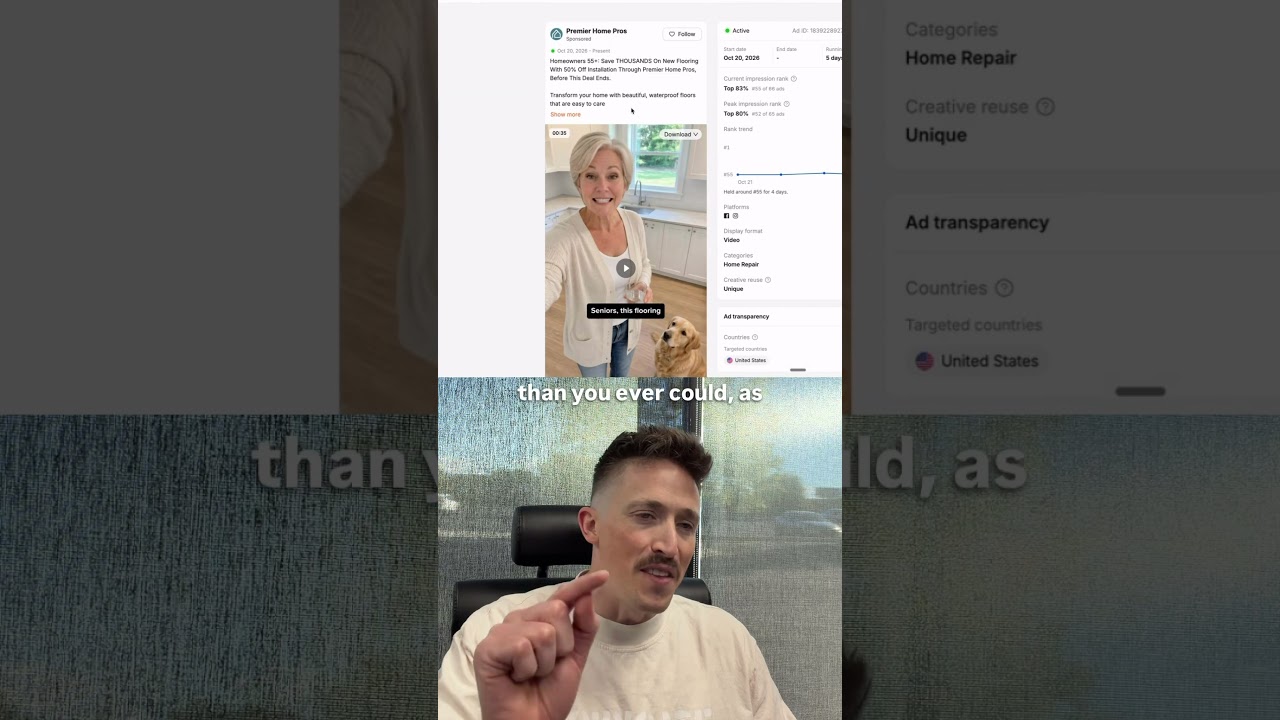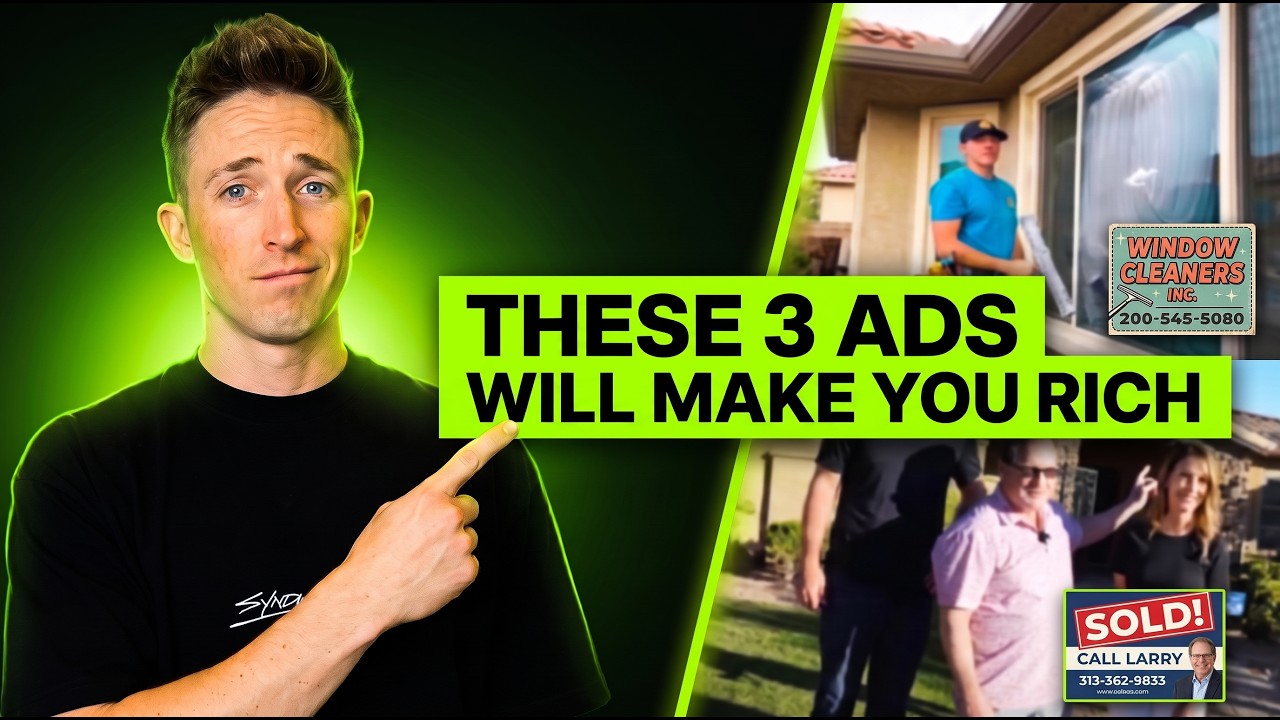
In this YouTube tutorial, Tanner Smith, CEO of Syndicate Marketing, teaches home‑service operators how to generate predictable, high‑quality leads and scale to $100K‑plus months using three proven ad formats on Meta (Facebook and Instagram). He begins by stressing that successful ads hinge on two fundamentals: human psychology (the deep‑seated desire for solutions and belief‑driven decision‑making) and Meta’s data‑rich algorithm that targets users based on on‑ and off‑app behavior. Smith explains why Meta is the “900‑pound gorilla” for home‑service advertising and outlines how to leverage its targeting tools. He then breaks down each of the three ad creatives: 1. Owner Intro Video – a 30‑60 second, raw, authentic video where the contractor appears on camera in a recognizable setting (truck, shop, job site), follows a scripted structure (area call‑out, intro, USP, social proof, CTA) and prioritises genuineness over polished production. 2. Customer Testimonial / Case‑Study Video – footage of happy customers answering four core questions (pre‑problem, why they chose you, experience, results) filmed on‑site, with the homeowner’s voice providing social proof; tips include offering a thank‑you gift, capturing before/after visuals, and keeping the edit concise. 3. Still‑Image Ads – quick‑to‑produce static creatives that allow rapid testing of multiple angles for maximum ROI. Throughout, Smith intersperses real‑world examples (TriStar Windows & Doors, M‑Roof, Window World, Allied Roofing Solutions) showing ad scripts, on‑screen accolades, pacing, and performance duration (e.g., ads running 100+ days). He emphasizes that ads need not be perfect; they must be launched, measured, and iterated based on data. Smith also establishes his authority by citing his agency’s experience (over 1,000 clients, $230 M ad spend, a 7‑figure home‑service business). The video concludes with actionable next steps: create the three ad types, test variations, track metrics, and refine to achieve scalable, predictable lead generation.
Chapters
What's up? Welcome back to the channel. My name is Tanner Smith. I'm CEO of Syndicate Marketing. And if you're here for the first time, the only goal of this channel is to help home service operators and contractors consistently scale and unlock $100K months and actually run a real business and understand what goes into that. So today we're gonna be talking about one of the things I'm most passionate about because it is everything I've dedicated my entire career to advertising and generating leads online. So I'm gonna break down the top 3 ad formats that you can copy today to go and actually generate leads for your business. And the great thing about this, I'm gonna explain the frameworks, the psychology, why it works, why it's super effective, show you real examples of these ads in the wild so you can literally copy and paste this into your business today. Let's dive in. So these are the 3 ad creatives that are going to print leads, and we're primarily going to focus on ads on Meta and Instagram. There's a whole other strategy for Google, launching Google Ads, maybe even YouTube Ads or TikTok Ads. We're going to focus on Meta, which is of course Facebook and Instagram today. And the reason why is because that is the tip of the spear. That is the best platform that you can consistently advertise on and get a scalable and predictable results. One thing to know before we dive in here is we do not have a loyalty to Meta or to Google or to TikTok. We simply go where the results are, where we're able to consistently and predictably get the outcomes we're looking for. And it just so happens that as of right now, 2026 moving into 2027, Meta is kind of the, you know, 900-pound gorilla in the room. They're the best ad platform for what we're trying to accomplish. So here we go. This is the number one reason why ads fail or why business owners and operators trying to get started or even seasoned veterans running a business aren't able to consistently unlock unlock results with ads, it all comes down to psychology and algorithms. So recognize here, we're going to kind of take a timeout and explain this in detail. So we're selling to real homeowners, okay? These are not robots that we're selling to. These are real people with real problems in your area that are looking for a solution that you can solve, okay? That's number one. You have to recognize that. I think sometimes we get so caught up in algorithms and AI that we forget that we're actually talking and selling to humans. Number 2 is we do have to understand how these algorithms are Working on Meta, where we're at, and how we can leverage this tool, because that's exactly what Meta is— it's a tool to our advantage. So what I want you to recognize, first things first, is how do we target? Because that's one of the main questions I get. It's, Tanner, how do we target the right individual? Well, I'm going to explain all of that to you in this video, but before I do and tap into algorithms, let's talk about psychology. Human beings have a serious flaw in their operating system, okay? We're great at a lot of things. One of the things that we're not good at is that we are very believing and want to believe in something. And sometimes if we don't find the right thing to believe in, we can get taken advantage of. This is how like if you've seen The Tinder Swindler, right? Documentary on Netflix. There's all of these scams and people get scammed online. How does that happen? I'll tell you and it goes down to the operating system flaw that we have as human beings and the psychology of how we think and operate. So, here's the flaw. As human beings, We all have problems and we're looking for solutions. If somebody can communicate to us our problems so clearly that it's almost like they're getting inside of our own minds, we are naturally going to assume that that individual can solve our problems. And that's not always the case. So what we want to make sure we're doing is obviously this is a tool that we're going to wield to our advantage here. We're going to make sure that we're communicating directly to that problem. I see a lot of home service operators, a lot of business owners that never get deep to this get deep to the pain. They never go 3 or 4 or 5 layers deep. They stay right here on the surface and talk about, this is how great I am, here's what we do. And that's not really what is going to work with ads. We want to focus mainly on the homeowners and the exact problems and solutions that they are looking for and searching for. That's what's going to get them to stop the scroll, watch the video, engage. But now that we understand the psychology of it, that's also going to be what Meta uses in the algorithms to target our ideal customers. So if we're able to understand the psychology of how human beings operate. Really what we're all looking for is solving our problems. If we create ad creatives that are communicating that, representing that both through the ad copy and the creative, we're going to be that much more ahead of the competition. Now let's talk about algorithms for a second here. How does Meta operate? Well, let's just take a step back. They are an advertising platform. That's it. That's how they generate revenue. And the way that they are able to generate revenue is because they are capturing and collecting billions of data points on all of their users. So what do I by that? Well, it's on-app activity as well as off-app activity. When you are engaging and you're scrolling on your social media— here, let me get my phone— they're interpreting every single one of the posts that you like, the amount of time you spend on a post, the things that you share, what you comment, the posts you're commenting on. But also, they're going and tracking every single one of the links that you're clicking on, the type of websites that you're engaging with, the type of products and services that you're actually purchasing in real time. So that's just kind of like some on-app activity that they're tracking, which is incredibly powerful. But where it really, really gets more powerful than that is when you consider the things that they're doing with the device that, you know, they're never going to say they're doing, but we've all seen it before. They're actually tracking the conversations you're having. They're hacking your microphone, listening, interpreting through the people that you're talking to, as well as your camera, your retina activity as you're scrolling past a piece of content. You probably have thought to yourself, Hang on a second. I think my phone's listening to me. And the reality is, is that it is because it's using all these data points, these billions of data points they have on you to ultimately predict which products and services you're needing and are interested in purchasing in real time. So here's an example of what I'm referring to here. The other day, I was actually just having a conversation with some friends about their hot tub. And I was saying, hey guys, do you like your hot tub? Is it something that you actually enjoy? Would you buy it again? Which brand did you buy? Why did you buy that brand? How hard is it to clean? You have somebody come out and service it? Like, I'm just having a conversation about that. Their hot tub and thinking maybe I should buy one because I'm maybe interested in it. Guess what I start seeing the next day on social media, on my Instagram account? I'm scrolling, hot tub ads. I didn't go and look at hot tubs online. I didn't go and look at Bullfrog Spas, nothing. They're tracking us to be able to predict our future buying decisions. Okay, so this is exactly how if you're in pest control, for example, right, maybe you're talking with your wife in the kitchen and you're like seeing all these ants and you're like, man, we have an ant problem this year. You're having a conversation and you're thinking like, dude, these ants are getting bad and I've tried to spray, I've used Ortho defense, it's not really getting the job done, and I don't know where these ants are coming from. There's got to be a way for us to solve the problem. What if in that exact moment you get a knock on the door? You open the door and it's a door-to-door pest control guy. He says, hey, listen, my name is Tanner with XYZ Pest Control. We're actually just down the street talking to Susie. We're gonna be helping her out with her ant problem. You've probably noticed that the ants are kind of bad this time of year. Anyways, I want to walk you through a special ant package that we've put together and our guarantee that will help you get rid of ants for good. Is that something that you're interested in? Okay, that's literally— you You might hate door-to-door guys, but if it's that exact scenario, that exact situation, you're not just going to be interested, you're going to buy what that guy has to sell because in that exact moment, he's getting in front of you with your solution. That is exactly how we target people and we use social media to our advantage. But instead of it being a physical door knock, it's a digital door knock in the form of a piece of content that is showing up on somebody's feed as they're scrolling and spending time online. Now, if you have this question of, well, Tanner, my ideal customers aren't online. Yeah, they are. enough excuse. We're able to target and find every single person depending on what your area is, your service, what you do. They're all online. If you haven't been able to target them yet, it's because you don't understand the psychology of how human beings make decisions and you don't know how to leverage and use the algorithms so that the algorithms can target, put your ad creatives directly in front of those that are most likely to purchase from you. Sound fair? So I know this is a little bit of a rant, but it's an important one. It's one that you really do need to understand. And the more that you actually launch ads and get your ad— your ads out there, your brand out there, the better you're gonna start see pattern recognition on this and really be more effective. So that's kind of a little nugget here that's going to be at the foundation of this entire conversation. Now, one thing about this— who am I? Why am I teaching this? Well, you know, we've been working with home service operators since 2018. We've worked with over 1,000 customers to date in my agency. I actually own and operate a multiple 7-figure home service business myself. We're probably on track to do about $5 million this year in our first year of operation. We have really aggressive plans to scale. And by the way, over the last you know, since 2018, we, me and my team have managed $230 million in spend. This isn't something that I'm just a rookie at. We've probably launched tens of thousands of different ads. And really over the last 8 years, we've been able to identify patterns and trends that get us consistent, predictable results. So let's dive into what those are. Really, here's the playbook to get started, to start getting leads on autopilot. Don't get overwhelmed. Keep it as simple as possible. I only want you to focus on 3 types of ads. And these 3 types of ads are going to do 3 different jobs for you, or, or 3 different things for you in your business. Number 1, we're gonna focus on what we call the owner intro video. The key with this is to basically turn you from an advertiser, someone that's behind a computer, into a local neighbor, someone that they know, like, and trust, and it builds familiarity. Number 2, we're gonna focus on what we call the customer testimonial. This is ultimately just triggering social proof as human beings, and it's not coming from you as a company, it's coming from somebody that looks exactly like the people you're trying to target in the area you're targeting them. It's really powerful. Number 3, still images. This is your biggest bang for your buck Takes no time to create. We can test a ton of different angles, and ultimately you get really clear on exactly the type of person that you're trying to target here. So let's just dive right into it. Number 1 is the owner intro video. Now, how does the owner intro video work? Number 1, you yourself as the contractor or operator need to get on camera and you need to introduce yourself to the town. So these should be about 30 to 60 seconds in length. You should be using your phone, and ultimately you want to have your backdrop be your truck, your shop, your job in progress, something that is recognizable, that builds trust and credibility. As a bonus here, you know, have it be branded with your swag, be wearing corporate apparel if you have that. Just anything that can make you more recognizable and professional is really, really important here. Now I know what you're gonna say, Tanner, I don't want to get on camera. I personally don't think I am good on camera. I don't know what to say. I don't know how to say it. You know, I'm not a professional videographer. That's the genius, and that's exactly why these videos work so well. In fact, we have clients that have hired professional video crews, come out with professional lighting and audio to shoot this type of an owner intro video. And guess what? They spend thousands of dollars on the creative, the video itself, and then it out— it doesn't, doesn't work. Because if it looks too polished, if it looks and feels like an ad, people are going to scroll right past it. So going back to the psychology component of this, why the raw and authentic and genuine videos work so well is that people don't like ads. People spend money to block ads. They feel like advertisements are, you You know, they're distracting, they're disruptive to your day. But what people are interested in is relevant pieces of content. So why not just make a relevant piece of content speaking to somebody with a specific problem in your area, an ad, and making it very informal, very genuine and authentic? That's the goal here, okay? So ultimately, here's kind of the initial framework that I will teach and train my clients on. And once you get really good at this type of a script and framework, the key here is that you don't just become a robot. And you do the same thing over and over and over again. No, it's about understanding how you can play around inside of this framework but create different variations. So here's exactly how it works. 0 to 5 seconds is where we're gonna be calling out the area, saying, hey, XYZ homeowners, you know, this is where they are going to realize that you're actually targeting them in your area. Okay, the next 5 to 10 seconds are to say who you are, introduce yourself, what your name is, what your company is. The next 10 to 45 seconds potentially, okay, this doesn't have to be 45 seconds, the shorter the better. You're going to simply explain what you do, explain your unique selling proposition, AKA how you're solving problems for people looking for the exact thing that you are selling, and explain how you're different. So the better you can explain how you're different in a way that is going to create trust and credibility, the better. Sometimes people just say, hey, you know, we've been in business for 35 years. That's okay. But if you can say, we've been in business for 35 years, and one of the things that we've learned over that time is that we are that much more experienced. We're able to save you more time. We're able to understand if you actually need this solution or not, we're able to provide you with better quotes and more, more quick turnaround times. Make sure you're not just talking about yourself. Okay. But if you're going to talk about yourself, do it in a way that's going to actually help the homeowner or help your ideal client. Okay. Also throw, throw social proof in there. If you have awards or accolades or prizes, these are all things that you can also lace into this section. This is where you can really get creative and play around with what you do and why you're different. Okay. And then the last 15 seconds is a call to action. Name the pain one more time, give them a clear next step. Sometimes I see people say, hey, listen, so if you want us to do, you know, your roof, or you want to hear us, you know, give you a quote on your gutters, or if you want to do XYZ, like click link below. That's not what we're doing here. Keep it concise and focused on one thing. If you're able to do multiple things, fantastic. Most contractors or most home service business operators do. But in this, for the sake of the ad, for the sake of generating a qualified appointment and lead, just make sure that you're creating one ad for one type of service, for one type of person, for one type of issue that you're solving. That's going to get you much higher quality leads. It's gonna help you close deals faster, and it's gonna ultimately help you create more trackable and scalable advertising. Sound fair? So ultimately, this is kind of the structure that I want you to play around. And what I want to do now is show you some real-life examples of what I'm talking about. This is almost verbatim an example of an owner intro ad that has been working pretty well. This is a company, TriStar Windows and Doors. They've been running this ad for 337 days. Do you realize how powerful that is? Now, when you see something like this, okay, they've been running for 137 days. There's really 2 assumptions we have. Number one, they're either really stupid and they are continuing to spend money on ads that don't work for them, or this ad is performing. And if something's not broke, we don't fix it, so we keep running it. So actually, let's take a look at what this video is.
Hey East Tennessee, Josh here with TriStar Windows and Doors. Uh, just finished up a successful fall home show season in Knoxville. Wanted to address the number one question that we get asked, and And it's what makes you different. So I believe what makes us different is 2 things, actually, the people and the process. So the people, you're dealing with me, you're seeing me in our advertising. Accountability is a huge thing for me. I'm not outsourcing any of our advertising. I'm not outsourcing companies to do our fall home shows or our spring home shows. I am attending them. So is my project manager, Billy, who's the one that would actually be in the home talking about your project with Number 2 is the process. We don't have one product that we shove down your throat. We have a multitude of products, manufacturers that we can choose from. So we want to meet you where you are and help you. We have stuff from entry level all the way up to premium and everything in between. We want to help you get what you need for your home. We're not professional advertisers. We're not actors. We're just everyday people that live in your community. And you know, we think that that's important that that you meet with real people and that you're meeting with the people that are going to be in your home. So if you would like, give us a call. We would love to look at your project with you. You can find out why we were voted the number one window and door company with the community in Knoxville. So give us a call. Our phone number is 865-518-7731. You can visit us on the web. It is windowsbytristar.com. Love to hear from you. Love to help you out with your project. Let us show you why we were voted number 1. Thanks. Hey, East Tennessee.
Okay, so this ad, for example, right? I could pick it apart. There's a lot of things that he could have done better. It's not perfect by any means. But guess what? Ads don't have to be perfect. That's not the point here. The point is that we are testing and we are throwing stuff at the market that has a high probability of success. Now notice there's a lot of things that he did do well here. He has a little thing up here in the corner that pops up throwing some, you know, accolades and credentials. He's just a down-to-earth guy, really genuine, right? The The lighting is terrible. The audio is not great. That's kind of the whole point of the whole thing. But he's calling out the exact area. He's talking about what separates them. He's talking about how these are real people that are in the community that want to speak with them. And it just feels very, very genuine. So ultimately, this is an example of an ad that I think is great. Now, in terms of the pacing of it, sure, it could have been sped up a little bit. He could have maybe made it more concise. But once again, that's not the point to make it perfect. So that's one thing I've noticed that most home service operators struggle with is they feel like it has to be perfect. Before they put it out there. That type of logic, that type of mindset is going to keep you from ever being successful in the first place. Once you have an ad like this that you're getting real data on and it's, and it's actually working or it's not working, we can then iterate based off of the data we're collecting because we track everything. We can create different versions and iterations of that. So let's just go back here. Here's another one I want to walk you through. This is more of an example that's not exactly that, that same format I walked you through, but it's one that I feel really is effective. Sorry, but it's one that feels really effective in in getting outside of the box and being more creative. Okay, so you'll notice we go back to this section over here, right? This ad does a lot of things out of order. It's not you know calling out the specific area up front. It's not saying who he is within the first five to ten seconds, right? What they're doing here is kind of switching the order around, but it works really really well because of I think the the way that they've tested. So that's the great thing about. This type of an ad creative is it can really just be super fun to play around with. Hey, maybe you call out a specific need up front. You don't introduce yourself until the end. You showcase, you know, part of your project up front. There's little cutouts that he does talking about before and afters, right? Before and after their services. He's showing right here just kind of like a sped up shot of somebody who actually washing the side of the home. I mean, really, really cool, great ad. And by the way, it's been running for 151 days. This ad's probably printing leads leads for these guys. In fact, I know it is. So ultimately, that's an example of the owner intro video, one that's very by the book, one that is a little bit more experimental. And that's the whole goal here, is once you get the hang of it, you play around, you try different versions and different iterations, you track all of the data, and based off of what you're seeing, you continue to implement new versions. All right, now let's talk about the second ad. These are what we call customer testimonial videos or case studies. And ultimately, the reason why these work so well is because most of your competitors are simply too shy to make them. And the reason why they're so effective on top of it is because it's an ad that can come from your company but doesn't feel like you're just saying it or you're— it's coming from you. Meaning if I say, hey, I'm the best in that, I'm the best there is, you guys need to work with me. Okay, maybe somebody will believe me. But if I have real people in the exact same area or town that look exactly like the people that are looking for the same service that they just got from me, and they're talking about how great I am, it's that much more believable. So here's how to put this type of an ad together. Number 1, pick your happiest customers. Number 2, Number 2, offer a thank you. Try to get them some sort of a nice gift in exchange for 20 minutes of their time. If you just did a great job for them, most people would be willing to oblige. They're like, yeah, for sure, let's shoot a little video. I would love to help you out with your business. And yeah, maybe you give them a little Amazon gift card or take them over a little gift basket. It's another way for you just to get your foot in the door, create more rapport and trust, and ultimately maybe get some word-of-mouth referrals as well. And then ultimately try to go film at their home. Having the finished work right behind them is very, very powerful. So here's ultimately when you get into the home, some things to help you help guide your conversation to get the most out of it. Number 1, ask these 4 questions. What was going on before you called us? What was the problem like? Uh, what were you experiencing? Let them just kind of riff to you and just really try to get out where they were at, what they were experiencing, what their problems were, because those are gonna be the same problems that your ideal clients and customers are going to be feeling and facing. Number 2 is, why did you choose us over other quotes? So was it the presentation? Was it the pricing? Was it the professionalism? Was it our attention to detail? What, what it was in that process? Because if people are looking to get quotes or, or are in the process of getting quotes right now, and the homeowner can say something that you guys are doing differently or something that was special about you. Once again, another way to call out and be attractive to your ideal customer. Third question, how was the experience working with us? How did we do? What was our team like? You know, did we show up? Were we professional? What was, you know, impressive of— what was impressive about our delivery? That's kind of the third type of question you need to be asking here. And then lastly, hey, how do you like the result? What is the result like? Would you recommend us? And ultimately, let's just let them riff. If you ask these 4 questions, and iterations on these 4 questions and then just shut up and let your customers talk. Dude, you're gonna have more content than you know what to do with, and you'll be able to chop that up and leverage and use it in all sorts of ad creatives. So ultimately what we're gonna do right now is dive back into an example of a customer testimonial video that I think is really, really powerful. So step 1 is, uh, let's take a look at this one right here.
Hi there, it's Victor from M-Roof, and we finished another project in Brampton, and it's a standing seam roof, and it's a special one to some extent because in a while solar panels will be installed on top of it. Standing seam metal roofs are perfect for low slopes, modern design, and clean finish with no visible screws.
Thank you, M-Roof. You did an absolutely fantastic job. The staff were very professional. And they cleaned everything up and the roof is beyond our expectations. Couldn't ask for a better job.
Fantastic job. Thank you so much.
So if you want to have a standing seam roof on your house, submit a form below and we'll prepare a quote for you.
So fantastic ad. I mean, it's been running for 17 days here. I would anticipate this ad to be running for an extended amount of time. I mean, this thing could run for probably years because it doesn't a lot of things really well. Real feedback from real customers that showcases the project. And here's another thing to consider here. This guy has a pretty thick accent, but it's not stopping him, right? I, I work with a lot of business owners and operators that feel uncomfortable. I don't speak well, or I've got an accent. It doesn't matter. Being authentic and genuine and just showing up and letting your customers do some of the talking too is, is part of the genius of the customer testimonial video. Now, um, one thing I love about this, and I think that they probably could have done a little bit better, is get the customers speaking a little bit more upfront. But he walked through exactly what they finished, showed some cool drone footage up here, you know, talking about what they do, how they're installing solar panels. And then ultimately, once again, they let their customers do the talking. He ends with a very clear call to action, right? If you're interested in getting this on your house, you know, click link below and, you know, get a quote and done. Now, one thing to consider here, what if I don't have a drone, Tanner? What if I don't have professional drone footage? That's okay. Get up there with an iPhone or You know, show what your crews were doing up there. Have your crews, while they're up there on the roof, take before and afters, or showcase it from the, from the bottom of the home. Like, just do the best you can with the tools that you have. But just because there's drone footage here, that's not why this, this ad performed. I mean, it probably could be just as effective if somebody's shooting stuff with an iPhone from the ground, okay? It's the principles of the psychology that allowed this ad to be effective and to perform well. Now, once again, Again, as with the other ad creatives, it's all about understanding the frameworks and getting creative. So I wanna show you a couple of other customer testimonial videos or case study videos that have been pretty effective that I think you guys could take and leverage and use for your business as well. So here's this one right here.
I'm in Ashley Mills from The Handmade Home.
And these are the top 5 reasons we always choose Window World Doors and Windows for our clients' renovation projects. Number 1, natural sunlight for this home is key, so we love that we were able to bring in windows and doors from Window World to really accentuate that. Also, the black color is going to pop against the rest of the house.
Number 2, with so many windows, we wanted to make sure we were as energy efficient as possible, and Window World checked all those boxes. With the low-E glass and the Solar Zone, we're so happy we're installing these.
Number 3, when it's actually time to clean these Window World windows, it won't be a problem.
Number 4, one thing you'll definitely notice with your Window World windows—
Hey, Jamin!
—is noise reduction.
Number 5, what we love as designers are the many colors, styles, grid configurations, and hardware options that Window World has to offer. Choose Window World, America's exterior remodeler,
for your next home renovation project.
So this isn't exactly like a true or pure customer testimonial video, but I love that they have kind of this brand walking through what the windows do, The features and benefits of the windows. And this is something that you could try to get your homeowners to do or your customers to do. Just walk through in their home at the project, the things that they enjoy about your service, the attention to detail. And it's probably not going to be this polished. Obviously, they are very comfortable being on camera, but it doesn't have to be. You can take the same exact type of inspiration and apply it to maybe giving your homeowners an example of what you would like to see them do. Let's just walk through the project. Let's walk through the home and you just explain to us what you enjoy about us, how we worked with you, our attention to detail, you know, how we presented the quote to you. And this is gonna be a type of format that is gonna work really well. As you can see, this ad's been running for 114 days. So once again, either the ad is— they're totally, you know, they suck at what they do and they're blowing money and wasting money on the ad, or the ad's performing well. And when it comes to a company like Window World, yeah, this ad is definitely printing for them. One other example here that I want to walk through is this one from Allied Roofing Solutions. And once again, is it perfect? No, but I think that they did a really good job. It wasn't really a customer testimonial per se, but it is a case And even if the homeowner isn't willing to get on camera, okay, maybe they're willing to let you shoot a video of the completed project. And it's a great way for you to do a couple things. Number one, get an owner intro video, kind of have that same effect there with you being on camera but also showcasing the social proof of a completed job.
Today we're showcasing another beautiful full roof replacement completed here in East Windsor, New Jersey. This home was upgraded with Owens Corning's True Definition Duration Shingles in Williamsburg Gray to match perfectly with this colonial-style brick home. We didn't just replace the shingles, we installed the complete Owens Corning roofing system designed for long-term protection, ventilation, and performance. That includes Owens Corning's WeatherLock G ice and water barrier, Owens Corning's ProArmor synthetic underlayment, an F5 aluminum drip edge, Owens Corning starter shingles, Owens Corning VentSure ridge vents for ventilation, and the Owens Corning True Definition Shingles featuring SureNail technology. Every detail on this roof was installed to manufacturer specifications to ensure proper airflow, durability, and a clean finish appearance that's built to last. If you're looking for a company that values craftsmanship, premium materials, and professionalism, Allied Roofing Solutions has you covered. And again, this is James with Allied Roofing Solutions. If you're looking for a free inspection on your next roofing project, please give us a call, go online, or check us out on our website. Thank you.
Couple things on this ad, right? I mean, they're showing the home, the B-roll of it's fantastic. Yeah, they've got a bunch of drone shots, but once again, if you don't have a drone, who cares? You don't need one. I feel like if I wanted to pick this thing apart, number one, the captions are tiny, like hard to read. He's talking really, really fast, kind of hard to understand. Once again, who cares? Do your absolute best and just send it. And then ultimately, if it performs, which I think it is, it's been running for 30 days now, guess what? You create a different version of it. You can take this type of B-roll and footage, you can chop, use, re-edit, slice it, and you have a bunch of different versions and iterations can leverage and use. And one thing I would say to try to put this over the top is if he could have gotten the homeowners on camera, that would have been amazing. But he didn't. Homeowners probably weren't comfortable with it. And so ultimately, just do the best with what you have. It's not an excuse to just say, oh, well, the homeowners, you know, weren't willing to get on camera. So I can't do a case study or testimony style of video, or, hey, you know, I, you know, need to have everything perfect. Nothing is ever gonna be perfect. You just got to send it. So if you're seeing kind of a theme here, yes, I'm giving you some structure and some bullet points and some guidance on kind of these 3 ad types, the frameworks that work. But the main takeaway here is just send it, just do it, try it, launch it, and, and go make it happen. Let's get to the 3rd ad type now. So the 3rd type of ad creative here that you need to be leveraging and using a lot are image ads. And there's a lot of different types of variations of these, but there was a period of time where image ads weren't as effective. That is no longer the case with the Andromeda updates, with what we've been able to see with the rise of AI. There's no excuse for you not to have basically a ton of different iterations and things that you can leverage and use here on Image. And it's honestly a core component of our success with our own companies and also with all of our clients. So I'm gonna walk you through, number one, why they're super effective, give you a bunch of different examples of, of what this looks like so you can leverage and use it. Number one, most people are scrolling through social media right on their phones here and their sound is off. So that's why captions on videos are super important. But also they want to get kind of a really quick, clear takeaway of something that they're looking for. So going back to it, everyone's looking for certain products or solutions to things that all of us have problems. If it can be communicated really clearly through an image. The clarity of what you're trying to do, the problem that you're solving, it can be literally immediate, meaning there's no video to watch, there's nothing to read. It's literally just boom, they understand what the image is doing, what the takeaway is. And ultimately that image creative lands instantly with them recognizing if it's something they're interested in or not. Okay, that's also very, very important. Number 2, AI is making them super easy to create. I'm gonna show you some AI ad creatives here and ultimately give you some prompts of things that you can do and how you can take it and leverage and use it. But you can literally turn one good photo from a job site or one stock image photo, right? Like, it doesn't have to be even yours, and you can leverage it and turn it into tons of different polished ads in minutes and then ultimately iterate off of those. The third thing here is you have a lot more to test. So the Andromeda update, there's a whole training we could do on just this component as well. And this, this, this training today is not really about the tactical implementation, right? How to set these ads up and run them, that's going to be down the road. And also we cover that in detail in my school community. But ultimately, you have a lot more angles to test. Meta has a lot variations to play with, and it's gonna be able to get you winners faster. So if you can find winners quickly, then you can iterate off of them and add video creatives that kind of expand those angles. So those are kind of the 3 main reasons. And the rule here is I say put 2 to 4 images into every new campaign that you're launching, every new offer that you're launching, every new area that you're launching, every new type of customer you're targeting or service that you're trying to launch. Having 2 to 4 ads in there that are images, it's just gonna help you be more well-rounded and find winners faster. So ultimately here's kind of the AI workflow. You want to choose a strong vertical photo. So most of the times when it comes to image ad aspect ratio, they're gonna be 4:5 and 19:6. So ultimately, the ones that are vertical take up a lot more room. They just capture more of the feed, and it's easier to click on. You don't really ever want to launch a square or really kind of like a horizontal landscape style. There are times and places for that which we can get into, but ultimately we want to choose strong vertical photos to begin with. Then what we want to do do is we want to give AI our logo, your colors, your offer, and you want to make AI ask you 5 questions as it relates to your product and service. When you do that, you just repeat this, right, with all new photos, and you kind of find the ones that look the best, that you're able to kind of see, yes, I can, I can understand how that catches my attention. And that's really kind of the golden rule here as you're creating ads for your business. The ones that immediately capture your attention— put yourself in the shoes of your prospects— those are the ones that you should probably test. You want to try to maybe 10, 15, 20, or 30 of these ads created just quickly, and then slowly whittle it down to the 5 that are the best. And here's the prompt I would give you. We're running a promo. Here's my offer. Here's the service. I've attached my photo, my logo, my brand colors. Make 3 Facebook-ready still image ads that feature this offer. Before you make anything, ask me 5 clarifying questions so the results are as strong as possible. Now, when Gemini or Claude or ChatGPT whatever large language model you're using comes back to you with those 5 questions, they're probably gonna ask about your unique selling proposition. What makes you different? You know, what service areas that you're, you're actually wanting to, to run the ads in? And ultimately be very specific on those and how you respond to those 3 to 5 different questions is gonna determine kind of the quality of these ads. So once again, you might have to go through a couple different iterations before you find one that works well. And the key here is just to get in the sandbox and play around with it. I could show you the entire workflow that we use to get the highest converting ads immediately. And quickly, and that's also in our training and our school community that we have. But ultimately, I want you guys to just get in the sandbox and play around with it because it's so fun to explore and see what AI can do for you. So let's go take a look at some of these AI ads and also image ads that maybe aren't even AI, and then see how you guys can maybe take some of this inspiration for your business. Perfect. So this one right here, Honest Abe Roofing—they've been running this ad for 600 days. Okay, and it's super simple. They're calling out the exact. Pain. It's really clear to know what they're doing. The contrasting colors are super easy to read and understand what it is. Get a new roof as low as $149 a month. Copy is old roofs wanted. We're looking for a few Evansville area homes. Once again, calling out the area that need an updated roof. Get your new roof through the special offer for as low as $149 per month. You may qualify for 0% down or for $0 down. Nothing special here. You can tell this is probably like a little AI graphic that they put together. Simple blue and red background. Running this thing for 600 days. Check this one out here. Here's an AI one that looks really good. Face it, it's time to replace all your windows. So logo up here, see your savings, great headline. So if a homeowner's really like, man, I know I need new windows, I've been kind of putting it off, maybe I've gotten a couple of quotes, I haven't been able to pull the trigger on it. Maybe they see this ad and it's just bottom of funnel enough that they're like, yeah, I need new windows. And this is a really cool looking home that I'm I'm gonna, you know, maybe click and get a quote, right? They've been running this thing for 33 days. Really good example of just, hey, showcasing the home, showcasing exactly what you do. Get to the point. Clear headline, clear takeaway. Another one here. I like this one a lot. Been only running for 6 days, but I think this is a great example of leveraging AI. So here's what your windows should cost in 2026. Tap how many windows you need replaced to get pricing. 4 windows, 4 to 7, 8 to 10, 11+ windows. It's just a guy. They're probably targeting older homeowners, people that are in their forever home, probably, probably not looking to move. They've probably been there for an extended period of time because they're, you know, maybe boomers and they know that their windows need to be replaced. You can tell there's a lot of psychology that goes into this ad, and the reason why it probably works is because of the person holding the sign right in front of a new window, and ultimately a clear takeaway with the sign that's easy to read, easy to consume it. You can see how this would kind of break off of the page or break away from the scroll if you're wondering, hey, what do windows actually cost? And I'm trying to get a quote, what does it look like? Cool ad. Now Another one here. This is kind of before and after, standard before and after. Get a whole house of beautiful custom energy-efficient windows for as low as $99 a month plus a 15-year money-back warranty. Before and after. I mean, 532 days they've been running this ad. Super simple. I mean, they took a picture of the old window, picture of the new window, side-by-side comparison, clear call to action and headline in the middle. Crazy how well this stuff Stuff works. Last one here. This one's a little bit more busy, but I wanted to still give you an example of this. Like you know, it doesn't have to be perfect, and I could break this down and pick this apart. Like for example, it's just way too busy. Your eyes don't know exactly where where it goes to. They're trying to throw a lot onto this ad. But the key here is you can throw all of this into into ChatGPT or Claude, and it can create you something exactly like this in two minutes. And you can iterate off of it and test it and see how it works. See how it performs. So I would be. Be, you know, pretty shocked if this exact ad as it currently sits works. It's just too busy and there's too much to read. It feels overwhelming. But something like this and to iterate off of it would also be, you know, totally worth a test for your product, for your service. So ultimately, as it relates to image ad creatives here, here are some photos that I want to give you. It's kind of like a really good foundation. If you do these 4 things and capture these 4 photos, you're gonna be able to turn them into really powerful ad creatives. So tech with your product— this is really good if you're doing you know, water treatments, HVAC, windows, something that is like, oh, I can immediately see the new product, like, in real time. Another thing here is crew in front of the truck. This works for kind of your everyday trade, in front of a truck, in front of a home, showing what you're doing. This type of stuff is really powerful. Another one here is before and afters. As you saw with that before and after out of the window, holy cow, someone can see that is an old window that looks a lot like the old windows I have. Look how good the new one looks. This is fantastic. For remodeling, roofing, lighting, cleaning, something where there's a really visceral and, and visual before and after component. And lastly, here's the finished project. So showing exactly what the final job looks like. This is great for pools, remodeling, outdoor living, lighting, something once again that's very visual, really powerful. So here's why you want to try to launch with these different types of ad creatives, why I'm giving you these 3 different examples of ad types and then iterations inside of these ad types. Because the way Meta works is you want Meta to pick the winner. Meta's much more intelligent than you are as an advertiser or as a business owner, right? They're scraping and interpreting literally billions of ads. There are hundreds of billions of dollars that have been spent on their platform. They know what works, what gets the clicks, what has a high probability of converting. And so if you can give it fuel, kind of like the breathing room, it's going to have a lot more to work with. And this is typically what we see of launching our ads. So for every 10 ads that we launch, we're typically going to see a clear winner, one that's going to get the majority of the spend, the majority of the clicks, the majority of the leads. There's usually a good and a solid runner-up, right? So that's pretty great. You want to take the winner and scale and spend a lot more money on it. Okay. With the runner-up, what you want to do too is, you know, maybe slowly increase the spend, track those key performance indicators a lot more closely. But ultimately, you know, sometimes the runner-up just needs a lot more spend for it to become a winner. And sometimes, you know, you just need more spend and you'll actually see that it falls off of a cliff. That's totally fine. Now, one thing that a lot of business owners struggle with is the fact that there isn't like a clear timeline on how long an ad will be running for or be winning for. Sometimes an ad is running for 2 weeks and it performs great within that 2-week period, and then it just falls off of a cliff. It stops working. Sometimes, as you saw in these examples, it can run for a year, 2 years, 3 years or more and still perform. I mean, we have ad creatives for our clients that we've been running for 5 years because they just continue to perform. So ultimately, it's hard to predict when an ad is gonna, what we call, have ad fatigue and stop performing or not. The key is that you just take these winners and these runner-ups and you just keep making variations of it, right? New headlines, same image, new colors or layout. You have maybe the same idea but a different photo. And even with the video creatives, maybe you have certain components of that video that you want to test and reuse and recycle. Maybe you chop up the, a different hook and you play around with things. The key is that you're constantly in this process of iterating and launching. And this is why once again, it's good to have a foundation of 3 different ad types you can go off of, because if you can kind of get some quick wins with 3 ads that are gonna have the highest probability of success out of the gates, it then becomes really easy for you to iterate off of that and build something out that's really effective down the road. Here's kind of an example of what I would suggest Starting out launching a new campaign, have two owner intro videos. Have owner intro A, owner intro B. Have them be different in script, maybe different in where you shoot them. Have some variations there so that you have kind of two completely different ads that you can pull from and get data on. Find a couple different testimonial videos or case study videos like we talked about, and then ultimately launch four different image ads. Maybe have some that are before and after. You have some that are you know AI generated with somebody holding up a sign. Maybe you have you know something where it's a simple graphic like the the roofing example. Example, with the red top and the blue top, it's really contrasting and easy to read. We play around with these and create wide variations as you're launching and testing. What you don't want to do is have all of these still images be basically the same image with a different headline. Okay, that's not a wide enough of a test. Um, that might make sense if you're spending hundreds of thousands or millions of dollars on your ad spend every single month. Like, testing those tiny little tweaks can make a big difference. But where you're at right now, just launching, spending $50, $100 a day, you want to find wide variations and really clear winners that you can then iterate off of moving forward. So going back to this, okay, you don't need a production crew. You need 3 things. You need your phone, you need a lapel mic, maybe, maybe not. You could basically probably get away with your, your phone audio or your phone microphone if you're not in an area that's really noisy. If you're next to a road or a job site, I would recommend maybe getting a lapel mic. You can find them for $10 off of Amazon. And ultimately, maybe you need a cheap tripod. Maybe it's $15 to $20 online. You don't need to have thousands of dollars equipment to pull this off. And then the other thing that you need is just the gumption to go out and do it, shoot it, test it, launch it, and then ultimately just see what's working. The market will tell you what it likes, and you go from there. So one of the things I think I get a lot of is, Tanner, what, what's— what do we do? Is it— does it— is it quantity or is it quality? You don't know what quality is until you test. Quality is going to be what generates you qualified appointments and leads that are turning into real revenue for you. For you to be able to actually understand quality and actually close deals, you have to have quantity. So get out there, send it, crush it, create these videos, create these ads, and just have the confidence to actually bet on yourself long-term. Now wrapping up this video, here's your homework for this week to actually take this knowledge and actually go implement it, because knowledge without implementation is nothing. Sometimes people say knowledge is power. I disagree. Knowledge plus implementation is power. So what you have to do is Monday, film 2 owner interviews. Intros, 2 different backdrops. Tuesday, go ask 3 of your most recent customers or your, your best jobs, your best customers for a testimonial to say, hey, can we come out to your home? Can we shoot the job? Can we kind of showcase the project? We'd like to highlight your home as kind of a case study for us. In exchange, would you be willing for us to give you, you know, a $100 Amazon gift card? And just try to put that out there. If you ask 3 and you've done a great job for them, you'll probably get one of them that will say, yeah, come on by. What time can we do it? Schedule it, get it on the calendar. Wednesday, shoot 4 photos or go through all of the photos that you have shot over the last couple of months and pick 4 that you feel like highlight your service, your job, your quality that you want to leverage and use for AI or for image ad creatives. And then go and make the stills on Thursday. Run the prompt on each photo, see what AI spits out to you. You might be there playing around for 30 to 45 minutes, but if you actually dedicate 30 minutes on Thursday to making these image ads, you're going to have a bunch of ads that are going to be effective. You'll be able to go through and see exactly what's working well. And ultimately, you're going to be able to be more confident in do and create better ads the next time around. This is a skill that compounds. It's not just to set it and forget it. If you do this every single week, takes about 30 minutes, it's going to put you eons ahead of people in your area that aren't willing to do this. Okay, that's going to compound over time, make you the go-to person in your market. And then on Friday, launch them. Actually pull out your credit card, set up a Meta Business Portfolio account if you don't have one. If you do have one, go in there, create the campaign, launch the campaign, and start spending money and let Meta find the winner. So ultimately this week I want you to go and put these creatives together, put a campaign together, and go and launch them. Start spending some real money and then ultimately track that every single day. Check in on it, see what's working well, and launch more ads. This is how you're gonna scale and grow your business aggressively. Now shameless plug for Syndicate Marketing, okay? This is actually what we do for hundreds of active customers. We've done it for thousands of customers over the last 8 years. We are professionals. This is what we do all day, every day. And if you're just thinking to yourself, that's not what I want to do, I just want to focus on actually quoting the jobs, closing the deals, and then completing the jobs, making my customers happy, then fantastic. That's what we actually do at Syndicate Marketing. So we have a full done-for-you where my team will come in, we'll script, we'll plan everything, we'll actually give you the scripts. You still have to shoot the videos, take the pictures, and send them to my team, but we do all of the editing, we create all of the AI images for you, and on top of that, we build landing pages, we develop the landing pages, we make them mobile responsive, we set up your CRM, we track everything and send you weekly reports so you know exactly where every single dollar is going, and we are tracking everything in real time. And then we actually scale the winners and are actually helping you generate more leads, close more jobs. So if this is something that you're interested in, there's a link in the description below this video where you can actually book a call with my team. But if you're like, hey, I, you know, feel like I could do it myself and I want to learn how to do it myself, then fantastic. I have a free community on school, it's called Scale to 7, where we go over trainings like this one in detail, not just you a type of ad creative, 3 types of ad creatives. We have literally thousands of different types of ads that you can test and run and tweak. You can steal our exact formula. You can actually steal our exact landing pages, our CRM, our process, our websites, and get step-by-step trainings on how to actually grow and build a multi-7-figure home services business. Another thing here with the Scale to 7 community is you get to meet other owners and operators that are on the same path that you are. Really powerful getting in a room with people that are, you know, doing the same thing you're doing. Plus, I offer You know, live calls, Q&A calls where I break down your ads in real time and help you guys out. So if that's something you're interested in as well, go ahead, check the description and join us on the Scale to 7 community. So there you have it, the top 3 ad creatives that print leads. And hopefully if you guys have made it to the end of this video, it was valuable, it was useful. If you want more trainings like this, go ahead, like and subscribe to the channel. I'm dropping new videos every single week and I hope to see you on the next one. Go crush it.