Very Detailed Caucasian Sew in Tutorial
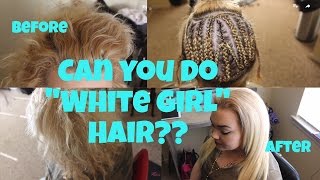
Stylist LaToya Kelly installs a sew-in on Caucasian hair, explaining why it needs silver clips to separate roots and coarse braiding hair for firmness. She uses three Peruvian body-wave bundles, sews under the braid to hide tracks, and walks through maintenance, blending, and styling throughout.
Chapters
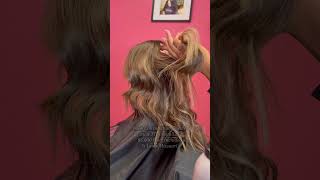
Hey everybody, it's TT Does It All back again with the Caucasian sew-in that everyone wants to see. I have done multiple clients and this is their afters, but this is a particular one I'm going to show you the full video of. This is the blonde one and this is her before picture, and, um, we did the versatile sew-in on her, which I do have a detailed video of, and, um Yeah, we did some blonde extensions. We used 3 bundles, I think it was 18, 20, and a 16-inch on this one. I cut it to face frame and match her length, and she loved it, and she was just very shocked at how flat it was and how painless it was. This is one of my regulars. She has just thinner hair, so So this is the before, and you can see all the spaces through the ends. And this is the after, where you can see that it's just fuller. And this is only one bundle used in her hair, just to kind of fill out the spaces. This is Angel, and this is the sew-in that I'm going to be doing right now. She has come to me a few times for sew-ins and her regular, her regular hair. Um, I recorded this video probably about 6 months ago, if not more, and, um, I did not get to save the beginning video, but her hair is cut into a bob. And if you all have watched my versatile sew-in video, I do show thoroughly excuse my phone, I do show thoroughly how to do this braid pattern, and it's one of my usual braid patterns. But the difference between Caucasian hair and African American hair textures, it's a lot more silky, it's a lot lighter, so it's feather-like. So for me, the difference in her hair and an African American texture is I have to use the silver clips, which I put in my list of things that I use for sew-ins. I have to use those to keep the root of her hair separated from what I am braiding. And I also have to use braiding hair because sometimes a Caucasian client's hair can be so blunt, and since it's so silky, I do add in braiding hair, and that just adds that more coarse texture, and it makes that braid firmer and tighter so that it doesn't come loose. But if you look at her braid pattern and the braid pattern of my traditional, um, African American client, it's the exact same braid pattern. Her braids aren't, her braids aren't any bigger, they're not any wider, they're not any looser. They're flat to her head just like everyone else's. And I did not braid the bottom of the back of her hair because with the length of her hair and the texture of it being so silky, it will not hold a braid for long. So it's just better to have a sturdy foundation where you can, which she's getting longer inches, so it will cover the rest of it.. So it was just best to leave that out and start the braid in the back where it was long enough that it will hold for the entire sew-in. And she did leave the front of her hairline out for coverage in case she wants to pull it all back into a ponytail. And instead of like the Versatile where it's kind of a horseshoe where she can do 3 parts, this is just one natural part where she can just do the part on the left side of her head. And this is the final braid, which as you see, there's still braiding hair going into that. And I'm using a net on her hair for just an extra reinforced protection, and I'm going to sew just like I do any other client. So I tuck the end of that braid in. Of course, Harley gets in her lap, but I do always braid the leave-out away from the sew-in so that there's no hairs accidentally being sewn into the net or into the extensions. So then I'll sew on the net, and again, just like every other sew-in, I start the net exactly where I'm going to start the sew-in. Since she's going to have more hair on the right side of her head, the right side of her head is exactly where I'm going to start the, the stitching the net on. So I do the front first, the back is always last because I need the front of the net to be extremely flat and then the back of it, if I need to fold over any excess lace, I can. So I'm cutting off the excess lace and then I'm going to start the bundle exactly where I started her, um, threading of the net onto her head. And I am sewing under the braid. I know you all are asking for a video of me doing that, and I will as soon as I get back home. I'm still in Seattle, so, um, yeah, I will work on that as soon as I get back home. But I'm sewing under the braid so that if she does go to lift it, or even if she puts it in a low ponytail, you don't see the actual track itself. Or a braid. And, um, yeah, I'm just going to go back and forth. We're not cutting any of the hair. And she did buy this hair from me. This is her second time buying extensions from me. The first time she got the Brazilian deep wave, and this time she's getting the Peruvian body wave, which is just gorgeous. It looks so pretty. Wait till you guys see it.
Okay, but, um, anywho, while I'm stitching, what could I talk to you you guys about.
I don't know, you guys have to comment. Did you all see my updated, updated list of tools I use and everything that I just posted? Um, I hope you guys enjoyed that one. I hope it was informative. But, um, yeah, I need some more video suggestions because I'm running out of ideas, guys. All right, so anywho, she is using the hairinkkansascity.com extensions, 3 bundles. So how'd you like the hair itself? I loved it.
I loved everything about it. Um, I love the way it moved.
I love how you layered it. I loved it.
Good.
I had like— do the next one, and I think it lasted like 2 weeks before I just took it all out and was just like, let me just get That's why people are so afraid to do it.
And I think like you just have to be patient and you have to be tedious. You can't be sloppy, you know. If you're sloppy with black hair, you damn sure cannot do a Caucasian person's hair because, Lord Jesus. Well, that's why when you say like, how do, um, how do people get their hair to last so many months or so many sew-ins? That's why you do not cut cut them. If you cut them, like, it'll be hell trying to place those things and put them back in. Like, with these, these are 3 different lengths, so when you come back, I know exactly where they go. Yeah, when you have, like, quality— people, some people don't know the difference, you know? So a lot of people will continue to go to her because they don't know any better. They don't know it should be better. They don't know how long it's supposed to actually last. So what made you choose a sew-in over, like, glue or, or tape-ins or fusions or whatever.
I've used glue and tape with my wigs, and I had like ripped out some edges. Oh my goodness. Yeah, and then trying to, trying to use everything to like dissolve the glue and the tape. So all those chemical smells and just dealing with it, and just, it's too much.
I don't know, it's just such a risk. I don't like that. And it's so much to put it in, and it's so tedious to take it out. The hair is going to come out, mhm, because it's just that tension. So fusions aren't really that safe. I see a lot with tape-ins, but with tape-ins, you still have so much to do with them because so much of your hair is still out. And with you, like, this is all extension right here, so you got none of your real hair to deal with, which is what I want, bro.
Just Right.
And then we'll have—
because this stuff's not going nowhere for a couple months. I will say, when I walked in like that day with the long green to work, like all these white girls just came, let me see, like sticking their fingers in it.
Oh really?
And my friend who works in a hair salon, and she's a— it's like some rap truce or something like that, and she's black, and she's like, that's why I don't let people stop letting them touch your hair. It's okay, they're not gonna hurt anything. They were like digging their fingers in to see how it was.
No. Then I had, um, when I used to— when I was in hair school, I used to let them like grow a part through it, flip it up, move it around, do everything, you know, because, well, we were in hair school, so I wanted them to see the, the ins and outs of extensions, especially the ones that I do. They know about tape-ins and everything else. They had no clue about like sewing. Like, do you actually use needle and thread? And I'm like, literally needle and thread. Yes, it would not work without needle and thread. And like, people think it's painful. Like, people think that you are like about to start bleeding at the scalp right now. And that's why a lot of people fierce that was too.
That girl did braid really tight though.
Really?
And I noticed that that was another part of why I took it down, because I could feel like itchiness and bumps like starting to form.
Oh my goodness.
So I was just like, well, I want to have some hair after this is over.
Yeah, but that's— I don't know, I, I take into account everything and let Lately, since I was growing out my mohawk, I was able to let my braider kind of do what she does on my clients on me. So, you know, showing her how to stitch it the way I would stitch it, how to sew it down, where to place everything. And basically I end up, you know, with one of my own sew-ins. And I learned things about it. Like, I learned, okay, if I have her— sorry, if I have her braid it this way and not leave this section out right here, it starts to grow out like this over a month, and I end up wanting to take it down faster. Whereas if she had left that up, or, you know, yeah, so I kind of learned like different things about my work by wearing it. Yeah, I love my weave.
I love your weave too. I do, I really do. I remember you're like, how'd you find me? I was like, girl, you're all over Google. What are you talking about? Like that picture Whatever that picture was where it was like the girl like you— I can't remember if you were in that, but everybody looked like a model and they all have like really long, long—
that one? Is it that one?
Look around the corner.
Yes.
Oh, okay.
Yes, it was just like there was nobody else with even pictures like that, right? I think another problem with like when white people get so in is blending. Like, you know how you're like, I want layers, I want you to blend in with my hair? Like, they don't do that. They leave— their leave-out is like sitting up here, and then the rest of their hair is hanging down low, and it's so obvious. It's really— oh, it's terrible. I went to LA and I was doing a girl's hair in the ESPYs.
Oh cool.
And let me tell you, I saw like— there's like a gifting suite, and there was a model. She was like a model for like this comfort— or not comfort, a mattress company. And her weave was so bad. Like, I was— it was like a line of her hair and then the weave. And I'm like, this is like— why wouldn't they just put layers in this? It's so terrible.
Maybe another white girl did it, probably. But when they have the clip-in extensions extensions and it's just like short and then long.
Just blend it. Like, even clip-ins can be cut. That way you can just put them back in the same spot. No one knows they're there.
I really don't think it ever occurs to anybody to even blend it, cut it. Yeah, cut it off. And they're like, no, I paid money, I paid $200. Buy shorter ones.
She's going to go ahead and have me style it as well. And again, she actually started out with me when she had a mohawk and we did green hair and it was just gorgeous. I took her from blonde to green and turquoise and now she's grown out from that into a bob and ready for a sew-in.
So this is me finishing up her sew-in, and I am also going to style it. And you all have the specifics of her install, but I hope you all found this video very useful. It's still quite a bit of information left as I style it, but I wanted to let you all listen in on kind of a regular conversation and a few questions and answers that I get about installing and styling Caucasian hair. So now I am styling it, and I do have a video about how I'm curling it. I'm curling away from the face on each side, and this is how much hair she has left out on the hairline, and that's showing it how it covers, and you see that there's nothing showing. Everything just blends right in. So after I finish curling, I'm going to show you kind of a video of the before and then a video of the after, and let me know what you guys think. As this is noted, I go a lot faster over her natural hair, so look at how fast how fast I go. See that? It's very fast because her natural hair cannot take as much heat as extensions, and that's traditional with the typical person's hair, their natural hair. You don't want to leave the heat on as long as you would on the extensions. Not only am I curling the hair, but I'm knocking out the natural body wave pattern of it. If you all notice, I didn't straighten it out before curling it. Which I don't do. I mean, I never straighten it out before curling it. So I hope y'all enjoy the finished look of her hair. I'll show you a couple of the products I use as well as the capture of the finished product, and you all comment and let me know what you guys think.
If you enjoyed this video, please subscribe.
Don't forget to comment.
Rate, and share this video with fellow stylists or clients that you want to see my work.
More from LaToya
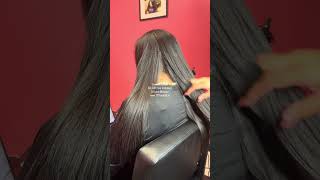
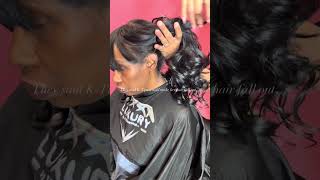
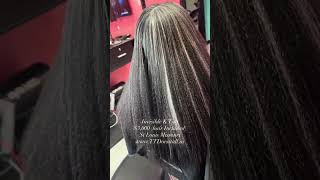

St. Louis, Missouri - Lasts 4–6 months - Takes 4–6 hours - Investment: $3,000 www.TTDoesitall.ai
What are #ktips? Here’s your answer! Schedule at www.TTDoesitall.ai 🩷 #extensions #ktipextensions
4-6 hours install and last 4-6 months #ktipextensions done by the right stylist the right way 💕
Located in St Louis Missouri 💝 Consultations available www.TTDoesitall.ai 💕#ktips #natural

K Tips take 4-6 hours to install and last for 4-6 months with proper care! #ktipextensions