The entrepreneurial artistry

Ramon Estrada, who has launched six startups, talks about moving from operator to coaching high-revenue founders. He argues that creativity is an operating principle, that a company expresses the founder's identity, and that inner work and energy matter as much as strategy.
Chapters
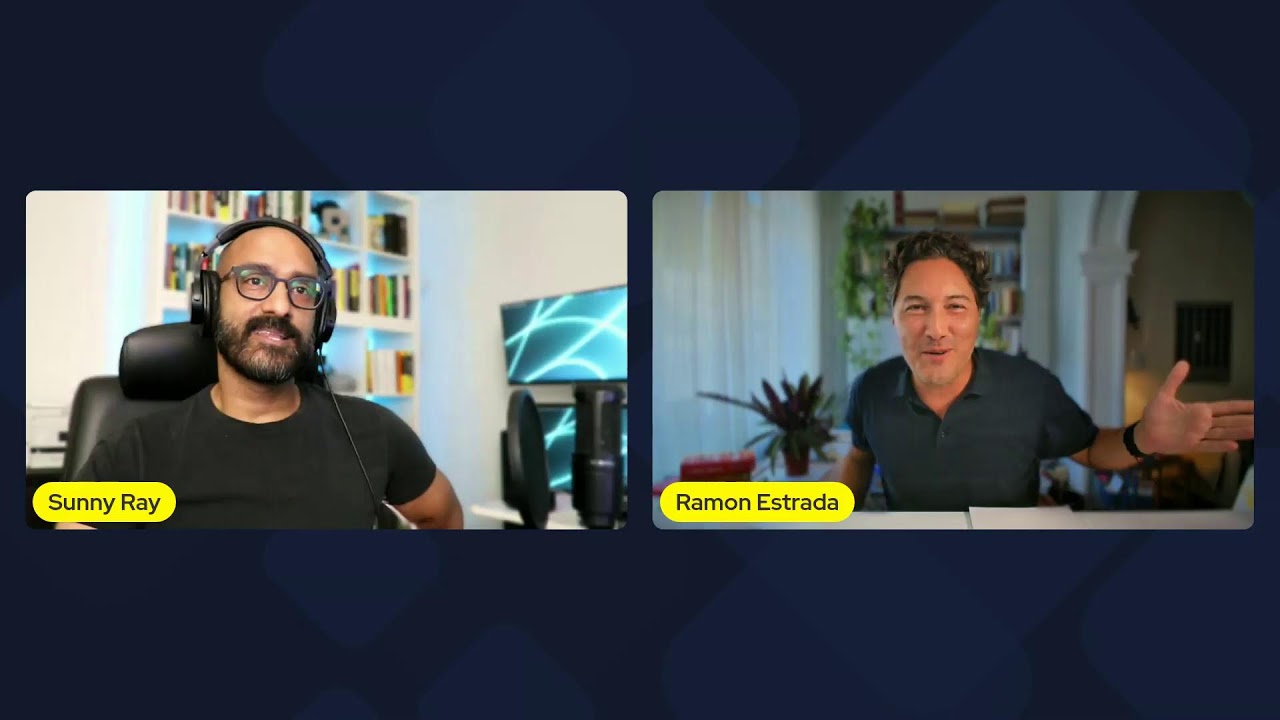
All right, Ramon, we're back. We're live. You caught your train. Now we're— so how was the— how was your trip to Madrid?
It was amazing, honestly. Yeah, I was there for a day and a half, and it's always interesting. Madrid, it's a vibrant city. It is, isn't it?
Yeah, I've only been once or twice, but I remember it being so. So, you know, last time, uh, we kind of ended on the, the loneliness at the top and kind of the courage to sit with it, right? That was kind of our main theme. Since then, you wrote that you had been quiet, uh, for a season, listening kind of beneath the surface, not lost but creating. Like, what were you actually kind of listening for?
I think, um, First of all, Sunny, I think that there's a coherence between my own journey and what I am offering to, to my coaching clients and even people, um, you know, where I'm heading, I'm leading with my content, is that sometimes we get so in love with what we are creating, with external part, that we forget about ourselves. And when I revamped my career, you would say, professional career, after being an entrepreneur and then moving to Barcelona and starting as a coach, I started to focus on being busy, right, and having as many clients as possible. And I was offering my services of executive coaching and facilitation for all sorts of people, up until a moment where I thought, okay, but this is not resonating with me deep in my heart, because yes, I can do a lot of things by now, But is this really my tribe? You know, coaching executives in large corporations. I mean, we all have needs. We all are human. We all want to deliver some value, to be joyful, and of course to bring in results and to have a good performance. But deep inside my heart, I realized that no. I mean, the real pain that I have connected with is the one of starting something from scratch, giving all my energy to that dream, to that vision, who I'm becoming, and then realizing that eventually at one stage things take longer than expected and it's harder than, than, than I thought. And what happens there is our own trauma, our own emotions, our own lack of seeing ourselves and taking care of ourselves starts to take a toll. Right. Right? So what I did in the past year and a half is really refocus and revamp my coaching offering to focus mainly on the niche of founder CEOs, which is a little bit different than the general entrepreneur, let's say, because I like working and I can really offer value to founders who already have a company, right? That they have already a product-market fit, that they have revenues on top of €5 million, €10 million, or dollars. and they have employees, because that's where you switch from being a startup founder that you do everything into a moment where you need to change your identity and become more of a specialist. A specialist in what? In doing what truly is good for you, where you excel as a founder, and that makes a difference to organize the scale of your company. So I would say that has been my internal journey, plus including more about getting to know myself. And I would say that entrepreneurship, Sonny, for me is the ultimate self-development path because we are always creating something outside of our comfort zone. So there are massive opportunities to grow. And I would say that the founder's mindset and our energy, our coherence is the ultimate also bottleneck on the company's growth.
You were born in Mexico City, then you mentioned you moved to Veracruz, Madrid, Lisbon, Monterrey, and now Barcelona. Most founders I talk to have one hometown, right? So what does moving through all those places do to how you read people and to who you essentially became?
That's a lovely question because sometimes I ask my, my clients, okay, so who are you, right? And they say, no, I'm Mexican, or I'm Austrian, or whatever. I think that what has allowed me to move— I've been having and growing up with instability and also having to move out also because I wanted to later in my life— has allowed me to really Realize by contrast, okay, who am I? What do I like? What I don't like? It's about opening the map, right? And there is this saying that says, the map is not the territory. The territory is everything. If I tell you to move from one place, A to B, in your city, and you're driving, I don't know, 10 miles, I will give you directions of the streets directly. So So you create a map inside your head, but you won't have the whole territory. You won't have all the pictures of the streets, of people walking. You know, we need to focus to navigate through life. So I would say that something that I learned is opening myself to new possibilities, to meeting new people, to also knowing there's also a distinction between being a tourist and being a traveler. A tourist is someone that goes to their top 10 places, check, check, check, check, check, instead of getting immersed into a new culture, meeting new people, and opening your mind. I would say it has helped me to be more of a world traveler, not being that focused into being directly moving from one place to the other. For instance, I was 7 months, just 7 months, living in Portugal, in Lisbon. I learned Portuguese because I was like fully immersed, you know, listening to the news, talking to people. Of course, I had some classes, but it's about this aspect of getting the most. When life gives you lemon, prepare lemonade. Now, that really helps because it has given me some resilience and some flexibility in my mind to think in different ways.
Yeah, speaking of lemonade, I tell you what happened this weekend. My eight-year-old, an eleven-year-old, and two-year-old—they they've joined forces with their best friends who are also eleven and eight-year-old girls, and they decided to sell lemonade at the baseball diamond over the weekend. They they went; they got set up. They went and bought all their equipment and cups and everything, and after forty minutes. They made a few sales, which I think is the positive part, but they were shut down by the local. There was a guy that you know sells there, and he's got obviously permits and things like that, and decided that he didn't like the competition, and decided to you know go threaten them with regulatory. Anyways, and they came home, and they were all like super sad, and they were like, "Oh my God!" Like this is. Horrible people are so difficult. I was so proud of them. You know, it's like, so you guys made ten dollars each? Like, do you know how hard it is to make ten dollars? Like, that's still something. But yeah, no, it's entrepreneurship definitely will will teach you more than any any book. Hey, you know, Ramon, you've got like alongside the engineering degree. You've got an MBA, you've spent more than 20 years in, you know, completely different schools as well, right? You've done Qigong, you've done meditation, shamanism, whole range of different things. Where did that path start and what was the young engineer really looking for?
There's a book called The Master and His Emissary. By Dr. Iain McGilchrist, and he, he talks there about sometimes we think, okay, we have 2 hemispheres in our brain, right? And, and the left and the right, and the left is more rational, the right is more creative. He says no, we have 2 brains. The 2 brains are rational and the 2 brains are creative. And what's magical here is that he says that We have 2 brains because in a way they think simultaneously depending on the situation. And what happens is that their left brain is more focused into the task, is more like driven into doing something. So think of, um, one of the examples that he talks about is about a pigeon. A pigeon is looking at the grain or the piece of food, right, to go and to feed himself or his, his flock, you know. But the right brain is not focused on the task, it's more in the context, it's all around, it's connecting to, let's see if there's an eagle, let's see if there's a dog, right? So it's a survival mechanism, but both are rational and creative. By saying this, I would say that inside of me, there has been an extremely developed, in a way, left brain. That's the engineering part that has helped me to really to focus, to think on processes. And throughout my life, I would say that was mostly what moved me forward from a lot of uncertainty and a lot of, um, you would say, challenges that I faced in my life. But the part that it was more spiritual, that was more going into the depth of life, understanding— actually, this comes from my grandmother's side. My grandmother from my mother's side, she was a character. Honestly, there's a movie about her. She really revolutionized around the '60s the concept of female beauty in Mexico where she started to develop all these creams and treatments to make women slim. And she had all the high-class women in Mexico City into her clinics and her places. And she made a lot of money. But my grandmother didn't come from money. I mean, she had in her family, but she was the daughter of 2 half— how would you say— half-brothers, no? So back then in the early 20th century in Mexico, right, that was sin, that was super bad. So she was rejected by the family, so she had to make money by herself, and she had 8 kids. 8 kids. And in the 1950s, my grandmother started to study Indian philosophy and Silva Mind Control and all these techniques to really make the most of her mind. And that's how she created an empire. So I grew— an empire that now unfortunately it's gone. I would say I have— I haven't inherited, um, nothing that relevant other than the lineage of her way of thinking. Since I was a tiny boy, she started to talk to me about the power of the mind, about how our— there is this rational 5-sense world which is external, and that we can think of so many things. So of course, I was extremely curious as a kid about Siddhartha, about Hinduism, about Kundalini. So I would say that ever since I was 18, I started to have a spiritual path, mostly because of the curiosity of my, of my grandmother. But I didn't touch into the depth of my heart. I was doing that also a little bit into the performance mode, because this is something, Sonia, that I would like to talk about maybe just briefly, is that sometimes we hide our spiritual truth or our way of, of, of working with ourselves in order to perform better. Let me be a manifester, right? Okay, so every night I will do these, these, these, these. That's a way of doing that. And I really believe that, um, actually Claudio Naranjo, he was a Chilean psychiatrist, he said that human beings, we are eagles, but we like living like hens. So, you know, we are a different kind of bird. We are eagles. We can fly as high as we want, but we like to be here in the ground level. By saying this, I would say that I was in a way trying to perform through my spirituality, but then I discovered that I needed to go deep and to start healing my wounds, my own way of being, and to understand who I am. So in a way, now This is what I bring into my founder CEO coaching program is, okay, how can you excel in your business? Your business needs to make sense. I think I talked about like the glass, the vessel. It needs to make sense, but also the uniqueness of each founder, of each entrepreneur needs to be there because I think we all vibrate in our own frequency. We are all different. So we need to know ourselves in order for our project, our company to shine and not to be paying the cost of depression, anxiety, mental health, and all that. So that's, I would say, what comes to my mind.
You also say that you love jazz and Sherlock Holmes, right? So those are 2 opposite kinds of thinking, right? One is improvisation, another one is deduction. Do you see yourself in both? And which one runs the show when you're in a room with a founder?
Oh, great question. Let me think about it for a second. I think that what comes to me is the feeling of— it's like a ladder. No, there's a ladder in many ways in which, for instance, to really To master an instrument and to be able to improvise, you need to know the technique, right? You need to understand about the notes, the technique, the scales, and there's a basic functionality. I would say that's a little bit more of a scientific way and what maybe some— I learned in the MBA about business, right? It's all about that. But there comes a point where you have enough experience to bring your uniqueness and the way that you do to play that instrument. So, it's more like the improv of jazzing, right? When there is this group of people, this— I don't know, a quartet, right? Where each one is playing the same thing, but eventually there's a moment where the piano needs to be by itself. So, it's more this improv part. And it's more about the feeling, it's more about creating something together, having a high vibrational state. The Sherlock part— so yes, I do that a bit. My sessions are quite fluent, um, because I'm playing with the different elements that come to the place. There is this concept of the field. We are by ourselves, but right now you and I, no matter that we are distance apart, There is this feel, there is this connection. We are just in the same vibe. Maybe you are right now directing the conversation, but I'm co-creating with you, and maybe you will get a thread. What happens with Sherlock, I see something that I love about Sherlock is his ability. I mean, he's a fictional character based on someone who I think it was somehow real, but Sherlock is finding First, there's a goal. It's like a founder. He has a goal. He has, in a way, a plan. He needs to deduct a killer or a robbery or something, but he's using the different elements that are around him. And then in his mind, he's threading the connection between all these elements and finding the way. But I think he's jazzing, you know, it's like, okay, this, let me bring it here. And I don't know, I see these like these movies about Sherlock that the new ones with the— I don't know, I don't remember— this Richie guy, you know, where all these images come to his mind and he's Sherlock, he's bringing elements. And I would say that's how we process information and we bring wisdom with all the knowledge that we have. Now with AI, I'm a little bit worried because all the information is going to come without us processing. I think we are going to be losing somehow of the, you know, if it's a graph of the frequencies and colors and all that, I think sometimes AI can flatten that. So yeah, I love the sense of Sherlock, the using the information, and I would say that's also that makes it magical. Yeah, actually I had a, I had a small puppet of Sherlock, and that I gave away, but I had it in my— in my— on my desk, like, to remind me of this quality.
You know, you've said that you believe everything can be solved with essentially creativity. You know, that's a— that's a big claim from a, like, a former industrial engineer. Like, when did creativity stop being kind of a nice-to-have for you and become, like, the actual kind of operating principle?
Going back to our spiritual— your question about spirituality, right? It's in the Bible that we were created with the same qualities as God, as the light of the Creator, as a universe. And I believe there's a creation, no matter that I have studied Buddhism. And of course, for the Buddhists, there's no God. It's only an enlightened mind. And they don't go, who created this? They don't care. All they care is, let's move away from suffering. These are the mechanisms, and I would say that Siddhartha Gautama, the Buddha, was the top psychologist in the world, right? He managed to really understand the mind. But I believe that the only way that we can have agency and be able to transform the problems that we're facing in the world is to think of ourselves as creators. Mm-hmm. Just like in the image of God. I'm not saying we are God, I'm not saying that, but we have inherently in us, we have the capacity to create possibilities, but we need to own that. And sometimes as founders, after years of doing things and we are in this low energy level, low frequency level, we forget how powerful we are, how we started something out of nothing. And I would say that's like a big bank, right? Sometimes the founders, they have like this big bank. And there is this concept called the karma or the cause and effect. Every choice that we make has a ripple effect. It's like a domino effect in a network. So if we clear up our thoughts and we are aligned with what we want to achieve, we can move the thread and to transform problems into possibilities. I think that's in the quantum. I think more— when I think as an engineer, I think more not in Newtonian ways, which is more subject-object, but more in the quantum. I like to explore possibilities, take the one that sounds better for me, for my clients, where our intuition and the energy is higher, that it's more exciting. And let's act truth to that. So yes, I believe that's creation, but now I like more the word co-creation. Co-creation because it opens ourselves to bringing others, to bring allies, and sometimes even for us to pray, right? Like, hey God, or our higher version of ourselves, our soul, please guide me and And show me the way and just focusing on that and moving forward. But disempowerment is huge in founders and that's what creates us to be thinking in the Groundhog Day. Nothing moves, everything is the same. And I also feel that. I mean, I have faced that and it's not nice because founders, we are builders. We are problem solvers.
So, Ramon, you trained in systems optimization control, and now your whole practice is about the parts of a person you can't really optimize, right? So how did the engineer in you make peace with the mystic?
I heard your question, but I'm just like, how can I bring these 2 pieces Um, I think one of the major— the new paradigms that are coming, Sunny, has to do with that. That the old paradigm up until the past, maybe since the Industrial Revolution, we think that the world, everything is mechanistic. The planet is an unlimited source of resources that we can use. People are also resources that we need to make more efficient, and we are just in this production chain in order to produce something out of inputs into outputs and make the most of the profit. You mentioned your kids later on. I have 2 kids as well. Having kids is totally irrational. I mean, honestly, it doesn't make sense. It's really demanding. It's totally out of our control in a way because they have their own personalities. Wow, same parents, maybe we try to educate them themselves, but they are different. So I think that that's what makes life real. It's like, yeah, we can have our best intentions, but things are not mechanistic. And ourselves, we are not here to be optimized. We are here to become a better version of ourselves, whatever that is. So the engineer is still there. I, I have a process My, right now, my high-ticket offer, my high-ticket program, it's 90 days. I have steps, I have everything organized, but each session and the journey is customized because I'm looking what's there. So the engineer helps me to move through the territory and to bring the results. But the mystic in me, you said, the one that wants to have the experience of God, the experience also of connecting humanly with my clients, with you now, with life, has given me more color. So imagine that this is like, the engineering is like driving a car in the French countryside through highways, but the mystic is there like being wowed by the scenery, you know, by the goats, and I really want to experience life. I wouldn't like at all to be sitting all day on my desk with a VR, glasses and just eating popcorn and getting fed without the possibility of honestly living life. And I really love drinking wine, not reading about wine. It's funny, right?
Yeah, understood. So, you know, you've told me that if someone hands you a book on leadership, neuroscience, or philosophy, you're kind of like in your element, right? So what's the idea most recently that's rearranged, uh, you know, you and then like the one shaping kind of how you show up this year?
Um, maybe it's not a new idea, but I just got back to that idea. Um, there is this author, his name is Steven Pressfield, and he wrote the book, um, The War of Art. I think that's the title, or The Art of War. No, The War of Art. And in one of his books, um, He goes to the concept of resistance. Maybe his main topic is about creative people, artists, not being able to show themselves and to create something that is unique and meaningful. And he says that the largest resistance is this part of ourselves that is telling us not to do things, not to Say it in this way or the other. In my own way of coaching, I can really excel throughout the credentials that I have on the rational side. Right? I had like I don't know fifteen already programs on coaching. I have MBA from Yes, Executive Education on Venture Capital, Harvard, Berkeley, blah blah blah. You know all the credential side. I have that covered. But in a way, I was hiding behind that. I wasn't showing the mystic. I wasn't showing my true color. I wasn't showing personality. And that was because of the resistance. Resistance is what makes founders not really show themselves in a, in the proper way. When I had my fintech company, I was really resistant about putting myself on videos explaining important things. That was back in 2014, 2015. I mean, YouTube wasn't that massive. We didn't have the ability of recording a lot of things on the phone. You know, everything needed to be more With a lot of production, but I was hesitant. I was hesitating about doing that and showing myself. That was resistance. And now, even now, I mean, honestly, I'm now being super open about this aspect of business, the boardroom, the inner work, and the creative and spiritual part of that, because I believe that's the secret ingredient for the new breed of founders who really are are sick of going through, through the same protocols and frameworks and all that. So I would say this resistance, fun enough, it's as old as you can tell. It's in the Bible, and even Kabbalah talks about it. And that's the term Satan. Satan, no, the Bible is— you would say the devil. It's this adversary. It is adversary that it's a force According to Kabbalah, it's a force also created by the light of the Creator, by the universe, by God. For what? For making us stay in the comfort zone and for us to show ourselves and to make the things that our soul needs to do to evolve. So it's a tool, it's a tool, it's something that is there to help us. But honestly, if we follow that a lot, it could kill our creativity, our uniqueness, and our authentic self. It could really drown our soul. So I am into that. And that's my— also would say what I'm facing right now in how can I create content that really feels more like myself and it's not in the typical coaching for founders stuff, you see. How can I communicate in a way that is authentic and how can I make all these in a way that it's true to myself? So I would say the highest power of entrepreneurs is their authentic self and their uniqueness. It's becoming more an artist. It's becoming more like I said in the last time, a Picasso's a Picasso. It's super clear, right? It's not a painting from somebody else. So that's the old new thing that I'm following. I cannot hear you. You're on mute.
Oh, sorry. I was gonna say a lot of this resonates for me as well, Ramon, because I don't know if I told you on the last one, but I had, uh, my 11-year-old daughter come home from, from, uh, church one day and asked me essentially to help reconcile the world of spirituality with science. And my initial gut reaction was You don't. Like those are two different worlds, and the harder you try, the worse it'll be. But that's what got me to double-click on quantum and Joe Dispenza's work. And you know, I've been a big fan of like I think Tony Robbins probably got me into this whole 25 years ago, right? Just that you could be better just by you know by following practices that many others have used, such as visualization, such as.
I don't know.
I mean, just a whole bunch of them. So I think you're definitely touching on something, and I think it's something that most people kind of shy away from. So you were a 6-time founder, right? Before you ever called yourself a coach, what was actually happening in the moment that you decided to stop building companies and start building the people who build them?
I think that was when I got When I let my ego, I said, I won't follow you in a way. It's not that I don't have an ego. I have an ego and egos are necessary. As long as we have a human body, ego is going to be there, right? But if you recognize it, in a way, I think I became a founder 6 times, as I said, one way or the other, because I really wanted to be in front of the company. I wanted to, yes, I wanted to be in the Forbes cover and to be, you know, having, being in press and making money and having a cool life, or at least showing that I had a good life. Funny enough, um, that didn't— that worked out in stages, but then eventually didn't give me any, any sense of self-worth. That's when I said, okay, what am I looking here? Am I really here to serve the world, to make the world better, or is it just an ego trip? And I mean, part of me wanted to democratize finance of the fintech company But also I wanted to have visibility. And that's when I started to become a coach and I went into this coaching program because I wanted to become a better leader. I said, yes, I'm really asking my team to do things, but I'm not looking at them. I'm not being a good leader. I'm being a good boss, pushing them, right? Telling them what to do and all that. But I wasn't a good leader. I wasn't developing my team. Just one story, and this really was for me the worst. I would say as a founder, for me it was awful. It was one day I went to a really important meeting in Mexico City. It was around 2015, and this meeting was 1 hour and a half away from my office, not because it was really long, but it was traffic and all that. So at one stage I decided not to go to the office. It was late in the the afternoon, and I said I will go home, right? So, okay, I told, um, the— my, my assistant and some people, I'm not going to the office, so see you tomorrow, right? Okay, bye, everything well. So I'm about to arrive in my home, and it was already closing time in the office. And what happened, Sony, is that I got a message from the alarm company that the alarm was was ringing in my office. So I thought, okay, somebody broke in. And of course, it was maybe 15, 30 minutes after usually the time we close. So I called my assistant to see if she was there. She didn't answer the phone. I called my number 2, and I called my number 3, and nobody answered the phones. So I had to go to the office. I went there. It was really close to my home back then. It was 10 minutes. I go there and what happened is somebody shut the door, locked it, but the door wasn't properly closed, right? So the door was open with the lock on and the alarm was on. So at one stage the wind opened the door, so the alarm rang. Nobody broke in and all that. But what happened is that These 3 people that I called, nobody took the phone after closing time. You know, it was 6:30 in the afternoon or something. Nobody called me back and nobody asked me, why did you call me the next day? You see, it was like I thought, really, I'm by myself. You see, I cannot count on some people. I mean, honestly, I have to be the one opening, going and see what's happening because— I could go into the victim side. Oh, you didn't do this, but honestly, I wasn't having the engagement, and I wasn't having the love of my team. And honestly, that was because I didn't love them like back then. I was wanting them to perform because I was paying them well, you know, and I give them the right. the right resources, the right office. I— we did barbecues every— on the rooftop every 2 weeks, every 3 weeks. And but I wasn't connecting to my team. And I realized something needs to change in me because honestly, I deserve that. I was a high-achieving asshole. And that's when I said, no, I need to change. I need to become more. And now Honestly, it's not that I am not an entrepreneur. I am an entrepreneur. I'm launching 2 online memberships, one for coaches, one for founders. I have my own way of doing my coaching, but I feel way better serving those founders that are in pain, that feel disempowered, that feel drained, that have no clarity where to go, and that maybe they need more, a little bit of a direction. And for me, what I love the most is connecting with them, and seeing the light in them that sometimes they do not see in themselves and allowing this light to shine again and to get fresh ideas, fresh creativity. I would say that's why I say also my job, my work as a coach is also highly creative because again, I am in this co-creative mode and we also talk about the company because I've been there. I've been through different businesses and I have almost a full cycle from launching a company to selling it, not with with the same company, not with mine, but with different companies. I would say I've been through all that. So that's, um, that's what I like, Sonny. It's also— it's being there for my— for, for high— highly talented founders and helping them achieve. And I think that's more powerful than me being the, you know, the top, the top founder. And, and that's what it took, took me. So I love my drive.
And the whole thesis of your show is that a company is a work of art, right? And that the founder is essentially the artist. So that's a hard turn, right? From business is essentially a machine that you optimize. When did that click and what did you have to unlearn to actually believe it?
It took me a while. Um, I mean, my first business, I would— as I said, I, it was— I didn't even consider myself an entrepreneur because I had a side business and I bought a franchise. So am I an entrepreneur because I start a franchise? I think not. I think, yes, I was a business— um, I, I was a, well, entrepreneur, but with a lower cap E, right? I wasn't creating something with my own brand, with my colors. So I was, I was just applying a manual and making money out of that. And it brought me good money, the first one. The second one, where I re— with my partner, we reinvented the model and we joined— we were in these real estate developments using our own— we were using the processes with our own mind, with our own visibility. We multiplied maybe by 7 the investment in a few months, right? So it was amazing. And then I took it to the third level, which was, okay, I know that getting mortgages is important, I know the process, I have the contacts. Now let me put a price comparison in a website with really, really cool colors, name, visibility. And back then, Sony the banks, a bank, one of the largest banks in Mexico, because we were bringing, we were bringing so much transparency into the credits mortgage, into the mortgages in the market, that one of the banks called me, the legal team, and they said that if I don't put part of the information they're comparing the credits, they were going to sue me. Of course, that was for me like, What? I mean, we just started, we just launched, we were in the press, but I had maybe 2, 3, 4, 5 clients, not many clients, and one of the largest banks in Mexico wanted to sue us. I was like, what? What the fuck? What is this? But then I thought, okay, I said, okay, just give me the chance to show you that we are transparent and that we're not bringing, um, you know, the wrong ideas to the people. Transparency means we're doing things equal for all the banks. So what I did with my team is we started comparing credits from the major players in Mexico. We went into a notary and we've used our methodology and our technology to show the results. And we gave all these to all the major banks. And then we played this information again publicly And the legal team couldn't do a thing with us, right? So I would say that's artistry. When my will and my desire, and also my team, to really revolutionize and to make all the information more democratic in a cool way, you know, with these colors, with technology— the company is— I still get emails from some players in the, in the industry asking me if I'm willing to sell the brand. Because that was the artistry. That's what made us different from other brokers and from other banks, you know. So I would say that the people that are just focused— the founders that are just focused on performance and they forget that branding, culture, product, service, you know, it's this unreasonable service making the most for the people— it shows. But it has to be ingrained in the DNA of the founder. A company is deeply related to how the founder is, with the way the founder— where the founder puts its attention. This is a little bit Dr. Joe Dispenza, right? Where you put your attention, your energy will get there, and you will see. So yes, I want my clients, and I want to see companies that really resonate and that are, wow, that are an expression of how the founder is. Just look at Patagonia. Patagonia is Yvon Chouinard's DNA about, yeah, taking care of the environment, about having Mother Earth as a shareholder. You know, it's not about just selling products that are, are cool or not. Honestly, I think that the way these— this— I don't know him, but I would really love to, to meet him. He has also this book about Let My People Serve. You know, he's thinking about the environment. So it's all over. The way this guy is, eventually enough, it's in the company, you know. Um, so that's, that's my idea. Yeah.
So, uh, you know, so your central claim, Ramon, is, is this, that a company cannot grow bigger than the founder, right? That the team and the culture are essentially downstream of what is happening inside the CEO. Just to like, can you push back on that with me? Like, is a great company not supposed to outgrow any one person? I mean, Steve Jobs is dead, but Apple keeps producing.
Yeah, of course. I mean, it would be extremely sad, Sonny, if Steve Jobs dies and then Apple dies. I think that's not the idea. That's not what our founder wants, right? Right. Um, I think that, um, eventually we need to, to be responsible and accountable. And I really believe— think of, just think of family businesses. There are like a large proportion of businesses are family businesses, and at one stage the founders were highly entrepreneurial. And some families need to come to bring protocols into, okay, now we have more shareholders, we have the family, and they need to have all the controlling and all the vision strategies as a company, plus they also have a family council or a committee and they have rules. But I would say that companies are really impulsed, leveraged by founders, but they can also be limited. I have seen that many times where the founder is clueless about who he or she is, And they are limiting the expansion because they think they know it all, or they are in such a big pressure not to be open for new possibilities, or also the money mindset, my friend. Sometimes we're also really scared about money. If I grow my company this much, what am I going to do with this? My life is going to be crazy. I faced it as a founder. When when my companies started to make a lot of money, I started to get some calls from people in my family asking for loans, asking me if I could help them on this and that. And one of these people was my father. And my father didn't had he had a his professional career was really rocky, and he didn't provide for me and my family for many years. I mean, for my mom, my my brothers. My father divorced my mother when I was 14. My mother had brain cancer. So, when I was doing really well, then my father was showing up every time he needed money. Guess what happened? A part of me started to really be hurt about my father only looking for me and wanting to be with me when he wants money, right? So, yes, I gave him money once, twice, 3 times. But then at the 4th or the 5th, I was like, no, I don't want to give you money, you know. What was easier for me to say, I'm not going to give you money, or I don't have money to give you? The latter. It started to be easier to say, I don't want, I don't want to give you money, I don't have money to give you. And that became a self-fulfilling prophecy at one stage, you see. I think the way we think starts to affect the way we handle our companies. And funny enough, this example that I'm bringing is from my family, from my personal life. But as founders, everything is connected. We are totally clueless about what life will bring to us. But all those founders that face divorce, death of a close family member, health problems, and all that, these family-related personal thing is going to affect how the founder behaves, takes decisions, the level of energy, the clarity of his or her vision, strategy, how he or she shows up, and it will affect the company. So that's why I say the more flexible the founder's map, the way the founder deals with life, the more empowered, the more the founder knows him or herself. And I'm not saying just by that the company will be a success. I mean, everything on the business side needs to be proper. There needs to be a good product service, the pricing, the strategy, delivery, operations, finance, you know. But that part is more the science, you know. It's what needs to be done, and many consultants can help on that. And but the inner work, it's a work that hurts sometimes and makes us feel vulnerable. So I believe in creating the safest space for these conversations to happen.
Sounds good, Ramon. So I guess, uh, maybe finish up with where do people double-click and learn more and perhaps sign up with some of your programs, and then we can land the plane after that.
Yeah, thank you. For me, I, I would say I would love to connect with your audience in, let's say, social media at Ramon Estrada T, as well as I have a lead— you could say I have a guide for founders to reset their energy, and it's on ramon.estrada.com. So it's slash or hyphen?
How do you call this? Slash? Yeah.
ramonestrada.com/d— well, the Founder Energy Reset. Let's put it on the side notes, it's easier. But I really worked on this guide for founders to reset their energy, their mindset, and to move forward.
Awesome, awesome, Ramon. Well, we've got, uh, yeah, quite a few people listening live, so thank you all, appreciate it as usual. And, uh, yeah, until next time.
Thank you so