Emasculation Nation (w/ Dr. Abud Bakri)
In this episode of the "Emasculation Nation" podcast, host Ryan Ayala and endocrinologist Dr. Aboud Bakri explore the intersection of masculine identity, competitive drive, and bio‑hacking. The conversation begins with a discussion of how male camaraderie and rivalry—whether in the gym, at work, or on social media—serve as a natural engine for testosterone production and personal growth. They argue that modern culture’s push toward egalitarianism and participation trophies suppresses this innate competition, leading to a form of psychogenic hypogonadism. The duo then delves into the physiological side of androgenicity, using high‑dose L‑carnitine and Tongkat Ali as experimental probes to reveal an individual’s baseline androgenic response. They note that the androgen receptor’s sensitivity, rather than circulating testosterone alone, determines behavior and drive. Personal anecdotes illustrate how these supplements can trigger hyper‑aggressive, goal‑oriented states, but also how the same environment can produce opposite outcomes depending on a person’s baseline. A major theme is the concept of "pulsation"—the need to align periods of intense work with periods of deep recovery, mirroring natural day‑night, weekly, and seasonal cycles. Dr. Bakri frames this as a duality principle rooted in biology and philosophy, contrasting modern flat lifestyles with the rhythmic patterns of hunter‑gatherer ancestors. This leads to the "hunter‑farmer" hypothesis: humans are wired for short, high‑intensity bursts (the hunter) followed by restorative rest, whereas contemporary society forces a constant, low‑intensity farmer mode. The conversation uses vivid animal metaphors, especially the lion versus monkey (or chimp) analogy, to illustrate how an environment that cages a naturally dominant animal leads to loss of libido, erectile dysfunction, and depressive states. They argue that mismatched environments—not personal weakness—cause these issues, likening it to a sick fish whose tank needs cleaning rather than medication. Finally, they stress the importance of personalized bio‑optimization. Dr. Bakri shares practical environmental tweaks (working outdoors, sunlight exposure, timing of supplements like BPC‑157) and cautions against one‑size‑fits‑all advice prevalent on health‑Twitter. The episode concludes with a call for mechanistic understanding, cognitive flexibility, and modern solutions to modern problems, hinting at future “Bio Bros 2.0” discussions.
Chapters
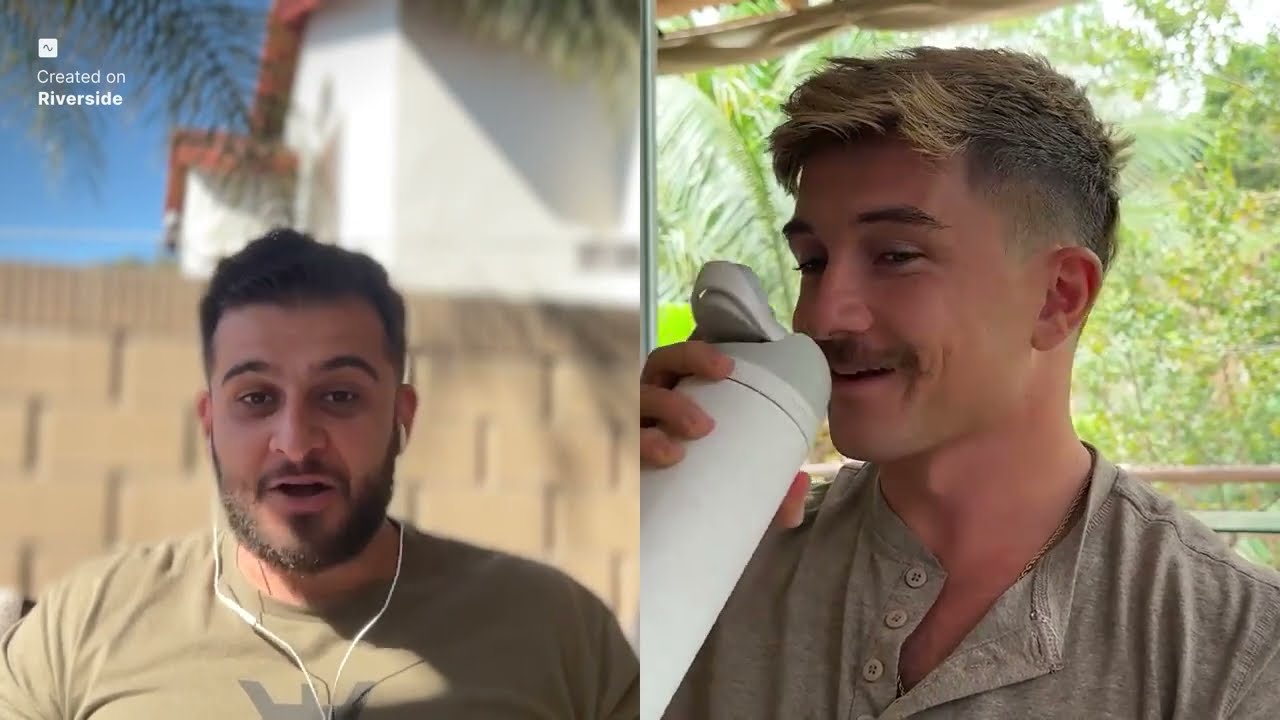
Gentlemen, what's going on? We are back with Dr. Aboud Bakri. Aboud was one of the first guests I had on the podcast, and we've been wanting to do a round 2 for a while. We finally got around to it. Same day scheduling, texted him this morning, asked him if he's free, and he's like, let's do it. Aboud, Dr. Bakri, welcome.
It's good to be back on, man. I think we're gonna rip a time hole in reality right now, so let's do this.
Yeah, we always do, dude. I was listening to your podcast with Zayed on the 2 AM Pod, and I told you over text, but like, all of the things that you were saying were things that were like, man, that's so true. I was like, that's, you know, like, that's right. Like, absolutely. It's incredible. And I think the biggest thing, so I'm thinking about like, why do I resonate with your approach so much? Why do I find it so fascinating and refreshing is because you entertain a lot of nuance. And I do believe that that comes from the fact that you are an MD, right? Like you are seeing the reality of the world that we live in where a lot of people in our space and, you know, me included, we have very much crafted an environment where we are almost out of touch because we just don't engage with the reality of the world.
It's a different world, man. If you guys came with me in the hospital on rounds, you guys would be like, oh, this is what real world looks like. Not like health Twitter.
Yeah, it's so crazy. I forget the fact that you are a full-time doctor and I want to dive into what that environment is like and how that may have had or may have an effect on you for better or worse. And you discussed a little bit on the 2 AM pod about how you mitigate that, but I'm sure that'd be very helpful for a lot of people who are in environments that aren't ideal. You know, I get a lot of shit because my environment, everyone's like, yo, like not everyone can live like that. Like that's such an unrealistic goal. And although I do believe that it is possible if you want it bad enough, there is merit to it. Like some people depending on their life goals, like they just have to make do with the environments that are given to them.
Agreed. I mean, the whole thing about lifestyle design is key because you have to design your life in a way that is congruent with your biology. And what that looks like will vary person to person. Some people are so robust and so healthy that it doesn't matter where you put them. You can put them in the most blue light toxic environment working night shifts and they're so healthy. Eventually, some of those people usually break at the leptin, pomacy level. But many people early on, like you'll notice it in medical school, in residency. I've had friends that autoimmune disorders break out in third year of medical school., people have severe mental health crises in the middle of all that because of the circadian disturbances, and they're requiring, you know, SSRIs, amphetamines, all these different things just to get by. And you have to know who you are, how you function. You have to be very self-aware. I think that's where you are, uh, the forefront of discussing, like, knowing what works for you specifically. Black seed oil or methylene blue or what— or BPC-157 is the cure-all for everything doesn't mean it's going to be what works for your specific biology. Even if you were to get all the labs and all the genetic testing and all the stuff, we don't know everything and we cannot quantify everything. It's more of a trial and error, uh, and you got to realize that you yourself, if you're a male, you're a different person throughout the seasons. If you're a female, you're a different person every week to week if you're not on, um, birth control. So like how you structure your life, like I have to become a different person every other week. So I have to restructure how I live, how I do things week to week so I can, you know, optimize for whatever I have at the moment.
Well, I want to touch on something there. You mentioned how obviously women are different. You know, they have a lot more hormonal fluctuations than men, and that changes literally, quite literally, who they are and how they operate. But with men, you said it's more seasonal. And this is something I realize is how drastically different I am in a winter or Arctic environment. As someone who grew up in the Midwest, you know, I am so drastically different in the winter. And I hate it. There's merit to it. I enjoy it. I like some of the things that it brings out, but it's like, it, it, it— living in an environment, in a tropical environment so long, it's like, I like who I am here. I don't want to go back to that other version of me. What kind of changes do you see in men throughout the seasons? What can we expect, and how are we supposed to reconcile that?
So what, what they discussed in the research is the long day versus short day photoperiod. So you have, you know, when you have a lot of light abundance versus low light abundance. And I think that if we were living, you know, in tropical setting and you're having pretty much the same photoperiod year-round, that's more of a stability structure. But for everyone else that lives, you know, not on the equator, you're gonna have a long day photoperiod, which is the summer, where you have a lot of light availability, and you're gonna have a short day photoperiod, which is cold, long nights, a lot of melatonin production— should be— and you should be recovering and regenerating and burning the fat stores that you have so you can release some of that vitamin D. And, um, going into the uncoupling pathway at the level of the mitochondria. The problem is that most people in the wintertime have cold environments, low sunlight, and have a bunch of artificial light, so they don't lean into the, uh, short day photoperiod. So if people were in the winter to get more sleep than they were in the summer, get more cold exposure, given that they are uncoupled haplotype, which means that there are somebody from Europe and the northern climates, not necessarily from an African mitochondrial haplotype, they would thrive in the winter based on that. Problem is, if you don't have a good summer, you're not going to have a good winter. If you don't have enough vitamin D stores in your fat cells in the summertime, your winter is going to be very miserable because you're going to be a low vitamin D state, mood disorders, all these things you're going to creep in.
Interesting. And that's interesting that you kind of explain the fact that your winter is predicated on your experiences and you're taking an opportunity of the summer. I think people have a tough time grasping that because of, call it recency bias, but we even see it on a smaller scale with circadian rhythm, right? Everyone, like when you tell someone that the way that you get better sleep is by changing the things that you do during the day, everyone's like, that doesn't make sense. Like I'm sleeping at night, so what do I do right before I go to bed? But in reality, like you have to prime yourself during the day. Now, another thing that you mentioned, you bring up haplotypes a lot, right? And how we are genetically engineered to thrive in certain environments. You know, given our melanin status, probably a multitude of other mechanisms, hormones and neurotransmitters. But I'm always curious about that because my lineage comes from mountains, right? Like, I come from the Tehranian Mountains and I come from the German Alps. So I'm coming from literal mountain dwellers, but I objectively thrive way better in a tropical environment. Now, I chalk that up to the fact that there always was a small segment of a tribe or a population that had that inherent urge to go and explore to a new region and essentially populate there. Is there any merit to that? Obviously that's a little bit more pseudoscientific, but is there any logic or reasoning why someone with a cold-blooded haplotype would thrive better in a tropical equatorial environment?
What seems to be the case, and if we follow the idea that the genetic Eve, the first female, is an African haplotype, that would suggest that everybody is adapted to the equator. Everybody thrives on the equator, can do well with high sunlight, very warm climates. And the adaptation came for the people that ventured out into Europe and to northern climates. They then adapted to that environment, but they kept the tropical adaptation. So that's why people of African descent do not do well at higher climates. But people of European descent can pretty much do well anywhere as long as they know how to tap into what system there is and they build up their, you know, their solar callus, they're melanated properly, they're not burning and damaging their skin that way.
Gotcha. That's super interesting. It's an adaptation. So you can always regress, right, and go back to that more foundational—
those foundations calibrated to light. Some people calibrate it's cold. That's why, like, all my, my friends of African descent, they don't hate ice baths. Like, very rarely will they want to jump in an ice bath. They're like, what are you doing? This is horrible. Interesting. Mitochondria don't leak energy, while someone from Europe, their mitochondria has to leak energy in the winter to allow them to heat up so they don't die in the winter. While someone in Africa has no need to lose energy out of their mitochondria. Their mitochondria are so tightly coupled to maintain whatever, whatever food they eat. And use that for fuel. Well, in, in a European setting, you have to upregulate UCP1, uncoupling protein 1 and 2 and 3, so that you can generate heat and survive the winter.
Super interesting. And I see, you know, that's something that I was interested in when it comes to body types as well, because I've had guys come to me and they're like, man, you know, no matter how hard I train, I still kind of just look flat, right? Like, I look flat, I carry a little bit more weight, I don't have those really large round muscle bellies. And I'm like, well, what is your lineage? Like, oh, I'm Serbian. All right. Like, it's like, you know, I'm from Eastern Europe. I'm from, you know, Mongolia. It's like, well, your ancestors adapted like their physiology to survive in that cold environment. It would be very nonsensical for them to be dickskin lean, to have giant muscle bellies and really long limbs with like really large muscle bellies because you'd just be dumping heat. And that's a realization that people have to make, like your body type as hard as you may want to train is very much predicated on the environmental circumstances of your ancestors. And you kind of got to deal with that. That's why like it's so interesting to see in fighters, right? In fighters, they're all training the same style. And you look at Fedor Emelianenko and then Kevin Randleman, two completely different builds. Yeah. Long arms. And like some dudes are just all torsos. Like the, the more colder, like they, like the more, more colder environments they come from, they're just all torso because they need to maintain that body heat.
And the weird thing that's starting to happen, I'm starting to notice as I study people, uh, just by looking at them, is that when you have crossbreeding between different cultures, right, you find somebody that their mother might be a European haplotype, because that's where you get your mitochondria mostly from your mom, or almost exclusively from your mom, yet your phenotype of your physiology is, uh, an African physiology. So you have like these dichotomies, and you have to realize where, where your ancestors came from, what what your physiology looks like, and then you adapt to that.
Yeah, man, that's so interesting. I'm very fascinated in, for lack of a better term, crossbreeding, right? Taking these two otherwise disparate genetic pools and intermingling them and what impact that has on the individual, right? Like, it convolutes it a lot, but it does give you innate benefits because you are taking two very drastically different, like, gene encodings, combining them, and essentially creating, you know, potentially a super specimen because like I come from very two disparate lineages, especially when it comes from the cultural standpoint, right? Like German versus Persian culture. Persians, very expressive. They wear their emotions on their sleeve. Germans, extremely uptight, extremely nuanced, neurotic, and modest. You combine those and there's this weird cognitive dissonance and I'm like, oh, like that would explain a lot of my, like a lot of the duality there. But another great example is Eric. I don't know if you know Eric Kier, but he's like part Eastern Asian or like Southeast Asian and then he's part like German and Irish. And the dude has the craziest build I've ever seen. He's got very small joints, very small, um, like, yeah, pretty much small joints, right? Like small neck, small waist, small elbows. But he's got massive muscle bellies. And it's like, it's, it looks like a World of Warcraft carrier. And I'm like, oh, it's because of your mixed genetics.
Yeah, he's a phenom. I'd be interested to see what his muscle, uh, genotype looks like. Is he, uh, I, I would wonder if he has an MSTN mutation. I have a myostat mutation as well.
Yeah, you have a myostat mutation as well, don't you?
I do. One copy.
Yeah. Is that— is there any historical or evolutionary significance to that, or is that just a fluke mutation?
It's more common in African genotype pools and less common in Europeans. And that makes sense. It goes back to the couple thing. So like with the coupling of mitochondria, you are more likely to want to store muscle if you're an African, sub-Saharan African hunter-gatherer tribal warrior than you would in, in the European climate. So it makes sense that, uh, since like 30% of my DNA comes from Africa, that I would have that mutation. I think that's where it comes from, from that side of the lineage.
Is that Northern African?
Northern African, yes, and some, some Sub-Saharan African. I mean, dude, I have Mongolian in me because the last— the last month I could see you on horseback because the last Mongol, uh, defeat in the Middle East was about 30 miles from where my parents were born. So when I did the 23andMe, it's like, oh, you have some Mongolian. I'm like, what the heck is this? I'm very mixed. So it's very interesting, even though technically my parents lived in Jerusalem, the greater Jerusalem area, and they have very similar upbringings. But the mixture that went through that as different— Alexander the Great comes through and Julius Caesar, and then you get get the Khans coming through and all these things, you get such an interesting gene pool.
Yeah, the Holy Land was really the original melting pot.
It is.
It really was. And I'm really curious with Middle Eastern culture as well, because back in the day, right, in like the 1400s, or, you know, even like, you know, the era of Jesus, um, a lot of the world was kind of caught up with these, you know, feudalist wars and fighting each other over ideals and stuff. And a lot of these pockets in the Middle East were focusing on expansive discoveries in academia, right? The sciences, astrology, mathematics. And it's really fascinating to me. I see a lot of people with Middle Eastern descent, they tend to err on the side of, I don't know if I'd call it intellectualism or academia. You know, do you think there's, is that strictly a cultural thing or, you know, does our genetic heritage have an effect on our proclivities and interests from an intellectual standpoint?
It definitely does have an effect. The problem is what you're seeing is Middle Eastern people in the United States, which is already sub-selecting for a group of people that had to leave their countries, either show some kind of merit or be sneaky smart enough to get out of their countries, escape whatever was going on, and come here. So that's already a sub-selected bottleneck of people that are a little different than your baseline Middle Eastern cohort because they either have to have enough IQ to prove themselves in the rigorous academic systems here. Or they have to be smart enough to make some kind of deal or do some kind of transactions to get here. So that's why the people here, there's even this hypothesis that the immigrant populations that come to the United States have a higher degree of mania, either unipolar mania, which is a nebulous described concept that no one knows about yet, or actually full-on bipolar mania. So there's that, there's that part of it. And on top of all that. Like, if you want to talk about very clashing biology, we— like, for example, just on my thing, I have a myostatin gene mutation, which is African, while I have the COMT mutation, catechol-O-methyltransferase, which is a warrior subtype, which is not African. So I have a physiology that is adding on muscle, being more warrior type. While a mental system that is more quote unquote warrior. And then add to all the different epigenetic changes that happen based on your experiences, your family's experiences, any kind of trauma, any kind of refugee status. And you've got this interesting biology. That's why everyone's so unique.
Yeah, very, very interesting. You know, I think it's so important and I believe we've discussed this before, but for all of history, it's— there's been such an emphasis on, you know,, I guess, honoring your lineage, right? A lot of people were just named son of whoever their father was. You can go back and trace your lineage. I know you have. That is so lost in the modern world. And the more that you do it, the more everything in your life tends to make sense. And it's really interesting that you mentioned that because I kind of come from that too. Like, one side, obviously, like, uh, Middle Eastern immigrants, they were selected for— like, you had to be relatively intelligent to get out, right? Because that's how you got out. It was through education. It was through being savvy. And then the other side, like, I go back on my, my German lineage and I just see all of my ancestors just, you know, military men. They were all fighting, you know. Grandpa was a boxer in the military. Great-grandpa was just an absolute knuckle-dragger. And I very much have both of those. And it's such a weird duality, but it just, it helps make sense of who you are. Very, very interesting, right?
And if you can do that at the historical level, the genetic level, understanding what kind of problems they went through and why those things were selected you get a very rich experience through your own life.
Absolutely. So, you know, going back to talking about myostatin, something that you did a really good job of bringing to light in the Twitter space was this new follistatin gene therapy. And I'm actually having Farboud on tomorrow. Wow. One of the first 200 people to get the follistatin gene therapy. Wow. And within a matter of days, he has noted incredible improvements in a number of markers libido, energy, fat loss, you know, just vitality. I'm curious, what implications first and foremost do you think this has for health in general, healthcare in general, but also for, you know, I guess, what would you call it, enhancement, like biological enhancement? And then also, what risk do you see with something as invasive as gene therapy?
Let's unpack that. Number one, the FosTEN gene therapy is very interesting because you, what you're doing is you're increasing both muscle muscle quality and muscle hypertrophy size. So, you're getting better muscle that's younger and you're getting bigger muscles as a result of that. And, that will vary depending on your hormonal milieu, what's your IGF-1, what's your testosterone, all these things will kind of factor in and dictate how the gene therapy responds to you. But, the reason he's having all these great improvements is his inflammatory markers are probably way improved because remember muscles make myokines and they're counter— countering the adipokines and adipocytokines that the fat cells are making. So you're having this better milieu that's a more younger inflammatory milieu. And that's why, of course, your erections get better and your energy levels are higher because you're pretty much getting younger from this therapy. And that's what a lot of people are talking about. It's like, yeah, the muscle is cool, but it's more about the youthfulness to it because I think younger people have higher levels of follistatin than older people. Even like because I have the MYSTAN mutation, my A1C stays below 5 no matter what I eat. I can eat a full carb, 300-gram carb a day diet. My A1C is never above 5 because of the muscle mass, the ability of the muscle to absorb sugar without insulin. Because you have a GLUT4 and GLUT2 transporter, you have insulin-independent glucose uptake. What has— now the interesting, really interesting part, but you talk about enhancement and like athletes and stuff, is when they get more than one dose. So someone gets 2 doses of this or 3 doses of this, what happens? How much muscle can they actually accrue? And what changes does that do? And what does it affect the joints? And does it affect fertility? Those are all the big questions. Because what I've noticed is when I've played around with, uh, over-the-counter topical— I'm not over the top— over-the-counter oral, um, myostatin inhibitors, Fortetropin, uh, Epicatechin, I noticed my androgen system downregulates. Really?
Yes.
I've noticed this multiple times, and I'm gonna get lab work before and after, but it makes sense because the body counter-regulates down. Hey, you're making so much muscle, let's pull back the testosterone system. The same thing happens in blood. If your hemoglobin gets too high, your body pulls back on, um, it raises SHBG to lower free testosterone so you don't get— because testosterone drives more hemoglobin production. So this is a very niche system. You got to realize when you perturb that system something else might come out of that.
Yeah, it's so interesting, right? And I, I really try to tell people this, like, if you go enhanced, you just open up a whole can of worms. You are now playing an entirely different game because your body loves to maintain homeostasis. It is an incredible autoregulator. But this is something where this just opens up an entirely new playing field, right? Because the issue with anabolic steroids, um, I was watching a video on androgen receptor downregulation. A lot of people think, you know, like, they'll take TRT, and then they'll realize that the TRT gets less effective. Not less effective from like an overall, like their libido doesn't go down or anything like that. Not from an androgenic standpoint, but from an anabolic standpoint.
Right.
And a lot of people were pointing the finger at androgen receptor downregulation, but in reality what's happening is myostatin downregulate or myostatin upregulation. So they're, they, they become less sensitive to follistatin. So this would hypothetically, you know, this is all hypothetical, but yep. Balance the two, right? Like, you are, you are kind of cracking both of those eggs. And I can't even imagine— I'm sure someone who's taken this follistatin therapy is also on exogenous hormones, and I'd be very curious to see the outcomes with that combination.
I think they're synergistic because the guy I posted on the, the thread, the before and after, he was already on TRT. And I think that he was on TRT in the before photo. Yeah.
Damn.
Yeah, he, he actually DM'd me. He's like, hey, by the way, that's me in the picture. I'm like, whoa, okay. Uh, and he's like, yeah, I was already on TRT, I was already like training and everything, and this just opened up a new gateway for me. Well, I know someone like Dave Asprey, he doesn't really change that much, like his physiology hasn't changed much with the follistatin gene therapy, or Bryan Johnson, whoever it is. They haven't really changed that much. Now the guy, the Dr. Adil Khan, he said he's gonna have, uh, testosterone gene therapy coming. That's going to be interesting because if they're able to like genetically upregulate kisspeptin or GnRH or LH, whatever, whatever pathway they choose, now we're talking because now you're going to have natural upregulation of testosterone synthesis throughout the HPG axis.
Yeah, man, that'll be really interesting. Dave Asprey is a really interesting one. He gets a lot of hate and a lot of it's justifiable, right? Because he's kind of out there, but it can't— like, he is extremely intelligent and he is out there experimenting. He has skin in the game. And we, we got like, we can't forget that this guy's, Dave's very smart. Like Dave was very successful before he got into biohacking. But Dave also has horrible, like, uh, like phenotype, like his horrible phenotype, like horrible physical genetics. He used to be incredibly obese. He used to be incredibly unhealthy. So it is funny. He's, he's highly unsensitive to a lot of these things that I'm sure if anyone else would do would experience incredible results.
Right.
I guess the question here is like, how does that happen? Like how, why is it? And this is actually more important. Why is it that the stereotypical nerd has so many, I guess, what they make up or what they were blessed with from an intellectual standpoint, they were cursed with from a physical standpoint, right? They almost always have a recessed chin. They almost always have just low androgen physiognomy, almost always have nearsightedness or are wearing glasses, have a really hard time building muscle. Why is it that we almost always see that dichotomy, like the meathead, you know, guy with room temperature IQ, and then the hyper-intellect that, you know, can barely do a bodyweight squat?
I think so. There's two, there's two questions there. There's a lot of questions there, actually, if we back into this. Number one, is it the behaviors that come out of that? For example, if you are a nerd and you have high IQ, you start succeeding well in school, you end up studying all day, not going outside, not playing sports, not competing against your peers. You have a truncated, poor puberty because you're not in that competitive environment, not playing football, you're not lifting weights, you're not courting girls. So is that part of that? So then you're having less of an androgenic puberty, so then you're not as androgenic. Is it because your mitochondrial density is so absorbed in your brain that you don't have mitochondrial density to use for your muscles? Like your, your, uh, idol, Dr. Jack Kruse, He, and I'm saying that facetiously, of course, he says that we shouldn't bury our mitochondrial density in our muscles and we should focus on heart and brain because chimpanzees and gorillas all bury it in their muscles, but we have to focus on our brains and our hearts because they have such a harder job. That's another question to think about, to ponder. Is it because just the parental environment? Like when you're smart and you're doing good in school, you have these overbearing parents. And then that kind of emasculates your puberty. Is it because like the other group of the people that are more athletic, that their parents kind of like, free, free, go do whatever you want to do, don't care about academics. They're out there doing things. They're getting into fights and they're joining the local school gang or whatever it is. So it's a very interesting thing. And that's why when I see a kid that is on that academic pathway, you got to make sure that they do other things too. Like, Andrew Tate talks about this always. He's like, his dad put him in chess, he won a chess tournament, he's like, okay, get up, you're gonna go do boxing now. See, you're not gonna be a nerd.
Yeah, yeah, it's, it's super interesting, you know. Is it, is it nature or is it nurture? And, you know, does nurture define your nature? Um, it, it's a chicken and the egg thing too. Yeah, you know, I think that's— it's such a trap to get into. I do it all the time. It's like, man, you know, what would I be like now if my nutritional environment growing up was different, if my activity environment was different during puberty? You know, I was on a lot of pharmaceuticals through a majority of my, of my like teens and I'm like, what impact did that have? And then, you know, that's just such a dark hole to get down. At the end of the day, it's like, all right, well that happened. What can I do to make changes and strides now? And for me, I made pretty significant changes and strides in my 20s. Yeah, I really did.
And no, go ahead. Go ahead.
Yeah, I think like it doesn't serve you to believe that those developmental pathways are closed. Right? Like every year we're like, oh, like actually you continue developing whether it's cognitively, whether it's physically later and later. You know, I think you really just have to take like an optimistic and opportunistic standpoint when it comes to like making, I don't know, epigenetic changes.
Yeah. You shouldn't nocebo yourself. Like theoretically, if all of our moms had better mitochondrias and had us when they were 15 instead of whenever they had us, we'd be better off. But we can't change that, we can't control that now. So we just got to make do with what we got. And it's better to believe that you can maximize where you are than to try to dwell on, oh, I could have been a better man, because that's— even that in itself is very low-T philosophy or psychology, if you want to call it that.
Yeah, the optimizer— I realized it firsthand, like, the best way to emasculate yourself is being obsessed with optimizing everything. I've never seen someone become really obsessed with not touching receipts, or just having everything dialed and become more androgenic as an outcome. A lot of my improvements came when I literally just said, fuck it. And I like went and just started living a very relatively degenerate lifestyle and really not caring. You mentioned chess and this is something really interesting because chess at the end of the day is a form of competition, right? It is for all intents and purposes, a form of sport, a cognitive sport, but a sport nonetheless. And I look at Magnus Carlsen and Magnus Carlsen looks like me, looks to me as a guy that would be an absolute phenom if he was in any form of sport. I mean, he's got the, like, just the, you know, the growth hormone face, the giant jaw, the protruded brow line, all of the physical features of someone with really high androgen signaling. But he, like, focused that on chest. So now he just looks like, you know, a nerdy guy that had, like, a nerdy outlook, but like a very high T baseline. Do you think that that's because of his comp— like his consistent winning in competition? Or do you think that he is so dominating because of his natural proclivities for higher, you know, competitive outcomes based on his hormone profile?
It's the— it's a chicken and egg again, and it's a— it's an undivorceable wheel. And the way I always describe it is that when you hit puberty, you are endowed by elevated levels of androgens for free, for with no investment of your own. You're just given it. Here you go, here's your androgen level, have fun. And those who use those androgens to compete, to shape reality, to structure the world around them with what they've been given— because androgens shape the mind, they masculate the, the male brain, it becomes dopaminergic, action-oriented, productive brain. That's what androgens do. And if you keep doing that, you keep feeding that cycle with victory. Victory drives testosterone, testosterone drives victory. Victory drives testosterone, testosterone drives victory. You keep that cycle going, you get to keep those androgens as you age. And the people I see that they have androgens in their 60s— my own dad— androgens in their 60s, above 800 total testosterone, are people that keep going on that cycle. And the problem is most people, they're 25, they enter the workforce, they're cucked by their boss, they have a very emasculated lifestyle, they're not on the beach like Noah, They're just very caged in. They go home, they're stressed out, they order Uber Eats, and they live miserable life. And they don't have that androgenic lifestyle. They don't have victories. They don't compete against other men. And then that goes away. So I think what happens with Magnus is he starts young, is playing chess. He goes through puberty winning, kicking ass, beating people twice his age. You know that dopaminergic, testosterone-ergic boost you get from beating guys that are double your age in chess when you're like a 12-year-old? Like, come on, that's like the perfect puberty. Uh, and then he, he keeps to— he gets to ride that wave the rest of his life, while the other people that don't have competition in their life, uh, lose that.
Yeah, very, very interesting. And it really makes me question what the impact is of, you know, the modern teenage experience. People are in their room, they're not socializing, maybe they're having some form of competition via video games.
Yes.
A lot of this time, like, now it's not even spent on video games, it's just spent consuming and watching porn and watching TikTok and just consumption, consumption, consumption. And people, like, even the guys, like, the big bodybuilding scene going on. I went to a gym, like a commercial gym in the States a few months ago, and it was, it was near a college, so it was all college kids. And I was like, we did not look like this in college. Like, these guys just looked a mask. Yeah, petal neck, big muscles, that's great. But from just a sheer physiognomy standpoint, very emasculated. And, you know, it makes me wonder, it's like, what is the cause of this? Is this biological or is this psychological? And the answer, as always, oftentimes lies in the middle.
It's probably both. Um, and like, to go back to what you said about like the receipts and the people that are hyper-optimized, I've realized that there's no way to get around all the microplastics and all the toxins in the water and all these things. You can mitigate to an extent. You can go live on the beach. You can get out of the poor environments of Southern California and New York City and blah blah blah blah. But the reality is my goal is to make my androgen system from GnRH, LH, and the testicles themselves be as receptive to just making testosterone and making as much androgens as possible so that I don't even have to sweat it. So I'm like, hey, yeah, these microplastics might lower or inhibit my system, but I'm just going to try to overcome it by making more. Because I realized even alligators in the wild have smaller penises now because of the microplastics. So like, when I, when I read that study, I was like, okay, it's game over for us. If alligators in the wild that don't drink out of plastic bottles are having this problem because it's just in the water supply itself. Yeah, good luck, buddy.
Yeah, it is terrifying. I do believe that that antifragile approach is the most important thing as a forefront before getting into any of the optimizing, right? Like, the objective with health is to give you opportunity to experience more out of life, not less. If you start becoming paranoid, paranoid of the contaminants, it's going to ruin your life. You're going to get a lot more out of being exposed to certain toxins that are inevitable even if you are optimizing, you're still going to experience them. And then have those life experiences that upregulate a lot of these systems that we're discussing. Now, speaking of upregulating and speaking of, you know, development, it's really interesting to me. I went to high school with a guy who had a developmental disorder. You know, he essentially just grew slowly. He didn't have the proper signaling. So his parents put him on growth hormone and the dude looked— he looked like, um, he had massive hands. Massive protruded jaw and like, uh, brow line. And I was always curious, like, how did that affect him psychologically? And we have Barron Trump now who's like 6'8", and a lot of people like, yeah, he was pumped up with growth hormone. What effect do you think that has? Do you think that is like a viable thing that you could see people doing in the future, is like, you know, essentially drugging up people, like kids in, in their teens? Like, I know they're already doing that for— they are, you know, uh, like gender dysphoria reasons, but like to essentially, you know, masculinize a male as opposed to the other way around.
You know, we've been discussing this, um, offline with some of the boys like, uh, Dennis and Bowtie Biohacker and all these guys. Um, theoretically, you could do a number of things during puberty to elongate the puberty window, enhance the puberty window, uh, through 3 different hormonal pathways. Number 1, you could block estrogen. To increase the time that your growth plates have until they close. So you have less, you have less estrogen because estrogen closes the growth plate. Once the growth plate closes, you're pretty much done for height unless you go get some kind of surgery to enhance your tibia, fibula length. I think it's tibias that they're doing it on, which is horrible. You could then while blocking estrogen, take super physiological levels of growth hormone or MK-677 or ipamorelin, tesamorelin, all the different peptides. Now you're blocking the estrogen, you're increasing the growth hormone, you're increasing the length of time that you can grow. And some people now are taking exogenous DHT on top of all that to further masculinize their brain and enhance penile size and enhance the androgenization of their brain. So now you got, you got a very interesting situation where if you notice your theoretical son is not energizing well because of whatever environmental habits they're going through, Do you, uh, dose them up with some DHT and, and see what happens? Do you, uh, further masculinize them as if it were a gender, gender therapy in the other direction? Yeah, gender changing, you're gender confirming, uh, further gender confirming. Because I, now I think about it, I wish I had more DHT when I was during puberty, just for the sake of, uh, having a more robust puberty. I would think my bones would be bigger, my muscles would be bigger, everything would just be more enhanced. But it is what it is.
It is what it is. I think about it all the time. Yeah. If my primary care provider didn't treat me like a little science experiment, I'd probably be like 7 feet tall. I'd be massive. I'd be Dwayne 'The Rock' Johnson. I'd be the Persian Dwayne 'The Rock' Johnson. But what do you think? Is there, in this incredible new landscape of gene editing and really essentially taking our biology into our own hands, Would there ever be a potential for us to induce a secondary puberty to reopen those growth plates? And I'm sure with those come a lot of contraindications, but do you even see that on the forefront?
It would have to be some kind of gene therapy that would go into the growth plates that are closed and cause so much osteoclastic activity that you would break so much bone that I think the, the risk to reward would be, would be very dangerous. Now, it's definitely possible. You just have to really engineer those cells. Ideally, you'd have to do that during puberty. But figuring that out would be interesting. Think about it. We haven't been able to figure out a simple situation, which would be penile growth, because the penis has no growth plates, has no bone in it. And yet something happens around age 21 and suddenly it doesn't respond to DHT anymore. It doesn't grow. You can put all the DHT in the world on to your penis. It wouldn't grow. Because if somebody figured this out, this would be the next billion-dollar business. If you could figure out some kind of actual, uh, functional, uh, penile growth scheme. So if someone's business-minded, this is where I would put my, uh, eggs in the basket. But we, um, are playing with too many systems. And the problem with biology is there's so much redundancy, which is effective for making our biology efficient but also dangerous for side effects. That's why a lot of the drugs we have they have side effects in weird tissues that you wouldn't expect to have side effects for because there's so much redundancy with the same pathways and the same enzymes and hormones and peptides.
Yeah, that is a reality and everyone needs to be really clear on that. It's very rare and nearly impossible that any compound or substance is going to act on just one mechanism.
Yes.
Right. Like I bring it up all the time, but Rogaine, the most common hair loss treatment, was originally used as like a heart palpitation medication and they started giving it to patients. Yeah, they started growing hair in the palm of their hands. Like, oh, we already got the patent. Let's repurpose this and put it on balding men's scalps. Yeah. Moving on. I want to talk about your environment and how you adapt and maintain like pretty good health in a highly intensive, high stress, highly unnatural environment. Cause there's a lot of people out there that are probably in similar situations. If anything, you're probably on like the upper level limit. I mean, I can't imagine many professions that are more stressful than your experiences, especially in residency. So first of all, what does your day-to-day look like? Like what does your environment look like? Uh, maybe explain in residency and then what it's like now.
Yeah. Residency is called residency cuz you actually had to live in the hospital before. Like you were a resident in the hospital and you were expected to be there 24/7, be available for patients. Nowadays they've become more friendly and they make us do only 80 hours a week. As you can imagine, that's like two full-time jobs. Stacked on together. Sometimes we're doing 28-hour calls every 4th day. So every 4th day you're sleeping in the hospital, and by sleep I mean you get a 20-minute nap, and you're on the hospital wards the whole time. Some residency programs you are operating for 36 hours straight. You're in the OR, you're taking trauma calls, you're working really hard, you're stretching your limits, you're going on very minimal sleep, you still have other social life obligations to attend to. But you are stretched thin, you are hypercaffeinated to try to get through everything. And it's a very high stress environment because everything you do, everything you say, number one, could kill or harm somebody. And number two, you can get sued for it too. So there's that additional stress for those kind of things. And then if you do the wrong thing, you get chewed out by your superiors. And your superiors at residency programs tend to be assholes. And that in itself lowers your testosterone levels because you are lower on the social hierarchy. So it's a very, very high stress environment from the moment you walk in to the moment you leave. Even after you leave, sometimes you're getting paged and messaged by nurses saying like, hey, XYZ happened, this patient, this happened, what should we do? That's during residency. Uh, you're doing like average from 60 to 80 hours a week for 3 to 7 years depending on what specialty you're in, and you're getting beat up. And that's why most people, if you look at them before and after residency, they've aged quite a bit from, from just those pictures. Um, if you're able to use biohacking and know your physiology and know biology, you can now thrive to the maximum extent that residency would allow you to thrive. It's not going to be tropical anabolism by any extent. Uh, I noticed my health also— all my numbers took a hit during residency, but you know, you have to learn how to cope, learn how to use circadian health to your advantage to shift your rhythms You have to use exogenous compounds to upregulate dopamine or downregulate dopamine or sleep better or keep your gains in the gym to the maximum effect, use nutritional habits to mitigate those things. Not only on top of that, the hospital is full of junk food, man. The hospital food is junk. The nurses are always having potlucks. They're bringing junk. There's always donuts for some reason in the hospital. It's a very poor environment nowadays. I'm working 7 days on, 7 days off. So right now I'm on the tail end of my 7 off. When I'm 7 on, I'm on from 6 AM to 6 PM. Uh, I don't do night shifts anymore, although night shifts would allow me to make more money. I'm not going to trade money for health. That's, that's a red line for me. Um, so I'm on for 12 hours a day, 7 days straight. Um, you're pretty much getting paged from 6:01 till 5— 6:01 AM till 5:59 PM, and you're getting hammered paged about this patient and that patient, this is happening, and This patient needs this. Oh, this patient's blood pressure is dropping. What should you do? And it's a very high-stakes environment. And there's like a social hierarchy in the hospital too, which makes it very high school-ish. Like, it's like high school all over again. There's cliques. There's, there's, oh, he, did you see him? You see her? Did you do this? It's very interesting. But you're under blue light all day. You're under high stress. You're eating junk food. You're constantly, constantly being interrupted. So you're not having a constant flow of good focus. So it's very scattered-brained in that sense. So very unoptimal environment.
It sounds like it. And I think there's this idea, you know, what doesn't kill you makes you stronger, which does have merit. And it's something I've been trying to reenact in my life as well, because I was living a lifestyle that was relatively not nearly to the level of what you were doing, but, you know, I was spending a lot of time behind the computer, a lot of time inside working pretty extensive hours, and it gave me a lot of, like, personal development, right? Just dealing with hardship. But it also, like, tanked my health quite a bit. And then I went all the way to the other end, like, didn't use an alarm for, like, a year and a half, right? Like, really did not do much and was super chill. But I lost a lot of those traits that I gained. So now I'm trying to regain that middle period. I'm trying to get comfortable with operating when I'm not at 100%. Like, you know, even today I did not get a lot of sleep last night. I didn't really want to do much today, but I'm like, I'm going to make myself do it instead, just because. Where do you think that balance is? Like, do you think that with even all the pro-aging effects of all that stress, you know, the wear and tear from a psychological standpoint, are there benefits to inducing that level of chaos in your life?
I definitely think so, as long as the psychology— and this will harpen back to our first conversation— over a year ago, as long as psychology is concomitant with a tough masculine mind. Because if you're a male and you lean into stress, you can achieve great things. And at the tail end of that, you get rewarded for what stress you lead into. But if you have a very complaining, very negative outlook on life, you're always bitching and moaning about X, Y, and Z. Like, what allowed me to thrive in residency is I would not bitch and moan. I would just get through residency. I would do my work. I would be— it'd be 28-hour shifts. I would be on rhodiola and caffeine extended release and all these different substances to allow me to have energy. People like, hey, how are you so energetic? You've been awake for 24 hours. Well, I lean into my biology. I realize I'm going to be here anyway, so might as well maximize what I'm doing. And that allowed me to thrive in residency and it gave me skill sets where now I know I can, I can pull a 120-hour work week. Even on my weeks off, I don't chill and sit down. I actually grind out like this morning. I was already starting to do my task. I started talking to you about Tangar Ali. I was like, you know what, let's rip a pod. So there's always a lot to achieve there. I don't think men should lean out of stress. That's kind of the PD thing to not be in a stressful environment. You don't achieve greatness without stress. You don't achieve greatness without sacrificing some aspect of your health, nor should you be as a man so refined and pure and protected. You should kind of be wounded up and scarred and have injuries and have different things going for you, and you should be able to lean into those things.
I couldn't agree more. And that's the biggest issue. I, I adapt a lot of stuff from Ray Peat. I think that his work is incredible. But this modern Peat movement, I think first and foremost it attracts someone that didn't like stress in the first place, that wasn't able to perform in a high-stress environment. They weren't very competitive to begin with, and then they're doing all of these procedures and protocols that in my opinion were developed for women. Like Ray Peat's work was primarily on female health, right? So now they're all just a bunch of, you know, complainers that sit behind a computer and they lash out at people that are doing anything competitive. I was talking to one of my friends who's kind of adjacent in that space and he was like posting like a link to like an affiliate and he like made this big story about like, you know, like, ah, you like, you don't have to do it. Like he was very, they're very shy about doing anything that's achieving something, right? Creating things or trying to win. And he's like, yeah, like, this space just really doesn't like that. I'm like, like, fuck them. It's, it's like a crab in a bucket thing. And it's so true. I realized it too. And I want to talk about this, but I always performed the best when I had a lot expected of me, a lot demanded of me, and I was pushing above my limits because that's what gave me enough dopaminergic stimulus to dial in. And I found that I performed incredibly well. All markers of my life improved when I had a really stacked plate. And then in my mind I was like, man, I wonder how much better I'd do if I took away one of these things and applied that energy to just one other thing. And I do that and my performance lowered. So I'm curious, is that like, are some people just born with it and others not? Is it a learned trait or is it just, you know, like some people are built different?
I mean, there are some people that are built different. Like Dennis and I always talk about this. There's like the farm boy that's built well, had a great upbringing. Great nutrition. They're just robust and tough. I guess a lot of the refugee population that moved to the United States actually in the '60s to '80s, they're just built different because they realize, hey, we had to come to this country, we had to grind, we had to make it happen. No ifs, ands, or buts about it. There is part of it, learned traits from your upbringing. There is the laxity of modern life where everyone's entitled and you get to have things because you live in America and everything's great. My greatest and most productive times would come after my trips to the Middle East as a kid. Like, I would go to the Middle East for a summer, and then I come back and I get a 4.0 GPA, grind super hard, do well in all aspects of life whilst working a job, because I realized, hey, like, nothing's, nothing's given to you. You got to grind through that. So that's more of a psychology. At the physiological level, you have to have enough dopaminergic signaling. And if you are stressed out and poor leptin sensitivity, poor health, highly inflammatory, your body shunts away some of that dopamine production. So there is that part of it. And if you can lean into both, you can have an iron mind psychologically, and you can have all your neurotransmitters firing naturally for you. You are undefeated. You cannot be destroyed. That's why I tell people, you have to learn how to lean into both recovery and into high stress, high load. And I think if you can do both, if you can learn how to go hard, grind, destroy the world, and then take some breaks, you can be a very robust, advanced person.
Yeah, it's really interesting. And you know, when you think about that archetype, right, the person that's just completely resilient to stress, unlimited energy, just an absolute conqueror, you oftentimes think of someone like Thrax, that is like Thrax, like Thraximus Maximus, you know, like just giant human, you know, just giga chad. But then you look at a lot of the instances of people that were that archetype in history, they were like relatively physically unimpressive, right? Napoleon, I mean, I don't know anyone more prolific than Napoleon, more capable of handling stress. Alexander the Great was not that physically impressive. I mean, Winston Churchill, if you want to put him up there, yeah, the guy was short, fat, and depressed. Um, you know, another one, Teddy Roosevelt, incredibly sickly child, but they still all had that grit potentially because of getting the poor cards that they were dealt and having no other option but to power through that. So there is that disconnect there, which is really interesting to me. Um, like Yeah, I mean, I guess like, does that to you signal that it's more of a learned trait, more of a psychological component independent of like physical development and hormonal development?
Can you repeat that question one more time?
Sorry. So like that ability for resilience, that ability to essentially just have like a really high tolerance, we're tying that back to testosterone signaling among other things and a high threshold for stress. But oftentimes the people that we see capable of doing that at the highest level were not physically impressive. They're not someone that you look at like, oh, this person has crazy testosterone levels.
Yeah, because within the natty range of testosterone, you're not going to have that much physical difference. I think people overestimate what testosterone can do for physical difference and underestimate what myostatin and follistatin and growth hormone and the actual androgen receptor density in the muscle make a difference. Because I don't think a testosterone of 800 versus testosterone of 600 versus 1,500, it's gonna make that much difference in the natty range for how much, how much muscle and physical acumen you can develop. On top of that, I don't think they have the training regiments that would support a physical acumen that would be anything to speak of. Uh, I don't think Napoleon or Winston Churchill, all these guys trained like that because they weren't on the battlefield, uh, like, uh, the pre-gunfire era. So I think the warriors before gunpowder, uh, were more robust when they're using a sword to combat and they were actually on the battlefield and you had to slug around a giant sword and you had to be able to run into battle and have physical stamina and all these things. If you go back in history, I think they're way more impressive, uh, physically speaking. Like, some of these Persian conquerors, uh, were more impressive than some of the later generations would be. So I think that that's part of that, uh, because a high androgen mind doesn't necessarily mean you have high androgen levels, because if you androgenated I don't know, I made up that word right now. If you androgenized your mind, uh, through puberty well, you have such sensitive testosterone receptors in the mind that as long as you have sufficient levels that can saturate those receptors, it doesn't matter. What I tell people is the greatest thing you can have is a very good upbringing, and then you have a very structured mind, and then you throw on testosterone on top of that, and suddenly now you're ready to go. I think that's what happens to these people. They have like a rough upbringing, they learn that nothing's given, They get tough physically, and then their testosterone hits in puberty, and that is, is nas to whatever they're doing. So I think we have to focus less on testosterone levels for natties and focus more on testosterone, overall testosterone signaling, and what is it signaling to. Because testosterone signaling at the brainstem structure, right, deep brain structures. But what is your forebrain built up? If your forebrain is sissy, I'm sorry, if you have testosterone of 1,500, it doesn't matter. It's just pushing more sissy behavior. So like, you have to have strong behaviors at baseline that testosterone can then promote, because testosterone is not the end-all be-all. It's only a knob of volume that goes up or down, right? It only enhances whatever is there. Like, uh, Robert Sapolsky talks about this. If you were to take a bunch of Buddhist monks and inject them with testosterone, they would just do more acts of kindness. If you were to go to philanthropists and inject them with testosterone, they would just donate more money. If you go to a criminal and give them testosterone, they do more crime. So testosterone just enhances what's already natively there. And if what's native— what natively is there is pathetic, then you just have a more pathetic life. And that's what happens to all these kids. They're imbued with testosterone naturally, uh, in puberty, and it just enhances nothing. There's nothing for them to live for, to die for, to do anything.
So interesting. And I couldn't agree more with that sentiment. I think it's highly overlooked. You know, testosterone, like money, it's an amplifier, right? It's not going to change who you are, it's just going to amplify who you already are. And we see it now with a lot of these buffoons and these clowns that make a bunch of money and like shitty ways, right? Influencers and a lot of crypto guys. And then they go and they hop on testosterone and they just become bigger assholes. Like that guy BitBoy Crypto, right? He was the biggest kind of weasel, you know, just absolute slimy guy, not physically impressive in the slightest, not intellectually impressive in the slightest. Hopped on a bunch of gear, immediately became a huge asshole, cheated on his wife, made an absolute fool out of himself. We see with guys like Vitaly, we see with so many of these influencers, It's just an amplifier. And it's super interesting to me. There's a guy, Joseph Everett, from what I've learned, and he posts a lot of good stuff online of these studies that's showing testosterone increases generosity. Testosterone makes, like, it reduces violence in these certain populations. And it's something that's really interesting. It's such a common phenomenon too, because we see the same thing with money. Like, people take, like, make a bunch of money thinking it's going to make them, it's going to make up for all of their insecurities and all of their lack. And it doesn't, right? And then they go and they move on to testosterone and it still doesn't. So in that case, like, what do you do? Like, if you are like, I don't know, call it a weak person for lack of a better term. Like, these things aren't gonna work. Are you just stuck with that? Like, where does that change start? For me, I think it all starts with like mindset. I also just think that some people are born with it. You know, I really think that has a factor as well. It's all about how you reacted to situations in your past. But I think anyone can reach that at a certain point. I don't know, I'm curious your thoughts on that.
I think you froze again. The last thing I heard you say was that anyone can reach that at a certain point. I think anyone can de-pussify themselves, essentially, like go from a weak character to a strong character. And how to have masculinity and how to masculinize yourself and, and all these kind of like red pill self-help groups about becoming masculine. No masculine men talk about how masculine they are. That is the most pussy thing you can do. It's like, oh, I'm such a masculine man. That means you got some insecurities, buddy. Masculinity is getting out in the world and getting punched in the face and standing back up. Like, these guys, what they need is they need hardship. They really, really need hardship. And at 3 levels, like, I figured out that in reading the biological papers, there are 3 things that regulate your androgen levels through comfort: estrogen, prolactin, and opioids. All 3 of those things lower your androgen signaling, right? So they're— your body's designed in comfort, in ease, to lower androgen signaling throughout different mechanisms. Opioids directly at the caspeptin neurons. Estrogen— you're, um, aromatizing your own testosterone to estrogen, and that signals your brain to make less testosterone. And prolactin— you're having so much pleasure, okay, you don't need testosterone. Testosterone is there for you to beat other men. If you're in high pleasure, why do you need to beat other men? Just keep doing what you're doing. So these guys, they, they need to get out in the world and get beat up and do things and actually suffer and go through stuff. And can they do that after having a very easy childhood? Maybe not. I think the worst thing that can happen to you is if you're born trust fund baby And then you have nothing, nothing for you to ever masculinize yourself, and you're miserable all your life because you've already achieved everything. What more is there to achieve? That's why the pipeline you mentioned is make a lot of money, jump on gear, do psychedelics, come back and just do the same thing over and over again. They make some kind of fake meaning that I'm changing the world. Well, I tell guys, like, two guys came up to me in the gym yesterday and they're asking me advice on stuff, and they're like, yeah, should I read this influencer or that influencer? I'm like, buddy, Forget the influencers. You got to go out in the world and say, I want to make the world a better place. Like, no, you don't. What you want to do is make yourself a better person, because if you're a better person, everything around you gets better. If you're a good, upstanding, righteous person that's doing the right things, influencing people in the right way, you just improved your microenvironment. If everybody did that, then the whole world would get better. But all these people pontificate about making the world a better place and saving society, but that's all bullshit. And that's why it comes with masculine development. There has to become some kind of masculine pathway for you to develop. We miss that nowadays because we don't have masculine tribes, we don't have army service, we don't have those men groups that allow you to have that development.
Some competitive, just like, you know, almost like, you know, toxically aggressive. And like, they really beat that down. Yeah, toxically masculine, as they call it. And they really beat that out of you in college. Like, they make you feel bad about it, they make you feel like a piece of shit, and then they're like, no, like, you need to go to therapy, like, you need to go and then you go to therapist and then they imbue all these ideas into you that you need to be more in touch with your feelings, right? It's not all about competition. And I did that, right? Because I don't think therapists are bad objectively. It's nice to have someone to just talk to that you can, like, 'cause you know, like paper is more patient than people, but nothing beats taking ideas out of your own head and expressing them because that crystallizes them. It makes them real and it makes them objective. But like, yeah, they, I think everything is against the modern man to embrace their nature. And that's why everyone's lonely. Everyone's depressed and everyone's looking for an easy out. And then they're misled by all of these really dumb red pill movements that make no sense and they don't really contribute. I, you know, I think everyone has their assumptions, but why is it that this, like, it's being pushed so hard to essentially demasculinize and emasculate, you know, an entire generation.
Yeah, because the masculine is dangerous. Masculine is not controllable. The masculine is very unpredictable. You, you have all these things, and it's not good for business because you got to remember the capitalistic system is based on consumptive processes. What happened is the British Empire had so much textile they're producing, and they realized, hey, we have no one to consume our textiles. People would just wear the same clothes every other day and wash their clothes and then put it on again. They're very low consumptive environment. Notice those people end up ruling the whole world, that very low consumptive society. Very productive. The, the early Brits, they ended up conquering the whole world essentially, but they needed markets to consume their things. So they started going around and, and creating the concept of fashion and style and consumption. And then you have this society that, that is now focusing consumption, which is great for female thriving. Females can thrive so well in hyper-consumptive society. And in history, whenever there's been a hyper-consumptive society, the females end up running the show. If it's not the king, it's the king's mom or the king's wife or whoever it is ends up running the show while the king's a drunkard who's just sleeping around. So, uh, this society is number one, not ideal for, for masculine development. Number two, it's structured to beat the masculine out of you because you as a masculine do not fit into the, the circle-shaped peg as a square. So they want to beat that out of you and, and, and, and de-sharpen you. They want to make you into a circle and fit you into this peg so you can just flow with society, work your job, fund the system and keep things going. But if you want to opt out of that, oh, shame on you, you're, you're a toxic man, you're, you're not actually a good person. It's like, no, I literally am wired to be competitive and to be healthy the more competitive, um, acts I engage in. So you're telling me I don't— I shouldn't be competitive and therefore I should emasculate myself and be less healthy as a result? And then you wonder why men are having heart attacks in their 50s.
Yeah, you know, it comes back to consumerism. In my opinion, uh, the best thing that I ever did was embracing minimalism Removing my attachment to things because that is oftentimes one of those things that people grasp onto to fill that void, that lack of purpose, that lack of identity, and that lack of self-sufficiency. Like getting rid of all of your shit and, you know, doing some semblance of minimalism, living out of a suitcase, just not purchasing stuff is the most empowering thing you can do. I mean, you know, where I live, I don't really have area, like the nearest shopping mall is probably like an hour and a half away. You know, the nearest supermarket's like 50 minutes away. I've never gone the entirety of the time that I've lived here. I don't buy anything. I go back to the States and I immediately have this abundance of Amazon. I can get anything I want in the world in 2 days and it doesn't feel good. It feels overbearing. You know, it's like going from eating natural, real food 24/7 to going and having the hyper-processed, scientifically derived combinations of fat and sugar that they have in most consumer packaged goods. It feels unnatural once you get the real thing. I do think that it does— a lot of it comes down to consumerism. And we want to talk about health. Everybody wants a biological explanation. A lot of it's more of these psychological components. And there's a reason that they are downplaying this self-sufficiency and this self-autonomy, because consumerism breeds dependence and dependence, like, potentiates consumerism.
And if you think about it, it's biologically rooted, because if you are a young man that lived 1,000 years ago and you're in a tribe and you're living with your village, whatever it is, and you're comfortable, your testosterone levels don't need to be that high. Then you leave your village to go on campaign, to go fight the neighboring village, or to go invade and get resources, whatever it may be. You leave your village, you lose fat along the way, so you have less aromatase activity. You are less comfortable, so you have less opioid signaling. You have less pleasure because you're not, uh, you're not with your spouse or the other females. You have less prolactin. Your body's like, hey, we're in a tough environment, we need to make more testosterone now so we can go out and do these things. So then you go out, your testosterone is raging. When you, when you get to the battlefield, you succeed theoretically, and now your testosterone rages further. You come back as a victor, as a champion. You get to live in your village again. You get to have your choice of all the finest ladies and the finest foods and all these things from your success. Now your body's like, hey, estrogen goes higher, prolactin goes higher, opioid signaling goes higher. You don't need to have high testosterone, bro. You're chilling out. You're, you're back at home. Let's lower testosterone levels. Let's let you chill out. And come back to a baseline. So when people tell me how to raise my testosterone, I tell them, why does your testosterone need to be high in the first place for what you are doing? Like, what about your lifestyle has high T? You're, you're a radiologist that works in the hospital in front of a computer all day. What about that is high testosterone? And you're not going to take a supplement to raise that. That's very consumptive at its root. So what are you doing that requires you to do to have testosterone? Are you like— I, I've noticed this, my erectile quality gets better when I do jiu-jitsu, like my, my, my morning wood. When I succeed in jiu-jitsu, the next morning I have— even if I sleep less, I have the hardest rating erections. It's all about, uh, competing against other men. And that aspect is just missing in society.
It really is. And I was going to ask you, what do you think are the best things that men can do to induce that need for androgen signaling? And for me, it's fighting, right? It's fighting. It's like living in a, in a more feral environment, for a lack of a better term. That has been the best thing I've done. And I was talking to this with Lucas the other day. I was talking about this, where you wouldn't take a nootropic to sit down and do nothing, right? You wouldn't enhance your cognitive function to not utilize it. Why are you taking testosterone-boosting supplements to do things that don't require testosterone? And the most important thing here, and we've discussed it a lot, is that it is a positive feedback loop, right? You start winning in jiu-jitsu, your desire to compete and your desire to fight increases. As that desire to fight increases, your competitive nature increases, and you win more. So you need to get on the bandwagon. Maybe utilize these tools to get that gear going, but you need to reinforce it with actions and behaviors. Is there anything else in conjunction with fighting, which in my opinion is, is the best option, that you found is a useful thing that people, and men in particular, can incorporate to bring out some of that testosterone signaling and production?
Do any kind of environment where you're competing at equal level men If it's a lower level man, you're beating the shit out of them, whether in chess or debate or in verbal fluency or any kind of thing. You don't get that kick because your brain recognizes that you should have won anyways. It's all about perceived outcome, not actual outcome. It's equal level men, whether you're going and you're shooting skeets or you're playing chess or you're debating or you're lifting weights. Like, you know, the gym, I realized when we would go and we'd all test our squat maxes, that was a very androgenic, pro-androgenic signaling environment. So it's all about having a group of men that you can compete against, that you can compare results against, in a calm, collective, friendly environment, but still have some level of competition. Problem is you don't have that anymore. It's very cut off. You're in your own little cell. And I bet you if you ran the study, like if you beat the computer in chess at an equal level versus beating a friend that had the same skill level as that computer, you'd have a higher androgen signaling response from beating the human being because it actually meant something to you. It's all about the meaning we attach to these things. And Robert Sapolsky covers this very well in his book Behavior. I think it's called Behave. It's about human biology at its best and its worst. So it's any kind of competitive event. Jiu-jitsu and Muay Thai and all these things are great because not only are you competing, you're doing the physical aspect of it. So you're losing some of that body fat, you're getting beat up, you're lowering opioid signaling. Like, I don't shy away from pain. I think pain is actually an important part of testosterone boosting. Like naltrexone— if you took naltrexone, you would boost testosterone. And so does pain, because if you're in pain, that means, hey, I'm getting injured, I need to get back and fight. So like all these sub-subtle, uh, psychological cues tell your brainstem to behave differently. So we need to tap into that, we need to have that back into our lives. And you cannot just live, um, a very typical cuck lifestyle. And that's why the whole book is called Fight Club. It's about masculinity, but it's called Fight Club. Like, the book is all about the two guys who— the narrator is a complete cuck and he has no masculine drive at all, while Tyler Durden is the masculine version of himself and he has all the masculine traits. He produces soap out of the fat of rich people. He beats up people for fun. He leads a tribe of men, of like-minded guys. Well, other guys going to IKEA, he's buying all the furniture, similar to your Amazon example from earlier. He's can't sleep, he's depressed, and he's in, in therapy groups. Like the dichotomy there tells you everything you need to know about masculine development.
Yeah. I, I love that movie. That movie is so perfect. And my favorite quote is the things you own end up owning you.
Yes.
I post that like once a month and it's so true. I, it's interesting. I, I haven't looked at it from that lens where like that is the masculine underlying essence of an individual. But yeah, that's huge. The camaraderie aspect is really important here as well. Being in a group of men that are all competing against one another, it's like I'll have my friends come and we'll live in a house together and I live a pretty independent lifestyle. But when I'm in that environment, we're all friends. I want to compete. I want to compete with all of them. It doesn't matter what we're doing. You have to find ways to induce competition into your life regardless of what it is. Every time I go to the gym, no matter what gym I'm in, I always find someone and I don't not like them., but it's like, I'm gonna lift extra hard because you are probably the closest, like, equivalent that I have here. And like, I wanna be stronger than you.
Yes.
Yes. And if you don't have that, you just, you need to induce it in one way or the other. I know there's always an environment where you can find someone to compete with, right? Like, there's always someone on Twitter where it's like, I don't not like you, but I want to beat you. And you know, in work, is there a co— like, is there a peer that you have that you're friendly with, but it's like, hey, let's have a little friendly competition here. That does absolute numbers. It really is. It's something that they want to downplay, right? They want to get participation trophies. They want to remove competition entirely, which is absolutely ridiculous and nonsensical. Go back to any part in history. Look at what the kids were doing. They were fighting each other. They were racing each other. What did we do at recess when we were kids? We wanted to see who was the fastest, right?
Yes.
They would have let us, we would have been wrestling.
Exactly. And that's what we have to tap into. Like Vance was telling me that when he, when he came down to Mexico with you, you're always trying to compete. I'm like, yeah, that's my boy, dude. That's what's up. You have to be able to lean into these things, and they, they beat it out of you. They just don't want you having it. And it's so frustrating because, uh, the good part is, as we fight back against this, we're actually, uh, boosting our own testosterone levels as we're fighting the system. So it's a, it's a very funny ironic loop because we are talking about this, we're, we're making content about this, we're out there in the forefront discussing the importance of these things, but society is just broken for men. And, and that whole movie predicted all these things happening, and now it's just on blast thanks to social media. Social media has only exacerbated this whole situation, um, and to the point where the narrator in the movie has no name. We don't know his name. He's just the narrator because he's so emasculated. He doesn't even get a name. He's just some, some bitch. So like, you leave him be and you don't care about him while a real man, to leave a legacy, to have a name, to be Alexander, to be Caesar, to be whoever it is, you must lean into these things and suffer and grind and do things. So there's a whole psychogenic hypogonadism that's going on and that's affecting people's lives. And I noticed it, dude, I'm sure you've noticed this as you walk through, especially when you come back to the States, look at who girls are dating nowadays. Like they're leaving guys who are very emasculated and going for guys that are way more Chad. Those Chad guys sometimes are sleeping with 10+ girls at a time. Which is a problem in and of itself. But the girls aren't interested in, in these kind of emasculated men. They know at a base these guys aren't worthwhile. So the selective pressures of females even is further exacerbating this whole thing.
Yeah, baseline biology always shines through. Doesn't matter how much, you know, societal conditioning there is. Like, our, our primal natural instincts will always express themselves and bubble up to the surface. I mean, it's just so true. It's funny that you bring up Vans. You know, everyone knows Vance here. He's a professional fighter. I'm like, I know Vance can beat the shit out of me, but I don't care. I'm going, like, I am not going to let him beat the shit out of me. And we'd come home after going out and we would like, you know, we'd be poking jabs at each other. I'd always rile him up and then we'd go and we'd fight for like 40 minutes in the living room. And that's the best feeling ever of not giving up. Most people would give up. Most people would submit. And I think that's the worst thing you can do. I'd rather get the shit beat out of me than submit. And I'm not like, like, I was small as a kid and I grew up in an environment where everyone was really large. I was in Minnesota, everyone's Scandinavian, they're 6'4" by the age of 15. So a lot of people that were in my position, they capitulated and they focused on things that didn't require physical grit. But I think regardless of where you're starting, regardless of your circumstance, you can essentially understand your biology and your psychology to a level where you can find ways to compete and find ways to win both physically and mentally. From a competition standpoint.
Yeah, and I think you could create a test for this for a man. I just thought about this on the spot. Is if you injected them with a high dose of L-carnitine and you notice what the man wants to do that next day, you would see what their baseline androgenicity is like. Because if you inject them with L-carnitine and they're not looking to either beat the shit out of other guys or acquire as many females as possible or work as hard as possible, they are a broken man. They have a lot of psychological work that needs to be done. Because I don't know if you've tested out— if you inject somebody with L-carnitine they are suddenly hyperandrogenic, which shows you that it's not necessarily about the testosterone level. It is the androgen receptor and how the brain is built around the androgenicity that matters the most. And it seems that men, they only, they only let that go once they've, they've psychologically given up. And once they psychologically give up, they no longer have that, that, that charms them. They no longer have that, that edge, and they become this very meh boring individual, especially as they age. But guys that keep it— I've seen guys in their 70s that they keep this, keep this going. They're sharp, they're witty, they'll go to the gym, they're doing all these things. And those guys maintain their level of masculinity and their natural engine levels. So the engine levels, for me, are more of a representative of what's going on underneath the hood than actual goal in the— of, in and of themselves. Unless you're going out of that natty range. Out of the natty range, you want to maximize the amount of engines you have so you can grow the muscles. Because we have to separate the androgenic components of testosterone and the anabolic components of testosterone because they have different functions, although they are overlapping.
Yeah, I noticed it for sure. I mean, I've never taken injectable L-carnitine, but I take oral L-carnitine, and I'm a hyper-responder. Same. I— same thing with Tongkat Ali. We talk about that. Like, I, I've been taking a low dose of Tongkat Ali, and I'm just like hyper manic and hyper aggressive. And it's good. Like, I'm just like really go-getter, but it's almost overbearing. Same thing with L-carnitine. It's, it's absolutely ridiculous. And I think you brought up a good point. I remember you like writing about this, but essentially like if, if one guy were to retain, like, I forget the way that you worded it, but essentially like one guy retains, you know, abstains from sex or whatever, and he becomes like hyper goal-oriented, hyper aggressive, like hyper androgenic. And then another person who may have already been beaten down retains and they reclude even more. And that idea of like, you know, the environment that like breaks rocks, hardens diamonds or something like that. Yes, yes, yes. The similar environment will have two different, like drastically different impacts on two different people depending on maybe their baseline and their mindset going into it. Arnold Schwarzenegger attributes a lot of his success to his hard upbringing. Arnold Schwarzenegger's brother killed himself and attributed it to that same upbringing.
Wow. And Arnold Schwarzenegger ends up being like the most androgenic successful guy in the modern world. I mean, bodybuilding, Mr. Olympia, multiple-time champion, governor, most famous actor in the world for, for the '80s and '90s. So you're talking about a very successful upbringing. And it may be that now, now harping back to what we talked about earlier, that their baseline physiology was not adapted to that same environment. So I, I have a, the Middle Eastern crisis where all my cousins are now compared against what I've been able to achieve, right? So they are— some of them are succeeding and they're able to thrive against that. Some of them are folding and they're like, I hate this. I don't want to go to school. I don't want to go to college. I don't want to do all these things, right? So it's a gift and a curse. And I think the— now getting into being the nurturer, the mentor, the guide, the father, the coach, you have to see what the person in front of you is and then tailor what you do to them based on that. And that's why it's not a one-size-fits-all for, for supplementation, for lifestyle design, for whatever it is. And the, what the wisdom is seeing differences and knowing how to prescribe things. The problem with Health Twitter and all those things is there's always one answer. It's always just go in the sun, or just do this, or just lift more weights, or just do this, or just take the supplement, just take BPC-157, everything will be fixed, right? But it's way more nuanced and complicated, and you have to know when to take things and when not to. Like, if I'm gonna have a very demanding day, I'm not taking BPC-157 the night before. Because that BPC-157 mellows me out. But if I had a very rough day and I need to recover, and I know tomorrow I'm gonna chill, I'm just gonna take— I'll take BPC-157. So like, that's what we want people to learn. Uh, and I noticed that comes through in your content. Like, when I was reading your piece on bulking, I could see that you're telling people, this is how you do this, and it's how you think about this. It's about heuristics, about how to manage the things around you.
Yeah, yeah, yeah. You know, Dennis does a really good job at explaining this idea of pulsing. Right. And he does that a lot in reference to BBC, which, which is what you mentioned. I find that a really interesting phenomenon and not discussed enough. I mean, like, I don't even, I don't even know how to verbalize it, but the idea of nuance, I think it comes down to nuance. I mean, I'm sure you've talked to Dennis a lot about his pulsing phenomenon. How would you explain that? How would you articulate the idea of pulsing as a primary heuristic?
The way I explain it, uh, this is getting philosophical and it's gonna go back to the biological, is that we as humans live in duality. Uh, and if you want to get to like, to like Aristotelian first unmoved mover, the only, the only thing that lives in, in singular is the unmoved mover, right? Uh, which would be in the religious perspective, uh, the Creator, the God figure. Uh, while the human being is a dualistic person. There's male, female, there's night and day, there's, um, good times and bad times, there's rain and there's sunshine. We charge our lives based on duality. The, the— we talked about this earlier— the sharper your light exposure during the day, the deeper your sleep is at night. The harder your work is, the more recovery time you're going to need. The problem with the modern world is these things are being flattened. Women, females, are getting more androgenic with PCOS. They're having DHEA and all these things rising, while men are having lower androgens. Everything's getting flattened away. The beauty part, when you can tap into, is the, the pulsation, the duality. When you realize, hey, I'm gonna work super hard during the day, I'm gonna recover super hard at night. Where most people are like, I work so hard, I don't need to sleep, I don't care about sleep, I don't need, uh, sleep. They end up burning out. But if you realize, hey, I'm gonna work for 14 hours today and I'm gonna sleep for 8 hours, you get that duality, that perfect recovery state, so you can get up again and then work the 14 hours. So the pulsation is about doing things for certain amounts of times and then moving on to another thing that is appropriate for that time. So there's a time and place for everything. You don't want high dopamine levels at night. You want high dopamine levels during the day while you're going out and doing things. So there's— there you have to realize that there's daily pulsations, there's weekly pulsations, there's seasonal pulsations, there's all these different things that happen. And once you can tap into that, now you can become the best version of yourself.
Yeah, no, that's a perfect way of putting it. And it is, uh, a societal push to be more mellowed out. And I think a big thing here is also just to be consistent. And I bring it back to the hunter-farmer hypothesis. Look at the activities of a hunter, right? Sprint super hard, work super hard, get the kill, and then rest, recover, eat with your tribe, and then get ready for the next one, right? When it comes to a farmer, you need to show up every single day regardless of what the season is. You need to go through the cycle, show up 8 hours a day. And we're being pushed to be more of the farmer ethos, right? Because that's more consistent, that's more congruent with the industrial society that we live in. But our true nature is of that sprint and rest format, of that, you know, that tribal hunter environment that we evolved in for the majority, the drastic majority of human existence.
Yeah, and it's about the, uh, optimization of the masculine mind Do you want to be more a lion or do you want to be more a vegetarian animal, whatever that may be, where that just eats all day? Like, like lion versus monkey, let's call it. Uh, so the monkey just eats all day and they're eating, they're eating, uh, some kind of plant produce all day while the lion just goes for the kill and then they get to chill afterwards. So that's what you want to optimize for, and you realize that, and then now you can really tap into things. Like, I, I tell a story always, uh, outside of, uh, Las Vegas in Henderson, they have the lion enclosure where they train the lions for the shows. And I went to go visit this lion enclosure, and they had this— the top lion, giant mane, black beard. Black— the blackness in the beard signifies higher testosterone levels. This lion refuses to mate with any female lion they put in front of him. They thought he was gay. They put a male lion in front of him, he still wouldn't mount. He— this guy refuses to, to mate at all. And I'm like, I asked trainer, I'm like, why is that? What's going on? He's like, we checked his hormones, we checked all these things, he's healthy, he doesn't want to mate. And if you look at it, uh, I kept watching that lion the whole time. He came up to the fence, very pathetic as he walked over. He got up, the trainer threw him a piece of meat and he ate it. It was very emasculated. And the lion behaved that way in the rest of his life because he was so caged in. He was unable to go for the hunt, unable to be unchained. He was refusing to engage in intercourse with a female lion, which shows you that the modern modern society, the modern environment where you are in your job, you're in your cubicle, you're stuck all day, you get no, uh, competitive nature to you. There's no, uh, sprinting, there's nothing to that nature. No wonder all these guys have erectile dysfunction. They have no desire, no libido, nothing, because their life is so flat. So we have to realize that we are more like the lion and less like the chimp. And when it comes to this, and we have to tailor our lives to that.
That's so interesting, you know. And it, it's oftentimes looked as a sign of weakness when, like, you respond badly to a poor environment. You know, everyone's like, oh, like, you're kind of a pussy because you don't like living in cities, like cities are too much for you. Like, yeah, cry a sob story. But you know, you can't put a shark, a great white shark, in an aquarium. You physically can't. They just can't do it. That alpha animal is incompatible with that artificial environment. But you can put a cockroach in literally any environment and it'll do just fine. Does that make the cockroach stronger better than the shark? Probably not. So, you know, that's something that I realize. I think that's been a really big driving factor in my life. Like, if I'm in an artificial environment, if I'm in an environment that's not suited for me, I get depressed immediately, right? Most people, when they get depressed, they say, oh, it's not the cage, it's me, right? And, you know, there's that quote where it's like, you know, if a fish is sick— if an aquarium is dirty, you wouldn't drug the fish, you'd clean the aquariums, clean the tank. And, you know, I think we're just approaching it from that wrong standpoint. We're trying to treat the animal when we're not addressing the environment. Like, that lion is objectively, you know, the king of the jungle, that one in particular, but it is completely robbed of everything that makes it that lion. Doesn't make it any weaker, it just makes it an environmental mismatch.
Yeah, you clean the fish tank with the methylene blue. That's what— that's what you do when you solve all your problems. But, uh, real talk though, Uh, the problem is what people don't realize is once you study neurobiology and you understand your brainstem is a subconscious, um, calculator of your environment, it's constantly taking environmental cues trying to figure out what to do. Should I make more cortisol? Should I make more testosterone? Should I do this? Should I do that? Then you realize how important environmental design is because it is constantly calculating and seeing where you are. Are you in the top of the hierarchy? Are you low in the hierarchy? Are your— is your nutrient status low? So you should set it as high. So we increase appetite, should we decrease appetite? All these things are happening subconsciously at the level of the brainstem. Realize how important the environment is. It's not like, oh, you pussy, just, just power through it. Yeah, to a level you could, you could just, you know, brute force it and get through. But the reality is that there's more to it, and you can only undo so much damage before you, you're expending so much resources on that. So I, I have to spend a lot of resources time-wise to undo what the hospital does for me. If I would thrive more if I was just living a very different lifestyle. But for example, I do all my work out here in the backyard and get sunlight during, during that time. I review my patient charts outside the hospital on my computer before going inside, just to kind of maximize that. I go for walks throughout the day. If I have any calls with a nurse or a patient's family, instead of doing it at my desk in the hospital, I do it outside. I will— I go for an outdoor walk. Small things like that, just to undo what has happened from my environment.
Yeah, I think you do a really good job with that. You did a good job explaining that in your podcast on the 2 AM Pod. And that's what we have to do in this modern world. If you want to compete in these modern games, right, the modern corporate structure, or really just like the modern, you know, society, you need modern solutions, right? Modern problems require modern solutions. I always say that you need to understand things from a mechanistic level, have some cognitive flexibility to be able to apply these tactics to your life. But Aboud, we should probably wrap this up. This has been going for a while. I appreciate you coming on as always. We should definitely do another part soon. Like I said, I want to get the Bio Bros 2.0 going. I got a bunch of really good minds out here and, uh, so many things to talk about.
Definitely, brother. Good talking to you always. I think, uh, we had a lot of gems here, and we'll hit you on the next time.
Awesome. Thanks, Abud.
Take it easy, man.