20 Years of Creative Secrets: How to Execute Your Vision in 2026
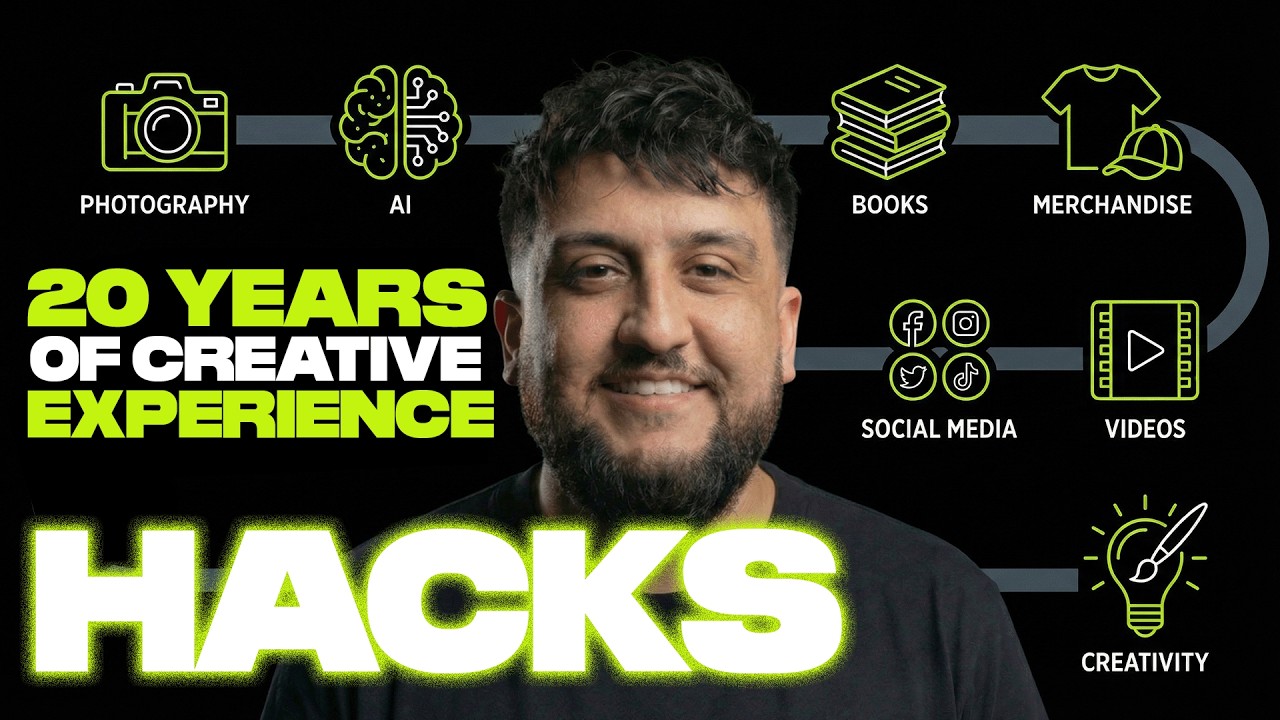
In this YouTube video, creator Javier Torres shares a rapid-fire roundup of practical tips and tricks he’s gathered over 20 years in creative services, spanning photography, AI, book writing, merchandise production, social media, video lighting, and overall creative strategy. He begins by recommending Lightroom for batch photo editing and deep dives into its color and luminosity sliders, then highlights VSCO Film presets for adding analog character. Moving to AI, he lists current image and video generators (DALL·E, Midjourney, Higgsfield, Kling) and stresses AI as a tool rather than a replacement. For authors, he showcases Claude’s desktop app and Google Gemini as powerful assistants for research, ideation, and manuscript drafting. In merchandise, he explains the value of attending the Sourcing by Magic trade show and using Milanote to organize global manufacturers and suppliers. He then outlines social‑media “content games,” urging viewers to follow creators Ava and Mr. OMG Adrian for hooks, competitor research, and scripting. For video production, he demonstrates how to control lighting with a single key light, an Amaran Verge Max, and strategic blackout of ambient light. Finally, he revisits his own content on clarity, mood‑boarding, and audience avatars, emphasizing the importance of building with the end in mind. Throughout, he mixes personal anecdotes, equipment links, and a call to action for community growth, ending with a prayer and invitation to subscribe.
Chapters
What's going on, people? Today's video is going to be a little bit different. I had a friend reach out to me asking about how I did my lighting, and it sparked an idea. What if I did a tips and tricks video? And so that's what we're going to do today. I'm going to be breaking down 5 to 7 different industries and some of my favorite tips and tricks that I've learned over the 20 years of creative services, from amateur to pro-level stuff. If that sounds like something you're interested in, make sure to watch the end of this video. Let's get into it. I'm going to crack open a Red Bull. So let's get into this. I don't know where this is going to go, but salud. Industry number 1 that we're going to be tackling is photos. So one of the major tricks for people who are just starting off in photography and you want to learn how to edit photos, I suggest learning Lightroom. Maybe if you guys haven't heard about it, it's a product in the Adobe Creative Suite and it's actually specialized for photography. A lot of people might be thinking, wait, isn't that what Photoshop is about? Photoshop is a very, very powerful tool. I use it almost every single day, but when I'm doing full-on photo projects, Lightroom is my go-to. Why is that? It specializes in batch processing of photo. The powerful thing is you can do one correction to a photo, and as long as it's in the same sort of lighting scenario— let's just say like I took 100 photos in the same area with this light setup— you could apply all the corrections to one photo, you copy paste it, and you're able to paste and sync all 100 photos with the exact same edits, curve adjustments, color, white balance. Everything is going to be baked into it, and it's a very powerful tool. For you guys who are just getting started, that might be a game changer for you. And for you guys who have been doing Lightroom for a very long time, one of my favorite things is going down into the color sliders. There's things like luminosity, the hue saturation. If you go to the very bottom, playing with that is a definite game changer. So I've been doing photography, working with Lightroom for over 15, 20 years. And one of the coolest things that I learned very early on is when they started releasing the VSCO Film. I think they— it's a subscription now, but early on you're able to buy VSCO Film One, which came with all the film emulations, Canon, Fuji, you know, et cetera, et cetera. It was a real game changer because it made it feel like film. It took away that digital feeling and it gave it something with a little bit of life. I know you guys know this stuff, but for professionals, I want you— if you've never done this before, if you have some sort of a film emulation like that, I want you to click on it, go down to where it has the camera profiles, go down to the luminosity sliders are, and look at what it actually changes. For me, years ago, going down into those different sliders, seeing exactly what was changing with each individual preset, I was able to kind of see Oh wait, why does this look a little desaturated? Why is this— how's this color tone? How's the, the, the skin look a little bit brighter? And the crazy thing is going into the luminosity, going into the saturation, going into the, the different labels that are there. I'm kind of blanking out. I don't have it in front of me, but those sliders are very powerful. The very powerful thing about the luminosity sliders and the hue and saturation It's actually broken down into all the different colors in the photo. For instance, orange. Orange is the color tone of most skin types. So going into the luminosity, you're either able— if it's like in a shadow, bump it up to make it brighter, bring it down. And then even on bright sunny days outside, using that luminosity, if the blue sky is kind of blown out, being able to bring it down and get it into a proper exposure is a really cool tip. It's taught me so much about Lightroom, going into those presets, playing with it. I honestly think it's one of the biggest hacks for photography. If you've never tried it, I encourage you to try it out today. Industry number 2 is AI. This is something that's just recently happened within the last 3 or 4 years, and even within the last 6 months, AI is crazier, powerful, more usable than ever before. I know, like, even 2 years ago when I was using DALL-E, which is the ChatGPT image model, it was pretty trash. But now things like Nano Banana, ChatGPT, their newest image models, very powerful. If it's something you haven't touched in a long time, I encourage you Start learning it. AI is not going anywhere. It's the people that know how to leverage AI that are going to be ahead of the game. For me, it's a tool. It's not something that I want it to take all the creative ideas and make it on its own. It's a tool for me as a painter has a paintbrush. AI is one of those tools. I actually made a video. I'll link it up, up here where I break down 7 different industries and my favorite tips in those industries for AI. So I'll leave— I'll let the video speak for itself. Just to give you a couple of things of some of my favorite places to use AI would be Higgsfield has a lot of great photo video models on there. Kling is probably one of my favorite photo to video platforms. I still really like Midjourney for just ideating different sort of images. And yeah, those are some of my favorite. If you're looking to get into AI, I would say definitely check out Higgsfield. Check out Kling. Check out Midjourney still. I, it's not as powerful as it once was, but I'm definitely not sleeping on it. And make sure to check out this video on AI where it breaks down 7 industries and some of my favorite tips in this. The next industry is this books. And it kind of has to do with AI because that's one of my favorite tips. I actually just started using Claude. And oh my gosh, as far as for helping with book writing, Claude is definitely a game changer. They actually have an app that you're able to download onto your computer and work with your local files. It's able to search the web for you. I know there's a whole thing called ClaudeBot, which is like now called ClawBot because of the sounding like Claude. That's a whole different thing. I'm just talking about the Claude official app that you're able to download in the Mac Store. I actually have it loaded on my laptop. It's able to work with the files, able to help you kind of ideate, watch things, take screenshots. It's a very powerful tool. So I definitely suggest if you're looking to do a book, it could help you do research. It could help you write the manuscript. For me right now, I'm really liking Claude as far as the LLM of choice. For writing books, manuscripts. The other cool things are Google Gemini. I feel like Google Gemini has one of the coolest, like, tones that, uh, out of all the LLMs, the large language models, it actually talks a little bit younger, cooler. I think it has some really cool ideas. I like using that for YouTube. But anyways, that's a little bit on the AI tips as far as for writing books. I definitely would recommend if you haven't checked it out, check out Claude. That's one of my biggest tips right now. Checking that out, learning that, that's a whole different video that maybe we can go into. But I just, um, some people ask me, what do you use? What do you like? Do you like chat? I like chat for talking like a friend, but I definitely like Claude right now for helping anything for manuscripts, books, ideation on that. So if you're looking to write a book, definitely check out VOD. The next industry that I'm going to be talking about is merchandise. What can I say about merchandise? I did a whole video talking about turning your message into a movement. I started a brand called Vintage Jesus Tees back in 2019. It's one of the largest, um, curation of Jesus tees on the internet, and I think the best collection in the world. That's actually the tagline that I use in showing that video. So if you watch it, you're going to hear that same statement all over again. But as far as, um, you know, creating a brand merchandise, what can I say? Um, oh, here's one. It actually happened a week or two ago, uh, February, depending on where you're watching this. It's a conference called Sourcing by Magic. That's called Sourcing by Magic. So there's the Magic Trade Show, which is happening right next door to it, where they have all like the coolest up-and-coming brands where they show their latest collections, drops, uh, be able to connect with different stores, vendors, salespeople. That's really cool. But on the other side, an event called sourcing. That's where all the wholesalers from all over the world, all the manufacturers, all the big companies for gallery department, for like all the biggest companies are there. Uh, there's manufacturers from China, Pakistan, uh, let's say Uh, Portugal, Mexico, all over. You could get AOP done there. That's all over prints, tags, zippers. They, they're the ones that make the little zippers. Every manufacturer is there. So if you've never checked out sourcing, there's, I think another one that happens in New York. I definitely suggest that. Or there's another one called, the other one is called Inspiration. I think it's called ISS. It happens in Long Beach. I think that one just passed as well. Or it might be, they might have it twice a year. That's where you're able to check out the latest blanks, all the cool t-shirts, deal with a lot of cool manufacturers. So if you're a merch brand and you want to take your stuff up to the next level, I definitely suggest making a trip to head out to Vegas to go to Sourcing. This is a game changer. I actually want to shout out Eric and Superline Wholesale for kind of putting me onto that. I went 2 years ago. I have a full— let me see, Milanote. Let me see if I could pull this up really quick. I was showing someone yesterday. Yeah, I'm not sure if you could see this, but I have everything organized in my Milanote. All the different factories, let's say, sports labels, patches. Like, let's just— we'll do patches really quick. These are the guys that do stuff for Nike. I think there's even, let's say, look, the manufacturers who do Off-White are there. Nike, different things. So yeah, they, they have people from all over the world with all over quality. If, if Off-White's getting stuff done by these guys, if Nike's getting stuff done by these guys, I definitely think you should check it out. So make sure. I'm not sure if it happens twice a year, but make sure to check out sourcing. I don't think you're going to regret it. The next industry that I'm going to be talking about is social media. I just did a video last week talking about how social media is dead and now it's interest media. If you don't know which game you're playing, you're going to get stuck in the past. There's 5 different content games that people are playing in today's social media era. And if you don't know which one you're playing, you're going to get left in the dust. Make sure to watch this video on social media, what games they are. But let me give you a practical tip, practical tip, or maybe just some accounts that you could follow. I suggest an account. Her name is Ava. I'll put her right here. She breaks down all the different content types, hooks, how to research competitors. Honestly, She does such a great job that I'm just going to link her. Check that out. Another great person is Mr. OMG Adrian, Adrian Per. I've shouted him out in a few different videos. I just love the way that he breaks down videos. He teaches the way he scripts, the way he does a shot list. This guy is a legend. So if you're looking to step up your social media game, here's a quick tip. Follow these 2 accounts. You're not going to regret it. Next industry is video. This is a tip from my friend who inspired this whole video. Asking me how I light this. So pretty much in this house, there's so much light that comes in. I have a big old giant, like 12, 20-foot high windows, which is really cool to live in. But as far as for filming, it's very inconsistent of lighting. So if you're trying to do video, one of my biggest tips is control your lighting. I'm in the dark right now. I don't have my overhead lights on because I want to control my lighting. The light that is on is my one key light. Let me turn on the lights really quick and let me just show you a difference on how different it is when you don't control your lighting. So this right here actually doesn't look too bad, but maybe it's because I have my one key light here. But as you can see, this is, you know, how cheap, cheesy lighting is. Look, look at this shot. This is how some people shoot. They might have a little ring light. So I have a little, the Ink, the Inky. What I'll do is I'll find one of these on Amazon and link it up. But this is a little light. Let me turn this on. Boom. You see how that light separates me from the background? Controlling that. Let me actually turn the overhead light off and show you how I'm building this lighting setup real quick. So you can see right here, super pitch black. Only thing is the TV. Let me turn on my backlight. Boom. So this one separates me from the background and then boom. This is the new Amaran Uh, Verge Max. I'll make sure to link that in the description as well. I'll put like a little bit of like a gear list in the description. Just comment gear and I'll send you a list of all the things you're able to get off Amazon. Got a really cool stand here. I even did a little bit of like an unboxing. Maybe I'll upload that sometime. But as you can see, I control the lighting by having it pitch black, having my key light right here. A little bit of a separation in the back. It's a little tiny part of my house that it's my office right here. But yeah, if you want to control your lighting, I say big, beautiful light. I have a grid on here and yeah, turn the lights off and just leave the lights that you want on. I think it's going to help a whole bunch on making your lighting look beautiful, which is going to help your videos. Last industry that I'm going to be talking about in general is just creativity and The major thing with that is strategy. My very first video is talking about clarity. And I think my second to last video, sorry for talking about in that context. I'll just make sure to link them here. And then here's the next one. One of them was about mood boarding, the importance of mood boarding, and it talks about collaboration. I think the title of the video is 1 1 7, and that's because it's about collaboration. I know I'm giving out the video, but if that's something that you're interested in, it's the importance of mood boarding, collaborating with people, and being able to pull someone else's idea to turn it into something bigger. That's that video. The next video I'm going to talk about is my very first one on clarity. It's titled Your Vision Isn't Stuck, You Are. So one of the biggest tips with that is building With the end in mind. How do you do that? Knowing who your audience is is key. Knowing who your avatar is. If you don't know who you're speaking to, you're going to be lost. In this video, I'm speaking to someone who wants practical advice, wants a couple of quick tips and tricks, and someone that kind of probably already knows what I do. If you know, if you've never watched me before, some of these tips Probably won't resonate with you. It's more for like people that know what I do and are kind of looking for a little bit of that inside game. Oh, he does that. Oh, he does that. Cool. This video isn't for everyone, but neither should all of your videos. Some of them are for a specific audience. Some of them are more broad. So this video on clarity will definitely help you out. Well, that's it for today, people. I just wanted to turn on the camera Keep that creative muscle cranking. Give you a couple of just really quick tips and tricks. Show off some of my old videos if you haven't watched them, you know, putting it as a little bit of a commercial because I'm barely building this page. I just started in 2026 and I'm committed to posting one video a week till the end, till I hit my goals. I won't share all those goals with you guys yet. I want you guys to come along with me on the journey. But if any of this video resonated with you, can you please do me the favor of subscribing, liking it, putting a comment? I don't think I've even gotten one comment on any of my videos. So if you're the first person to put a comment, I love you. I definitely big shout out to you. Kiss, a hug, a dap, whatever it might be. I'm building this to be able to reach the people that I'm called to. I pray to be able to look back on these videos and laugh. Right now, as it stands, I only have 50 subscribers. The average video view is probably anywhere from 25 to 50, and we're just getting started. I can't wait till there's hundreds of it, but I'm not even doing it to go viral. I'm doing it to reach the people that I'm called to reach. I say that as a time capsule. So if it ever does get thousands of views, or, you know, we're doing some really cool things, this is something really cool to look back on because success is a journey. Success is a process. Anyways, I'm ranting. Thank you guys so much for watching to the end of this video. I know it's a little bit of a different one. We're trying out new formats. We're trying out different things to be able to help you. I love you guys. God bless you guys, and let's say a quick prayer. Lord Jesus Christ, God, I just thank you, Father God, for everyone that's watching this video. Thank you, God, that they blessed me by watching it. If they watch all the way to the end, I pray you just give them an extra blessing, Father God. Thank you so much, Father God, for what you're doing with me, what you're doing with this channel, what you're doing in my life, God. I'm honored to be able to serve pastors, authors, leaders, People just like this who are watching, fellow creatives. We love you and we thank you in Jesus' name. Thank you guys. I love you guys so much. God bless you guys. Catch you guys in the next one. Peace. Time to start editing, huh? Let's go.