How To FIX Any Advertising Campaign In 2 Steps...
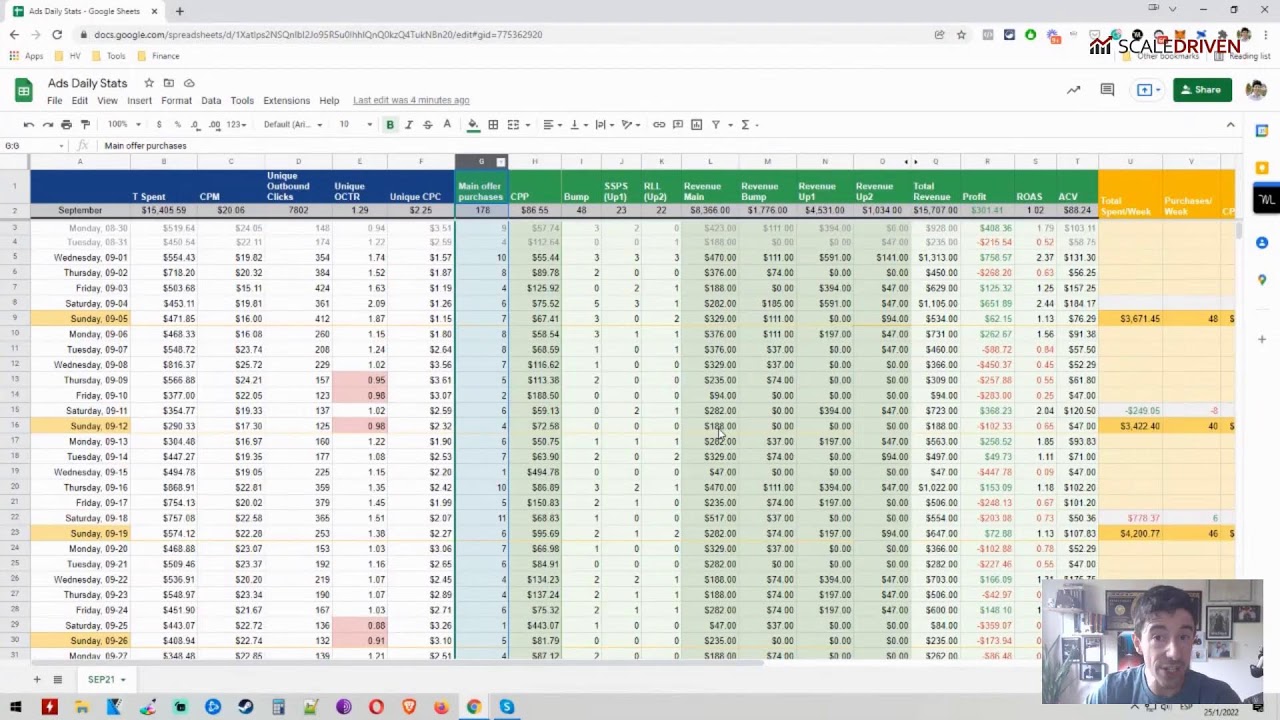
In this video, Hernan Vazquez of ScaleDriven presents a concise two‑step framework for diagnosing and fixing under‑performing advertising campaigns, regardless of the platform (e.g., Facebook, YouTube). He explains that a campaign’s issues boil down to either the ads themselves or the downstream funnel. To differentiate, he shows how to structure a dashboard that separates in‑platform (ad) metrics from out‑of‑platform (funnel) metrics. The key ad‑health indicator is the Unique Outbound Click‑Through Rate (U‑Outbound CTR); a value above 1 % signals that targeting, creative, and copy are effective. Funnel health is assessed through ROAS, profit, and conversion rates at each stage of an acquisition funnel (sales‑page conversion, order‑bump uptake, upsell conversions). Using a real client example (US$15 k spend, 7,802 clicks, 1.29 % U‑Outbound CTR, ROAS 1.02, 178 purchases), he demonstrates how the metrics reveal a solid ad performance but a sales‑page conversion that needs improvement (2 % vs a target of ≥10 %). He recommends split‑testing the sales page, then scaling the budget once funnel metrics improve. Throughout, he promotes ScaleDriven’s consulting services and invites viewers to schedule a call via scaledriven.com.
Chapters
how you can fix any advertising campaign in 2 simple steps. I'm going to simplify the whole advertising game for you and your company in this episode. In this content right here, we're going to be talking about how to fix any advertising campaign in 2 simple steps. With that being said, if you need help scaling your advertising campaigns profitably over the next couple of months, head over to scaledriven.com. At scaledriven.com, we focus on scaling advertising campaigns so that you can make more money, get more revenue, get more clients, and all of that. And, you know, all of that fun stuff that we do at scaledriven.com. Now I'm going to share with you why sometimes, uh, the, the, the results that you're getting have to do with your advertising, but sometimes I would say 50 to 60% of your time, uh, of the time rather, it— they don't have to do with your ads. And I'm going to share with you really clearly in an actual live example of how— about, you know, I'm going to share with you how to fix these advertising campaigns. Basically, you can use this and run with it and fix any type of advertising campaign that you're running independently of the network that you're running in. Let's say you're running them on Facebook or YouTube, it doesn't really matter. With these 2 steps, you will be able to fix any advertising campaign. Now again, if you need help scaling, go to scaledriven.com. Read the message that's on scaledriven.com, specifically tailored for people that want to scale their business, okay, through ads and through better follow-up and funnels and all of that fun stuff. Stuff. All right, so here are the 2 steps to fixing any advertising campaign. And the reason why I want to share with you guys this is because I've been going through some past historic data from some— for some of our clients. And, uh, once we started implementing this framework, everything changed for us because this allows us to have clarity of what's going on, whether it is on the ads or whether it is on the funnel. Because at the end of the day, you either have an ad problem or you have a funnel problem. And the way you fix this is by actually understanding when you have an ad problem and when you have a funnel problem. Okay, so these are the things that we want to pay attention to. Now, there's some metrics, some specific metrics that will tell you if the problem is your ads Or the problem is your funnel. There are some specific metrics. So we're basically simplifying the whole advertising game so you don't have to be guessing. You don't have to be testing 15 different things at once. You only need to check, okay, are we, are we hitting these metrics? If we are, then it's not the ads. And are we hitting these metrics? If we are, then it's not the funnel, might be the ads. Okay, so it's either one or the other. And I'm going to share with you how we set up the dashboards for our clients. So if you're watching this, uh, on video format, uh, you will see on screen that, um, how we're setting up the frame, the, the dashboard. And this is exactly how I like to set up dashboards in Facebook as well. All right, because that will tell you whether it is the ads or is the funnel. Okay, so let me actually share my screen. real quick so that you know exactly what we're talking about. So I'm going to share the screen right here and hide the overlay. All right, there we go. So this is the typical dashboard that we set up for clients, right? As you can see, we have the dashboard divided into 2 main sections right here, one of them being in-Facebook metrics and the other one being out-of-Facebook metrics, meaning Facebook metrics and funnel metrics. And this is really important. This is exactly how you want to set up your dashboard in the Facebook Ads Manager as well. You want to have in-Facebook metrics, meaning everything that has to do with the ads, and out-of-Facebook metrics, meaning everything that has to do with your funnel. Now, this is an acquisition funnel, and the purpose of this acquisition funnel was to break even or better, acquire a customer at a break even or better. And this was, I think it was September '21. Yeah, so I deleted everything that had to do with the client name and the product name name. But this is data that the media buyers at scaledriven.com will punch in every single day. So we'll have somebody to go in, punch in these metrics at the end of the day so that we can see what's going on day in and day out, day after day after day. And as you can see, we have a couple of days beforehand and a couple of days after so we can see trends. Okay, so what we're looking for here is to spot Trends. And again, this is an acquisition funnel that had a main offer, it had an order bump, it had a, a, and it had 2 upsells. Okay, so typical proverbial, uh, acquisition funnel. Again, uh, one front-end, one front-end offer, an order bump, and then 2 upsells. All right, and then here we can see how the funnel is performing and how the ads are performing. Now Excuse me. The number one most important metric— or here are some metrics that will tell you if it's the ads that are not working, okay? The number one most important metrics— that metric that I always pay attention to when it comes to understanding if the ads are working or not is this metric right here. It's unique outbound CTR, okay? So unique Outbound CTR. Now Facebook has many metrics, okay, when it comes to CTR. It has CTR All, it has Unique CTR. The one that we're looking for, okay, the one that we're looking for is called Unique Outbound CTR, and you want to have this set up in your dashboard in Facebook. The reason why, and this metric signals, is how many people that are watching, that are seeing the ads printed on their screens are clicking outside of Facebook. And we're talking about unique people that are seeing the ads that are clicking outside of Facebook. All right, now this is unique outbound clicks. Okay, so let me— outbound clicks. And then here is unique cost per click. All right, so we're always talking about unique hits here. All right, so unique outbound CTR is the number one most important metric. Now I always like to say that anything above 1% in Facebook It's good. Anything above 1% unique outbound CTR is a good metric to have. So if you have your, your ads performing at less than 1% and you're seeing that your cost per click is super high, you're seeing your CPMs are super high, then that might mean— in fact, it doesn't— it, it really means that the problem is your ads. So you need to write better copy, have better images, have better videos. Okay, so unique outbound CTR needs to be at least 1% or more to actually understand that your ads are performing. Why? Because that means that your targeting is on point. That means that your messaging is on point. That means that your images are on point. That means that people are clicking on, on your ads. Out of 100 impressions, you get 1 click. All right, so that's anything above 1% is good. Anything above 2% is really good. Anything above 3% is great. Now for this month Here we spent $15,000 on this account and we got, uh, 7,802 clicks. Uh, our unique CPC was $2, CPM was $20, and, uh, our unique outbound CTR was 1.29%, which is okay. All right, some days, as you can see, the media buyer signaled that we had lower than 1%, but that's fine because overall throughout the month we had a unique outbound CTR of over 1.29, which is telling me that the ads are good. Okay, this is telling me the ads are good. We don't need to focus on the ads. We need to move to the next stage. Now, this funnel broke even during this month. Okay, so we spent $15,000 and we had— we made, I think, a little bit over $15,000. So we made— actually, we made a little bit of money. Uh, the ROAS was 1.02. And we made $300 profit, which is pretty cool. Uh, now the profit here, uh, again, this is an acquisition funnel. So what we're trying to do is we cut the profit as closest to zero as possible because that means that we're scaling as much as possible. And here's what we want to pay attention to, okay? There's a couple metrics that you want to pay attention to to make sure that your funnel is working. The first one is, of course, the profit and the ROAS. Okay, if the ROAS was under 1 on this case, then we will be looking at the rest of the metrics. Now since it is 1, then it's telling me, okay, let's keep it going. Now the problem with this, or the, the challenge that I see with this funnel, is that if we spend $15,000 and we got a 1% ROAS, that means that we cannot scale a lot. Because as we start scaling here, we were spending like $500 a day, $300 day, $400 a day. If we want to go from $500 to $1,000 a day, then we need the ROAS to be higher because our cost per purchase is going to go up. All right, so a couple metrics to consider here is that we want to have at least 10% of people clicking or landing on our sales page to buy the main offer. Now this is less, I think this is around, let's see, Let's do some math here. So 178 divided by 1,702, so that is 2%. Okay, so the sales page needs work in order for us to scale. So this is the first thing that we see. The first thing that we see is that the sales page needs some work because right now we're spending, uh, we, we have a 2%. We want to have at least 10%. All right, at this scale. Now, auto bump, 48 auto bumps out of 178 purchases, which is Okay, because this means that we are, uh, at 26%. That is healthy for an order bump. And then we want to have at least 10% upsell 1 and 10% upsell 2. We are a little bit above 10%, so this means that we are on the money. So if we wanted to— if we wanted to optimize anything on this funnel, it will be this one, okay? It will be the sales page. So in this case, I would start doing split testing on the sales page so that we can get it closer to 10%. Because this will change the economics of the funnel if we wanted to scale. Now the client can come and tell us, no, we're good, you know, we're spending $15K, we're making another $15K. And the main point here is that we added 178 new buyers to our funnel. Okay, so we added 178 new buyers to our funnels during this month, and we actually got paid to do so. Which is the power of acquisition funnels and why, you know, I'm so, so, so bullish on acquisition funnels. All right, in general, because 178 purchases, uh, those are new buyers that you get in your funnel so that they can buy something else down the road, and then you're getting paid to do it. This is mind-blowingly good. All right, so this funnel was working. So these are some metrics that allows you to understand what to fix. Is it the ad or is it the funnel? How do you know? Well, you revise the metric. For the ads, it's the unique outbound CTR. For the funnel, first, the first thing that I take a look at is the ROAS. Are we ROAS positive? If not, then we start optimizing the funnel. But if my, if my ads are 1.29 unique outbound CTR, I forget about my ads. The ads are not the problem. The, the funnel is the problem. Right now, if we were under 1% unique outbound CTR, then we need to refresh the match and we need to refresh creatives. We need to review the, uh, the copy. We need to do a lot of stuff to actually get the ads back on track above 1%. But since they're good, then I don't pay attention to the ads. Okay, the only thing that I do is to go in and scale the budget as I start making the funnel better. Okay, so I hope that this helps. Uh, this is how We actually— this is how we actually optimize any funnel, and this is how we actually fix any funnel and any advertising campaign in 2 steps. The thing that you need to ask yourself is, are people clicking on my ads? If not, you need to fix those. And are people buying my stuff? If not, you need to fix that. All right, so those are the 2 things that you can always and ever do to fix any advertising campaign. So I hope this helps. If you want our help, going ahead and fixing your ads, or maybe fixing your funnel, because we can help you with that as well. We can help you writing better copy, having better follow-up, having better offers in your funnel. Head out, head over to scaledriven.com. It's scaledriven.com. And on that page, you'll see there's a little bit of a message there. You can read that message. There's a couple case studies as well so that you can check them out. And if you like what you see, you can schedule a call with my team right there and then. We'll be more than happy to help you out. We'll be more than happy to have a conversation with you to see if we're a good fit. If we're a good fit, we'll tell you how we work. If we're not a good fit, we'll also tell you. And, uh, no high pressure, and you will get a lot of value out of that call. Thank you guys for watching. If you have any questions, any comments, any remarks, anything that you want to add, drop them in the comment section somewhere around this video or this content, however it is that you're consuming it right now. And I'll see you guys on the next live stream. Bye-bye.









