How To Turn $1.00 Into $2.00 Using Low Ticket Offers - LowTicketBook.com
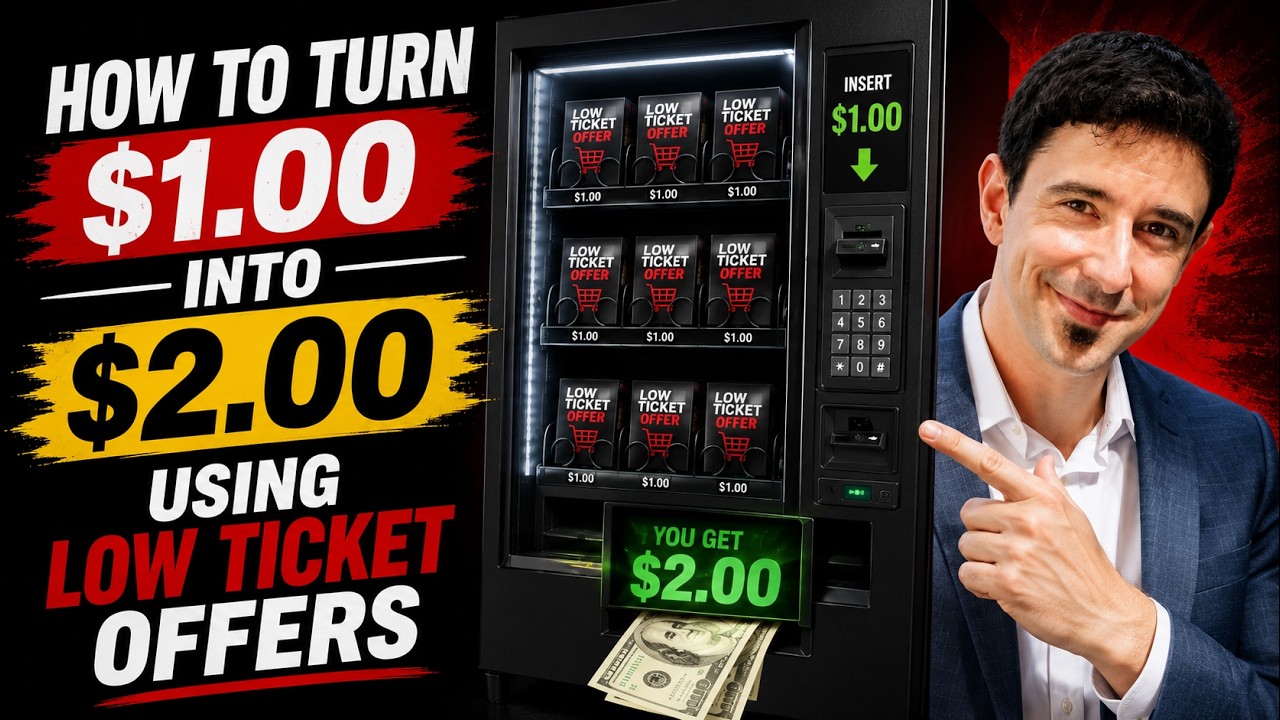
A $5 front-end offer becomes profitable when you add order bumps, upsells, and backend products that push average order value well above your ad costs. The vending machine model shows how lifetime value compounds across the entire funnel, letting you spend more on traffic as you scale.
Chapters
Imagine this. Imagine that I give you access to a vending machine that for every dollar that you put in, $2 come out. So for every dollar, you put in a dollar and then $2 come out. But there's a catch. The catch is that you put in a dollar today and the vending machine will give you 80 cents out today. And then every month after, you know, today, it will complete the $2. So you actually need to wait for you to get the total amount. So there's a, I don't know, some sort of computer inside of the machine that it will automatically calculate. And then every month you come back and it gives you another 10 cents, and then the next month it gives you another 10 cents, and then the next month it gives you another 10 cents. The question becomes, how many dollars would you put into that machine knowing that that's the mechanic of how it works? Right. How many dollars would you put in? You would like put as many dollars as possible because you know for a fact that for every dollar that you put in, you're gonna get $2 out. It's just that it's not gonna happen right now. It will happen through time, and you have a guarantee that that will happen. So you will spend all of your time and all of your money, and you will go out there and get credit or whatever. You will empty your bank account into that machine if you're doing things right. Well, that's exactly how low-ticket offers work for clients and students and even for everyone putting together low-ticket offers because if you think about it, that's exactly what we are doing when it comes to low-ticket offers, especially when we sell something expensive on the backend, you know, a service, a coaching program, or a local business or whatever. If you're selling something expensive online, you know that those people will eventually transact with you, just not right now. And by the way, sending cold traffic to a high-ticket offer straight up, trying to convince a random stranger from the internet to trust you with, I don't know, $3K, $4K, $5K, $10K right off the bat, it's the most expensive way to fill up those programs, to get those type of clients. But with a low-ticket offer, you kind of flip the math because what we do with low-ticket offers is exactly that. We spend a dollar today and we try to get as close as possible to a dollar today. So we try the vending machine to actually spit out a dollar today. Sometimes that's doable. Some days that's not possible. Some days you will get 60 cents back. Some days you will get 80 cents back. Some days you will get $1.20, and that's pretty good. But if you do things the right way, that vending machine will keep on spitting out money through time. So let me actually walk you through how I like to think about low-ticket offers. And I have this specific student, I had a call with her yesterday. That's why it's fresh on my mind, and she was looking at things kind of the wrong way. So here's how this student was thinking, right? This student was sending traffic again. She had this vending machine, she put that together, super smart lady, by the way. She got a lot of dollars into that vending machine, and she was able to, you know, sell a lot of her stuff. Actually, when we had this conversation, she sold over 10,000, you know, copies of her low-ticket offer. But the reason why she couldn't scale and the reason why we hopped on a call in the first place, she jumped into my low-ticket accelerator. And then for every student, I offer like a one-on-one complimentary onboarding call. I, uh, I have been stuck in this level for a while. I cannot scale. Like I've been spending $300 a day and that's at most what I can scale and what I can spend. And I want to go from $300 a day to $1,000 a day. I actually want to spend more money to grow faster, which is the right mentality, by the way. Again, super smart lady. Super sharp. You could see that she knew what she was doing. But here's the thing, and here's where I had to kind of, you know, coach her a little bit so that she could actually see things a little bit different. So we have this vending machine. So let's imagine that this is the vending machine, right? Let me put the iPad down. So again, this is the slot and this is where money comes out, right? So again, you put a dollar in. And then today, 80 cents will come out, right? But then you come next month and you get another 10 cents, and then you come next month and then you get another 10 cents, right? And then you come next month and you get another 10 cents, right, for every dollar that you put in. So again, this keeps on compounding, and the analogy is that this is called lifetime value, right, of a customer. If you do your things right, if you keep on selling people stuff, then the lifetime value of a customer should go up. So that means that after you've made your money back with that customer, right, you liquidate as much as possible here. So actually, you liquidate $0.80 out of every dollar that you spend. And then every time you sell those people something else, then that becomes profit, right? And this is where, I don't know, at some point, this machine, you come in here, and this machine will give you, you know, $100. Why? Because, I don't know, you sold something more expensive in the backend. So that's part of the lifetime value, right? So the lifetime value should, again, if you do things right, keep growing through time. But here's where I had to kind of, you know, coach her a little bit in terms of how low-ticket offers and acquisition machines generally work. So in my case, I run traffic to my Rapid Scale Framework. You might have seen it. If you're not seeing it, there's going to be a link somewhere around here so that you can check it out. But it's a $5 course on how to structure Facebook ads, right? So I run ads, I run traffic to this offer that is $5, right? And then I have some other stuff in the funnel, some other offers, right? And then I have a thank you page. Okay, there we go. Amazing graphic, by the way. Super, super professional graphic design. But I run ads to a $5 offer. Now here's the thing, I spend, or I spend generally every day on Meta, anywhere between $25 to $40 to get a buyer. So if you think about it, the vending machine is actually way less than that, right? Because I'm putting in $25 and it's only spitting out $5. But here's the thing, and here's the secret, and here's the thing that not a lot of people talk about or they look at it. In the wrong way is that this front-end offer, it's not the only thing that's on that funnel. I have, as I mentioned, other offers. So some people that come through this funnel might just buy the $5 thing, but some other people might buy my other offers on this funnel. So I have 2 order bumps, I have 2 upsells, one of them is recurring, I have a downsell, blah, blah, blah, blah, blah. So all of the things that I tell my students to do. Right? And what happens with this is that there's this little metric that again not a lot of people talk about, which is called average order value or AOV. AOV, and this is called by the way CPA or CAC or cost to acquire a customer, right? Or CPA, et cetera, et cetera. So, you know, it has different names depending on who talks about it, right? But here's the thing. My CAC, my CPA on this one offer is $25 to $40, but my average order value again, depending on the week, depending on the day, because this fluctuates, it's also $25 to $40, right? And the goal here is to increase this, of course, right? I'm always obsessed about how can I increase my average order value, and I explain why in a second. But the main point is that the difference between these 2 will dictate how much I can scale. And this is what I told this lady, is that the higher your average order value— let's say that my average order value here goes from $40 to $60. Now I can spend more here to acquire a customer. And guess what? When you scale your ads, when you go from $300 a day to $500 a day to $1,000 a day, you're targeting colder and colder audiences. So that means that your costs will inevitably go up. It doesn't matter what you do. It doesn't matter who you are. Your costs as you scale will go up. So you compensate that by increasing your average order value. Now, here's the thing. If I only look at this $5 transaction, then I can only spend $5 to get my money back immediately, right? Again, the vending machine analogy. I can only put $5 to get $5 back. When I put $10 in, it doesn't work. But if I look at my average order value as a whole, then now The math changes. And average order value is a simple, you know, it's a term that we use a lot in marketing, which means how much money people are giving you right away at the point of transaction. So they go through my funnel. Again, some people will only get the $5 thing, but some other people will take the upsells, the downsells, and all of that. And then eventually we end up with, you know, a $60, $50, $40, depending on the week, right? It fluctuates up and down. Depending on that, it's where and how much I can spend. So the more I increase my average order value, the more I can spend and the more I can scale my ads. So this lady, super smart lady, she was focusing on the $5 thing. So she was saying, oh, I can only spend $5 because if I try to spend more, it doesn't work. Well, it's never going to work because making profit just on that one front-end thing, it's super hard. It's super, super hard. Anyone that's running these type of strategies will tell you that the thing that carries the funnel is not that $5 front-end thing. It's how many people at what rate are buying the other things throughout the funnel. That's called average order value, and that's when the analogy of the vending machine makes a lot more sense because if you can only put $5 in and then you can take $5 back, you're always capped. as to how much money you can spend. But now, if you program the vending machine so now it spits out $40 for every $5 that you put in, and then it multiplies, now you can spend a lot more and you can still keep your money back. But here's the thing, this doesn't include anything on the backend. What do I mean? I mean that this is just point— this is just frontend. This is just the point of transaction. Mm-hmm. This is what happens at the beginning immediately, maybe immediately, maybe over the first 3 days, maybe over the first 7 days. The more you keep on selling these people and people saying yes to your backend high-ticket stuff, then that's where things start growing. That's where the lifetime value goes up and you go from $60 to $80 to $100 to $200 to $300. And this is how businesses, real businesses scale. This is how they do it, right? They acquire a buyer. for under their lifetime value, ideally under their average order value, and then they sell more stuff to them so that the lifetime value can go up basically or virtually infinitely if you think about it. Okay, so I hope that is helpful. That's how we're doing, you know, that's what we're doing to scale. That's how we are kind of, you know, battling the math or the increasing ad cost that's happening across the board for everyone that's running ads on Meta right now or any other network, by the way. And that's the math and the thing that I break down in my book, Low Ticket Profits, which you can get on Amazon. If you go to Amazon, it has like really good reviews. And it's a, you know, it's a pretty cool little book, you can sit down, read an afternoon, it's really heavily tactical. So it has a lot of benchmarks, a lot of stuff on how we want and how I like to do things. So that's number one. And then the other thing is that I'm doing a live class breaking down how we're putting this together for clients, for students, how they're winning no matter the niche, no matter what you're selling. Some people might be selling something expensive on the back end. Some people might be selling something, you know, mid-ticket. You don't need to have something expensive, but if you do have something expensive to sell, all the better. So I'm going to leave some links somewhere around here so that you can join the class. It's completely free to join, and, uh, you know, I'm getting a lot of good reviews out of that class. People seem to like it, so I hope that you would like it too. Anyways, hope that this was helpful, and I see you on the next video. Bye-bye.









