Red 🔴 Yellow 🟡 Green 🟢: A Simple Way To Optimize Your Meta/Facebook Ads - MakeMyAdsGreatAgain.com
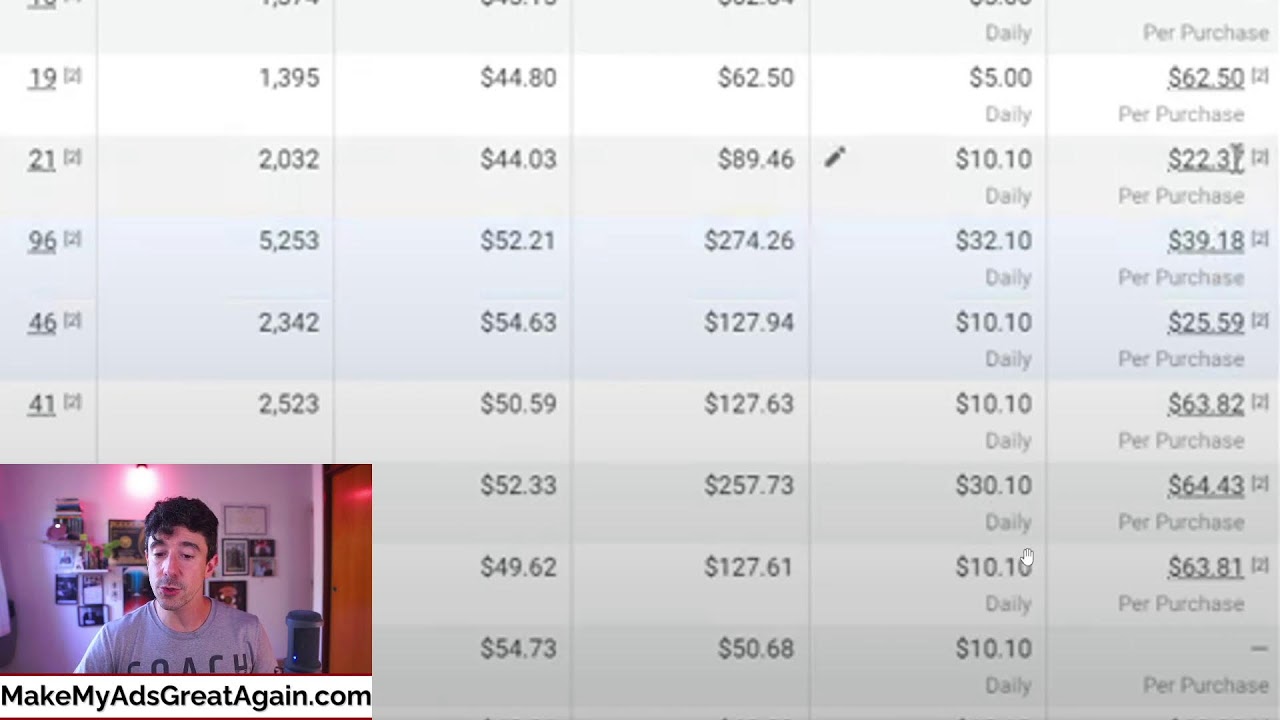
A framework for managing Meta ads using three categories: Green (under your cost target, scale up 20% every 48 hours), Yellow (near target, wait), Red (over target or failing, pause). Let new ad sets spend 2-4 times your KPI before deciding which bucket they belong in.
Chapters
Today, I want to share with you a really, really simple way that you can use to actually scale your ads, to scale and optimize your Meta ads, your Facebook ads, your Instagram ads. I'm going to share with you what I call the traffic light system to actually scale and optimize your ads. So it becomes really clear as to what you're supposed to be doing. Every single day with your ad accounts. This is something that we do at scale-driven.com for all of our clients. It's something that I learned from running ads for Agora Publishing, and this is something that we use with our media buyers as well at ScaleDriven to actually optimize campaigns. It's pretty cool. It's pretty simple. It's really easy to understand, so there's nothing complicated around this. With that being said, welcome everybody. I'm super excited to be going live today and sharing with you this thing. Let me actually find it. Okay, cool. Here we are. I'm going to share my screen in a second. Now, this is a methodology that I learned when I was working with Agora Publishing. Many of you guys might be aware of Agora Publishing or they know, but if you don't know who Agora Publishing is, Agora Publishing is the number one information publisher in the world and they make a couple billion dollars per year. They're a huge company and they have different divisions. They sell mostly information around around different topics, topics like health, investments, opportunities, and all of that. And they have several divisions and they're always looking for new experts and looking for new divisions and whatnot. And what they do is they build the marketing machine around these experts. Now, Agora is really famous. Agora Publishing is really famous because of its copywriters. They have a really cool model where they will get people into their monthly newsletters, and these are like actual physical newsletters in the mail. And the copywriters of Agora are one of the best, are some of the best in the world. Actually, many copywriters, many junior copywriters, they go to work for Agora just because of their copywriting training. It's really, really good. And they do this to the tune of millions and billions of dollars. And I had the pleasure and honor of working with them for a couple of their divisions. I worked with a couple of their divisions running Facebook ads for some of their information products. Again, this is all information-based. Something that I learned from them was that they would use basically a 2-way system to scale campaigns. When a campaign was profitable, they would grade it green, and when a campaign was not profitable, they would rate it red. Green or red, and that's it. If a campaign was profitable, it was green, we should scale. If a campaign was not profitable, it was red, and we should pause it. Maybe make some tweaks, maybe go for it and whatnot, and then relaunch it. So it's a really two-way, really one and zero, black and white way of running a business, especially on the paid acquisition side of things. And that really stuck with me because you might think that this Agora behemoth of a company, they would have this complicated system to scale campaigns, and it wasn't the case. They still tracked everything. Okay? Let's be clear here. They had a fantastic tracking system. They tracked every single metric that you can think of. when it comes to scaling campaigns, especially on paid media, they did this. We got on a meeting with them and they were like, hey, is this campaign profitable? Green. Let's keep on spending. Is this campaign not profitable? Red. Let's stop it. Let's pause it. Let's try something else. So really simple. So in this case, what I want to share with you is I'm going to share my screen in a second and I'm going to share with you what's called the red, yellow, green methodology. I added the yellow in there because it makes sense You will see it in a second, but it makes sense for you to have a yellow in there sometimes. But this strategy, this traffic light system, will allow you to understand, okay, these are the campaigns and the ad sets that I want to scale. These are the campaigns and the ad sets that I want to pause. And these are the campaigns and the ad sets that I want to, you know, just do nothing with. Okay. So let me actually share my screen. Oh, by the way, before I share my screen, if you're a coach, if you're a consultant, if you sell information and if you want our help scaling your campaigns this year, if you want to bring a world-class team to help you scale, whether you're running ads on Meta or YouTube or Google or TikTok or whatever it is that you're running ads, go to makemyadsgreatagain.com. That's down here, makemyadsgreatagain.com. And there's also a link somewhere around here. There's a message waiting for you there at makemyadsgreatagain.com. Check it out. It's pretty cool. And if you like what you hear, if you like what you see, you should schedule a call with us. And then we'll go from there. Okay, so let me share my screen and we'll go from there. Okay, cool. So this is a screenshot of a student of mine that I was helping the other day and I'm like, hey dude, can I take a screenshot of this? Do you mind if I illustrate the red, yellow, green concept with this ad account? And he was like, no, I'm fine with it. So I took a screenshot and I'm going to be moving things around so that you can see it better. I'm going to be zooming in a little bit and moving things around so that you can see it a little bit better. Let me actually do this. Okay, yeah, that's probably better. So the way this works is really simple. For every campaign that you have, for every campaign that's happening in your ad account or campaigns or ad sets, you need to have a desired KPI. In other words, how much you want to pay per lead, per purchase. On this case where he's selling an information product of around $40, so he has an information product, but on your case, it could be per lead, Per booked appointment, per you know purchase, whatever that is. Okay, so whatever that is, you have a goal. You have a goal, an ideal KPI, an ideal metric that you want to hit when it comes to when it comes to getting this campaign. So for example, if we can get leads for under ten dollars, we can get leads all day. If we can get booked appointments for under hundred dollars, we can get booked appointments all day. On this case, he's selling a forty dollar information product. So his KPI This is an acquisition funnel. He's not trying to make any money out of this. His KPI is $40 or less. Okay, so as long as we're getting buyers for $40 or less, we're good. So the first thing that you need to decide is your KPI, and this is going to be your metric to actually scale or stop campaigns. This is something that you want to sit down and do the math. We help our clients do the math on their behalf, but that is something that you want to go ahead and have in mind. So once you understand this, the next thing that you want to do is whenever you're launching ads is you want to You want to go ahead and spend money because what you're doing, what you're basically doing when you're spending money is you're collecting data. So a lot of people are saying, well, I want to get leads for $20 or I want to get buyers for $40, but they're stopping things ahead of time. So they might stop a campaign because it spent $30 and they didn't get any sale, or they spent like $5 and no leads, so they stop it. The main problem with that is that you're not leaving enough breathing room to the algorithm to actually do its thing, and you won't collect enough data— excuse me— enough data if you keep on doing this. So my first recommendation is you need to leave your ad sets, your campaign spending anywhere between 2 to 5 times— sorry, 2 to 4 times your desired KPI. So if you want to get booked appointments for, let's say, $100, you want your ads, your ad sets, your campaigns to spend anywhere between $200 to $300 before you stop them. The same happened with this. In this case, again, our KPI is a $40 information product, so our KPI is that we want to leave things running anywhere between 3 to 5 times— sorry, 3 to 4 times KPI. So in this case, we want the ad sets to spend anywhere between $120 to $160, maybe $200 before we stop them. So that's the next thing. So the first thing is to decide your KPI. The second thing is to leave those ad sets once you launch them. And I talked about how to launch campaigns in other videos, but if you take a look at that, then you want to leave those running for a while. And for a while, I mean, it's all a matter of budget. It's not a matter of time. A lot of people ask me, how much time should I leave my ads running? Well, it's not about the time. It's about the budget. Budget plus time. Because if you're spending $10 a day, for you to spend $120 or $130, you need to wait 13 days on that ad set. But if you're spending $50 a day, you only need to wait 3 days. Okay, so it's not a matter of time, it's a matter of budget. So let me move this around real quick. Let me move this around. I want to do this with the whole 2 things. Okay, well, that's not what I wanted to do. Sorry, guys. I'm moving this around real quick. I'm gonna move the video here, and then I'm gonna move the little thing here. Okay, there we go. Okay, so that you can actually see the purchases, which is what matters. So Right here, okay, we have this KPI, which is $40. Okay, so now we start. Now that we have decided our KPI, now that we have spent some money, now we start grading these ad sets in red, yellow, green. So as you might imagine, as I explained a second ago, green means scale. So any ad sets that have spent enough money and they're under KPI, You will scale. Okay, so those are green ads. So in this case, we have this one right here. Okay, we have this one. This has spent $89, almost $90. $2,237 is a green ad set right here. Then we have another one which is down here, $127. We have a green ad set right here, $2,559. These are under our desired KPI. So what do we do? We're going to scale them. We're going to bump up the budget and we're going to bump up the budget 20% every 48 hours. That's my way of doing things. That's how I like to do things. 20% in 48 hours for these ad sets right here. So this ad set right here will go to $12 and some cents and this one the same right today. And then you wait 48 hours and then you scale again. Okay. So that's when it comes to these, these 2 ad sets. Now we have red ad sets. Red ad sets are the ones that have spent enough money. They're over KPI or they didn't get you any leads or any sales or any purchases or any booked appointments. Right. Or any scheduled calls or whatever you're trying to do. And those are the red, those are the ones that you're going to stop. Because green means scale, red means stop. So you're going to stop those ad sets. So for example, this one, $63.82, way over KPI, $23 over KPI, spend $127, want to stop it. Okay, we're going to stop this one right here, $64.257, going to stop it. $63.127, going to stop it. Okay, so we have 1, 2, 3 reds that we're going to stop. This one up here, we have some new ad sets that they haven't spent enough. So these ones up here, I recommend to keep on running even if we have some that are over KPI and some of them they didn't have any purchases. These top right here, I suggested to my students to keep on running at least until they reach $120 per ad set. Okay, so this is going to take a while because these are at $5 a day, these are at $10 a day. So now here's the interesting part. You're going to scale the green ones, you're going to stop the red ones, and this one right here, $39.18. What do we do with that one? If you have an ad set that is right at KPI, maybe $1 or $2 below or $2 above it, so this is $39, or you have one that it's $41, $42 right there, right at KPI, $1 or $2 or $3 below or whatnot, that's a yellow ad set. So you're not going to be— you're not going to do anything. Okay, the yellow ad set, you don't do anything. You don't scale it, you don't stop it. Here's why. This ad set, if it keeps on spending, it might tip over and become a red one because it will go over KPI, or it might become a green one if it gets, let's say, a couple of more sales over the next couple days, which might happen because, by the way, the Facebook dashboard is not real-time. So these ad sets right here might have a little bit of lag. So if you stop this, you might be missing out on a couple sales that are not reporting back here. So that's important to know. Okay, so $39, $39.18, that's a yellow ad set. I'm not going to do anything with it. I'm just going to keep it running. And it might tilt to one end or the other. It might become a red ad set, which in that case I'm going to stop. It might become a green ad set, which in that case I'm going to bump up the budget. Okay, once it reaches the green stage, what's happening is that if you have an ad set or a campaign right at KPI, and if you scale that, the chances of that becoming a red ad set or a red campaign go up. Because as you know, the more you scale your campaigns, the more you're going to pay per customer. This is like golden rule of advertising, right? And if you're not familiar with that, go watch my video on the scaling of the ladder of ad scaling or the ad scaling ladder. So go check it out because in that case, I explain to you in detail what happens here. Okay. So as you can see, this gives you visibility and this tells you exactly every single day you go in and then you check red, yellow, green. Okay, and then you check again the next day, red, yellow, green. And then you check again the next day, and red, yellow, green. And when you launch new things, then you can also grade them red, yellow, green, red, yellow, green. That's what we're doing. We're going in, we're scaling what's working, we're stopping what's not working. Red, yellow, green. An ad set that's working, you scale. That's green, you scale. An ad set that's not working, and you know exactly why it's not working because it went over KPI, you stop it. And then the yellow ones, you don't touch because if you touch it, you might go into the red. There's a higher chance that you will go into the red than if you go into the green. Okay. So I hope that this is helpful. This is our kind of our traffic light system on scaling campaigns and scaling ad sets and whatnot. Again, go check out my video on the ad scaling ladder because that will clear out some questions if you are— if you have questions about why am I spending more and paying more, right? Or how can I scale a campaign from $100 a day to $500 to $1,000 to $2,000 a day? That's all explained in the ad scaling ladder video, which is somewhere around here, and— or you can find it on my channel. Okay, so I hope that is helpful. If you have a working campaign and you want us to, to help you take it to the next level, if you are hitting a glass ceiling when it comes to scaling, or maybe your ads are not performing the way they used to, if you sell high ticket, if you sell information and you want our help to take it to the next level, go to makemyadsgreatagain.com. There's a message waiting for you there. There's a link somewhere around here so that you can click on it. Go check out that message, go check out the testimonials, go check out the results that we have there. And if that resonates with you, click the button and you can schedule a call with me and my team. And then on that call, we'll ask you a couple of questions to see if we're a good fit. And if we're a good fit, we'll tell you how we work. If not, we'll also tell you. No hard feelings. And we have a lot of good results for our clients, but we also have a lot of good resources that we give away on those calls because we want people that book a call with us to win. Okay, so I hope that is helpful. Thank you so much for watching. Let me know if I can help you in any way, shape, or form. Let me know if you have any questions. Just drop them in the comments somewhere around here. I do read all the questions, all the comments, all the DMs.









