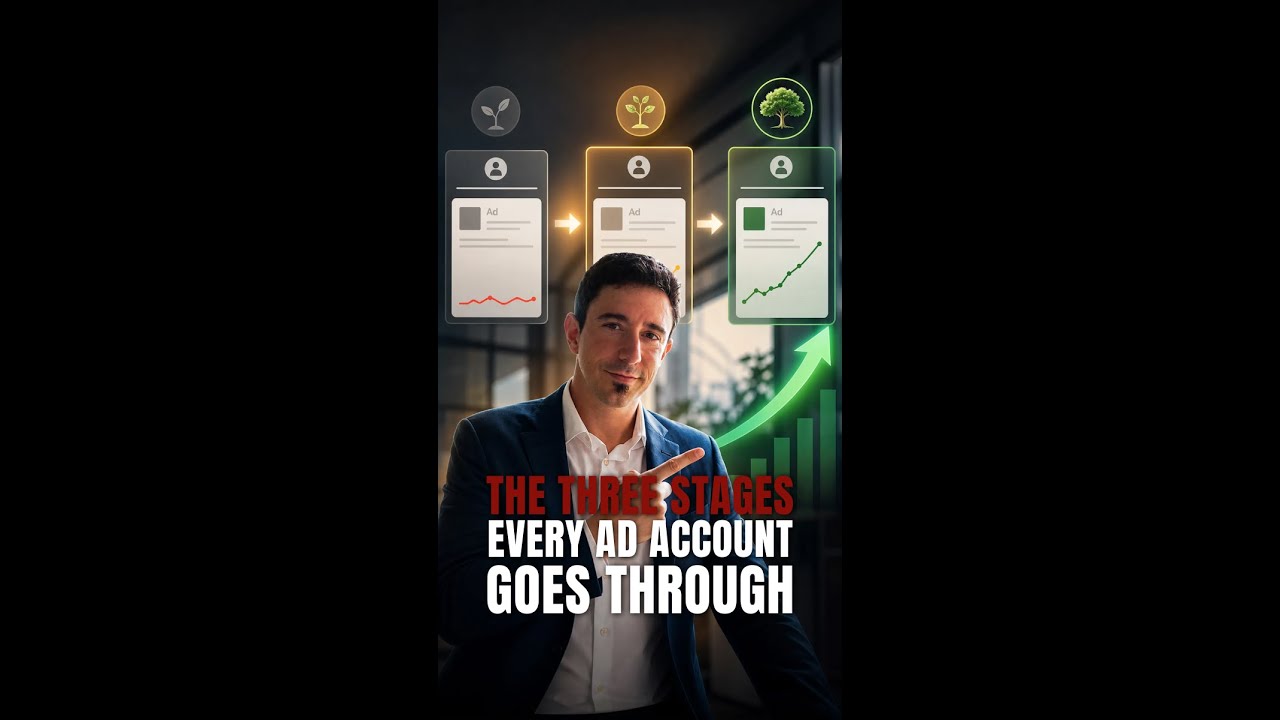
Hernan Vazquez says rising CPMs aren't the real problem. Most advertisers scale too early, before their Meta account has gathered enough data. He breaks ad accounts into three stages: data-gathering with new creatives and audiences, optimization using pixel data and funnel upgrades, then broad scaling once the algorithm has signal to work with.
Chapters
Most advertisers try to scale way too early before they've actually earned the data to do it. That's usually where things start going wrong. The easiest way to think about it is that every ad account goes through stages, and each stage needs a different approach. In the first stage, you're really just gathering data. The offer is new, the funnel is new, and the pixel doesn't know much yet. So this is where you test creatives, test audiences, and figure out what people actually respond to. A lot of the time, you're not making much money here, and that's fine. You're paying to learn. Then you move into the second stage, which is where the account starts getting smarter. Now you've got some pixel data, you got a few proven creatives, and you can start using that data to go after better audiences. This is usually where things start to get more profitable because you're no longer guessing the same way you were at the beginning. It's also where a lot of the funnel improvements start to matter more, like order bumps, upsells, and better follow-up. Then eventually you get to the 3rd stage where the account has enough data that you can start going broader. At that point, Meta has a much better idea of who your buyer is and you can let the algorithm do more of the heavy lifting. That's where a lot of people get confused. They hear somebody talk about broad targeting or Advantage+ and they try to jump straight there on a brand new offer with a brand new pixel. Then when it doesn't work, they assume broad targeting is broken. Usually it's not. Usually they just skip the part where the account learns. That's why the order matters so much. First you gather data, then you use that data to scale more intelligently. Then once the system has enough signal, you can open things up and let it run broader. Each stage builds the next one. So if you feel stuck, the question is not just what tactic sounds best right now. The better question is, what stage is this account actually in? Because the right move depends on that. You have to run the playbook for the stage you're in, not the stage you wish you were already at.