What you need to know about the new SBA and PPP Loans
Jason Kraus hosts tax experts Neil and Ryan to explain PPP loans, EIDL advances, and employee retention credits for small businesses. They cover forgiveness rules, the 60/40 payroll requirement, and whether second-draw loans are available to restaurants under the 3.5x multiplier.
Chapters
Let me get this recorded here. Yeah, thanks everyone who's jumping on. And yeah, excited to have the presentation here for the PPP and new SBA loan financing programs. You know, I know a lot of us have questions around like what the second round of financing is. Some of us applied for, you know, received the first round and And it's a great initiative that we can all take advantage of now as we look to grow and scale our startup businesses. And yeah, excited to bring in our experts here with Ryan and Neil to dive in a little bit deeper and give some of the ins and outs of what the new program— or what's involved in the new programs. Who should be applying and how you can go about that process. And here we go.
Just—
Okay, let's get started, I guess. Should we? Shall we?
Yeah. And anytime— let me just share my screen here. And yeah, we can also keep this interactive too if you guys have questions. Um, yeah, yeah, questions throughout, uh, feel free to ask either in the chat or just ask directly.
Yeah.
Um, okay, so thank you everybody, and especially thanks to, uh, Ryan and Jason for organizing this, and I hope everybody is staying safe and healthy.
Let's try to stay safe and healthy.
A little bit about myself. I am the founder of Smart Tax Corporation. The reason I chose Smart Tax Corporation is I think everybody has to pay taxes.
That is granted.
But if we can pay taxes smartly, that's the whole idea, that what are the various tax plannings we can do, not tax loopholes.
tax planning, and within the tax laws, whatever we can do to make sure we can pay taxes smartly will be the way to go.
So I started my practice in 2008, and then I sold one practice and started the Smart Tax Corporation in 2018.
And the various industries I cater to are healthcare, real estate, construction industries, Especially the privately held businesses, not-for-profit organizations, medical and pharmaceuticals, especially restaurants now, they are suffering a lot. So we have to do something for them.
The hotel industry, IT consulting, 2 new additions we have in 2020 is fantasy sports.
Those are the betting ones, as well as some artificial intelligence companies. Companies. They are really, really gaining momentum as we speak. And obviously cryptocurrencies, they're, they're making a lot of money. Like everybody knows, Bitcoins are out of the roof, and people are calling and saying, do I really have to pay taxes on cryptocurrency? And the answer is yeah, you have to, because it's considered a property.
What are the various areas we provide service. We mainly provide service on the tax areas as well as advisory services. So it could be domestic taxes, tax preparation of all types.
We do international tax consulting. That's our—
one of the niche areas. And business and personal tax planning, tax planning for high net worth individuals, IRS and state audit representations. I am part-time CFO for a few companies. I do money coaching for a bunch of clients, iNetwork clients or businesses. I do obviously bookkeeping and payroll. So that's the gamut.
It's a one-stop shop where you can get all the services you want, both business and individual. Okay, next slide. So this is where we hit the road and we want to Start talking about the various PPPs.
Now, everybody knows that PPP 1 came around sometime last year, April, May timeframe. And everybody was scrambling. There was misinformation all over the place.
People did not know what to do.
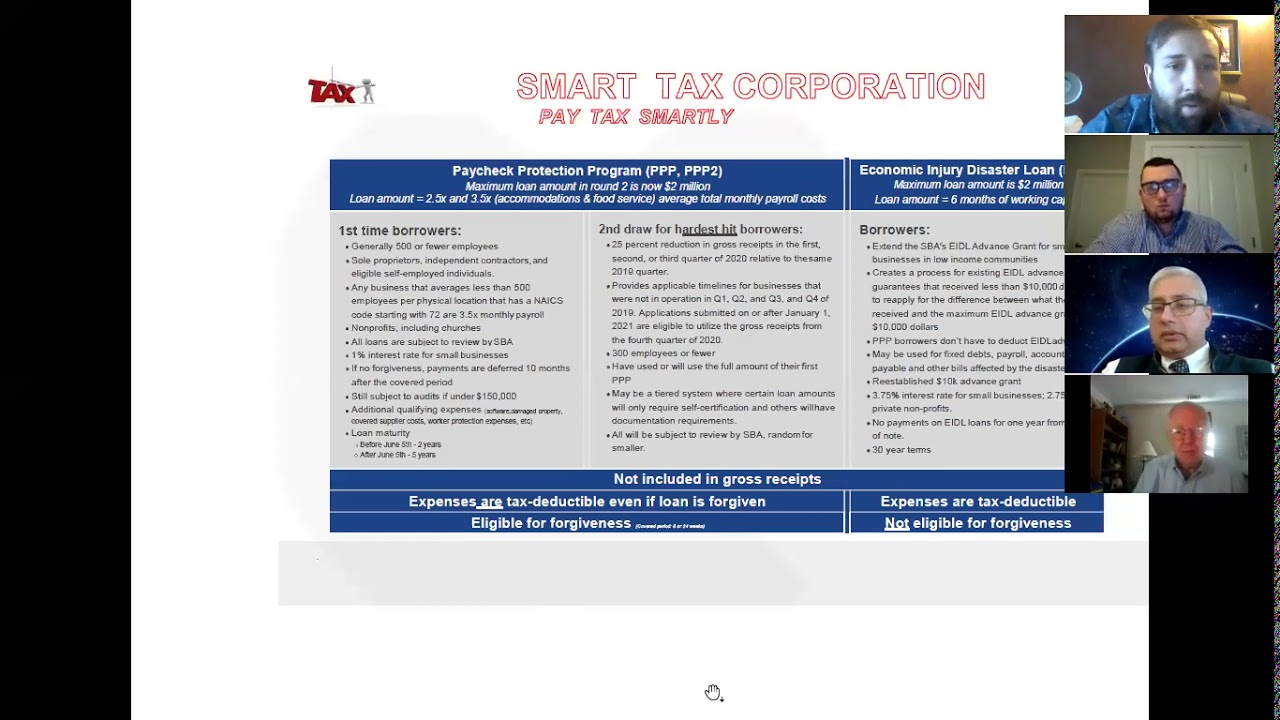
People who got the money, maybe they didn't need the money finally. Some of them returned the money. So it was a total chaos. Hopefully, PPP 2 will be much better. And what we will try to focus here first is spend a little bit of time on this particular slide because this is the most important slide. I want to give you guys an overview of the PPP, and then we will drill down onto each of these 3 columns. $284 billion was available for the first and the second draw PPP loan. Program is extended up to March 31st, 2021. And if you have not already applied for PPP 1, you can apply for PPP now. You have to basically go and apply for PPP first draw. We call it either PPP 1, first draw. It's the same thing. And then if you are able to utilize the money within the covered period, you will be able to apply for PPP 2.
Whatever you do, you have a small window up to March 31st, 2021, because that's the deadline for you guys to go ahead and apply. And we are doing that as we speak.
It started last Tuesday and it's just going Pretty good as of now. PPP costs are now eligible for deductibility. That's a big thing. That's a very big thing. That was not the case. And there was a lot of confusion. IRS came back and said that, you know what, the money you're going to get will be forgiven.
So the PPP loan can be forgiven, but you cannot deduct the cost. And everyone started jumping up and down, I'm sure. A lot of the senators started getting phone calls. They spoke with whoever they wanted to speak.
Ultimately, the good news, starting December 27th, 2020, the PPP loan amount which you get— suppose you get $50,000— it is not your income. So what happens with that? It gets added to your basis as if you are contributing that money to your business. It is not your income. On the other hand, whatever money you have spent on the PPP, the 60/40 rule— we will talk about it later today— 60% up, at least 60% will be payroll cost and 40%, capped at 40%, will be the non-payroll cost. You will be able to claim those as your deductions. The good thing is these are dedicated funds for very small businesses or community leaders and minority institutions, nonprofit organizations. They're all getting this loan. One caveat, one or few of the caveats, one of the caveats is you must be in operation February 15th, 2020.
You must be in operation.
You cannot come back and say, I started my business on February 20th, can I get the loan?
Not happening.
Now, the next caveat is the 25% rule. So as you see, let's read through the first-time borrowers. Generally 500 or fewer employees, sole proprietors, independent contractors, and eligible self-employed individuals are eligible to get loans. So if I'm being hired by somebody and they issue me a 1099, you cannot claim that deduction. But I, on my own, can go ahead and apply for the PPP loan.
That was the case.
Still, that is prevalent. As well as partners can also go ahead— partnerships can start to claim the loan, including the partners.
so-called guaranteed payments.
Nonprofits are eligible. Any business that averages less than 500 employees per physical location that has an NAICS of 72, which is basically the restaurant, they are going to get the 3.5 times of the monthly payroll, not the 2.5. So if you're in the restaurant industries, so you have to look at your tax return and see what code applies to you. whatever code applies, that's how you basically decide you're going to get 3.5%.
If not, the vast majority continues to get the 2.5%, whatever they got last time on PPP first draw.
All loans are now subject to SBA review.
Why?
Because there were some bad apples. Those who didn't have companies started to create their companies, started creating payroll, started one— started to apply for first draw PPP loan, SBA will have clearly come back and said that's not going to happen this time. We are going to do a background check. We are going to verify your EIN this time. So like last time, the loan was provided pretty quickly. This time SBA will do the background check and then come back to your lender and tell your lender that, hey, you know what, please issue the loan, and then that person or the company will get the loan. All loans are subject to review by SBA. 1% interest rate.
This is amazing.
This is amazing. 1% interest rate. And somewhere I was reading the other day that you have until 10 months to apply for forgiveness. Now, if you are going to really apply for forgiveness, why wait? You got the loan, you utilize the money, go right ahead, go right ahead and claim your forgiveness. But let me tell you, there are various forms for claiming the forgiveness. If it is less than $50,000 for PPP first draw, there is a 3508-S form that needs to be completed.
It's a very simple form.
What we are hearing If you have not done the forgiveness yet, maybe, maybe wait until February 16th, 2021, when new rulings and new forms are most likely going to come out, which will be a self-declaration kind of a form. I don't know, a lot of people don't know. The form has not yet come out. If it comes out, definitely we will get in touch with you guys. That is a much easier form which you can complete. Just give your signature saying, yes, I've used the fund properly. If you're audited, I'm sure you have done the 60/40 rule.
You should not face any problem, but do wait if you want to wait.
If you don't want to wait, you can go ahead and do your forgiveness request as soon as you can. As I mentioned, there will be some audits. There will be some audits, and those audits could be painful. I was reading somewhere that there are 3 penalties. The first one is up to 5 years of imprisonment. Then the second one was $250,000 fine and up to 5 years of imprisonment. And you don't want to hear the third one.
It is 30 years of imprisonment, no questions asked.
So let's not try to do anything under the rug. So let's try to keep it simple. So that's why it is hard, and that's why when anybody does the PPP loan, or if we are doing the PPP loan for anybody, we get into a Zoom call, we share the screen. we make our clients sign because they are signing under penalties of perjury, under penalties of perjury, that you are signing that whatever information you're providing, you are aware and you are going to use the fund based upon the rules or guidelines that has been mentioned by the PPP SBA. Any questions? So far, no?
Okay. Yeah, so this is the first time, or that was all for first-time borrowers. And then do you consider somebody that Basically groups that have gotten the other side, the economic, the economic injury disaster loan, but not a PPP, a first-time borrower or a second-time borrower here.
Can you repeat that question? Your voice was choppy.
Oh yeah, so basically the question is if you've gotten an EIDL, the economic Injury Disaster Loan, but you haven't gotten a PPP yet, are you a first-time or a second-time borrower?
You have to be a first-time borrower, no questions. Okay, so PPP 2 will be applicable for those who have received PPP 1. If you have not received PPP 1, you will be a PPP first drawer and The good thing is you can use either the 2019 payroll or you can use the 2020 payroll. Take a look at your 940 payroll and figure out. If you're a Schedule C, do a quick and dirty tax return of your Schedule C. Figure out where you stand, what's your profit like, and take advantage. Make sure you don't leave a single dollar on the table. This is free money which will be forgiven. Don't leave a dime. If you can squeeze a dime from the SBA, go for it. Go for it. You should make sure that you're doing the calculation correctly. Otherwise, there is a formula that needs to be plugged in. And based on that, the number, the magic number will come up.
Neil, I'd like to follow up on Jason's question. We're a lean startup, so we have zero employees, no payroll, everything outsourced. And we applied for the Economic Injury Disaster Loan just to get our rent covered, and it was denied. So I don't know whether you must have a payroll to take advantage of PPP or not.
Very good question, Gerald. Well, the name of the program is Paychecks Protection Program. Now let me ask you, Gerald, is your organization S corp, C corp? What is the tax structure?
Delaware C corp.
Well, if you are a C corp, if you don't have payroll, this is not applicable. PPP will not work for you.
Okay.
Well, otherwise the whole PPP program is Based on how much was your payroll in the previous year. When did you start your business?
2010.
You started in 2010. I, uh, yeah, if you don't have payroll, you will not qualify, unfortunately.
Okay. I appreciate that. Thank you very much.
But you said you did not get the EIDL also?
Correct.
Did, did you appeal?
I guess informally, but they just said you don't have any payroll, you don't qualify.
For EIDL?
Yeah.
EIDL doesn't look at payroll. EIDL looks at your revenue and COGS, cost of goods sold.
Well, we're a pre-revenue medical device company, so we have nothing to sell until we get FDA clearance. So there's no cost of goods sold because there were no goods sold.
Yeah, then they will not give you— I have another healthcare where I'm part-time CFO of that. They are facing the same challenge that they have a very little, very nominal revenue. They have very nominal COGS, but they got very, very small amount of EIDL and we are trying to get in touch with SBA. It has been a brutal experience, unfortunately.
Okay.
On the other hand, SBA is calling me on my clients' behalf and saying, hey, we have money, do you want to take this money? And we are like, this company doesn't need money, but the other company needs the money. They said no. It's a brutal last 6 months, brutal. And the people we talk with at SBA, they are just the receptionists, unfortunately. They do not have any visibility as to how the loan processing officers work. They can just send an email. I'm sure you must have experienced that.
Exactly.
It's horrible.
Well, the whole idea of the PPP is to ensure those who are employees are able to get that. Now, if you don't have payroll, the whole formula will not work.
Okay, I appreciate that. Thank you, Neal.
I'm sorry, but—
It's okay.
I wish they would have thought about these instances, but if you're a C corp, if you don't have payroll, That's, that's quite tough.
Okay.
Okay, one, one of the things real quick, Gerald, and this is good for any company, um, depending on employees and stuff, but like benefits, um, benefits can count as a payroll cost. So premiums that you're paying towards dental, vision, um, any group life or DI, stuff like that, which might not fall into this, but just expanding on kind of what Neil just said. That is one new provision in this that has come out, um, that, that can fall under the payroll costs.
Yeah.
Okay, thank you.
So, Gerald, do you have any retirements? Uh, do you guys pay for retirements? Maybe you, you should connect with Ryan.
Uh, is Ryan part of your company?
I'm part of Ryan's company.
Yeah, so I, I brought in, uh, Neil because we work collectively together, and, and, you know, I did— I, uh I don't do any of the tax stuff, just the planning.
Yeah, so he's the go-to guy for retirement and benefits. Like, my role is to help you save in taxes, and Ryan's role is to grow that savings into greener pastures.
So, Ryan, are you ryan@smarttaxcorp.com?
No, no, I'm, uh, ryan@towerhillfinancial.com.
Okay, got it.
And Ryan's in our Prepare for VC community page as well. So you could also like, yeah, chat with him through there or email as well. And yeah, maybe we can get you in that after this as well.
Yeah, I think so.
All right, sorry to interrupt, guys.
No, no worries.
This is a good question. That's a good question. These are the questions.
We need questions because see, a lot of webinars that is happening is everybody is talking and nobody wants to listen to your concerns. And I'm like, if I'm not listening to the concerns, how is this going to work?
Right.
And one of the other things, uh, that we'll be able to do is I know we sent over kind of this slide deck to Jason and we'll, we'll make sure it's posted as well as the recording. And I did email Jason something else as well, um, that I built out that kind of goes through, you know, some of the things we talked about.
It's—
there might be some overlap, but it's good and powerful stuff to read through.
So yeah.
Okay, so like I was explaining, for PPP, to claim the PPP forgiveness, originally when the PPP 1 or PPP first draw came out They said the payroll costs will include your salaries, wages, tips, state and local employer taxes, group healthcare benefits, retirement benefits. There is a slight change that has happened. Obviously, those are applicable, which is salaries, wages, tips, state and local employer taxes, group healthcare benefits, retirement benefits. The 3 new additions are group life, Group disability and dental and vision. So if you are paying any of these things, you can claim the PPP, but obviously you need to have people. And then the non-payroll cost is the 40%—
4-0, 40%.
Those included rent, mortgage interest, utilities, interest on other debt. And the new additions that has come across is operational expenditures, if you have any operational property damage costs, any supplier costs, the workers' protection costs.
So all those things start to play.
Like I had mentioned, PPP 1, or first draw, if you had 500 employees, you were— you could get— this is 300 or less. So this expense must have received the first draw and have used or will use the funds. So you still have time. If you have not applied for PPP 1, you can request PPP 1. Get in touch with us, Ryan, who have— me. Get in touch. Hey, we need to figure out if we qualify for PPP 1. If you're an independent contractor, you still qualify. Partnerships do qualify. Now for PPP 2, this is the second draw for the hardest-hit borrowers. And one condition I told you is you need to be in operation February 15th, 2020. The second condition, I'm coming to it now, 25% reduction in gross receipts or revenue in the 2019 versus 2020 quarters. So you take quarter 1, 2019, compare it with quarter 1, 2020. Same thing you do for the other 3 quarters. If you see there is a decline of 25% or less, you qualify. I have a bunch of people who has the percentage as 10%, 12%, 15%.
They unfortunately do not qualify.
I have someone who called me and said, hey, I have 24.9%, do I qualify? I told him, put your hand in your heart and ask your conscience. If you think you qualify, talk with your conscience and maybe go for it. But the rule is pretty clear. They did not get into the percentages of 24.9 rounded off.
They said 25%.
Provides applicable timeliness for the businesses that were not in operation.
So there are some exceptions which can be looked into to see if you qualify or not.
And the maximum loan amount is $2 million. With $2 million, you go ahead and claim the loan amount and you can use it for the payroll and the non-payroll costs we talked about.
that will help you utilize the funds.
Again, if you are in the restaurant industry, you get 3.5. What is 3.5? So basically, take a look at your payroll for 2019. I'm saying in a very simple term, take a look at your payroll. $100,000, suppose it is $100,000. $100,000 divided by 12 months times 2.5, you will come at the magic number $20,833. $20,833.
That's the magic number.
Why did I choose $100,000? Because it says if anybody's payroll last year was more than $100,000, it is capped at $100,000, any one employee's. But overall, if you have X number of employees and you have some getting $50 grand, some getting $100 grand, add up your payroll. Divide by 12 times 2.5, you will get the loan—
PPP loan amount number.
If you are in the restaurant industry, you will get 3.5, no questions asked. Uh, you have to use, or you have a plan to use, the full amount of their first PPP. Now, if you apply for PPP One or PPP first draw now, you have to use or will have used the PPP first draw to go ahead and claim the PPP 2. And both programs end 31st March 2021. That's the caveat out there. Now, what about the forgiveness? You can either do a 24-week period or you can do a 8-week period to calculate your expenses. So 8 weeks basically means 2 months, but technically no, 8 weeks is 8 weeks. Or you can choose the 24-week period because most of the people I serve, they have the payroll which they are able to, uh, write off within that 24-week period. So we just choose 100% payroll, enter the payroll amount. You have already spent the amount.
You can claim for forgiveness. You're done.
If you can't use the money, the only thing is it will not be forgiven.
It will not be forgiven.
What happens if it is not forgiven? You have to pay it back. The interest rate is 1%.
You just pay it back interest rate is 1%, no questions asked.
Any questions we have? Because we finished kind of— we finished the PPP too. I can go into more details, but I don't know if you guys want to. So before we jump into EIDL, just wanted to take a quick question, one or two, otherwise we'll move on to EIDL.
Any other questions here?
Okay, good.
Okay, EIDL, Economic Injury Disaster Loan. Obviously the maximum loan amount is $2 million. The loan amount is 6 months of working capital. Extend the SBA EIDL advance grant for small businesses. Let's take a pause and talk about the EIDL advance. Those who have— those of you who have done PPP first draw, you may have seen when you were doing the first draw that you may have got some EIDL advance. EIDL advance was calculated based upon number of employees. Up to 10 employees, you get $1,000 for each employee. If you have 10 employees, you get $10,000. When the PPP calculation was done, they said that, hey, you have to make sure that PPP loan amount has to be given back and the advance has to be deducted, has to be deducted. So in other words, you were not given the full forgiveness. So if I got $30,000— if I got $2,000 in EIDL advance, my PPP was $30,000. So $30,000 minus $2,000 is $28,000 that was forgiven. That's the old, old language. The new good news, EIDL advance, no questions asked. It is free money. It is free money. Take it and run. Take it and run. You don't have to worry about it. EIDL advance does not get deducted from the PPP anymore. What happens to that EIDL advance? It just gets added to your basis. So if you have got $5,000, you may have left it in the balance sheet. You can just take it into your capital, into your equity, and increase your basis.
You don't have to worry.
You don't have to pay it back. If you have got it in error, congratulations. Nobody is going to ask you for that money back anymore.
Good for you.
Okay. Now create a process for the existing EIDL advance, $10,000. We already talked about that. PPP borrowers don't have to deduct the EIDL advance. May be used for fixed debts, payrolls, accounts payable, and other bills affected by the disaster. Or reestablish a $10K credit because you don't have to pay it back anymore. No payments on EIDL loans for 1 year from the date of note. But you know what? The interest rate is 3.75%.
3.75%.
So somebody, uh, we helped got the EIDL loan. He has 2 companies. He got the EIDL loan. And when we were doing some money coaching, I told him, are you eligible for refinancing? So he came came back and he said, yep, I got refinancing. So he got that additional $100,000, let's assume $100,000. He got the additional $100,000. The interest rate he was getting was 2-point-something, which is less than 3.75%. So immediately he took some cash refinancing, he took some cash out, he took that $100,000, paid off the EIDL loan because the interest rate was—
Hi.
So these are the kind of things we chug along, plug along. We try to see where we can help you save in not only taxes, but also save your money. These are all hard-earned money. If we can save in any way, we try to do it. Doesn't mean it is applicable in every situation, but we love it when we are able to save some money for clients. So that's the good thing we can look into on the EIDL portion. Expenses are tax deductible, but these are not eligible for forgiveness.
They're not eligible for forgiveness.
Jason, if we don't have any questions, we can go to the next slide.
Sure.
Okay, so employee retention credit. This is something new that has come along. It is— I'm trying to— I'll try to keep it very simple, short and sweet. So this employee retention credit earlier was not available if anybody got PPP. If anybody got PPP, you could not claim the employee retention credit. But with the change in the law says that yes, you can claim the employee retention credit. Or in other words, those who are doing the PPP forgiveness calculation, like I said, we would take 100% of the payroll cost. Maybe no, maybe no. We might go back and try to see if we can squeeze some extra dollars from the non-payroll cost and try to free up some money from the payroll. Because if we can show that we have used only 60% of the payroll cost and 40% of non-payroll cost, that frees up some PPP money and we can use that money for employee retention credit. In other words, If you have claimed PPP, you cannot get the employee retention credit. So if you can free some money out from the PPP, obviously that money could be used in the employee retention credit. This is eligible for credit of 50% in 2020 and 70% in 2021, only 2 quarters of 2021 this is applicable, of qualified employee wages. Up to $10,000 in wages per employee per year for 2020. But then it becomes per quarter, basically 2 quarters. So in other words, $10,000 in wages per quarter times 2 quarters with a 70%, the simple math is $7,000 times 2, $14,000.
Up to $14,000 you can get per employee retention credit.
How you do it?
You do it through your payroll forms. Whoever is the payroll provider, we are doing payrolls. And so we do the calculation and we plug in and say, okay, we are going to do employee retention credit for the employees.
This is available for sole proprietorship, small businesses with less than 500. Like I said, can now accept PPP but need to be used on different wages.
So if you can free up some wages, you can definitely use this money for the ERC, ERTC.
Must be fully or partially closed and have 50% or 20% drop in quarterly gross receipts. Yes, this is a catch.
This is a catch.
Why I say it's a catch? It says you must be fully or partially closed. So wherever you are located, if the governor or the mayor had closed your business in 2020, if you're fully closed or partially closed, then only you will— that's one of the conditions for you to claim the ERTC. And the second condition is your revenue should have dropped quarterly, 50% in 2020 or just 20% in 2021.
Then you are able to claim this kind of credits.
This is interesting because this definitely is going to help a lot of companies in a nice way, and they will be able to retain their employees and get some extra credits. Employer payroll tax deferment. This is employer portion of Social Security tax. You can be eligible even if you are a PPP borrower, but you need to pay it back starting January 1st, 2022. The caveat here is, and the hue and cry we are constantly hearing is, okay, We can stop doing the Social Security and Medicare taxes. We can stop deducting these taxes from our employee.
This is also applicable to the employees.
But what happens if the employee leaves? What happens if the employee leaves?
You can chase the employee to get that money. So you need to have a separate agreement with your employee.
Most of the employers just don't want to have that extra headache in their head. especially with what's going on in their own life. They're saying, you know what, I'm not going to mess with this. That's that. Additional relief and loans like 7, which is basically the SBA loan. Then there are 504 microloans, state loans, local loans. There are a lot of loans that has come across now since federal government has given some funding. On that $900 billion that was passed in December, the states and the local governments are giving out money. $25,000, $75,000, these are all grants you're getting, you may get, but you have to apply for that. We have done for our clients. If they have less than 5 employees, some of, most of them are going to get $25,000 and this is a grant. Which means you don't have to even give it back. But again, you have to use it. You have to state what you are going to use it for.
But $25,000 with today's kind of business, the expenses are always higher. You can easily find out where to use that $25,000. If you have a rent—
rental place in Boston, definitely your rent is there.
You should be able to claim those.
Non-bank lenders are there. We generally don't deal with non-bank lenders because they are sometimes headache. They ask for a lot of information.
So we try to do with banks or other reputed financial institution work with them.
Shuttered venue. I'm not going to touch base on shuttered venue because this is not the right forum for shuttered venue. In other words, Just a quick example, shuttered venue means Broadway, those theaters, AMC theaters, all those theaters or other places, those venues that has closed because of COVID they can get money from the federal government, but there are some catches to that.
You have to apply very fast, but I don't think this audience is interested to know about shuttered venue. If they do, Feel free to email us.
100% meal deduction, that's a new thing that has come across in 2021 just to help restaurants figure out that, hey, if you eat in a new restaurant—
or not a new restaurant, if you eat in a restaurant—
instead of 50% deduction, you would be eligible for 100% deduction. Before we move to the next slide, do we have any questions? From anybody?
Yeah, just on the additional programs. So I mean, the rest of like, or all the last slide and some of the ones here on, you know, the, or through the SBA. For the state loans and grants or local loans, where do you recommend checking out, you know, figuring out what programs are available?
Do Google MGCC. MGCC, I think Massachusetts Grants Council or something. I think it starts with MGCC, but I could get back to you later. Those were available. You should have got an email if you're signed up with the local government, unless and until— I mean, Boston, I don't know if you're based in Boston or somewhere else. It, it just depends.
Boston was getting a lot of grants, so it depends on your area where you live.
Lynn got one. I have a few clients in Lynn.
They were able to get one.
Now, all the participants here, is everybody from Massachusetts, or do we have from other states also? Just, you can feel free to type in the chat if you are from other states.
other states. OK, should we move to the next?
Sure.
OK, this is a quick and dirty one. COVID forecasting and cash flows. So we would recommend that you do cash flow analysis, you do cash management, or We— these are services we provide: estimated tax payments, forecasting, budgeting, debt restructuring, determination of future funding needs. So feel free. We feel these should be done, or if you feel that your expenses are going out of control, feel free to schedule time with our money coaches so that we can guide and tell you what is going wrong or what can be done. to minimize your expenses. Revenue is definitely something you have to advertise or promote or make sure revenue is well planned.
So that's why we do some budget analysis and often banks love to hear from us that, okay, if it is coming from a CPA, they will take it seriously.
Biden tax planning, I can guarantee Me and Ryan always go back on a dollar bet every time. We have a bet right now that Biden will most likely increase that March 31st, 2021 PPP too. We don't know, he might, he might think that timeframe is too less for everybody. He might increase it.
We don't know.
But Biden has a very elaborate tax planning. Hopefully he will be able to pass some. Hopefully he may not be able to pass. We don't know. I don't want to start predicting, but definitely what I'm hearing, some of the TCJA, Tax Cuts and Jobs Act, that was passed by our previous president could be curtailed, could be repealed, could be reduced.
We don't know.
CARES Act, business loans, all those, we will see what happens. Retirement there, I mean, Ryan can speak a lot on these retirements. He has seen a lot of changes that has come through.
The SECURE Act was passed, which was a good thing.
The other day, somebody was asking me about RMD, required minimum distribution, and in 2020, you don't need to take an RMD. In 2020, you could take money from your 401, you can take money from your retirement accounts up to $100,000.
and you can pay it in the next 3 years.
Otherwise, you may have to pay tax, but if you return that money, you don't have to.
I will—
maybe after I go over a bunch of bullet points, if Ryan has some points to add on that, that would be very nice of you, Ryan. So then we have the insurance and asset protection. I, I will let Ryan talk on that. Legal loopholes. Yes, there are some, but you need to qualify to claim that. There are some specific strategies we do on a case-by-case on high net worth clients, trying to see how they can save. One of the big things is capital gains. I have a client who made significant amount, millions in capital gains, and so we are trying to come up with some trust strategies, some opportunity funds, opportunity zone funds where they can put the money.
This way they can reduce their taxes. So there are various things we will do.
Asset and gift freeze.
You all know up to $15,000, if you give a gift, you don't have to pay any taxes.
But even before— above that $15,000, there are ways you don't have to worry about paying taxes. Wealth management, this is Ryan's expertise. I'm not going to get into that.
And capital gains, we did cover.
So I can go— if nobody has any questions, I can explore some of the individual tax plannings that could have been done or could be done or take advantage of some tidbits and bits of the Taxes in 2020, but I will give it a minute and see who has what to contribute or say.
This is a fast fire, right?
Ryan, you want to jump in and, uh, share some of your views on retirement?
Yeah, I mean, I think, um, and we've done a few of these before, Jason, so I think, I mean, I think they'll kind of go into another series or something like that that we can run. Um, but, you know, at a high level today, I wanted you, Neil, to go over the PPP stuff, um, you know, for the businesses and whatnot. And I think Generally, this correlates to any facet of planning within business too. So utilizing either of these loan programs and anything else that a business has stemming from executive planning to 401 or any other sort of retirement planning and even individual planning. So I think that's— I mean, that could be a whole other series within itself. So you know, people can, um, obviously we can stay in touch offline, stuff like that. So I, uh, know one big thing I just will say here is the cat— all the cash flow, COVID forecasting, and, you know, the analyses and everything, management, um, is, is really big within businesses now. So, you know, finding not only just within PPP but just forecasting what 2021 and you know, beyond is going to look like has been a lot of the, the work that we've done with businesses. And you don't have to be a C corp, you can be any sort of, um, type of filing that, that we work with. So, um, but yeah, I mean, you know, Jason and I, we've, we've talked about a lot of stuff in the past, so I will, uh, kind of open it up, um, and see if we have any specific questions. I know, I know that there were some before, but Or anything you think, Jason, that we should, uh, you know, close out with as we approach the 3 o'clock hour?
If I get a few more minutes, I could run through some of the tax plannings or finance filing season quick snap. But go ahead, is there a question?
Oh no, I was just gonna say, um, Yeah, but I think, you know, I think this was, yeah, super helpful on, um, yeah, on the PPP side. And, you know, appreciate like Ryan's group, uh, Tower Hill Financial. I'm excited, Neil, that we're connected here for the, the Smart Tax, um, Corporation as well. Like, you guys have been a great resource. And, um, you know, we're gonna make sure everybody everybody that's on this and everybody that watches it afterwards, uh, you know, has you guys as a, as a resource to connect for any other questions, either on what we went over today or, you know, other benefits and planning and, um, tax preparation questions that, that come about.
Cool.
Okay, so since we have a few minutes, why don't I just, uh, touch base on some Filing Season Quick Guides. In the CARES Act, the recovery rebate credit has been introduced.
It's $1,200 for recovery rebate credit, or it could be $2,400 for married filing joint, plus $500 per qualifying child. So you should be able to claim those credits in your tax return, but keep in mind there are some Income limitations. So if you are joint filer, it's $150,000, or if you're head of household, $112,000, the usual thing.
I talked about the 10% early withdrawal penalty. Required minimum distribution has been waived. One big— I don't know whether it's big, but one thing you should look into is a $300 charitable contribution.
that has come across which is above the line. Earlier charitable contribution was not allowed unless and until you had itemized deduction. Like most of you know that itemized deduction is kind of gone or suspended until 2025 because the standard deduction has been increased to $24,000 plus, but this year it is $300.
So for joint filers, it is $300. You can claim above the line deduction for cash donations up to $300. 2021, you can claim $600. I don't know whether a 3rd grader was writing the bill at that time and forgot or whatever, so you don't get the $600 this year.
You get the $600 next year.
The net investment income tax is always there, the 3.8%.
So if you have capital gains, you will be paying the net investment income tax. I always say net investment income tax was introduced when our famous Governor Mitt Romney was not paying enough in taxes and the Obama administration brought this net investment income tax. That's how it is.
Kind of a stickler. It's a kind of an AMT, but at the end of the day, you have to pay this tax. Self-employment taxes has always been around the corner. Standard deduction is $24,800 for married filing joints or $12,400 for single filers. Then if you're going to take standard mileage, it is 57, I think, 57.5 cents, something like that. If you want to take standard mileage deduction, I was reading somewhere that This 2020 is one of those exception years where just because people have not driven in 2020, the standard mileage may not be greater than your actual cost. So if you choose, this is the only year where you can say, okay, I'm going to take actual cost rather than standard mileage, but Generally, if you are taking standard mileage, you have to continue to do standard mileage. If you have taken actual cost, you have to take actual cost, but again, check with us if it applies to you.
We will make sure we are doing the tax returns smartly.
There is earned income credit. There is child tax credit, adoption credit, for American Opportunity Life Turning Life learning credits. These are all there for the education. There is the Section 179 and bonus depreciation. There has been some tax law changes around this, so reach out if you want to know more about that.
And then the last thing is retirement plan, which I think we have covered a lot, or Ryan would be a better person. Ryan and Jason would be a better person to explain those to you guys.
These are just a quick summary of the 2020, and I know we don't have enough time, but definitely, like I say, you have to throw away your old calendar because that is not good anymore. So similarly, tax planning— if you have to do tax planning, rather do it during the year so that you can plan accordingly rather than once the year is over. But this is an exception year. It's a very hard year for a lot of people.
I hope everybody is safe. Stay safe, stay healthy, and let's help each other.
Appreciate that. And yeah, you did a really great job running down everything here. And, you know, I know we went over a lot of content, and I think that was You know, for the best too. Like, now anybody that was either on or was watching it after we've done the recording can sort of, you know, figure out like, should I talk to, you know, should I talk to Neil and Ryan about the EIDL or the SBA Part 2 and sort of know where they fit into everything. And I know you guys are a great resource to connect further on that. So yeah, excited. Um, you know, yeah, I appreciate you guys coming on, sharing your knowledge here, and excited to, uh, have this, um, basically continue the conversations with anybody else, uh, that wants to learn more.
Thank you.
Thank you, everybody.
Thank you for the good words.
Thanks, Neil and Ryan.
You're welcome.
Give your feedbacks if there is any other area you would like to—
like us to host Uh, webinar, we would love to do that. We are there, we are here to help you guys.
Sounds great.
Yeah, and we're, um, yeah, and you know, you don't have to be our client or Tower Hills client, Smart Taxes client.
If you need any question, if we could help, we would be willing to help because that's what we are here for.
And, uh, and for you 2 guys, uh, I work in urinary incontinence in women, so if you have any friendly women that need help, be glad to help out.
Thank you.
As we say in Boston, we have a wicked piss of a product. Thank you, guys.
There you go.
Cheers.
Yeah, I appreciate it.
Okay.
Okay, thank you. Nice meeting you, Jason. Stay safe.
Nice meeting you too. And yeah, I'll send out the recording and loop you guys in on, um, yeah, all the follow-ups.
Okay, thank you.
Thanks, Jason.
You know what, Jason, I will send you, uh, 2 more