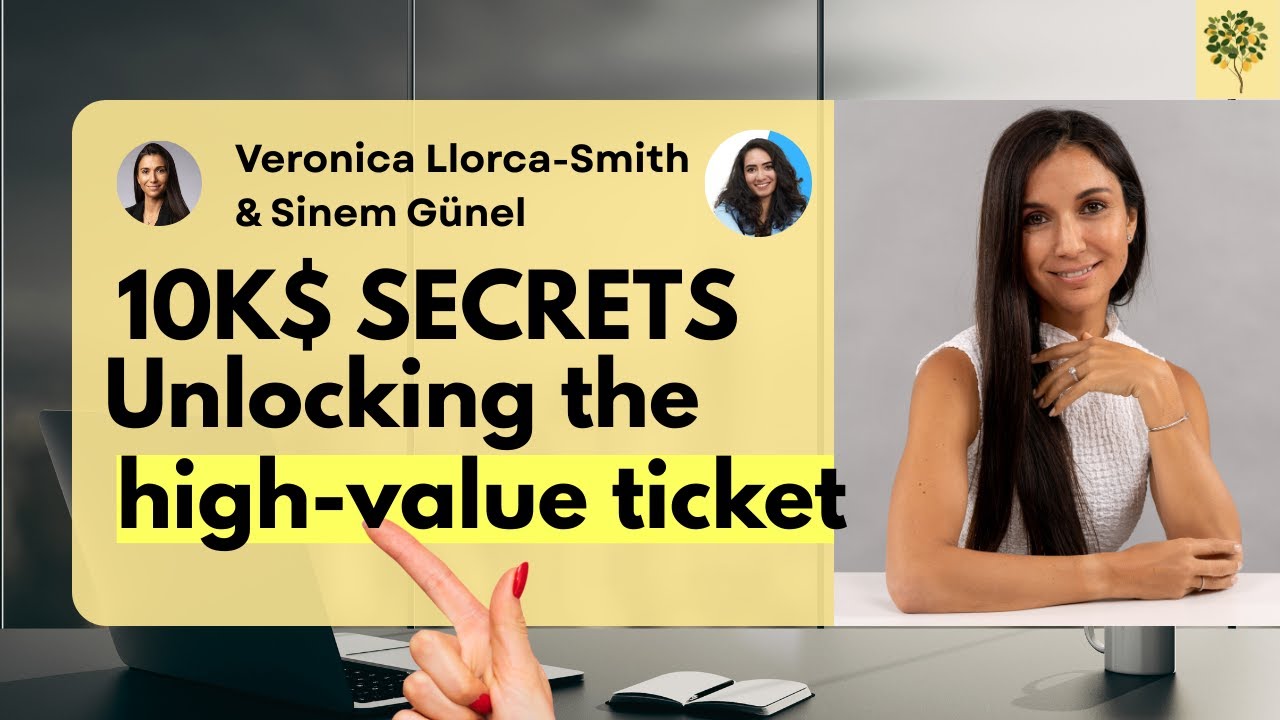
Veronica LLorca-Smith moved from selling low-priced products to high-ticket offers by overcoming imposter syndrome and testing her prototype approach. She landed her first $1,000 corporate workshop through pro-bono work and asking, then raised prices to $5,000 by adding value and building her personal brand as a mom, triathlete, and former corporate leader.
Chapters
We are live. Hi everyone, and welcome to this session. I don't do a lot of live sessions, so I'm particularly excited about this one. I'm excited to have Veronica with me today. Veronica, you are a keynote speaker, a coach, a bestselling Substack author, the author of a brand new book, among others. You're a triathlete, a mom. You're a big inspiration for me personally and for so many other people. And there are a million topics that I would love to talk to you about and ask you about, but we're going to keep this session very focused. So for everyone joining in, I already see a lot of names in the chat, so welcome and yeah, hello, welcome to the session. The chat is open, so if you're with us live, feel free to use the chat if you have any questions throughout the session. And, um, we're gonna keep this session focused, uh, because we have something really exciting to talk about. Veronica is one of 15 contributors to a project we launched recently. It's a book, the 10K Secrets book, an anthology with 15 contributors. And Veronica has written a chapter for it called Unlocking the Power of the high ticket, high value ticket. And in my opinion, that's one of those pieces that doesn't just give advice or kind of introduce something new, but it's really triggering. Like it makes you think in a different way, especially as a creator, especially if you are at a point where you want to monetize or you want to monetize more successfully, it changes how you think because it opens up your mind to a new perspective, a new opportunity that you might not have considered so far. Especially because high-ticket selling is something a lot of people are afraid of. And I would love to dive a little bit deeper into this whole idea and the concept of the chapter you have written. Um, for everyone who is listening, if you are not familiar with the 10K Secrets project yet, you can get your free copy and Veronica's chapter is included inside the 10K Secrets book. It's at 10ksecrets.substack.com. So Veronica, Veronica, let's dive in. Your chapter is called Unlocking the Power of the High Value Ticket. Why did you choose that topic in the first place? You have, like, we gave you, we didn't give you, give you any constraints, right? You've been able to talk about whatever has helped you most or you have found most useful as a strategy. Why did you choose this one?
So to be honest, Simen, I chose that particular topic out of frustration as a creator, because when I started my journey, so 2 and a half years ago, what I realized is that I was putting so much work and I talk about it in the chapter and I was doing and doing and keeping myself busy, but I didn't see the results. And the reason why is because I was trying to reach 1,000 people to be able to make my value proposition and my business sustainable. And at one point I realized that that was not working and it was so, so hard to try to sell something, anything, even if it's a $1 item to 1,000 people. And so I realized, and also looking around, that there had to be a better way of doing it. There had to be a more strategic one. And that's where I started working and shifting a little bit from trying to sell very low-value items to trying to focus on what is, one offer that can be very high value, that can add value to individuals and organizations, and that can really help me move the needle. So to be honest, it was really a reflection of my own personal story because I do believe that many creators can face the same issue, working a lot, trying to be as productive as possible. And yet when you look at the equation of input and output, it's not really there.
Was there a specific moment or a trigger that made you realize That you're putting so much in, but not getting the output you wanted? Was, was that kind of a business reflection you did, a review, or was it like an emotional mental point?
So to be honest, I would love to tell you that there was one specific moment, but I think it was a feeling. And to give you an example, you know, when, for example, if you've been trying to lose weight for a while and you've tried all different diets, And nothing works. And you have that feeling of frustration. Or in my case, as a triathlete, I'm a pretty bad swimmer. And I realized that I'm swimming and swimming and swimming, but I wasn't seeing any progress. And so at one point, I said, I need to get a private coach. So I think it was more that feeling of putting a lot of work and not seeing the results. And there's a phrase somewhere that goes along the lines of, when it gets to the point where the pain of staying the same is bigger than the effort of changing, that's when you realize that you have to do something. So I can't tell you that it was a specific point in time, but I remember that feeling of waking up one morning and then the next morning and then the next morning and feeling frustrated and saying, well, if I want to have different results, I'm going to have to look at these differently and rethink my strategy.
And I mean, you've been at this point yourself and you, It's not even that long ago, right? It's, this has been quite, not a short journey, but it's been very intense for you to just go into content creation and make these switches, go into higher ticket selling, et cetera. But when you look back at kind of the before picture and compare that to what you're seeing, because you are still working with a lot of creators, and you are seeing their journeys and their fears and what's holding them back. What do you think is holding so many people back from going into higher ticket and going into higher value products? And even when they see the math and they understand that, okay, if I have a $2,000 client, it's easier to make like a full-time living. Why do you think are so many people afraid of taking that step and going into it?
So I think that's a really good question. And if I have a moment of vulnerability here, myself, looking back at my own journey, I think there was a, there is a piece of lack of self-belief, and a little bit of imposter syndrome, because most people are fine with putting a product that costs $5 or $10 or $20 But the mindset shift that you need to say, I have something that I believe is worth $1,000 or $5,000, is something that really starts with your mindset. And I think that's one of the things that holds a lot of people back, is really being your first stakeholder and convincing yourself that what I do has value. And for me, it was a journey. And nowadays I actually think that I should even increase my prices because I've come to the point where I'm comfortable delivering the type of workshops and services that I do. In my case, it's keynotes for companies and workshops and, and B2B services. So I think the mindset is a huge one. And I think there's also this belief that many people have that it's easier to sell something that is worth $5 than to sell something that is worth $5,000. And while that is not incorrect. The truth is that it's very hard to sell that same $5 unit to 1,000 people. Let me give you a very specific example. I'm an author. I've seen a few authors there. I saw Peter and a few others there. And as an author, I recently published a book with Penguin Random House, so the biggest publisher in the world. And you might think, oh, right here. Oh, you have it.
It's right here.
Awesome.
Oops.
So, so the reality of a book, to make it very tangible, is that a book costs what, $15, perhaps $18 on Amazon. If you work with a publisher, you only get 8% of the royalties. So we're doing the math there. I would need to have 1,000 clients for me to make $8,000 from, from books. So that's a lot of readers. For me to find, and so it's also bringing that to to the business life and doing the numbers. If you do the numbers, you realize that whether it's a book or whether it's five dollar subscriptions on Substack is going to take you a long time to grow to grow that community. So to bring it back, look at the mindset and what's holding you back, and then sit down and do the numbers. You know, piece of paper and try to see okay, what do I need? So we're talking about the ten thousand US dollar month. What do I need to make that happen? If you're going to go for subscriptions, or if you're going to go for books or low-cost items, how many of those do you, do you realistically need to sell? In my case, with my webinars, with my workshops, it's $5,000. So I realistically need 2 of those a month to be able to reach those numbers.
Yeah. I think it's so important to emphasize that you have all these different options. You can sell a $1 product to 10,000 people. What matters is that you are aware of what it will take to make that shift or to get from A to B, because it's very clear that if you have 2 $5,000 per month clients, a huge part of what you have to do is really communicate the value of your work very clearly and have a very strong value proposition so that someone or some organization is willing to pay that amount for your effort. On the other hand, if you are selling a book, a mini course, a $5 subscription, you have to do a lot of content marketing. You have to put out a lot of articles, videos, short-form notes, gain visibility, and you're just doing very different tasks and to a different volume. I mean, if you had focused on building your audience as much as possible and selling to your audience, you would be, you would probably be publishing a lot more content, right? You don't have to do that because your income is not entirely dependent on that because you're taking a different path. And I think that's also a key message of the 10K Secrets book. It's like, there are a lot of different ways to make $10,000 a month by building an online business or building a digital business, building a digital presence. We are covering 15 very specific strategies inside the book, but that's just, a tiny percentage of all the possibilities that are out there. And I think that's the beauty of it, or the beauty of this journey is when you opt for the options that make sense for you and that fit your strengths and your personality. And it seems like you have found a really sweet spot, a golden spot there for you that works really well. Also, with Like looking at the rest of your life, right? As a mom, as a triathlete, you have other priorities. You have commitments that take up a lot of time, so you want to be, you probably want to be able to plan in advance and have a set schedule that you can rely on, which working with those bigger clients, I guess, makes easier than constantly changing your plans and— Not really knowing where your next income is going to come from.
Yes. And that's such a good point because now, right now we're talking about the high value ticket, but the reality is that you can really create your own formula. It's not an either or, like, I love writing books and I love working on my newsletter. And even though you said that I don't put— you're not saying that I don't put a lot of work, but that I don't necessarily invest that much. The reality is that I do because I love it. And I think it's really great when you can really listen to your passions and find that formula that works for you. So for me, the high-value tickets are great because they bring the income and it's something that I love doing. It allows me to leverage my corporate experience as well, which I didn't want to just say goodbye to 15 years of corporate experience, but at the same time, What do I really love doing? I love talking to people. I love being able to have my own community. I love that sense of building my, my tribe and having webinars. I'm going to have one this week and having a live with you. So I think the beauty is that you can mix these different pieces. So in my case, I have these 3 pillars. So I do my B2B workshops. I have my community where I have my subscriptions and my coaching and all of that. And then I have my books, courses, and things like this. So for whoever is listening, I love Sinem's message that you have so many ways of creating your own path and your own formula.
And one thing that goes into creating your own path is how you present those offers and how you price them. One thing that you say in your chapter is abundance starts with you. And we already talked a lot about what it took mentally for you to go from your corporate job to being a creator, being an entrepreneur, and then also offering those B2B workshops and talks that you're giving. But is there anything else that helped you overcome like this mental barrier of charging more? Because I assume that your prices have also gone up over the last few years and months. You said that you—
Yeah.
are actually thinking that it would be valid to charge even more now. Do you have any tips for people who are going into higher value ticket or who are, you know, being inspired by your chapter or this talk and thinking, well, I actually have something valuable that I could also offer for maybe several thousand dollars to organizations because it actually, it can actually help make a difference for them?
Sure. And that's, that's a really good question because I very often talk about the mindset But I think you need the mindset and you need the action, and the action very often precedes confidence. So if you want to be a confident speaker, if you want to be a confident writer, if you want to be a confident whatever it is, you name it, you need to take those steps first. And so one thing that personally really helped me strengthen that value and reinforce that courage or that confidence was really doing. So the moment that I delivered my first session and I was super nervous and it was quite cheap, I think now in retrospect, I put so much work into it and the feedback was quite positive. And so you do one session and you get a little bit of positive feedback and you also get constructive feedback, both, but that's really what encourages you to keep going and keep improving and trying to find ways and things to do it better. And then from there, once you do it a couple of times, you have that confidence to say, actually, I think that I can increase the value. So it's not only the mindset, I think it's also about doing. And it's the same with life. So, Sinem, you told me that you recently ran your first 10K.
Yes.
So what happens when you run your first 10K? That you probably think that what once you thought was unachievable, like a half marathon, maybe now it's a possibility because you've set the bar and you were able to reach it. And then from there, maybe you do your next race, which might be a 15K, and then you go to your half marathon. And I think when we're talking about the business world, it's very similar. For my first session, I think I charged something like a bit over $1,000. And I thought, oh my God, this is so expensive. What if I don't deliver? But then I did it and I saw the feedback and I saw that I was able to engage people and And to add value. And from there I said, well, actually I think I can do this better. And there are some tweaks that I can add. I added things like interaction, adding polls to my sessions, for example, being better at the activities, group activities, having a survey at the end. And from there I started to increase the prices. So I think that combination of the mindset and what you tell yourself every day when you go in front of the mirror, before this session, I told myself, This is going to be a great session with Sinem because you have to, because you're your first stakeholder and you really have to believe in yourself, but that is not enough. You also have to put your shoes, right? Go for your 10K run, or in my case, do that first session and try to get better every time. And the reality is that in a bit over a year, I started with sessions that were $1,000 to now $5,000. And probably next year I will be increasing them again because I'm adding value and I believe that I'm getting better and I'm trying to work on new resources and studying and continuously raising my bar so that that bar can then be reflected in a higher price.
One thing you also mentioned in your chapter is this idea of testing with a prototype and being very open and flexible to changes if you realize that there's actually a tweak that makes sense. And I assume that even with those first offers that you had, your corporate background probably had a huge impact, right? You knew a lot about organizations going into them. Nevertheless, I know how challenging it is to go in and deliver a talk or a workshop when you don't know that specific organization and what exactly the people in this room want or need. Did you have your own process for forming these first workshops, talks, webinars, and kind of building your own prototypes for these higher value offers?
Sure. So maybe to bring everybody on the same page, what I mean by prototype is that nowadays, if I'm going to create a new session for my clients, so recently I created a new outline. For a session on allyship. So in the leadership world, how to be a better ally in your organization. And I created just a framework or an outline, which is what I call a prototype. So instead of delivering this whole presentation first and seeing if it lands or not, that would be at least 10 to 12 hours of work. I have a clear vision. I think about what is the summary, what is the blurb, What is the high-level content and what is the outcome? And then I start pitching clients. And I do this now because, as you said, I'm able to leverage my corporate experience to know what are some of the pain points in organizations. In this case, it might be multicultural teams that don't really know how to work together. So, so I take these personal experiences and I try to turn that into a product that can add value to companies. But I wanted to share a little bit more on how I went into these prototype type of model, because one of the first potential clients that I had asked me to make a pitch for a session. And it wasn't something related to wellness in organizations. And I did spend 12 to 14 hours perhaps developing the entire presentation, the deck. It was probably around 60 pages and so on. I went to the organization. It was like a big Fortune 500 company. I delivered internally the entire deck. And then at the end of it, a couple of days later, they said, oh, we really liked your presentation, but actually we decided to go with another speaker. And that's what made me realize that having a prototype makes a lot of sense because it allows you to fail quickly. And that's something that I see all the time, maybe out of 10 outlines that I have, perhaps only 6 or 7 are the ones that go through. But what it means from a productivity standpoint is that I don't have to spend 10 to 12 hours like I did before in, in this session. So that's why I recommend people, as scary as it is, to try the prototype approach so that you have an idea of what your course is going to be. You can even build it together with your audience. I've done this in the past where I launched a course on personal brand, and every week I was sharing a session Instead of having to wait for 4 months perhaps to have the course ready, you have like this prototype approach. And instead of speaking to the void or like in my case, spending so many hours to create a presentation that in the end I didn't deliver, what a shame, but it was a great lesson. Yeah.
Um, let's actually stay there for a moment. Um, because one of the things I would love to hear about as well is very specifically the first high-value ticket client that you won and that you worked with, or let's say the first 3, if the process has been similar. Um, how did you actually land that gig or how did you land that client? What went into it from the moment you decided, okay, I want to do this, I want to deliver. And I think you said it was a $1,000 offer, the first one. And all the way from, you know, I want to do this to I got it and I got paid for doing this exciting thing. What did the process look like?
Sure. And to be very transparent in what I do in workshops and public speaking and so on, having credibility and having visibility is so important. And I think the same applies to most things too, to be honest. But before I actually got my paid gigs, I did a lot of pro pro bono work because I wanted to make sure that I had the experience, that I had the visibility, that I had some credibility to back me up. So in things like chambers of commerce conferences and so on, I did pro bono work. And then I was starting to work on this idea of having webinars that were paid. And one day I was having a coffee with, with a connection and he started to share the issues that he was having in his team here in Hong Kong, things like lack of communication and lack of command skills and different things. And you know what I did? I asked. And sometimes it's as simple as actually having the courage to ask, hey, did you know that I actually do sessions for companies? I customize them. I have some of them that are off the shelf. Would you like me to send you a proposal? And it made me realize that so often something that is as simple as asking is something that we don't do enough. We feel that we're going to be abrasive or we might be seen as, as too aggressive, for example. And for me, that was it. Like I had the courage to ask and he said, oh yeah, sure. Send me a proposal. And sure enough, like a few weeks later, I did my first session with them and then I did a second one. So, so that was my first client. And to be honest, it was such a game changer mentally and also for my business because it made me realize that actually I had value that I could offer to other organizations. And so from there, I was much more proactive in changing the mindset from I'm selling you something to actually I'm helping you. In my case, I have more than 15 years experience working in multicultural teams. I think that I can repackage that to help organizations that are struggling with themes related to cultural differences, how to have better teamwork, how to improve the communication and things like that. But I think just like anything, I think your first client is really game changer, whether it's coaching, whether it's even your paid subscriber. I remember who that was. So for me, that was a before and an after.
I love everything you said because there are so many similarities to our own journey. Because when we started our first business, Philip and I, or our first organization has actually been a nonprofit. And the first big client we had was, the journey was very similar because it was basically a one-on-one conversation and it was someone from Philip's hometown, and they've been at an event, and Philip just went up to him. It was a politician, and he said, hey, we're doing these workshops for students back in Vienna. We're doing it at university. And I think because Philip is from a small, small town on the countryside, and he said, I think it would be great to do these workshops here for the younger people in this area as well. What do you think? And it ended up being a— back then, a €10,000 job for 3 workshops that we delivered, 3 full-day workshops. It's been mind-blowing. Like, that's been a mind-blowing amount of money for me back then. And I think that was 2018. And we've been so excited to go all in and really deliver 3 kick-ass workshops to do a short video recapping all of it. And then you have done it once, you know exactly how it worked. You have the visuals, you have the slides, but you also have cool photos and videos. And, and you can say, hey, look what we did. We can do this again. And it kind of starts to snowball and, and just get bigger and better. But this first conversation, that's definitely a step out of the comfort zone for many people, no matter if you're doing it face-to-face, if you're sending a cold outreach email, or you're stepping into a room and hosting a live session or a webinar. But I think that's the reminder so many of us need. Sometimes you are, you don't feel 100% ready to do it, but you just pretend that you are because you trust in your ability to figure it out. And you're willing to kind of go that extra mile and spend a few extra hours making sure that whatever you promise to do is really good. And it delivers the value you promised.
Absolutely. And also, I always talk about building blocks. Like if you're going to start thinking straight away that you're going to go on a podium in front of 500 people, you're probably going to set yourself for failure. However, if you start small, for example, what we're doing today is a live session. I remember the first one that I did on Substack was not so long ago. And I was pretty mortified, but what happens is everything is a big deal until you do it, and then you do it and it's not a big deal anymore. So you do your first live session, and then from there, perhaps you do a webinar for your paid subscribers, which is what I did in the past, and it's still a safe environment because it's with people that you already know. And then next thing, maybe you do a workshop for a company, and it might be a workshop for 15 people, and you build up and up and up. And to give you an example, one of the most terrifying things that I did was last year for a global company. They asked me to be their keynote speaker, and this was for a virtual summit. So all over the place, all over the world. It was almost midnight here in Hong Kong, and it was only 20 minutes, which was extremely challenging because the shorter it is, I find, the more dreadful it is. And all participants had their camera off. So that meant that I was talking to myself here in the dark in Hong Kong at midnight, hoping that people somewhere were finding it interesting. What happened is I had a lot of mileage behind to be able to handle that situation. If I were to start today and do that straight away, it would probably be a disaster. So I really love this idea of the building blocks and kind of stretch your area of comfort and your space of safety.
Yeah, I love that. So important. You, you, you never start from zero. You build up on what you've done before and you build up on these experiences. And of course, if I were to put you into a room, no matter if it's physical or digital, with 1,000 people, and that's the first time you talk, or you look into a camera and you feel like you're talking to yourself, you have no idea what the reactions are. And if you're completely off, That's frightening. You test the baby steps. You do a stream for 5 people, for 10 people. Maybe you have a guest that puts the, like, some of the pressure off of you and you always build up from there. I think that's a really important reminder as well. Veronica, another, I think, big topic for you, or I would even say one of your favorite topics probably, is this whole personal branding chapter or what would you do around it? I know you have a lot of resources around personal branding. You help your clients with that as well. And I'm assuming that everything you do to position yourself also has a huge value and a huge importance for your higher value clients as well. Because when we look at your profiles and at your content, it's It's very clear that you have your corporate background, you have your international experience, you are a triathlete, you are a mom, and you have identified certain characteristics as almost like marketable assets that people associate with you. And it's very clear you are a tangible person because of these things about your life that you share and about your experiences. If you would have come onto Substack, you started talking about whatever, personal branding, building your business, um, making an income, and you don't share any of that background of yours, it would be hard to have a picture of who is this person, why is she talking about these things, and what's different about her, right? Because you're one of a million people who are saying very similar things, but you identified these blocks that make you unique and that make you very memorable. And my question is, did you decide on those intentionally or was it more like a natural process for you to share more about your life over time? How are they helping you with your higher value clients? Is that something you are aware of or do you think it's kind Kind of a side effect? And what do you wish you had known 2 years ago?
So maybe we can start there. I used to think when I was in the corporate world that we all had like these different hats. Like for me, I was Veronica, the corporate girl, and that was one part of my life. And it was the corporate, the stricter, the suit girl. And then I had my private life where, as you said, being a mom, being a triathlete, traveling, all of that part. And I realized that humans are multidimensional. And so it doesn't really make sense to have this division. And very often I would just hold back from sharing things that I thought were meaningful to me. And as you said, when we talk about personal brand, the idea really is to create your niche of one, to create your market of one. Because yes, public speakers, you have thousands of them out there. So what is going to make you unique? What is going to make you special? And so I wish I had known before that you don't have to pretend that you're 2 different people. And in fact, many people laugh at this, but in my LinkedIn profile, I have all the different things like public speaker and so on. And I have CEM, and in brackets I have Chief Executive Mom, because I want to make a statement. I want people to feel that, hey, It's okay if I love playing piano or if I love basketball or whatever it is, because at the end of the day, no matter what we do, it's always a people business. I always say that the newsletter is not a writing business, it's a people business. And we want to connect with the person who is on the other side of the screen. That's why when you told me that you went for a 10K run, I was like, oh, this is, this is cool. Like, we were able to relate to these personal stories. So I wish I had known that. Earlier. In terms of how I chose those, I think it happened naturally. And I actually encourage people, of course, to think about what you want to be known for. But the reality is, if you want to talk about your sports, or if you want to talk about nature, because that's what you're passionate about, or traveling, then there is an instinct there that I love following. And for me, it's not an either/or. Like when I talk about Sports is not just for the sake of saying I went for a 10K run. Like, really, this morning I went for an 18K run because I'm training for a half marathon, and I was going through all my business and all the, the writing that I have to do and my strategy. So for me, being a runner is a huge part of being a writer. This is my reality. For someone else, it might be cooking. That's maybe where they find their, their inspiration. So I think that very often around us is where we find our personal brand, because it's a fancy word, but at the end of the day, it's about being personal and what are some of the things that make you, you. So your other question was, does this help me with my high-value ticket workshops and, and so on? And it does, it does, because it's more memorable when you remember, oh yeah, the speaker who writes books, or the speaker who is also a mom and does cooking or whatever that is. So in my case, for example, one thing that I talk about very often and on LinkedIn and also on Substack is traveling. I recently came back from Spain. Next week I'm going to Australia. I've lived in many countries. I love and I speak different languages and I happen to talk about multicultural teams. So the connection is there. It's not just the work that I do, it's who I am. Traveling, understanding different cultures, trying to learn from different people. And so for me, it's all about connecting the dots. So look around and try to see what are some things that make you, you, that can explain why you do what you do. Whether you're a coach, you love helping people, you love animals, you maybe see the relationship there. So I always think that it's about connecting those dots. So definitely it helps me. I even have a session that is called an athlete's mindset. And I'm not a world champion. I don't have any, any world records or anything like that. But again, it's what makes me me. And I do encourage everyone to be fit, to go out there, to look after their health, because I think that that's going to have a positive impact on their work, on their productivity. So definitely it's, it's something that, that I encourage people to focus on.
What I love about everything you said is that all these topics, they're topics you're excited about and that you're knowledgeable about, but they are not the topics you talk about. They don't confuse your content and your audience because that's a challenge I see very often with new creators, entrepreneurs, writers. It's like they are passionate about those 15 different topics and they want to write about all of them. And of course, you, you could write about being a triathlete, you could write about running, you could write about how to be faster, how to become like start running. You could write about how you are organizing your life as a mom. You could write about, you could write packing lists for your international travels. You could do all these things because that's what you know. But that's not what you do. These are parts of your life that help you kind of amplify your core messages and help you be more memorable, as you said, in your business, as a speaker, also with your content. It's kind of an edge that people connect to you. It's not what you talk about per se. It's just this additional piece of information about you as a person. And I think in the beginning, it can be very challenging to see the difference. And that's why people often struggle to build memorable brands, whether it's a personal brand or even just giving their Substack a name and a catchy phrase that clarifies what it's all about. Because for you, oftentimes it all comes down to certain key messages, right? And you have the lemon tree mindset, which you're known for. which can be applied to so many areas of someone's life and business. But you are giving very specific examples of, okay, this is how I applied it when I was— I think you've been stuck in Australia, right? During COVID Or this is how I applied it when I wrote my first book, how I applied it when I switched from corporate to being my own boss. And that's when you can use those passions or hobbies or even personality traits to amplify your message, to be more unique and to, to make sure that people associate you with the right things, the things that you choose to be associated with, instead of having content all over the place that ends up being confusing. And that usually has the effect that people don't know what to expect from you and when to go to your publication or when to ask you to deliver a workshop. Because you could deliver workshops for triathletes and for moms and for people who want to travel more. But then you would be— it will be very easy to confuse you and to not know when exactly to trust Veronica or to call Veronica to do a certain job. And I think that's just a nice reminder for people starting out. You don't have to hide those passions and hobbies and the things that make you uniquely you, but there is a right and a wrong way to use them so that they have a positive instead of a negative impact.
Yes. And I think that the multi-passionate conversation is always one that gets people interested and and fired up because the reality is we're all multi-passionate and I truly believe that we can still be multi-passionate creators, but we need to be focused and that's where I think sometimes the disconnect is. If you're not making that connection for the readers, then one day I'm Veronica the triathlete and the next day I'm Veronica the mom and the next day the one who travels the world and it can be very confusing. However, if you're connecting those dots and staying on your message, For me, I'm trying to help writers and creators create a digital ecosystem so that they can turn their passion into their lifestyle. That's my message. And then from there is, what do I learn from triathlon that can help those people? Or how does traveling the world perhaps give me a broader perspective? Again, it's about connecting the dots. So yes, you can be multi-passionate, but you have to think on the impact and how that is going to land Yeah, wonderful.
We're running out of time, so I have a final question that I didn't send you over, but I think it's an easy one. It just came to my mind while we were talking because you said it's important to be focused and to be clear. And I think especially for you, as you said in the beginning, or people like you, you have so many responsibilities, you have things going on, you have to be very resourceful and mindful about what you say yes to as well. As we said in the beginning, this conversation is the result of you being part of the 10K Secrets book. Um, again, everyone who's listening, you can download the entire book with Veronica's chapter at 10ksecrets.substack.com. It's a free book with 15 individual strategies that helped creators earn over $10,000 in a single month. And talking about that level of focus and being very resourceful, what, in that specific case, what made you say yes to the 10K Secrets project? What was exciting or worth considering, you know, submitting your chapter to it?
So to zoom out a little bit, talking about clarity, It's been a journey for me to learn to say no and still be friendly and helpful. I think when you start as a creator, you get all these requests, coffee chats, and can I pick on your brain and all of that. And we tend to say yes because we want to be nice and we want to be friendly. And the result is that we're all over the place. We spread out our energy and we have very little left in our own cup. And so I had to learn to be able to prioritize and say no while still being helpful. And while still sending people in a different direction or resources and so on. So that's number one. So I've learned to say no, but I did say yes to you. And the reason why is because I think trust is so important. Like, if you want to work with someone, I think building that relationship is the first step. A lot of people ask me, how do I get recommendations on Substack or elsewhere? How do I get testimonials? How do I get people to collaborate with me? It starts with a relationship. Like, for those who don't know the background, Sinem and I, we connected almost a year ago, I think, when I was in Spain. We had an initial chat, then we did a couple of collaborations together. So for me, when someone like Sinem tells me, hey, Veronica, I have a partnership that I would like you to be a part of, almost with my eyes closed, I can say this, I would say yes, because I know that you think in terms of win-win. collaboration and partnership. And I'm the same. And so when you build that level of trust, most of the time you're going to say yes. So this is a testimony to the relationship and that I think is honestly so important in a world that is dominated by AI. So I say yes to people more than projects, to be honest.
That's a really nice way to put it. And I love it. I think that it also puts a perspective on what being a creator and a digital entrepreneur can look like. Because when you're starting out, it often looks very isolated, and you think a lot in terms of platforms and algorithms and strategy. And it's hard to see that personal connections and relationships can be a huge and a very relevant part of everything that you do and can be a great amplifier. It's definitely been a huge part of our journey on Substack as well. The people we have met, the people who have supported us, it's— I can probably attribute 50% of our growth to just the conversations we have with people like you who have been incredibly relevant when we started our journey because you've been on Substack way before us. You've had so much knowledge and you've been willing to share that and you've been willing to share what you have learned and you do that through your content as well. But still it's a huge, huge commitment to hop on a call and answer questions and help someone out. And I think when you're starting out as a creator, it can seem like very lonely and isolated. And that's the reality for most of us because when I started creating content or writing on the internet, I didn't know anyone else who was doing that. It's a very odd thing to do when you talk to your friends or family. Most people don't write or most people don't create content. So it's so valuable to find your people and to find your tribe. And yeah, still thank you for saying yes. It's obviously, it's not an obvious expectation when you ask someone to collaborate on a project like that. I just saw Dave saying, where do we download the book? I'll try to put it in the chat as well. Let me see if that works. So you can go to 10ksecrets.substack.com, and you can also find the publication directly on my profile. If you go to my profile, you will see the 10K Secrets publication. When you subscribe to the publication, you will receive the Well, Veronica, thank you so much. Um, this has been a really powerful, um, and inspiring and actionable session. I have learned a lot. Um, and, and I'm sure the others who listened in as well, and I'm really grateful that you kind of pulled back the curtain, shared your journey, shared your strategies, what has worked for you, what you have tweaked. And I think it's just a testimony to how far you can come when you combine courage with your existing experiences and clarity so that you are not afraid to show up and put yourself out there. Yeah. I can just say to everyone, go check out Veronica's chapter inside 10K Secrets. Subscribe to the Lemon Tree Mindset if you're not subscribed yet. Subscribe to Write, Build, Scale if you want, if you want to join us for more such sessions with other creators. Do you have any final words, Veronica?
No, I think we covered everything, but just a final word. Like, I'm very big on collaboration. I talked about sports and I always say that together we run farther. So if you're watching us today, I have a little challenge for you, which is find one person, one new person that you can collaborate with. Think in terms of win-win, because when we join forces, it is true that the sum is always greater than, than its parts. So that's my final message.
Beautiful. Thank you so much. Thanks everyone for joining, and thank you for your time and for your openness, Veronica. Take care everyone. Have an amazing rest of the day. Bye-bye.
More from Veronica



How Much Speakers Charge And Where To Find Paid Gigs [Public Speaking Bootcamp]







